




Abstract
Biobank sample storage is critical in population health and epidemiology studies. Biobanks bridge two very different worlds: they connect to the participants and patients at an individual level, but they also aggregate information and represent the cutting edge of scientific discovery. In this brief report, we describe how the LifeLines study in the Netherlands manages its resources for communication and services, and how it can serve as a model for the Human Heredity and Health in Africa Initiative (H3Africa Initiative).
Introduction
M
Scientific researchers depend on biobanks to supply well-annotated, high-quality samples that are collected within appropriate ethical parameters, with an infallible chain of custody. As many large population studies exceed 100,000 participants and often involve time-course sampling, the numbers of samples can quickly run into the millions. Biobanks therefore need to manage their resources efficiently to keep up with demand.2,3
For biobanks to act as service hubs, they need to have an auditable system to collect, organize, and store samples, and a way to communicate with each other. All samples typically have a Globally Unique Identifier (GUID), and a list of common data elements (CDE) to ensure that relevant data is collected. The CDE list is used as metadata to standardize definitions between software systems, which enables data to be used across multiple studies.
Standardization also facilitates data collection because it allows for more robust study analytics, and some elements of data collection can be automated.4,5 For example, CDE can also be used to establish a back-end, web-based interface that links to the biospecimen database, where certain elements can be included in the downstream sample processing workflow software. 5 Larger biobanking initiatives should consider advanced automation and information technology (IT) infrastructures to track and process samples.
Instrumentation and sample processing automation are deployed at varying levels throughout the hub-and-spoke service network of a biobank. For example, participants are assigned unique identifiers, and a software application programming interface (API) is organized to include relevant data elements, facilitating automated sample registration linking back to the software and IT systems of the regional spokes and hubs.5,6
Discussion
The LifeLines Study
The LifeLines study (https://www.lifelines.nl/) is a population-based, observational follow-up study that seeks to identify universal risk factors and risk-factor modifiers for multi-factorial disease using 165,000 participants in the Netherlands. 6 This life-course epidemiology study will examine healthy aging and prevalent diseases such as cardiovascular disease, diabetes, asthma/COPD (chronic obstructive pulmonary disease), and depression. 7
The LifeLines study is a prime example of how modern technology is facilitating audit trails and enhancing privacy standards during sample collection, storage, and analysis. These standards are implemented by the biobank to meet best practices set by the International Society for Biological and Environmental Repositories (ISBER).
The LifeLines study has established 10 collection centers throughout the three northern provinces of the Netherlands. Participants are recruited by establishing collaborations with general practitioners, and assigned a unique identifier to track interactions with that specific person. 6
Additional participant information is collected with annual questionnaires, and by linking to general practitioners and pharmacy registries. Blood and urine are collected every 5 years, and all information is anonymized and included in the study's dataset. The study will use this data to assess how disease risks—genetic heredity, time-dependent or environmental—can impact health outcomes. 7
The clinical Trial Coordination Center (TCC) at the University Medical Center Groningen (UMCG) curates the data for the LifeLines study. 8 The TCC developed electronic case form reports that incorporate CDEs and unique identifiers so the information can be ported to multiple software programs and databases. This enables project staff to enter data and access it from various locations throughout the Netherlands.
The linking and tracking of data begins as soon as the sample is collected and is performed at the database level with a complete audit trail. The laboratory information management system (LIMS) registers the sample for transport and records the temperature conditions during the sample's journey.
The LifeLines study processes about 2000 primary tubes daily, resulting in more than 8000 aliquots for storage. 9 Sample processing begins a few hours after samples are retrieved from the collection sites and transported to the central processing laboratory. The majority of samples go through an automated processing step for storage, which is performed by liquid handlers with complete LIMS tracking and tracing.
Liquid handling machines read the unique sample identifier at intake and keep a complete sample history in the instrument log file. This information is used to update the LIMS with actions involving the sample, such as generating aliquots into new tubes. All samples are processed and stored within 10 hours of collection.
To store its collection, the LifeLines study chose the BiOS™ system from Hamilton Storage Technologies, an innovative automated system designed for ultra-low-temperature storage of sensitive biological samples. The system ensures the integrity of up to 10 million sample tubes at temperatures as low as −80°C. The LifeLines study has already collected approximately 5 million samples and plans to collect more than 8 million by 2017. 6
Researchers who want to use the data and samples in the LifeLines study submit a proposal that is screened by an expert committee. If deemed scientifically significant, data and samples are released to the researcher by the LifeLines study.
The “hub” of the LifeLines study is located in a historic building in the center of Groningen near the UMCG hospital. The building's limited floor space did not allow for storing millions of samples, so they are kept several miles away, in an industrial park that underwent a thorough risk assessment. The need to transport the samples from the LifeLines laboratory to the new off-site, state-of-the-art automated storage facility created an additional challenge, and Hamilton Storage Technologies designed custom-made transportation cassettes for this purpose. 9
After processing, the samples are placed into the transportation cassettes, which are put into ultra-low-temperature freezers and transported by truck to the new storage facility. Once there, the freezers are placed in a temperature-controlled, low-humidity room adjacent to the BiOS system. 9 The transportation cassettes can be placed directly in the I/O module of the BiOS for immediate processing into the storage chests. This ensures the sample is secure and stays viable for many years.
The H3Africa Initiative
The H3Africa Initiative (http://www.h3africa.org/) aims to facilitate a contemporary research approach to the study of genomics and environmental determinants of common diseases with the goal of improving the health of African populations. The goal of the H3Africa biobanking initiative is to build a fully functioning biorepository for African countries that can receive and distribute samples utilizing international standards. 10 The initiative is expected to lead to the distribution of biological research samples to at least 15 countries in Africa.
This H3Africa pilot biobanking initiative is directed by Professor Akin Abayomi of South Africa's National Health Laboratory Services (Tygerberg Hospital business unit) and the Faculty of Medicine of Stellenbosch University in collaboration with the South African National Bioinformatics Institute (SANBI), Rutgers University (RUCDR), IFASEMB, and the Scripps Research Institute for Regenerative Medicine. 11
The H3Africa biobanking team plans to employ ISBER best practices to catalog the genetic diversity of African populations and, in turn, contribute to the knowledge of human diversity and disease biology. 12 Researchers believe that discoveries from the genetically diverse population of Africa will help identify genetic risk factors that might be harder to identify in more genetically homogenous populations. 12 Studies that are being explored range from case-control, genome-wide association studies in rheumatic heart disease to pharmacogenomics and pharmacokinetic multi-center and multi-country trials.11,13
The H3Africa Initiative has to cover a diversity of heritages, wide-ranging climates, and vast distances. In 2012, the bioinformatics networks in Africa could be described as a mixture of point-to-point and hub-and-spoke networks (Fig. 1). 14 To ensure that the H3Africa Initiative has the IT infrastructure to support its study, Nicola Mulder, principal investigator at the University of Cape Town in South Africa, is performing a needs assessment. Dr. Mulder is charged with building a communication infrastructure project to enhance existing nodes across the African continent and provide a pan-African bioinformatics network. 15
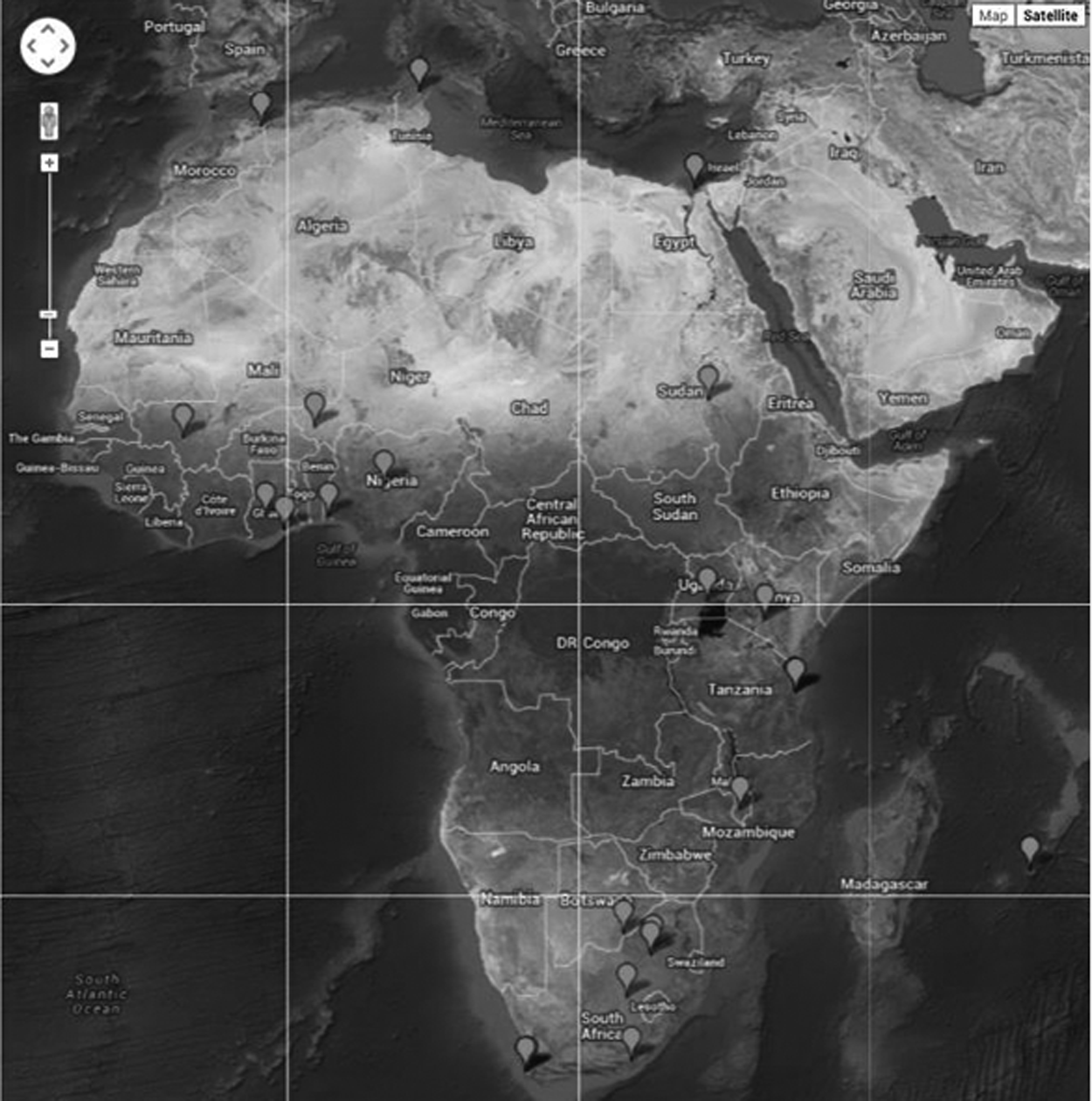
H3ABioNet Map, participating African Institutions. Map of the 32 institutions supporting the H3Africa Initiative in Africa (accessed online December, 2013). H3ABioNet has two US institutions, the University of Illinois and Harvard School of Public Health. An interactive map is found online at: http://www.h3abionet.org/about/map.
The H3ABioNet program (http://www.h3africa.org/projects/16-projects/64-h3abionet-a-sustainable-african-bioinformatics-network-for-h3africa), which is creating a sustainable Bioinformatics Network to support H3Africa researchers through the development of bioinformatics capacity on the continent, aims to have 20 nodes, with nine full nodes, six associate nodes, and five development nodes. 15 The network will provide infrastructure and hardware, human resources, tools, training, and computational solutions for genomic and population-based research, as well as communications among African researchers and other interested parties. This will enable samples to be followed throughout the network, from collection to storage and analysis, as often as needed.
The initial grants for biobanks and investigators for the H3Africa Initiative supported pilot projects to understand the needs, test capabilities, and assess strengths as well as areas in need of better infrastructure. 16 Pilot Phase I biorepository projects were funded at the Institute for Human Virology (IHV) in Nigeria (partnered with the Coriell Institute for Medical Research) and Stellenbosch University in South Africa (partnered with the South African National Biodiversity Institute and the Scripps Institute for Regenerative Medicine). 17
The principal investigators at these institutions have participated in a variety of international and African projects, giving them unique insight into the challenges of establishing biorepositories in Africa. For example, the IHV was formed in 2004 as part of the US President's Emergency Plan for AIDS Relief (PEPFAR). The IHV also participates in studies for the Global Fund to Fight AIDS, Tuberculosis and Malaria. It supports treatment sites comprised of primary, secondary, and tertiary health centers in 28 states within Nigeria. 18 It is expected that these pilot studies will lead to a 5-year grant to establish biobanks equipped with automated liquid handlers and automated storage units.
Cultural differences between African countries and inconsistent levels of infrastructure within a country compound the difficulties of conducting a study to international standards in Africa. This makes the hub-and-spoke model important to deploy, but it also makes the study vulnerable to breaks within the system between points. Differences begin at obtaining informed consent from potential participants and continue through collecting the sample and transporting it back to the study site. For example, in western societies, an individual will give their consent to participate, while in some communities in Africa the tribal leader may have the authority to grant consent for multiple participants. Language barriers are also more pronounced in Africa; Nigeria, for instance, has 11 official languages and 510 living tribal languages.
To overcome these challenges, the H3Africa Initiative is employing local researchers and staff who speak the languages, deploying motorcycles to remote villages to collect samples, and exploring how best to keep samples viable in ambient conditions, among other practices. 19 One such researcher is Dr. Alash'le Abimiku of the IHV in Nigeria. He will assess current practices to identify strengths and weaknesses, upgrade repository practices and infrastructure to meet the needs of the H3Africa Initiative, advocate for host government and community support, and conduct implementation and quality control tests that will allow scale-up by the end of the pilot period. 18
Conclusion
The LifeLines study and the H3Africa Initiative bridge vastly different cultures and technological infrastructure. While the LifeLines study has collected more than 5 million samples, the H3Africa Initiative is still setting up the biobanks and building infrastructure and capabilities (Fig. 2).
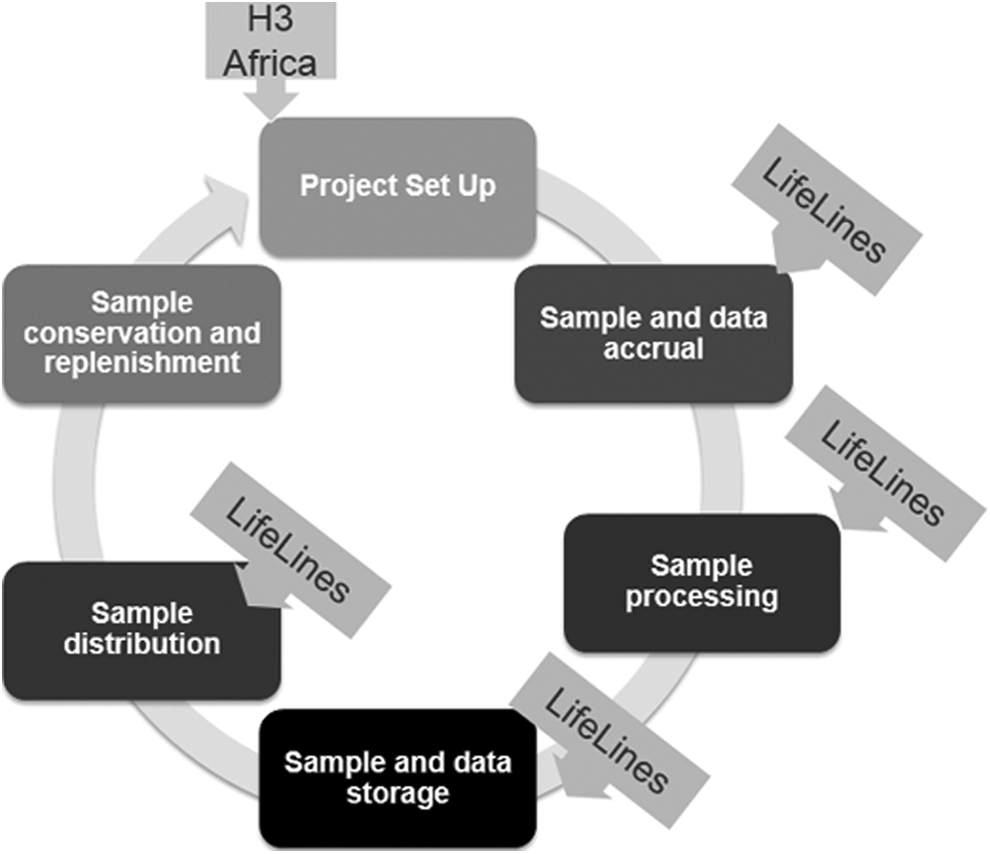
Current status of the biobanking components of the LifeLines study and the H3Africa Initiative. Illustration of the six different phases of development of a biobank (modified from Biobanking Solutions (http://www.biobankingsolutions.ac.uk/) and P3G (http://p3g.org/).
The LifeLines study illustrates several key components of a successful biobanking effort such as careful resource management, thoughtful IT infrastructure design supporting the communication needs, and design of specialized equipment when necessary. The “hub-and-spoke-model,” which connects the hub to its collaborators, may serve as a useful model for the H3Africa Initiative, although it may be necessary to implement this model slightly differently. The hub-and-spoke model is very effective in gaining efficiencies and conserving resources, but it is vulnerable to disruption when one route goes down. In some cases in Africa, overcoming logistical issues between routes may be untenable due to lack of infrastructure. As such, an approach that incorporates relevant parts of other models may be the most efficient.
The largest challenge for the H3Africa Initiative is finding trained scientists and technicians who can manage the complexities of the study and commit to following procedures even in the most challenging circumstances. The H3Africa Initiative has recruited a consortium of high-level researchers from renowned institutions both in Africa and from other countries. As the investigators gain experience with state-of-the-art instrumentation and automation and the latest in IT infrastructure, they are sharing this knowledge with local researchers and employing local talent.
Footnotes
Acknowledgment
The authors would like to thank Pasquale De Blasio for his insights into the H3Africa project.
Author Disclosure Statement
No competing financial interests exist.