




Abstract
Formalin-fixed paraffin-embedded (FFPE) tissues stored in Departments of Pathology have become valuable sources of material for both diagnostic and research purposes. Obtaining nucleic acids from this material may be challenging, especially after storage for several years. The present study was aimed at evaluating DNA degradation over time by comparing the quality of DNA obtained in 2002 with the quality of DNA obtained in 2010 from the same paraffin blocks. The DNA obtained after several years from FFPE tissues was, in the majority of cases, of lower quality in terms of amplifiable length of nuclear DNA by PCR, and only a minority of them are still equally amplifiable. For this reason, if it is suspected that a molecular analysis may be necessary in the future, it would be important to obtain nucleic acids shortly after the diagnostic process is over or, when possible, to keep frozen samples at the institutional biorepository.
Introduction
T
To evaluate nucleic acid degradation over time, we have performed a comparison between the quality of DNA obtained from FFPE samples shortly after the processing (less than 1 month) and after 8 years of storage in standard conditions (room temperature). DNA extraction from FFPE tissue requires special protocols because the material is often scarce and degraded. However, FFPE tissues have several advantages over fresh or frozen tissue samples, i.e., they are easy to handle and long-term storage is relatively inexpensive.
Material and Methods
Samples
We randomly selected DNA from 43 FFPE tissues from the Parc de Salut MAR Biobank (MARBiobanc), that had been processed in 2002 and had undergone molecular testing shortly after processing (less than 1 month). All cases corresponded to lymph node biopsies that had been referred to the Department of Pathology with a suspected diagnosis of lymphoma. Time from surgery to fixation ranged from 5 to 30 minutes. Slices of lymph node tissue (1–2 mm thick) were immediately immersed in buffered neutral 10% formalin (4% formaldehyde) and allowed to fix for 4 to 18 hours. Subsequently, they were dehydrated through a series of ethanol baths, immersed in xylene, and embedded in paraffin (melting point 58°C). DNA was obtained in 2002 (during the first month after tissue reception and processing in paraffin) from two paraffin sections of 15 μm using the QIAamp DNA Mini Kit (Qiagen Gmbh, Hilden, Germany). A new DNA extraction was performed from these same blocks in 2010 (8 years later) using the same protocol, except for the automation of the kit manipulation with the Qiacube robot (Qiagen). Three additional cases were studied later in which DNA quality assessment had been performed immediately after sample processing (2005) and could be reassessed at present (2014). Samples were obtained with written informed consent in accordance with the Declaration of Helsinki and appropriate Ethics Committee approvals.
DNA quality asessment
DNA quality was assessed by analyzing the amplifiable length of nuclear DNA using a previously described multiplex PCR protocol that amplifies five fragments of 100, 200, 300, 400, and 600 base pairs (bp) from four different target genes. 3
Results and Discussion
In 38 out of 43 cases, assessment of DNA quality showed that DNA extracted in 2002, that had been kept frozen at −20°C, was of higher integrity than the DNA extracted from the same samples in 2010 (8 years later) (Table 1 and Fig. 1), and only in five cases was the same amplifiable length of nuclear DNA obtained (400 bp). The difference between the quality of the DNA from both groups of samples was statistically significant (p<0.001). Similar results have been reported comparing recently prepared versus 5 year-old FFPE breast cancer cells. 5
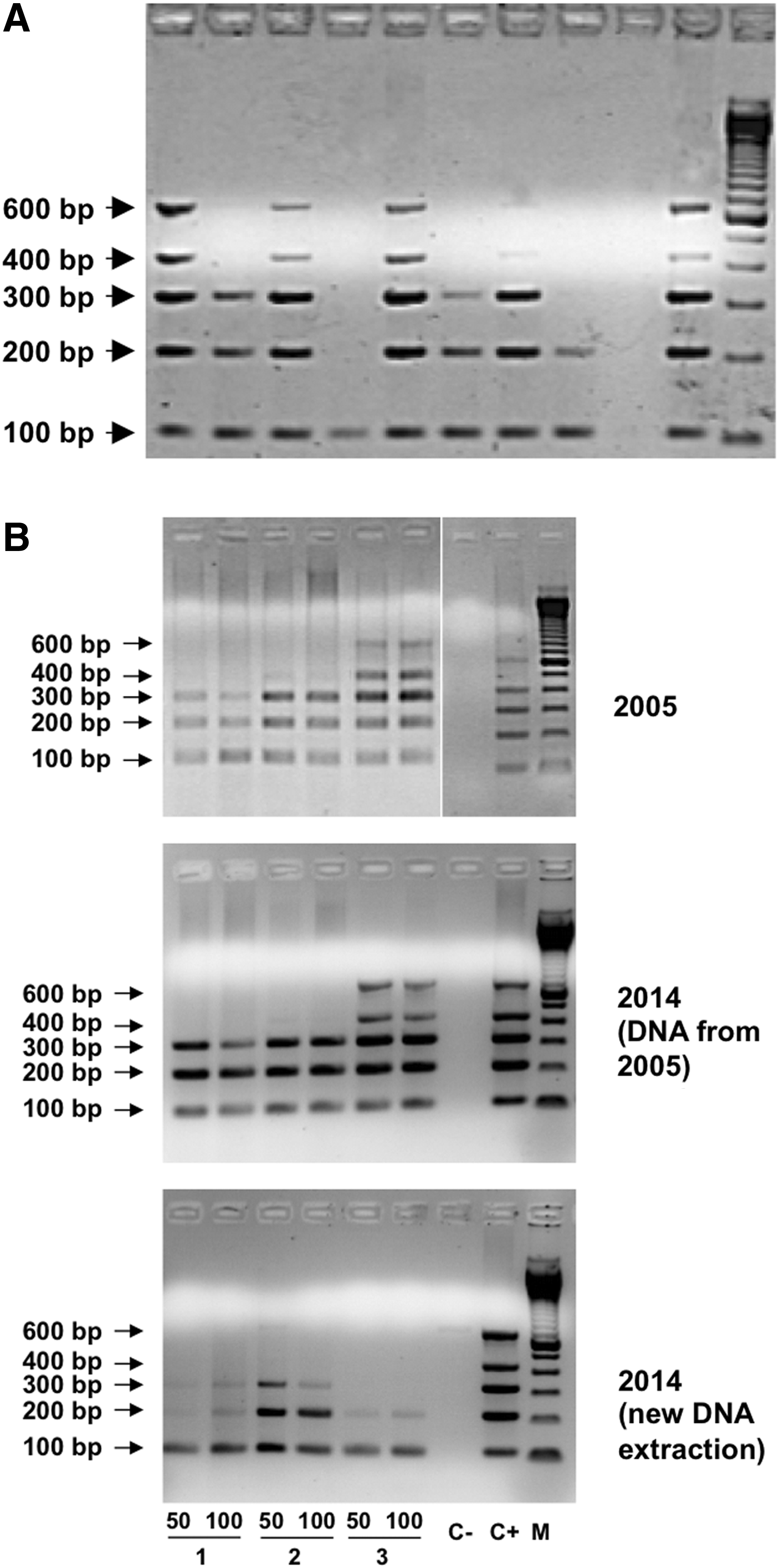
We further compared DNA quality variation by analyzing three additional cases, in which DNA quality assessment had been performed immediately after sample acquisition (2005). We reassessed at present (2014) the quality of the remaining DNA that had been stored frozen and compared it also with a new DNA extraction. As shown in Figure 1B, no significant differences were observed when comparing the amplifiable length of nuclear DNA in 2005 and at present, indicating that although some degradation may have occurred during these 9 years, it had not affected significantly the suitability of this DNA to undergo molecular studies.
Analysis of molecular biomarkers or genetic alterations by PCR with DNA from FFPE samples, such as T-cell receptor or immunoglobulin heavy or light chain rearrangements in cases with a suspicion of lymphomas, or gene mutations in several types of solid tumors or hematologic neoplasms, is usually optimized by analyzing amplicons not larger than 300–400 bp. Nevertheless, it is important to have the best possible quality of DNA. New markers are being rapidly developed, and the analysis of old samples may be important in daily practice in making clinical decisions. In these cases, we sometimes face problems in amplifying and obtaining an informative result due to low DNA quality from stored FFPE samples. Similar observations have been made regarding RNA extracted from FFPE tissues, which is usually heavily degraded due to its higher instability, regardless of the extraction protocols used. Results suggest that RNA should be isolated preferably within 1 year after tissue embedding (i.e., before fragmentation during storage of FFPE samples becomes limiting for performance of the RNA in enzymatic assays).6,7
In summary, although it has been demonstrated that DNA degrades over time, a comparison of DNA extracted from human biopsies at two different time points had not been reported. We have shown that DNA obtained after several years from FFPE tissues is, in the majority of cases, of lower quality in terms of amplifiable length of nuclear DNA by PCR, and only a minority of these samples are still equally amplifiable. Frozen tissue still remains the best source of high-quality nucleic acids and should be maintained as possible at the institutional biorepository. However, when no frozen tissue is available and it is suspected that a molecular analysis may be necessary in the future, it would be important to obtain DNA shortly after the diagnostic process is over and preserve it in the frozen state, to assure that its quality and usefulness can be preserved over time.
Footnotes
Acknowledgments
This study was supported by grants from Instituto de Salud Carlos III FEDER (PI11/02010); Red Temática de Investigación Cooperativa en Cáncer (RTICC, FEDER) (PT13/0010/0005, RD12/0036/0044, RD09/0076/00036, and RD07/0020/2004) and the “Xarxa de Bancs de tumors” sponsored by Pla Director d'Oncologia de Catalunya (XBTC).
Author Disclosure Statement
The authors declare no conflict of interest to disclose.