




Abstract
Method validation is one of the crucial processes for a professional biobank. However, there are no routine guidelines specially designed for such studies. Therefore, in line with the need for competence in testing and calibration, the International Organization for Standardization (ISO) concept has been introduced to biobanking as a model for Quality Management Systems in this field. Accurate interpretation of the experimental data about the human genome depends on the quality of the genomic DNA. In this study, we focused on the validation of DNA quantitation by spectrophotometry, a basic bio-analytical method in molecular biology. The key factors of precision, accuracy testing, and linearity assessment are presented in assessing the method quality. Internal and external quality controls have been included as required. Our data show that the method of spectrophotometry is qualified for DNA quantitation.
Introduction
W
Produced by the Association Francaise de Normalisation (AFNOR, the French Standards Organisation) in 2008, NF S 96-9000 is the first quality standard specific to biobanks. 3 It is based on Organization for Economic Co-operation and Development (OECD) recommendations and the International Organization for Standardization (ISO) 9001:2000 standard. So far no international standard is specific for biobanks. However, international reference documents that could apply to biobanks include the Biorepository Accreditation Program (BAP) developed by the College of American Pathologists (CAP) (available at: http://u22.cc/44lxtt, updated July 8, 2013), the 2012 Best Practices for Repositories developed by the International Society for Biological and Environmental Repositories (ISBER), ISO 9001:2000, ISO 17025:2005, and ISO Guide 34:2000. 4 The Shanghai Clinical Research Center (SCRC) was appointed as the third-party coordinator to establish the prototype of the Shanghai Biobank Network (SBN). 5 SCRC also developed best practices guidelines for SBN, including hundreds of SOPs and bio-analytical methods.
DNA extraction from biospecimens, such as whole blood or buffy coat, is still considered as a necessary step for all downstream analyses including whole genome sequencing, SNP genotyping, and other applications demanding high quality DNA. Reliable DNA quantitation is important for many applications in molecular biology. Inaccurate measurement of DNA concentration could potentially have negative influences on the downstream analysis results. The significance of validated analytical methodology used in bio-studies was discussed in 1987; 6 however, quality control (QC) procedures in DNA analysis associated with biospecimen studies have not been well-described in the literature. A DNA QC program normally consists of both analytical and functional QC, including concentration, purity, fragmentation, and successful PCR. 7 In this project, we performed method validation and internal and external QC checks on DNA concentration measured by spectrophotometry in accordance with Section 5.9 of ISO/IEC 17025:2005 as it applies to every test. The process should contribute to the best practice guidelines in the Shanghai Biobanking Network and provide the basis for standard operating procedures (SOPs) of potential QC projects.
Materials and Methods
Certified DNA reference material
Calf thymus DNA reference material (Code: BW2702) was provided by the National Institute of Metrology, China (Table 1) was used.
Spectrophotometry
In the proficiency testing (PT) program organized by ISBER/IBBL (Integrated BioBank of Luxembourg), there are several methods recommended for DNA quantitation and purity. According to the most popular method employed, spectrophotometry was applied in this study. We performed DNA quantitation and purity by NanoDrop 2000 Spectrophotometer, as well as the Eppendorf BioSpectrometer, employed as a direct platform comparison.
Method validation
In order to test whether spectrophotometry is acceptable for its intended purpose, we performed method validation. The guidelines from the Food and Drug Administration (FDA), International Conference on Harmonisation (ICH), and the United States Pharmacopeia (USP) provide the references to perform such validations. Although there is a general framework about the type of studies that should be done, great diversity exists in how they are performed. 8 Method validation for DNA quantitation performed by the Shanghai Engineering Research Center of Biobank (SERCB) includes studies on precision, accuracy and linearity.
Precision
Precision is usually assessed on both a within-run and a between-run basis. The within-batch assessment is considered as a measure of the precision under optimal conditions. However, the between-run assessment should be considered as a better representation of precision. 9 Precision of DNA quantitation is assessed by repeated analysis of calf thymus DNA reference material at low (100.6 ng/μL) and high (1006 ng/μL) concentrations on the Nanodrop. It is recommended that the concentration of DNA sample should be in the range of 2.5 ∼ 50 ng/μL by BioSpectrometer, so we chose 40 and 4 ng/μL as two concentration levels on that platform. Since precision is related to the concept of variation around a central value, imprecision is actually what is measured. For a normal distribution, the measure of imprecision is the standard deviation (SD). 10
Within-run assessment. DNA quantitation was repeated 20 times at each concentration level.
Between-run assessment. For daily analysis of a batch, it was repeated four times at each concentration level. The assessment lasted for 5 consecutive days.
For measurements we have:
The coefficient of variation (CV) is defined as:
In this work, CV≤10% will be acceptable. 11
Within-run imprecision is estimated using the equation below.
where:
sw=standard deviation for within-run imprecision.
n=total number of replicates.
CVw=coefficient of variation for within-run imprecision.
Between-run imprecision is estimated using the equation below
The first step is to calculate the variance for the daily means (B) using the equation.
where:
D=total number of days.
The second step is to calculate the Repeatability (sr)
where:
D=total number of days.
n=total number of replicates per day.
xdi=result for replicate i on day d.
Finally, we can calculate the between-run imprecision using the equation:
where:
sb=standard deviation for between-run imprecision.
n=total number of replicates per day.
CVb=coefficient of variation for between-run imprecision.
Accuracy
The accuracy of a method is the closeness of the measured value to the true value for the sample, which can be assessed by analyzing a sample of known concentration and comparing the measured value to the true value.
8
Since we used the calf thymus DNA reference material with a certified value (1006 ng/μL) as the testing sample, results from a between-run assessment is suitable for accuracy assessment, which is represented by the average of relative measurement bias (
For measurements we have:
where:
X=target value.
D=total number of days.
bi%d=relative measurement of bias on day d.
In this work,
Linearity
A linearity assessment verifies that the sample solutions are in a concentration range where the response is linearly proportional to concentration. 8 In this study, we prepared standard solutions at 13 concentration levels for NanoDrop, covering the range from 2 ng/μL (detection limit of Nanodrop 2000) to 1006 ng/μL (original concentration of calf thymus DNA reference material). For the BioSpectrometer, we prepared standard solutions at eight concentration levels. DNA concentration during our daily work was within this range. There were three replicate results at each concentration, and the average value and CV were calculated. Only the data with CV≤10% were chosen. A correlation coefficient of >0.98 is generally considered as evidence of acceptable fit of the data to the regression line. 12
Acceptance of data
All the data were analyzed using a Levey-Jennings Chart. 13
Internal quality control
Internal quality control was performed once per month. Calf thymus DNA reference material was used as the positive control before and after every run of DNA quantitation. At least 20 data points were collected at the end of the month and analyzed by Levey-Jennings Chart and Westgard's Rules (Table 2 and Fig. 1). 14

Logic diagram for Westgard's Rules. (From Westgard JO, et al., 1981, reference 14.)
External quality control (Proficiency Testing program organized by ISBER/IBBL)
Proficiency Testing (PT), required by ISO/IEC 17025:2005, is a critical part of a laboratory's quality management system (QMS). It allows laboratories to compare their analytical performance with that of other laboratories using similar methods. 15
SCRC, as the first participant of this program from China, received a series of blinded samples from IBBL in 2012 and submitted the results for assessment against values determined by reference laboratories.
Results
Based on the NanoDrop 2000 Spectrophotometer platform, we prepared two concentration levels of DNA reference material (1006 ng/μL and 100.6 ng/μL, dilution ratio 1:10). DNA quantitation was performed following the methods described in the Materials and Methods section. The original data collected for precision and accuracy assessment were shown in Table 3 and Table 4. CVw, CVb and
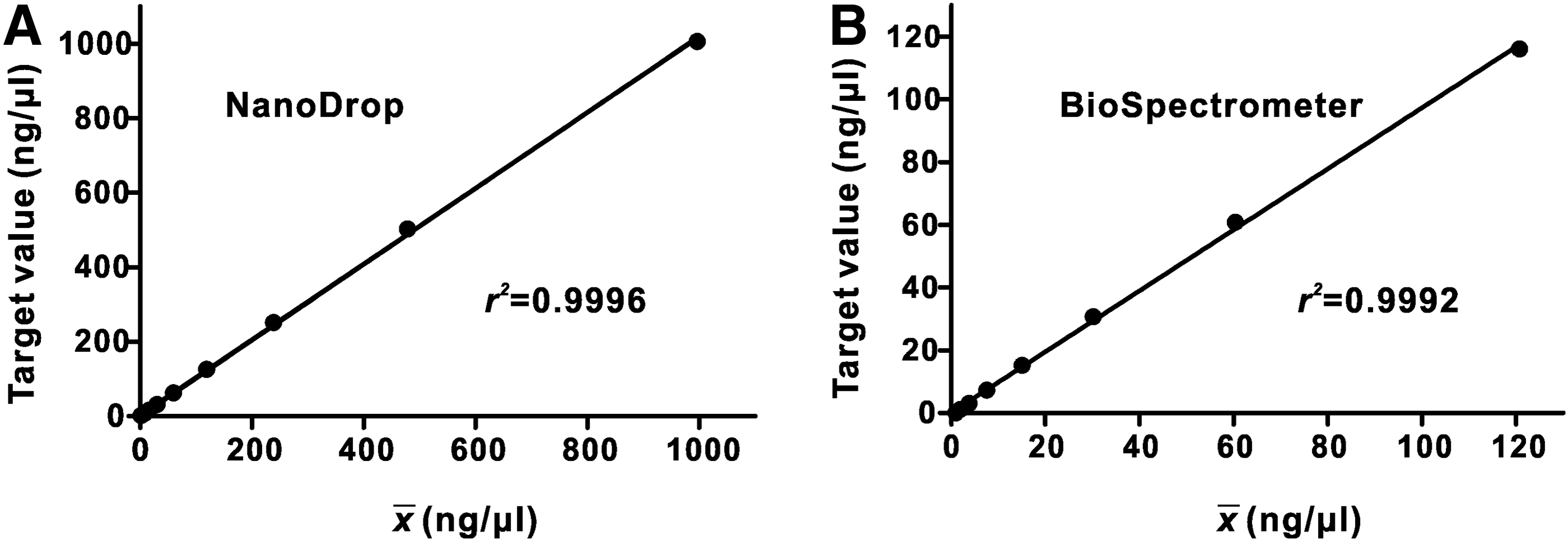
Linear regression for linearity assessment by NanoDrop
Internal quality control was performed every month. The 12s rule is used as a warning rule that triggers a more detailed inspection of the data by using 13s, 22s, R4s, and
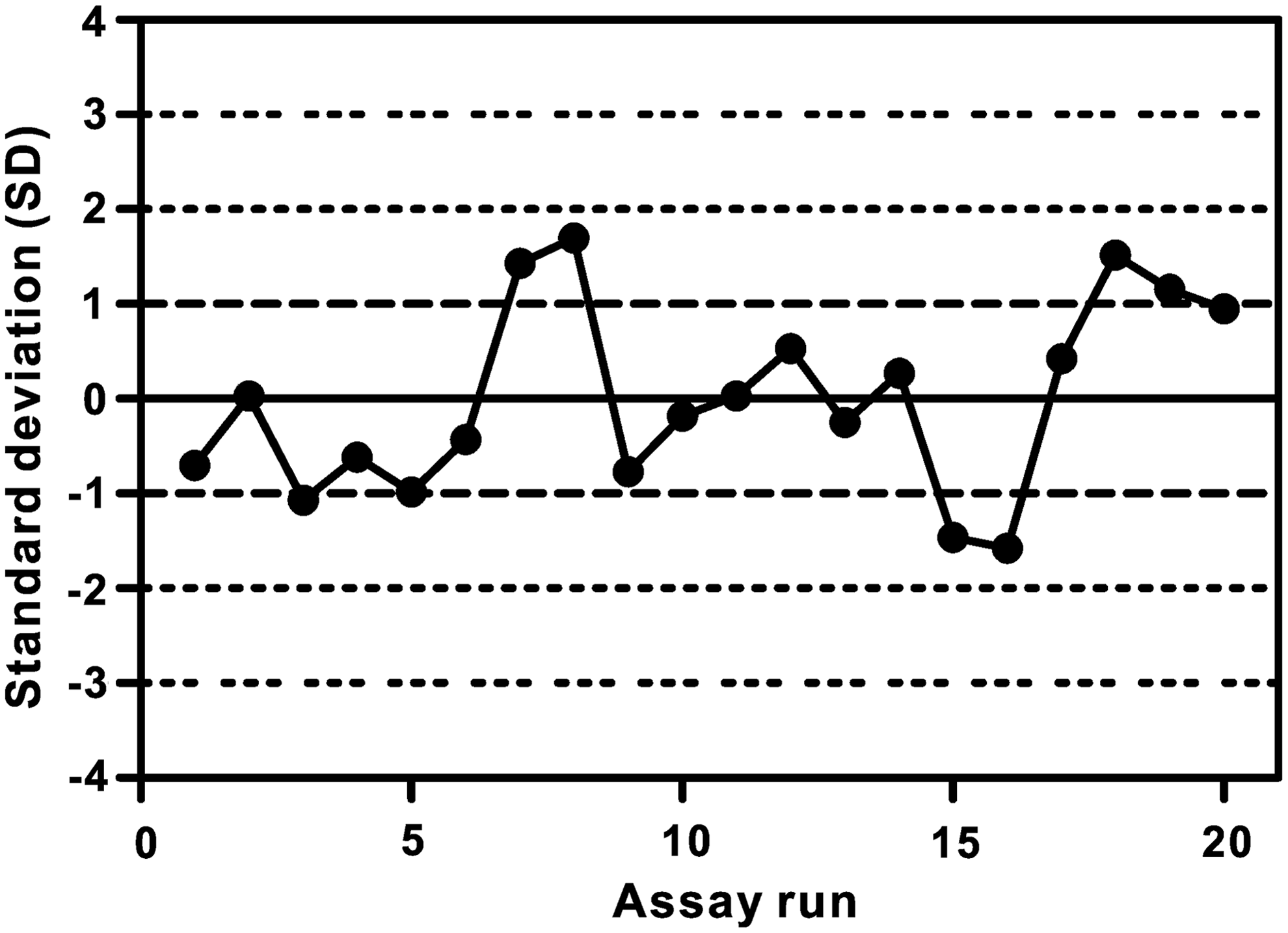
Internal quality control data collected in August, 2013.
We received the final PT Report (Report Number: DNA2012_R1_Report01) after submitting the results of series of blinded samples from IBBL, shown in Figure 4. Our scores for both sample tubes were designated as ‘accurate’ or ‘very satisfactory.’
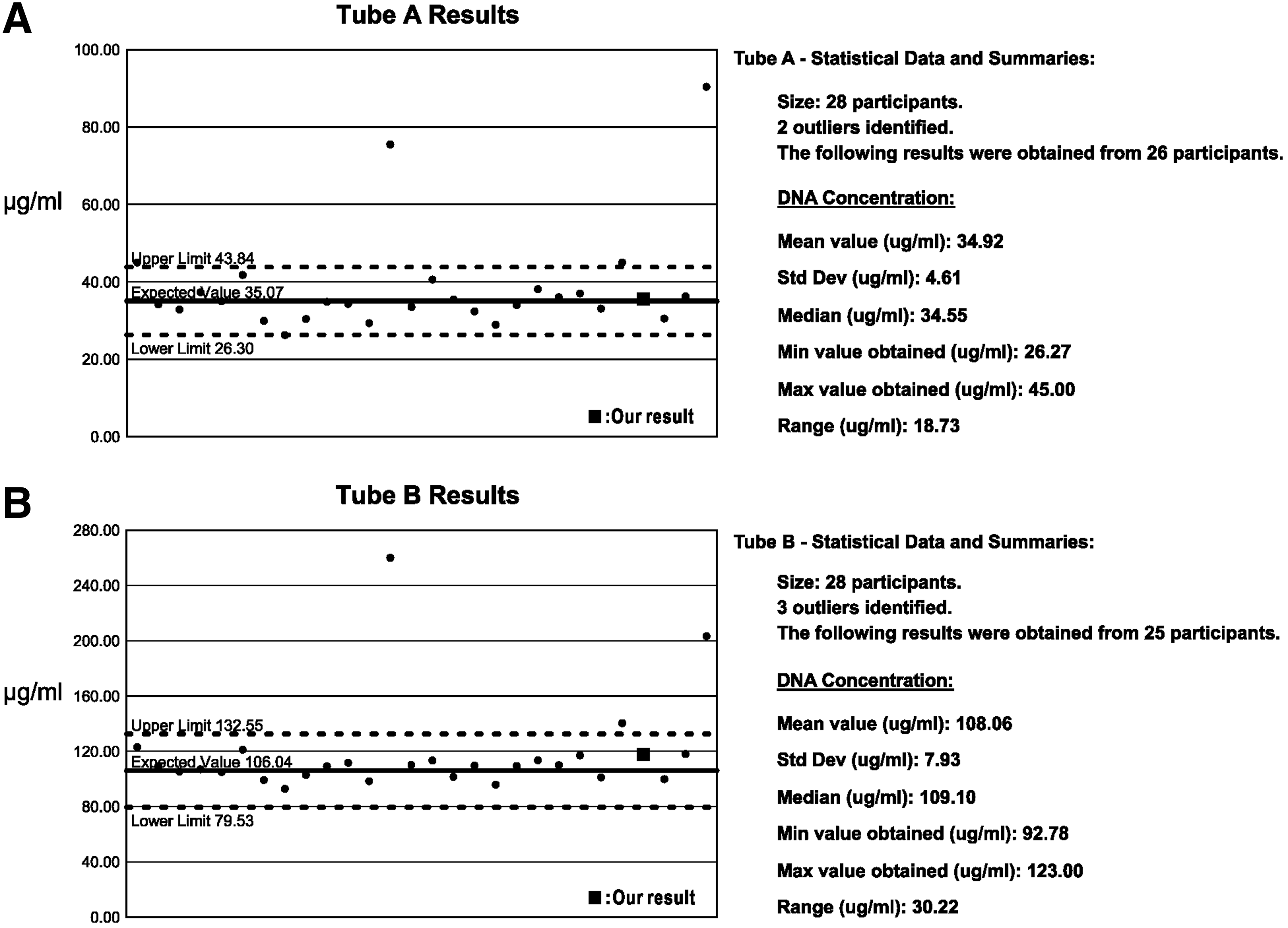
Proficiency Testing results of DNA quantitation provided by ISBER. For each test item, tube A
Discussion
The goal of biobanking science is to analyze and transfer bio-sample information to organized data that can be used for translational medicine. SCRC has been authorized to be the central hub of the Shanghai Biobank Network (SBN). In order to ensure high quality of the biospecimens and relevant data, the quality management system based on ISO/IEC 17025:2005 has been developed and implemented at SCRC. The quality program in the SCRC biobank (SERCB), as well as the handling and storage standard operation procedures of biospecimens, has been developed to meet the requirements of quality assurance and quality control principles.
According to the guidelines from College of American Pathologists (Biorepository Accreditation Program Checklist) and ISBER (2012 Best Practices for Repositories), there is a long list of check points during the collection, storage, retrieval, testing, and distribution of different types of biospecimens, whose quality is assessed by data gathered from analysis by various techniques. However, the validation requirements for these techniques remain unclear.
Method validation is the one way to prove that an analytical method is acceptable. Validation of bio-analytical methods used to generate data for the pharmaceutical industry is well-developed. In general, methods validation could include studies on specificity, accuracy, linearity, range, precision, detection limit, quantitation limit, and robustness. 8 But this approach is not widely used in the biobanking field.
Research based on human genomic DNA became widespread after the human genome project was initiated in 1990. Furthermore, DNA is much easier to process and use than the other types of biospecimens. According to well-accepted principles, we performed validation of the spectrophotometry method for DNA quantitation, including precision, accuracy, and linearity, for a straightforward approach. Our data show that all of these three parameters met the cutoff values and suggest that spectrophotometry is acceptable for DNA quantitation. To monitor the validity of tests and ensure that trends of resulting data are detectable, we used certified reference materials for internal quality control following the Westgard's Rules. For external control, we also participated in proficiency-testing program organized by ISBER/IBBL.
This simple validation model for DNA quantitation will be part of the sampling program for biospecimen quality control in the Shanghai Biobank Network (SBN). There are 12 participating hospitals in this sampling program at present.
This is our first attempt to introduce the concept of method validation into our biobank network program, following well-accepted principles. There are some limitations in this work. Although only three parameters have been chosen, it should be noted that the measurements themselves are not the key point, since they can be easily repeated. However, the value of biospecimens is increased by the incorporation of associated data. Considering data mining as a further stage of biobanking, we strongly recommend that the data produced in the initial management of the biospecimens should be collected by acceptable analysis methods with solid validation.
Footnotes
Acknowledgments
This work was supported by Scientific Research Program of Science and Technology Commission of Shanghai Municipality [program numbers 12DZ2294903 and 10DZ2251800].
Author Disclosure Statement
No competing financial interests exist.