




Abstract
Objective:
Biorepositories have been key resources in examining genetically-linked diseases, particularly cancer. Asian Americans contribute to biorepositories at lower rates than other racial groups, but the reasons for this are unclear. We hypothesized that attitudes toward biospecimen research mediate the relationship between demographic and healthcare access factors, and willingness to donate blood for research purposes among individuals of Korean heritage.
Methods:
Descriptive statistics and bivariate analyses were utilized to characterize the sample with respect to demographic, psychosocial, and behavioral variables. Structural equation modeling with 5000 re-sample bootstrapping was used to assess each component of the proposed simple mediation models.
Results:
Attitudes towards biospecimen research fully mediate associations between age, income, number of years lived in the United States, and having a regular physician and willingness to donate blood for the purpose of research.
Conclusion:
Participants were willing to donate blood for the purpose of research despite having neutral feelings towards biospecimen research as a whole. Participants reported higher willingness to donate blood for research purposes when they were older, had lived in the United States longer, had higher income, and had a regular doctor that they visited. Many of the significant relationships between demographic and health care access factors, attitudes towards biospecimen research, and willingness to donate blood for the purpose of research may be explained by the extent of acculturation of the participants in the United States.
Introduction
B
Several studies have examined biospecimen banking and research participation in the United States. One study found that while minority donors were willing to participate in an antibody screening project by donating blood, they were generally unwilling to allow the analyzed biospecimen samples to be stored for future research. 8 This study also found that while Asian Americans were more likely to consent to storing biospecimen samples in a repository than were African Americans and Hispanics, they were 29% less likely to consent than were Caucasians. In a study conducted by Lee et al. on willingness to participate in a breast cancer biobank at mammography screening, 9 Asian American women were found to be significantly less likely to donate blood or saliva as compared to Caucasian women. Similarly, Sanner and Frazier 10 found that being of East Asian descent was a statistically significant predictor of nonparticipation in biospecimen banking when compared to other races, after controlling for age and gender. Taken together, these studies suggest that East Asians are generally unwilling to participate in biospecimen research.
Factors that affect willingness to participate in biospecimen banking in the United States also have been examined. In the Sanner and Frazier study, 25% of the participants reported the act of blood donation or a blood draw as the main reason for not participating in biobanking. 10 Luque et al. found that biobank participation decisions are affected by personal life experiences, family histories, and cost-benefit beliefs. 11 Wang et al. showed that people who favored participation in government research and those who believed in genetic determinism, and that genetic research would prevent disease, had positive attitudes toward donation and storage of their blood for genetic research. 12
Other concerns that affect participation in biospecimen research include fear that the genetic information donated will be used against the donator, fear of a profit motive, and lack of trust in the biobank to protect the biospecimens from other potential abuse by researchers.13,14 Past research suggests that a number of demographic factors, including older age and higher education, are associated with greater willingness to donate blood for research in the United States.9,10,15 Studies examining the effect of acculturation, including the number of years lived in the United States, place of birth, and English-speaking proficiency, and healthcare access and barriers on willingness to donate blood for research in other minority groups, have had conflicting results.15–17
While prior studies have examined participants' motivation to contribute to biospecimen research,8–10 there has not been a thorough examination of this motivation with respect to individuals of Korean descent. The purpose of this study is to examine attitudes toward biospecimen research as a mediator of the relationship between demographic and healthcare access factors and willingness to donate blood for the purpose of research among individuals of Korean heritage. It was hypothesized that attitudes toward biospecimen research mediate the individual relationships between age, gender, marital status, educational attainment, income, number of years lived in the US, health insurance status, and having a regular physician and willingness to donate blood for the purpose of research.
Materials and Methods
Study sites and participant recruitment
Guided by the principles of community-based participatory research, the Center for Asian Health (CAH) of Temple University has established long-term partnerships with the Korean community in the study targeted geographic areas, through empowerment and engagement of collaborating Korean churches in its research development, implementation, and dissemination process. Nearly 80% of Korean Americans attend churches regularly. Church serves as an important social and educational center that provides cultural ties, identity, and acceptance as part of the community and social network. The unique status of Korean churches underscores their importance as an ideal avenue for recruiting community-based participants for health research. In working with Korean church pastors and church staff, we recruited 180 Korean Americans from four Korean churches in the Greater Philadelphia area. The inclusion criteria included: 1) self-identified Korean ethnicity, 2) aged 18 or older. Participants were compensated $20 each for participating in this study. The study was approved by the Temple University Institutional Review Board.
Data collection procedures
Prior to project implementation, CAH research team staff conducted discussion and training with Korean church pastors and staff about the study purpose, participant criteria, participant rights/confidentiality protection, the long-term benefits to the community, and research data collection procedures. All research survey forms in English were translated and back-translated into Korean to ensure the scientific and cultural appropriateness of the instrument for Korean participants. Church pastors announced the study and encouraged church members' participation. The survey form was collected in Korean churches within a group setting. It took about 20 to 30 minutes to complete the survey questionnaire. Bilingual CAH research staff members and trained church staff provided language assistance and explained questions about the questionnaire at all church sites. The completeness of the questionnaires was checked to ensure the quality of data.
Measures
Study surveys were developed in English, translated into Korean, and back-translated into English to ensure equivalence. The Korean language version was then pre-tested for acceptability of comprehension and cultural appropriateness, and necessary modifications were made.
Demographic items
Age, sex, marital status, number of years lived in the US, place of birth in the US, education, employment, income, and English-speaking proficiency were obtained at baseline.
Healthcare access and barriers
Participants reported whether they had health insurance and a regular healthcare provider, and the language that their physician uses when speaking to them.
Biospecimen research attitudes
Participants' feelings of support and trust of biospecimen processing and healthcare system services were measured. Participants responded to how well they agreed with the following five statements using a five-point Likert-type scale (1=“Strongly Disagree,” 2=“Disagree,” 3=“Not Sure,” 4=“Agree,” and 5=“Strongly Agree”): “I support biospecimen research,” “I trust researchers at universities and hospitals to evaluate risks and benefits of biospecimen research,” “I trust governmental authorities to evaluate the risks and benefits of biospecimen research,” “I trust pharmaceutical-based researchers to evaluate the risks and benefits of biospecimen research,” and “I trust the U.S. healthcare system/personnel and services.” Internal consistency of the five items for support and trust of biospecimen research using Cronbach's alpha was 0.906. Therefore, a summary item for attitudes toward biospecimen research was created by taking the average five-point Likert-scale response of the five questions. This attitudes summary item was calculated for all participants who responded to at least four of the five questions.
Outcome measure
Self-reported willingness to participate in blood donation as part of a research project was measured at baseline on a 10-point Likert-type scale, with 1 indicating little willingness and 10 indicating complete willingness.
Statistical analyses
Data were analyzed using Stata, Version 13.0. Descriptive statistics were used to characterize the sample with respect to demographic, psychosocial, and behavioral variables. Willingness to participate in a project by donating blood and attitudes toward biospecimen research were non-normally distributed Likert-scale response variables, and Wilcoxon tests, Kruskal-Wallis tests, and Spearman ranked correlations were used to assess potential relationships between willingness to donate blood as part of a project, attitudes toward biospecimen research, and demographic and healthcare access variables. Indirect and total effects were estimated using structural equation models. Standard errors of these effects were estimated via bias-corrected acceleration 18 on 5000 bootstrap samples, consistent with current recommendations. 19
Results
Sample characteristics
Table 1 presents a summary of the demographics and healthcare access characteristics of the sample. The median age of the sample population was 53.5 years. The study population was approximately half male (54.4%) and half female (45.6%). More than half (54.7%) of the participants reported an annual household income below $40,000 per year. The median years lived in the US was 23.0 years. The majority (97.8%) of the study population was born outside of the US. Most participants (83.2%) attended some college or earned an undergraduate or graduate degree. Most (79.4%) of the participants were married or living as married. More than half (53.3%) of the participants were employed at the time of the survey. Half (52.2%) of the study population reported not speaking English well or at all, while almost half (47.2%) reported speaking English very well or fairly well. More than one-third (41.7%) of participants' physicians spoke to them in the participant's native language, and 20% of participants' physicians conversed with them in English only. More than half of participants had health insurance (57.8%) and a regular physician (57.2%).
IQR, interquartile range; sd, standard deviation.
Not married consists of never married, divorced/separated, widowed, and other; 2Willingness to donate blood reported on a scale of 1 to 10, with 10 being most willing to donate; 3Attitudes toward biospecimen research based on average score on 5-point Likert scale of five questions regarding support and trust of biospecimen research, with 1 representing strongly disagree and 5 representing strongly agree.
Spearman ranked correlation test; ‡Wilcoxon-Mann-Whitney test; §Kruskal Wallis test; *Significant at p<0.05; **Significant at p<0.01.
Willingness to participate in blood donation
To evaluate whether demographic and healthcare access variables were associated with willingness to participate in a project by donating blood, statistical analyses were conducted. The results indicated that willingness to participate in a project by donating blood was not significantly associated with age, gender, place of birth in the US, number of years lived in the US among this mixed sample, highest grade of school completed, annual household income, health insurance status, having a regular physician to visit, English-speaking proficiency, or language spoken with physician. Spearman's rank correlation shows a statistically significant relationship between attitudes toward biospecimen research and willingness to donate blood (rho=0.368, p<0.001).
Attitudes toward biospecimen research
To examine whether demographic and healthcare access variables were associated with attitudes toward biospecimen research, additional statistical analyses were conducted. Attitudes toward biospecimen research were not significantly associated with gender, place of birth in the US, highest grade of school completed, English-speaking proficiency, or language spoken with physician. Wilcoxon-Mann-Whitney analysis indicated that participants who were married or living as married were more likely to have positive attitudes about biospecimen research than were unmarried participants, z=−3.218, p=0.001. Additional Wilcoxon-Mann-Whitney analysis showed that participants with health insurance had statistically significantly more positive attitudes toward biospecimen research than did participants without health insurance, z=−2.061, p=0.039. Similarly, participants who reported having a regular physician had a more positive attitude toward biospecimen research than did other participants, z=−3.218, p=0.001. Participants with an annual household income above $40,000 also had more positive attitudes toward biospecimen research, z=−3.217, p=0.001. Spearman's rank correlation shows a statistically significant relationship between attitudes toward biospecimen research and age of the participant (rho=0.20, p=0.007) and years lived in the US (rho=0.208, p=0.006).
Regression analyses
Regression analyses were conducted to assess potential predictive relationships between demographic and healthcare access variables and willingness to donate blood for the purpose of biospecimen research. Place of birth in the US, English-speaking proficiency, and language physician speaks with participant were excluded from this analysis because they were not significantly associated with attitudes toward biospecimen research or willingness to donate blood. Gender and educational attainment also were not significantly associated with attitudes toward biospecimen research or willingness to donate blood, but they were included in regression analyses because they are important demographic indicators. Only attitudes toward biospecimen research showed a statistically significant relationship with willingness to donate blood (B=1.153, p<.001). Multivariate regression analyses were then conducted to control for attitudes toward biospecimen research. With the inclusion of attitudes toward biospecimen research in each model, the Wald test became statistically significant, although the regression coefficient of the independent variables did not, suggesting that attitudes toward biospecimen research represented the only observed mediator of the associations between demographic characteristics and willingness to donate blood.
Simple mediation models
Multiple regression analyses were conducted to assess each component of the proposed simple mediation models (Fig. 1). As presented in Table 2, the direct effect of the proposed mediator, attitudes toward research, on willingness to donate blood for the purpose of research, was statistically significant (p<0.001) in all of the simple mediation models. First, it was found that no demographic or healthcare access variables were associated with willingness to donate blood for the purpose of research. It also was found that increasing age, income, number of years lived in the US, and having a regular doctor were statistically significantly associated with positive attitudes toward biospecimen research. Mediation analyses were conducted using the bootstrapping method with bias-corrected confidence estimates, for which the 95% confidence interval of the indirect, direct, and total effects was obtained with 5000 bootstrap resamples. The results of the bootstrapped mediation analysis confirmed the mediating role of attitudes toward biospecimen research in the relationship between age, income, health insurance, and regular doctor and willingness to donate blood for the purpose of research (Table 2). In addition, the results indicated that the direct effect of age, income, health insurance, and regular doctor individually on willingness to donate blood for the purpose of research became nonsignificant when accounting for attitudes toward biospecimen research, thus suggesting full mediation.
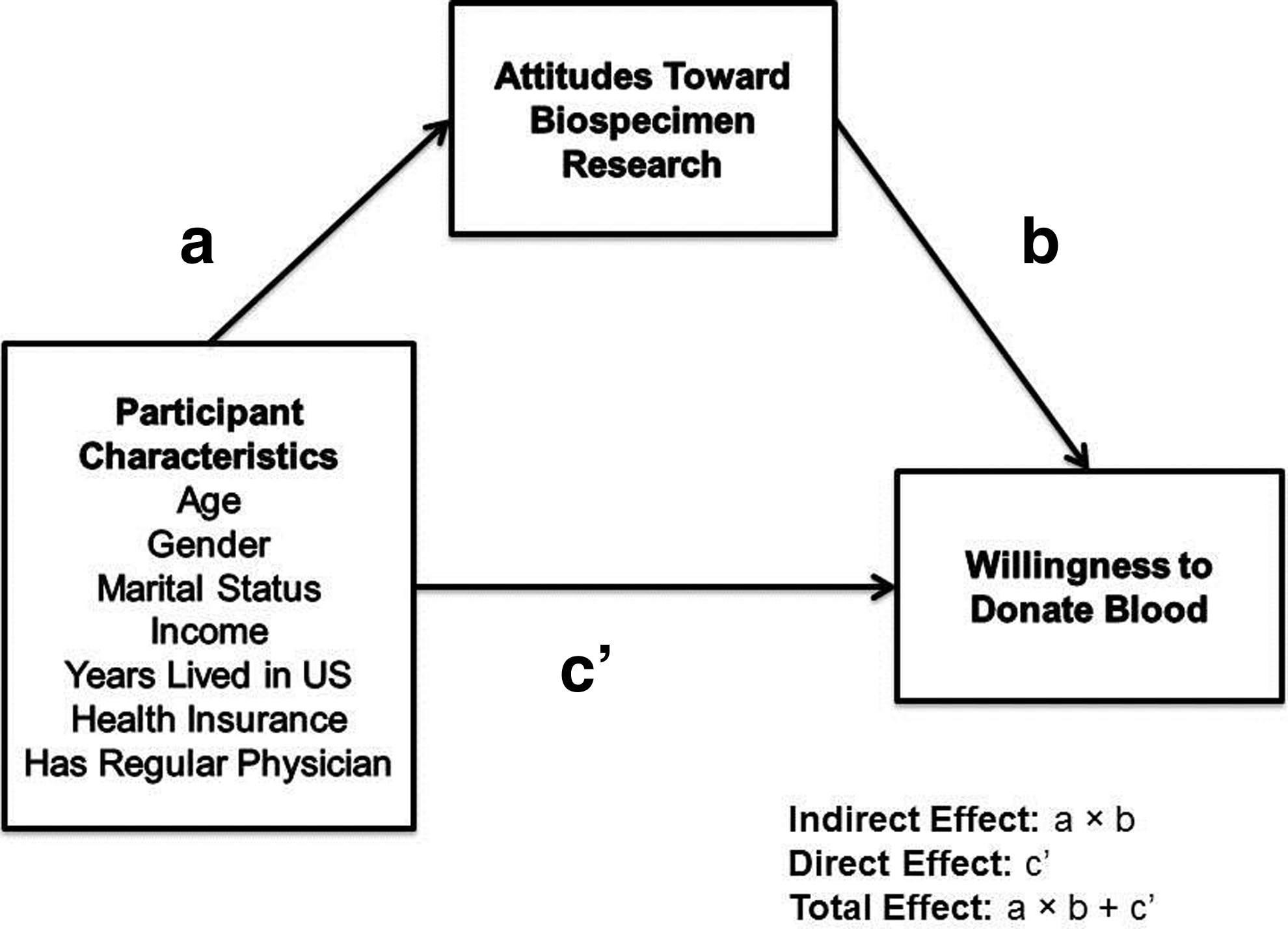
Attitudes toward biospecimen research mediate the association between patient characteristics and willingness to donate blood.
p<0.05, **p<0.01, ***p<0.001
Discussion
As expected, findings from this study suggest that attitudes toward biospecimen research are the main predictors of an individual's willingness to donate blood for the purpose of research. Despite statistically significant bivariate associations between age, marital status, income, years lived in the US, health insurance, and having a regular physician and attitudes toward biospecimen research, none of the aforementioned demographic or healthcare access variables was significantly associated with the willingness to donate blood outcome variable. Simple mediation models suggest that attitudes toward biospecimen research account for the individual relationships between age, income, number of years lived in the US, and having a regular physician and willingness to donate blood for the purpose of research. No mediation effect of attitudes toward biospecimen research on the individual relationships between gender, marital status, educational attainment, and health insurance status was observed.
Overall, participants in this study were willing to donate blood for the purpose of research, despite having neutral feelings as a whole toward biospecimen research. Many of the significant relationships between demographic and healthcare access factors, attitudes toward biospecimen research, and willingness to donate blood for the purpose of research may be explained by the extent of acculturation of the participants in the US. Participants who were younger or who lived in the US for fewer years were less willing to donate blood when attitudes were a significant mediator. This suggests that younger participants had less positive attitudes toward biospecimen research than did older participants, which affected their willingness to donate blood for biospecimen research. Similar findings have also been found in other minority groups including Chinese and Hispanics.15,20 Older participants may experience more medical issues than do young participants, thereby producing a higher immediate need for biospecimen research. Older Chinese participants have also been found to be more willing to donate to research if it benefits future generations. 21
These findings also suggest that participants who have lived in the US longer, had a higher income, or who had a regular doctor to visit were more willing to donate blood for research purposes. This suggests that people who have lived in the US longer or who have a regular doctor may have more positive attitudes toward medical research and the US medical care system, which increases their willingness to donate blood for research. Income and educational attainment are usually highly correlated, suggesting that those with a higher income may have had more knowledge of biospecimen research. Future research on the effects of acculturation factors on willingness to donate blood for the purpose of research appears warranted.
To confirm these findings, additional studies on the Korean American population in regard to biospecimen research should be conducted. At this time, there are no other studies in the Korean American population to which these results can be compared. However, studies in other populations suggest similar findings. Kerath et al. found statistically significant associations between increasing age and marital status and the belief in societal importance of genetic research as well as no relationship between age, gender, and educational attainment and willingness to participate in genetic research in a study population that was 68% non-Hispanic White. 14 Wang et al. found significant associations between education, positive family history, non-Hispanic White race, and geography and positive attitudes toward biospecimen research in their study of non-Hispanic Whites, African Americans, and Hispanics. Multiple regression analyses from that study also found the exclusion of demographic characteristics when attitudes and behaviors were included in the model, which suggests that attitudes regarding research participation and genetic determinism and health behaviors are the most significant contributor to a person's attitudes toward blood storage or donation for biospecimen research.
Additionally, the reasons for not wanting to donate blood for biospecimen research should be explored in the Korean American population. Other studies have found discomfort and anxiety in regard to the blood draw process, fear of the results of the research being used against them, and lack of trust in biobanks and researchers not to abuse their samples as major limiting factors in willingness to donate blood for biospecimen research.13,14 Knowledge of what factors and beliefs prevent biospecimen donations within this particular population is a key factor to informing potential participants of their rights, which should reduce their fears of biospecimen donation.
Future studies in biospecimen donation for research purposes also should address the impact of knowledge of biospecimen research practices on individual attitudes and the role that knowledge and attitudes have on actual donating behavior. Knowledge about genetics, as well as personal or family history of genetic diseases, also should be explored. Additionally, it has not been examined whether self-reported willingness to donate blood for the purpose of research predicts actual donation of blood for the purpose of research. Therefore, further research is warranted to examine the utility of self-reported willingness to donate blood as a proxy for actual blood donation behavior.
Limitations
A limitation of this analysis was the small sample size, which restricts the generalizability of the results. Therefore, the findings in this study are preliminary, and larger studies with more participants should be conducted. An additional limitation of this study was the large number of students who participated in the study. This may have confounded the results due to their low income, which did not correlate with the usual related finding of high educational attainment. Another limitation of the study was the use of willingness to donate blood for research as the proxy for willingness to donate any type of biospecimen. It is possible that some participants would have been more willing to donate saliva, which involves a much less invasive biospecimen sampling method than the collection of blood. Similarly, those participants who indicated a high willingness to donate blood for research purposes may be less willing to donate tissue samples.
Another limitation of the study was the use of willingness to donate blood as a proxy for actual donation of blood. Lee et al. observed that 66% of women expressed a willingness to donate blood or saliva at a mammography screening visit, but that only 56% actually donated. Finally, a major limitation of this study was selection bias. It is possible that eligible participants who elected to join in this study had more positive attitudes toward biospecimen research and a higher willingness to donate blood for the purpose of research than did those who elected not to participate in this study. The same factors that contributed to individuals' participating in this study could affect their responses to the survey questions, which would lead to more highly and positively correlated results.
Conclusions
These findings have implications for future intervention programs that aim to improve attitudes toward biospecimen research and willingness to donate biospecimen samples. More complex mediation models, including multiple mediation and moderated mediation, are warranted to observe other potential relationships between the demographic and healthcare access variables observed in this analysis, attitudes toward biospecimen research, and willingness to donate blood for the purpose of research. Biospecimen banks are key resources in the examination of genetically-linked diseases, therefore biospecimen donation by Korean Americans, as well as other Asian subpopulations, is imperative for studying genetically-linked diseases and creating personalized medicine approaches to treating them. By determining factors that affect attitudes toward biospecimen research and willingness to donate biospecimens, intervention programs can be created to increase biospecimen donation and, thus, increase health research initiatives in Korean Americans.
Footnotes
Acknowledgments
The authors wish to thank volunteers and partners of Temple University's Center for Asian Health, Asian Community Health Coalition. This project was supported by NIH-NCI's Community Network Program Center, ACCHDC (U54CA153513, PI: Grace X. Ma).
Author Disclosure Statement
The authors declare that there is no financial conflict of interest.