




Abstract
Biorepositories, the coordinating hubs for the collection and annotation of biospecimens, are under increasing financial pressure and are challenged to remain sustainable. To gain a better understanding of the current funding situation for Canadian biorepositories and the relative contributions they receive from different funding sources, the Canadian Tumour Repository Network (CTRNet) conducted two surveys. The first survey targeted CTRNet's six main nodes to ascertain the relative funding sources and levels of user fees. The second survey was targeted to a broader range of biorepositories (n=45) to ascertain business practices in application of user fees. The results show that >70% of Canadian biorepositories apply user fees and that the majority apply differential fees to different user groups (academic vs. industry, local vs. international). However, user fees typically comprise only 6% of overall operational budgets. We conclude that while strategies to drive up user fee levels need to be implemented, it is essential for the many stakeholders in the biomedical health research sector to consider this issue in order to ensure the ongoing availability of research biospecimens and data that are standardized, high-quality, and that are therefore capable of meeting research needs.
Introduction
H
As the demands of scale and quality and the complexity of the processes involved in compiling biospecimens and linked data has increased, biobanking has emerged as a specialized activity conducted by dedicated organizations called biorepositories. It is important to recognize that the primary purpose of human health biorepositories is to enable the supply of essential biological materials to support research, but they do not typically themselves conduct research. This distinction makes biorepositories ineligible for the vast majority of research grant funding mechanisms. This is also true for other forms of health research infrastructure (e.g., animal care units, advanced microscopy facilities, Research Ethics Boards). However, these other health research infrastructures are typically supported by institutions and indirect costs of research funding mechanisms in Canada that have yet to include biorepositories. This difference may in part be due to the fact that biobanking has only recently emerged as a discipline and, as we have previously highlighted, that biorepositories are unique in several important ways: 2 they are highly diverse in focus; 3 they are subject to complex legal 4 , ethical, 5 and social challenges; and finally, the commodity they are responsible for, the biospecimen, is both finite and its value appreciates over long periods of time. These unique characteristics contribute to a key issue for the discipline of biobanking—the widespread failure to recognize that biobanking sustainability is a broader system issue that involves multiple elements, not just financial, but also operational and social. 2 The tendency to focus solely on the financial dimension of individual biorepositories and their sustainability results in an oversimplification of the valuation of the biorepository infrastructure. This has contributed to the current challenge faced by most individual biorepositories—how to fill the financial gap that typically arises after the initial setup phase when self-sustainability through user fee revenues proves to be unattainable.
Within Canada, biorepositories often seek to fill this funding gap through an uncertain and shifting mixture of funding sources from host institutions, nonprofit foundations, and user fees. To gain a better understanding of the current funding situation for Canadian biorepositories and the relative contributions they receive from the various funding sources, the Canadian Tumour Repository Network (CTRNet; www.ctrnet.ca), a consortium of leading Canadian tumour biorepositories, undertook two national surveys. The purpose of this article is to summarize these results and to describe resources that have been created by CTRNet to assist Canadian biorepositories in achieving financial sustainability.
Methods
Survey #1—CTRNet Node Survey
CTRNet includes six charter member biorepository nodes: British Columbia Tumour Tissue Repository (http://www.bccrc.ca/dept/ttr), Alberta Cancer Research Biorepository (http://www.translab.ca/alberta-cancer-research-biorepository/), Manitoba Tumour Bank (http://www.umanitoba.ca/institutes/manitoba_institute_cell_biology/MICB/Platforms/MbTumourBank.html), Ontario Tumour Bank (http://www.ontariotumourbank.ca), NCIC Clinical Trials Group (http://www.ctg.queensu.ca/TissueBank/index.html), and Réseau de Recherche Sur le Cancer du Fond de Recherche Québec—Santé Network (http://www.rrcancer.ca). The leader from each node sits on the CTRNet Management Committee (CMC), which is responsible for CTRNet's activities. The CMC receives expert strategic advice and guidance from an External Advisory Committee (Fig. 1).
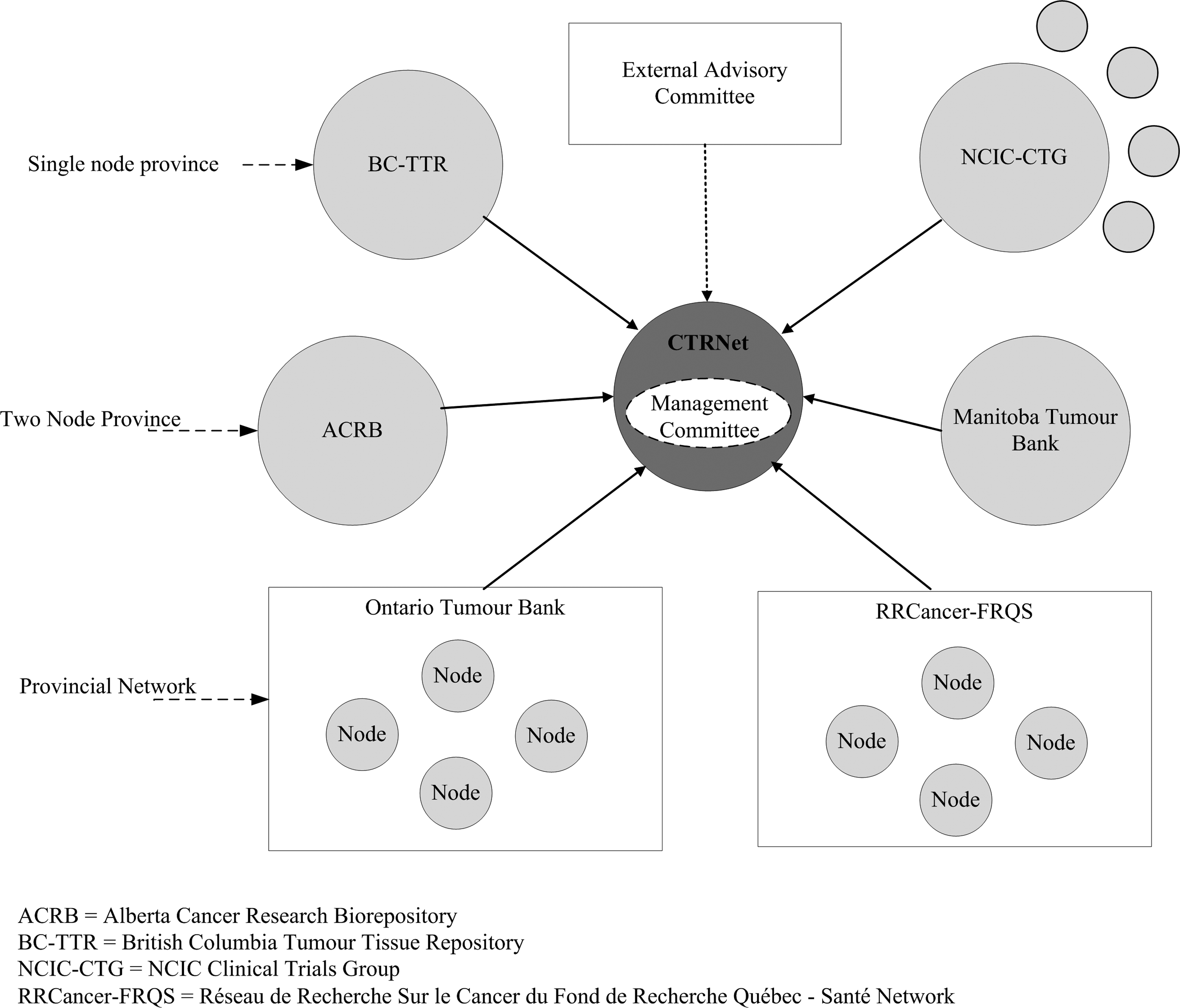
The organizational structure of CTRNet.
CTRNet's aim is to enhance the capacity and quality of biobanking through standardization and improvement of biobanking processes and frameworks. One of the objectives stemming from this overall aim is to support biorepositories in establishing and maintaining financial sustainability. As a first step towards creating benchmarks of the financial inputs for Canadian biorepositories, the six CTRNet nodes were surveyed to compile two sets of data:
1. A summary of the annual biospecimen outputs from their biorepository; and 2. An estimate of the financial contributions they receive from four funding sources: i. host institution ii. charitable nonprofit foundation iii. research grants iv. user fee revenues
The survey was delivered in July 2013 using a direct short interview format. These data were collected by circulating standardized collection templates with data definitions to guide data input to each CTRNet node leader or their delegated biorepository business manager.
Survey #2—Broader survey of Canadian biorepositories
As a second step in the process of planning benchmarks for output and user fees for Canadian biorepositories, a second survey was delivered to both CTRNet nodes and a broader spectrum of other biorepositories in Canada. This survey included a section on baseline demographic-type questions to delineate the type and scale of each biorepository, and a section on decisions related to implementation of user fees (in addition to a section on business practices around implementation of material transfer agreements, requirements for research ethics board approvals and scientific committee approvals that are not relevant to this analysis and not reported here).
In September 2013, the survey was distributed to 45 individuals who were either the Principal Investigator or the manager for a Canadian biorepository. The survey was delivered using FluidSurveys (http://fluidsurveys.com/). It remained open for 2 weeks.
Results
Survey #1—CTRNet Node Survey
In order to put into context the financial inputs of the various CTRNet biorepository nodes, their leaders were asked to provide a high-level summary of their annual biospecimen outputs and the number of projects supported. Biospecimens were considered on the basis of three categories decided upon by the CMC: primary samples (e.g., plasma, buffy coat, whole tissue blocks), aliquots (e.g., tissue sections), and derived products (e.g., RNA, DNA, proteins). These results showed that half of CTRNet nodes release all three categories as noted, while the other half release only aliquots (Table 1).There was a wide range of biospecimens released/distributed per year: range=500 to 6500 (mean=3842). Finally, CTRNet nodes were also surveyed for the number of cases released/distributed per year, since this metric indicates the biorepository's business focus and customer value of having matched biospecimens derived from the same patient, and the overall number of projects supported per year (Table 1). It should be noted that the business focus of some CTRNet nodes is on accruing maximal numbers of cases with a specific type of biospecimen (e.g., frozen tissue or blood), while others are focused on accruing fewer cases with multiple biospecimen types and events (e.g., recurrences or metastases) from each case. This simply reflects differing approaches to biospecimen accrual in response to varying demands from research recipients utilizing that biorepository.
Primary samples (e.g., plasma, buffy coat, whole tissue blocks); bAliquots (e.g., tissue sections); cDerived products (e.g., RNA, DNA, proteins); dEstimated number, grouped into three categories to preserve anonymity of nodes: 1,000–10,000; 10,000–20,000; 20,000–30,000; eCase was defined as an incidence of primary cancer.
The financial input data reported by each CTRNet biorepository node are summarized in Table 2. Across CTRNet, the representative contribution of the first three financial sources varies considerably: coverage by host institution range=15%–88%; coverage by charitable nonprofit foundations range=0%–78%; coverage by research granting agencies range=0%–50%. The medians of the sources in financial models across these six leading biorepositories is host institution 73%, nonprofit foundation 30%, grants 10%, user fees 6%. The results show that the narrowest range between nodes exists for coverage by user fees: range=2%–25%. These data are anonymized; however, the node numbers indicated in Tables 1 and 2 are equivalent.
Survey #2—Broader survey of Canadian biorepositories
The overall response rate to the survey was 55%; however, only complete responses (49%) were considered in the analysis. Based on responses to the basic operational questions, the majority of respondents represented mature biorepositories: 86% had been operating for more than 5 years, and 82% had biospecimen/data release processes underway for over 5 years (Fig. 2). With respect to the business practices questions, the majority of respondents had standardized approaches to determining and applying user fees: 73% had a set fee schedule or pricing guide in place; 64% had policies in place with respect to the fees applied based on the user's location (e.g., Canadian vs. international); and 77% had a policy in place to charge different user fees to academic vs. industry users (the remaining respondents answered that this question was not applicable) (Fig. 3).
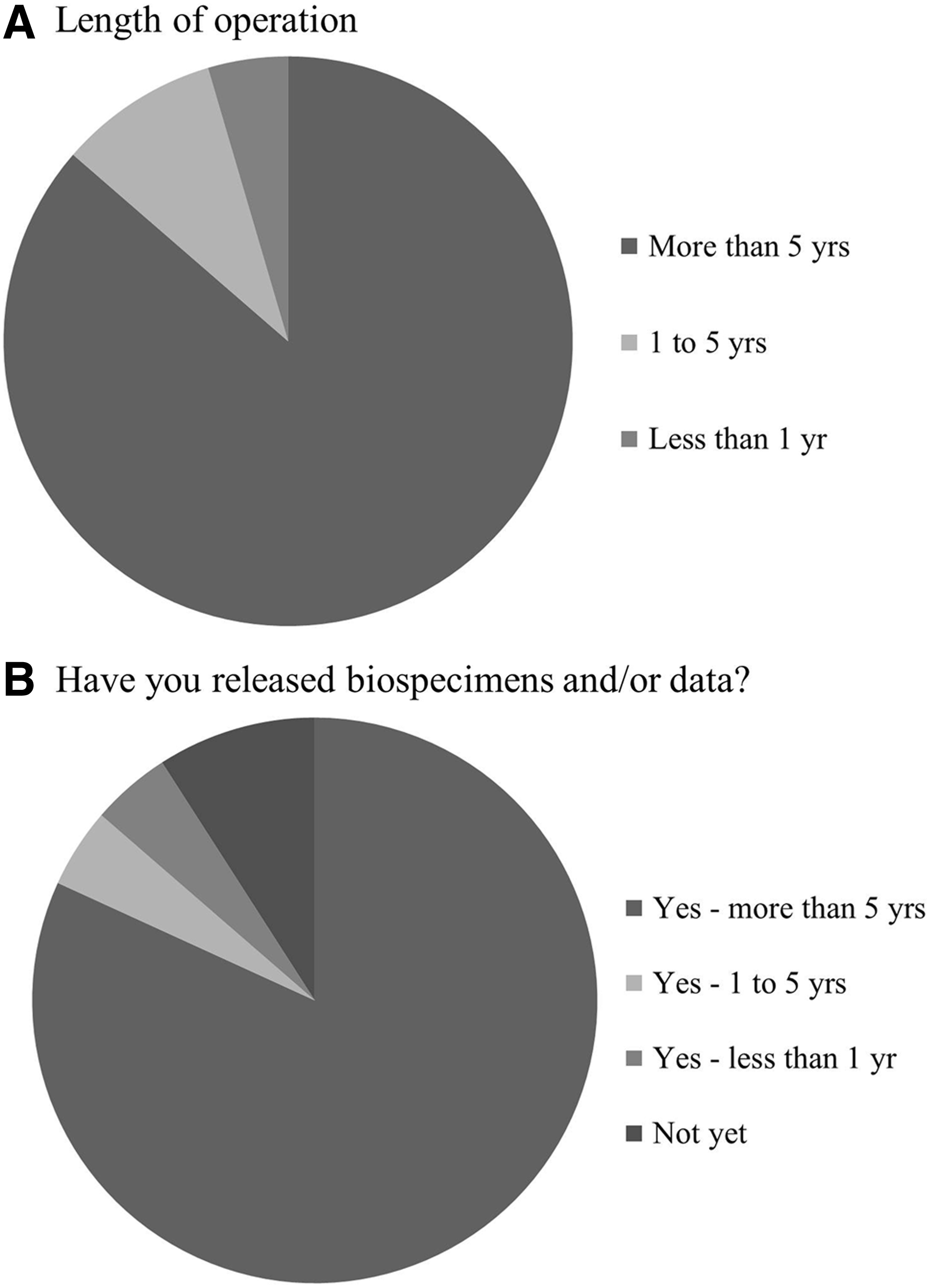
Survey results: Basic operational data reported by respondents.

Survey results: Financial data reported by respondents.
Only one respondent reported that 100% of operating costs were covered by user fees received. The highest proportion of respondents answered that coverage by user fees was less than 25% of operating costs (50% of respondents). Remaining respondents answered either that that coverage by user fees was 25%–50% of operating costs (∼30% of respondents), or 50%–75% of operating costs (∼15% of respondents).
Discussion
There are two persistent and problematic assumptions made by research funders in Canada: 1) health researchers are able to access adequate quality and quantity of biospecimens to enable their research; and 2) biorepositories are capable of sustaining themselves financially to provide the biospecimens that researchers need through user fee revenues. National surveys of researchers have previously raised doubt about the first assumption 6 and as previously described by others, 7 we have shown here that the second assumption is inaccurate for most biorepositories. Although there may be exceptions to this generalization, 8 taken together these findings indicate that the concept of ‘financial sustainability success’ needs to be redefined.
Our results show that user fee revenues alone are inadequate to cover the operational costs of biorepositories, suggesting that a stable and realistic funding framework cannot currently be based on user fees. An alternate model is therefore needed, and we assert that it should be one wherein biorepositories receive ongoing major contributions from host institutions or research infrastructure programs. User fees should, however, be a standardized component of an alternate financial framework for several reasons: 1) to ensure recognition of value as exemplified by the well-known saying, “people don't appreciate what they don't pay for;” 2) to encourage responsible use and careful appraisal of the biospecimen needs to answer specific research questions; and 3) to provide a metric for funders to measure output activity and to gauge the need for biorepositories. For individual biorepositories, the user fees applied and the overall revenue target should be clearly defined and agreed upon by the biorepository's financial stakeholders, in line with the biorepository's overall purpose and maturity. It is clear that to ensure sustainability of biorepositories, long-term sustained institutional or governmental funding is required as is commonly the case for other, perhaps better recognized and more formalized components of the health research infrastructure (e.g., animal care units, Research Ethics Boards).
Currently, user fee levels are largely determined by market forces and are probably too low to adequately address the issues noted above. 9 Raising user fees from the current levels, which are clearly inadequate, to offset a tangible proportion of the operational costs, is a challenge that cannot be met by biorepositories alone. Necessary elements to address this challenge would include: 1) provision of adequate funding to researchers to meet higher user fees; 2) encouragement from funders for researchers to use certified biorepositories, and recognition by researchers of the value to their research of using biospecimens associated with standardized processes and known quality metrics; 3) establishment of harmonized user fees to reduce competition between biorepositories; and 4) implementation of mandatory biospecimen/data reporting requirements by journals. In the absence of a drive to address these elements, many researchers will continue to seek the cheapest biospecimens available from black market or cheap biorepository sources and to publish their results based on these. This will continue to undercut attempts to raise the quality of research data through encouraging the use of known quality materials from certified biorepositories. There is a cost associated with ensuring quality. If quality assurance is to be respected and ensured, then the research establishment will need to make adequate resource provision for this purpose.
In addition to highlighting the need for a new paradigm for biorepository funding, our findings also indicate that since the prospects of significant user fee revenue are limited and alternative funding sources are so variable, there is a need for new strategies and tools to enable biorepositories to directly address financial sustainability. To date, CTRNet has developed several such tools. First, a user fee calculator was created to establish accurate and rationalized user fees and to enable harmonization. It was designed to enable biorepository leaders to define their costs of production and distribution by inputting operational and capital costs, as well as unique, user-defined variables in order to calculate appropriate user fees. In addition to the inherent value of establishing rationalized user fees, the ability to define the true costs of production and distribution allows for a realistic discussion of infrastructure funding requirements between the biorepository and its funding stakeholders. The user fee calculator is adaptable for both tumor and non-tumor biorepositories and is available on-line (www.biobanking.org).
Second, the Permission to Contact (PTC) platform has been developed to streamline consent processes and increase efficiency for biorepositories. 10 As many people involved with biobanking and health research have experienced, obtaining patient consent to collect, store, and annotate biospecimens for research purposes often involves significant time and resources. The central concept of the PTC platform is to integrate the first step of the biorepository participation consent process into the routine workflows of the hospital and to operate this first component of the consent process as a shared process accessible by all appropriately qualified research projects. We have previously shown that operation of this PTC platform can enhance enrollment of patients into biorepositories, reduce the overall research consent costs, and can be sustainable across a diverse set of patient groups.10,11 CTRNet's strategic focus continues to include the development of resources that support biorepositories in maintaining financial sustainability, including responding to the expressed desire by Canadian host institutions for CTRNet to establish funding benchmarks.
As custodians of invaluable biospecimens, CTRNet biorepository node leaders seek to employ sound business practices to maximize their ability to secure adequate funding to maintain their node, in accordance with the node's overall mission. 12 However, even these well-established biorepositories are challenged to remain financially secure within the current funding paradigm, wherein user fee revenues are expected to completely or significantly offset operational costs within a few years of start-up. This type of model is not realistic in most cases and it has resulted in the financial instability of many biorepositories within Canada. 9 It is essential for the biomedical health research sector to gain an understanding of this issue in order to successfully guarantee the availability of research biospecimens and data that are standardized, high-quality, and that are therefore capable of meeting research needs.
Footnotes
Acknowledgments
The authors thank Mr. Aaron Suggitt for his work in creating and distributing the standardized collection templates and data definitions used to collect data from CTRNet nodes (Survey #1). They also thank Ms. Stefanie Cheah for her help in formatting the figures.
Author Disclosure Statement
There are no conflicts of interest to disclose. This work was conducted on behalf of the Canadian Tumour Repository Network which is funded by the Institute for Cancer Research, Canadian Institutes for Health Research. All authors contributed to the ideas presented here and to the development and preparation of the manuscript. All authors read and approved the final manuscript.