




Abstract
Background:
Isolation of high-quality RNA from tissue is mandatory for producing reliable data for downstream applications. In heart tissue, the relative strengths and weaknesses of different approaches to isolate total RNA are unknown. The objective of this study was to compare different RNA isolation methods in healthy and diseased human myocardium.
Methods:
Frozen left ventricular myocardium was obtained from individuals with heart failure and individuals who died from non-cardiac causes with normal heart function (control). Three extraction methods, including guanidine isothiocyanate (TRIzol), silica-gel column (RNeasy), and the combination method (TRIzol/RNeasy), were assessed for their effect on the yield, integrity, and gene expression levels of RNA using quantitative real-time PCR.
Results:
In the control group (n=5), the highest RNA yield per tissue mass was obtained with TRIzol, and a significantly higher RNA integrity was obtained from the RNeasy method. The quantification cycle (Cq) values for both the reference gene GAPDH and two target genes were lower with TRIzol. Normalization by GAPDH showed the highest gene expression levels with RNeasy. Similar patterns were observed in the heart failure group (n=5), suggesting assays were not negatively impacted by myocardial disease processes.
Conclusion:
In both healthy and diseased heart tissue, the TRIzol method provides the highest RNA yield, while the RNeasy method shows superior RNA integrity, demonstrating comparable RNA quality in studies examining myocardial disease. A balanced approach to RNA quality is necessary for the successful downstream applications of RNA.
Introduction
A
There are three distinct, widely used protocols for RNA extraction from heart tissue, including 1) guanidine isothiocynate-phenol:chloroform (GTC) method; 2) a silica-gel column (SGC) method; and 3) a combination of the two. GTC-based RNA isolation technology was developed by Chomczynski and Sacchi and utilizes commercial reagents such as TRIzol. 4 TRIzol is a mono-phasic solution that maintains RNA integrity while disrupting cellular proteins and RNAses. 5 Qiagen's RNeasy, another popular method of RNA isolation, combines use of a silica-based membrane that has high affinity for nucleic acids, with the speed of microspin technology. 6 Conventional methods to determine RNA purity rely on optical density (OD) measurements performed by a UV/VIS spectrophotometer. The ratio of OD 260 nm to 280 nm, which absorb nucleic acids and proteins, respectively, is a conventional measurement of RNA purity; a value greater than 1.8 indicates “pure” RNA.6,7 However, RNA concentration based on OD measurement may be overestimated,7,8 suggesting more comprehensive assessment is needed.
The most convenient and objective way of assessing the quality of RNA is by use of lab-on-chip technologies. The Agilent 2100 Bioanalyzer (Agilent Technologies, Santa Clara, CA) and the Experion (Bio-Rad Laboratories, Hercules, CA) both provide a standard of RNA quality control, using Bayesian learning networks that take into account eight features from the electrophoretic trace of rRNA, including the total RNA ratio, height of the 18S rRNA peak, and height of the lower marker. 9 The software measures the amount of 28S and 18S ribosomal RNA, and high-integrity is identified by a 28S:18S ratio of ∼2.0. The RNA Quality Index (RQI) uses a scale from 1 to 10, with 1 the most degraded RNA and 10 the most intact. The goal of the current study was to systematically compare the three methods of RNA extraction for human heart muscle tissue, including both healthy and diseased tissues, in terms of RNA quantity, purity, integrity, and gene expression.
Materials and Methods
Cardiac tissue samples
Tissue from patients with heart failure (HF) was harvested from the left ventricular (LV) apical free wall excluding major vasculature at the time of LV assist device placement (Table 1). In all cases, the cause of HF was non-ischemic cardiomyopathy. The LV tissue, which was obtained in 2006 and 2007, was excised, immediately frozen in liquid nitrogen and stored at −140°C. Through cooperation with the National Disease Research Interchange (NDRI), healthy heart tissue (control group), obtained in 2012 and 2013, was excised from the LV apical free wall from five organ donors who died in motor vehicle accidents, and transported on ice in histidine-trypophan-ketoglutarate (HTK) or University of Wisconsin (UW) solution (Table 1). All donor hearts demonstrated normal cardiac structure and function. These studies were approved by the Institutional Review Board at Cincinnati Children's Hospital Medical Center.
Tissue processing
Frozen LV tissue was divided into pieces using a sterile blade on dry ice to prevent visible thawing, and then collected in 2 mL Precellys®24 tubes containing mixed beads and appropriate lyses buffer, according to the manufacturer's instructions. All samples were processed in triplicate for each method (Fig. 1). Samples were homogenized in a Precellys®24 homogenizer.
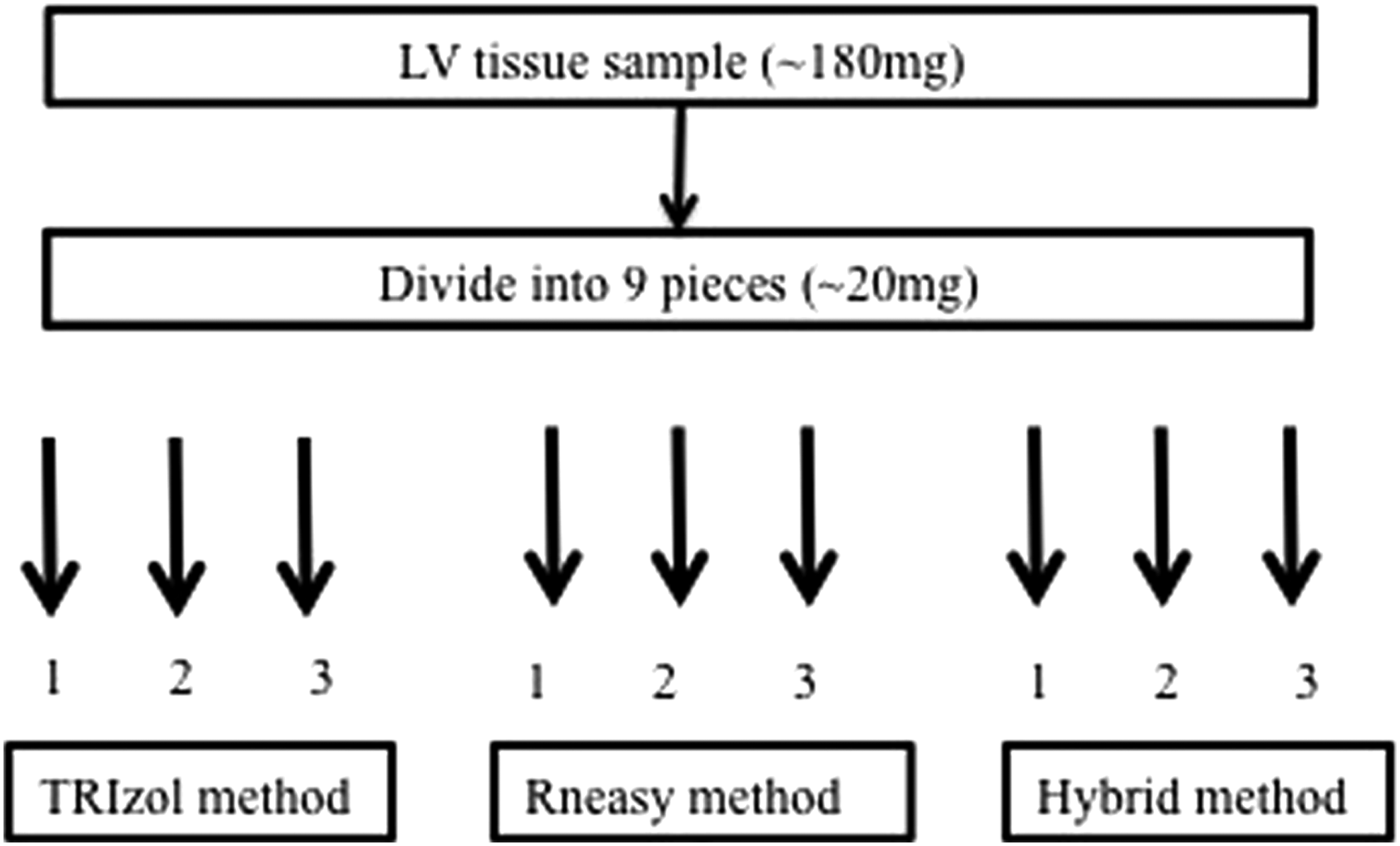
Tissue processing. Frozen left ventricular (LV) tissue from each heart (control and heart failure groups) was divided into nine pieces. Three pieces were treated with a specific RNA extraction method in triplicate.
Total RNA extraction by guanidine isothiocyanate (GTC) method (TRIzol)
LV and control tissues were homogenized in 80 μL TRIzol per mg tissue, according to the manufacturer's instructions. After incubation at room temperature for 5 min, 0.2 mL of chloroform per 1 mL TRIzol was added to the lysate and vortexed for 15 sec. Following centrifugation, the aqueous phase was transferred to nuclease-free tubes. Isopropyl alcohol (0.5 mL per 1 mL initial TRIzol) was added to the supernatant. The RNA precipitate was washed twice with 75% ethanol and centrifuged at 7500 g for 5 min at 4°C. After removing the ethanol and air-drying the RNA pellet, 30 μL RNase-free water was added to rehydrate the pellet. Samples were quantified, aliquoted, and stored at −80°C until further analysis.
Total RNA extraction by silica-gel column method (RNeasy)
LV and control tissues were homogenized in 350 μL Buffer RLT with β-mercaptoethanol (β-ME; 10 μL per 1 mL Buffer RLT). The lysate was transferred to 2 mL tubes and processed automatically by QIAcube®, according to the manufacturer's instructions for RNeasy Mini Kit for Animal Cells and Tissues. 6 The RNA product was eluted in a total volume of 30 μL of RNase-free water. Samples were quantified, aliquoted, and stored at −80°C until further analysis.
Total RNA extraction by hybrid method (TRIzol/RNeasy)
LV and control tissues were homogenized in TRIzol (80 μL per mg tissue), according to the manufacturer's instructions. After incubation at room temperature, 0.2 mL of chloroform per 1 ml TRIzol was added to the lysate. Following centrifugation, the aqueous phase was transferred to nuclease-free tubes and then processed automatically by QIAcube®, according to the manufacturer's instructions for the RNeasy Mini Kit. The RNA product was eluted in a total volume of 30 μL of RNase-free water.
Total RNA quantity and purity assessment
The total RNA concentration and purity were determined in duplicate by spectrophotometry on the basis of OD at 260 and 280 nm with a nominal 0.5 mm path length using the Epoch Microplate Spectrophotometer (BioTek, Winooski, VT). An OD260/280 ration close to 2.0 indicates higher purity DNA. The total RNA was determined based on RNA concentration and final elution volume. RNA yield (μg per milligram of starting LV tissue per sample) was calculated by dividing the total RNA by the mass of the LV tissue used for homogenization.
Total RNA integrity assessment by electropherogram
RNA integrity was determined in triplicate by measuring the 28S/18S rRNA ratio using the Experion Automated Electrophoresis System (Bio-Rad Laboratories). The 28S/18S ratio was automatically calculated based on the area of the peaks corresponding to the rRNAs. A rRNA ratio close to 2 was considered intact RNA. RQI was generated using an Experion software algorithm, which takes into account the entire electrophoretic trace. 9 All electropherogram profiles were visually inspected.
Synthesis of cDNA
First-strand, complementary DNA (cDNA) was synthesized using 0.5 μg RNA in a total reaction volume of 20 μL according to manufacturer's instructions for iScript Reverse Transcription Supermix for RT-qPCR (#170-8840, Bio-Rad Laboratories). The reaction mixture was incubated at 25°C for 5 min, at 42°C for 30 min, and at 85°C for 5 min on a PTC-100 Thermal Cycler (Bio-Rad Laboratories).
Quantitative real-time RT-PCR
Quantitative real-time RT-PCR was performed using Taqman gene expression assays with inventoried probes (Applied Biosystems, Foster City, CA) for cardiac myosin binding protein-C (MYBPC-3; assay Hs00165232_m1; 4217 bp), β-myosin heavy chain (MHC7; assay Hs01110632_m1; 6044 bp), and glyceraldehyde 3-phosphate dehydrogenase (GAPDH; 4310884E; 1310 bp). The 20 μL reaction mixture, including 1 μL of cDNA products (∼25 ng/μL), was prepared in triplicate. All assays were performed in the CFX Connect Real-Time PCR Detection System (Bio-Rad). The Cq value is used to compare differences quantitatively in starting transcripts, with a difference of one cycle reflecting a two-fold difference in starting transcript level.
Statistical analysis
Statistical analysis was performed by independent-sample t-test (one-tailed distribution, unequal standard deviation, p value <0.05). Outliers using inter-quartile range (IQR) criteria were removed before testing. For quantitative Real-Time RT-PCR, the mean quantification cycle (Cq) values for target genes (MYBPC-3 and MHC7) and the reference gene (GAPDH) were compared by RNA extraction methods in HF and control groups.
Results
TRIzol RNA extraction method resulted in higher total RNA yield
Total RNA yield was evaluated by absorbance at 260 nm using spectrophotometry. The three RNA extraction methods were compared in terms of total RNA yield (μg per milligram of tissue). Among all individual RNA samples, the TRIzol method gave the highest RNA yield at 83 μg of RNA per mg of tissue, and the RNeasy method gave the lowest RNA yield at 50 μg of RNA per mg of tissue. For the control group, the use of TRIzol produced a significantly greater RNA yield compared to both the RNeasy (p-value=0.0003) and hybrid methods (p-value=0.0057). The RNeasy method produced a significantly lower RNA yield compared to the hybrid method (p-value=0.0072). The same general pattern was observed in the HF group, where the TRIzol method produced a significantly greater RNA yield compared to both the RNeasy (p-value=0.0004) and hybrid methods (p-value=0.0067). Results are summarized in Tables 2 and 3 and Figure 2.
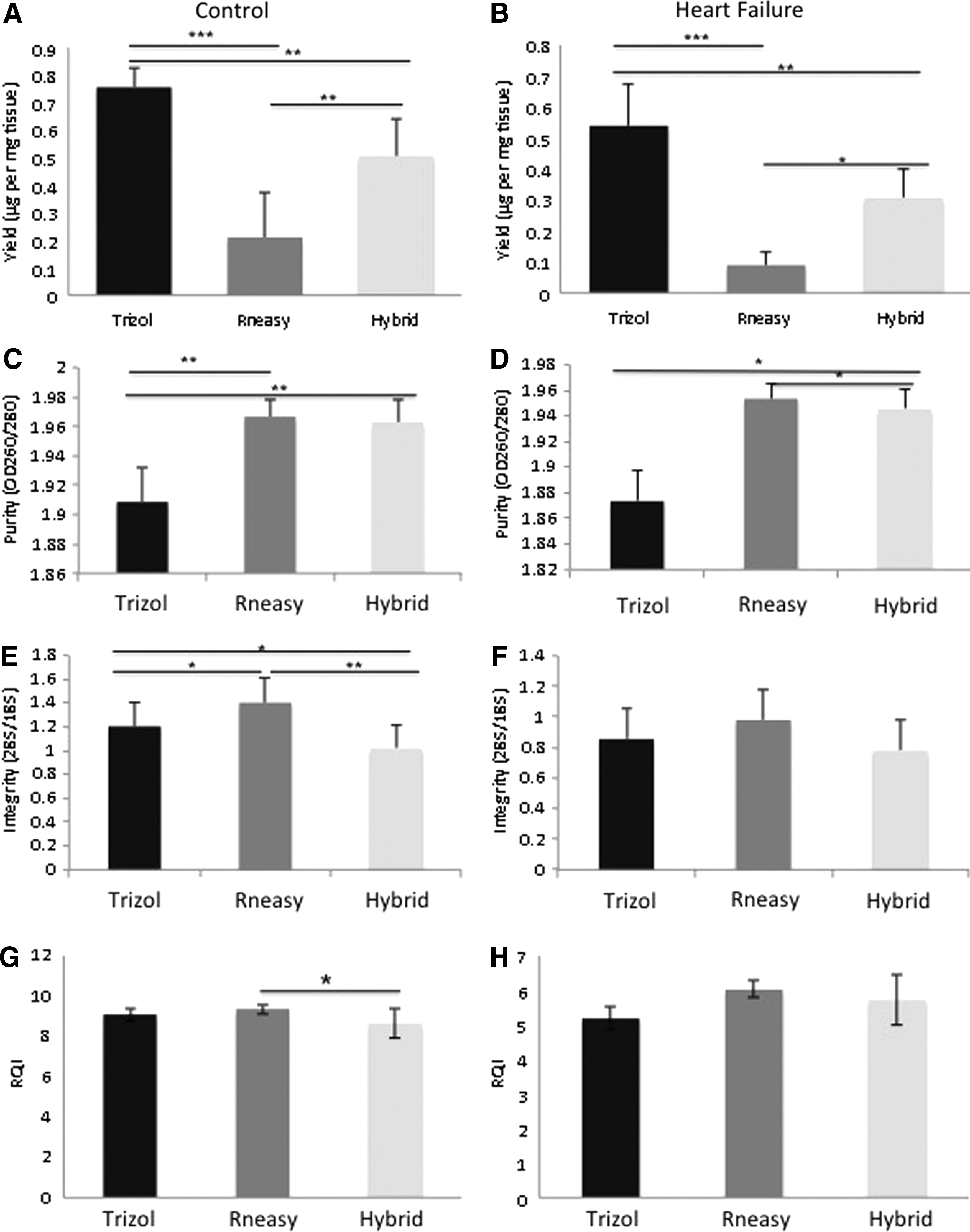
Comparison of RNA yield, purity, integrity, and RQI for myocardial tissue using three extraction methods.
RNeasy RNA extraction method resulted in higher RNA purity
RNA purity was measured as the ratio of OD 260 nm to 280 nm. The maximum and minimum OD 260/280 ratios observed in an individual sample in the control group was 1.98 using RNeasy and 1.87 using TRIzol, respectively. In the HF group, the same pattern was observed: the maximum OD 260/280 ratio was 1.98 for RNeasy, and the minimum OD 260/280 ratio was 1.79 for TRIzol. For the control group, the RNeasy and hybrid methods produced significantly higher OD 260/280 ratios (closer to 2.0) compared to TRIzol (p-values=0.0015, 0.0018, respectively). For the HF group, the RNeasy and hybrid methods produced significantly higher OD 260/280 ratios when compared to that of TRIzol (p-values=0.01, 0.01, respectively). Results are summarized in Tables 2 and 3 and Figure 2.
RNeasy RNA extraction method resulted in higher RNA integrity
In the control group, the maximum 28S/18S ratio was 1.61 for RNeasy, whereas the minimum value was 0.77 for the hybrid method. In the HF group, the maximum 28S/18S ratio was 1.57 and the minimum 28S/18S ratio was 0.07 for RNeasy. In the control group, RNeasy produced RNA with a significantly higher 28S/18S ratio in comparison with the TRIzol (p-value=0.033) or hybrid methods (p-value=0.0027). The hybrid method produced RNA with a significantly lower 28S/18S ratio in comparison with the RNeasy (p-value=0.0027) or TRIzol (p-value=0.039) methods. In the HF group, there was no statistical difference between the 28S/18S ratios resulting from the different RNA extraction techniques. Results are summarized in Tables 2 and 3 and Figure 2.
TRIzol extraction method preserves low molecular weight RNAs
Electrophoretic profiles for all 90 RNA samples (five control and five HF tissue samples, and nine reactions) were analyzed (Fig. 1). Three representative electropherograms are shown in Figure 3. Overall assessment of the gels showed that RNA preparations obtained using the TRIzol method uniquely preserve low molecular weight RNA transcripts (∼100 bps). The signal in the 100 bp region corresponds to 5S rRNA.

Comparison of representative RNA samples from control hearts using three extraction methods.
RNeasy RNA extraction method resulted in higher RNA integrity measured by RQI
In the control group, the minimum RQI was 7.53 obtained using the hybrid method, whereas the maximum RQI was 9.63 obtained using the RNeasy method. In the HF group, the minimum RQI was 2.03 for the TRIzol method, whereas the maximum RQI was 9.25 obtained using the RNeasy method. In both the control and HF groups, RNA samples with the maximum RQI per individual sample were products of the RNeasy method. The mean RQI value of five heart tissue samples was compared to determine if a difference in integrity arose from the extraction method used. For the control group, RNeasy produced RNA with a significantly higher RQI on average when compared to the hybrid method (p-value=0.047). There was no statistically significant difference between methods in the HF group. Results are summarized in Tables 2 and 3 and Figure 2.
RNA quality and quantification cycles
RNA integrity was evaluated based on quality parameters derived from real-time RT-PCR (Fig. 4, Supplementary Table S1; supplementary material is available in the online article at www.liebertonline.com/bio). Using TaqMan real-time RT-PCR, we tested the ability to detect transcripts of reference (GAPDH) and target genes (MYBPC-3 and MHC7) in each of the RNA preparations. All transcripts could be detected in 25 ng of RNA. There was a 1- to 2-cycle difference between transcripts isolated by different methods. Specifically, the Cq values of the reference gene transcripts were significantly smaller when TRIzol was used. However, the Cq values of the target gene transcripts were significantly smaller with the RNeasy method than with the hybrid method. The Cq values of GADPH cDNA transcripts were significantly lower with the TRIzol method compared to RNeasy but there was no difference in the Cq values in the target gene transcripts (Fig. 4, Table 4).
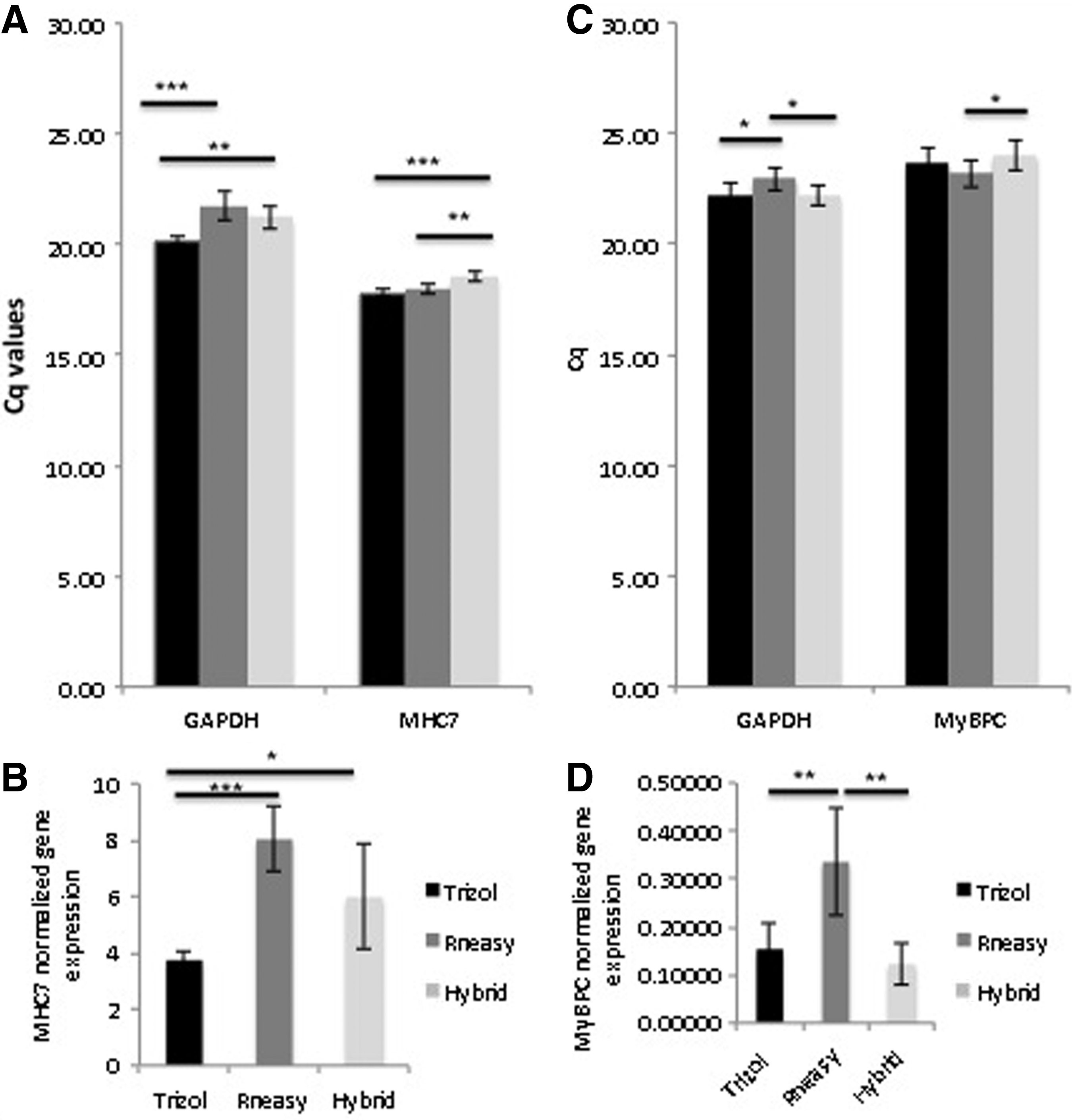
Comparison of real-time RT-PCR parameters for target genes MHC7 and MYBPC-3 using three RNA extraction methods.
Impact of RNA integrity on single gene expression
In principle, normalized reference gene expression levels should be similar, displaying low variation across all samples. We used relative transcript quantification by comparing the Cq values of the two target genes to the Cq value of the reference gene. In the control group, the normalized expression for both target gene transcripts (MHC7 and MYBPC-3) isolated with RNeasy was significantly greater than when TRIzol was used. The normalized gene expression level of MHC7 obtained using the hybrid method was significantly higher when compared to use of the TRIzol method, and that of MYBPC-3 was significantly higher compared to the RNeasy method. In the HF group, no statistically significant differences were identified, but the same general patterns were observed with greater transcripts from the RNeasy method (Fig. 4, Table 4).
Discussion
High-quality RNA samples are the basis for reliable gene expression results. The objective of the current study was to compare three different RNA extraction techniques using heart tissue, and then to compare healthy and diseased myocardium. Our finding that the total recovery of RNA was higher with TRIzol in cardiac muscle is consistent with previous studies using other types of tissues.10,11 Importantly, diseased heart tissue demonstrated similar indices of RNA quality when compared to healthy heart tissue, suggesting that disease processes do not adversely affect the RNA assays. Our results show that RNA product is obtainable and unchanged in quality in the context of disease, providing confidence for investigators examining mechanisms of heart failure. One explanation for the difference in RNA yield between extraction methods is the possibility that RNA may get clogged with tissue lysate using silica-gel membranes. The phenol–chloroform-based method tends to concentrate RNA in the ethanol precipitation steps, resulting in increased total recovery. The highest RNA purity measured by OD 260/280 ratio was obtained with the RNeasy method, consistent with previous studies examining sputum and lung.10,11 The overall measure of RNA quality was the highest with the RNeasy method. Visual assessment of electropherograms showed that low molecular weight RNA transcripts are uniquely preserved using the TrRIzol method. Our evaluation of RNA integrity using an electropherogram showed that the RNeasy method produced higher RNA integrity in human myocardial tissue than the other methods tested, which confirms the more subjective findings obtained using manual gel analysis showing 18 S and 28 S bands. 11 Importantly, this approach potentially advances a more exact measure of RNA product, an important consideration for complete expression analysis and optimal quality assurance.
RNA transcripts are present at a wide range of concentrations within cells. Using TaqMan real-time RT-PCR assays, we determined the ability to detect high (GAPDH) and low (MYBPC-3 and MHC7) abundance transcripts using each of the RNA extraction methods. Assessment of the Cq values of the gene transcripts was conducted to determine how many cycles of amplification would be needed to yield a positive result. We anticipated that more intact cDNA would reach the set fluorescence threshold with fewer cycles. We found that target gene transcripts (MYBPC-3 and MHC7) showed significantly higher Cq values for RNA obtained from the hybrid method, consistent with our RQI assessment. The Cq values of the target transcripts were significantly smaller when using the RNeasy method than when using the hybrid method. We also found that cDNA transcripts from GADPH using the TRIzol method reached the threshold with significantly lower Cq values than when the RNeasy method was used (Fig. 3, Supplementary Table S1), consistent with previous findings. 10
The mean normalized expression of target gene transcripts estimated based on RT-PCR measurements was greater for control samples obtained by the RNeasy method when compared to the TRIzol method, possibly because RNA transcripts greater than 2000 bp are better preserved by RNeasy, as shown in the electrophoretic tracings (Fig. 3). Since the target transcripts MYBPC-3 and MHC7 were 4217 bp and 6044 bp, respectively, the RNeasy method could have preserved more RNA copies of those genes. The standard deviation around the average value of normalized expression for the TRIzol method is smaller than that compared to the RNeasy method (Supplementary Table S1), suggesting that performing RT-PCR on RNA samples obtained by TRIzol produces more precise results (smaller standard deviation). Additionally, RNeasy may result in a more accurate measurement of normalized expression on the basis that it preserves relatively larger copies of RNA transcripts, those with >2000 bp.
We analyzed the effects of different RNA extraction methods on gene expression studies based on relative quantitation. In principle, normalized gene expression levels should be similar in all samples within a group, displaying a low variation across samples. However, in this study we found that there were significant differences in gene expression levels resulting directly from the type of RNA extraction method used. Specifically, gene expression levels of the two target genes used were significantly lower with TRIzol than with RNeasy only in the control group. However, in this study we found that there were significant differences in gene expression levels only in the control group resulting directly from the type of RNA extraction method used. Specifically, gene expression levels of the two target genes used were significantly lower with TRIzol than with RNeasy. In the HF group, the absence of a significant difference in gene expression between RNA extraction methods may be explained by relatively lower RNA concentration and poorer RNA integrity, despite similar RNA quality. The difference in RNA quality arising from the choice of extraction method may not pose a significant problem for researchers who exclusively use PCR amplification. However, for researchers who use RNA-based assays, as well as those who direct biobanks, identification and replication of pure RNA products is crucial. Further, the exact evaluation of RNA products may be important for complete expression analysis and optimal quality assurance, consistent with best practices.3,12 The significance of optimal expression analysis impacts both investigator initiated and core service quality assurance, and ultimately the accuracy and validity of patient oriented translational research efforts.
Footnotes
Author Disclosure Statement
The authors have no disclosures of financial interests to report.
References
Supplementary Material
Please find the following supplemental material available below.
For Open Access articles published under a Creative Commons License, all supplemental material carries the same license as the article it is associated with.
For non-Open Access articles published, all supplemental material carries a non-exclusive license, and permission requests for re-use of supplemental material or any part of supplemental material shall be sent directly to the copyright owner as specified in the copyright notice associated with the article.
