




Abstract
The present study evaluated the maintenance of Sporothrix spp. (6 Sporothrix brasiliensis; 6 S. schenckii; 5 S. mexicana, and 3 S. globosa) in saline at 4°C, and in 10% glycerol plus either 10% lactose or 10% sucrose, at −20°C and −80°C. Viability was assessed after 3, 6, and 9 months of storage, through the recovery of strains on potato dextrose agar and analysis of macro- and micromorphological features. Conidium quantification was performed before and after storage, at 3, 6 and 9 months. 100% viability was observed, regardless of storage conditions or time period. Storage at 4°C and at −20°C did not alter the number of conidia, but lower conidium counts were observed at −80°C. This study shows that the combination of glycerol with lactose or sucrose is effective to maintain Sporothrix spp. at freezing temperatures.
Introduction
F
Different studies have demonstrated the continued viability of Sporothrix spp. strains over 13 to 41 years using various preservation techniques, such as storage in sterile distilled water or saline2,6,7 and mineral oil,3,7 and through quarterly sampling in Sabouraud dextrose agar. 2 However, there are few reports on the successful cryopreservation of Sporothrix spp. 8 and none of them evaluate different storage conditions for different periods of time. Cryopreservation has been considered the best and most widely applicable preservation technique for filamentous fungi and thus is the method of choice in many culture collections. However, different fungal species require different cryopreservation protocols. 9 Storage at freezing temperatures has been employed to preserve fungal viability using penetrating cryoprotectants such as glycerol and DMSO,10,11 or nonpenetrating ones, such as glucose and lactose.11–13 However, there are no published reports on the combined use of both classes of cryoprotectants for fungal preservation.
Thus, the present study aimed to evaluate the maintenance of Sporothrix spp. at 4°C, in physiological saline, and at −20° and −80°C, using the penetrating cryoprotectant glycerol associated with the nonpenetrating cryoprotectants lactose or sucrose, for 3, 6, and 9 months.
Material and Methods
Microorganisms
Twenty Sporothrix spp. strains in the filamentous form were used: six Sporothrix brasiliensis (CEMM 05-3-061, CEMM 05-3-053, CEMM 05-3-064, CEMM 05-3-070, CEMM 05-3-071, CEMM 05-3-079), six S. schenckii (CEMM 05-3-048, CEMM 05-3-090, CEMM 05-3-092, CEMM 05-3-095, CEMM 05-3-097, CEMM 05-4-002); five S. mexicana (CEMM 05-3-100, CEMM 05-4-001, CEMM 05-4-007, CEMM 05-4-008, CEMM 05-4-009), and three S. globosa (CEMM 05-4-004, CEMM 05-4-005, CEMM 05-3-006). They were provided by the Laboratory of Medical Molecular Mycology, Federal University of São Paulo (UNIFESP) and stored in the fungal collection of the Specialized Medical Mycology Center (CEMM), School of Medicine, Federal University of Ceará, Brazil.
Storage
For the storage process, Sporothrix spp. strains were grown on potato dextrose agar for 7 days, at 25°–28°C. Fragments (2 cm) of each strain were stored in cryotubes containing different stock solutions, which were chosen based on previous studies:10,12,13 1) 0.9% saline; 2) 10% glycerol (Vetec, Brazil) plus 10% lactose (GL) (Vetec, Brazil); and 3) 10% glycerol plus 10% sucrose (GS) (EEL, Brazil). Disaccharide solutions were prepared with distilled water. Cryotubes containing saline were stored at 4°C, while those containing the cryoprotectants GL and GS were kept at −20°C and −80°C, for periods of 3, 6, and 9 months.12,13
Viability of stored strains and conidium count
At the end of each period, the strains were removed from storage and subcultured on potato dextrose agar medium (Difco, USA). Viability was defined as the ability to grow on potato dextrose agar, after storage, under any of the tested conditions. After 7 days of incubation at 25°–28°C, the recovered isolates were analyzed for their macromorphological and micromorphological characteristics, under optical microscopy, stained with lactophenol cotton blue. 10
At the time of storage and after each storage period, a colony fragment was analyzed by fluorescence microscopy (400X) using calcofluor white to quantify the number of conidia, in 10 different fields.14,15 The results were analyzed using Student's t-test for paired samples; p-values lower than 0.05 indicate statistically significant differences.
Results
All Sporothrix spp. strains analyzed in this study were viable after storage, regardless of the condition and length of storage. Thus, 100% viability was observed for all evaluated species and no contamination was observed in the recovery process. Microscopic analysis showed the same micromorphological characteristics for all recovered strains, independently of species or storage conditions/length. Hyaline, septate, and branched hyphae presenting conidia arranged in terminal clusters at the end of conidiophores (resembling “daisy flowers” characteristic of the genus Sporothrix), were observed in all cases (Fig. 1A). The macroscopic analysis also showed that the recovered strains produced colonies with leathery texture and rough surface, consistent with their morphology before storage (Fig. 1B). Regarding color, three isolates of S. brasiliensis species had pigmented colonies after 6- and 9-month storage at 4°C and at −20°C, in GL and GS (Fig. 1C). The other species exhibited white to beige colonies before and after storage.
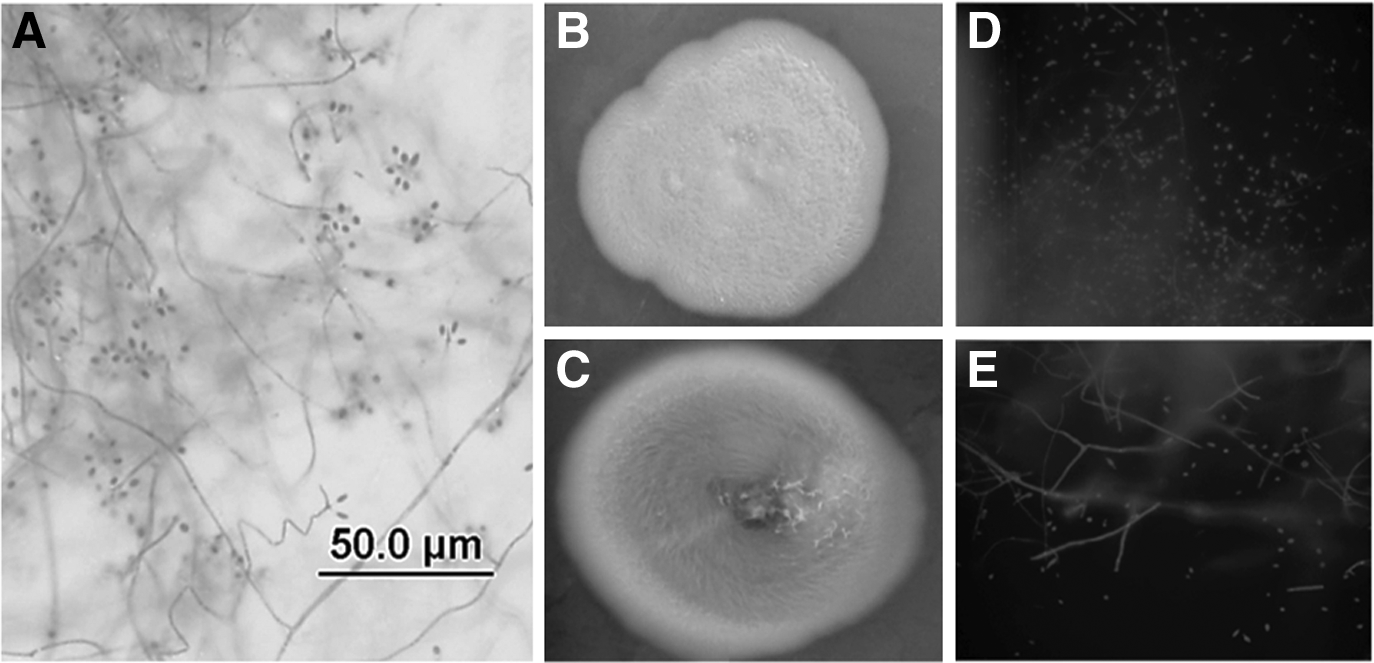
Morphological aspects of S. brasiliensis after storage in GL for 9 months.
Regarding conidium counts, the final result was based on the mean number of conidium of all strains analyzed under the same storage condition and length. The stock in saline at 4°C showed no change in the number of conidia when compared to the previous count. Stocks kept in GL and GS at −20°C exhibited a small reduction in the number of conidia, with no statistically significant differences. Stocks in GL and GS at −80°C showed a decrease in the number of conidia after all analyzed storage periods (Fig. 1D and E), when compared to the pre-storage count. Statistically significant differences (p<0.05) were observed at −80°C for GL and GS after 3 and 6 months, as well as for GL after 9 months (Table 1).
GL, glycerol 10% +lactose 10%; GS, glycerol 10% +sucrose 10%.
indicates statistically significant differences when compared to conidium count prior to storage.
Discussion
Studies in mycology are largely dependent on the isolation and maintenance of pure cultures. The recent description of new species composing the S. schenckii species complex arouses interest in correctly identifying species of Sporothrix maintained in fungal collections. Moreover, there are few reports on the cryopreservation of Sporothrix spp. 8 Thus, the present study assessed the maintenance of four species of the S. schenckii species complex under different storage conditions.
A viability of 100% was observed for all strains stored in saline at 4°C, independent of storage length, as measured by conidium count. A similar result was reported by Mendoza et al., who obtained 100% viability after storage through the Castellani method. 2 As observed in the present study, all analyzed isolates maintained their macro- and micromorphological characteristics. 2 According to previous reports, maintenance of Sporothrix spp. through Castellani's method demonstrated satisfactory fungal viability. However, despite the simplicity of this method, it requires frequent monitoring of fungal colonies to prevent both dehydration due to evaporation of the saline solution and culture contamination with mycophagous mites, which are very common in tropical regions. 16 Additionally, this method is not effective in preventing alterations in the biochemical activity, susceptibility profile, and virulence of Sporothrix spp. strains.3,7,17,18 Therefore, cryopreservation is the currently preferred technique in many culture collections because it decreases cell metabolic activity, allowing the isolates to remain stable for extended periods of time, in addition to preventing colony contamination.9,12
On the other hand, the freezing process can irreversibly damage fungal cells, and hence, different cryoprotectants have been used to reduce cell damage. 9 In this study, the use of glycerol as a penetrating cryoprotectant associated with the nonpenetrating cryoprotectants sucrose or lactose was shown to be a valid alternative for the cryopreservation of the S. schenckii species complex, resulting in 100% recovery, even after 9 months of storage, at both −20° to −80°C. Furthermore, it is important to emphasize that the macro- and micromorphological characteristics of the Sporothrix spp. strains were also preserved, indicating that these cryoprotectants can be used to maintain collections of these fungal species.
Regarding the conidium count, colonies kept at 4°C and at −20°C showed no change in the number of conidia when compared to pre-storage counts. However, cryopreservation at −80°C, while not affecting fungal viability, caused a significant reduction in the number of conidia. This finding may be associated with the destruction of conidia caused by lower temperatures. Thus, stocks in saline at 4°C, or in penetrating and nonpenetrating cryoprotectants at −20°C, were more effective in maintaining the integrity of Sporothrix spp. conidia.
This study shows that the combination of glycerol and lactose or sucrose is effective to maintain strains of the Sporothrix schenckii species complex at freezing temperatures. Further studies may show whether these methods are able to stably maintain the genetic, physiological and virulence characteristics of each strain.
Footnotes
Acknowledgments
We thank the research grants from National Scientific and Technological Research Council; Brazil (CNPq; PROTAX 562296/2010-7; 304779/2011-3; 504189/2012-3).
Author Disclosure Statement
No conflicting financial interests exist.