




Abstract
Purpose:
A novel frozen sample aliquotter, which consists of a drilling system in which a coring probe extracts multiple frozen cores from one frozen sample, was developed to avoid thawing and refreezing of samples. The aliquotter was tested to determine if it is suitable for metabolomics analyses in reproducibility and variability studies.
Method:
Twenty volunteers (10 males and 10 females) were enrolled in this study. Each of the volunteers' serum was aliquotted to one 1.8 mL tube and one 150 μL tube (control). Then the serum was frozen at −80°C for 2 weeks. Four frozen cores were taken from the perimeter of each of the 1.8 mL parent tubes by the aliquotter. The cores, the frozen serum remaining in the parent samples after extracting four frozen cores (Remainder), and control were analyzed using a gas chromatography time-of-flight mass spectrometry platform to test the reproducibility and variability of the samples in metabolomics analyses.
Result:
There were no significant differences between the Core, Remainder, and Control groups based on multivariate analysis of metabolomics analyses. In the reproducibility study, the average CV for the cores was 10.07%. In the variability study, the average changes ranged from 81.07% to 119.82% and 81.06% to 119.74% for Core and Remainder samples compared to Control, respectively.
Conclusion:
The frozen sample aliquotter technology can extract multiple consistently homogenous aliquots without thawing the parent sample, and the coring process with serum produces good samples for metabolomics analyses.
Introduction
S
Long-term (−80°C) storage of up to 2.5 years has been found to have almost negligible effects for samples analyzed by metabolomics platforms. 2 However, serum metabolite concentrations were only unaffected by one or two freeze-thaw cycles.3,4 Specifically, up to 37% variability in HDL and LDL cholesterol could result from a single freeze-thaw cycle. 5 Thus, limiting freeze/thaw cycles is critical to maintaining serum metabolomics research quality, in terms of maintenance of peak numbers and intensity. Best Practices from the International Society for Biological and Environmental Repositories (ISBER) recommends selecting aliquot sizes that are appropriate for the intended uses for the specimens, in order to minimize the number of times that a sample is thawed and refrozen before it is used, and to limit the potential of freeze/thaw cycles occurring when samples are introduced or removed from storage. 6 A frozen sample aliquotter provides an opportunity to aliquot samples without the freeze/thaw process. A novel frozen sample aliquotter consisting of a drilling system in which a coring probe extracts multiple frozen cores from one frozen sample was developed by CryoXtract instruments, LLC (Melrose, MA). Notably, the working environment was cooled by liquid nitrogen. After frozen cores are extracted, the remainder of the parent sample can be returned to the freezer without any freeze/thaw process. The technology has been evaluated by quantifying four biochemical biomarkers. 7 In this study, the aliquotter was tested to determine if it is suitable for metabolomics analysis, using a gas chromatography time-of-flight mass spectrometry (GC-TOFMS) platform in reproducibility and variability studies. The aim of this study was to test if the frozen cores extracted from a frozen sample are the same as the parent sample and if the core, the remainder, and sample not undergoing the coring process (control) are of exactly the same quality.
Materials and Methods
Study design and subjects
Twenty volunteers (10 males and 10 females), all residents of the city of Shanghai, China, were enrolled in this study. Standardized examinations and tests applied to the study participants are described in Table 1. Each of the volunteers' serum was aliquotted to one 1.8 mL tube (parent tube for coring) and one 150 μL tube (control). The samples were then frozen at −80°C for 2 weeks. Four frozen cores were taken from the perimeter of each of the parent tubes. For each of the 20 volunteers, a core was extracted from the frozen sample using the Frozen Sample Aliquotter (Core). The frozen serum remaining in the parent samples after extracting four frozen cores (Remainder) and the conventionally-pipetted serum aliquots (Control) were prepared before the metabolomics analysis, in order to perform the variability study. Six subjects (3 males and 3 females) serum samples were selected for the reproducibility study, and all of the four cores were prepared to perform the metabolomics study afterwards. Also 20 μL serum from each core, remainder, and control were pooled together as quality controls (QC), since this pooled sample contained all the metabolites, and could be used to adjust the data later.
BMI, body mass index; DP, diastolic pressure; SP, systolic pressure.
This study was approved by the Institutional Review Board of Shanghai Jiao Tong University Affiliated Sixth People's Hospital, in accordance with the principles of the Helsinki Declaration. Written informed consent was obtained from each participant.
Chemicals
Leucine-enkephalin, formic acid, chloroform, pyridine, anhydrous sodium sulfate, BSTFA (1% TMCS), heptadecanoic acid, methoxyamine, and L-2-chlorophenylalanine were purchased from Sigma-Aldrich (St. Louis, MO). HPLC grade methanol and acetonitrile were obtained from Merck Chemicals (Darmstadt, Germany). All aqueous solutions were prepared with ultrapure water produced by a Milli-Q system (18.2 MΩ, Millipore, Bedford, MA).
Sample preparation and analysis by GC-TOFMS
Samples were derivatized and subsequently analyzed by GC-TOFMS following our previously published protocols with minor modifications. 8 Briefly, a 100 μL aliquot of serum sample was spiked with two internal standard solutions (10 μL of L-2-chlorophenylalanine in water, 0.3 mg/mL; 10 μL of heptadecanoic acid in methanol, 1 mg/mL) and vortexed for 10 sec. The extraction was conducted with 300 μL of methanol/ chloroform (3:1). After vortexing for 30 sec and storing for 10 min at −20°C, the samples were centrifuged at 10,000 rpm for 10 minutes. An aliquot of the 300 μL supernatant was transferred to a glass sampling vial to vacuum-dry at room temperature.
The dried analytes were dissolved in 80 μL of methoxyamine (15 mg/mL in pyridine) and kept for 90 min at 30°C and then silylated with 80 μL of BSTFA (1%TMCS) at 70°C for 60 min. Each 1 μL aliquot of the derivatized solution was injected into an Agilent 6890N gas chromatograph coupled with a Pegasus HT time-of-flight mass spectrometer (Leco Corporation, St. Joseph, MI) in the splitless mode. A DB-5 ms capillary column (30 m×250 μm i.d., 0.25-μm film thickness; Agilent J&W Scientific, Folsom, CA) was used for separation. Helium was used as the carrier gas at a constant flow rate of 1.0 mL/min. The temperature of injection, transfer interface, and ion source was set to 270, 260, and 200°C, respectively. The GC oven temperature was started at 80°C for 2 min, then raised to 180°C with a rate of 10°C/min, followed by 5°C/ min to 240°C, and 25°C/min to 290°C and maintained at 290°C for 9 min. The measurements were made with electron impact ionization (70 eV) in the full scan mode (m/z 30-600).
Each 1 μL aliquot of the derivatized solution was injected in splitless mode into an Agilent 6890N GC coupled with a Pegasus HT TOFMS (Leco Corporation, St Joseph, USA). The samples were run in the order of core-remainder-control, alternately, to minimize systematic analytical deviations. QC samples were run in the interval of every 10 samples. Separation was achieved on a DB-5MS capillary column (30 m×250 μm I.D., 0.25-μm film thickness; (5%-phenyl)-methylpolysiloxane bonded and cross-linked; Agilent J&W Scientific, Folsom, CA, USA) with helium as the carrier gas at a constant flow rate of 1.0 mL/min. The temperature of injection, transfer interface, and ion source was set to 270°C, 270°C, and 220°C, respectively. The GC temperature programming was set to 2 min isothermal heating at 80°C, followed by 10°C/min oven temperature ramps to 180°C, 6°C/min to 230°C, and 40°C/min to 295°C, and a final 8 min maintenance at 295°C. Electron impact ionization (70 eV) at full scan mode (m/z 30-600) was used, with an acquisition rate of 20 spectrum/second in the TOFMS setting.
Data analysis
The acquired MS data from GC-TOFMS were analyzed by ChromaTOF software (v 4.34, LECO, USA). After alignment with the Statistic Compare component, the CSV file was obtained with three-dimensional data sets including sample information, peak retention time, and peak intensities. Internal standards and any known pseudo positive peaks, such as peaks caused by noise, column bleed, and the BSTFA derivatization procedure, were removed from the data set.
Metabolites were identified by comparing the mass fragments with NIST 05 Standard mass spectral databases in NIST MS search 2.0 (National Institute of Standards and Technology, NIST, Gaithersburg, MD, USA) software with a similarity of more than 70%, and then verified manually by available reference standards in our lab.
The identified metabolites were analyzed and validated by multivariate statistical methods. Principal component analysis (PCA) and orthogonal partial least squares-discriminant analysis (OPLS-DA) were carried out (SIMCA-P 12.0, Umetrics, Umeå, Sweden) to visualize the variations among the serum samples from different groups. 9
Results
Characteristics of the volunteers
Twenty unique volunteers (10 males and 10 females) participated in this study. The mean age was 50.85±10.48 (SD) years and mean BMI was 23.62±3.93 (SD) kg/m2. The average systolic pressure and diastolic pressure was 128.20±19.48 (SD) mmHg and 80.85±12.47 (SD) mmHg, respectively (Table 1).
Metabolic profile of GC-TOFMS analysis
A wide range of carbohydrates, amino acids, organic acids, and alcohols were detected using GC-TOFMS analysis. Among a total of 388 chromatographic features obtained from the GC-TOFMS spectra of serum samples, 140 metabolites were identified with NIST 05 standard mass spectral databases, with a similarity >70% and 90 were further verified by available reference standards. From our QC results, the average Coefficients of Variation (CV) of the 90 metabolites ranged from 6.5%–18.9% and the average CV for the entire profile was 12.0%. Figure 1 illustrates the scores plots of PCA models of the subjects from the Core, Remainder, and Control groups. There were no separation trends between either the Core and Control group (R2X=0.726) or the Remainder and Control group (R2X=0.603). The OPLS-DA models cannot be created automatically, and the Q2 (cum)=0.129 for Core and Control group and 0.0975 for Remainder and Control group, respectively, if forced to model with 1 predictive component and 2 orthogonal components. These results show there are no significant differences between the Core, Remainder, and Control groups based on multivariate analysis.
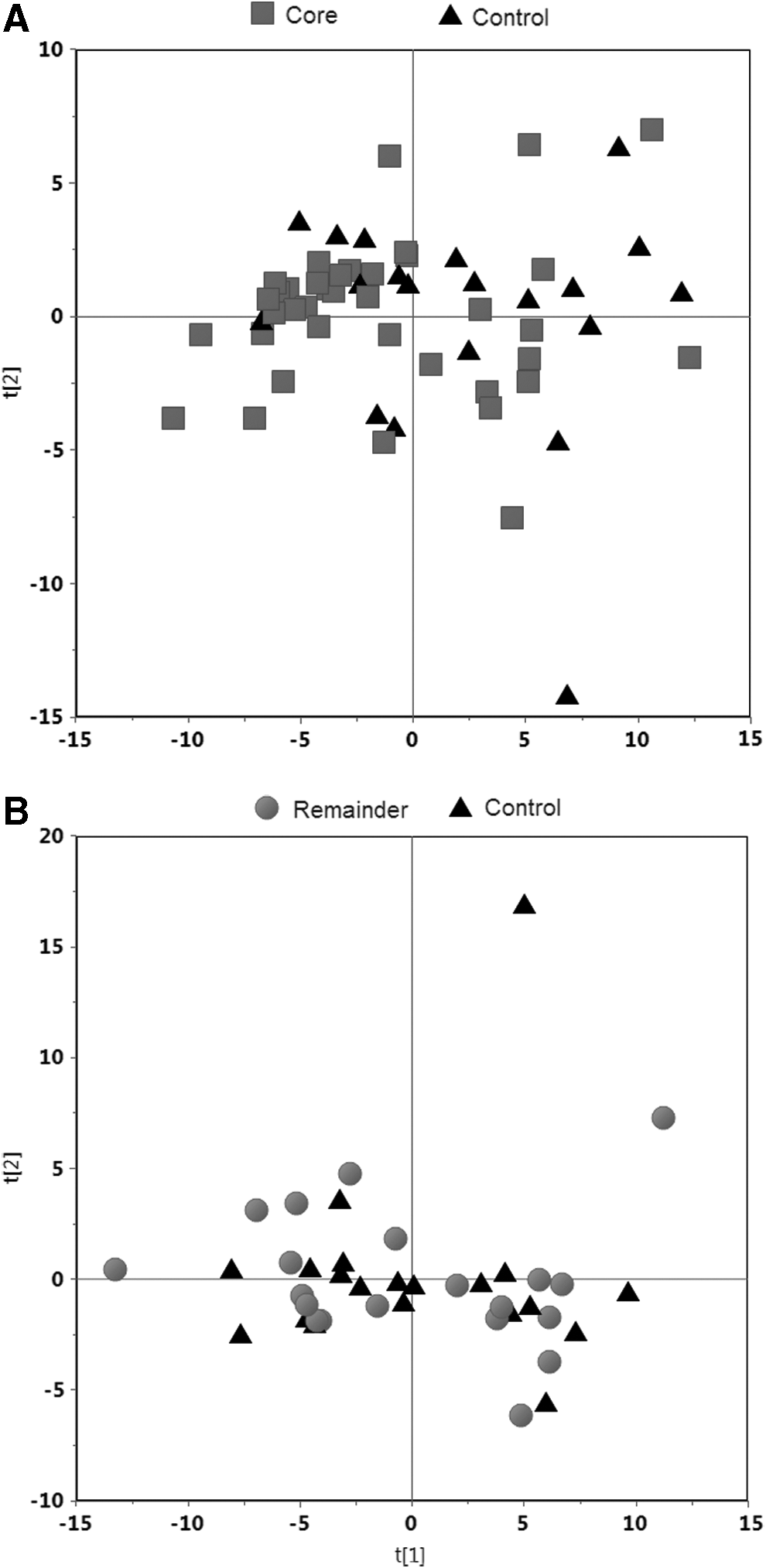
Metabolic profiles depicted by PCA scores plot of GC-TOFMS data from human serum of
Reproducibility study
Four cores of serum each from donors 2, 4, 5, 6, 7, and 16 were measured and analyzed. For the 90 metabolites, the average CV ranged from 3.11% to 17.39% and the average CV for the cores was 10.07%. Representative metabolites from carbohydrates, amino acids, organic acids, and alcohols were selected as shown in Table 2. The results show that the amino acids perform best with a CV lower than 10%, followed by organic acids and alcohols with CVs around 10%, and then carbohydrates with CVs higher than 10%. The results are not surprising, since GC-TOFMS is better for detecting amino acids than carbohydrates.
Representative metabolites from carbohydrates, amino acids, organic acids, and alcohols were selected as shown in this table.
Variability study
The comparison of Core results to Control results, Remainder results to Control results, and Core results to Remainder results are shown in Table 3 for the variability study. The average changes ranged from 81.07% to 119.82% and 81.06% to 119.74% for Core and Remainder compared to Control, respectively. Across all donors, the average concentration of all the 90 metabolites was 1.61% higher in the Cores and 2.83% higher in the Remainder as compared to the Control.
The average ratios of 20 donors are shown. Representative metabolites from carbohydrates, amino acids, organic acids, and alcohols were selected as shown in this table.
Discussion
In this study we evaluated the reproducibility and variability of frozen samples which were sampled using a frozen sample aliquotter, by metabolomics analysis using the GC-TOFMS platform.
The multivariate analysis concluded that there was no significant difference between the Core, the Remainder, and the Control. The reproducibility study showed the four frozen cores extracted with the Frozen Sample Aliquotter were essentially in agreement with each other. The average CV for the cores was 10.07%, which was acceptable when compared to the CV of the QC samples (12.0%). Amino acids out-performed organic acids, alcohols, and carbohydrates, which is not surprising, since amino acids have good peak intensity, and retention time is thus easy to identify on the GC-TOFMS platform. The variability study showed agreement among the Core, Remainder, and Control groups. The average ratio change between the Cores compared to Controls (+1.61%) and the Remainders compared to Controls (+2.83%) can be ignored as compared to the CV of the QC (12.0%). This was most important, as it demonstrated that the metabolites in the parent samples were not affected by the coring process, and the parent sample is adequate in terms of metabolite concentrations. The Remainders, which comprise the majority of the samples, can be safely preserved at −80°C for later use.
In summary, the frozen sample aliquotter technology can extract multiple consistently homogenous aliquots without thawing the parent sample, and the coring process with serum produces samples which are of good quality for metabolomics analysis. This technology may be very useful for biobanks, for it not only can aliquot valuable samples without a freeze-thaw cycle, but can also save a significant amount of space, as it allows for aliquoting samples just before they are used rather than when they initially go into storage in biobanks.
Footnotes
Acknowledgments

Author Disclosure Statement
No competing financial interests exist. This work was supported by the Drug Innovation Program of the National Science and Technology Project (2015ZX09307001-002), Shanghai Science and Technology funds (12DZ2295004), National Natural Science Foundation of China (81170760).