




Abstract
Due to the requirement for comprehensive clinical research efforts in China, the importance of biobanking in modern clinical research is outlined in this overview. Hospitals, universities, and research institutes have been well organized as fundamental resources for Chinese biobanking initiatives and the resulting bio-sample collections. Here, a brief history and time line of development of biobanking in China will be introduced, as well as strategic designs for future biobanking development.
Introduction
A
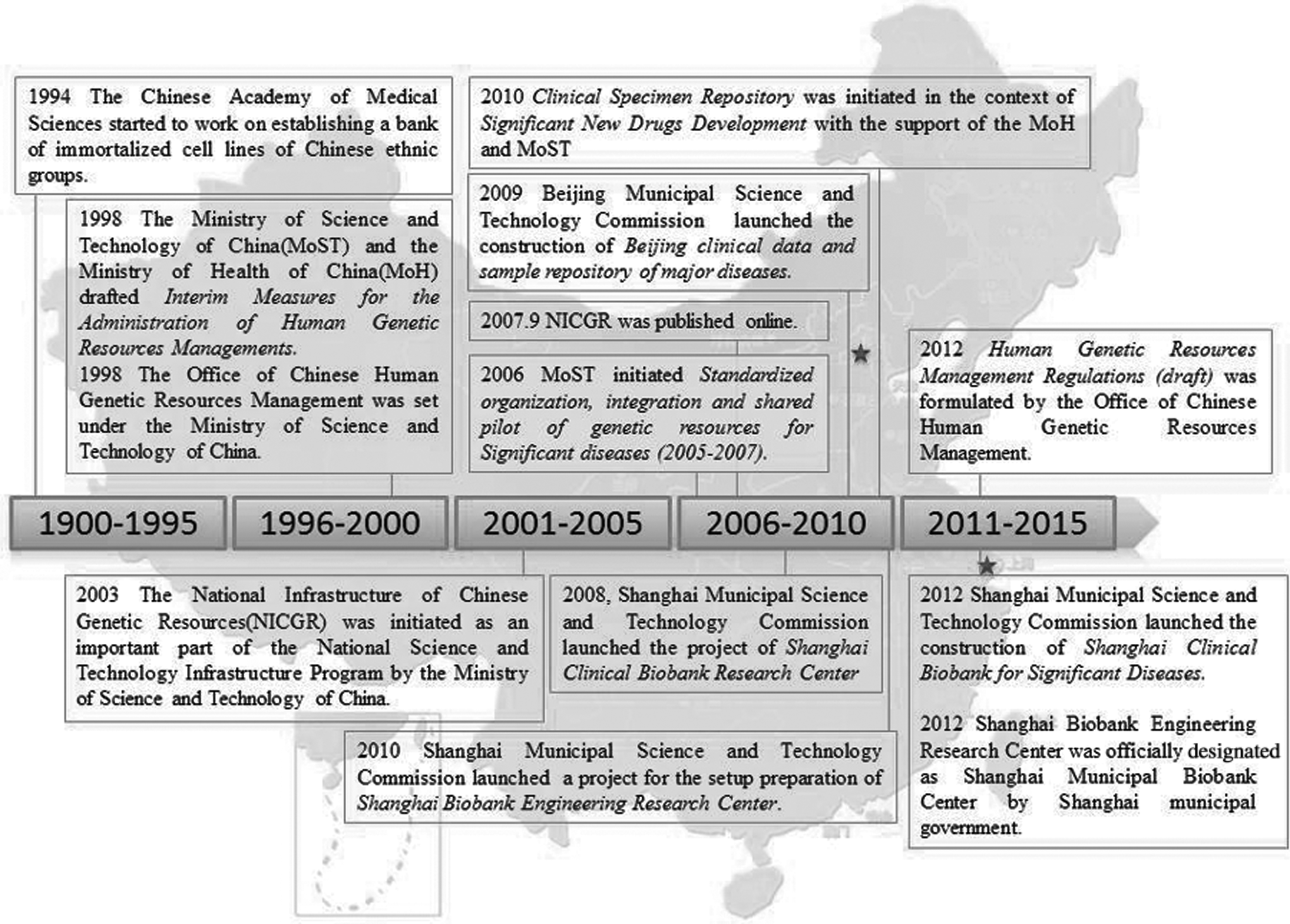
Timeline of Chinese biobanking development.
In July 2003, the National Infrastructure of Chinese Genetic Resources (NICGR) was initiated as an important component of the National Science and Technology Infrastructure Program by the MoST, and the resource was open for access through the internet in September 2007. Similarly, the MoST initiated another project called Standardized Organization, Integration and Shared Pilot of Genetic Resources for Significant Diseases (2005–2007), aiming to integrate genetic resources of selected diseases. Importantly, the sharing mechanism was also considered as a crucial aspect for biobanking initiatives within the scope of this project. 4
In line with the Outline of the National Program for Long and Medium-Term Scientific and Technological Development (2006–2020), a major science and technology project on Significant New Drugs Development was launched. 5 In 2010, the project called Clinical Specimen Repository was initiated in the context of Significant New Drugs Development, with the support of the MoH and MoST. 6 Accordingly, MoST published the Mega-projects of Science Research for the 10th Five-Year Plan in 2011, where construction of a large human genetic biobank for biological samples, specimens, patient cases, and a sharing service system became a key goal. Through further development of shared major science and technology infrastructure, China is dedicated to enhancing innovation capability in biotechnology.
Beijing, Shanghai, and Shenzhen are the leading locations for the construction and development of Chinese biobanks, as many biomedical research centers/institutes and clinical facilities are located in these cities. Currently, a wealth of clinical samples are preserved as medical resources and many facilities, such as hospitals and universities, are equipped with the capability for high-quality technologies for sample processing, storage, and utilization. The project of Significant New Drugs Development, as mentioned previously, was led by Beijing Union Medical College Hospital, together with another nine leading research-based hospitals (e.g., Beijing Institute for Cancer Research, the Chinese Academy of Medical Sciences Fu Wai Hospital, and Peking University First Hospital). The biobanking project has focused on sample collections for four disease categories (malignancies, cardiovascular and cerebrovascular diseases, metabolic diseases, and neurodegenerative diseases). In 2009, the Beijing Municipal Science and Technology Commission also launched the construction of the Beijing Biobank of Clinical Resources led by Capital Medical University, Tiantan Hospital, Beijing You An Hospital, and nine other local research hospitals with distributed construction tasks for cardiovascular diseases, AIDS, emerging infectious disease emergencies, diabetes, cancers, and five other disease categories. 7
Biobank construction has also been paid a significant amount of attention by the Shanghai municipal government. In October 2008, the Shanghai Municipal Science and Technology Commission (SMSTC) 8 launched the Shanghai Clinical Biobank project, led by the Shanghai Clinical Research Center (SCRC), together with the Shanghai Chest Hospital, Fudan University Cancer Hospital, Shanghai Children's Medical Center, and Shanghai Chang Zheng Hospital. In May 2010, SMSTC launched another project to commission SCRC for establishment of an engineering center for biobanking, focusing on the common issues in the field. In August 2012, the Shanghai Biobank Engineering Research Center was officially established as the first municipal engineering center for biobanking initiatives. Highlighted by the twelfth 5-year plan of strategic emerging industry development issued by the Shanghai Municipal Government in 2012, 9 biobank and clinical pathological biopositories have become important platforms and major initiatives within the Shanghai biomedicine and medical apparatus and instruments development roadmap. In October 2012, SMSTC launched the construction of the Shanghai Clinical Biobank for Significant Diseases, also called the Shanghai Clinical biobank project, sponsored by Shanghai Shen Kang Hospital Center, and with Shanghai Biobank Engineering Research Center as a third-party service provider to build a shared platform in Shanghai based on the their joint medical project, which covers clinical data and samples from major tertiary hospitals.
To combine the traditional biobank and a big nucleotide and phenotypic database together, the China National Genebank (Shenzhen, Guangdong), known as CNGB, was founded in 2011, as a nonprofit institute approved by the central government of China and operated by BGI-Shenzhen. 10 Through collaborative activities between universities, hospitals, and scientific institutes that share an interest in biobanking, resource utilization, and bioinformatics, CNGB is committed to developing a biobank consortium across China and the construction of an expanding network worldwide, to provide a platform for information sharing and exchange of biobank materials, -omics data acquisition, and multi-omics scientific research. Working closely with ethical review boards and following the applicable regulations to secure the data, CNGB has set as its principal task integrating the contribution of bioresources data into an -omics database that will support both scientific research and commercial applications, such as translational medicine, breeding, and new energy exploitation.
Aside from clinical biorepositories, in a large cohort study, together with the University of Oxford, the Chinese Academy of Medical Sciences launched a Prospective Study of Chronic Diseases In China (China Kadoorie Biobank). As one of the world's largest prospective cohort studies for large populations, the China Kadoorie Biobank will be in operation for at least 20 years. 11 In addition, Fudan University integrated more than twenty research institutes in China for the core cohort demonstration study of Chinese populations in Taizhou, Jiangsu Province. In 2012, Fudan University also supported the Large Cohort Key Technology Demonstration Research on Regional Population Health, in the context of the National Science and Technology Support Program For Twelfth Five-Year Plan, aimed at establishing appropriate and key technologies for a large cohort of a healthy regional population, and will probably integrate and share these technologies in a later phase. 12
Present and Future
During recent years, the Chinese biobank development has made great progress. Chinese biobanking has laid a solid foundation to promote the development of life science and translational medicine, with the aim of improving the prevention and treatment of major diseases in China. In the future, the Chinese biobanking initiatives will begin with National Biobank Centers as a first attempt, which will be the most efficient way to take the biobanking strategies to a practical level. Locations with strong backgrounds of medical science will be given the priority to establish national facilities, for example in Beijing, Shanghai, Shenzhen, and other locations. For integrating national comprehensive medical research institutions together with the joint research hospitals, the national biobank centers will be centralized banks, not the largest biobanks in the county but rather as bio-storage institutes for strategically important projects. The national biobank centers will also work as backup repositories for specific bio-samples. A quality management system will be designed for implementation as the standard for Chinese biobanking. That is, a national biobank center will not replace any biobanks in clinical practice, but may serve as a demonstration project for biobank engineering and design in China. As a reference biobank, the national biobank center will not only emphasize biobanking standards, but also introduce cutting-edge technologies into biobanks with the aim of consistency and cost efficiency.
At present, Beijing, Shanghai, and Shenzhen have taken the lead in the national biobank construction. For example, the project Clinical Specimen Repository in the context of the major science and technology project Significant New Drugs Development, led by the Beijing Union Medical College Hospital, is the largest clinical biobank in China currently. The project is committed to establishing a national biobank with uniform standards, centralized collection/preservation of biological specimens, and coordinated utilization. Four major disease categories have been outlined to build a clinical resource database and its corresponding biological repository, and the information network platform. Based on significant demands for the national biological research and pharmaceutical industry development programs, bio-sample collection could be expanded in its scale and types of samples. The operation and management model has been improved as a model for the future standards of the regional biobank construction and operation in China. In 2012, the project obtained the support of the Beijing Economic and Technological Development Zone (Beijing Yizhuang), with an area of 5000 square meters, and funding of ¥200 million (approximately $33 million USD). The current plan is to build the clinical resource database and its corresponding biological repository, which can collect more than 200,000 cases, with a total of 100 million samples.
Initiated in Shanghai, the idea of the Clinical Biobank for Significant Diseases (CBSD) is to build a hospital-based biobank, with sample collection decentralized and data stored in a centralized biobank. It focuses on four kinds of disease categories including diabetes, metabolic diseases, cancers, and neurological and hereditary disorders. The first People's Hospital, Ruijin Hospital, Zhongshan Hospital, and other 21 hospitals made a concerted effort to construct CBSD. Meanwhile, as the third-party service provider, the Shanghai Biobank Engineering Research Center is responsible for the backup of data/samples and to explore technical support, a management services model and shared operational design. Thus, a “centralized and scattered” model was established and a case-centric, clinical, and bio-sample information integrated biobank information system was formed. It is postulated that the program can promote the effective utilization of biological samples in a productive way. Based on the disease biobank construction, the population biobank construction will also be initiated in the future. The ideal model is to set up a standardized and sustainable biobank network based on satellite storage supplemented with centralized backup.
As an unincorporated international collaborative institute, CNGB is devoted to the comprehensive collection of biological resources preservation, data generation, and establishing a global network to promote information sharing and exchange. Resources to be collected include specimens from humans, animals, plants, microorganisms, and marine samples. In addition, a metagenome resource bank that could leverage microbial diversity to support therapeutics and industrialized applications is also included. So far, a number of projects with significant international influence have been initiated by CNGB, such as the 3-Million Genomes Project, the 1000 Mendelian Disorders Project, and the 1000 Fish Transcriptome Project (Fish T1K). CNGB has collected more than 1.5 million traceable biospecimens, stored 20PB (petabyte) data and released three approved standards. i In June 2013, the CNGB ethics committee was established.
The National Biobank Centers will establish a replicable biobank model with reasonable standards, quality management systems, efficient utilization of samples, and mutually beneficial mechanisms for sharing, internationally compliant ethical norms and intellectual property rights. Accordingly, other cities in the country (e.g., Guangzhou, Chengdu, and Shenyang) could follow this path. Over a period of time, national biobank networks can be connected through the gradual integration of existing and planned biobank resources. The protocol for bio-sample sharing can be therefore discussed within an agreed upon framework. With a compatible informatics platform, the communication between the biobanks will be facilitated by national biobank networks. On the other hand, the harmonization of biobanks will be improved and national biobank standards can be promoted.
Meanwhile, for a professional biobank, long-term support and financial planning are crucial. The Chinese government will guide biobank development through major national programs related to a variety of diseases. The major national research programs will provide comprehensive funding to cover the whole life span of bio-sample collection, transportation, and long-term storage. Therefore, the development of national biobank centers will be comprehensive, and the resources of national centers will be more sustainable with the inclusion of cost recovery and independent government support.
Concerning ethical, legal, and social issues (ELSI), the updated version of ‘Administration of Human Genetic Resources’ has been under review. The importance of regulation of human bio-samples has been emphasized by the MoST of the People's Republic of China. ‘The guideline of bioethics in China biobanking’ 13 was also drafted to recommend practical regulations for biobanking ethics in China. In line with these recommendations, the timetable of biobank-relevant legal requirements will be scheduled as soon as possible to align with the China biobanking strategy.
Furthermore, involvement and engagement of the public is of great importance in biobanking. The public trust in medical institutions has become a serious issue for biobanking in China. 14 The public awareness will be raised and continued participation, trust, and support from the public will be emphasized for biobanking development. The biobank system will be designed for clinical science, which serves the population in China, including donors themselves. In addition, through these developments professional education and training will be valued and enhanced as well.
In conclusion, with the rapid development of life sciences research, China will make additional investments in biobanking. Although there are universal challenges that Chinese biobankers are confronting, such as the underuse of samples, ELSI, establishment of compatible data management and international standards and other issues, the potential significant advances in translational medical research cannot be overestimated. In the near future, the top-level design, the capability of management and national biobank sustainability will be a major focus for the Chinese Biobanking Initiative. The Chinese Biobanking Initiative will support modern clinical research, help address important health issues, and ultimately serve the development of the national economy and the people's livelihood.
Footnotes
Author Disclosure Statement
No competing financial interests exist.