




Abstract
It is particularly necessary for biomedical researchers to obtain applicable biosamples accurately and efficiently, especially from a biobank with multiple-disease catalogs. To optimize the retrieval procedure, especially in the early stages of a non-automatic biobank, we developed a procedure that combined the electronic information system with a graphically designed printed recording system, which assisted in retrieving the samples quickly in a visualized way. In this procedure, we designed tables depending on the structure of equipment and registered the corresponding information in the tables layer by layer. Different samples from different types of diseases were first registered in the electronic system with the specific pre-allocation and barcodes. Then they were stored in the allocated position using their respective barcodes. In this way, the sample number and the location information in the electronic database were completely matched with the printed record. When the samples are needed, it is convenient to check the electronic information with the printed record. This procedure provides a convenient way to record the sample information during its lifecycle, and helps the administrator to double check information about the sample. The current solution offers an easy way for the transformation of a non-automatic biobank from the small-scale early-stage to the large-scale highly-automated level.
Introduction
B
Automated biobank development is the result of a long process. During this development period, it is necessary to explore an effective and practical way to manage the biobank while it is at the stage of small-scale with no automation. For those biobanks that need to establish an automatic biobank ultimately, but need to collect samples for their research currently, an adaptive solution might be practical in the early stage, which eventually will help to establish a highly-automatic biobank.
Biobanking involves comprehensive procedures including the sample collection, processing, delivery, storage, distribution, and retrieval.6,7 Standard Operating Procedures (SOPs) have been developed to ensure sample quality and minimize variability in research results. The SOPs draw on the Best Practices issued by ISBER and other organizations, which provide recommendations for standard workflows and operating procedures. Although these Best Practices are widely accepted and applied in biobanks of several countries, they still need to be adjusted according to the practical situation in the local biobank, including the amount of funding, the desired work scope, and the stage of biobank establishment, especially for a small-scale biobank in its early stage of development.
From the beginning of 2012, we began to establish a biobank focusing on pediatric diseases. The Biobank in the Shanghai Children's Hospital collects a variety of disease samples from patients with congenital birth defects, metabolic diseases, tumors, and infectious diseases. Through a disease-specific information card, we have standardized the original procedure, which contained complex clinical information. 8 In addition, with the support of the Shanghai Jiao Tong University School of Medicine, the biobank of our hospital was equipped with an electronic information system developed by Shanghai Jiao Tong University School of Medicine.
However, the graphic storage module of this system was still in development, and the automatic storage and retrieval procedures needed to be updated, in order to be comparable with the highly-automated biobanks of developed countries. 9 In order to manage the samples, especially for those in the storage and delivery cycle, as well as managing the repeated use of the storage position after the samples were delivered in our non-automatic small-scale biobank, we designed a combined system consisting of an electronic information system. A printed record was a practical solution before we completed the construction of the highly-automated biobank. The printed recording system was designed graphically layer by layer in a visual way. Different samples from different types of diseases were registered and stored in the electronic system with the specific allocation and specific barcodes, which were in accordance with the printed tables. This combined system allowed us to manage the samples with accuracy and efficiency, as well as providing a chance to obtain more funds to develop a highly-automated system. Through this approach, both the search time and the mismatch between samples and information were greatly reduced during these 2 years. Our experience may be valuable for the management of a developing biobank in its early small-scale stage.
Materials and Methods
Framework of management, and funding application
To establish a standardized and sustainable biobank, the organizational framework was formed in the initial stage, which provided the support for effective management and a standardized work procedure (Fig. 1). Sample collection is based on the projects approved by the hospital academic committee. The committee designates different departments to manage the clinical information and samples. We have applied the initial funding from the Science and Technology Commission of Shanghai Municipality, Shanghai Jiao Tong University School of Medicine, and other sources during the past 2 years. These initial funds provided fundamental support. In order to set up a functional biobank within our limited budget, we designed the combined system described in detail in the following paragraphs, which may provide guidance for other small-scale early-stage non-automatic biobanks.

Organizational framework. The organization is composed of an Ethics Committee, Management Center of the Biobank, and an Academic Board. The Management Center of the Biobank includes clinical departments and management center for samples.
Procedures for non-automatic biobank management
1. The graphically-designed printed system consisted of the overall structure of freezers (Fig. 2A), the allocation of respective frozen boxes in the freezers corresponding to different disease catalogs (Fig. 2B), and the detailed information records of individual samples (Fig. 2C). The sample numbers were registered in the electronic system in advance, and barcodes were printed without allocation information for sample collection preparation.
2. Before the sample collection, we distributed the disease-specific cards 8 to the clinician responsible for the collection of disease samples. Briefly, the card is designed according to the classification and characteristics of the specific disease. It includes not only the name, hospital number of donor/patient, and the clinical information, but also the required sample form, and the specific sample transport conditions. The standardized card can save time and encourage the clinician to collect the disease samples, as well as ensure the quality of samples from the start of the procedure.
3. Once the samples are received, they are double-checked by the administrator to determine whether the numbers of the samples and cards, the types of disease and samples are matched. Then the administrator will record this information on the card named Table 1 (Fig. 2C) which is designed to match the frozen storage box. The sample information from different projects are recorded on different Table 1 cards. The title of Table 1 contains the name of clinical department, project, storage form, the number of the frozen storage box, and the storage location in the freezer.
4. After recording is finished, we label the samples with barcodes and manually put them in the frozen storage box one by one as they were recorded in respective Table 1. We designed another table named Table 2 (Fig. 2B), which corresponds to the support rack in the freezer. The frozen storage box is put on the rack, and we record the location information and the number of the frozen storage box on Table 2. The individual support rack can be located specifically within the structure of the freezer (Fig. 2A).
5. Finally, the administrator uploads the barcode-labeled samples to the electronic information system with allocation information. Through the electronic information system, the clinical staffs can record the complex clinical information through connecting with the Hospital Information System (HIS) and Lab Information System (LIS) systems of the hospital.

Procedure of the printed recording system. The samples are stored by this procedure:
Results
Overall construction of the biobank and funding support
The framework of our organizational management is shown in Figure 1. It consists of three parts that form the backbone of biobank management. The Academic Board and the Ethics Committee approve whether the samples are allowed to be collected. Once approved, the project is set up in the management system. Then the clinical departments are responsible for the clinical information, while the management center of biobank is responsible for sample collection, storage, and distribution. Through this approach to standardized management, we have collected dozens of samples from patients with pediatric diseases. In addition, we have obtained financial support from the Science and Technology Commission of Shanghai Municipality and Shanghai Jiao Tong University School of Medicine during the past 2 years, which provided important initial funding. With these funds we established a small-scale non-automatic biobank focusing on pediatric diseases, which will provide essential foundation for a highly automated biobank in the future.
Combined system provides an adaptive way to build a biobank from small-scale non-automatic stage to highly-automatic stage
The combined system is consists of electronic and printed systems (Fig. 2). The electronic system was developed by Shanghai Jiao Tong University School of Medicine, which can manage the samples from registration to delivery, except for the visualized storage management. The sample numbers were registered in the electronic system in advance, and barcodes were printed without allocation information before sample collection. The graphically-designed printed system contains the overall structure of freezers (Fig. 2A), the allocation of respective frozen boxes (Fig. 2B), and the detailed information records for samples (Fig. 2C). Using this system, all samples are organized in an orderly way in the biobank.
The primary layer of the printed system is the frozen box (Fig. 2C). According to the image of the frozen box, the “Table 1” (Fig. 2C) records the location of every sample with its barcode in a specific frozen box. In addition, the Table 1 is classified depending on different details such as the name of clinical department, project name, sample form, the number of the frozen storage box, and the storage location in the freezer. Consequently, the frozen box will be stored in the freezer, with a printed record in Table 2 (Fig. 2B) representing the location of individual frozen box designed to serve as the middle layer of printed system. The space in the freezer is designated in advance according to the disease-catalog-based allocation, which is recorded as the top layer of the printed system (Fig. 2A). In this way, we can record the sample information layer by layer in a visual way.
When the technician accepts new samples and has finished the recording, he/she uploads this information to the electronic system with position information according to the disease-catalog-based allocation. The workflow is quite simple, but it is helpful for management of samples in the early stage of a small-scale non-automatic biobank (Fig. 3).
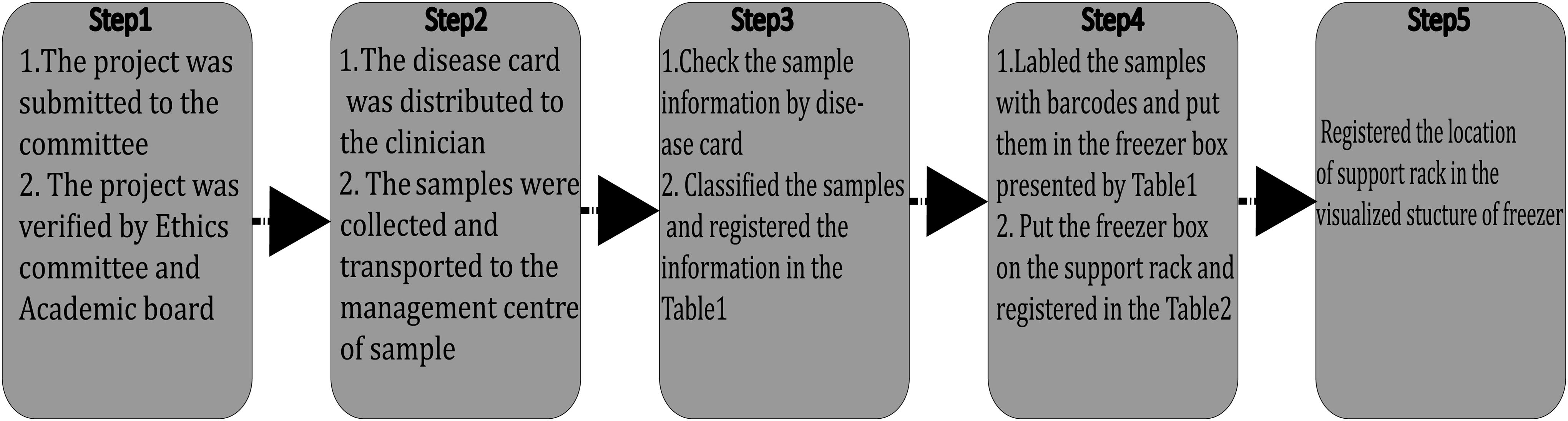
The workflow of a non-automated biobank. The workflow introduces the management procedure of a non-automated biobank from project to sample collection and storage.
Discussion
Due to the enormous amount of disease information contained in the samples, biobanks are important resources in the development and validation of new diagnostic markers and new therapeutic agents.10,11 Based on our experience, standardized management is necessary even in the early stage of biobank development. This not only ensures the sample quality but also increases the possibility of obtaining additional financial support in the next phase of development.
In the past 2 years, a comprehensive biobank comprised of more than twenty categories of diseases has been constructed in the Shanghai Children's Hospital. During this process, we distributed disease-specific cards to clinicians, which were designed according to the classification and characteristics of the specific disease. 8 After collection, the samples were managed with the electronic system developed by the Shanghai Jiao Tong University School of Medicine. When completed, this system will manage the whole procedure from sample registration to sample delivery.
However, the graphic storage module of this system is still in development. The automatic storage and retrieval procedure could be conducted in this system, but still needs further development to become comparable to highly-automatic biobanks. For example, highly-automatic biobanks are often equipped with Radio Frequency IDentification (RFID systems and electronic manipulation of samples for highly-automated batch processing. This approach requires a large investment of funds. Some reports indicate that the minimum operating cost to maintain an automated biobank is approximately US $370,000 for the basic equipment and US $370,000 for consumables for every 1000 patients per year. 12 We have obtained start-up funds of about US $450,000 for the last 2 years. Thus, a practical management approach with lower investment needs to be explored for our biobank in its early start-up stage.
In addition to the shortage of funds, there are some practical obstacles that prompted us to enhance our management system to reduce processing errors. For example, any manual handling could potentially cause a mismatch between samples and the associated information. Furthermore, we found that sample positions are easily confused if the samples are retrieved and the storage positions are reused by other samples, especially in the electronic system without the graphic storage module. In addition, we found it particularly inconvenient to manage the samples according to their chronological sample number sequence, regardless of disease category. A method to manage the samples in order in a simple way needed to be investigated. The designation of specific disease samples in specific allocation in advance was then applied in our system to settle this issue.
Due to the above challenges, we designed this special work flow based on our limited biobank funds and the existing situation. Through the combination of electronic and printed systems, we managed our samples in order, which provided an adaptive way for the transformation of a non-automated biobank from a small-scale early-stage to the large-scale highly-automated level.
As a practical approach, our system could provide guidance in the following aspects: First, the disease-specific card indicates the method of sample collection and shipping, where the three tables in Figure 2 record the sample information and storage location individually. The disease-specific card defines the sample categories and the corresponding shipping conditions which ensure the quality of samples. The Table 1 described in Figure 2 records name, hospital number, and date, while the Table 2 in Figure 2 presents the number and location of the frozen box in a freezer. Both the electronic and printed records of these cards and tables provide an added level of insurance for the storage of samples. Using this standardized approach, we increased the efficiency of management and decreased the incidence of errors.
Second, it is convenient to pre-allocate specific disease samples in specific positions in freezers, especially for the disease categories for which samples are retrieved frequently. The designation of specific disease samples with specific allocation in advance helps the biobank with multiple disease categories to manually input and output the samples accurately and efficiently without the help of RFID and electronic manipulation.
In addition, this kind of combined system is an alternative and adaptive solution for developing biobanks. Although we understand the importance of automation and manage the biobank data with an information management system, there are significant gaps in the biobank development because of limited funding resources. We designed a combined system to store and record the sample information, which aims to ensure the samples are qualified and the information is integrated in a timely way.
Finally, our electronic information system enables sharing of information resources with other institutes, and could be upgraded in the future in the support of the Shanghai Jiao Tong University School of Medicine and the IT department of our hospital. An excellent biobank is based on the use of validated procedures of collection, storage, shipping, and access to samples, all of which depend eventually on a highly developed automatic system. 13 For some fully developed biobanks, automation and national biobank networks have been constructed, and the procedures for sample collection and information recording are well-established and effective.14,15 Although we could immediately find the required samples with high efficiency from our current non-automated biobank, developing an advanced automatic biobank is still our ultimate goal. In the coming years, we are planning to build a collaborative biobank network, improving the level of automation and information, sharing the valuable resources, and promoting the evidence-based scientific and medical research development.
Footnotes
Author Disclosure Statement
No competing financial interests exist. The development of the Biobank is supported by Shanghai Science and Technology Committee(Grant No: 12DZ2295006) and “985 Project” Funds from Shanghai Jiaotong University School of Medicine (Grant No: YBKL2013008).