




Abstract
Background:
Preanalytical variables have a great impact on sample matrices and are a source of laboratory errors. The effect of cryobanking, which is gaining great importance recently, requires systematic investigation. The arachidonic acid metabolism is useful as a quality marker since eicosanoids are easily subjected to in vitro oxidation processes.
Materials and Methods:
Polyunsaturated fatty acids (PUFAs) and related metabolites were analyzed by online solid-phase extraction coupled to liquid chromatography–tandem mass spectrometry. The influence of different plasma anticoagulants, as well as serum, freeze–thaw cycles (n = 5), short-term storage at 4°C, room temperature up to 120 minutes, and long-term storage at −20°C, −80°C, and −150°C up to 180 days, were investigated. We further investigated the influence of protein depletion, antioxidants, and shock-freezing on plasma.
Results:
PUFA metabolites were stable at 4°C in ethylenediaminetetraacetic acid (EDTA)-stabilized whole blood for 120 minutes and in EDTA-plasma for 30 minutes. Plasma stability at 4°C could be further increased up to 7 days after protein depletion, while addition of antioxidants such as butylated hydroxytoluene or coverage with nitrogen had no protective effects. Repeated freeze–thaw cycles (n > 1) resulted in eicosanoid formation up to 63%. Long-term storage at −20°C led to substantial eicosanoid increases after 30 days, which could be prevented by depleting proteins before storage. Cryobanking at −80°C and −150°C revealed decreased concentrations of eight eicosanoids after 180 days. An advantage of shock-freezing with liquid nitrogen could not be confirmed compared to conventional freezing.
Conclusion:
Defined preanalytical conditions for eicosanoid analysis in human matrices are required to minimize in vitro data variability.
Introduction
E
Materials and Methods
Chemicals and reagents
Unlabeled and deuterium-labeled PUFA and eicosanoid standards were purchased from Cayman Chemicals (Ann Arbor, MI), see Supplementary Table S1 (Supplementary Data are available online at www.liebertpub.com/bio). Solvents, precipitation reagents, calibrators, quality controls, and internal standard solution were prepared as previously described. 15 Polypropylene safe-lock tubes, multifly needle sets, and polypropylene Monovettes® (lithium heparine, citrate, K3-EDTA) were obtained from Sarstedt (Nümbrecht, Germany), cryotubes from FluidX (Oakville, ON, Canada), solvents from BioSolve (Valkenswaard, Netherlands), and water from a Barnstead NANOpure Water Purification System (Thermo Fisher Scientific, Waltham, MA).
Sample collection
Blood samples were collected from six healthy volunteers (three males, three females, 27 ± 6 years) by venipuncture for fresh blood and plasma experiments. The blood samples were centrifuged at 2000 g for 10 minutes at room temperature (RT) and stored under various conditions depending on the experimental protocol. For other storage experiments, pooled plasma from residual blood was used. The study of the preanalytical investigation of PUFAs and eicosanoids in human plasma was approved by the Ethics Committee of the University of Leipzig 082-10-190-42010.
Sample preparation and quantification by LC-MS/MS
Sample preparation and analysis through LC-MS/MS were performed as previously described. 15 In brief, 200 μL of sample was mixed with 450 μL of precipitation solution containing the deuterium-labeled standard solution (c = 5 ng/mL in methanol–water 50:50 [v/v] and 50 ng/mL for AA-d8) and vortexed for 2 minutes. Samples were centrifuged at 10,000 g for 5 minutes. The clear supernatant was transferred into an autosampler vial and stored at −80°C until analysis. A Strata-X column (20 × 2 mm i.d., 25 μm particle size; Phenomenex, Aschaffenburg, Germany) was used for online solid-phase extraction. LC-MS/MS analysis was carried out on a 5500 QTrap mass spectrometer (AB Sciex, Darmstadt, Germany) using negative electrospray ionization. Chromatographic separation of analytes was performed on a Kinetex C18 column (100 × 2.1 mm i.d., 2.6 μm particle size; Phenomenex). Scheduled multiple reaction monitoring experiments were used for the quantitative analysis of free PUFAs and oxidized metabolites, mainly eicosanoids (Supplementary Table S1).
Preanalytical investigations of whole blood and plasma
Preanalytical investigations were performed using native or spiked pooled ethylenediaminetetraacetic acid (EDTA)-plasma. Six PUFAs, 28 eicosanoids, and related lipids with an analytical coefficient of variation (CV) between 4% and 24% were monitored in all plasma stability experiments (Supplementary Table S2).
Comparison of anticoagulants
Lithium heparin, citrate, EDTA-K3-stabilized plasma and serum from three individuals were centrifuged (2000 g, 10 minutes, RT) 30 minutes after blood collection. Samples were aliquoted and stored at −80°C until sample pretreatment for LC-MS/MS analysis.
Stability of PUFAs and eicosanoids in EDTA-whole blood
After venipuncture, whole blood was kept at 4°C or RT for 30, 60, 90, and 120 minutes until centrifugation in Monovettes containing EDTA-K3 (n = 3). Individually stored aliquots were kept at −80°C before sample pretreatment. Concentration changes were related to the earliest time point (30 minutes, 4°C).
Stability of PUFAs and eicosanoids in EDTA-plasma
After centrifugation, EDTA-stabilized plasma was kept at 4°C or RT for 0, 30, 60, 90, and 120 minutes (n = 3). Individually stored aliquots were kept at −80°C before sample pretreatment. Concentration changes were related to the earliest time point (0 minutes). The influence of protein depletion with 30% or 60% methanol (MeOH) (v/v) was tested in plasma, which was stored at 4°C for 7 days (n = 3). The influence of antioxidants was tested for plasma, which was stored at 4°C for 7 days with the addition of butylated hydroxytoluene (BHT, 20 μM) or coverage with gaseous nitrogen (n = 3). Analyte stability for five freeze–thaw cycles was investigated (n = 3). Therefore, individual aliquots were incubated for 30 minutes at RT with subsequent refreezing at −80°C on 5 consecutive working days. Concentration changes were related to unfrozen plasma.
Long-term stability was investigated at temperatures of −20°C, −80°C, and −150°C over a storage time of 1 day, 1, 2, and 6 months (n = 3). Concentration changes were related to the earliest time point (1 day). Furthermore, plasma aliquots were either conventionally frozen or shock-frozen in liquid nitrogen and stored at −80°C or −150°C for 2 days (n = 3). Concentration changes were related to conventional frozen plasma.
The stability of pretreated samples before LC-MS/MS was investigated for up to 48 hours in a cooled autosampler (10°C). Furthermore, sample extracts were measured either directly after pretreatment or after storage overnight at −80°C.
Statistics
The significance of changes in analyte concentrations was calculated by the acceptable change limit (ACL = 2.77 × CV). 16 The CV was assessed on the basis of the interassay variation of the quality controls monitored during the experiments (n = 9); see Supplementary Table S2 for further information. If the linear regression trend of an analyte exceeded the ACL, the difference was considered to be significant.
Results
Stability of PUFAs and eicosanoids in EDTA-whole blood
The storage of EDTA-whole blood at RT until centrifugation resulted in increased concentrations exceeding the ACL of 12-HETE (30 minutes), 12-hydroxyheptadecatrienoic acid (12-HHT) (30 minutes), and TxB2 (90 minutes). Storage of EDTA-whole blood at 4°C revealed no changes until 120 minutes (Supplementary Table S3).
Comparison of anticoagulants and serum
Six PUFAs, 17 eicosanoids, and related lipids could be quantified in citrate, lithium heparinized, and EDTA-stabilized plasma samples independently from the applied anticoagulant. Compared to EDTA-stabilized plasma (100%), individual different concentration changes of HETEs (5-, 11-, 12-, and 15-HETE), HODEs, 12-HHT, and TxB2 were observed for citrate and heparinized plasma up to 250%. In serum, four additional eicosanoids (TxB1, LTB4, 12-OxoETE, and 12-HEPE) were found. Furthermore, concentrations for 5-HETE, Tetranor-12-HETE, 5-HEPE, and HODEs rose up to 175%, while 11-, 12-, and 15-HETE, 12-HHT, and TxB2 were remarkably elevated up to 18,803% compared to EDTA-plasma (100%) (Supplementary Table S3).
Stability of PUFAs and eicosanoids in EDTA-stabilized plasma
At 4°C, PUFAs and eicosanoid concentrations did not change until 120 minutes after centrifugation with the exception of an increase for 9-HETE exceeding the ACL after 60 minutes. At RT, in addition to the observed changes at 4°C, other metabolites exceeded the ACL during storage such as 15-HETE (60 minutes), 5-OxoETE (90 minutes), as well as 12-HETE and EPA (120 minutes), see Supplementary Table S3. The concentration changes in plasma could be prevented by an immediate addition of 60% (v/v) MeOH (or higher) after centrifugation, which was demonstrated to be stable up to 7 days at 4°C (Supplementary Table S3). Incubation with lower volume addition either increased the concentration of eicosanoids such as 11- and 12-HETEs, DHETs, HODEs, and EPA or decreased the concentration of 5-HETE, LA, and DHGLA, which, for example, is shown in Figure 1 for the analytes 11- and 5-HETEs, which showed the highest variation. Addition of BHT or coverage with gaseous nitrogen did not affect on PUFA or eicosanoid concentrations (data not shown).
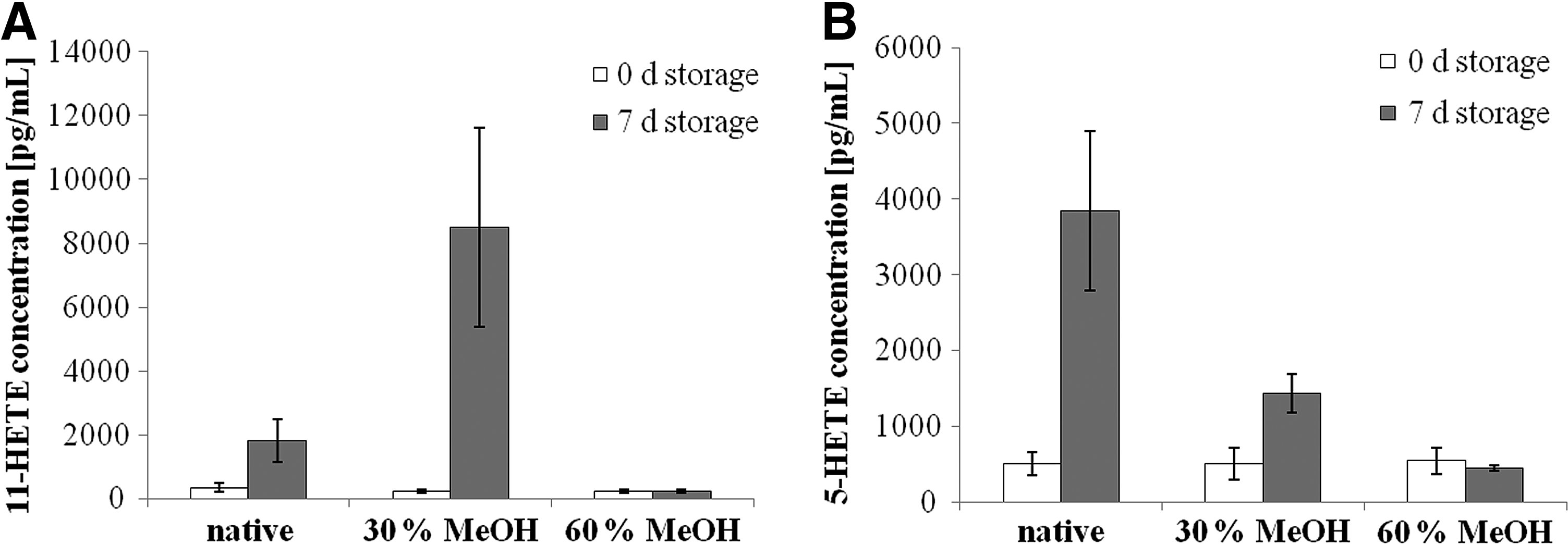
Concentration of
Freeze–thaw cycles
Since eicosanoid concentrations, for example, for 12-HETE exceeded the ACL after the first freeze–thaw cycle, the ACL was set to one cycle. Significant increases were found for 12-HEPE and 12-HETE (two cycles), as well as 12-HHT, 10,17-dihydroxydocosahexaenoic acid (DiHDoHe), Tetranor-12-HETE, and 5-HETE (five cycles), see Supplementary Table S3. Figure 2 shows that the most unstable analyte was 12-HETE and the most stable analyte was 11-HETE for up to five freeze–thaw cycles.
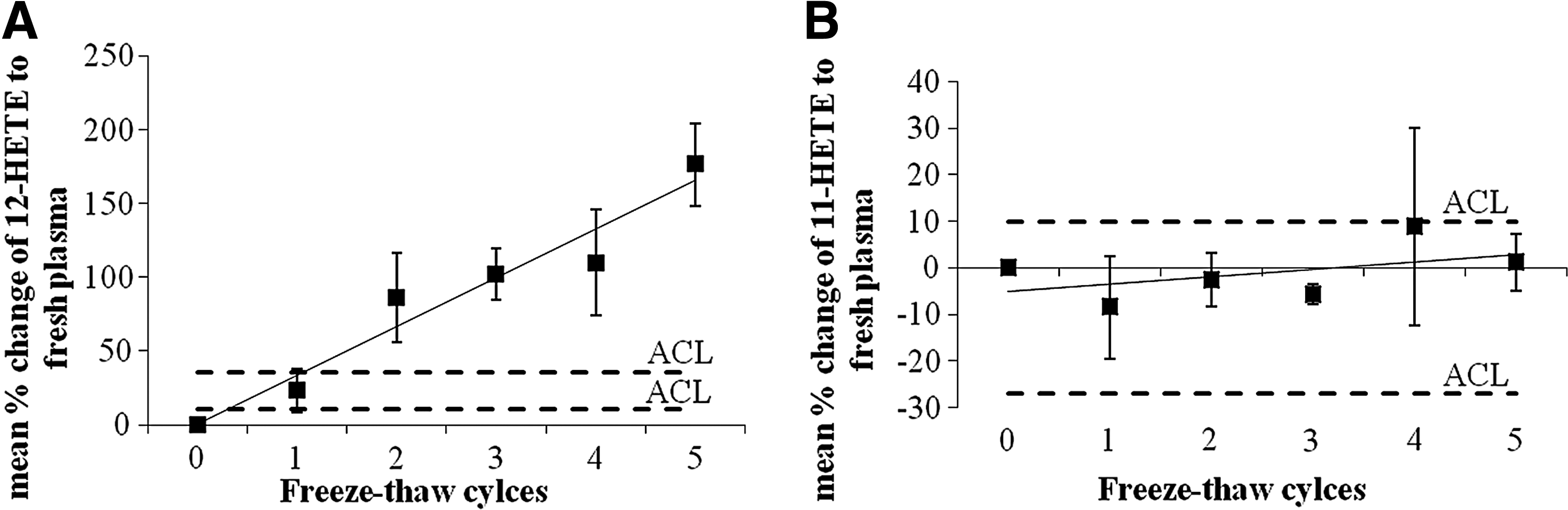
Freeze–thaw stability for EDTA-plasma is shown for
Long-term stability
The long-term stability up to 6 months was investigated for pooled EDTA-plasma stored at −20°C, −80°C, or −150°C. At −20°C, significant concentration changes up to 6 months were observed for 2 PUFAs and 17 eicosanoids with 5-, 11-, and 12-HETE exceeding the ACL after only 1 month of storage. Again, the concentration increase of HETEs and HODEs could be prevented by the addition of 60% MeOH (data not shown). The storage at −80°C and −150°C revealed significant concentration decreases for DHGLA and eight eicosanoids after 6 months (Supplementary Table S3). In Figure 3, the concentration of the most unstable analyte 11-HETE is presented, where the ACL was exceeded after only 1 month of storage at −20°C, while it tended to decrease at −80°C and −150°C, and Figure 3B shows 17-HETE as an example for a stable analyte.

Comparison of concentration stability of
Furthermore, an advantageous effect of shock-freezing could not be observed for concentrations of PUFAs or eicosanoids (Supplementary Table S3).
Stability of PUFAs and eicosanoids in pretreated samples
After pretreatment of the plasma samples, the extracts, which are dissolved in a precipitation solution containing MeOH/H2O (80/20 v/v) and zinc sulfate heptahydrate (17.8 g/L), were stable up to 48 hours at 4°C. Furthermore, no difference was found between fresh and overnight frozen (−80°C) pretreated samples.
A summary of the preanalytical experiments is provided in Table 1.
Examples for unstable and stable metabolites are given. The raw data for each experiment are given in Supplementary Table S3.
AA, arachidonic acid; DHA, docosahexaenoic acid; DHET, dihydroxyeicosatrienoic acid; EDTA, ethylenediaminetetraacetic acid; HETE, hydroxyeicosatetraenoic acid; HODE, hydroxyoctadecadienoic acid; PUFAs, polyunsaturated fatty acids; RT, room temperature.
Discussion
Varying preanalytical conditions have a great impact on data generation and interpretation. In this study, our preanalytical investigations show that PUFA and eicosanoid analysis are dramatically affected by in vitro metabolism starting from blood collection until sample storage.
The applied different sample matrices showed that the clotting cascade is activated in serum right after blood taking, resulting in tremendous increases in levels of TxB2, 12-HHT, and some HETEs, as previously reported.17,18 This indicates the intense enzymatic activity of COX and LOX during clotting.19–22 Plasma is therefore highly recommended. We were also able to identify increased concentrations of COX and LOX metabolites for citrate and lithium-heparinized plasma. This observation may be due to the still activated enzymes and emphasizes the use of EDTA-plasma due to the complete and nonreversible chelation of Ca2+ and Mg2+. 13
As shown in previous studies, whole blood and plasma should be stored at 4°C.13,23 In native whole blood, all detectable metabolites appeared to be stable up to 120 minutes. Since it is unusual to spike whole blood, assessments for other metabolites could not be made. It is interesting to note that even structurally similar metabolites such as HETEs were found to have a different stability behavior, as presented in Figures 1–3. Results found in spike-plasma indicate that samples should be processed as soon as possible, because 9-HETE significantly increased after 60 minutes of storage at 4°C, while all other metabolites remained stable up to 120 minutes. Addition of 60% (v/v) MeOH increased the stability of plasma up to 7 days at 4°C. Interestingly, an addition of only 30% (v/v) MeOH resulted in partially increased activation of HETE formation. This result may be caused by fixing the enzyme conformation by low MeOH concentrations, resulting in increased enzymatic activity while simultaneously inhibiting other pathways. 24 The hypothesis of eicosanoid changes being a result of enzymatic activity is supported by the finding that addition of BHT as an antioxidant or nitrogen coverage had no protective effect.
In contrast to previous studies, we found substantial influences of freeze–thaw cycles on eicosanoid concentrations in plasma. The focus on other eicosanoids such as PGs or the use of higher concentrated standards may be a reason.25–27
Samples cannot be stored at −20°C for eicosanoid analysis due to incomplete freezing. 28 Storage at −80°C and −150°C showed similar changes for a storage time of 6 months, which was also reported for other metabolite classes such as oxysterols or cytokines for biobanking studied up to 1 year.29,30 An additional point concerned the different types of freezing. Shock-freezing in liquid nitrogen gained much importance recently due to avoidance of ice formation. 31 However, in our study, we could not identify a benefit of shock-freezing.
In this study, the ACL was applied as the criterion to assess significant changes of the different experimental setups with respect to the CV of the methodology. However, due to the increasing sensitivity of mass spectrometric methods, the CV might be further reduced and could show different results.
In summary, we recommend the following protocol for the analysis of PUFAs and eicosanoids in plasma:
• Store EDTA whole blood at 4°C for a maximum of 120 minutes before centrifugation. • Store EDTA plasma at 4°C for a maximum of 30 minutes. • Add 60% (v/v) methanol for EDTA plasma storage at 4°C > 30 minutes. • Store EDTA plasma at −80°C or lower after aliquoting. • Use only once-thawed samples.
Footnotes
Acknowledgments
This publication is supported by the LIFE–Leipzig Research Center for Civilization Diseases, Universität Leipzig. This project was funded by means of the European Social Fund, by the European Regional Development Fund (ERDF), and the Free State of Saxony.
Author Disclosure Statement
No conflicting financial interests exist.
References
Supplementary Material
Please find the following supplemental material available below.
For Open Access articles published under a Creative Commons License, all supplemental material carries the same license as the article it is associated with.
For non-Open Access articles published, all supplemental material carries a non-exclusive license, and permission requests for re-use of supplemental material or any part of supplemental material shall be sent directly to the copyright owner as specified in the copyright notice associated with the article.
