




Abstract
Biobanks have become indispensable tools for a wide array of life and environmental sciences, and biotechnology. To evaluate trends in biobanking, 20,000 bibliographic records were retrieved and analyzed between 1939 and 2014 from the Scopus database using a series of biobank-related search terms within titles and keywords. Since the 1990s, the field of biobanking has been, and still is, experiencing above-average growth in terms of publications, journals, and thematic orientations. Almost two-thirds of all indexed biobanking documents have been published in the last decade, with now >1,000 publications in 600 distinct journals per year. Around 50,000 individual authors can be identified who have so far contributed to the field of biobanking, with an average of 1.5 publications per author. Author affiliations follow an uneven distribution: 42% of the authors are based in Europe, 33% in North America, 13% in Asia, 5% in South America, 4% in Australasia, and 2% in Africa. Analyzing the most common title words revealed (as did the journals) a strong focus on blood banking, but other biospecimen types—especially seeds, cells, and tissues—have been gaining increasing weight recently. Among medical applications, transfusion dominates, followed by transplantation. While a noticeable increase in disease and especially health occurred at the beginning of the millennium, cohort and consent seem to have become high-relevance topics only in this decade. In terms of banked organisms, human dominates, followed by viruses and plants (especially represented through seed banking). A very rough estimate based on subject categories suggests that a third of all publications in biobanking focus on organisms other than humans. However, animal, fungal, and microbial biobanking are still underrepresented, especially when considering their shares in global biodiversity.
Introduction
B
The purpose of the present study is to observe the development of biobanking using bibliometric tools and indicators. Bibliometrics applies quantitative methods to analyze academic publications as an information process, using the identified patterns and dynamics in scientific publication efforts as a proxy for the development of the analyzed discipline.16–20
For that purpose, the bibliographic database Scopus was queried, and >20,000 references to publications on biobanks were retrieved (represented through various general terms and special repository types in the search terms) since the beginning of coverage in bibliographic databases, that is, since 1939. The term “biobank research” has been used over the last years with various meanings. It has been used to signify (1) any research conducted with biobank-supplied biospecimens (research with the biospecimens), (2) biospecimen research (research on the biospecimens), and (3) research on biobanks (e.g., bioethics). It has also been used to signify high throughput research, most often linked to Next Generation Sequencing. The latter arguably constitutes a misuse of the word. To include as little research with biobank samples and rather to target research on biobanks or biospecimens, abstracts have not been considered while generating the data set of references. The retrieved data set was used to investigate, among other issues, the dynamics of annual publication numbers and involved journals, the geographic distribution of authors, and the use of relevant title words over time. The findings are offered to the biobanking community as an incentive to reflect on current trends in biobanking and biobank-connected publications.
Data and Methods
A data set containing bibliographic records for biobank-related journal articles and other publications was compiled using Elsevier's Scopus database. 21 The search was conducted in June 2014 using the following search string that covers the majority of biobanking areas, or at least a highly representative fraction: “DNA bank*” OR “RNA bank*” OR “gene bank*” OR “tissue bank*” OR biobank* OR “seed bank*” OR “environmental specimen bank*” OR “blood bank*” OR cryobank* OR “cryogenic bank*” OR biorepositor* OR “population bank*” OR “cell bank*” OR “urine bank” OR “saliva bank*” OR “brain bank*” OR “organ bank*” OR “environmental repositor*” OR “biological repositor*” OR “tissue collection*” OR “cell collection*” OR “DNA collection*” OR “biospecimen bank*” OR “biological specimen bank*” OR “serum bank*” OR “liver bank*” OR “sperm bank*” OR “semen bank*” OR “gamete bank*” OR “embryo bank*” OR “vaccine bank*” OR “pathogen collection*” OR “tumor bank*” OR “cancer bank*” OR “disease bank*” OR “bone bank*” OR “marrow bank*” OR “population collection*” OR biospecimen*, querying the respective database fields for publication titles, for Scopus index terms, and for author keywords. The abstracts were deliberately excluded from the search to avoid inflating the data set with thematically not biobank-oriented publications, that is, with publications that merely cite biobanks as sample sources. Thus, around 9,000 publications matching the above search terms within only the abstract did not enter the analysis. An alternative database, Web of Science by Thomson Reuters,22,23 includes a search within abstracts when conducting a combined query in titles plus keywords. Therefore, Scopus was used rather than Web of Science for the present analysis.
It was tested how the rationale of excluding abstract hits was able to filter out “biobank research” of the aforementioned type 1 (research conducted with biobank-supplied biospecimens) by comparing the data set to a randomly assembled data set. Of 50 references obtained by looking for biobank* in abstracts only and targeting research with biospecimens, only 2 references (4%) belonging to type 1 biobank research were also represented in the main data set.
After initial cleaning of the data (removal of duplicates), the final data set contained 20,837 records, each referring to an individual publication. Using Microsoft Excel 2010, Google Refine 24 v2.5, and text editors, the retrieved data set was searched to assess document types and subject areas represented and to determine the number of publications per year, the journals involved, and their contribution to the field, as well as the authors and their contributions (including affiliations and geographic distribution).
In addition, frequently occurring words in titles were extracted, grouped by year, and counted through a Perl script. For that purpose, special characters and punctuation were first removed from the data set, and an extensive blacklist of frequent words with low information content was defined (e.g., a, about, absence, absent, across, after, all, among, an, also, although). This enabled the identification of scientifically relevant topics. For those analyses that considered developments in publication history, records for the year 2014 were usually excluded to avoid skew, as not all publications from 2014 had yet been entered in Scopus. Even for 2013, the database may not have been complete (possible lag in publication aggregation), as Figures 1 and 2 indicate.
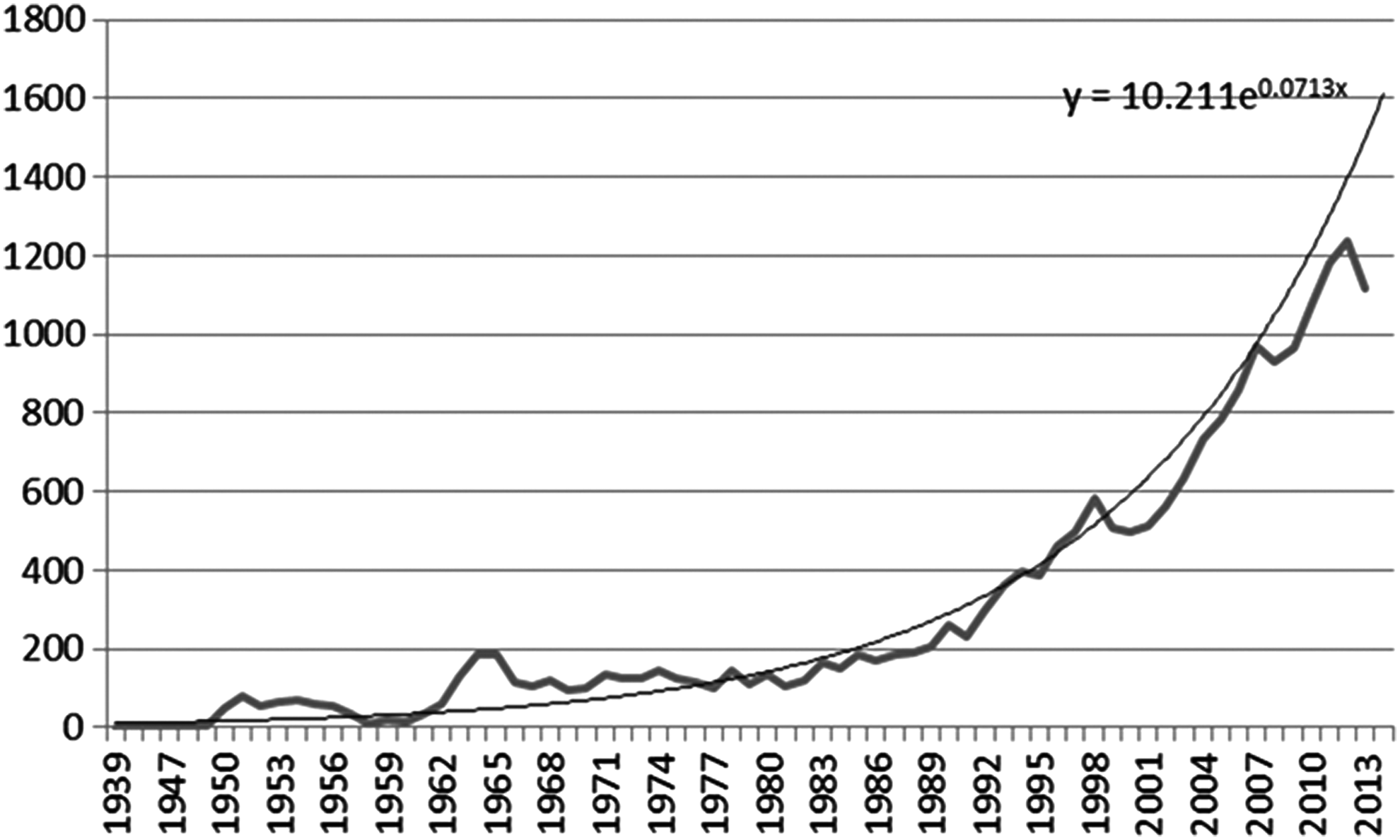
Publication output by year. (Note: not all publications for 2013 had been aggregated by the database by mid-2014.)

Annual number of journals publishing biobanking articles (as inferred from the search terms).
Results and Discussion
Number and type of publications
The 20,837 retrieved publications were published between 1939 and June 2014. The first repositories mentioned are blood banks (1 publication in 1939, 25 10 in the 1940s) and bone banks (8 of the 17 publications in the 1940s). Publication numbers start to increase considerably in the 1950s (ca. 500 records), although this probably represents an artifact of data collection, as citation indices and bibliographic databases started to be compiled in the 1950s and 1960s. 26 It may therefore be assumed that biobanking publications occurred in higher numbers even before the 1950s. After the number of new biobanking publications registered in Scopus doubled in the 1960s (ca. 1,100 publications), the growth in publication rate was very limited in the 1970s (1,200 new publications), slowly picked up in the 1980s (1,600 publications), and exploded in the 1990s with 4,000 publication records. For the first decade of this millennium, 7,500 publications have been registered; an extrapolation until 2020 suggests a further 15,000 publications for these 10 years. Currently, 60% of all indexed biobanking documents have been published since 2000. This is in line with the finding that two-thirds of almost 900 active biobanks in the United States have been established within the last decade, 27 and provides evidence for a correlation between pure biobank statistics and the bibliometric data presented here. Figure 1 shows how the records have accumulated non-linearly over time and underpins the impression that the “field of biobanking has changed tremendously over the past 30 years.” 28
The yearly relative growth rates in the number of biobanking publications fluctuate, especially in the earlier years, but since 2000, they average >7%. De Solla Price found a relative annual growth rate of 4.7% in biological, chemical, and physical abstracts, 29 while Behrens and Lankenau differentiate a yearly growth of 3.9% in astronomy, 5.0% in chemistry, and 6.7% in physics publications. 30 Larsen and von Ins derive current growth rates from various databases, for example 2.7% Science Citation Index, 2.8% MathSciNet, 4.2% Lecture Notes in Computer Science, 4.3% Chemical Abstracts, and 5.6% PubMed. 31 Thus, with a 7% annual increase, biobanking publications are currently aggregated at a higher rate than the “standard” increase rate of scientific output generation.
Although there is a local downward slope at the end of the graph (but note the possible explanation for 2013 described above), Figure 1 does not show any indications that biobank growth is nearing saturation. Interestingly, the steep increase in publication rate in the 1990s (10.5% yearly increase on average) is mirrored by a steep increase in biomedical PhD graduation rates, observed in the 1990s and 2000s. 32
The following document types were represented among the retrieved publications: 70% original articles, 10% reviews, 5% conference proceedings, 4% letters, 3% notes, 3% editorials, 2% short surveys, 0.6% book chapters, 0.2% errata, 0.1% books, and the remaining 2.1% undefined. However, it should be noted that Scopus data collection efforts are focused toward publications in scientific journals (rather than books, for example).
Subject areas represented
An inspection of the Scopus subject categories with which the references are associated reveals 5 main subject areas. Of all the retrieved references, 62% have been attributed to medicine, 13% to biochemistry, genetics, and molecular biology, another 13% to agricultural and biological sciences, 11% to immunology and microbiology, and 9% to environmental science (several publications have been assigned to >1 subject area). Summing up the last 3 categories and assuming some duplication with the second category, one could very roughly assume that around a third of all publications in biobanking center on plants, animals, fungi, “microorganisms,” and viruses (see also discussion below). Apart from the aforementioned main categories, all remaining categories are represented in 2% (e.g., pharmacology, etc.) or less (e.g., veterinary with 1%) of all references.
Involved journals
The 20,837 publications referenced in the data set have been published in 4,687 titles (henceforth “journals,” as the overwhelming majority of referenced documents have been published as such, see above). Usually <100 different journals published biobanking articles each year during the 1960s and 1970s (Fig. 2). In the 1980s and especially 1990s, this number rose steadily until the year 2000 when the mark of 300 journals was first exceeded. Since 2011, the number of journals publishing biobanking articles has remained >600. The annual mean growth of the number of journals with publications on biobanking since the year 2000 lies at 6%.
Of all 4,687 journals, 240 contributed half of all publications. The 50 journals containing the highest number of articles on our biobank-related search terms are listed in Appendix 1. The data set contained only 18 journals with >100 publications (contributing 19% of the total publications) on biobanking while almost half (47%) of the data set's journals contributed only 1 publication each. Biobanking is represented in a relatively but not extraordinarily high number of journals; it still fits the ubiquitous power law for “scattering” of information20,33 and falls only slightly short of reaching the typical Pareto distribution: 20% of all journals have together published 73% of the total biobank publications.
The 5 + 1 journals with the highest number of articles citing biobanking are plotted in Figure 3. With 1,166 total hits (see Appendix 1), Transfusion is the journal with by far the most biobank publications, followed by Vox Sanguinis with 377 publications. This, as also seen below from extracted title words (Fig. 4), shows the emphasis on blood biobanking in the literature. It is interesting that this strong focus on blood biobanking is not very obvious at general, global, or regional biobanking meetings [e.g., International Society for Biological and Environmental Repositories (ISBER), European, Middle Eastern, and African Society for Biopreservation and Biobanking (ESBB), Asian Network of Research Resource Centers (ANRRC), and the Biobank Branch, China Medicinal Biotech Association (BBCMBA)]. Position 3 in the biobanking publication hierarchy is occupied by Cell and Tissue Banking (213 articles), which brings in a focus other than blood, followed by the “generalist” journals Nature (171) and Science (165), with an impressively high number of articles citing biobanking. The first explicitly non-human-oriented journal ranks at position 12: Plant Ecology with 122 documents. Biopreservation and Biobanking appears at position 21 with 91 articles indexed as, or entitled with, one of the referenced forms of biobanking. Due to its recent development and its specialization on the topic (the only specialized biobanking journal apart from Cell and Tissue Banking among the first 50 journals), it was plotted together with the 5 journals with the highest output (Fig. 3). The increase in articles since 2009 for Biopreservation and Biobanking is very noticeable. Since 2011, only Transfusion had more biobanking output, and the gap between the two is closing. The journal was renamed Biopreservation and Biobanking from Cell Preservation Technology in 2009, with only 18 articles matching the present search terms between 2003 and 2008. Furthermore, Clinical Chemistry, one of the important journals for the advancement of clinical biology, is represented by few (20) hits in the data set. This is a result of the search-term choice, which included all aspects of biobanking and did not specifically target the (biospecimen) research underpinning biobanking and technically enabling it. This approach of course includes biopreservation literature, as long as it mentions the most common forms of “biological banking,” but biobank management and use abound in the data.

Development of the 5 most strongly represented journals in the field (through all years), together with Biopreservation and Biobanking.

Occurrence of frequent and specifically selected biospecimen types (or subtypes) in titles over time. A color version of this figure is available online at www.liebertpub.com/bio
Author and geographic statistics for biobanking publications
The 20,837 publications referenced in the data set have 49,274 authors and 74,673 (co-)authorships (on average 1.5 publications per author). Setting this into relation of the total number of publications, an average of 3.6 co-authors per publication can be derived in the biobanking domain.
The individual country with the highest number of authors citing biobanking is the US (>11,000 authors), followed by the United Kingdom (2,796), Germany (2,516), France (2,017), and Italy (1,874; see Appendix 2 for the full list). Out of a total of 146 represented countries, the first 5 together (3.4%) contribute >50% of all authors and first authorships; 90% of all authors work in a core set of 29 countries (19.8% of the total).
When grouping the countries by continent (Table 1), a clear divide becomes apparent: according to Scopus, the biobanking community (if all authors are defined as “biobankers”) reaches its highest density predominantly in Europe (42%) and North America (33%), followed by Asia (13%), South America (5.2%), Australasia (4%), and Africa (2.4%). At least from a biodiversity-oriented perspective, this stands in stark contrast to the actual needs for biobanking in tropical regions, 34 where the diversity of life is highest (for biodiversity research, a similar imbalance has been found). 35 Also from a medical and anthropological perspective, it is obvious that biobanking still has to be intensively fostered on continents containing developing countries.36–39 A glimpse into the most actively publishing institutions within the data set suggests a strong bias toward the Northern hemisphere (see Appendix 3 for the 25 most strongly represented institutions).
Note that only for 39K of 49K authors, the data allowed assignment to a country.
These literature-derived data correlate loosely with the biobank survey data of Hewitt and Watson, 1 who received 52% (n = 295) of their feedback from Europe, 35% from North America, 6% from Australasia, 5% from Asia, 2% from Africa, and 0% from South America. The discrepancies can be explained by a communication bias (Asia and South America having been reached less effectively, and Europe more effectively by ESBB and ISBER).
Most frequently used meaningful words in publication titles
From all 20,837 publication titles present in the data set, the most common “meaningful” words were extracted, that is, those words potentially determining the scientific content of the associated publication. Table 2 details the 50 commonest words. Only the following 9 terms or term complexes had ≥1,000 hits in all titles: blood, bank/s and banking, seed/s, cell/s, donor/s and donation/s, transfusion/s, tissue/s, biobank/s and biobanking, and human. One of the most conspicuous findings is that the term blood scored more hits in the referenced titles than *bank/s or *banking, which were a relevant component of most search terms. As was found with the prevalence of Transfusion among the journal titles, this indicates the overwhelming historical preponderance of clinical biobanking and partly explains why it is still difficult to separate clinical from research biobanking. The frontier between the two is still sometimes unclear: blood bank or transplant bank specimens that do not qualify for clinical use (because of delayed collection, contamination, “expiration,” or other reasons) may be used in research biobanking; tumor banks often serve both clinical and research purposes in the same facility. Figure 4 illustrates the blood preponderance as well, but shows also that other biospecimen types, especially seeds, cells, and tissues, are becoming more important than was the case in “historical” biobanking times (roughly until the late 1980s), when blood dominated the biospecimen types much more strongly.
It must also be noted that the term bank and its derivatives occurs in only 28% of all retrieved publication titles. This observation reveals that most data sets have been obtained through their keywords instead of titles (although a few search terms did not contain bank). Interestingly, the increase in the total number of publications is higher than the increase in bank derivatives in the titles, meaning that publications are progressively recognized and indexed (by authors and/or the database) as biobanking publications.
In the literature referenced in the data set, the term biobank or biobanks (as a generic broader term for different biological specimen repositories) appears in a title for the first time in 1985 in Dutch, as biobanken, in a veterinary journal. 40 The term re-emerges in the titles in the 1990s with a focus on Scandinavian initiatives41–44 (see also Hewitt and Watson on the topic). 1 Since then, it has been used extensively (now >200 hits in titles per year)—much more often than repository or repositories (including biorepositor*), which had been used as early as 1978 (for cell-line repositories),45–47 mostly in the US, but until 2004 only intermittently, and currently reaches just around 30 annual matches in titles. A possible reason for this lies in the higher portability of the term biobank among languages (of which there exist fewer in North America than in Europe; derivatives comprise, for example, biobank/Biobank, biobanco, biobanque, biobanca, biobanka, biopankki, and biopanga).
The development of selected terms among the referenced titles is shown graphically for individual years in Figures 4–7. Apart from the already-mentioned biospecimen types (Fig. 4), relevant topics were examined in a medical context, especially the applications to which biobanked samples are put (Fig. 5). Transfusion dominates, with the exception of the early 1960s (and again the early 1970s), when transplant shows a marked record of title occurrences, mirroring the advancement in the field thanks to development of immunosuppressive drugs. 48 While a noticeable increase in disease and especially health occurs at the beginning of the millennium, cohort and consent seem to have become highly relevant topics only in the current decade, when large population cohorts have been funded in Europe (e.g., Decode, UK Biobank, LifeGene, LifeLines, German National Cohort), Canada (CARTaGENE), and the US (e.g., Multi-Ethnic Study of Atherosclerosis, Framingham Heart Study-Generation 3).

Occurrence of selected frequent title words over time. A color version of this figure is available online at www.liebertpub.com/bio
Specific phrases that denote methodological biobanking issues and standardization are not apparent when correlating the data to the total number of publications (Fig. 6). The term best practice* was not present in titles before 2008, and only finds its way into a handful of titles since then. Quality has experienced a more rapid growth than method or standard. Preanalytic* is only represented in a few, at most 5, titles per year since 2008 (not shown). Before 2008, it occurred only once among the retrieved titles, in 1996. 49
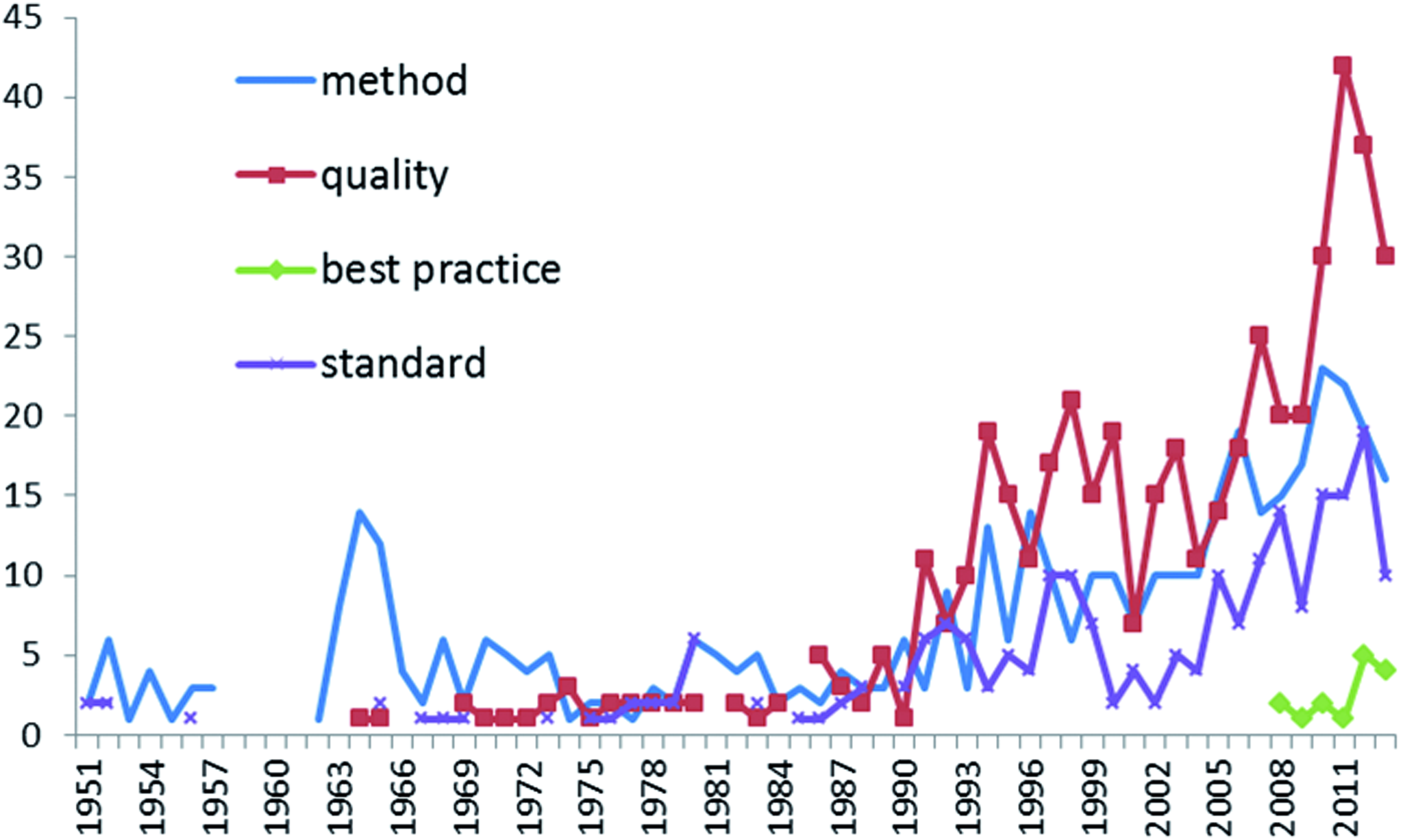
Occurrence of selected methodology- and standardization-oriented terms in titles over time. A color version of this figure is available online at www.liebertpub.com/bio
Finally, the development of selected title words indicating the banked type of organism was analyzed (Fig. 7). As expected, human was found at first position. Titles containing the word viral increased in the 1990s to the point where, for a few years, viral was a more frequently used title word than human. Since the early 2000s, a strong increase in plant biobanking can be witnessed, which currently ranks second after human biobanking. In times of overpopulation, planetary genetic depletion, and ensuing food vulnerability, 50 seed biobanks mostly account for this trend. Seed* is the third most common title term in the data set (second after blood if omitting the mostly search-inherent bank*; see Table 2). Figure 4 suggests seeds might be the “rising stars” among biospecimen types. While the total number of publications and most other mentions for biospecimen types were caught in a downward oscillation during 2012 and 2013 (see above), seed increases steadily.
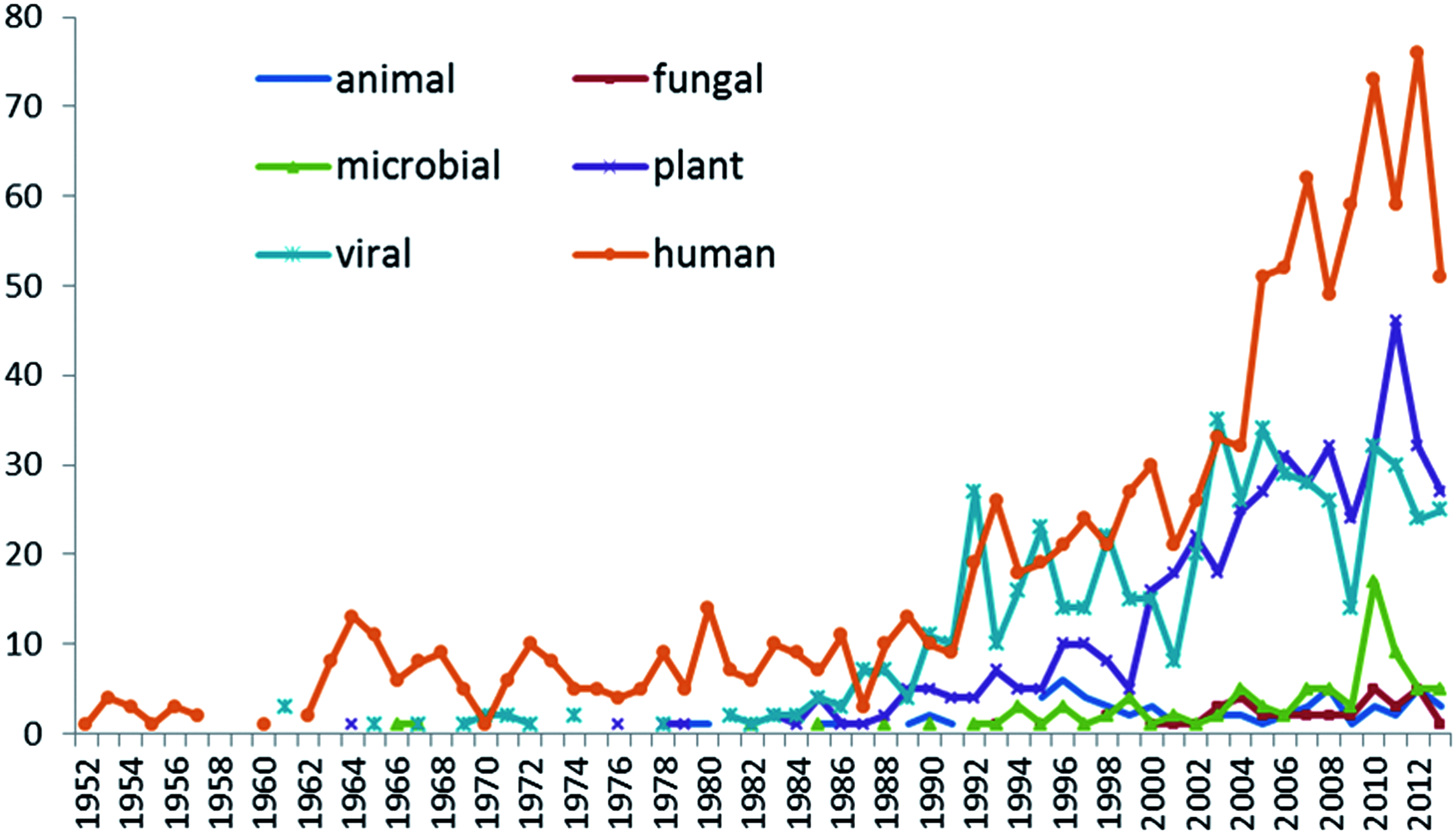
Frequency of reference to the organisms' taxonomy in titles over time. Note: (1) many publications will not explicitly mention the biological kingdom, but subordinate-level taxa, and thus this figure can only reflect a general tendency rather than delivering exact numbers on taxonomy of the banked organisms; (2) hits for bacterial were even less frequent than microbial. A color version of this figure is available online at www.liebertpub.com/bio
Besides seeds, plant biobanking seems fairly well represented as well, as plants, forests, and weeds are all frequently used title words (Table 2). This finding, as well as the appearance of soil at position 12 of the most frequently used title words, makes it clear that a scenario when biobanking meant only human biobanking or medical biobanking belongs to a time long past (see also Hewitt and Watson). 1 However, “biodiversity biobanking”14,15 is still focused on plants with commercial value and viruses: animals (not counting Homo sapiens), fungi, non-pathogenic “microorganisms,” and plants without a known commercial value are heavily underrepresented (see Fig. 4), leading us to the realization that today's biobanking efforts are still ignoring the largest proportion of life's diversity. 51 Apart from hindering basic biodiversity research, this also implies a problematic situation for human society in light of the current biodiversity crisis52–55 and of the impending global ecological destabilization connected to it, with yet unforeseeable consequences. 56
Conclusion
The present data, which correlate with data derived from biobank surveys, indicate a strong non-linear growth in biobanking activity since the late 1980s and most substantially over the last decade. While human biobanking abounds, there has also been a recent (but still too selective) focus on biodiversity biobanking and an increasingly interdisciplinary diversification in biospecimens and topics. This increase in biobanking activity is in general very promising, but a major concern still lies with the geographic disequilibrium that was encountered in Scopus' author distributions. Should this not be a database artifact, how could a North-South divide be overcome? Is this only a question for science policy, or can individual measures such as biobank partnerships make a difference? And how can biobanking be strengthened as a whole and the integration of the wide spectrum of biobanking themes and goals be increased, especially within and among biobanking networks and associations? ISBER, as a global scientific society in biobanking, has a key role to play in this respect. There are also other questions that these data confront us with: if the current biobanking growth persists, which is to be expected, how will samples be made accessible and how will the data be integrated? One publication every other year was found on integration (no increase), and one publication each year with access* in their titles. Does this suffice, and are the data that are collected sufficient to enable cross-usage? Also, how can the continuing support for the accumulated wealth of samples be guaranteed—especially for those samples that will be passed on as a legacy to the next generation of biobankers and scientists? Does repository planning include future crisis scenarios? Best practice forms a key component that helps in planning ahead (as best as possible to do). One might not always feel the necessity to compile best practices or to adopt them right away, e.g., when collecting samples for a study that seems in itself hermetic, but at the end of the day, after going through the full “biobanking equation,” it becomes clear how relevant it is—or would have been—for many samples to adopt overarching standards and legacy thinking.
Footnotes
Acknowledgments
We want to thank William Mathieson for proofreading and commenting on the manuscript, two anonymous reviewers for very helpful and constructive critiques, and Alexander Donath for contributing the Perl script used in analyzing title words.
Author Disclosure Statement
No conflicting financial interests exist.
| 1 | Transfusion | 1,166 |
| 2 | Vox Sanguinis | 377 |
| 3 | Cell and Tissue Banking | 213 |
| 4 | Nature | 171 |
| 5 | Science | 165 |
| 6 | Transfusion Clinique et Biologique | 164 |
| 7 | Journal of the American Medical Association | 153 |
| 8 | Lancet | 149 |
| 9 | Transplantation Proceedings | 144 |
| 10 | Bone Marrow Transplantation | 136 |
| 11 | Transfusion and Apheresis Science | 132 |
| 12 | Plant Ecology | 122 |
| 13 | Transfusion Medicine | 121 |
| 14 | American Journal of Clinical Pathology | 121 |
| 15 | Weed Science | 117 |
| 16 | Fertility and Sterility | 109 |
| 17 | Laboratory Medicine | 105 |
| 18 | New England Journal of Medicine | 96 |
| 19 | Archives of Pathology and Laboratory Medicine | 93 |
| 20 | Transfusion Medicine Reviews | 92 |
| 21 | Biopreservation and Biobanking | 91 |
| 22 | Journal of Vegetation Science | 88 |
| 23 | Transfusion Science | 76 |
| 24 | Problemy Gematologii i Perelivaniia Krovi | 75 |
| 25 | MLO Medical Laboratory Observer | 74 |
| 26 | Weed Research | 73 |
| 27 | Journal of Clinical Apheresis | 73 |
| 28 | Journal of Ecology | 67 |
| 29 | Canadian Journal of Botany | 66 |
| 30 | Journal of Arid Environments | 65 |
| 31 | Immunohematology | 65 |
| 32 | Infusionstherapie und Transfusionsmedizin | 63 |
| 33 | Journal of Applied Ecology | 62 |
| 34 | Molecular Endocrinology Baltimore Md | 57 |
| 35 | British Medical Journal | 56 |
| 36 | Sangre | 54 |
| 37 | Forest Ecology and Management | 53 |
| 38 | Medical Journal of Australia | 53 |
| 39 | Seed Science Research | 53 |
| 40 | Ugeskrift for Laeger | 52 |
| 41 | Transfusion Medicine and Hemotherapy | 52 |
| 42 | Aquatic Botany | 52 |
| 43 | Science of the Total Environment | 50 |
| 44 | Nederlands Tijdschrift Voor Geneeskunde | 49 |
| 45 | Restoration Ecology | 49 |
| 46 | Applied Vegetation Science | 48 |
| 47 | Hospitals | 46 |
| 48 | Blood Transfusion | 46 |
| 49 | BMJ Clinical Research Ed | 46 |
| 50 | Human Reproduction | 46 |
| United States | 11,142 |
| United Kingdom | 2,796 |
| Germany | 2,516 |
| France | 2,017 |
| Italy | 1,874 |
| Spain | 1,571 |
| Australia | 1,406 |
| Canada | 1,316 |
| Netherlands | 1,233 |
| Japan | 1,149 |
| Brazil | 1,112 |
| China | 1,059 |
| India | 682 |
| Belgium | 526 |
| Sweden | 520 |
| Switzerland | 393 |
| Argentina | 365 |
| Israel | 343 |
| Norway | 335 |
| Mexico | 327 |
| Turkey | 326 |
| Denmark | 307 |
| Austria | 304 |
| South Korea | 273 |
| Iran | 267 |
| Poland | 255 |
| Finland | 250 |
| South Africa | 246 |
| Hungary | 231 |
| Czech Republic | 211 |
| Greece | 194 |
| Taiwan | 188 |
| Russia | 178 |
| Nigeria | 174 |
| New Zealand | 149 |
| Chile | 148 |
| Thailand | 146 |
| Ireland | 143 |
| Saudi Arabia | 133 |
| Portugal | 122 |
| Hong Kong | 119 |
| Pakistan | 114 |
| Croatia | 108 |
| Singapore | 99 |
| Malaysia | 92 |
| Venezuela | 87 |
| Colombia | 77 |
| Cuba | 72 |
| Romania | 64 |
| Kenya | 59 |
| Egypt | 54 |
| Slovakia | 46 |
| Ghana | 40 |
| Uruguay | 38 |
| Serbia | 37 |
| Estonia | 36 |
| Slovenia | 36 |
| Ethiopia | 35 |
| Cameroon | 32 |
| Tunisia | 32 |
| Peru | 31 |
| Tanzania | 30 |
| Uganda | 28 |
| Bulgaria | 25 |
| Lithuania | 25 |
| Costa Rica | 24 |
| Sri Lanka | 22 |
| Lebanon | 21 |
| Philippines | 21 |
| Iceland | 18 |
| Jordan | 18 |
| Morocco | 18 |
| Ukraine | 18 |
| Czechoslovakia | 17 |
| Senegal | 17 |
| Burkina Faso | 16 |
| Bolivia | 15 |
| Nepal | 15 |
| Korea | 14 |
| Kuwait | 14 |
| Cote d'Ivoire | 13 |
| Viet Nam | 13 |
| Bosnia and Herzegovina | 12 |
| Gambia | 12 |
| Mali | 12 |
| Afghanistan | 11 |
| Georgia | 11 |
| Sierra Leone | 11 |
| Iraq | 10 |
| Sudan | 10 |
| Syria | 10 |
| Togo | 10 |
| Bangladesh | 9 |
| Jamaica | 9 |
| Dominican Republic | 8 |
| Luxembourg | 8 |
| Mozambique | 8 |
| Zimbabwe | 8 |
| Ecuador | 7 |
| French Guiana | 7 |
| Guinea | 7 |
| Indonesia | 7 |
| Kazakhstan | 7 |
| USSR | 7 |
| Congo | 6 |
| Guatemala | 6 |
| Namibia | 6 |
| Trinidad and Tobago | 6 |
| United Arab Emirates | 6 |
| Azerbaijan | 5 |
| Cyprus | 5 |
| Madagascar | 5 |
| Malawi | 5 |
| Oman | 5 |
| Panama | 5 |
| Botswana | 4 |
| Latvia | 4 |
| Malta | 4 |
| Algeria | 3 |
| Bahrain | 3 |
| Honduras | 3 |
| Laos | 3 |
| Qatar | 3 |
| Zambia | 3 |
| Albania | 2 |
| Angola | 2 |
| Benin | 2 |
| Cambodia | 2 |
| Djibouti | 2 |
| Libya | 2 |
| Mongolia | 2 |
| Nicaragua | 2 |
| Papua New Guinea | 2 |
| Paraguay | 2 |
| Rwanda | 2 |
| Yugoslavia | 2 |
| Armenia | 1 |
| Belarus | 1 |
| Equatorial Guinea | 1 |
| Gabon | 1 |
| Guyana | 1 |
| Macedonia | 1 |
| Mauritius | 1 |
| Saint Kitts and Nevis | 1 |
| Yemen | 1 |
Note: the data allowed assignment to a country for only 38,961/49,274 authors.
| National Cancer Institute | 116 |
| University of Minnesota Twin Cities | 112 |
| University of California, San Francisco | 103 |
| Etablissement Francais du Sang | 101 |
| VA Medical Center | 95 |
| National Blood Service | 93 |
| University of Western Australia | 90 |
| University of Birmingham | 88 |
| University of Oxford | 86 |
| McGill University | 83 |
| University of Sydney | 80 |
| The University of British Columbia | 78 |
| University of Washington Seattle | 77 |
| INSERM | 75 |
| University of Cambridge | 75 |
| American Red Cross | 73 |
| National Institutes of Health, Bethesda | 72 |
| Chinese Academy of Sciences | 72 |
| Massachusetts General Hospital | 71 |
| Karolinska Institutet | 70 |
| University of Toronto | 70 |
| Universidade de Sao Paulo | 69 |
| Erasmus University Medical Center | 69 |
| Katholieke Universiteit Leuven | 66 |
| University of Sheffield | 65 |