




Abstract
Several approaches to the preservation of biological materials at ambient temperature and the relative impact on sample stability and degradation are reviewed, with a focus on nucleic acids. This appraisal is undertaken within the framework of biobank risk, quality management systems, and accreditation, with a view to assessing how best to apply ambient temperature sample storage to ensure stability, reduce costs, improve handling logistics, and increase the efficiency of biobank procedures.
Introduction
B
While the current review emphasizes the possibility of ambient temperature storage of nucleic acids in terms of logistics, safety, and cost, ambient temperature storage is of value only if the stability of the samples is sufficient. The degradation mechanisms of nucleic acids and the conditions that ensure sample stability are briefly reviewed, and various procedures for ambient temperature storage and the conditions for validating the procedures in the context of biobanking are described.
Ambient Temperature Storage
Automation and logistics
Large-scale biobanking 4 requires automation. 16 This is especially true for biospecimens for which traditional low temperature storage methods may be technically and logistically difficult12,17 and where storage of difficult-to-manage biospecimens and cultures present additional challenges for their preservation.1,8,18 For example, stringent cold-chain management is critical for biospecimens conserved in the metastable, vitrified state and preserved at low and ultra-low temperatures. 18 For environmental specimens collected from remote locations, complex logistics can limit the feasibility of their transportation in the cold state, and transfer under ambient conditions may be a more realistic option.19,20
Risk management
Risk management is a crucial factor in biobank operations. Recent power outages within the United States and Japan have shown the vulnerability of biobanks, especially with respect to mechanical freezers, which rely on uninterrupted electrical power. Along with many other natural disasters, these incidents have reinforced the potential for unanticipated and catastrophic consequences. Hurricane Katrina in the southeastern US (September 2005) and the tsunami that affected the Fukushima nuclear power plant (March 2011) caused widespread geographic devastation. Destruction was on such a wide scale that the idea of immediately bringing in relief or removing samples from the area was impractical. Conversely, seemingly small incidents resulted in a power outage in California (September 2011), caused by an accident during routine maintenance, and one in the northeastern US (August 2003), caused by a branch falling on a transmission line. In both cases, a single mechanical blow to the electrical grid caused cascading outages over large geographic regions. These four examples demonstrate the need for alternative sample storage modalities that do not require electricity, or that can withstand short to longer power outages, floods, and other catastrophes.
In traditional collections, samples are stored in aliquots in separate freezers, providing redundancy in the case of a mechanical freezer breakdown. A more robust backup solution can be achieved by storing samples at a “mirror bank” dozens or hundreds of kilometers away. Unfortunately, this is rarely possible for technical, logistical, and financial reasons. More practically, mirror banking within the same city, on a different power grid, can serve to protect sample collections. Regardless, the recent events described above demonstrate that even mirror banks can be affected by power outages.
These disaster scenarios, crisis management, and future risk analysis raise the question of what alternatives to mechanical freezers are available. One alternative is storage in liquid nitrogen, which does not have some of the issues related to mechanical freezers such as the need for electricity on a constant basis. Another alternative is storage at ambient temperature. While future standards may include storing nucleic acids at ambient temperature for long periods, duplicate storage in both mechanical freezers and ambient temperature facilities could help with the transition to these new storage modalities. This would provide an important level of security for precious biospecimens that is not possible through storage in mechanical freezers alone. In order to protect the nucleic acids further, physical separation between aliquots should still be maintained.
Cost considerations
At a time of reduced budgets, sample storage is now an increasing cost line for institutions and biobanks. This pressure has led to the development of novel technologies in ambient temperature biopreservation that merit analysis, for both scientific performance and impact on cost.
The decision of whether to store samples at ambient temperature after special processing rather than directly in cold conditions starts with an evaluation of the intended use of the samples. If the samples are fit for ambient storage, a second consideration is risk. The decision may be made to store samples at ambient temperature based on the reduced risk inherent in such storage, independent of cost. For example, the Stanford University and Medical School sample collection that is housed on campus has an estimated value of $2.8 billion. 21 The value of such biobanks is an important consideration when deciding on the best storage conditions.
In general, cryopreservation requires more capital equipment and has higher ongoing running costs, whereas ambient temperature preservation requires higher up-front processing costs but lower running costs. The principal drivers of cost are (1) the temperature of storage, (2) the security (e.g., alarm, mirror bank, backup freezers), and (3) the preparation of samples (costs for sample preparation are either for subcontractor and shipment if the processing is performed by an external supplier, or for consumables and equipment if the processing is on-site). Shipment costs vary substantially between the two approaches (Table 1).
USPS, United States Postal Service.
General cost considerations
Three issues make the cost analysis complex. It is often difficult to capture all the costs associated with cold storage. Backup freezers, generators, 24/7 on-call staff, maintenance, safety, quality management, and air-conditioning are just a few of the costs related to cold storage that are often accounted for in “facilities” or “overheads.” Second, assuming the full costs of cold storage have been captured, the choice of container has a major impact on storage cost per sample. A standard aliquot of DNA for cold storage can be stored in a 300-μL container. If, however, it is stored in a 2-mL container as is often the case, the storage cost per sample is increased at a minimum 3-fold simply because the container takes up more storage space. The scale of the biobank operation is a third source of cost variation. For example, the cost per sample for processing 100,000 samples ready for ambient temperature storage will be materially lower than for processing 100 samples. As a separate issue, if the institution already has an entire infrastructure for large-scale cold storage for serum or plasma samples, the marginal cost of adding one or two freezers for DNA samples may be negligible. In addition, the raw cost of rent, labor, and electricity can vary significantly between sites, with all three generally higher in Europe than in North America.
Cost of cold storage
The creation and operation of a cold-chain-managed infrastructure is costly. Costs vary for decentralized sample storage across an institute vs. outsourced using commercial storage facilities. For outsourced biosample storage in a good manufacturing practice facility, the price varies by supplier. Different cost matrixes can apply, depending on the commercial supplier, and certain facilities calculate cost per sample independently of container size. For one supplier, the storage cost per sample can be $0.19 per month or $22 for 10 years. For another supplier, using a per freezer price, a typical cost is $1,000 per freezer per month. With 50,000 containers per freezer, this is $0.02 per sample per month, or $2.40 per sample for 10 years. The French National Cancer Institute (INCa) report on the operating costs of biobanks estimates that the long-term costs of storage at −80°C vary from €0.20 to €1 per sample per year, or €2–10 (approximately $13.50) for 10 years. 22 Neither methodology nor indication of the container size are provided in the report, but the above examples show that the cost will vary widely according to the site and method of calculation.
Costs of sample processing for ambient temperature storage
The cost for processing samples for ambient temperature storage is also difficult to determine, since it varies based on the technique used. Two suppliers of consumables, equipment, and services have provided the costs for processing a sample in preparation for ambient temperature storage that range from $1 to $5 per sample (unpublished data; global estimates of all cost categories combined, provided by Biomatrica and Imagene).
Cost of storage at ambient temperature
Compared with the costs for cold storage and processing, it has been assumed that the cost of ambient temperature storage is negligible. In reality, this is not the case, as space and infrastructure are still required, but the cost will be comparatively smaller. It should be noted that some ambient temperature technologies still require control of relative humidity. In this case, energy consumption and backup equipment must be taken into account.
Cost comparison
The wide variation in reported costs means that it is essential for each institution to perform its own cost comparison based on quotations from suppliers and internal cost analysis. Any comparison requires the notion of time. It is unlikely to be cost-effective to process samples (or a collection) for ambient temperature storage if they are to be used after a year. On the contrary, if it is known that a sample is to be kept for 10–100 years, ambient temperature storage will probably be cost-effective. In the present analysis, a storage period of 10 years is used. In broad terms, the cost of ambient temperature stabilization is between $1 and $5, and the cold storage cost is between $2.40 and $13.50 per sample for 10 years. Figure 1 shows the region where ambient temperature storage is cost-effective; this information can be used by decision makers in their financial analyses. Based on this figure, ambient temperature storage ranges from 13.5 times less expensive to 2.4 times more expensive than cold temperature storage, depending on the scenario.
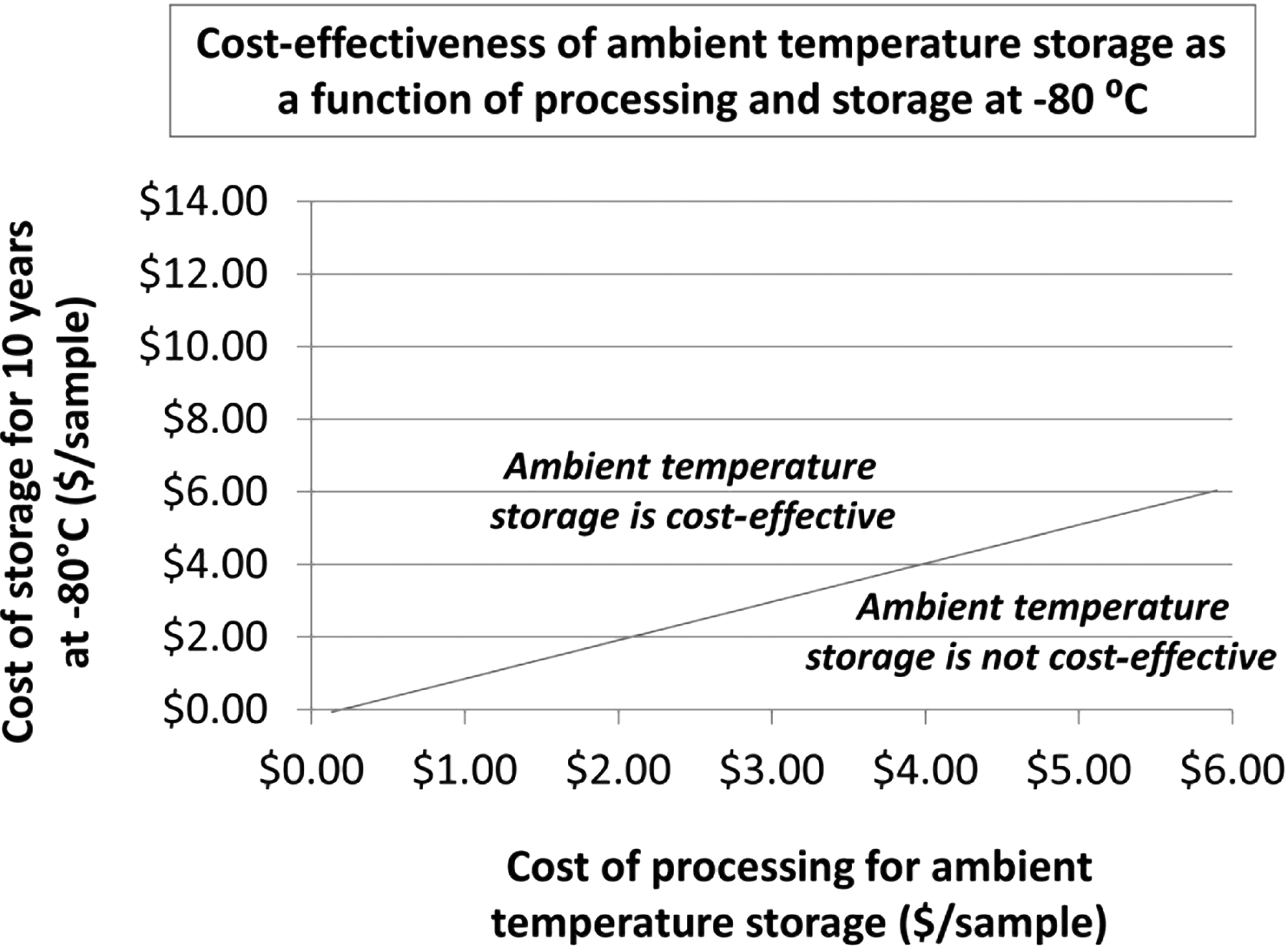
Cost-effectiveness of ambient temperature storage as a function of processing and storage at −80°C. Similar graphs need to be established on a case-by-case basis for different applications and different conditions.
Degradation of Nucleic Acids in an Aqueous Environment
Nucleic acid degradation in the frozen state
DNA and RNA in tissues degrade rapidly if not immediately frozen, mainly through the action of nucleases and reactive oxygen species triggered by cell death. 23 Tissue samples are generally archived at −80°C or −140°C in mechanical freezers or in liquid nitrogen at −196°C in Dewar cryogenic containers. Under these conditions, degradation is thought to be negligible. However, there is evidence that enzymatic activity continues at -80°C 24 and RNA degrades at −70°C. 25 Once DNA has been extracted from tissue, some reports indicate that freeze–thaw cycles can damage long molecules, probably through shearing of double-stranded DNA. 26 Single-strand breaks can also occur, and extensive degradation has been reported for synthetic oligonucleotides. 27
Nucleic acid degradation in solution
Purified DNA stored in the liquid phase can be degraded by multiple factors: water, UV light, ozone, oxygen, metabolites, and various co-purified contaminants (e.g., traces of metal ions, lipids, and polyphenols). Water is not only a reactant, but also allows oxidation processes. 28 These factors lead to DNA lesions such as depurination (a major degradation process), depyrimidination and deamination, base or sugar oxidation, cross-linking, and single-strand DNA breaks, which represent major threats to DNA preservation. Some of these factors provide a rich source of errors, which are ultimately perpetuated in the sequence during the amplification procedures commonly used in DNA analysis.
RNA is much more labile than DNA. It is degraded by the same chemical factors, but the main non-enzymatic, chain-breaking mechanism is a trans-esterification reaction initiated by an attack of the 3′-5′ phosphate by the ribose 2′ OH.29,30 Moreover, RNA is sensitive to trace amounts of RNAses that are prevalent in many environments and samples.
Stabilization of nucleic acids in tissues or in solution at ambient temperature
Commercial products for liquid stabilization
Stabilization of nucleic acids in the liquid phase at ambient temperature can be achieved by commercial reagents such as RNAgard, DNAgard, PAXgene (Qiagen), and Allprotect (Qiagen) for tissues, cells, and blood (Table 2). Novel biostabilizers have been developed (DNAstable Plus, Biomatrica) that reduce the hydrolysis in liquid so that purified DNA can be stored for 1 year at ambient temperature.
For highly accurate quantitative RNA analysis from blood samples, it is important to eliminate uncontrolled RNA synthesis and degradation, as well as non-enzymatic and RNAse-catalyzed reactions immediately after collection. Maintenance of the original RNA transcript levels in whole-blood samples under ambient temperature storage conditions without freezing has recently gained importance in biobanking applications. Progress in preserving the complete transcriptome during transport at ambient temperature has been shown for either 3 days (using Paxgene RNA) 31 or 14 days (using RNAgard).32,33
Other technologies
Several efficient stabilization procedures, primarily for DNA, have been described, such as solutions containing dimethyl sulfoxide, NaCl, EDTA, cetyltrimethyl ammonium bromide, ascorbate, trehalose, and sorbitol, 19 and lysis solutions (e.g., Tryzol™) or various alcohols.23,34 Tissue preservation in formalin is also being used. Nuclease activities are abolished, but formaldehyde induces degradation and cross-links in nucleic acids. However, analysis of short fragments remains possible (discussed further below).
Limits of the technologies
Most of the procedures described above are especially useful in the case of blood or tissue collection to avoid early degradation or changes in gene expression. For tissues, when immediate freezing is not possible, the technologies described above are suitable for short-term storage at ambient temperature. Short-term storage at ambient temperature is also needed for field collection and transportation of environmental specimens, when cold facilities are not available. For longer periods of storage of purified molecules, desiccation procedures are generally used to avoid cold storage.
Nucleic Acid Preservation in the Dry State at Ambient Temperature
The application of dehydration-based technologies to preserve the integrity of biological materials is improving the efficacy of non-temperature controlled storage. The basic premise of anhydrous preservation is the cautious removal of water from a sample containing anhydro-protectants in such a controlled manner that a stable matrix is formed, allowing storage at ambient temperature.9,10,35–37 This technology is well known in the food preservation and pharmaceutical industries.38–41
Preservation of nucleic acids
Preservation of dehydrated DNA in bones, teeth, and archaeological remains at ambient temperature has been convincingly demonstrated for samples that are 50,000–140,000 years old, 42 although retrieval of RNA from these samples has not yet been possible. It has been observed that the retrieval of DNA and its quality were less dependent on the age of the remains than on the environmental conditions.43,44 A rapid postmortem desiccation and an anoxic and/or anhydrous environment are fundamental for effective preservation. Removal of water increases the chemical stability of DNA, first by inhibiting hydrolysis and oxidation, and second by decreasing molecular mobility. However, in most cases, solid-state DNA contains enough water to promote depurination, base deamination, and oxidation. 45 Many “traditional” methods of preservation have evolved to handle a wide diversity of biomaterials by adapting low humidity platforms to improve storage procedures.
Blotting
Dry storage is of central importance to herbarium collections. Dried, preserved specimens document the identity of many thousands of plants and fungi.46–48 The practice of pressing plants between sheets of paper and drying them has been around for some 500 years.46,48 Such specimens are typically dried under conditions of low ambient humidity and good air exchange around and through the presses. The resulting pressed plants are then affixed to a sheet of cartridge or other archival quality paper for long-term storage. 46 While the preservation of herbarium specimens has been the subject of concern, 49 a simple and safe method using forced-air space heaters has been described for rapidly drying specimens of very high quality that is suitable for extraction of DNA. 50
Lyophilization
DNA preservation is fairly effective in lyophilized tissues. However, moisture and oxygen have been shown to lower DNA stability significantly.51,52 Exposure to moisture and oxygen is difficult to avoid because container closures such as rubber stoppers are not hermetic. Use of glass vials could ensure a hermetic seal, but the process is difficult to set up on a large scale, and the glass vials are fragile and difficult to ship and store. 53 RNA can also be retrieved after long-term storage of lyophilized tissues despite the faster degradation of RNA than DNA. 51
Lyophilized, purified DNA or DNA complexed with lipids can also be stored for long periods at ambient temperature, although the lyophilization process per se can promote some degradation. 54 Moreover, DNA redissolution may be very difficult, likely due to moisture exposure, which can be prevented by addition of sugars or hydroxylated polymers.55,56
Air or vacuum drying in the presence of matrix
A common and convenient procedure for nucleic acid dehydration is air-drying of ethanol precipitates or small volumes of solution. Vacuum drying allows a more thorough dehydration and use of larger volumes. However, even thoroughly dried DNA, if exposed to air, regains a fair amount of water: about 5 molecules per nucleotide at 50% relative humidity. 57 This has to be taken into account, since most areas of the northern hemisphere have a higher average relative humidity, possibly leading to a decrease of nucleic acid quality.58,59 A solution is to protect the sample inside an air- and water-tight container, as in the case of the DNA/RNAshell™ (Imagene) minicapsules.60,61
Air-exposed or air-protected samples can be stabilized through the use of matrix-forming compounds such as trehalose or commercial products such as DNAstable, 62 Gentegra™DNA, 63 or Allprotect™, 64 which are added to purified DNA prior to drying. Workable solutions for the stabilization of RNA in the presence of matrix such as RNAstable in the dry state have been tested for transport and storage at ambient temperature and low relative humidity, and short-term stability was reported.32,65
Compounds or reagents such as trehalose and DNAstable are thought to protect DNA through the formation of a synthetic glass matrix surrounding the individual nucleic acid molecules and occupying the hydrogen bonding sites. They may influence the Tg, and a higher glass transition temperature allows glass formation at higher humidity levels. Other mechanisms are possible. For instance, trehalose molecules and DNA have strong interactions leading to the formation of a rigid matrix contributing to decreased DNA molecular mobility and consequently to decreased degradation reaction rates.66,67 Finally, trehalose may act as a direct inhibitor of degradation reactions by acting as an antioxidant. 68 Also, due to its strong interaction with nucleic acids, trehalose may prevent deleterious elements from attacking them. 41
Other procedures
Other procedures to preserve nucleic acids include alcohol dehydration and paraffin embedding, or the use of solid supports. Formalin-fixed, paraffin-embedded tissues constitute a huge archival reservoir.69,70 In the classical, widely used procedure, tissue samples are first fixed in a formaldehyde-based solution and then dehydrated by organic solvents before being impregnated by paraffin. Although nucleic acids can suffer cuts and cross-links limiting analysis to short-range polymerase chain reaction (PCR), amplifiable fragments can be found after decades of storage.70–72
In recent years, non-aldehydic procedures of fixing tissues have been developed. Fixation is obtained by incubating tissues in alcohol solutions, sometimes containing additives such as acetic acid or trehalose. These procedures allow for extraction of high-quality DNA, but RNA degradation still occurs rather rapidly.68,73
A large number of archival specimens are also found as cells deposited on cellulose paper (in particular Guthrie cards) from where DNA, or in lesser measure RNA, can be extracted after extended periods of time.74–76 Several other procedures such as Bode Collectors™ and FTA™ paper use the same principle and present similar advantages and limitations, primarily because the papers need to be stored at low relative humidity for optimal performance.77,78
Other solid supports include gold microparticles, although moisture exposure has been shown to accelerate DNA degradation, and silica nanoparticles.79,80
Degradation rates at ambient temperature
It is fundamental to have an estimation of the shelf life of stored nucleic acids. However, for DNA, the rate of degradation at ambient temperature is difficult to assess, since it is relatively stable. In a recent report, the half-life at 10°C of a 242-nucleotide piece of ancient DNA was estimated to be 521 years. 81 More generally, an algorithm for estimation of the rate of DNA degradation in the solid state according to the “thermal age” concept82,83 has recently been developed by BioArCh, University of York. 83
Another method to determine degradation rate is to use extrapolations from studies run at high temperatures. It has been shown that the degradation rate of dehydrated DNA varies according to the Arrhenius equation.37,84 This means that in the temperature ranges used (70–140°C in Bonnet et al. 37 or 100–170°C in Vilenchik 84 ), there was no significant deviation due to changes in the physical state of the systems (such as a glass transition). From this work, one can calculate that at 25°C, after 50 years of storage, the average fragment size of genomic DNA would be 140,000 nucleotides if protected from the atmosphere, and 170 nucleotides if unprotected. 37 This means that after 50 years of storage at ambient temperature, DNA quality is sufficient for most analytical procedures, provided it is protected from the atmosphere. The degradation rate of dehydrated RNA also follows Arrhenius' law between 50°C and 130°C. 59 One can calculate that at 25°C, after 50 years of storage, the average fragment size of an RNA population would be 2,000 nucleotides when protected from the atmosphere; when unprotected, it could be 10–20 times smaller. 59
Seed Storage at Ambient Temperature
Seed storage is pertinent to the study of DNA at ambient temperature; in nature, seeds dehydrate naturally as part of their seasonal life cycle. This is an adaptive response that is manipulated to ensure that the genetic integrity and quality of seeds are maintained in artificial seed banks.
Seed banks play an important role in ex situ conservation, 85 as they are an efficient form of storage for many diverse species to preserve plant genetic resources in collections that hold the vast majority of crops. 86 Generally, storable seeds are defined as those that can be dried and do not die. Seeds that are tolerant of drying conditions are classified as “orthodox” seeds. Dried seeds can withstand the freezing process at sub-zero temperatures, and the aging process is slowed to extend storage time. Numerous gene-mediated responses are also involved in seed storage. 87
The international standards for long-term seed storage involve drying at 10–25°C and 10–15% relative humidity to a 3–7% moisture content followed by storage at −18°C, 88 which enables dried and frozen orthodox seeds to remain viable for tens or even hundreds of years. The Genebank standards for orthodox seeds have recently been updated to accommodate scientific advances for drying and storage. 86 While the modeling of seed longevity at sub-zero temperatures is challenging, cooling generally improves dry seed longevity; longer-term storage of short-lived orthodox seeds may well be facilitated by cryopreservation at ultra-low temperatures. 89 Seeds that are unable to survive drying cannot be stored frozen by long-term conventional methods, as their high water content results in the formation of intracellular ice, which is lethal to cells.
Species bearing desiccation-intolerant seeds are termed “recalcitrant” or intermediate in their storage behavior. 90 The ability of biospecimen science to expedite the ex situ conservation of recalcitrant seeds has been suggested to address problematic behavior during storage. 91 Cumulative osmotic stress models have been used to describe the dehydration kinetics of recalcitrant seeds under various drying conditions, 92 and further modeling has been explored to understand the critical factors during anhydrous preservation. 93
Validation of Ambient Temperature Methods
Validation of a processing/storage method
The evaluation of different storage systems should include the “future proofing” of biospecimen quality and stability.3,94 For storage under ambient conditions, it is necessary to determine the effect of variations in temperature and hydration status on the biological processes that contribute to storage instability, for example the propensity to generate reactive oxygen species at different storage temperatures. The use of tests and biomarkers to assess oxidative damage6,37 and molecular mobility may provide the evidence of sample quality upon long-term preservation. 95 Furthermore, careful control of moisture content and storage temperature is required because these are the major physical parameters that affect biospecimen stability.16,17,37,58
Biobank accreditation or certification to either national (e.g., CAP, NFS96-900) or international (e.g., ISO17025:2005, ISO15189:2007) standards require method validation.96,97 Method validation includes all the procedures and experiments performed in order to confirm that a method is fit for purpose. When changing operations to utilize a new technology, it is imperative to validate that samples are protected and that the new technology does not interfere with downstream applications. This is especially important in the case of ambient temperature stabilization, as these technologies typically involve addition of a reagent to the sample. The validation should follow a plan that includes assessment of the scope of the method and performance characteristics, and acceptance limits.
In the case of a specimen processing or storage method, the method validation should (1) confirm that the method is reproducible; (2) determine the method robustness; (3) show that specimens processed with the method are fit for downstream analysis, that is, the downstream analysis is feasible and accurate (this means there is no interference with the results due to the way the specimen was processed or stored); and (4) establish the stability of the samples processed or stored by the method through application of one or more assays.
Ambient temperature RNA storage
In the case of ambient temperature storage of RNA, relevant assays include (1) measure of the RNA integrity number (RIN); (2) measure of RNA yield (recovery); and (3) measure of RNA purity (OD260/280 ratio). RNA yield (recovery) and purity are measured by spectrophotometry. The most common assay for validation of RNA-related methods is determination of the RIN with the Agilent Bioanalyzer; RIN can range from 10 (intact RNA) to 1 (completely degraded RNA). 98 This measure, while simple, is insensitive to subtle changes, and analytical variability is not uncommon in a single laboratory (Betsou, unpublished data). Additionally, most applications require a minimal RIN (e.g., 7 or 8 for microarrays or RNA-seq), but the impact of changes in RIN on downstream applications is not well understood. For example, the RNA-seq technology can be adapted to obtain reliable results from degraded samples. 99
Reproducibility
Several RNA sample(s) should be split into different aliquots with each processed/stored independently, and the yield, purity, and RIN of all final (post-processing) RNA samples should be measured. The objective is to verify that the ambient temperature storage method produces samples with reproducible characteristics. The ambient temperature storage method is reproducible if the coefficient of variation (CV%) of the endpoints measured for each RNA sample is lower than the analytical method's combined uncertainty.
Robustness
Robustness represents the capacity to remain unaffected. Several sample(s) should be split into different aliquots with each submitted to different “stress” conditions and then tested by the assays described above. Stress conditions include temperature or humidity levels higher than those recommended by the manufacturers (“baseline conditions”). A method is robust to the stress conditions when the differences from the “baseline” results are smaller than the method's analytical uncertainty.
Compatibility with downstream application(s)
A more precise but less comprehensive method to validate the quality of RNA is targeted real-time qualitative reverse transcription (qRT)-PCR. This methodology tests transcripts from one gene at a time. A primary use of real-time qRT-PCR is to identify effects on a downstream application (e.g., could be caused by a chemical used in the room-temperature storage technology). Additionally, qRT-PCR data can be used to identify degradation of a particular RNA transcript. RNA degradation can vary depending on the nucleases present and random hydrolysis. Therefore, transcripts from multiple genes should be validated, and oligonucleotide primers should be designed for various regions of each gene to be tested (both 5′ and 3′). 100 In this case, it should be confirmed that the results, in terms of relative or absolute quantification of selected gene targets, are not significantly different from those obtained from RNA samples preserved by methods considered the gold standard (i.e., cryopreservation). Acceptance criteria should be less than 1 cycle threshold (Ct) different from the results obtained using the gold-standard conditions. This corresponds to twice the Ct threshold deemed acceptable for technical replicates of the same samples in real-time PCR. 101 Ambient temperature storage technologies should be validated for each downstream application (e.g., qRT-PCR analysis, microarray analysis, and RNA-seq analysis).17,65,102,103
Stability studies
Stability of a biological material refers to its ability to retain its properties and performance over a specified time interval when stored under specified conditions, that is, ambient temperature and relative humidity. In the case of a specimen storage method, stability is examined in terms of sample stability during long-term storage. This can be achieved using either real-time or accelerated aging studies, and assessment is done by performing specific assays.
Instability resulting in a change in RNA yield, purity, RIN, or gene expression level of 0.3san (san is the analytical uncertainty of the corresponding assay being used) is considered non-significant. 97 RNA stability is assessed using the last test date at which acceptance criteria are met that precedes two consecutive test dates where failure occurs. Preferably, the experimental and control aliquots are analyzed together, in the same run, if isochronous testing is feasible. A minimum of three test points (beginning, middle, and end) are used, equally spaced across the study's duration. The frequency of testing under at the long-term storage conditions can be every 3 months over the first year, every 6 months over the second year, and annually thereafter through the proposed retest period. As much as possible, real-time studies are preferable for estimating stability over a given storage time period.
One major limitation of stability studies is the length of time involved. Biobanks typically plan to store samples for years or decades, and it is unreasonable to wait this length of time to complete the validation of new storage technologies. For this reason, stability studies often use higher storage temperatures to simulate longer storage times, a technique known as accelerated aging. As an approximation, an increase of 10°C simulates a doubling of time. However, this assumes that the activation energy for the studied degradation reaction is around 16 kcal/mol, which is generally not the case. 104 Another important point to take into account, especially for nucleic acids, is the fact that heating leads to dehydration. So if the relative humidity is not controlled, the stability at high temperature will be overestimated. For instance, it has been reported that if relative humidity is not controlled, DNA can appear more stable at 56°C than at ambient temperature. 105 Rigorous accelerated aging studies with relative humidity control are thus appropriate to simulate aging provided that the real-time parameters are constant over the whole study (in particular, a constant percentage of relative humidity at all temperatures).
Once all the above work has been successfully performed, ambient temperature methods can be considered “validated.”
Conclusion
Large collections of stable biospecimens are essential to basic, translational, and clinical research. In this review, possible cost-efficient and logistically attractive alternative methods for ambient temperature storage of biospecimens are discussed. The ability to stabilize biosamples at ambient temperature for extended periods of time may present operational advantages, both for long-term storage and for sample shipment. There is a critical need for stabilization technologies that provide cost-effective and simple ambient temperature storage of biological samples and do not require cold logistics or complicated sample recovery protocols.
Footnotes
Acknowledgments
The 2014 Biospecimen Science Working Group (BSWG) consisted of Fay Betsou (chair), Erica Benson, Alexandre Bulla, Rodrigo Chuaqui, Judith Ann Clements, Domenico Coppola, Yvonne De Souza, Annemieke De Wilde, James Eliason, Barbara Glazer, William Grizzle, Elaine Gunter, Keith Harding, Verity Hodgkinson, Allison Hubel, Olga Kofanova, Theresa Kokkat, Iren Koppandi, Jacqueline Mackenzie-Dodds, Rolf Muller, Rebecca Pugh, Vinagolu Rajasekhar, Katheryn Shea, Amy Skubitz, Mark Sobel, Stella Somiari, Gunnel Tybring, Klara Valyi-Nagy. John H. Crowe and Jacques Bonnet are not members of the BSWG; both have significantly contributed to the article.
Author Disclosure Statement
R.M. worked for Biomatrica. J.B. works for Imagene. F.B., M.G.B., K.H., O.K., and J.H.C. have no conflicts of interest to declare.