




Abstract
Background:
Inappropriate handling of blood samples might induce or repress gene expression and/or lead to RNA degradation affecting downstream analysis. In particular, sample transport is a critical step for biobanking or multicenter studies because of uncontrolled variables (i.e., unstable temperature). We report the results of a pilot study implemented within the EC funded SPIDIA project, aimed to investigate the role of transport and storage of blood samples containing and not containing an RNA stabilizer.
Methods:
Blood was collected from a single donor both in EDTA and in PAXgene Blood RNA tubes. Half of the samples were sent to a second laboratory both at room temperature and at 4°C, whereas the remaining samples were stored at room temperature and at 4°C. Gene expression of selected genes (c-FOS, IL-1β, IL-8, and GAPDH) known to be induced or repressed by ex vivo blood handling and of blood-mRNA quality biomarkers identified and validated within the SPIDIA project, which allow for monitoring changes in unstabilized blood samples after collection and during transport and storage, were analyzed by RT-qPCR.
Results:
If the shipment of blood in tubes not containing RNA stabilizer is not performed under a stable condition, gene profile studies can be affected by the effects of transport. Moreover, also controlled temperature shipment (4°C) can influence the expression of specific genes if blood is collected in tubes not containing a stabilizer.
Conclusion:
The use of dedicated biomarkers or time course experiments should be performed in order to verify potential bias on gene expression analysis due to sample shipment and storage conditions. Alternatively, the use of RNA stabilizer containing tubes can represent a reliable option to avoid ex vivo RNA changes.
Introduction
B
Whole blood is a complex mixture of various cell types in which the relative distribution of white blood cells may differ substantially between normal and pathological subjects. Furthermore, gene expression in these cells may be affected by several factors that can either induce or repress gene expression, or lead to degradation of RNA if the blood is not handled properly upon sampling.1–4 Reliable quantification of mRNA levels for epidemiological, diagnostic, prognostic, and therapeutic purposes requires optimal RNA quality and quantity and optimized procedures for blood collection and preservation, in order to maintain the RNA profile consistent to the collection time.5,6 In order to prevent both in vitro RNA degradation and gene expression changes that can induce under- or overestimation of gene expression analysis, dedicated blood collection tubes containing RNA stabilizer can be used.6,7
SPIDIA is a four-year large-scale integrated project funded by the European Commission that involved studies of the standardization and improvement of pre-analytical procedures for in vitro diagnostics in order to close the gap between the more fully developed analytical procedures and the less standardized pre-analytical processes. A SPIDIA key aim was to develop external quality assessment schemes (EQAs) for the collection, transport, and processing of blood samples for RNA-based analyses.2,3 The results of these EQAs represented the basis for the development of guidelines and the blood mRNA quality biomarkers.
Before the implementation of the massive SPIDIA EQAs (involving more than 200 laboratories), we performed a pilot study specifically aimed to test the influence of transport and storage on the transport level of RNA extracted from blood samples collected in tubes containing and not containing RNA stabilizer. We analyzed gene expression of selected genes (c-FOS, IL-1β, IL-8, and GAPDH) known to be induced or repressed by ex vivo blood handling6,8–10 and of blood-mRNA quality biomarkers identified and validated within the SPIDIA project, which allow changes monitoring in unstabilized blood samples after collection and during transport and storage. 11
Materials and Methods
Study design
The study was implemented at a SPIDIA facility (University of Florence, Florence, Italy) using the blood collected from a single adult donor after approval by the Institutional Committee of Azienda Ospedaliero-Universitaria Careggi (Florence, Italy). The written informed consent was obtained. 461 mL of venous whole blood was collected into a blood collection bag (MacoPharma) prefilled with K3EDTA (1.79 mg/mL) kindly supplied by Becton Dickinson (BD, Plymouth, UK). Blood was transferred into a sterilized flask, mixed under gentle mixing conditions while cooled on ice, and immediately aliquoted into both RNA stabilizer containing tubes (PAXgene, PAXgene® Blood RNA tube, PreAnalytiX, Hombrechticon, n = 34, 2.5 mL blood/tube) and in tubes without RNA stabilizer (EST, Vacutainer® Evacuated Secondary Tubes, BD, n = 34, 3 mL blood/tube).
In order to monitor the effect of sample shipment, 16 EST and 16 PAXgene tubes were shipped both at room temperature (RT) and at 4°C to a SPIDIA laboratory in Germany (Qiagen GmbH, Hilden, Germany), using an international courier; the remaining tubes were stored at the SPIDIA facility in Florence. For the controlled temperature shipment, a dedicated box containing ice gel packs specific for temperature preservation (2°–8°C) for 48 h was used. The shipment was performed immediately after blood collection.
At the SPIDIA facility, blood samples were stored at the defined temperatures (RT and 4°C) and RNA was extracted at the pre-defined time points. The samples shipped to the SPIDIA laboratory were kept at room temperature and at uncontrolled temperature (storing samples in the same shipping box, containing ice gel packs) in order to mimic a delayed delivery. Samples were then processed at the same pre-defined time points. In particular, RNA extraction was performed immediately after blood collection to obtain corresponding time zero (T0) at the SPIDIA facility, and at 1, 2, 3, and 4 days after blood collection at the SPIDIA facility and at SPIDIA laboratory. For each storage time point, RNA was extracted from blood collected in two PAXgene and in two EST tubes. RNA samples extracted at the SPIDIA laboratory were returned to the SPIDIA facility in dry ice (Fig. 1).
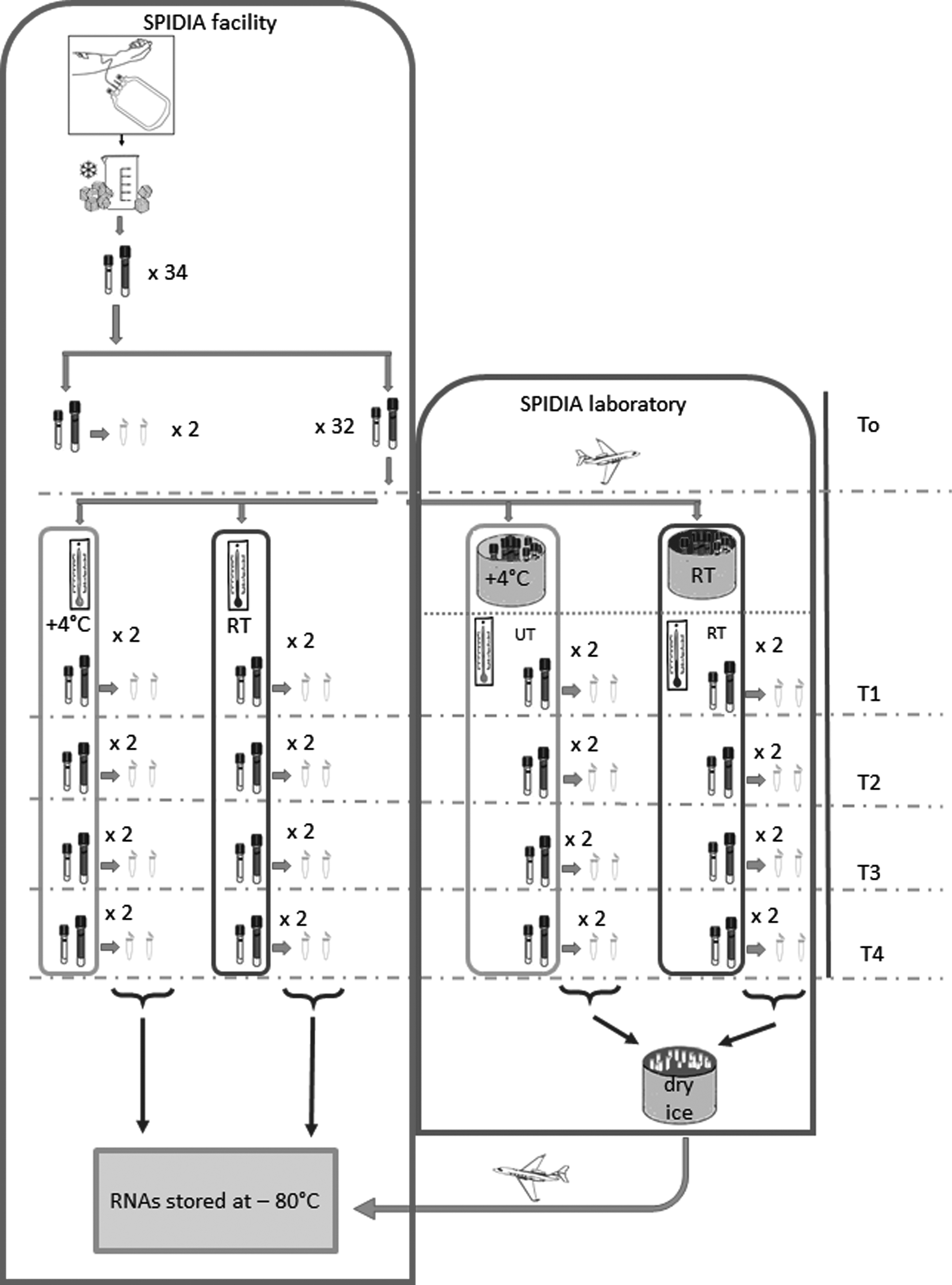
Schematic general workflow of the pilot study. At the SPIDIA facility, blood was collected from a single donor and aliquoted in tubes with and without RNA stabilizer. Blood samples were sent to SPIDIA laboratory in two different shipping boxes (RT and 4°C, respectively). At SPIDIA facility blood samples were stored at 4°C and at room temperature (RT); at SPIDIA laboratory, blood samples were stored at RT at uncontrolled temperature (UT), storing samples in the shipping box. Extracted RNA samples were sent back to SPIDIA facility in dry ice and stored at −80°C until analysis. T0 = RNA extracted immediately after blood collection; T1, T2, T3, and T4 = Time period (days) between blood collection and RNA preparation.
RNA extraction procedure
In order to reduce the influence of the RNA extraction procedure on RNA quality, all samples were extracted using the PAXgene Blood RNA kit (Qiagen), following the manufacturer's instructions, both at the SPIDIA facility and laboratory.2,3 Regarding RNA extraction from EST tubes, 2.5 mL of blood were transferred at the defined time point to a PAXgene Blood RNA tube, incubated for 2 hours and extracted using the PAXgene Blood RNA kit following the manufacturer's instructions. The extracted RNAs were stored at −80°C until the analysis.
RNA yield and purity
RNA purity (260/280 nm ratio) and concentration were measured by NanoDrop® 1000 UV spectrophotometer (NanoDrop Technologies).
RNA integrity
One μL of extracted RNA was analyzed by RNA 6000 Nano reagents and RNA Nano chips (Agilent Technologies) on an Agilent Bioanalyzer 2100 (Agilent Technologies). The RIN (RNA Integrity Number) score was evaluated by the software algorithm (version B02.02.S1238, Agilent Technologies).
Gene expression
Selected genes
For the evaluation of c-FOS, IL1β, IL8, and GAPDH expression, 400 ng of total RNA was reverse transcribed using a TaqMan Reverse Transcription Reagents kit (Life Technologies) and, for each sample, 12.5 ng of cDNA was added to 10 μL of PCR mix containing a primer set and 1 × Universal PCR Master Mix (Life Technologies). Primers and probes for GAPDH (Pre-Developed TaqMan® Assay Reagents, P.N. 4326317E), IL1β, IL8, and c-FOS (TaqMan Gene Expression Assay; Hs00174097_m1, Hs99999034_m1, and Hs00170630_m1, respectively) were from Life Technologies. Samples were incubated for 10 min at 95°C, then to 40 cycles of amplification at 95°C for 15 s, and 60°C for 60 s in the 7900HT Fast Real-Time PCR System (Life Technologies).
The amount of each target gene was evaluated using a standard curve. Each standard was obtained by cloning a cDNA fragment of the specific gene (c-FOS, GAPDH, IL1β, and IL8) into the plasmid pCR®2.1-TOPO® (Life Technologies). Each standard curve was generated by plotting the mean Cq of the technical replicates versus the logarithm of the known starting concentration. Samples and standards were measured in triplicates. The gene quantity was calculated as log10 (copies/μg total RNA).
12
Gene expression changes at each time point with respect to T0 were computed as follows:
Tx = RNA extraction time after blood collection; x = 1, 2, 3, 4 days.
EDTA quality biomarkers
Quality biomarkers for the evaluation of unstabilized blood samples, developed and validated within the SPIDIA project, were analyzed in addition to the selected genes. 11 For gene expression analysis of the upregulated (TNF, LMNA, and FOSB) and downregulated (TNRFSF10c) biomarkers, as well as for the three housekeeping genes (GAPDH, GUSB and PPIB) the reverse transcription was performed using the High Capacity cDNA Reverse Transcription Kit (Life Technologies) with random hexamers. Manufacturer's instructions were followed using 1 μg RNA in 100 μl reaction volume.
For quantitative PCR (qPCR), 2 μL of cDNA was added in a total volume 20 μL containing Quantitect probe PCR master mix (Qiagen), 100 nM TaqMan probe, 400 nM forward and reverse primers, and water and performed with the protocol as follows: activation at 95°C for 15 min and amplification for 50 cycles at 95°C for 15 s and at 61°C for 90 s, in the 7900HT Fast Real-Time PCR System (Life Technologies).3,11 All samples were analyzed in triplicate. qPCR assay design for both biomarkers and housekeeping genes are reported by Zhang et al. 11
The expression of LMNA, TNF, FOSB, and TNRFSF10c was evaluated relatively to the mean of the three housekeeping gene transcripts (GUSB, PPIB, GAPDH) and calibrated versus the T0 sample according to the comparative ΔΔCq method
13
as follows:
where “meanref” is the mean of the Cq values of the three housekeeping genes. 3
Tx = RNA extraction time after blood collection; x = 1, 2, 3, 4 days
Gene expression change at each time point with respect to T0.
Statistical analysis
In order to evaluate the influence of transport/temperature on gene expression, we implemented for each gene a two way ANOVA model 14 with the factor “tube” (EDTA, PAX) and the factor “modality of shipment” (no shipment (T0), shipment at 4°C and shipment at RT) with the first order interaction term. In this model the quantity and the ΔCq value (ΔCq = Cqbiomarker – Cqmeanref) for the selected genes and the biomarkers were considered as response variables, respectively. Within the modalities of the factor “tube”, the contrasts between gene expression at T0 and gene expression after 1 day shipment at RT or 4°C were considered to evaluate the shipment/temperature effect.
In order to assess the influence of storage conditions on the gene expression over time, a further two-way ANOVA model was implemented with the factors “time” (1, 2, 3, 4 days) and “storage conditions” (4°C, RT shipped or not shipped, uncontrolled temperature) with the first order interaction term. In this model the gene expression change respect to T0 was considered as a response variable.
The test for simple main effects for the factor “time” within each storage condition was used to evaluate if the gene expression change was affected by the adopted storage condition over time. In both models, to account for multiple comparisons, a Bonferroni adjusted alpha level was considered. Statistical analysis was performed using SAS software v. 9.2 (SAS Institute Inc. Cary, NC).
Results
Sample shipping
Effects on RNA Integrity Number (RIN) and RNA yield
RNA yield of all samples, both those extracted from blood stored at the SPIDIA facility, as well as those purified from shipped blood specimens, is reported in Supplementary Table S1 (Supplementary material is available online at www.liebertpub.com). We observed a quite heterogeneous distribution of the results, though we did not identify a systematic trend.
All samples showed RIN values higher than 5 except samples not shipped and stored at RT for 4 days. A RIN value of 5 is the cut off reported by Fleige et al.15,16 to distinguish RNA samples that can undergo qPCR analysis, and a slight decrease was observed over time (Supplementary Table S2). Thus, in our context, the shipment of blood at both 4°C and room temperature, independent of blood collection tube, caused no significant RNA degradation or systematically affected RNA yield.
Effects on gene expression
In order to study the role of sample shipping, we compared the obtained transcript levels for each selected and biomarker genes in samples shipped at 4°C or RT, and processed immediately after arrival (one day after blood collection), to the T0 sample obtained at the SPIDIA facility. The results of this comparison are reported in Supplementary Table S3 and Supplementary Figure S1.
In particular, for all the considered genes, no effect of shipment at 4°C in samples collected in tubes not containing RNA stabilizer was observed, with the exception of TNF (p = 0.0006). Conversely, shipment of tubes not containing stabilizer at RT had significant effects on all the genes with exception of GAPDH and TNFRSF10c. The shipment of PAXgene tubes both at RT and at 4°C had no effect on gene expression, even if LMNA expression slightly increased in comparison to T0 at RT with a borderline p value (p = 0.0052).
Sample storage after arrival
In order to study the role of storage conditions on the gene expression over time, we compared the transcript time profile (1, 2, 3, 4 days after blood collection) within each of the considered storage conditions at the SPIDIA facility and after arrival at the SPIDIA laboratory.
The gene expression profile in blood collected in PAXgene tubes showed no relevant changes for all the tested genes (Supplementary Figures S2 and S3). On the contrary, sample storage of EDTA tubes influenced the gene expression profile, as described below (see also Supplementary Table S4 and Supplementary Fig. S4).
Selected genes
In samples stored at RT both at the SPIDIA facility and laboratory, c-FOS gene expression increased within 1 day from collection and then decreased (p < 0.0001). For samples stored at room temperature after shipment at 4°C, the gene expression slightly changed over time with respect to T0 (p = 0.0004). On the contrary, samples stored at 4°C at the SPIDIA facility showed a stable c-FOS expression (Fig. 2A) in comparison to T0.

Gene expression of selected genes depending on time after blood collection evaluated respect to T0 (gray line in the graph, corresponding to “0” value in y-axis).
GAPDH gene expression was not statistically different over time in all the considered storage conditions, as expected for a housekeeping gene (Fig. 2 B).
IL1β gene expression was statistically different over time for all the tested conditions (at RT without shipment p = 0.0003, for the other conditions p < 0.0001) (Fig. 2C).
IL8 transcript levels were not statistically different over time in samples not shipped and stored at 4°C, whereas its expression significantly increased over time in the other considered conditions (p ≤ 0.0001) (Fig. 2D).
EDTA quality biomarkers
Upregulated EDTA biomarkers
LMNA, TNF, and FOSB transcript levels (Fig. 3A, B, and 3C, respectively) significantly increased over time in blood stored at RT or shipped and stored both at RT and uncontrolled temperature (p < 0.001). No significant gene expression change was observed in blood samples stored at the SPIDIA facility at 4°C.
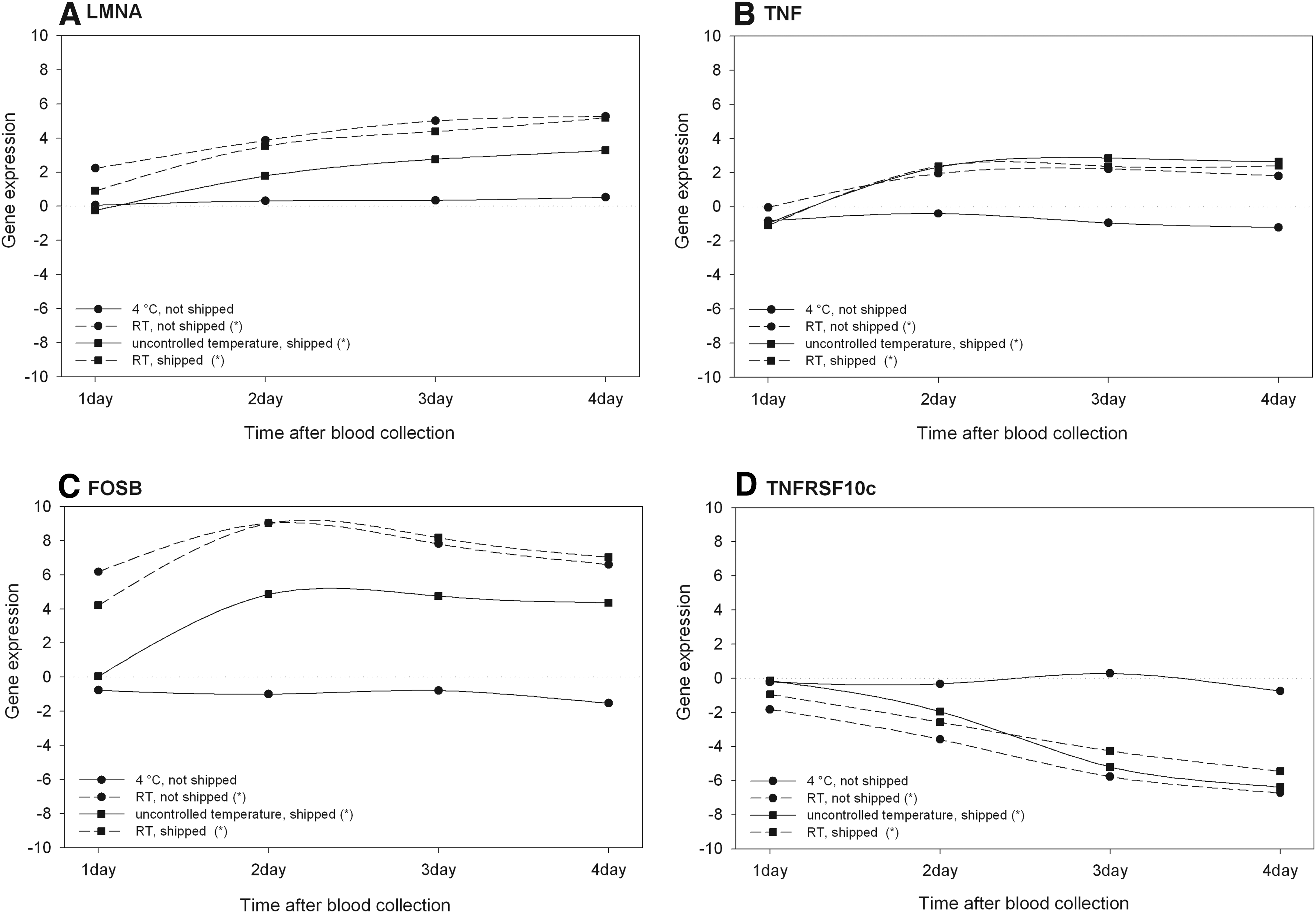
Gene expression of EDTA quality biomarkers depending on time after blood collection evaluated respect to T0 (gray line in the graph, corresponding to “0” value in y-axis).
Downregulated EDTA biomarker
TNFRSF10c gene expression was not statistically different over time if blood samples were stored at 4°C without shipping. When blood was stored at RT or shipped (both at RT or at 4°C) and stored at room temperature, the transcript level significantly decreased (p < 0.0001, for all conditions) (Fig. 3D).
Discussion
Pre-analytical variables play a crucial role on RNA stability, which is an essential requisite for gene expression studies. RNA degradation by endogenous RNases as well as expression of deregulated genes after blood drawing can alter gene expression signature, inducing a misinterpretation of mRNA analysis results. 17 The availability of blood collection devices containing RNA stabilizers, such as PAXgene Blood RNA Tubes and Tempus™ Blood RNA Tubes, significantly improved overall RNA quality.6,7,18 However, these specific blood collection tubes are quite expensive in comparison to blood tubes without stabilizer, and they require dedicated kits for RNA extraction. This is probably the main reason why most of the appropriately queried participants of the SPIDIA RNA EQAs,2,3 Pan European External Quality Assessments implemented within SPIDIA project, claimed to routinely adopt EDTA blood collection tubes for their gene expression studies.
Before starting the massive EQAs, in which each participant received the blood sample in the collection tube according to his request (containing or not-containing RNA stabilizer), we performed an internal pilot study aimed to investigate the role of blood transport. Transport of biospecimens is a critical step for biobanking or multicenter studies because of uncontrolled variables (i.e., unsettled temperature, sample shaking, shipment duration), and dedicated transport at defined time or at defined temperature is often expensive.
In our study, in order to prevent changes in expression signature due to the donor-related biological variability, blood was collected from a single donor in EDTA and aliquoted in empty tubes (to mimic EDTA collection tubes) and in PAXgene Blood RNA tubes. Shipping to a SPIDIA partner laboratory was carried out by an international courier using two different packages, in order to keep blood samples both at room temperature and at 4°C. The delivery to the remote laboratory occurred approximately 24 h after the shipment. To improve the reproducibility of the results, RNA extraction was performed using the same extraction procedure both at the SPIDIA facility and at the SPIDIA laboratory, and RT-qPCR analyses were carried processing all the RNA samples at the SPIDIA facility. 19
RNA quality (yield and RIN) was not influenced by shipping (Supplementary Tables S1 and S2). Nevertheless the RIN score, evaluated using the Agilent Bioanalyzer, is mainly based on rRNA features and does not represent a specific quality score for mRNA, 20 which is the target for gene expression studies. It is increasingly recognized 11 that pre-analytical factors can affect the quality of mRNA molecular based analysis,2,3 and this is particularly true for very sensitive analytical procedures such as qPCR. 19 A series of transcripts previously identified as up- and downregulated in blood collected in EDTA tubes after blood drawing,6,11 together with a set of validated biomarkers for monitoring ex vivo changes in gene expression developed within the SPIDIA project, 11 have been used as molecular targets to monitor the effects of blood shipment and storage on RT-qPCR results.
We had already observed a statistically significant variation for some of the target genes (both selected and biomarkers) in blood collected in EDTA tubes during the analysis of the second SPIDIA RNA EQA, 3 but in this pilot study we focused only on the influence of blood sample transport, having used a single donor and a single RNA extraction procedure instead of different extraction methods such as in the SPIDIA EQAs, in which every laboratory used its own purification protocol.
Shipment at RT of tubes without RNA stabilizer had significant effects on almost all the tested genes, with a few exceptions such as GAPDH (an extensively used housekeeping gene) and TNFRSF10c (Supplementary Table S3 and Supplementary Fig. S1). On the other hand, we observed that none of the tested genes was affected (no ex vivo changes observed) if blood transport occurred at 4°C in tubes not containing RNA stabilizer with the exception of TNF gene (Supplementary Table S3 and Supplementary Fig. S1). This fact indicates that even a 4°C shipment could influence gene expression analysis of specific target genes. Shipment of PAXgene Blood RNA tubes both at RT and at 4°C generally had no effects on gene expression. Only LMNA showed a slight increase (in comparison to T0) at RT (Supplementary Table S3 and Supplementary Fig. S1).
We also investigated the post-arrival storage influence on gene expression at inappropriate blood sample storage conditions such as RT or uncontrolled temperature. For all the tested genes, we observed (in RNA samples derived from EDTA tubes) a significant up- or downregulation over time, indicating that even samples in which no effects were detected due to the transport (tested by the analysis of RNA samples extracted immediately after the arrival) could show significant ex vivo changes due to the temperature storage before RNA extraction (Fig. 2, Fig. 3, Supplementary Table S4 and Supplementary Fig. S4).
In conclusion, when blood is collected in tubes not containing RNA stabilizer, gene profile studies can be affected by the conditions of transport if the sample shipment is not performed under settled conditions (i.e., 4°C and 24 h delivery). Moreover, expression of specific genes can be influenced also by a controlled temperature shipment. The use of dedicated biomarkers or time course experiments should be performed in order to verify potential bias on gene expression analysis due to sample shipment and storage conditions. Alternatively, the use of RNA stabilizer containing tubes can represent a reliable option to avoid ex vivo changes of the RNA profile.
Footnotes
Acknowledgments
Grant/funding support: The SPIDIA RNA study has been supported by European Union (FP7. Title “SPIDIA: Standardization and improvement of generic pre-analytical tool and procedures for in vitro diagnostic,” Grant agreement no. 222916).
Author Disclosure Statement
No conflicting financial interests exist.
References
Supplementary Material
Please find the following supplemental material available below.
For Open Access articles published under a Creative Commons License, all supplemental material carries the same license as the article it is associated with.
For non-Open Access articles published, all supplemental material carries a non-exclusive license, and permission requests for re-use of supplemental material or any part of supplemental material shall be sent directly to the copyright owner as specified in the copyright notice associated with the article.
