




Abstract
Background:
Umbilical cord blood is an economical and easy to obtain source of high-quality neonatal genomic DNA. However, although large numbers of cord blood samples have been collected, information on the yield and quality of the DNA extracted from cord blood is scarce. Moreover, considerable doubt still exists on the utility of the buffy coat instead of whole blood as a DNA source.
Methods:
We compared the sample storage and DNA extraction costs for whole blood, buffy coat, and all-cell pellet. We evaluated three different DNA purification kits and selected the most suitable one to purify 1011 buffy coat samples. We determined the DNA yield and optical density (OD) ratios and analyzed 48 single-nucleotide polymorphisms using time-of-flight mass spectrometry (TOF MS). We also analyzed eight possible preanalytical variables that may correlate with DNA yield or quality.
Results:
Buffy coat was the most economical and least labor-intensive source for sample storage and DNA extraction. The average yield of genomic DNA from 200 μL of buffy coat sample was 16.01 ± 8.00 μg, which is sufficient for analytic experiments. The mean A260/A280 ratio and the mean A260/A230 ratio were 1.89 ± 0.09 and 1.95 ± 0.66, respectively. More than 99.5% of DNA samples passed the TOF MS test. Only hemolysis showed a strong correlation with OD ratios of DNA, but not with yield.
Conclusion:
Our findings show that cord blood buffy coat yields high-quality DNA in sufficient quantities to meet the requirements of experiments. Buffy coat was also found to be the most economic, efficient, and stable source of genomic DNA.
Introduction
W
However, Gail pointed out in 2013 that the buffy coat yields only half as much DNA as whole blood or all cell pellet (ACP), which agrees with our results (Supplementary Table S1; Supplementary Data are available online at www.liebertpub.com/bio). To maximize the DNA yield, researchers use ACP rather than buffy coat. 1 However, because the volume of whole blood or ACP is much larger compared with the buffy coat, storage of whole blood or ACP would consume several times the costs of storing buffy coat and would require considerably more storage tubes, refrigerator or freezer space, bar codes, boxes, shelves, and labor (for aliquoting and sample management). Importantly, the DNA extraction process will become much more expensive and labor intensive. Therefore, the following questions are worth considering: (1) What is the common range of DNA yield from cord blood buffy coat collected by the birth cohort studies? Is the yield sufficient for subsequent studies? (2) Should whole blood or ACP, which are expensive, but yield more DNA, be stored instead of buffy coat? The answers to these questions will help researchers in designing appropriate procedures for blood sample collection and balancing costs and DNA yield.
Most of the downstream experiments not only have specific requirements for DNA quantity but also have specific criteria for DNA quality. Low DNA concentration or poor quality creates challenges in the research process, which can lead to false experimental results.9,10 Researchers would benefit from knowing if the DNA extracted from buffy coat meets the requirements for the chosen experimental method as it would help to improve the approach to sample storage. Unfortunately, only few publications have addressed the quality or yield of DNA extracted from cord blood buffy coat; however, several reports have discussed the yield and quality of the DNA extracted from peripheral blood buffy coat.5,6 Mychaleckyj et al. isolated 120 buffy coat samples for a clinical trial to assess the quality of DNA stored up to 9 years and analyzed several possible predictive factors that may influence DNA yield. 5 Caboux et al. extracted DNA from 50,000 peripheral buffy coat specimens and pointed out several factors that significantly influenced DNA yield. 6
In this work, we focused on the quantity and quality of the cord blood buffy coat collected by birth cohort studies. We compared the costs for storage of and DNA extraction from whole blood, buffy coat, and ACP. We isolated the genomic DNA of 1011 buffy coat specimens collected from a birth cohort and identified 48 single-nucleotide polymorphisms (SNPs) using time-of-flight mass spectrometry (TOF MS). Next, we analyzed whether eight perinatological factors would significantly affect the yield and quality of the DNA. In short, we investigated whether cord blood buffy coat would be a good source for DNA-based experiments and whether it is the best format for blood storage.
Methods
Sample collection and information retrieval
The samples and their associated information were obtained from a birth cohort study conducted at the Shanghai Xinhua Hospital and Shanghai International Peace Maternity and Child Health Hospital. Cord blood was collected from 1011 newborns, and information of the newborns and their mothers was obtained through a questionnaire survey and medical history. All the puerperae signed informed consent forms, and the protocol was approved by the Xinhua Hospital Institutional Review Board.
The cord blood was collected by the midwife with a No. 20-gauge needle. Within 10 minutes after birth, 20 mL cord blood was drawn from the umbilical cord into a single-use syringe and injected into an EDTA-K2 anticoagulation vacuum blood tube and a coagulation vacuum blood tube. The tubes were inverted 5–6 times and transported in a cold (around 10°C–18°C) container to the laboratory. The blood was centrifuged for 5 minutes at 1100 g and 4°C and fractionated into serum/plasma, buffy coat, red blood cells, or clot. If the buffy coat and red blood cells were not separated, they were called ACP. These fractions were aliquoted into 1.2-mL storage tubes and placed in −80°C freezers for long-term storage. The whole process from collection to storage was completed within 90 minutes.9,11 Basic sample information, questionnaires, and medical histories were collected.
DNA purification, quantification, and quality determination
After 6 months of storage at −80°C, the buffy coat specimens were retrieved and purified for genomic DNA extraction. We used whole blood DNA purification kits to extract the DNA from the buffy coat samples. We evaluated the QIAamp DNA blood Mini Kit (Cat. No. 51106; Qiagen), RelaxGene Blood DNA System (0.1–20 mL, Cat. No. DP319-01; Tiangen), and AxyPrep Blood Genomic DNA Miniprep Kit (Cat. No. AP-MN-BL-GDNA-50; Axygen) and selected the most suitable one for batch extraction. All kits were used according to the manufacturer's instructions. Each kit required 200 μL of buffy coat sample. We measured the concentration, A260/A280 ratio, and A260/A230 ratio of the DNA solution using an Epoch Multi-Volume Spectrophotometer System (BioTek, Inc.).12–14
SNP analysis using TOF MS
We selected 48 SNPs for analysis. We used the MassARRAY designer software to automatically design both polymerase chain reaction (PCR) and MassEXTEND primers for multiplexed assays. 15 Genomic DNA was amplified by PCR. We used a mixture of chain-terminating ddNTPs in a primer extension assay designed to detect sequence differences at the single-nucleotide level. The primer was extended depending upon the template sequence, resulting in an allele-specific difference in mass between the extension products, allowing differentiation between SNPs. Samples were transferred into the 384 SpectroCHIP, and the mass and correlating genotype were determined in real time. The results were automatically loaded into a database that allows convenient data analysis.
Preanalysis factors and data analyses
We chose five of the most common perinatological factors—three for the puerpera (gestational week, delivery mode, and pregnancy complication) and two for the newborn (sex and birth weight)—and determined their correlation with the DNA yield and optical density (OD) ratios. According to the perinatological definition, we divided the newborns into three groups based on their birth weight: <2500 g (underweight), 2500–4000 g (standard), and >4000 g (overweight). The puerperae were divided into two groups based on their gestational weeks: <37 weeks (premature delivery) and ≥37 weeks (nonpremature delivery). We collected information on pregnancy complications, including gestational hypertension, gestational diabetes, preeclampsia, placenta previa, placental abruption, threatened abortion, intrauterine growth restriction, and other complications. Based on this information, we divided the puerperae into two groups: yes (have complication) and no (do not have complication). The integrated data were then analyzed using SPSS and Microsoft Excel. Data gap analyses were performed using an F test, T test, or T′ test. For more accurate statistical data analysis, we used the log data instead of original data to calculate p values. The mean, maximum, minimum, and standard errors were calculated from the original data.
Results
Comparison of the storage costs for different forms
The costs of sample storage and DNA extraction from buffy coat, whole blood, and ACP are listed in Table 1. The buffy coat was the most economic form for storage as it required 70% lower expenses and 50% less labor than the other two. Not only does storage of buffy coat require less space and equipment but it also allows for DNA extraction at much lower costs. For example, purification of DNA from whole blood or ACP requires the midi kit, whereas the DNA from the buffy coat can be extracted using the mini kit. The midi kit is not only three times as expensive as the mini kit but also requires more than twice the work required for using the mini kit.
Take 2 mL of anticoagulated whole blood sample, for example, 0.2 mL buffy coat and 1 mL ACP are approximately equivalent to the same original sample—2 mL whole blood. Cost is calculated according to Chinese market price. All samples use Qiagen DNA extract kits, Nunc storage tubes.
ACP, all cell pellet.
Comparison of DNA purification kits
Before starting batch DNA purification, we evaluated the performance of three DNA purification kits. Qiagen kits have been widely accepted for their high and consistent quality, but they are expensive. Therefore, we attempted to identify cheaper kits for DNA extraction. We used whole blood DNA purification kits from Axygen, Qiagen, and Tiangen to extract genomic DNA from the buffy coat of 10 cord blood samples. The DNA concentrations and the A260/A280 and A260/A230 ratios of the DNA solutions were determined, and then the DNA samples were analyzed by electrophoresis in a 1% agarose gel. A summary of the advantages and disadvantages of each kit is shown in Table 2. The electrophoresis results were compared as shown in Figure 1A, and the distribution of concentrations and theA260/A280 and A260/A230 ratios are shown in Figure 1B. Based on these results, we chose the Qiagen QIAamp DNA blood Mini Kit for further experiments because it yielded not only better quality DNA but also consistent results. Although the costs of the Axygen and Tiangen kits were lower, the Axygen kit was not capable of providing consistent quality and yield (Fig. 1B). The DNA obtained using the Tiangen kit consistently contained a DNA-protein complex that was difficult to remove (Fig. 1A); this could have affected subsequent experiments.
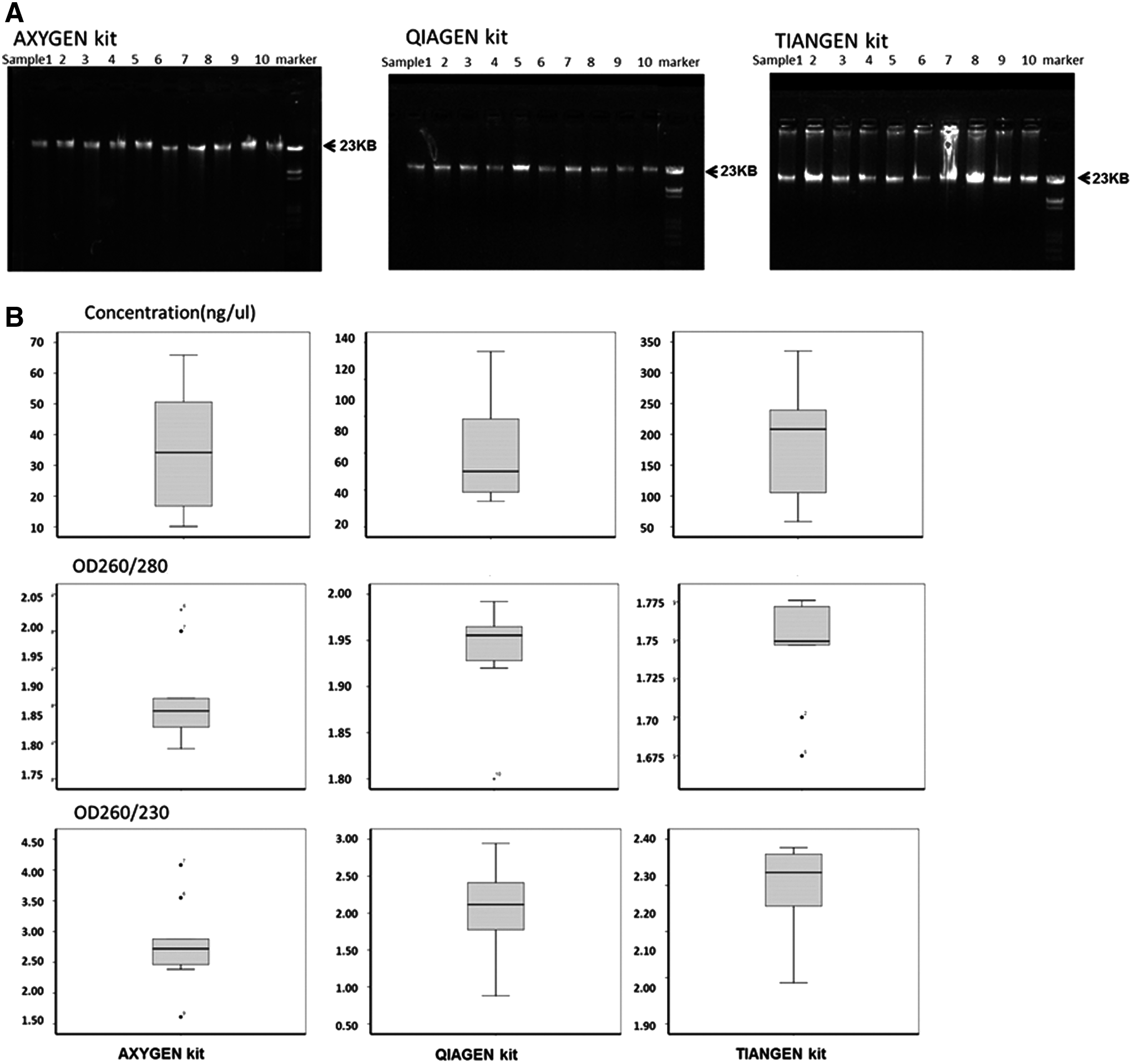
Comparison of DNA purification kits.
n = 10. DNA was extracted from 200 μL buffy coat sample. Cost is according to Chinese market price.
DNA yield and quality
We purified 1011 buffy coat samples using the Qiagen kit and analyzed the DNA quality and yield. A summary of the concentration, yield, and the A260/A280 and A260/A230 ratios is shown in Table 3. We analyzed the data using the Kolmogorov–Smirnov test and confirmed that the data distributions were approximately normal. Next, we plotted the frequency distributions (Fig. 2A) and created box plots of the yield and OD ratios of all samples (Fig. 2B). The mean concentration of the obtained DNA was 80.36 ± 40.00 ng/μL (equivalent to 16.01 ± 8.00 μg), with a maximum concentration of 345.72 ng/μL (equivalent to 69.14 μg) and a minimum of 12.34 ng/μL (equivalent to 2.47 μg). The mean A260/A280 ratio was 1.89 ± 0.09, with a maximum of 2.24 and a minimum of 1.17. The mean A260/A230 ratio was 1.95 ± 0.66, with a maximum of 5.26 and a minimum of 0.22.

Concentration of isolated DNA and A260/A280 and A260/A230 ratios.
SNP quality control
To further confirm the quality of the DNA samples, we analyzed 48 SNPs using TOF MS. TOF MS can detect dozens of SNPs in just one run. Furthermore, it is precise, reliable, and highly efficient. However, it also requires both a high quantity and high quality of DNA. Each run of TOF MS consumes 500 ng DNA, and the ideal DNA concentration should be ≥50 ng/μL. The A260/A280 ratio of the DNA solution should be between 1.8 and 2.0, with high integrity and purity of DNA. The average success rate of the SNP analysis for the 48 loci was more than 99.5%, with a maximum of 100% and a minimum of 98.90%. The high quality of the DNA was confirmed by the results. A part of the detailed data of the SNP test is shown in Supplementary Table S2.
Effect of preanalytical factors on DNA yield and OD ratios
We analyzed five perinatological factors—three for the puerpera (gestational week, delivery mode, and pregnancy complications) and two for the newborns (sex and birth weight)—and determined their correlation with DNA yield and OD ratios. The p values for T test or T′ test were >0.05, indicating no significant correlation between the five factors and the yield, A260/A280 ratio, and A260/A230 ratio of the extracted DNA. The details are shown in Table 4.
We also analyzed the effects of sample quality on DNA yield and OD ratios. While most of the buffy coat samples were of good quality, a few specimens exhibited problems, such as clotting, hemolysis, and small blood volumes. To assess whether these problems affected DNA quality, we compared the OD ratios of DNA purified from the problem samples with those from the normal samples. The results are shown in Table 5. Clotting and small blood volumes affected neither yield nor OD ratios. However, hemolysis in buffy coat samples led to significantly higher A260/A280 and A260/A230 ratios (p < 0.01) and was strongly correlated with OD ratios, but did not significantly affect yield.
Discussion
Although the number of studies based on cohort genomic DNA samples has increased dramatically, no widely accepted standard practice has been established for the storage of blood samples. The most economical and feasible way to store whole blood and its fractions, while ensuring high quality and sufficient yield of the extracted DNA, remains to be determined. In this study, we investigated whether the buffy coat is the best form to store the blood sample compared with whole blood and ACP.
Use of the buffy coat not only reduced costs and labor by 70% and 50%, respectively, but also provided additional benefits. For example, its smaller volume requires fewer storage equipment and supporting facilities, less management work, and less space for the equipment. In epidemiologic studies with a large number of samples, these benefits offered by the buffy coat can relieve the huge economic pressure on researchers. Furthermore, separation of the buffy coat is easy and not time-consuming. A skilled technician can separate the buffy coat very fast, and the automatic liquid workstation by Hamilton, Tecan, or other manufacturers can separate the buffy coat automatically.
We also tested the cheaper DNA extraction kits. However, they did not offer the same stability and high quality of extracted DNA as the Qiagen kits. Nevertheless, if a project has limited funding and the planned downstream experiments do not need high-quality DNA, such as ordinary PCR, the cheaper kits would also be a good choice. The DNA extracted using these cheaper kits is well suited for PCR (data not shown), although we did not test their suitability for other demanding experiments.
In this study, it is worth noting that although the number of the buffy coat samples was more than 1000, we still obtained the same high quantity and quality of DNA through manual operation using a convenient procedure with an acceptable workload. A skilled technician can purify nearly 100 buffy coat samples manually per day, without the automatic nuclear extraction equipment. However, due to the large sample volume, purification of DNA from whole blood or ACP needs more than twice the amount of work, which would significantly increase the overall workload, considering the enormous number of samples.
We analyzed whether the DNA yields from the buffy coat would be sufficient for the downstream experiments. According to our results, 200 μL buffy coat prepared from 2 mL whole blood yields 16.01 ± 8.00 μg DNA. In our birth cohort study, we collected 10 mL anticoagulated whole blood, which can provide about 1 mL buffy coat. Thus, the total average DNA yield would be about 80 μg. In general, a common PCR system needs 1020 ng template DNA, and a multiple PCR system with dozens of primers needs no more than 200 ng DNA. TOF MS, which can generate tremendous volumes of data in one run, requires 500 ng DNA. Most of the molecular biology techniques require nanograms of DNA, which continues to decrease with rapid technological advancements. The DNA extracted from the buffy coat is adequate for the downstream experiments for most research, even considering the repeat experiments when the results of the first round are not ideal.
Undoubtedly, the quality of the DNA is more important than the quantity. In this study, the A260/A280 ratio of the DNA solution was 1.89 ± 0.09 and the A260/A230 ratio was 1.95 ± 0.66, indicating good quality of the DNA sample. Furthermore, the average success rate of TOF MS for 48 SNPs was more than 99.5%, which confirmed the high quality of the DNA sample, considering that some failure is caused by imperfect primer design. TOF MS is one of the most demanding DNA-based methods, requiring DNA with high purity, good integrity, and at sufficient quantity and concentration. Based on the results of our TOF MS analysis, we believe that the quality of the DNA extracted from the buffy coat is capable of meeting the requirements of other demanding methods.
We also analyzed eight potential preanalytical variables that might affect the quality and quantity of DNA. Except for gestational age, the other variables have not been studied for their correlation with the quality and quantity of DNA extracted from cord blood. We chose these potential preanalytical variables partly based on previous findings.5,6,8 These findings showed that higher donor age and longer buffy coat storage time reduced DNA yield, and sex, body–mass index, cancer case–control status, and tobacco consumption were correlated with DNA quantity. One study reported that gestational age did not correlate with total DNA yield from cord blood, 8 which was consistent with our findings. Our results showed that only hemolysis negatively affected DNA quality. This result suggested that the buffy coat was a stable genomic DNA source and that the quality and quantity of DNA from the buffy coat were not easily affected. Prevention of hemolysis is not difficult, provided that the researchers follow standard procedures, which include careful guidelines for the time, temperature, and other conditions to be maintained throughout the process. The blood-related operation in our birth cohort study includes nearly 30 detailed standard procedures, which helped us to control the quality of the buffy coat samples, ensuring that the vast majority of the samples had acceptable quality.
In conclusion, storage of buffy coat, instead of whole blood and ACP, is a better approach for the epidemiologic researchers who need sufficient quantities of high-quality DNA while controlling the costs and labor. Our work can be helpful for epidemiologic researchers who base their work on DNA from samples collected for cohort studies to make a reasonable choice for blood storage in their future work.
Footnotes
Acknowledgments
This project was funded by “Establishing a Platform for Data Sharing Between Research and Clinical Practice to Facilitate Multicenter Collaboration” (No. 13430710300), “Establishing a Platform for Clinical Research Data Sharing to Facilitate Multicenter Collaboration by China–Canada Joint Effort” (No. 2014DFG31460), and The Shanghai Jiao Tong University Biobank Quality Control Project (No. YBKL2013005).
Author Disclosure Statement
No conflicting financial interests exist.
References
Supplementary Material
Please find the following supplemental material available below.
For Open Access articles published under a Creative Commons License, all supplemental material carries the same license as the article it is associated with.
For non-Open Access articles published, all supplemental material carries a non-exclusive license, and permission requests for re-use of supplemental material or any part of supplemental material shall be sent directly to the copyright owner as specified in the copyright notice associated with the article.
