




Abstract
The social structures that govern data/sample release aim to safeguard the confidentiality and privacy of cohort research participants (without whom there would be no data or samples) and enable the realization of societal benefit through optimizing the scientific use of those cohorts. Within collaborations involving multiple cohorts and biobanks, however, the local, national, and supranational institutional and legal guidelines for research (which produce a multiplicity of data access governance structures and guidelines) risk impeding the very science that is the raison d'etre of these consortia. We present an ethnographic study, which examined the epistemic and nonepistemic values driving decisions about data access and their consequences in the context of the pilot of an integrated approach to co-analysis of data. We demonstrate how the potential analytic flexibility offered by this approach was lost under contemporary data access governance. We identify three dominant values: protecting the research participant, protecting the study, and protecting the researcher. These values were both supported by and juxtaposed against a “public good” argument, and each was used as a rationale to both promote and inhibit sharing of data. While protection of the research participants was central to access permissions, decisions were also attentive to the desire of researchers to see their efforts in building population biobanks and cohorts realized in the form of scientific outputs. We conclude that systems for governing and enabling data access in large consortia need to (1) protect disclosure of research participant information or identity, (2) ensure the specific expectations of research participants are met, (3) embody systems of review that are transparent and not compromised by the specific interests of one particular group of stakeholders, and (4) facilitate data access procedures that are timely and efficient. Practical solutions are urgently needed. New approaches to data access governance should be trialed (and formally evaluated) with input from and discussion with stakeholders.
Introduction
T
The scientific (or epistemic) rationale for sharing is founded on a set of four quintessential precepts (or values). First, that no single cohort study can provide the depth and breadth of data and samples required to achieve sufficient power for valid (and robust) analysis of often small, biological effects, and associations.
Second, that no single cohort can provide the heterogeneity required to produce findings that will robustly hold for diverse populations with very different cultural, social, and environmental contexts (e.g., epigenetic influences).
Third, a fundamental requirement for achieving robust analyses requires that data from phenotypic variables or derived from samples (hereafter “data”) must be harmonized retrospectively—or, more rarely, standardized sufficiently well prospectively—to allow direct comparison.
Fourth, to enable sharing, data must be accessible; that is, they must be both small enough for transport under current IT systems and have the appropriate ethical and/or legal permissions in place to allow for their release. Increasingly, data are too large for easy and secure transport. And, in more practical terms, it would simply not be feasible for the study investigators who generated a data set to answer all the potential research questions that could be asked of those data.
From a societal perspective, the social structures (legislation, guidelines, ethical review, and data access controls) must meet the very reasonable expectations of safeguarding the confidentiality and privacy of cohort research participants (without whom there would be no data or samples) and their equally reasonable expectation of societal benefit through optimizing the scientific use of those studies.5–7
In response to the widely held value commitments directing science to the achievement of societal benefit—and in particular to allow valid privacy-protecting analysis of data from multiple cohorts—an integrated approach to secure co-analysis of data has been developed combining the DataSHaPER8,9 harmonization method, the Opal 10 and Mica 10 databasing and publishing tools, and DataSHIELD 11 analysis software to offer an open source mechanism for the secure analysis of harmonized research participant-level data without data ever needing to leave their host site 12 (Fig. 1).
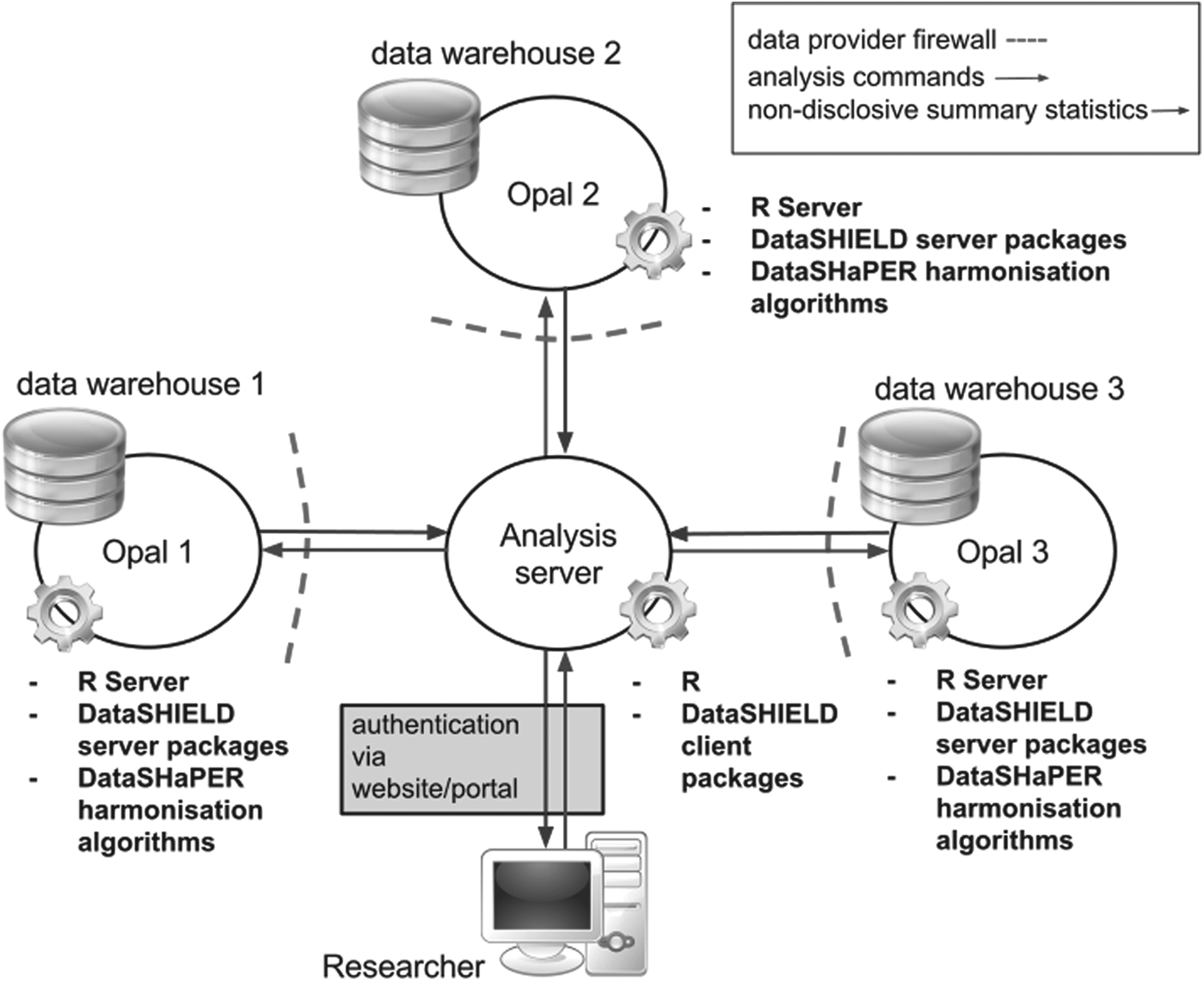
The figure shows the infrastructure setup used in the BioSHaRE-EU project. However, the infrastructure is quite flexible, and this represents only one possible configuration. For example, the analysis server could be removed altogether, and instead, researchers would each install the R client and DataSHIELD client packages locally. BioSHaRE-EU, Biobank Standardisation and Harmonisation for Research Excellence in the European Union.
The DataSHaPER is a structured method for data harmonization involving a series of steps progressing from initial definition of a research question through to the generation and validation of a harmonized data set. Fundamental elements within the DataSHaPER include creation of a “DataSchema” to identify and define key variables in a harmonized data set as well as creation of a library of algorithms for transforming selected variables from each individual study to produce the DataSchema variables required.
Opal, Mica, and DataSHIELD are open source software applications designed, respectively, to store, explore, and analyze study data. Both Mica and DataSHIELD are integrated into Opal, which provides the core infrastructure needed to store, describe, and manipulate data. Mica creates Web sites that provide details about data, metadata, and other materials from multiple studies (e.g., searchable study catalogues, descriptions of data sets, and electronic management of data access). DataSHIELD permits the secure co-analysis of study data and offers researchers a secure, privacy-protecting interface for analyzing data held in Opal through a specially tailored R statistical environment.
Importantly, in combination with Mica and Opal, DataSHIELD denies users access to the research participant-level data themselves while providing full and flexible access to the information held in those data. 11 Collectively, this integrated suite of infrastructural and methodological tools provides a new technological solution to key challenges implicit in creating, accessing, and securely coanalyzing the extensive high-quality harmonized data that underpin so much of modern biomedical science: hereafter, “the integrated approach to secure coanalysis of data”(Fig. 1).
These tools (comprising the integrated approach to secure coanalysis of data) were developed (DataSHIELD) or extended (Opal and DataSHaPER technology) as part of the 5-year Biobank Standardisation and Harmonisation for Research Excellence in the European Union (BioSHaRE-EU) project. 13 The BioSHaRE-EU project ultimately involved 15 European population-based cohort studies (www.bioshare.eu/studies) and successfully aimed to facilitate data harmonization and standardization for pooled analysis to investigate several common complex diseases and traits of substantial public health relevance10–12 (also see page 4—“Project Context” at www.bioshare.eu/content/final-publishable-summary). The tools provide a general platform for many data storage and analysis scenarios: The software tools are open source and continue to be actively developed beyond the BioSHaRE-EU as they are rolled out in new initiatives.
Here it is perhaps important to recognize that there are a number of ways in which data can be made available to users. None of these is “right” or “wrong” in all circumstances. 14 On the contrary, the crucial issue is to choose among the possible options that are appropriate for the particular context that has been encountered. 14 In this regard, it is sometimes implied that there is a stark choice between investing research resources in creating large centralized data storage sites from which users can obtain all their data (a centralized warehousing model) or a distributed model in which studies manage their own data and provide access for remote analysis—or joint coanalysis of several studies—by external users. This, latter, is a federated model. But, in reality, both approaches have strengths and weaknesses, and there is no sense in which one is “better” than the other.
For example, if highly specialist data demanding substantive informatics expertise (e.g., DNA sequence data) are to be held and made available locally at many studies (the federated model), the extensive knowledge, documentation, enabling hardware, and governance expertise will necessarily be replicated many times over. This would be highly inefficient and strongly argues the case for specialist genomic data to be made available under a centralized model—as is done, for example, at the EGA (European Genome-Phenome Archive, Europe) and dbGaP (the database of Genotypes and Phenotypes, United States).
In contrast, in relation to the rich array of general phenotypes (often covering tens of thousands of variables) generated over time by a major longitudinal study, a federated model may well be much more efficient. This is because the scientists and other professionals who know a study best (in almost all regards) are directly responsible for managing its data.
To consider just a few benefits, this greatly facilitates the identification and correction of data errors, the addition of new data (particularly when this represents updated assessment of data items collected earlier) to an appropriately structured database, the identification and management of data associated with an individual who has withdrawn from the study (the “right to be forgotten” now having been enshrined in European legislation), and provision of access to a much greater depth of knowledge about the data that may be sought by a user who needs to fully understand the context under which they were originally collected.
Although the BioSHaRE-EU project placed a particular emphasis on federated analysis—because that is the area in which new tools are particularly needed—it was fully recognized that both approaches have their appropriate places, and the tools that were developed can, in fact, be applied to data held in a single central repository as well as in a federated system.
Over the course of the BioSHaRE-EU project, a multimethod ethnographic study (including a formal evaluation of the tools above) was undertaken.15–17 The ethnographic study captured the enthusiasm of users and developers alike and explored the significant challenges they encountered when using the integrated approach to secure coanalysis of data.
Challenges varied according to the experience of respondents (e.g., their level of computational literacy) and the particular standpoint from which they spoke (e.g., developer, implementer, user, and study representative). Some difficulties when developing and implementing a new approach are unsurprising; indeed, it could be argued that challenges encountered in early iterations are a necessary part of advancing the usability and applicability of any new technology or tool.
In this instance, the integrated approach to secure coanalysis of data was experienced as being demanding for individual research users. In particular, effective use of the novel multifaceted infrastructure—and associated methods—that enabled and facilitated a secure federated approach to data access and coanalysis saw the emergence of a new type of scientist: one as familiar with computational systems and algorithmic syntax as with the rudiments of rigorous statistical analysis and interpretation.
A key feature of these usage challenges was their potential for amelioration or accommodation within the ongoing development of the tools comprising the integrated approach to secure coanalysis of data; for example, building a more “user-friendly” interface for DataSHIELD became part of the development strategy. In contrast, the other major challenge, which was identified during the implementation pilot, was found to lie outside the scope of remediation by the tool development process: namely, the complex array of governance mechanisms, pragmatic and political considerations that directly impact on the provision of access to particular data.
Under a typical contemporary governance model for data access, each new use of data held by a study requires a separate application for data access specifying which data are required, the research question(s) to be addressed (i.e., the uses to which those data will be put), explicit identification of the scientists who require access to the data, and—if data are to be physically transferred—how those data will ultimately be stored. All BioSHaRE-EU cohort studies required application to a dedicated study-specific data access committee, additionally one also required application for ethical approval for the research question.
Contemporary data access is typically based on the physical transfer of research participant-level data (often called microdata) using systems enabling secure transmission or else on the provision of secure physical sites, which users can visit to carry out an appropriately secured analysis of the data. Under both these approaches, research participant-level data are accessed directly during analysis. It is, in part, because these research participant-level data are potentially disclosive of research participant identity and/or sensitive information that formal governance systems are ubiquitous.
However, an alternative to this model is used in meta-analyses (e.g., GWAS), wherein multiple studies each contribute to an overarching joint analysis by conducting in-house analysis of their own research participant-level data and then transmitting the resultant study-level estimates (and standard errors) to a designated analysis center that combines the results, often using random-effects meta-analysis. Crucially, this means that it is the only study-level statistics—not research participant-level data—that must physically be shared, and study-level data are generally understood to be nondisclosive. †
The integrated approach to secure coanalysis of data using DataSHIELD for federated analysis of multiple studies represents a novel approach that may be viewed as combining the best features of both standard approaches: Research participant-level data are never directly visualized or physically accessed, but the analysis is typically able to use all the information held in the data. Furthermore, analytic control lies primarily with the analysis center—avoiding the need to request or direct individual studies to undertake analysis themselves—while the control of data security remains with the original studies and the data custodians within those studies.
Despite its potential benefits, this new integrated approach to data coanalysis had a clear potential to generate important new questions relating to study governance. The cohorts involved in the pilot of the integrated approach to secure coanalysis of data therefore needed to carefully assess their criteria for access based on an approach in which physical access to data was not required for analysis of those data. In doing that, however, it was recognized that some new challenges might be difficult to anticipate. In the event, the seeking of access permission comprised two components:
(1) Permission for physical access to harmonize the cohorts' data using the DataSHaPER—this would be led by the cohorts themselves, and each cohort could decide what role, if any, they wanted the central harmonization team to play, and it is that which would determine whether or not the central team needed permission to work with the study's research participant-level data, and
(2) Access permission to enable full research participant-level data analysis using DataSHIELD, although, given that the harmonization had then been completed, no physical access to the data was required at any study.
This pilot of the integrated approach to secure coanalysis of data thereby offered a unique opportunity to identify the foundational epistemic (scientific) and non-epistemic (social, cultural, moral, economic, etc.) values upon which the studies had made decisions about provision of access to their data. Such values usually remain tacit, embedded within official policy or criteria for decision making. But these values—as do all values—have significant consequences for action or practice. Indeed, we rely on them to do so. However, as a partial driver for this ethnographic research, it was recognized that there may be actions or practices consequent on such values that are in practice counterproductive and that this may only become evident when new modes of analysis render some governance protections no longer applicable or unnecessarily prohibitive: Governance of data is always a balance between constraint (protection) and openness (use).
Drawing upon the BioSHaRE-EU ethnographic study, this article therefore examines the epistemic and non-epistemic values driving decision making by studies about sharing data, the intersection of such practices with the requirements of a new mode of co-analysis of data, and their consequences.
Methods
We used an ethnographic methodology19,20 to understand data sharing and data access in the setting in which these occurred: in this case, the implementation pilot of an integrated approach to secure co-analysis of data. The ethnographic study of the BioSHaRE-EU comprised participant observation and individual and group interviews undertaken over the length of the project between December 2011 and November 2015. Here, we present findings from data generated from interviews with the developers, implementers, and users of the integrated approach and with cohort contacts from the 15 cohorts involved in the BioSHaRE-EU.
Telephone interviews were conducted with 21 people between September 2014 and January 2015, lasting an average of 45 minutes each. The discussions were audio recorded, transcribed verbatim, and analyzed thematically using the constant comparative method. 21 A purposive sample for interview was generated to include clinicians, epidemiologists, statisticians, bioinformaticians, study coordinators, and social scientists who had been actively involved in or associated with the BioSHaRE-EU for much or all of its existence.
During the interviews, respondents were asked about their experience in using, developing, and/or implementing one or more of the four tools and their thoughts on the usability and appropriateness of the tools for sharing and translating data from multiple cohort and biobank studies. Interview analysis was further informed by the broader understandings gained from participant observation undertaken during the BioSHaRE-EU meetings. We used these ethnographic observations to orientate and inform our primary analysis and do not present them here as a second substantive source of evidence in their own right.
Analysis and theoretical orientation: Ethnographic analysis is often descriptive (e.g., thematic analyses of qualitative findings), aiming to provide an in-depth understanding or “thick description” 22 of the phenomenon under examination. It may also include, as we do here, a more interpretive form of analysis to better understand or explicate the patterns of behavior, views, or practices observed. Ethnographic analysis typically proceeds inductively, meaning that the narrative or analytical categories developed are closely linked to the richness of the data rather than being led by a priori theory. This approach allows qualitative researchers to develop an insider's perspective and therefore better understand and explain social phenomena.
In this article, we focus upon the values that shape decision making about data sharing in general and in the context of the co-analysis approach used in the BioSHaRE-EU pilot specifically. Theoretically, we take the position that values expressed in the language used to describe them are, as claimed of language itself,23–26 performative. That is, values have effects: Values do not simply describe principles or standards but actively shape the definition and consequences of such principles or standards.
If, for example, we hold that research participant privacy is an important value, then we act not only to maintain that value in certain ways but also to preclude certain other actions. Co-analysis of data from multiple cohorts potentially operates in the context of competing values and interests: those of the cohort research participants and those of the researchers aiming to use the data derived from the involvement of such research participants.
To understand how values shaped the practice of data sharing, we, therefore, examined the consequences of two forms of values, epistemic and non-epistemic, called upon by study representatives and others in their descriptions of and rationales for data sharing. The term “epistemic” is used by philosophers, derived from the Greek epistēmē (knowledge), to mean “related to knowledge or its validation” (Oxford English Dictionary). Thus, “epistemic values” refer to knowledge-related principles or standards, and non-epistemic values refer to socioethical, cultural, economic, and other non-“knowledge-related” values, assumptions and standpoints. While this distinction (epistemic and non-epistemic) is somewhat arbitrary, it produces a useful foil for considering the range of values informing scientific and governance decisions in practice.
Qualitative analysis is necessarily interpretive, and as such, any interpretation made of the data is one of a number of possible interpretations. That being the case, it is a standard practice to build an argument for that analysis using a representative selection of extracts along with detailed interpretation so that readers may assess that interpretation for themselves (c.f. 27 ). We therefore present the findings of our analysis below using quotations from the interviews.
Respondents consented to the recording, transcription, and analysis of their interview with the understanding that quotations would be included in academic publications. Interviews were conducted in English, but, given the international nature of the research, for most respondents, English was their second, third, or even fourth language. To maintain the integrity of respondents' talk, we have not “corrected” the language or grammar used but have lightly edited it for ease of reading, where necessary. Where the words of both interviewer and respondent are included, these are differentiated by “INT” (interviewer) and “RES” (respondent).
Because the BioSHaRE-EU community is small and its members publicly identifiable, there is no indication given in quotations of the standpoint from which the respondent is speaking, unless this is necessary to explicate analysis. In fact, most speakers embodied multiple standpoints, for example, simultaneously being both developers and users of the tools as well as having some relationship with both the BioSHaRE-EU and a specific cohort.
While the analysis used the concept of epistemic and non-epistemic values to understand how values shaped data sharing, the findings present an argument that first identifies respondents' underpinning values (e.g., protecting the research participant, study, or researcher), the strategies used to achieve these values (e.g., varying modes of controlling access), critiques of these values and strategies, and the consequences of these values in terms of their effects on undertaking research.
Ethical approval was granted by the University of Leicester, College of Medical and Biological Sciences Research Ethics Committee.
Results
Data sharing values
Why use the DataSHIELD approach?
As noted in the “Introduction” section, the process of using a novel integrated approach to secure coanalysis of data during their development and piloting within the BioSHaRE-EU brought with it considerable challenges. Why then did the developers, implementers, users, and studies persevere with a process that many regarded as onerous? In the words of one study representative, the security provided for sensitive data by this approach outweighed the “hassle” (currently) required to make it work.
Data security is a major issue when you bring data together from different sites or to simply protect the data from being circulated anywhere. This approach [federated analysis under DataSHIELD] is a very important tool to address those issues—to improve data safety when handling sensitive material. So that is why we decided to get involved with this: to set up the service and everything that's necessary to work with it. And that was the basic motivation, conceiving this as a useful tool which addresses some serious issues in epidemiology. […] It improves data safety. That's the main advantage. Because in the end you need a strong “pro” argument otherwise you won't undergo the hassle of working with this kind of entry access with the data when you have other possibilities which are easier and more flexible.
Maintaining data security was a key driver and underpinning non-epistemic value evidenced in the ethnographic data and consistent across the studies involved in the BioSHaRE-EU. Data access arrangements as currently configured in European biobanks, however, presented a significant impediment to shared data analysis. These are inconsistent across biobanks and can be extremely time consuming. One study contact (also a user) summarized the issues as follows:
It's very hard if you want to do analysis in the scientific world. The need for doing analysis with more than one cohort is increasing. For almost every analysis you need to pool data from more than one cohort. But often it's difficult to pool them physically, to get the data from other cohorts on to your computer and do the analysis. It's a long and a complicated way because every cohort has its own board; it has to decide whether they want to give the data away or not. So it's a complicated process. So if it's possible to do it in the way that DataSHIELD does—this federated analysis so you don't have to apply for the data but you can just get full data without seeing the individual data—then it's a big advantage. It's easier to get the permission to do it. But on the other hand, technically, [the DataSHIELD approach] is complicated.
The challenge of multiple (and at times complex) procedures involved in gaining access to multiple studies is well known to anyone involved in meta-analyses or GWAS—in these instances, however, no research participant identifiable data need be released because primary analysis is done in-house and study-level results then pooled. The DataSHIELD approach offered the possibility of bypassing problems of physical data access while still undertaking a fully efficient joint analysis of the research participant-level data in all studies at once.
Protecting research participants
Protecting the research participant has fundamentally shaped the evolution of ethics and data access (non-epistemic value). Research participants are asked to consent to specific projects or actions based on the principle that has the right to know what they are agreeing to. The Declaration of Helsinki 28 holds that the primary purpose of medical research is to generate new knowledge. Where such research involves human research participants, the declaration holds that the goal of knowledge generation cannot take precedence over the rights and interests of research participants and that national or international ethical, legal, or regulatory requirements cannot undermine the protections under the declaration.
The conditions under which research participants are involved in research should include that research protects their dignity, rights to self-determination (i.e., research participants are adequately informed before consent), privacy and confidentiality, and research only be carried out by appropriately trained and qualified researchers. These precepts have carried through to access governance through the principle of one application for each proposed research question with access restricted to named bona fide researchers.
If I want to do a kind of research then I have to submit a proposal to the involved cohorts, and if they decide that I can do that then I get permission to use the data. But they have to be sure also, the cohorts, that only the people who have the permission for this certain analysis have access to the data. I think that's an important point.
For the studies, governance of data (or sample) use offers a critical point to ensure that the expectations and trust of their research participants are maintained (non-epistemic value). The other key governance apparatus is receipt of a positive ethical opinion for the research protocol and associated consent and research participant information package. These documents outline the scope of research participant involvement, the uses to which their data or material may be put, definition of any restrictions on that usage (e.g., who is permitted to use those data/samples), the cohort's responsibilities regarding research participant confidentiality and privacy, and other specific policies (e.g., return of results).
Consents and research participant information provide the framework establishing research participant expectations of study involvement and therein guide decision making about data access for further research. The integrated approach included importing study data into an Opal instance, which remained behind the study's firewall. Despite this, many study contacts needed to persuade their study's ethics, access or scientific boards that the integrated approach to secure co-analysis of data fulfilled existing commitments to research participants based on non-epistemic values.
From the ethical point of view, in the beginning I would say that people here were very, were concerned because probably they didn't immediately understand the fact that data uploaded was safe—because the novelty of all of this infrastructure—with DataSHIELD. So, the novelty is that the data are still in-house but there is the possibility to work on them without using or accessing individual data. So at the beginning it was a bit hard to make clear that there was no problem in ethics. But in the end it was clarified so we could go on.
When asked why such concerns likely arose in the first place, this respondent added as follows:
Probably there was some fear that some sensitive data could be disclosed and used in some way unethically. Or probably just some fear that somebody else could publish some research when this dataset is quite new. We have not published anything on this data yet because the collection is ongoing.
Elsewhere, a study representative echoed these data access concerns as well as a further concern for many studies.
RES [The study's access committee] were afraid that all the data would be put into something that they couldn't sort of control who got access. And I had to make a specific point about you can't really take out individual data because that's more sensitive. That people who do the research on the data pool, they can only do it via DataSHIELD. And then just get some summary data back.
INT Were they happy with that?
RES They were much more happy with that. They thought that when we have data in Opal, who's going to control what projects are being done? What persons can get access and all that kind of thing? And also because in [name of study] you have to pay a certain amount of money for each paper. But for when you have data in a consortium they don't charge the full price.
While research participant protection and uncertainty about the new technologies (Opal, Mica, and DataSHIELD) were primary concerns for the studies, these were not their only concerns. Control of who used their data had intellectual property and fiduciary implications (non-epistemic value). Often, the originators of the cohorts involved in the BioSHaRE-EU pilot of the integrated approach to secure coanalysis of data (i.e., the PI of the cohort itself) were themselves involved in using the data for scientific ends. In other cases, additional data were produced within the study by external researchers working with original samples (e.g., sequencing samples for particular research interests or disease categories). The resulting new data were viewed by some studies as the “property” of those researchers who had produced it (non-epistemic value).
As a result, the dynamic nature of these studies (i.e., that data collection and sample transformation are ongoing) necessitated upkeep. Funders increasingly expect studies to raise at least part of the funds required for such maintenance, most notably by charging for data access. Arguably, charging for data access constrains access, 29 but at the same time, it may contribute to long-term sustainability, potentially a balance between the number of users “now” versus the number over the useful lifetime of the study. Control of data access also performs the function of protecting the cohort and the cohort originators or data producers (referred to in this article as “researchers”).
Protecting the study and researchers
Studies used two particular means to control who used their data and therein protect the study and its researchers: first by ensuring the scientific rigor (apparently epistemic value) of proposed research through scientific review of data access applications and second by controlling duplication of research (underway or upcoming) by study or, other external, researchers (non-epistemic value).
So researchers submit an application to a research project. We look at it from a scientific point of view: Is it feasible? Does it make sense? Are the researchers bona fide researchers? So we don't want any journalists or anybody who's not a scientist accessing a resource for wrong doing. So we have quite a strict registration process. And they can be from academia or from the commercial world, but they have to be a bona fide researchers so that we limit any old Tom, Dick and Harry accessing the database. And if there's people that are submitting applications which strongly overlap then we suggest they collaborate: we put them in touch.
The practice of reviewing the science was viewed as providing a means of protecting the study from reputational damage (non-epistemic value). Restricting overlapping research served to protect the interests of the producers of study data; both the PI/investigators of the original study and additional researchers produced new data for the study via their later research. Operationalizing protection of study PI or data originator's IP was typically achieved through three alternative responses: (1) duplication was simply not allowed, (2) data originators were given a limited time for exclusive use of the data, and (3) researchers with similar ideas were brought together.
Not all studies imposed such restrictions. Practices varied widely, with some respondents declaring such scientific review as “old-fashioned.” One respondent, a senior bioscientist, stated as follows:
Bioscientists who are trying to control what research is done by other people and [who] believe that their way of doing it is better than what those other people are doing are being very arrogant and inappropriate. […] Basically, if you allow infrastructures to be available, then some of the time they will do fantastic science and some of the time they will do rubbish science. But the point is, is that the rubbish science ultimately won't get anywhere and therefore it is not up to us to decide which of those things get through because we can't predict necessarily which is really good stuff and which is the bad stuff.
Others who also viewed this protectionist stance as “old-fashioned” countered with a public good argument (non-epistemic value):
This is a kind of old fashioned way to think that “This is my project” and “This is my cohort” and “This is my biobank”—“I've started to collect this when I was in medical school and now when I retire I will give it as an inheritance to my best post doc.” It's not yours. If you work in the public office, your salary comes from public salary, your grants come from public tax money: it's everyone's. It's your wife's, it's your children's, it's your neighbours' data. And they should have the benefits of it, not you. Of course, you have some kind of an ownership over that because you have collected it and you maybe know [it] best, but that's an ownership based on your knowledge and skills, not based on ownership [of] property. So I very strongly think that people should be more open about—in parentheses—“their data.” It's not theirs. It's something they have assisted in collecting, but it's collected by a giant effort of scientists and tax payers.
Consequences of the current model of data access
By way of further examining the consequences of study values around data sharing, we offer a description of the experience of the BioSHaRE-EU researchers in accessing data for a pilot analysis using DataSHIELD. Ethnographic observation and interviews revealed that a key challenge the BioSHaRE-EU researchers encountered was gaining access to the data they required to conduct analyses using the integrated approach. Users and developers were equally impeded by the multiple, repetitive, and time-consuming procedures required to gain permission to use data for analysis.
The whole process that starts […] with applying for data to actually publishing your research paper takes a lot of time because so many actors are involved. This has been a major difficulty for me.
The complex governance of data access was widely experienced as an encumbrance and a major deterrent to research at every stage of the process, not simply at the outset. As research advanced, for instance, the need for additional data might arise. When this happened, the BioSHaRE-EU researchers had to again undertake the time-consuming process of requesting data and securing its release:
It's like writing a mini proposal every time you need to access another bit of data.
I think the biggest challenge […] has been trying to gather all of the data need[ed] from all of the different cohorts, you know, with different data request forms, different criteria, different speeds, different ethics requirements, you know, from five different biobanks and cohorts in, of course, four very different countries. That's been a huge undertaking, just obtaining the data.
When asked to describe any specific difficulties in accessing data, one BioSHaRE-EU researcher closely involved in the implementation of the tools identified the crux of the problem:
I think, in general, time is always an issue with data access, be it within the BioSHaRE-EU project or outside the BioSHaRE-EU project. Often the delays to data access are quite significant and it delays then the analysis and everything else that comes after accessing the data. […] I think if we were to redo BioSHaRE-EU, it'd be great if we could have a project where a group of five or six cohorts—whoever wants to participate in the project—agrees that there's going to be a group of variables from each of the studies that will be used for multiple research questions rather than doing one off research data access requests for every research question that we have—which is the traditional way of doing it. You build up your research proposal. You send it [to] each cohort that you want to have access to. They review it and then they give you access to the variables that you requested for your project. […] I think one thing within BioSHaRE-EU is that we wasted a lot of time preparing the data access requests for each and every one of the research questions and that delayed a lot of the research.
This description of time delays in gaining access to data presents an account of data sharing practice as usual, wherein separate data access applications (and in some cases additional requests for ethical review) are required for “each and every” research question and to each and every cohort involved in the analysis. The impact of this “traditional” approach is to extend considerably the time needed to conduct analysis, particularly when new unanticipated research questions emerge during analysis. As noted by the respondent, this may happen in any analysis. However, it is precisely the analytic flexibility offered by DataSHIELD that is lost under contemporary data access governance.
The “traditional” approach to data access was contrasted with an approach based on permissions attached to use of specific data sets, where permission is sought from multiple cohorts such that access is variable specific rather than research question specific. In the case of variable-specific access permission, any research question that fell within the bounds of the consents signed by study research participants would be possible without having to seek access for each specific research question as it emerged, as is currently the case. Thereby, flexibility would be made possible, for example, in harmonized data sets for which permission had been granted for each variable.
During the BioSHaRE-EU project, the values shaping data access were largely consistent across studies, although there was evidence of change as seen in the critiques of existing approaches to data access that emerged. Respondents reported that analysis under DataSHIELD could potentially ameliorate some access concerns while still upholding the core non-epistemic value of cohorts to protect research participants. There remained, nevertheless, a sense that existing systems had become entrenched for historical and contextual reasons, that is, that practices that had developed over time within the specific cultures and practices of each study.
I'm afraid that there is no way to avoid that different biobanks are preparing their own protocols. Because I think that people are coming from different cultures and so they have their own idea about the proper way to do things.
Many of the impediments to change were seen as human rather than scientific or technical challenges.
I think that the very big hurdles in science are human hurdles, human relationships. Problems that have nothing to do with science.
Moreover, the challenges identified time and again by respondents, in these interviews and in the ethnographic observations, arose from the interplay and tension between “competition” and “collaboration.” Conflicting values were seen to play out in terms of “scientific turf” and further entrenched by controlling data access in ways that allowed researchers exclusive or time-limited access to data for their own research questions.
While this may seem at odds with notions of open science, there were sound structural reasons for taking this position. In a contemporary approach to science that privileges discovery science and its impacts—where the outputs (peer-reviewed articles) of that science are the pathway to securing and retaining professional positions and achieving promotion and recognition (non-epistemic value)—protecting data access is a rational response. Respondents clearly identified a need for other mechanisms by which to recognize infrastructural science.
So the general view is moving in the right direction. But one of the things that's also been recognized is that given [individual and funder investment in large bioscience infrastructures], there has to be better ways of measuring people's output other than just simply their papers.
Some of these mechanisms already exist (e.g., BRIF 30 and proposals for recognition of data resource generation in future national research quality assessments), but these are not yet widely used.
Discussion
What is the way forward for governance of data access?
Each cohort involved in the BioSHaRE-EU was constrained by local, national, and supranational institutional and legal guidelines for research. These guidelines varied considerably not only across regions (e.g., EU) but even within single countries. The resultant data access guidelines also varied. Predictably, bespoke data access procedures were developed by individual studies at different times as they began to collect and then release data and samples. Such practices then continued to change as local, national, or international policy evolved and changed. The combined result has inevitably been a multiplicity of diverse data access governance requirements.
Not surprisingly, the pilot of the integrated approach for co-analysis under DataSHIELD found itself betwixt and between old models of governance and the new modes and technologies of co-analysis. Because DataSHIELD did not allow access to the research participant-level data held by studies, it offered the potential for new models of data access governance, with lower thresholds for granting permission and much simpler—possibly multistudy—mechanisms for seeking that access. However, without such a model already being in place, all analyses, to date, using the DataSHIELD approach have still needed to use existing processes for securing permission to use the data.
Paradoxically, this means that if the integrated approach to secure co-analysis of data is seen as being successful and becomes widely used—with governance mechanisms evolving in recognition of that change—its ease of use and relative benefit will markedly increase. However, in the meanwhile, those developing the approach recognize that they must ensure that the system offers enough benefits (including flexibility and ease of use) and acceptable costs (such as having to seek permission for a new approach that is not well understood by data access boards) and that even without the new governance mechanisms being in place, the integrated approach to secure co-analysis of data is still realistically competitive with more traditional approaches.
Crucially, this setting—in which the costs and benefits of the new and traditional approaches are well balanced—provided us with a unique analytic counterpoint for examining the epistemic and non-epistemic values underpinning and shaping contemporary data access governance. Our analysis enabled us to ask the question, “Which values remain in need of protection when privacy-protecting data analysis is possible?” and in turn, “What forms of data access governance is necessary to protect epistemic and nonepistemic values and interests of cohort research participants and researchers?”
Three dominant values emerged: protecting the research participant, protecting the study, and protecting the researcher. These values were both supported by and juxtaposed against a “public good” argument. Each was used as a rationale either to promote or to inhibit sharing of data. While DataSHIELD ameliorates these fears, studies will need to be persuaded that it is as effective as it claims to be before they will accept this new approach. Ultimately, DataSHIELD may prove especially protective of both research participants and studies since users cannot directly access research participant-level data. But studies can still withhold data to protect ongoing work. In one analysis, a particular cohort refused access to data, which were already being used in an analysis being conducted by a research group unrelated to the BioSHaRE-EU.
The originating epistemic driver of data sharing is as much pragmatic as it is principled: Bigger infrastructures are needed to answer the questions scientists want to answer, but collaboration is needed to achieve this. An overriding non-epistemic value in the study setting remains the protection of the research participants who provide the data and samples. Another important value is reflected in the understandable desire of researchers to see their efforts in building population biobanks and longitudinal cohort studies realized in the form of scientific findings and outputs. Indeed, the one epistemic value identified (scientific rigor) acted to reproduce non-epistemic values (e.g., protecting the researcher).
Reviewing the epistemic and non-epistemic values shaping data sharing and practices of data access enabled us to identify those criteria that most effectively facilitate that access, optimize the value of studies while protecting research participants. On this evidence, systems for governing and enabling data access need to
(1) Protect disclosure of research participant information or identity,
(2) Ensure the specific expectations of participants are met (e.g., noncommercialization and exclusion of particular stakeholders, such as tobacco companies),
(3) Embody systems of review that are transparent and not compromised by the specific interests of one particular group of stakeholders (although complete independence is unlikely because governance of access must be administered by individuals sufficiently knowledgeable and experienced and the field is a small one),
(4) Facilitate data access procedures that are timely and efficient. Good practice is in place for access to individual cohorts, but practices need to be adapted to the particular demands of access to multiple cohorts or biobanks.
To truly optimize the scientific value of the resources into which so much human and fiscal capital continues to be invested, suprastudy and supranational solutions for access governance are needed for collaborative projects, such as the BioSHaRE-EU, to streamline data access and ameliorate key challenges.
Possibilities include centralized portals for data access applications or joint agreement for blanket approval for the use of particular harmonized variables or data set of variables. Because roadblocks to data access involve embedded cultural and structural values that hamper data access, multistudy, and preferably regional or international, approaches that are mindful of these non-epistemic values need to be explored and tested.
Examples already exist of data governance and access mechanisms that aim to provide harmonized streamlined data access at national (e.g., Managing Ethico-social, Technical issues and Administration Data Access Committee [METADAC] in the United Kingdom 31 ) and international levels (e.g., the Public Population Project in Genomics and Society—International Policy interoperability and data Access Clearinghouse [P3GIPAC] 32 or Biobanking and Biomolecular Resources Research Infrastructure [BBMRI],33,34 and Global Alliance for Genomics and Health [GA4GH]).
However, these are not generally aimed at data access to multiple studies simultaneously for one common analysis. Nonetheless, their principles and approaches might be adapted by multistudy consortia. At the same time, new solutions may challenge current funding models, which, by default, promote multiple applications and the multiple opportunities for cost recovery they present. Funders, too, need to be part of the discussion of ways forward.
New consortia of researchers and multiple cohorts and biobanks, such as the BioSHaRE-EU, continue to be established. We have learned, in the findings presented above, that the complexity of interfacing with multiple governance systems in such consortia risks impeding the very science that is the raison d'etre of these consortia. Increasingly, journals are requiring that open access be made available to the data upon which research articles are based (e.g., PLOS journals, F1000, and BMC Genomics). Practical solutions are urgently needed and should, ideally, form part of the integrated approach to secure co-analysis; development of a governance component within that approach as it evolves will, necessarily, be designed to fit the range of contexts into which it will be applied.
Any new approach for access to multiple studies must first avoid reproducing or exacerbating features of traditional governance mechanisms that are no longer needed or have always been questionable. New approaches should be trialed (and formally evaluated) in negotiation with all stakeholders, including scientists and research participants, associated with the cohorts and biobanks in these new consortia, potential data users, funders, ethical committees and governance boards with oversight responsibility, and the broader research community.
The need for shared data access will only grow as new and more data-intensive research questions are posed by the scientific community. In particular, there is an increasing demand for the deep phenotype, genotype, and other omics data and samples that are offered by cohorts and biobanks but which are only available in large enough numbers when studies can be combined.
Footnotes
Acknowledgments
We would like to thank all participants in the BioSHaRE-EU ethnography and evaluation for their generosity in enabling us to work alongside them and for giving of their time in interviews. The research and analysis leading to these results were supported by the Biobank Standardisation and Harmonisation for Research Excellence in the European Union (BioSHaRE-EU) program, which received funding from the European Union Seventh Framework Programme (FP7/2007–2013) under grant agreement no. 261433, and the METADAC, which received funding from the Medical Research Council, Economic and Social Research Council, and Wellcome Trust (MR/N01104X/1). The Data to Knowledge (D2K) Research Group is also supported by funding from the European Union Seventh Framework Programme BBMRI-LPC (313010) (Biobanking and Biomolecular Resources Research Infrastructure—Large Prospective Cohorts), Medical Research Council, Wellcome Trust, 58READIE project (G1001799/2) (Realizing Easy Access to Data and Infrastructural Enhancement for the 1958 Birth Cohort Biomedical Resource), ALSPAC project (102215/Z/13/Z), the Welsh and Scottish Farr Institutes, and MRC-funded E-Health Informatics Research Centres (EHIRCs) (MR/K006525/1 and MR/K007017/1).
Author Disclosure Statement
No conflicting financial interests exist.