




Abstract
With the enactment of the Nagoya Protocol, biological resources are now increasingly considered as assets of an individual country, instead of as the common property of mankind. As worldwide interest for securing biological resources intensifies, research resource centers (RRCs), which collect, preserve, and provide resources and their information to academia and industries, are gathering more attention. The Asian Network of Research Resource Centers (ANRRC) strives for conservation and effective use of bioresources and their data by connecting resource centers of Asia, a continent with the greatest diversity of life. Since its foundation in 2009, the Network has significantly expanded to encompass 103 RRCs of 14 countries. Through the Network, member countries discuss opportunities for resource exchange and research collaboration and share biobanking information and regulations of different countries for international harmonization of resource management. ANRRC also contributes to developing of International Standards of biobanks and biological resources as a liaison to the International Organization for Standardization technical committee 276 Biotechnology.
Introduction
T
The Organisation for Economic Co-operation and Development (OECD) defined biological resources as the essential raw materials, including living organisms, cells, genes, and the related information, utilized for the advancement of biotechnology, human health, and research and development (R&D) in life sciences. The OECD further defined biological resource centers (BRCs) as repositories and providers of high-quality biological materials and information. 2 In other words, BRCs play pivotal roles in preserving the biodiversity of the planet, utilizing genetic resources, and building infrastructures for R&D. The progress in biotechnology accompanied significant growth of biological research, which in turn led to higher demand for bioresources and facilities to preserve and share these resources. As a result, diverse types of BRCs are now in operation around the globe with a variety of financial schemes, collections, and purposes. In 2006, OECD proposed the establishment of the Global Science Forum (GSF) and Scientific Collections International (SciColl) for global preservation and utilization of scientific research resources and officially launched these initiatives in 2013. 3
In the last decade, BRCs from all over the world have made efforts to provide high-quality resources managed with standardized operating procedures and to harmonize their guidelines to maximize conformity of resources among BRCs.4–7 They established networks to open up routes to share research data and resources. Well-known international networks include BBMRI-ERIC (Biobanking and BioMolecular Resources Research Infrastructure-European Research Infrastructure Consortium), 8 CTRNet (Canadian Tissue Repository Network), 9 ESBB (European, Middle Eastern & African Society for Biopreservation & Biobanking), 10 ISBER (International Society for Biological and Environmental Repositories), 11 P 3 G (Public Population Project in Genomics and Society), 12 and WFCC (World Federation for Culture Collections). 13 Some networks and societies such as ISBER and CTRNet develop and disseminate best practice guidelines and educational programs for BRCs. In Asia, the most prominent and extensive network for research resources is the Asian Network of Research Resource Centers (ANRRC), with 14 member countries in Asia and Oceania. 14
In this article, we describe the history, roles, and current activities of the ANRRC for collaboration among resource centers and exchange of information, technology, and resources in Asia, a continent with the greatest diversity of life (Fig. 1).
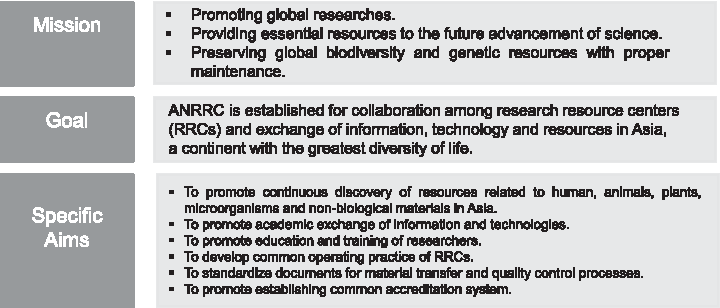
Mission and aims of ANRRC. ANRRC, Asian Network of Research Resource Centers.
History of ANRRC
In January 2009, 37 biobanking experts from 9 countries gathered for an ad-hoc meeting in Seoul, Korea, to discuss the establishment of a network dedicated to the research resource centers (RRCs) of Asia. The effort was headed by three institutes: the Korea National Research Resource Center (KNRRC), the Institute of Microbiology of Chinese Academy of Sciences (IMCAS), and the RIKEN BioResource Center (RIKEN BRC) of Japan. 14 All of the experts in attendance recognized the need for a platform to exchange biological resources and information for preservation, development and utilization of genetic resources in Asia, and agreed with the proposal of founding a network among Asian RRCs. In September of that year, the ANRRC held its first meeting in Seoul with BRCs and RRCs from 12 Asian countries. Subsequent annual meetings have been hosted by one of the three countries, with Korea, China, and Japan in rotation.
In the 2010 meeting hosted by the RIKEN BRC of Japan, the Executive Board of ANRRC declared the ANRRC Charter at the General Assembly. In May 2012, the ANRRC signed an affiliation agreement with ISBER at the Society's Annual Meeting in Vancouver, Canada, and continues to be an ISBER Affiliate Partner. At the fourth ANRRC International Meeting, held in October of the same year in Jeju Island, Korea, ANRRC and ESBB signed a memorandum of understanding for exchange of information, promotion of standardization, and development of education programs. During the Shanghai meeting of 2014, KNRRC was designated as the permanent secretariat of the Network by the member countries, in recognition of its stable and effective management. Figure 2 summarizes the history of ANRRC in a timeline.
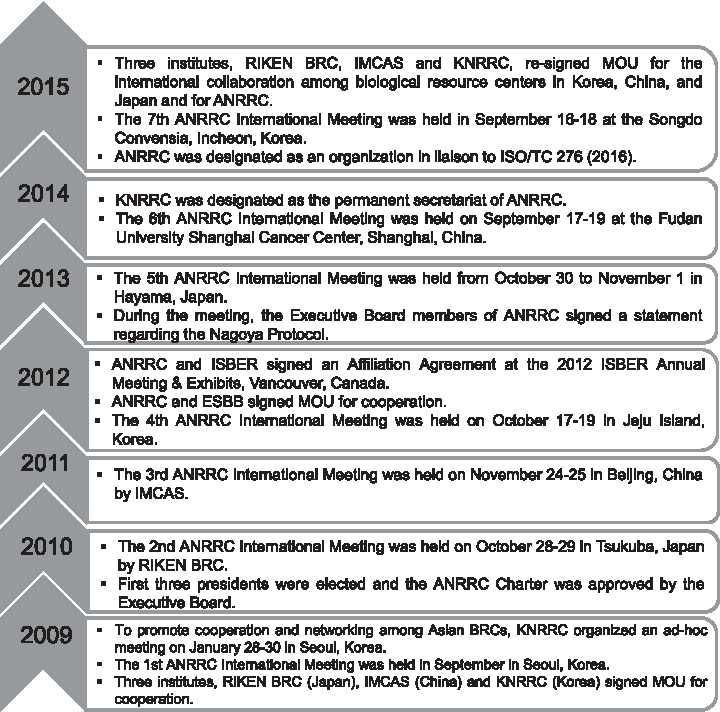
Timeline of ANRRC development. Since its establishment in 2009, ANRRC has gradually broadened its activity scope and established close relationships with other international and regional organizations such as ISBER, ESBB, and ISO. ESBB, European, Middle Eastern & African Society for Biopreservation & Biobanking; ISBER, International Society for Biological and Environmental Repositories; ISO, International Organization for Standardization.
Currently, the ANRRC holds an international meeting every year to strengthen the network and exchange information through various academic sessions, presentations, and meetings. Since the first meeting in 2009, over 12 countries have consistently participated in annual meetings. The ANRRC has now grown into an RRC/BRC network with the largest number of active member countries among Asian biobank networks. A total of 103 RRCs from 14 countries are the current members of the Network (Fig. 3). Among the member RRCs, biobanks of microorganisms comprise the highest in number, while biobanks of plants, animals, and human specimens are also well represented (Fig. 4). The ANRRC has further expanded its activities in international standardization of BRCs, as the Network was designated as an organization in liaison to the International Organization for Standardization (ISO) technical committee (TC) 276 Biotechnology in January 2016.

Number of RRCs by member countries. ANRRC has 103 RRCs from 14 member countries. The sum of Korea, Japan, and China accounts for ∼3/4 of RRC members. RRCs, research resource centers.

Number of RRCs by resource types. ANRRC accommodates diverse types of biological resources, among which microorganism represents the largest portion of total resources. RRCs handling nonbiological matters, such as fusion-materials, are also part of the Network as shown in the graph.
Governance and Management of ANRRC
According to the Charter of ANRRC, RRC members must be nonprofit RRCs, which have dedicated infrastructures for biological resources and technical staff, and are supported by their national government or equivalent funding agencies. When a qualified resource center submits an application to the Secretariat of ANRRC, the Executive Board reviews and decides on its admission to the Network. The ANRRC consists of the General Assembly, the decision-making body, the Executive Board that establishes and implements plans and strategies for ANRRC, four Committees that perform subject-specific tasks under the Executive Board, and the Secretariat that handles administrative tasks for the management of ANRRC (Fig. 5). The President and two Vice-Presidents, elected by the Board, are responsible for internal and external activities of ANRRC. The Executive Board comprises two representatives from each of the three core countries, Korea, Japan, and China, and one representative from each member country. The Board assumes various duties, including supervising the activities of ANRRC, implementing decisions of the General Assembly, preparing the amendment of articles, approving new board members, and establishing policies and financial plans for ANRRC. For matters requiring in-depth expertise, relevant committees assume the tasks and accordingly establish strategic plans. The Secretariat performs various tasks, such as operation of the ANRRC website, organization of an annual meeting, and establishment of liaison with other international organizations, industries, academia, and research centers. Four subject-specific committees under the Executive Board specialize in biobanking, biodiversity and regulation, international affairs, and information technology (IT). Duties of each committee are described in the following sections.

Overall structure of ANRRC. KNRRC has served as the permanent secretariat of ANRRC since 2014. ANRRC currently operates four working committees (in bold). The Network plans to establish committees on Scientific Affairs, Education & Training and Standardization for developing SOPs of various research resources. KNRRC, Korea National Research Resource Center.
Roles of Committees
Biobanking Committee
Scientists must have access to quality research resources to produce reliable research outcomes. Thus, one of the core duties of BRCs is to provide high-quality resources and accurate data for their appropriate uses in R&D. 15 Standardized quality management is the key to obtaining and providing high-quality research resources. To this end, the Committee strives to draw consensus from divergent regional and national guidelines and regulations regarding biobanking activities and to ensure easier access to quality resources among Asian countries. In particular, RRCs handling human-derived materials and its derivatives are bound to numerous regional and international regulations, as their activities entail ethical and legal issues. In this respect, the Committee makes additional efforts for international harmonization among Asian human biobanks by sharing procedures and guidelines for exchanging and using human specimens.
Biodiversity and Regulation Committee
Implementation of CBD provisions is now seemingly inevitable, as biodiversity constantly declines due to environmental changes and rapid economic development. Furthermore, potential benefits of biological resources are newly recognized due to the advancement of technology. As biobanking activities involve ex situ transfer of resources, the need for guidelines and regulations regarding BRCs is ever-increasing. As the Nagoya Protocol, a CBD supplement, entered into force, many governments have enthusiastically established pertinent policies and operational plans for RRCs. Along with these global movements regarding the Nagoya Protocol, the ANRRC strives to generate more collaborative works among Asian countries by sharing information of high biodiversity nations, such as India and China, on their resource management and regulations. Through understanding similarities and differences in biobanking policies, the Committee strives to expand collaboration among Asian resource centers.
International Affairs Committee
In 2013, the ISO established a new TC on biotechnology, ISO/TC 276, in which relevant experts from all over the world have participated to develop international standards necessary for biotechnology industries. In addition, ISO has established liaisons with other organizations involved in biobanking activities to solicit their input into standardization. The Category A liaison refers to an organization that makes effective contributions to the work of the TC, has access to all relevant documentation, and may nominate experts to join in the relevant working group. The ANRRC has recently obtained the formal approval from ISO/TC 276 for its participation as a Category A liaison. The ANRRC will set forth opinions on behalf of Asian countries in developing international standards in biobanking.
IT Committee
High-performance computing has enabled us to acquire a huge amount of information on various organisms. When this information is analyzed and processed by specialists with biological insights, it can be applied to add value to the products in various industries. Biotechnology has rapidly progressed with the use of cutting-edge technology for information processes, analysis, security, and sharing. For the effective use of information, BRCs must standardize data management schemes for bioresources and establish strategies for long-term preservation of resources. The IT Committee endeavors to increase accessibility to biological resource information of the member RRCs and to implement systematic data management for data security, storage, and utilization through collaboration among member countries. In the field of microorganisms, the ANRRC contributes to reducing cost and enhancing the efficiency of Asian scholars on research by sharing information of microbial resources in conjunction with the Global Catalogue of Microorganism (GCM). For systematic management of RRCs, ANRRC and GCM have held annual meetings to exchange up-to-date information on resource information management, data storage, and data utilization. Such efforts have become a fundamental infrastructure for sharing information between BRCs/RRCs of Asia and beyond.
Conclusion
Since the initial establishment of a microorganism resource center in Czech in 1896, 16 the concept of resource centers has constantly evolved. As thousands of BRCs are now in operation around the world, creating a dedicated platform for BRCs to share resources and data is vital and crucial for their improvement and sustainability. One of the many new challenges BRCs now encounter is the ability to constantly provide certified and high-quality bioresources and information. To this end, BRCs must develop close networks among themselves, develop common and standardized guidelines based on such platforms, and encourage other BRCs to adopt the guidelines that will improve their resource quality and conformity. Yet, many countries still vary in capacities and capabilities of BRC management. The ANRRC contributes to narrowing down the quality difference in resources between member countries by identifying and supporting centers that need improvement. The Network aims for mutual growth of Asian resource banks through cooperation and to further increase interactions among member countries.
Footnotes
Acknowledgments
This study was carried out under the auspices of the Ministry of Science, ICT, and Future Planning (MSIP) and the National Research Foundation (NRF) of Korea (NRF-2015M3A9B8028468).
Author Disclosure Statement
No conflicting financial interests exist.