




Abstract
As health research increasingly relies on biospecimens and associated data, new demands have emerged for biorepositories to provide assurances of the quality of their overall operations, not just assurances of the quality of the biospecimens and data that they hold. The biobanking community has responded in various ways, including the creation of two different programs to disseminate biobanking best practices. This article describes in detail the Canadian Tissue Repository Network (CTRNet) Biobank Certification Program and the College of American Pathologists (CAP) Biorepository Accreditation Program. Despite differences in their approaches, these programs share one key element—assessment of biobanking practices by an external organization. In the absence of a single internationally endorsed biobanking best practices dissemination program, the CTRNet and CAP programs provide two different solutions, each contributing to the pursuit of enhanced quality in biobanking.
Introduction
H
Human research biorepositories are evolving. They have existed in primitive forms as research collections for many decades. When health research entered the molecular biology era in the 1980s, the first generation of recognizable biorepositories emerged in response to the demands for increased numbers of biospecimens. As research then moved into the—omics era, there was added impetus for improved biospecimen quality, creation of standardized processes, documentation of procedures, more dense data annotation, and improved oversight. This provided the main focus for the second generation of biorepositories that have developed since the early 2000s. 4 Both of these generations required an internal focus on operational development within individual biorepositories. However, the advancement of research now demands that biorepositories evolve again with the addition of yet another new focus—standardization of processes between biorepositories.
The drivers for this new phase include the expanding scale of research to encompass larger national and international regions, as well as the growing importance of biobanking to the health research enterprise.1,5 At the same time, biorepositories face increasing challenges in sustainability and must find new ways to effectively communicate their value to an array of external stakeholders (i.e., public, patients, funders, and research users). 6 These three phases of biorepository development have been described as biobanking versions 1.0, 2.0, and now 3.0, 7 partly to emphasize that these phases should be viewed as cumulative layers in advancing the practice of biobanking (Fig. 1).

Biobanking version 1.0, 2.0, and 3.0.
To fully realize the era of “biobanking 3.0” and to meet new demands of health research, it is essential that evidence-based standards founded on accepted best practices are broadly implemented. However, as previously noted, human research biobanking is a very diverse activity that occurs across the research spectrum. Many informal biorepositories arise in the context of biobanking activity that occurs within research projects (e.g., as part of basic research programs, as an intrinsic component of translational studies, and in association with clinical trials), as well as the biobanking conducted by “professional” biorepositories. Furthermore, the quality focus varies in different phases of research, for example, clinical validation studies require a focus on the extent of accompanying data to enable accurate linkage to patient outcomes, whereas basic biology research studies do not need these kinds of data and instead require a quality focus on different aspects such as biospecimen composition. Different dissemination programs are helpful to communicate what is fit-for-purpose to all of these types of biorepositories, based on many factors such as the intended user base and desired impact.
A Call for Biobanking Quality
Quality management is fundamental to the successful operation of a biorepository and to ensure that it meets the needs of its research users and other stakeholders. Due to the complexity of the activity of biobanking, there are many activity streams that must be addressed. One major activity stream is the accrual of biospecimens, including biospecimen and data collection, processing, and storage. As complex analyses such as genomics, proteomics, and metabolomics have accelerated over the past decade, the need for quality assurance (QA) and standardization of variable biospecimen accrual processes have been a top priority. This is reflected by the emergence of “biospecimen science,” a discipline devoted to studying how preanalytical variation impacts downstream analytical results. 8
Similarly, the harmonization and standardization of data collection and definition have long been recognized as a priority since the ability of biorepositories to support large international research consortia through pooled data is dependent on standardized data annotation. 9 More recently, as the sensitivity of analytical methods has continued to increase, researchers increasingly need to compile highly specialized cohorts by combining biospecimens from multiple biorepositories across different regions. In both of these instances, the data nomenclature must be standardized if any research question is to be adequately answered. In addition to biospecimen accrual and data annotation, there are equally important nontechnical biobanking activities to standardize, including biorepository governance and oversight, participant recruitment, and informed consent processes. 10
As discussed in seminal biobanking publications11,12 and many others since,13,14 a biorepository should have in place an overall quality management system (QMS) to ensure that the entire biorepository operation conforms to applicable regulations and established protocols, and to ensure continuous improvement of biorepository processes. The QMS includes many elements, from QA, quality control (QC) testing, standard operating procedures (SOPs), personnel training, adoption of best practices, and responding to biorepository user feedback.
A key element previously unavailable to biorepositories has been quality assessment by an external organization. 14 This was partly because of the diversity among human research biorepositories that made it difficult to create a single set of biobanking standards, and therefore, any nationally or internationally endorsed program to disseminate best practices and standards. Nevertheless, the biobanking community has responded to this challenge with innovative approaches, and there are now different programs that have been developed to disseminate biobanking best practices. Among several examples of programs developed in different countries are the accreditation program implemented by French national network BIOBANQUES (based on a quality standard developed in 2008 15 ) and the program under development since 2014 in the United Kingdom by the National Cancer Research Institute Confederation of Cancer Biobanks (based on best practices). 16
The purpose of this article is to describe in detail two of these programs that are accessible internationally: the Canadian Tissue Repository Network (CTRNet) Biobank Certification Program and the College of American Pathologists (CAP) Biorepository Accreditation Program (BAP). Importantly, these two programs differ in their primary focus and, therefore, they should be thought of as complementary, not mutually exclusive. They may also be considered sequential steps toward a future international standardization program. That is, completion of the CTRNet Biobank Certification Program represents one step beyond self-assessment, but one step before the CAP BAP. The subsequent step to the CAP BAP would be assessment against an International Organization for Standardization (ISO) standard (Fig. 2). Both certification and accreditation programs provide confirmation that a set of prescribed requirements are fulfilled. Accreditation programs also provide recognition of technical competence to a set of preestablished standards. The following sections provide an overview of the CTRNet and CAP programs and a description of the applicable ISO standards that are available at this time.

Indication of potential applicability of CTRNet and CAP programs for biobanks supporting different phases of research and seeking to adopt biobanking best practices or ISO standards. CAP, College of American Pathologists; CTRNet, Canadian Tissue Repository Network; ISO, International Organization for Standardization.
CTRNet Biobank Certification Program
To work toward its overall aim of increasing the quality and capacity in Canadian biorepositories to support translational cancer research, CTRNet 17 designed its Biobank Certification Program to be applicable to the entire spectrum of research, including biobanking in the informal context conducted by researchers (corresponding to the category of “mono-user” biorepositories) as well as biobanking conducted by recognizable biorepositories (corresponding to the categories of oligo- and poly-user biorepositories).2,18 The CTRNet Program is based on four major components: (1) provision of information about the biobank to populate a registry and to enable classification and determination through a standardized decision tool of education and documentation requirements for different types of biobanks; (2) an in-depth, comprehensive biobanking education course—to ensure that biorepository personnel are equipped with the foundational and relevant knowledge that underpins biobanking best practices; (3) self-assessment against the CTRNet best practice guidelines (“Required Operational Practices” [ROPs])—to guide applicants through a process to identify areas where their organization falls short of best practices; and (4) external peer assessment that the biorepository declares compliance with the ROPs—to address the missing external assessment element for the discipline of biobanking. 13
These components are completed in two phases: (I) Registration—the first step that provides overview information on best practice guidelines and the foundational knowledge that underpins them, through operational practices documents and a web-based overview education course; and (II) Certification—the second step based on the classification algorithm that provides additional education specifically relevant to the type of biobank, asks for evidence of specific types of documentation, and a commitment to adopt the best practice guidelines. The entire process is based on a guided self-assessment of consistency with best practices and external peer assessment (Fig. 3). Certification is valid for 5 years, or less for research projects having a shorter duration, and can be renewed through a simple update mechanism.
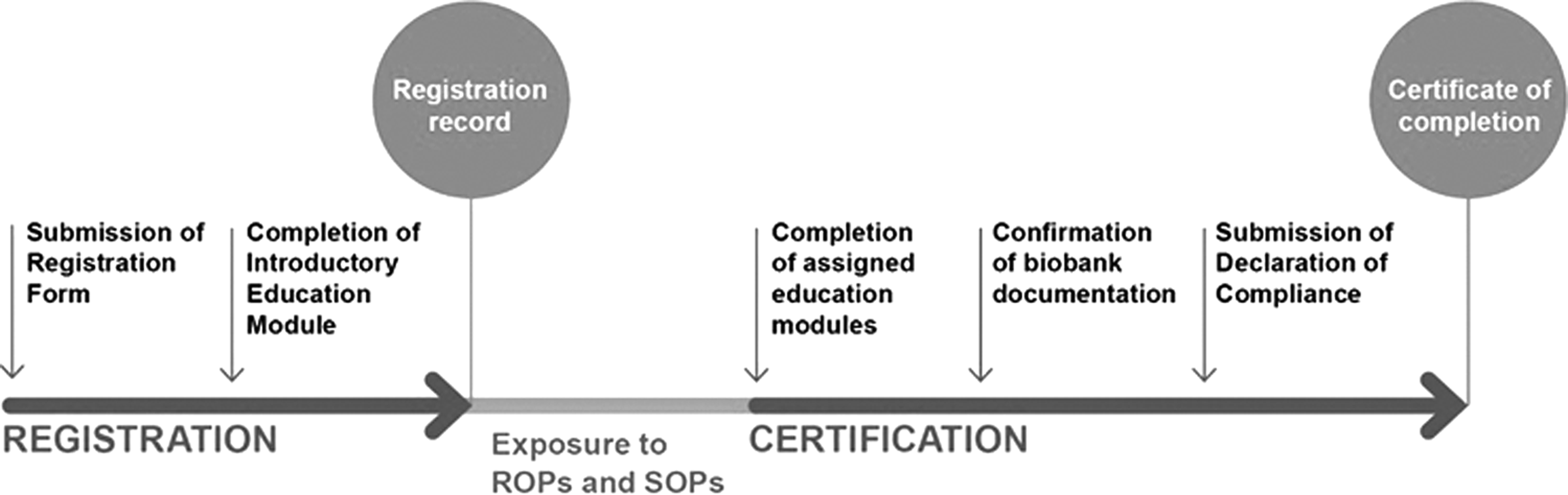
The CTRNet Biobank Certification process.
An important design element of the CTRNet Program is that the focus and extent of the education component and the depth of the peer assessment required are determined by a standardized decision tool. This ensures that the level of effort and focus of the certification process is appropriate for different types of biorepository. The basis for the decision tool is a classification schema. 2 Using an approach that considered the importance and relevance to different stakeholders of the many elements that comprise the design and functional elements of biorepositories, it was concluded that the most important elements for classification for the purpose of certification are brand (user type, leadership, and sponsor) and design (scale, accrual, data format, and data content).
This classification was refined specifically for the Certification Program to consider sequentially four subelements relevant to brand and design: scale, user type, data format, and leadership. This allows the classification of each biorepository for the purpose of assigning different requirements in a standardized way. In practice, scale and user type are perhaps the most distinguishing features in the context of a certification program. This is because this classification is a surrogate indicator of the relevance of harmonization and the need for education around governance to address the dual focus of the program on improving biospecimen quality and reducing risk of loss of public trust. 18 As the discipline of biobanking matures further, it may be important to develop an internationally accepted classification to facilitate deployment, broader adoption, and harmonization of certification processes such as this Program.
The CTRNet Biobank Certification Program was launched in November 2011 when the Registration component of the Program and the education modules were first made available. The Certification component of the program was launched for Canadian cancer biorepositories in April 2013. To facilitate dissemination of the Program and its education course beyond the cancer arena within Canada, CTRNet has formed partnerships with leading organizations that focus on other aspects of health research biobanking as well as healthcare more broadly. These partnerships include the Office of Biobank Education and Research in Canada, 19 the International Society for Biological and Environmental Biorepositories (ISBER), 20 and the International Society for Quality in Healthcare. 21 Adaptations to the Program were developed in response to these different partnerships, and since September 2013, access to the Certification Program was extended to noncancer biorepositories in Canada and internationally. Access to the education course was also made available through ISBER (www.isber.org/?page=IntrotoBiobanking). To date, over 100 biorepositories have participated in the program (∼30% international and 70% Canadian) and more than 500 individuals have utilized the accompanying education program (∼45% international and 55% Canadian).
CAP Biorepository Accreditation Program
The CAP was established in 1946 and remains the leading organization of board-certified pathologists in North America. Its mission is to serve patients, pathologists, and the public by fostering and advocating excellence in the practice of pathology and laboratory medicine worldwide. The CAP has led laboratory accreditation for more than 50 years with more than 7800 CAP-accredited laboratories in 50 countries 22 and is considered a leader in laboratory QA. The CAP is a member of the American Medical Association (AMA) as a national medical specialty society that has representation in the AMA House of Delegates and accredits laboratories under deemed authority by the Centers for Medicare and Medicaid Services (CMS). The CAP also offers a service to help laboratories earn accreditation to the ISO 15189:2012 Medical Laboratories Standard. With pathology being the medical area that focuses on the diagnosis of disease through the analysis of tissue, cell, and body fluid samples, many biorepositories are governed by the pathology departments within institutions. Furthermore, biorepositories are typically focused on analogous preanalytical processes, which are governed by CMS and other national health authorities for laboratories providing diagnostic results. The need for standardization in specimen preanalytical conditions and the alignment with the CAP mission were the primary reasons for establishment of the CAP BAP.
Each CAP accreditation program is governed by a set of core principles known as the Standards. The Standards constitute the core principles of the CAP accreditation Programs. Each Standard is evaluated by a set of checklist requirements that were established with the help of biorepository experts and experts from CAP's other accreditation programs, along with the guidelines and best practices of the International Society for Biological and Environmental Repositories, third edition, 23 the National Cancer Institute's Biorepositories and Biospecimen Research Branch, 24 the Organisation for Economic Co-Operation and Development, 25 and the Center for Medicare & Medicaid Services. 26 The BAP Advisory Working Group developed the first set of checklist requirements over a 1-year period. A pilot set of biorepositories with diverse activities and backgrounds were inspected the first year after launch in 2012, and the Biorepository Accreditation Committee (BAC) and the CAP Council on Accreditation closely monitored results of the inspections. The BAC further refines the checklist requirements as part of its continuous improvement activities and new versions are issued annually.
To be accredited, a biorepository must meet the biorepository laboratory general standards, which include general QMS, safety and general physical facility, and biorepository director qualification requirements. There is a separate biorepository checklist specific to individual biorepository activities. Given the diversity of biorepositories, the CAP BAP has a broad activity menu and applicant biorepositories apply for accreditation based on the scope of their activities. Examples of the activities include quality management of specimen handling; processing for nucleic acids, tissues, and cell specimens; storage; equipment programs; information technology; informed consent and ethics review board; and distribution policies and agreements. There are also specific requirements for biorepositories that sponsor protocols or have specimen sourcing activities. The checklist requirements require that documented practices be in place, and there must be evidence of compliance to the checklist requirement, but they are not prescriptive in how a biorepository achieves that standard. For example, the checklist requirement for preanalytical variables requires that “there is a mechanism in place to capture preanalytical variables that could impact potential uses of the biospecimens,” but it does not specify what mechanism must be used. Other checklist requirements associated with preanalytical variables do define key variables based on published literature, 27 but they do not limit the biorepository to only capturing these elements. The checklist requirements also require that a biorepository have quality monitors in place that will allow them to identify any problematic or error-prone areas within their systems, where improvements or focused education programs may be required. The specific quality monitors used and frequency of monitoring are defined by each biorepository. Checklist requirements are assigned as Phase I or Phase II. Phase I requirements compromise the quality of the services without endangering the health and safety of patients, clients, or personnel. Phase II requirements may have a serious impact on the quality of services or may endanger the health and safety of patients, clients, or personnel.
CAP utilizes a peer inspection process, so biorepositories are inspected by teams that have experience in the same activities the biorepository is performing as well as experience in performing inspections for CAP programs. These inspectors also undergo formal inspection training by CAP. This training program uses the “Read, Observe, Ask, Discover” (R.O.A.D.) technique. Inspectors are taught to review a sampling of the repository documents, observe biorepository practices by looking at what personnel are doing, ask probing questions, and discover through following a process being carried out by the biorepository. The CAP BAP is on a 3-year cycle with assessments being performed annually. The assessment for year 1 is an on-site inspection performed by a peer inspector. At the initiation of years 2 and 3, self-assessments are performed and biorepositories must submit their quality monitors to the CAP. This is followed by a conference with a CAP technical specialist to discuss the self-assessment and findings. All inspection results are provided to the CAP Accreditation Committee for a final decision on whether or not the biorepository should receive, or maintain, their accreditation status (Fig. 4).

The CAP Biorepository Accreditation Program process.
The program was launched in May of 2012. To date, there are 42 biorepositories that are fully CAP BAP accredited and 13 are in the process of obtaining accreditation. The program is currently available in the United States and is expected to be offered internationally in the future. The currently accredited biorepositories include academic research institutions and commercial biorepositories.
Development of an International Biobanking Standard
Standardization refers to the development and application of a set of published standards or models of operation. A leading body that develops standards is the ISO. ISO offers a range of broad standards that can be applied to biorepositories, for example, ISO 9001:2015 Quality Management Systems—Requirements. 28 ISO 9001:2015 has seven major sections, which include the context of the organization, leadership, planning, support, operations, performance evaluation, and improvement. The context of the organization provides an understanding of the purpose of the organization, how it serves the needs and expectations of interested parties, and defines the scope of activities and processes under the QMS. Planning uses a risk-based approach for the assessment of current and changing activities and the determination of quality objectives, and the development of plans to achieve them. Support outlines the resources, competencies, communication, and documentation practices required to achieve the quality objectives. Operations contain requirements for planning, customer interactions, design and production of actual products/services, including capture and implementation of customer specifications, control of materials and traceability of product, validation of equipment, software, assays and processes, and calibration and maintenance of equipment. The performance evaluation section provides information on monitoring, measurement and analysis through customer satisfaction, and performance of QC analysis, internal audits, and management review. Improvement provides information on handling deviations from established procedures, corrective and preventive actions, and for the performance of continuous improvement activities. Biorepositories that perform sample testing within medical laboratory workflows may be accredited to ISO 15189 Medical Laboratories—Requirements for quality and competence. 29 This Standard incorporates the principles of ISO 9001 and adds additional management and technical requirements associated with clinical laboratory testing activities. The management requirements focus on the responsibilities of the laboratory director, including interaction with the authorized personnel who requested the test and preservation of patient privacy throughout the sample receipt, testing, and result reporting cycle. Technical requirements detail personnel, facility, and equipment needs and the verification and validation procedures needed to ensure that any results provided by a certified laboratory are correct and are reported accurately. Another common standard is ISO/IEC 17025:2005, 30 which specifies the general requirements for the competence to carry out tests and/or calibrations, including sampling. It covers testing and calibration performed using standard methods, nonstandard methods, and laboratory-developed methods and is applicable to all organizations performing tests and/or calibrations.
While ISO 9001 requires good quality practices to be in place, it is not specific to biorepositories. In France, the Association Francaise de Normalisation produced the first quality standard specific to biorepositories in 2008—Standard NF S 96-900. 31 This standard incorporates some concepts and requirements of ISO 9001:2008 32 and adds additional requirements for a biorepository to provide evidence that the practices they are following for the collection, processing, and storage of biospecimens are suitable for the intended purpose of the biorepository. A growing set of European Committee for Standardization standards is available and work is now underway to develop an international ISO standard in biobanking for research purposes. This work is being conducted as a part of ISO/Technical Committee 276 Biotechnology. 33 ISO/TC 276 includes five distinct Work Groups: Terminology, Biobanks and Bioresources, Analytical Methods, Bioprocessing, and Data Processing and Integration. The Work Group specific to biobanking, WG2: Biobanks and Bioresources, took the approach of drawing from existing Best Practices documents23,25 to identify the key foundational principles. Currently, a draft document is undergoing an iterative process of review by participating countries and subsequent revision. It is anticipated that the final document will be finalized and distributed for adoption within a few years. 34 Once the ISO standard in biobanking for research purposes has been finalized, organizations seeking accreditation will need to complete the process as defined by their applicable accreditation body.
Other Tools Supporting Biobanking Quality
In addition to the comprehensive programs described above, published methodologies and other tools are available to support biobanking quality. These include the use of intrabiorepository methods35–38 and interbiorepository comparisons to determine performance using specific tests or measurements, as conducted by networks such as CTRNet 39 and others.40,41 The Integrated BioBank of Luxembourg (IBBL) offers a biospecimen proficiency testing program, 42 which operates in accordance with ISO 17043:2010. 43 IBBL provides test samples (for comparison of test methods) or processing items (for comparison of processing methods) to participating biorepositories, which then apply their routine SOPs. IBBL evaluates each participating biorepository's performance, relative to the assigned values for the test samples or processing items and relative to the results of the other participating biorepositories. Another tool available to biorepositories is the ISBER Self-Assessment Tool (SAT). 44 The ISBER SAT enables biorepositories to assess whether their SOPs follow the ISBER Best Practices for Repositories. 23 The goal of the SAT is to assist biorepositories in identifying areas where they need to improve to meet the current biobanking best practices. ISBER also provides a Preanalytical External Quality Assurance Survey. 45 This survey includes questions relative to preanalytical biorepository QA and QC practices. At the end of the survey, a report is generated that compares the biorepository's quality practices to other biorepositories. Finally, there are various education programs available to help biorepository leaders and personnel understand the principles that underpin biobanking best practices. These include the University of Luxembourg's Principles of Biobanking Course 46 and the ISBER-CTRNet Introduction to Biobanking Course.
It is also important to recognize that standardizing the conduct of biobanking across the research spectrum is a distinct topic from standardizing biobank outputs. In the former, the focus is on the internal functions and operations of biobanks, whereas in the latter, the focus is on the products that research users/biobank customers receive. This latter aspect of standardization is being addressed through tools such as the Biospecimen Reporting for Improved Study Quality guidelines 47 and the Sample PREanalytical Code 27 and needs to be incorporated into the developing international biobanking standard.
Conclusion
Professional biorepositories have long recognized that the development of evidence-based practices is critical to address and improve quality in research.23–25 Dissemination programs are a medium by which these practices can be implemented. And yet, demand among research consumers is only now beginning to emerge for known quality, standardized quality, and verified quality of biospecimens and annotating data. This reflects the recognition that to generate reproducible data, researchers must have confidence that important preanalytical variables associated with biospecimens and data are documented and known, have been reduced by adoption of common harmonized processes, or have been minimized by verification of standardized products.48–50
In this article, we have summarized two programs currently available that are principally focused on “process quality,” as opposed to “product quality.” This approach is ideal for those biorepositories supporting a variety of research users and where the specific product quality is best determined by the research user at the point of research, depending on their intended research application. For example, in a discovery phase research, a degree of known variation between samples can be an asset in exploring questions such as different preservation formats or multiple samples from the same individual patient. In this phase, known protocols that differ between biobanks may be the priority. For a translational phase experiment, elimination of known variation and selection of homogeneous sample sets are important, but the ability to test differences between sets from different biobanks can also be an asset. In this phase, standardization to achieve comparable quality is important. For a validation phase experiment, researchers require the ability to draw on samples from patients in different regions, representative of populations. In this phase, harmonization to a single standard to achieve equal quality is paramount. All three research phases are equally important as are the biorepositories that they rely upon. It is up to the biorepository to determine the type of research they intend to support and, therefore, which of the various types of approaches and programs are most applicable. With regard to product quality, the biorepository may choose to assume all aspects of quality testing or pass on part of the task of final product quality testing to the individual researchers, so that, they may ensure that the biospecimens meet their particular specifications (e.g., morphological preservation, molecular integrity).
Those involved in professional biobanking should clearly take the lead in developing standards and best practices, and programs to disseminate them. However, it is important to keep in mind that attaining and confirming “quality” are expensive, and the needs, depth, and relevance of distinct aspects of quality vary for different phases of research. We must therefore embed mechanisms within individual dissemination programs or, perhaps better, across a continuum of programs, to define and recognize the different quality levels of biospecimens and data that are needed for phases of research, and the different standards that are appropriate in terms of costs and benefits. The programs described in this study range from the CTRNet Biobank Certification Program that focuses mostly on promoting awareness and the need for adoption of common best practices across all research biobanking (including informal and professional biobanking), to the CAP BAP that focuses more on the implementation and the assessment of specific and/or improved quality levels to which some types of professional biorepositories can and should aspire. These types of programs may be thought of as complementary stepwise approaches to addressing quality across the spectrum of research biobanking by encouraging, ensuring, and assessing biobanking best practices across the research landscape.
Footnotes
Acknowledgments
This work was supported by the Tumour Tissue Repository Program at the BC Cancer Agency (supported by the Provincial Health Services Authority), the Canadian Tissue Repository Network (funded by grants from the Institute of Cancer Research—Canadian Institutes of Health Research and the Terry Fox Research Institute, and support from Canadian Cancer Research Alliance), and the Office of Biobank Education and Research, University of British Columbia (supported by the Department of Pathology and Laboratory Medicine, University of British Columbia).
Author Disclosure Statement
All authors contributed to the ideas presented in this study and to the development and preparation of the article. All authors read and approved the final article. R.O.B. is a paid consultant of the Canadian Tissue Repository Network (CTRNet). K.E.S. is a voluntary member of the Biorepository Accreditation Committee for the College of American Pathologists Biorepository Accreditation Committee. P.H.W. is a voluntary member of the CTRNet Executive Committee.