




Abstract
Background:
Comparative analysis of RNA expression profiles between cancer and adjacent noncancerous tissues is an important part of cancer research. High-quality RNA is essential for consistent, reliable results, especially for identification of cancer biomarkers. However, the impact of freeze-thaw cycles on the quality of RNA both in gastrointestinal cancer and paired adjacent tissues is still unclear.
Aim:
To investigate the influence of freeze-thaw cycles on RNA integrity and overall histomorphology of gastrointestinal cancer and paired adjacent noncancerous tissues.
Methods:
Gastrointestinal cancer and matched adjacent noncancerous tissues were frozen and thawed twice before extracting RNA. Total RNA in each sample was extracted with TRIzol reagents and the RNA integrity was assessed by RNA integrity number (RIN) on an Agilent Bioanalyzer. Light microscopy was then used to assess tissue composition and morphology.
Results:
RIN values for all samples tended to decrease in correlation with the frequency of freeze-thawing. With an RIN cutoff value of 6, RNA extracted from pancreatic cancer tissues was not qualified after the first freeze-thaw cycle. Moreover, all RNA extracted from adjacent noncancerous tissues had nonqualifying RIN scores after the first freeze-thaw cycle, except for liver tissues. Microscopically, all samples displayed qualified tissue morphology regardless of freeze-thaw cycle frequency.
Conclusion:
Freeze-thawing affects the RNA integrity, but not the tissue morphology of gastrointestinal cancer and paired adjacent noncancerous tissues. Furthermore, the RNA extracted from adjacent noncancerous tissues is more easily degraded than that in cancer tissues.
Introduction
A
RNA integrity number (RIN) is an advanced tool designed to estimate the integrity of total RNA. 7 It records the size distribution of RNA in a digital format based on both micro fluidics and micro capillary electrophoresis. 7 RIN determines RNA integrity using the ratio of ribosomal bands, and the entire electrophoretic trace of the sample, including the presence or absence of degradation products. Because this approach is independent of sample concentration and instrumentation used according to the manufacturer's guidelines, 8 and correlates better with RNA integrity than a 28S:18S peak ratio of 2.0,8,9 it is becoming a de facto standard for determination of RNA integrity.
Gastrointestinal cancer is defined as a malignant condition of the gastrointestinal tract, including the esophagus, stomach, liver, biliary system, pancreas, small and large intestines, and anus. 10 Some studies have determined the factors influencing the RNA integrity of gastrointestinal tissues. Human liver samples have been reported to show significant RNA degradation after 1 hour of cold ischemia, which was more pronounced in smaller samples. 11 On the other hand, the quality of fresh-frozen pancreatic tissues was not found to be adversely impacted by limited variations in warm ischemia times or different storage periods. 12 Moreover, it has been reported that RNA integrity in colon tissues are not affected by the ex vivo ischemia times and storage periods. 13 Such studies have prompted researchers to follow a standardized protocol when collecting different biospecimens. However, the effects of repeated freeze-thaw cycles on RNA integrity are not well understood, especially in adjacent noncancerous tissues of subjects with gastrointestinal cancer. Thus, the purpose of this study is to test the influence of repeated freeze-thaw cycles on the integrity of RNA extracted from gastrointestinal cancer and matched adjacent noncancerous tissues.
Materials and Methods
Patient clinical characteristics and sample collection
Samples were obtained from five common types of gastrointestinal cancer and matched adjacent noncancerous tissues, including gastric (n = 24 pairs), liver (n = 5 pairs), colon (n = 5 pairs), rectal (n = 5 pairs), and pancreatic (n = 7 pairs) tissues. Adjacent noncancerous tissues were at least 5-cm separated from primary tumors, and all samples were snap-frozen in liquid nitrogen immediately after the tissues were removed from the patient. Patients were 27- to 85 years old with a clear diagnosis according to World Health Organization guidelines for tumor diagnosis in the digestive system. 14 These patients were not treated with preoperative chemotherapy, and underwent surgical resection at Peking University Cancer Hospital (Beijing, China) from 2011 to 2015. Detailed clinical information for all patients is shown in Supplementary Table S1; Supplementary Data are available online at www.liebertpub.com/bio. Informed consent was obtained from all patients before study inclusion, and all protocols were approved by the Ethics Committee of Peking University Cancer Hospital.
Study design and sample treatment
Each snap-frozen tissue from a patient was cut into similar sized pieces (4 × 4 × 4 mm; about 30 μg). One (labeled FT0) was kept in RNAlater® RNA Stabilization Solution (Life Technologies, Carlsbad, CA) on ice. The second (labeled FT1) was immediately frozen at −80°C for 30 minutes, thawed at room temperature for 10 minutes, and then placed in RNAlater RNA Stabilization Solution. The third (labeled FT2) underwent two consecutive freeze-thaw cycles, each performed as described for FT1. Total RNA was extracted and assessed from all three pieces for each sample.
RNA isolation and RIN measurement
Each sample was ground to a powder under cool conditions of liquid nitrogen and immediately placed in 1 mL of TRIzol reagent (Invitrogen, Carlsbad, CA). Total RNA was then isolated according to the manufacturer's protocol. The extracted RNA was placed on ice before RIN assessment on an Agilent Bioanalyzer 2100 and RNA 6000 Pico Labchip kit (Agilent Biotechnologies, PaloAlto, CA). The RIN was used to estimate RNA degradation. According to the Bioanalyzer protocol, a RIN score cutoff of 6 was used to determine whether the RNA integrity was qualified or not. A sample above the cutoff RIN was considered to be nondegraded RNA.
Morphological assessment
All tissue sections (4 mm) were cut and stained with hematoxylin and eosin to assess morphology. Briefly, tissues embedded in optimal cutting temperature compound (OCT) were frozen at −80°C and cut into 10-μm thick sections using a cryostat. Frozen sections were fixed with absolute ethyl alcohol (1 minute), dipped in deionized water to remove OCT, and then stained in hematoxylin solution (5 minutes) before differentiating in 1% acid alcohol (1 minute), bluing in 1% ammonia water (1 minute), and counterstaining with eosin Y solution (10 seconds). Sections were then dehydrated with a serial ethanol gradient, cleared in xylene, and cover-slipped with mounting media. The morphological quality of all samples was tested by two pathologists who were blinded to the samples' treatment. Slides for each cancer type were divided into two groups by the pathologists, those without considerable morphological changes and those with morphological artifacts. If no significant morphological differences were detected in any sample from one of the experimental groups subjected to freeze-thawing, it was concluded that repeated freeze-thaw cycles did not adversely influence morphology.
Statistical analysis
Analysis was performed using IBM SPSS 13.0 software. Pairwise comparisons were performed to assess differences between the two experimental groups (FT0 vs. FT1; FT0 vs. FT2; FT1 vs. FT2). A randomized complete block design analysis using a general linear model test (GLM), followed by Student-Newman-Keuls multiple range tests at α = 0.05, were performed to assess the influence of fundamental factors on RIN values. All statistical tests were two-sided, and a p < 0.05 was considered statistically significant unless indicated otherwise.
Results
RNA integrity
The mean RIN score for each group of cancer and adjacent noncancerous tissues is shown in Table 1. Repeated freeze-thawing influenced the integrity of RNA extracted from all gastrointestinal cancer and adjacent noncancerous tissues except liver cancer tissues (Fig. 1C). The mean RIN score for RNA extracted from tissues decreased remarkably from FT0 to FT1 (Fig. 1A, B, D–J, p < 0.05), indicating greater sensitivity to freeze-thawing.
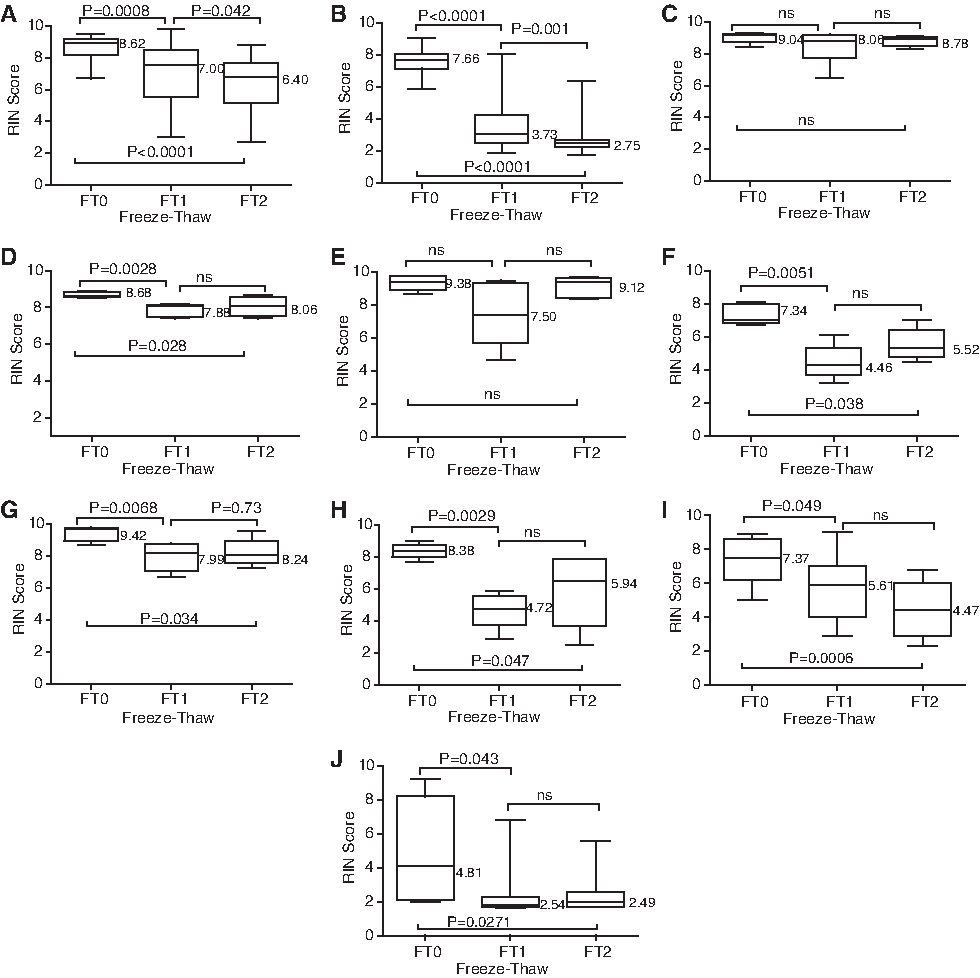
RIN values of RNA extracted from tissues.
CA, colon cancer adjacent tissues; CT, colon cancer tissues; GA, gastric cancer adjacent tissues; GT, gastric cancer tissues; LA, liver cancer adjacent tissues; LT, liver cancer tissues; PA, pancreatic cancer adjacent tissues; PT, pancreatic cancer tissues; RA, rectal cancer adjacent tissues; RT, rectal cancer tissues.
Furthermore, RNA extracted from adjacent noncancerous tissues degraded easier than that of cancer tissues. The RIN score in 1/7 pancreatic cancer and 5/7 adjacent noncancerous tissues was <6 at FT0 (Fig. 2A, pancreatic cancer tissues [PT], pancreatic cancer adjacent tissues [PA]), indicating unqualified RNA integrity. Except for pancreatic tissues, the integrity of RNA extracted from all the other tissues not subjected to freeze-thawing (FT0) was qualified (RIN scores >6, Fig. 2A). In our results, freeze-thawing certainly influenced the RNA integrity. Unqualified RIN scores were obtained from 7/24 gastric cancer and 20/24 noncancerous gastric tissues, 1/5 colon cancer and 4/5 noncancerous colon tissues, and 5/5 noncancerous rectal tissues at FT1 (Fig. 2C). Similarly, unqualified RIN scores were also found in 9/24 gastric cancer and 23/24 noncancerous gastric tissues at FT2 (Fig. 2E). We also calculated the 28S:18S. Using a cutoff ratio of 2.0, few of them were qualified even at FT0 (Fig. 2B, D, F). Obviously, the 28S/18S ratio of 2.0 is a stricter criterion than the RIN value of 6.
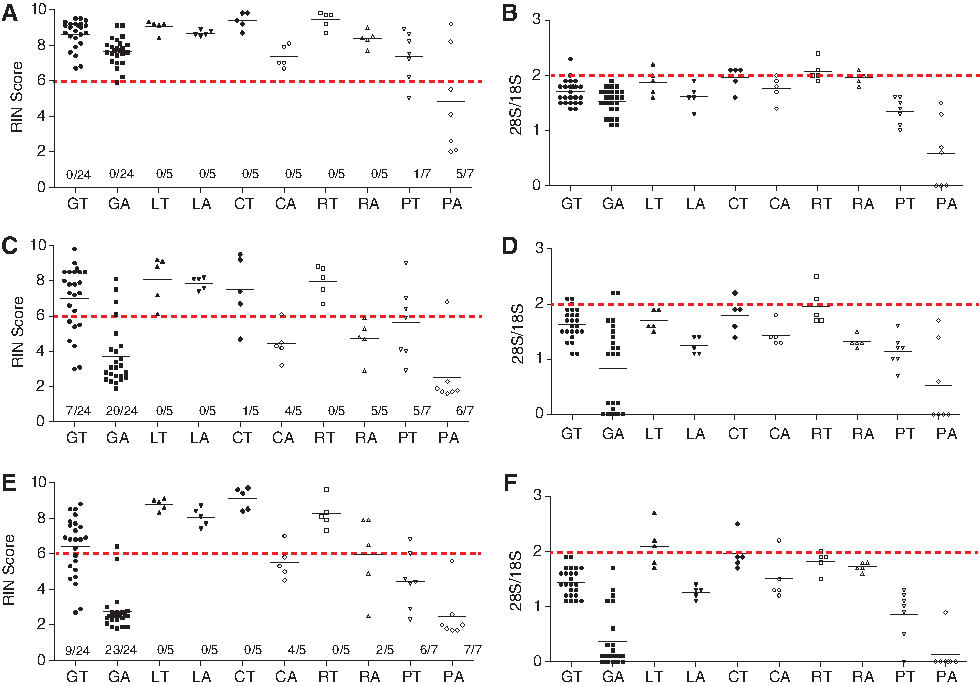
Scatter plot comparing RIN values and ratio of 28S/18S.
Freeze-thawing affects RNA integrity by GLM analysis
GLM analysis was used to analyze the effects of freeze-thawing and different tissue type on RNA integrity. As shown in Table 2, there was a significant difference in RIN scores between the different freeze-thaw cycles (p < 0.05) and different tissue type (p < 0.05). The mean RIN score decreased from 8.01 at FT0 to 5.62 at FT1 and 5.40 at FT2 (Table 1). As shown in Supplementary Table S2, the Student-Newman-Keuls multiple comparison tests divided the factor of freeze-thaw cycles into two subsets, indicating that any number in one subset (FT1 and FT2) is significantly different from that in the other subset (FT0). The Student-Newman-Keuls test also divided the factor of tissue type into four subsets (Supplementary Table S3). The first subset contained noncancerous pancreatic tissues only. The second was composed of noncancerous gastric and colon tissues, and pancreatic cancer tissues. The third subset consisted of noncancerous colon and rectal tissues, and pancreatic cancer tissues. The fourth subset contained gastric, rectal, liver, and colon cancer tissues, and noncancerous liver tissues. Consistent with the above results, repeated freeze-thaw cycles influenced the integrity of RNA extracted from both gastrointestinal cancer and adjacent noncancerous tissues. Similar to most kinds of adjacent noncancerous tissues, the integrity of RNA extracted from pancreatic cancer tissues was not qualified. However, the RNA integrity of noncancerous liver tissues was as good as those extracted from most cancer tissues.
R2 = 0.650 (adjusted R2 = 0.635).
Morphology
To determine whether repeated freeze-thawing influenced the morphology of gastrointestinal cancer and matched adjacent noncancerous tissues, all tissue sections were stained with hematoxylin and eosin and assessed by two pathologists blinded to the sample type. As shown in Figure 3, data indicate that repeated freeze-thaw cycles did not adversely influence morphology.
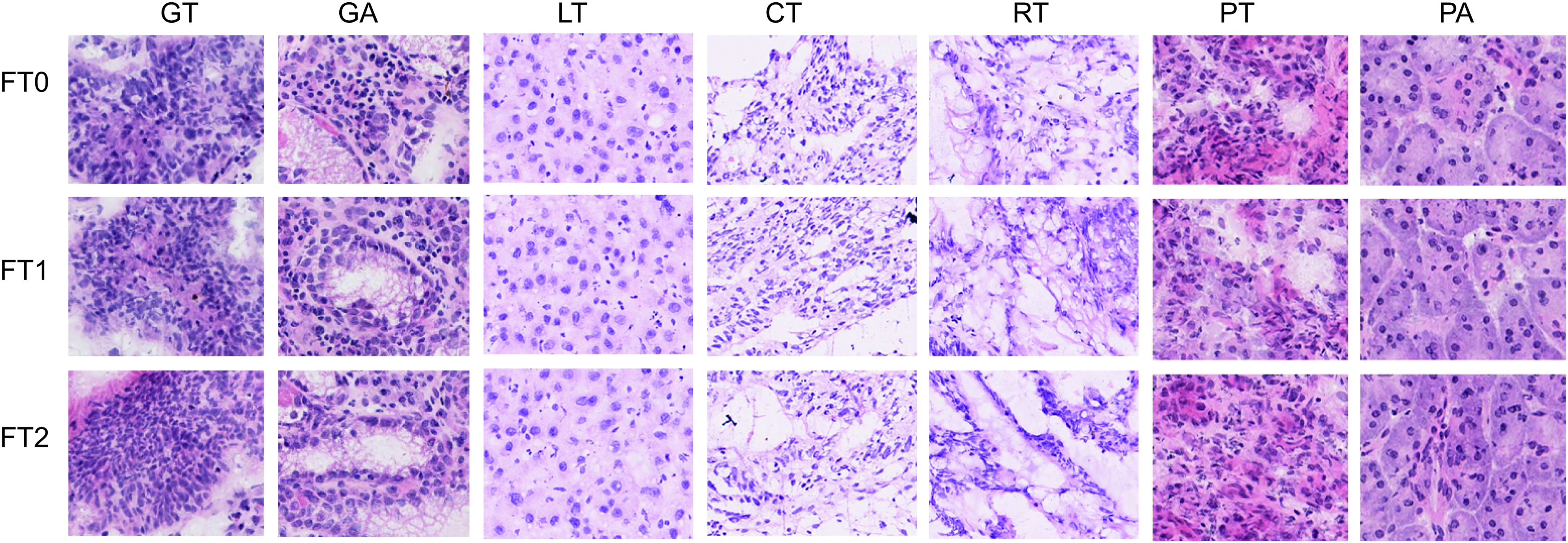
Morphology image of tissues stained by hematoxylin and eosin (X 80). Color images available online at www.liebertpub.com/bio
Discussion
The quality of biospecimens, from tissue procurement through experimental processing, is a prerequisite not only for analysis of the molecular characterization of cancer tissues, but also for high throughput sequencing. RNA integrity is particularly affected by freeze-thawing cycles, 15 but whether repeated freeze-thawing has the same influence on RNA integrity in cancer versus adjacent noncancerous tissues is not well understood. Here, we present the influence of repeated freeze-thaw cycles on RNA integrity in different types of gastrointestinal cancer and matched adjacent noncancerous tissues.
In our study, the integrity of RNA extracted from liver cancer tissues was not significantly influenced by repeated freeze-thawing. This was similar to a previous report that RNA integrity from human liver samples was not significantly influenced by the transport or freezing method, but changes in gene expression were observed in samples transported on gauze or in a salt solution. 11 It has been clearly reported that partial RNA fragmentation has a profound impact on global expression profiles, 16 and distorts the RNA-seq read coverage in a gene-specific manner. 17 Since the repeated freeze-thawing influences RNA integrity, it can be concluded that freeze-thawing has an impact on gene expression analysis. RNA degradation was particularly remarkable in pancreatic cancer tissues, either fresh or freeze-thawed. The pancreas reportedly contains large quantities of proteases, DNases, and RNases that initiate an autolytic process, 18 and the RNA degradation is likely correlated with the abundance of RNase 1 in pancreas. 19 Thus, isolation of intact and high-quality RNA from pancreatic tissue remains a challenge despite several proposed approaches to sample handling, including rapid removal of tissues from the abdominal cavity, handling only at cold temperatures, and inhibition of contaminating RNases. Consistent with a previous report, 15 a fraction of the RNA extracted from gastric and colon cancer tissues herein had RIN scores greater than 6 after the first freeze-thaw cycle, emphasizing the importance of proper sample aliquot storage.
Compared with the cancer tissues, the RNA in adjacent noncancerous tissues degraded easier. Although it has been reported that ischemia duration has no significant influence on the integrity of RNA extracted from fresh-frozen human normal colon 13 and ileum mucosa, 20 a significant decrease in integrity of RNA in adjacent noncancerous tissues has been observed (r = −0.24, p < 0.001). 21 These studies suggest that noncancerous tissues adjacent to tumors show different characteristics from normal tissues obtained from subjects without cancer. Taken together with the current results, it is clear that measures should be taken to protect RNA from degradation by avoiding repeated freeze-thawing or by adding an RNA stabilizer to preserve adjacent noncancerous tissues. However, the mechanisms underlying this type of RNA degradation in adjacent noncancerous tissues still requires further study.
In brief, we reported that RNA from pancreatic cancer tissues is the most sensitive to degradation, while RNA from liver cancer tissue appears to be unaffected by repeated freeze-thaw cycles. Different from cancer tissues, all types of para-cancerous tissues are prone to degradation. Taking the small sample size of all cancer types in this study into consideration, a large-scale study validating the impact of freeze-thaw cycles on RNA integrity will be needed in the future.
Footnotes
Acknowledgments
This work was supported in part by the Beijing Committee of Science and Technology in China (Grant No. D131100005313010) and the National High Technology Research and Development Program of China (863 Program, No. 2014AA020603).
Author Disclosure Statement
No conflicting financial interests exist.
References
Supplementary Material
Please find the following supplemental material available below.
For Open Access articles published under a Creative Commons License, all supplemental material carries the same license as the article it is associated with.
For non-Open Access articles published, all supplemental material carries a non-exclusive license, and permission requests for re-use of supplemental material or any part of supplemental material shall be sent directly to the copyright owner as specified in the copyright notice associated with the article.
