




Abstract
This article discusses the evolution of the University of Pittsburgh (UPitt) Health Sciences Tissue Bank (HSTB) operation and how it has successfully positioned itself, manages to sustain its value, and remains viable in today's research landscape. We describe the various components of our biobanking operation, which are valued by our researchers, thus leading to sustainability for our biorepository. Operating within the infrastructure of a large academic university, we have access to the most cutting-edge database resources for collecting, tracking, and annotating thousands of specimens. We are constantly improving upon our ability to provide real-time longitudinal follow-up data for our collections, thus providing researchers with valuable, highly annotated research specimens. We believe the combination of all that is described within this article helps to create a biobank that will remain sustainable well into the future.
Introduction
T
Our tissue bank was started with a single collection location, two part-time employees, and one organ collection initiative. The bank went through several high growth phases that eventually added three additional collection locations and virtually every organ system and many new disease programs. Additional staff were hired and, during this period, there were a number of initiatives that added information technology and administrative infrastructure incrementally. However, the infrastructure improvements did not keep up with the needs posed by the operational complexity and magnitude of sample collection on a day-to-day basis. The organizational structure and number of staff could not accommodate new initiatives that were needed to keep up with the needs created by a tightening fiscal climate, shifting research needs, and changing regulatory environment. This naturally resulted in failures in confidence among the programs and faculty investigators who used the bank. Prices were raised to increase cost recovery and utilization dropped further exacerbating the dilemma. Therefore, organizational deficiencies developed over time that drove fiscal deficits, which in turn resulted in a diminished ability to address the deficiencies.
Members of the institutional leadership were presented with the options to continue in this dysfunctional state, close the facility, or invest heavily in reorganization in the short term to develop a sustainable facility that is more used and useful in the long term. The decision was made to invest and since the incorporation of the initiatives described, we have built a highly functional organization, excellent effort tracking, and cost recovery, while improving quality, efficiency, and turnaround time for services. These factors have in turn improved morale, investigator confidence, and driven utilization of the fixed cost infrastructure, which has allowed the prices for services rendered to be lowered while decreasing the deficit.
The HSTB at UPitt is a multisite biorepository and works in collaboration with the University of Pittsburgh Medical Center (UPMC) and the University of Pittsburgh Cancer Institute (UPCI). UPMC consists of a network of 20 hospitals and the biobank has a major footprint at the 3 flagship hospitals and its largest community hospital. The comprehensive physical footprint in total of the HSTB is roughly 6000 sq. feet, housing 4 processing laboratories and 4 freezer farms (47 mechanical −80°C freezers and 6 large liquid nitrogen Dewar freezers). All freezers are on backup emergency power and are monitored around the clock. Having several freezer farms permits the ability to spread facility-related risk across geographic locations.
Today, the primary mission of the HSTB is to facilitate collection, processing, preserving, storing, disbursement, and annotation of specimens driven by researcher-defined protocols. At one time, the HSTB collected excess clinical material, but this became cost/storage prohibitive. The HSTB provides essential support for UPitt, UPMC, and UPCI research programs requiring biological materials from patients seen at UPMC. The bank's main objectives are to provide a mechanism to simplify and streamline the process of research tissue accrual and disbursement and to provide efficient research pathology support services, including histology, immunohistochemistry, and paraffin tissue microarrays.
Background
The first iteration of the HSTB operation began in 1994, with collections based on focal study needs. Once the infrastructure for the focal studies was in place, the ability to deidentify, annotate, and store excess pathology material was realized and a tissue library was established. The bank was essentially a clearinghouse for human-derived biological specimens, which served the needs of interested internal researchers.
The intention was to build a library of biological materials, which could be used for future study. However, over time, it became apparent that the excess material was not being fully utilized. Freezers were filling fast and utilization of this excess material was much lower than anticipated. In 2014, a decision was made to stop excess collections. All active collections are now grant funded or contract based, driven by IRB-approved researcher-defined protocols.
Throughout the 20 years of operation and cyclical funding booms and busts, lessons have been learned and missteps righted. This article intends to highlight what has worked best for the HSTB in maintaining a viable research resource. Below is a summary of successful components of our biobanking operation, which are valued by our researchers, thus leading to sustainability for our biorepository.
Methods
Blanket IRB
The Tissue Bank IRB is a general protocol that permits the banking of consented and excess tissue and disbursement to all researchers to simplify tissue acquisition. In addition, the HSTB IRB permits the bank to operate as a central repository for samples collected under our own purview as well as acting as the repository for researcher-specific IRB protocols, leveraging economies of scale. The HSTB IRB permits and promotes researcher flexibility in obtaining materials for proof-of-concept studies that could subsequently grow into more substantial projects.
Honest broker system
The HSTB has a full-service, IRB-approved Honest Broker System (HB015) to ensure research integrity and patient confidentiality. All specimens received by the bank are immediately deidentified by our Bio-Banking Information System. The linkage codes are maintained solely by the HSTB. The Honest Broker System is a cross-divisional, collaborative broker service used as the gold standard model by the UPMC/UPitt IRB. This system enables researchers to more easily gain access to samples deemed as nonhuman subjects in an efficient and secure manner. Nonhuman subjects in the United States are defined as subjects with whom an investigator is conducting research, but does not obtain data through intervention or interaction, nor do they receive any identifiable private information.
The involvement of the HSTB bankers in a UPMC honest broker system permits access to electronic medical record data otherwise unavailable to UPitt researchers. This annotation adds tremendous value to the specimens.
Pathology tissue archives
The HSTB has been given access and responsibility, with pathology leadership approval, to facilitate the utilization of formalin-fixed paraffin-embedded (FFPE) specimens for IRB-approved projects. Use of these specimens for research purposes requires deidentification and pathologist review and approval. Given the changing landscape regarding DNA and RNA extraction techniques from FFPE, this access has added a tremendous value to the bank as well as the greater university and its researchers.
Tissue utilization committees
Specimen distribution is based on a defined priority order of usage for investigators involved in a particular research field. The organ-specific Tissue Utilization Committees (TUCs) discuss and develop future research directions for the program and assess policies and procedures for the availability of tissue and biological materials for promising research projects. Each of these committees makes recommendations to the personnel of the HSTB for defining priorities in distribution of tissues. The study-specific consent includes language that allows for future usage in other studies. The request for materials by a researcher must be approved by the appropriate TUC before distribution of that material to customers.
Of important note, the design of the HSTB IRB allows the transfer of ownership of the specimens from a study of specific focus to one of greater breadth by making them part of the HSTB collection. In our experience, investigators are not initially open to this transference, but appointing these individuals as members of a TUC has proven to calm the anxiety associated with giving up total control while maintaining the authority to approve or deny access to requestors. At the outset, the consents for these collections are typically designed so they are not study specific. It is the institutional belief that making samples readily available for the greater research community has an exponential return on investment.
Marketing the resource
Extensive internal marketing is undertaken. This includes regular presentations to research interest groups and marketing posters advertising the contents and services of the HSTB. The HSTB presents at new faculty orientation sessions, making them aware of existing resources. Presentations are given to residents and fellows regarding how to handle specimens designated for research appropriately and informing them of tissue availability for their research needs. The HSTB has a robust tissue bank website, which advertises all services, including tissue microarray and research histology services, our blanket IRB, honest brokering services, imaging, and so on.
Cost recovery and transparent cost model
Institutional support is provided to the HSTB to lower costs across the board. This continued investment helps to stabilize the cost to the investigator in times of limited funding.
A cost model was approved and implemented for the HSTB that offers competitive standardized pricing to our customers. This cost model allows for regulatory compliance and offers the ability to incorporate fee for service as well as a mechanism for support through salary recovery. To keep our prices competitive, internal staff are rewarded with the application of institutional support, which lowers the cost to them. Outside entities who request services from us do not benefit from the subsidized fee. This information is readily available through the HSTB website for researchers.
In addition, the UPitt has provided access to administrative and billing personnel, who currently perform similar tasks for other core facilities, to aid the bank in the recovery of funds for services provided. This allows banking staff to focus on banking issues.
Tools for the researcher, efficiency for the bank
There are numerous established tools that are available as part of the functioning of the HSTB that serve to organize, manage, and efficiently meet the needs of the researcher. The following is a listing and description of each tool.
Online tools
Project management request tool
The HSTB has a user-friendly online tool for the entry of project requests and modifications by researchers. It is accessible to both UPitt and UPMC researchers. Customers are required to upload their IRB and protocol documents into the tool for review by the HSTB project manager. The tool is able to send the project request directly to the members of the appropriate TUC for approval through e-mail, including comments and questions that the project manager/TUC members might have. Once a project has been approved, the HSTB project manager is able to use the tool to autoassign the project to a tissue bank technician to begin working on the project. The technician enters updates on the status of the project into the tool and this autogenerates an email to the customer. The researcher can enter project modifications and comments into the tool; this information is then automatically provided to the project manager and tissue bank technician. The Project Management Request Tool fosters accountability at all levels and provides a venue for open interaction and communication (Fig. 1).

HSTB Project Management Tool Login Page for UPMC and University of Pittsburgh Users and Request Form. This interface allows access to the Project Management Tool, which is housed behind the UPMC firewall. The Project Request Form is a digitized form to collect basic project details directly from the primary investigator before the HSTB engagement. HSTB, Health Sciences Tissue Bank; UPMC, University of Pittsburgh Medical Center.
Biobanking inventory system
The HSTB has established an electronic biobanking inventory system called BIOS (Biospecimen Inventory and Operations System). The system was developed in-house and has been customized to manage our inventory for collections and disbursements of biological materials. It tracks warm ischemic time, inventory location (freezer number, rack number, box number, cell location), and derivative products. The ability to annotate each discrete specimen with clinical data exists, enhancing the value of each. BIOS is linked with the UPMC registration system to ensure accurate association with the specimen and patient history, as well as the pathology clinical report, and with the text information extraction system (TIES). 2 The HSTB staff technicians use BIOS for all steps of our operation, starting with obtaining a deidentified tissue bank number for the specimen and printing out barcode labels.
BIOS has researcher-level access and the ability to run reports and queries. Research-level access permits a complete deidentified view of inventory (Fig. 2).

BIOS Main Page. Options available include Inventory Search, Distribution, Work Lists, and Reports. The BIOS screen shown below the main page permits the bankers to search the inventory for various criteria. BIOS, Biospecimen Inventory and Operations System.
Tissue Bank Collaborations
The tissue bank collaborates with the TIES, the UPMC Cancer Center Registry Information Services, and the Pathology Laboratory Information System (CoPathPlus; Cerner Corporation, Kansas City, MO). A brief overview of these collaborations is given below:
Text information extraction system
TIES has over four million deidentified surgical pathology reports automatically updated monthly from reports in the clinical health system. The system takes free text from pathology reports and processes these reports into deidentified searchable data on patients. Instead of making researchers look for every synonym of a disease, TIES groups all synonymous words and abbreviations under a concept, returning more results. TIES oversees the TIES Cancer Research Network (TCRN), which has four members: Augusta University, UPitt, University of Pennsylvania, and Roswell Park Cancer Institute. It allows members to share data and tissue among properly vetted researchers, with the goal of promoting cross-institutional cancer research. The project manager of the HSTB is also the regulatory manager of TCRN (Fig. 3).
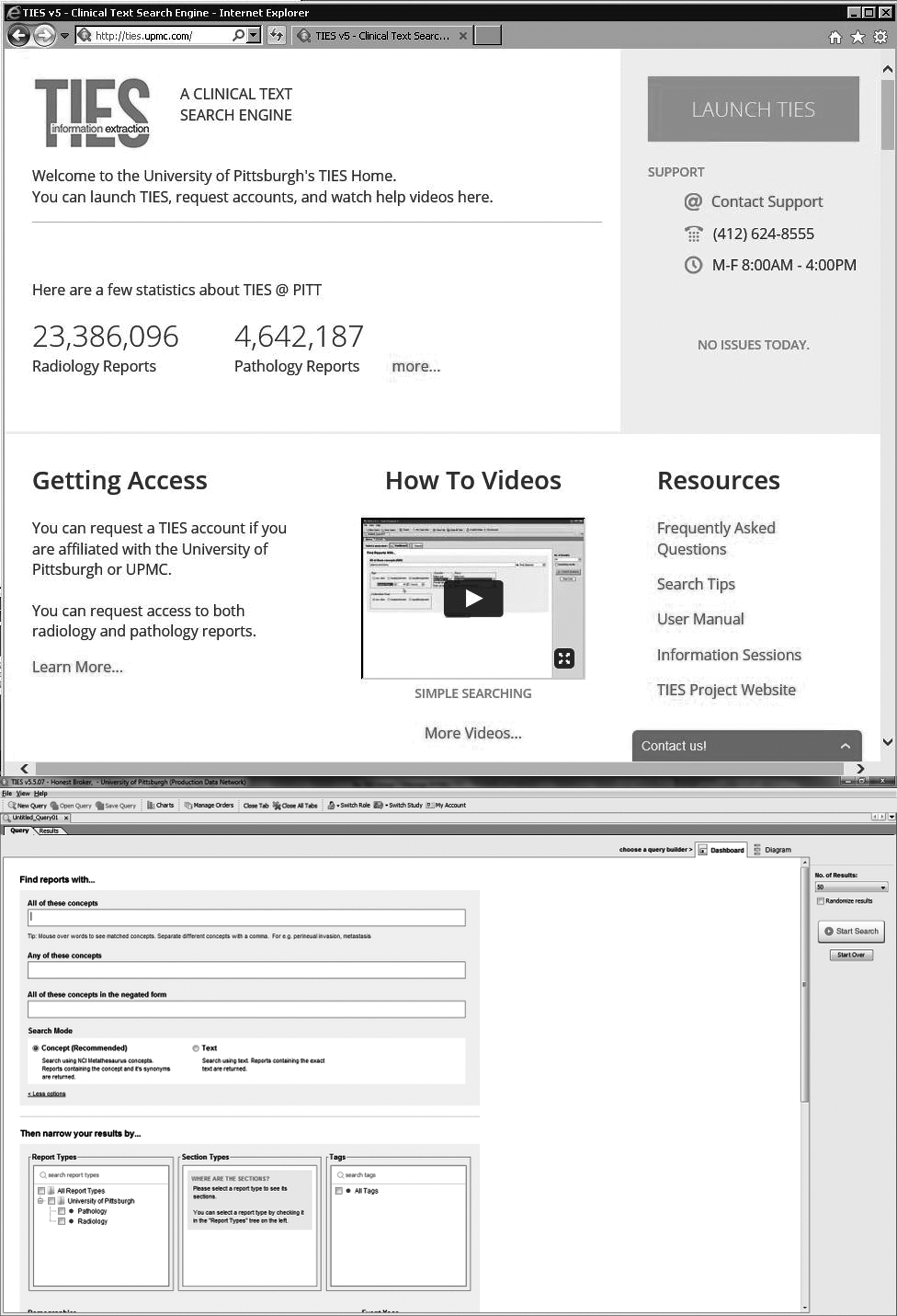
Text Information Extraction System (TIES) Developed by the Department of Biomedical Informatics at the University of Pittsburgh. The system pulls pathology and radiology data into a dynamic search environment and presents results to users completely deidentified. Linkage exists between BIOS and TIES, permitting users to search the inventory. Screen shown below shows a basic search screen that is available using concept terms and limiting variables (http://ties.dbmi.pitt.edu). TIES, Text Information Extraction System.
UPMC Cancer Center Registry Information Services
The UPMC Cancer Registry is a data system for collection, management, and analysis of patient demographic, grading, staging, treatment, and progression data on cancer patients. It is a service separated into two distinct subdivisions within the UPMC Network Cancer Registry, one handling data collection and dissemination for clinical and hospital operational purposes and the other dedicated to specific efforts and data needs of the research community of the Centers of Excellence within the UPMC Cancer Center and the UPCI.
The UPMC Network Cancer Registry comprises over 40 full-time staff responsible for maintaining a standardized data system for the collection, management, and analysis of patient demographic, grading, staging, treatment, and progression data on patients with a diagnosis of having cancer. It is also a key source for Honest Broker Services to meet the needs of the oncology research environment. Given their involvement within the honest broker system, bankers and cancer registry staff can communicate freely and obtain additional annotations for samples (i.e., specific treatment history, recurrence, mortality, etc.).
Cerner CoPathPlus
The Laboratory Information System, managed by the UPMC Anatomic Pathology Informatics Department, is a commercial product. This was developed in partnership with practicing pathologists and used for day-to-day clinical operations of anatomic pathology. The HSTB BIOS operating system links to diagnostic information in the CoPath system. CoPath is also available outside of BIOS for all HSTB staff to review results, synoptic reporting, and natural language searches.
Focus on Quality
College of American Pathologists certification
The UPitt HSTB is certified by the College of American Pathologists (CAP), which is a standard of excellence for biorepositories. The CAP Biorepository Accreditation Program (BAP) is designed to improve the quality and consistency of facilities that collect, process, store, and distribute biospecimens for research. This is the very first accreditation program for standardizing biorepository services. It is a peer-based inspection model, using one to two inspectors with current experience in an active biorepository, and qualified through a CAP Inspector Training Program. On-site inspections occur every 3 years using CAP accreditation checklists to assess compliance with program requirements.
Instituting a quality program requires an upfront and continued investment in time and effort. Ensuring accurate annotation, specimen handling, and storage are the key components that add direct value to research. As such, the quality program revolves around these concepts. 3
Ensuring the integrity of the specimens requires 24/7 monitoring, emergency backup power, and a thoughtful approach to minimize facility-related disasters. ISBER best practices recommend 10% availability in freezer space to permit the housing of specimens in an emergency (freezer malfunction). The HSTB also spreads risk related to fire, flood, and other types of disasters by locating freezer farms in four separate locations.
Annual user satisfaction survey and continuous improvement
On an annual basis, an electronic anonymous user satisfaction survey is sent to all users and potential users of the HSTB soliciting feedback. Survey participants have the opportunity to rate the HSTB as poor, below expectations, meeting expectations, above expectations, or excellent, as well as provide comments for each survey question. Questions request feedback on the quality of communication, sample quality, turnaround time, data annotation, honest brokering services, leadership, research pathology service, and overall value.
The results are compiled and shared both internally with the HSTB staff and leadership and externally with all researchers who were invited to take the survey. Action items are derived and planning and goals are established based upon the survey results in an attempt to make improvements in areas where necessary. The survey also provides feedback from users about potential new needs and generates queries and interest from new customers.
Well-trained dedicated staff and quality program
The HSTB technical staff members are experienced and knowledgeable and 100% of our anonymous survey responders rate the courtesy of our staff as meeting expectations (26%), above expectations (22%), or excellent (52%). There are orientation and training checklists for new hires. Individuals undergo competency assessment and are reassessed for competency annually. Our staff includes a project manager who oversees the Project Management Request Tool mentioned above as well as a quality manager who oversees a very robust quality management plan.
Conclusion
We believe the combination of all that is described within this article helps to create a biobank that is sustainable. It is critical to maximize value to researchers and to minimize their efforts in accessing, and acquiring, materials to populate their projects. Through the above initiatives, our services remove many barriers for researchers, supporting their research goals and enhancing our utilization as a biobank both now and for years to come. As we aggregate more information over the next year or so, we intend to write a subsequent article using data being collected to report on how these recently adopted initiatives have impacted revenue generation, the need for institutional deficit support, and the sustainability of our operation.
Footnotes
Acknowledgments
The authors wish to acknowledge the HSTB personnel for their contributions to the successful functioning of their organization. This study was supported by an IH Grant Award P30CA047904, University of Pittsburgh, and UPMC.
Author Disclosure Statement
No conflicting financial interests exist.