




Abstract
In the rewarming process during cryopreservation, preventing ice recrystallization and thermal stress is important, especially for large tissues and organs. Uniform and rapid heating is essential in ameliorating the problem and maintaining the viability of cryopreserved biological samples. Currently, the most promising method is heating by application of electromagnetic (EM) waves, the effectiveness of which is dependent on the dielectric properties (DP) of the cryopreserved materials. In this work, the cavity perturbation method was adopted to measure the DP of cryoprotectant solutions. Based on the values of DP, the cryoprotectant solutions most amenable to EM heating can be identified. A system composed of a rectangular resonant cavity, a network analyzer, and a fiber optic temperature meter was implemented for the measurement. The DP of three cryoprotectant solutions during cooling to −80°C were measured and presented. The data can be used to optimize the rewarming process with the numerical method. The results show that a cryoprotectant solution consisting of 41% (w/v) dimethyl sulfoxide and 6% (w/v) polyvinylpyrrolidone has the highest dielectric loss for EM rewarming among the tested solutions. In addition, the developed DP measurement system could not only improve the EM heating in cryopreservation but also benefit hyperthermia or other therapies associated with EM waves.
Introduction
L
For an effective warming technique, ultrafast thawing is needed to avoid recrystallization and thermal stress, especially for large tissues and organs. Currently, the most promising technique may be the utilization of electromagnetic (EM) waves, which can provide more rapid and volumetric warming compared to the conventional method of heating in a water bath.5–8
However, when cryopreserved material is heated by EM waves, the problem of “thermal runaway” should be taken into consideration. The dielectric properties (DP) of the biomaterials characterize the interaction between applied EM field and the biomaterials, and thereby determine the absorption of EM energy by the biomaterials.9,10 The DP are temperature dependent. If the warmer part of the biomaterial absorbs more heat, the temperature at that warmer part would be further increased, increasing temperature gradients and therefore thermal stresses. A large thermal stress can destroy the viability of cryopreserved tissues or organs.11,12 Since the DP play a key role in the absorption of EM energy, it is a priority to discover the DP of the biomaterials. In cryopreservation, especially in vitrification using a highly concentrated cryoprotective agent (CPA), the CPA/vitrification solutions dominate the properties of the cell suspensions or tissues. Therefore, the DP of the CPA/vitrification solutions should be determined so that EM rewarming can be optimized.
The measurement of the DP of biomaterials requires sensing and monitoring tools. In many biomedical applications, various measurement methods, including transmission and reflection techniques, have been used to determine DP.13–17 In the EM rewarming process of cryopreservation, measurement of DP in the subzero temperature range is a requisite. The cavity perturbation method has been used for measuring the electric properties of different kinds of materials18–22 due to its ability to measure the DP of low-loss dielectric materials. 23 In the subzero temperature range, the DP of biomaterials and CPA/vitrification solutions can be very small. Therefore, in this work, we adopted a cavity perturbation method to determine the DP of three different vitrification solutions at low temperatures. Briefly, a resonant cavity was designed and manufactured to measure the DP of cryopreserved biomaterials at 434 MHz. By inserting samples with different permittivity into the resonant cavity, the resonant frequency and quality factor could be changed. From the variation of the resonant frequency and the quality factor, the DP can be derived.
Methods
DP measurement system
The experimental system is shown in Figure 1. A rectangular single-mode resonant cavity resonating at around 434 MHz was manufactured. The dimension of the cavity is 680 × 400 × 350 mm. Copper was used to manufacture the cavity due to its low cost and excellent conductivity (to prevent EM leakage). The vitrification solutions, held in a thin plastic spherical shell manufactured in machine shop (18 mm radius), were transferred from a −80°C freezer to the center of the cavity. The temperature of the sample was gradually increased by the (very slow) warming of natural convection. This method was chosen in preference to using a precise temperature control apparatus because the presence of such a device in the cavity would influence the measurement. The final temperature difference after the measurement with slow warming in the material was less than 5°C. To avoid interfering with the EM field formed in the cavity (and therefore obtaining incorrect measurements), a fiber optic sensor connected to a temperature meter (Reflex; Neoptix, Quebec city, QC, Canada) instead of a thermocouple was inserted into the sample. The temperature was recorded with the fiber optic temperature meter. During the slow warming process, a network analyzer (E5061B; Keysight Technologies, Inc., Santa Rosa, CA) was used to track the resonant frequency and reflection signal

Dielectric property measurement system.
Perturbation theory
Through the change of resonant frequency
where f0 and Q0 are resonant frequency and quality factor of unperturbed cavity,
For nonmagnetic material,
where
Substituting (4) into (2), we have
where
k1 and k2 are constants to be determined.
Water, methanol, ethanol, 1-propanol, 2-propanol, ethylene glycol, and cyclohexane were used for calibration of the cavity to determine k1 and k2. The properties of these calibration solutions are listed in Table 1. 27 Constants k1 and k2 were calculated by linear regression. Figure 2 shows the resonant frequency shift of the cavity with different calibration solutions. Figure 3 shows the quality factor change. The correlation factor R-Square is 0.9943 for Figure 2 and 0.989 for Figure 3, demonstrating a good linearity and is consistent with the theoretical derivation. From the linear regression, k1 = 0.964 MHz and k2 = 0.2826.
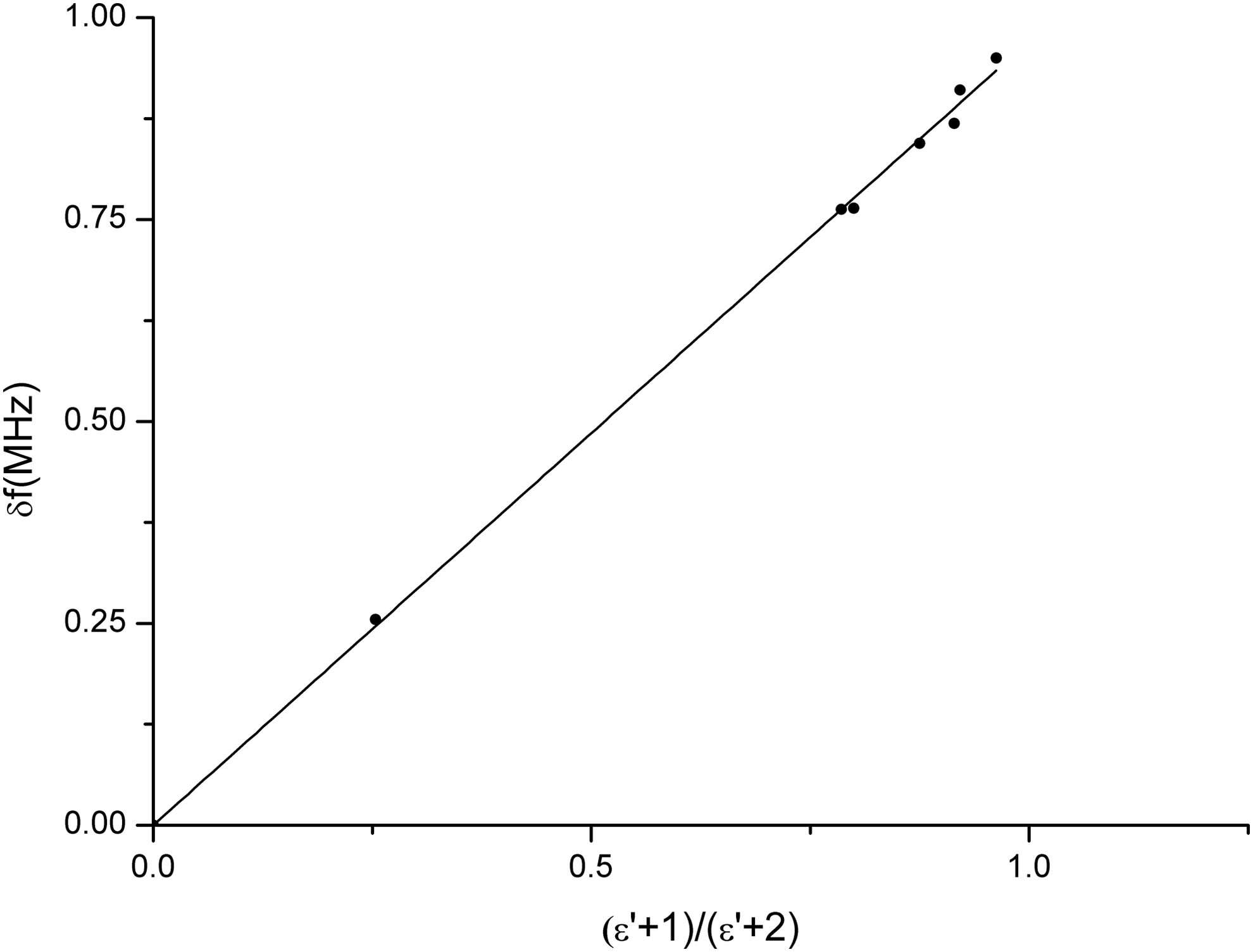
Resonant frequency shift of the resonant cavity after loading different calibration solutions: water, methanol, ethanol, 1-propanol, 2-propanol, ethylene glycol, and cyclohexane.
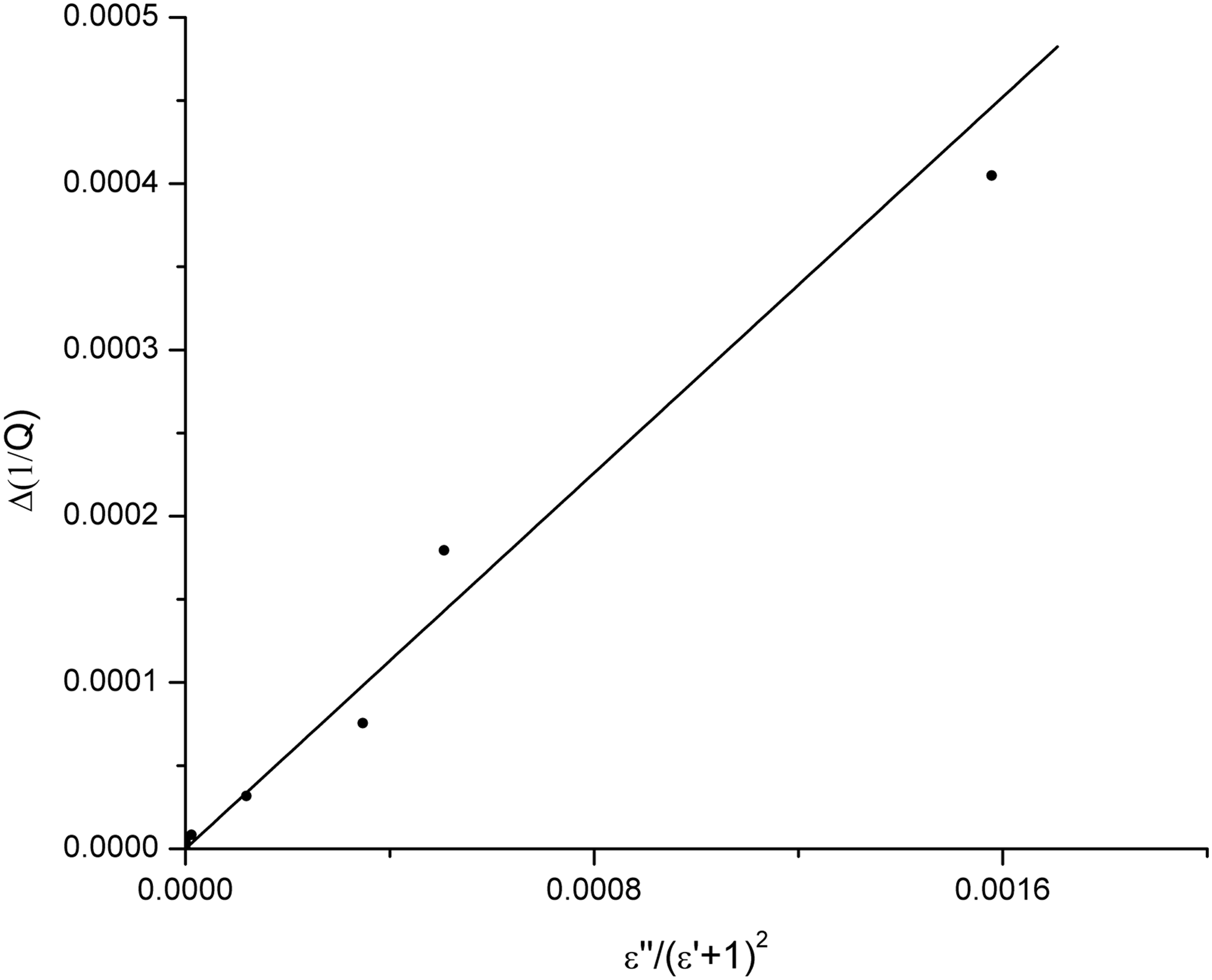
Inverse of quality factor change of the resonant cavity after loading different calibration solutions: water, methanol, ethanol, 1-propanol, 2-propanol, ethylene glycol, and cyclohexane.
Once k1 and k2 had been obtained, unknown cryopreserved materials were inserted into the cavity. Similarly, the resonant frequency and quality factor were changed. According to the shift frequency and quality factor of the cavity, complex permittivity of samples can be derived as follows:
Vitrification solution
The properties of cell suspensions are dominated by CPA/vitrification solutions. To achieve preservation of large tissues or even organs, vitrification should be the most promising approach.28–30 Therefore, a group of vitrification solutions composed of various common CPA solutions designed by Fahy 31 were measured in this work. The composition of the vitrification solutions is shown in Table 2.
D, dimethyl sulfoxide; E, ethylene glycol; P, propylene glycol; PVP, polyvinylpyrrolidone K30(Mr ∼ 40,000 Da). The remaining component of vitrification solutions is water.
Results and Discussion
The data are reported as mean with standard deviation. The measurements were performed at least three times independently. The DP of water at room temperature were used for comparison with previous literature values. 32 The measured dielectric constant value was 75 ± 5 and the dielectric loss was 2.2 ± 0.2, which in the authors` opinion are very close to the published values of 80 and 1.9, respectively. 32 We are confident that the DP measurement system could therefore produce reasonable values in measuring other low-loss biomaterials or CPA solutions.
Penetration depth
\documentclass{aastex}\usepackage{amsbsy}\usepackage{amsfonts}\usepackage{amssymb}\usepackage{bm}\usepackage{mathrsfs}\usepackage{pifont}\usepackage{stmaryrd}\usepackage{textcomp}\usepackage{portland, xspace}\usepackage{amsmath, amsxtra}\usepackage{upgreek}\pagestyle{empty}\DeclareMathSizes{10}{9}{7}{6}\begin{document}
$$\delta$$
\end{document}
Figure 4 shows the variation in the dielectric constant
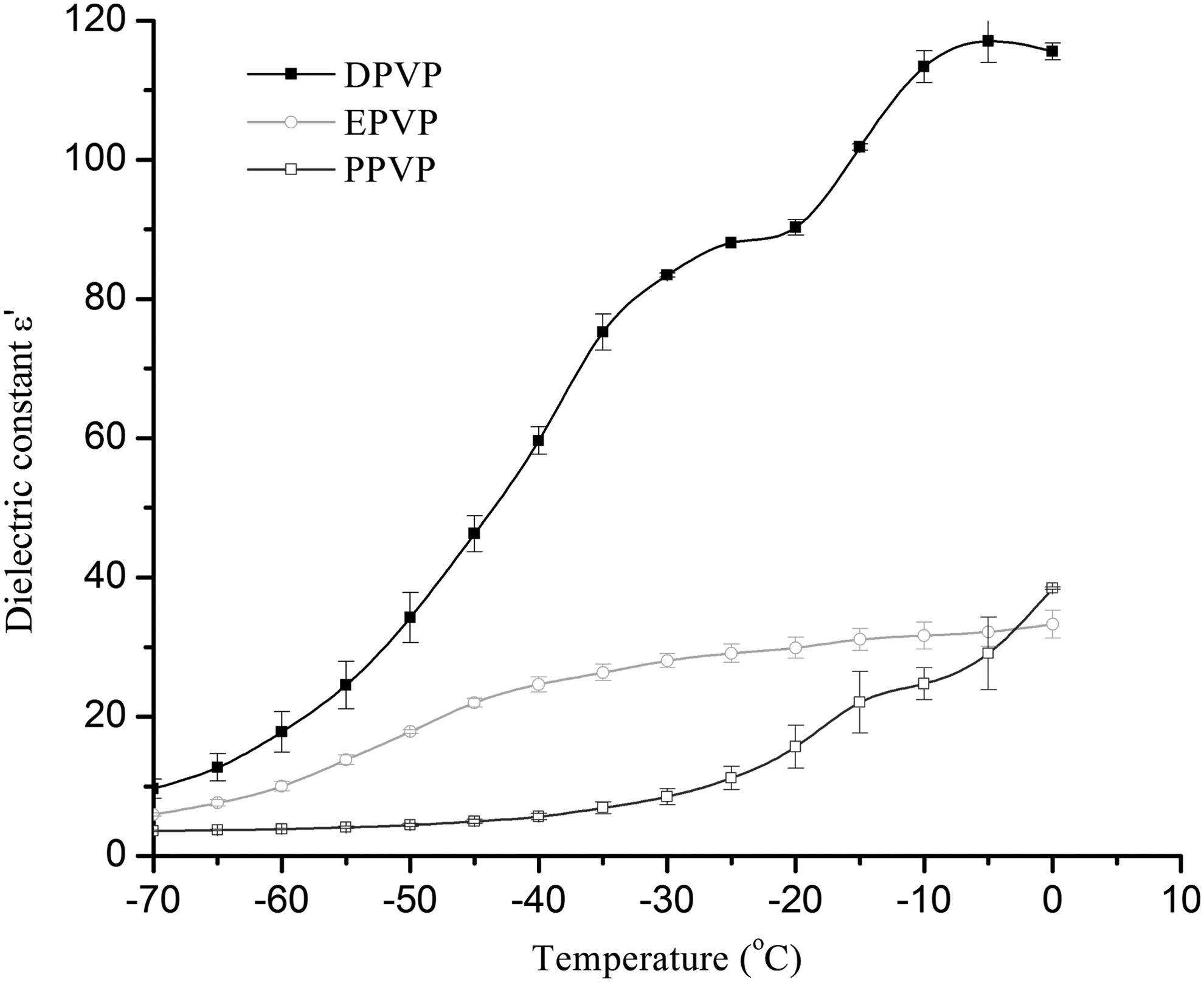
Measured dielectric constant of tested vitrification solutions in the subzero temperature range.
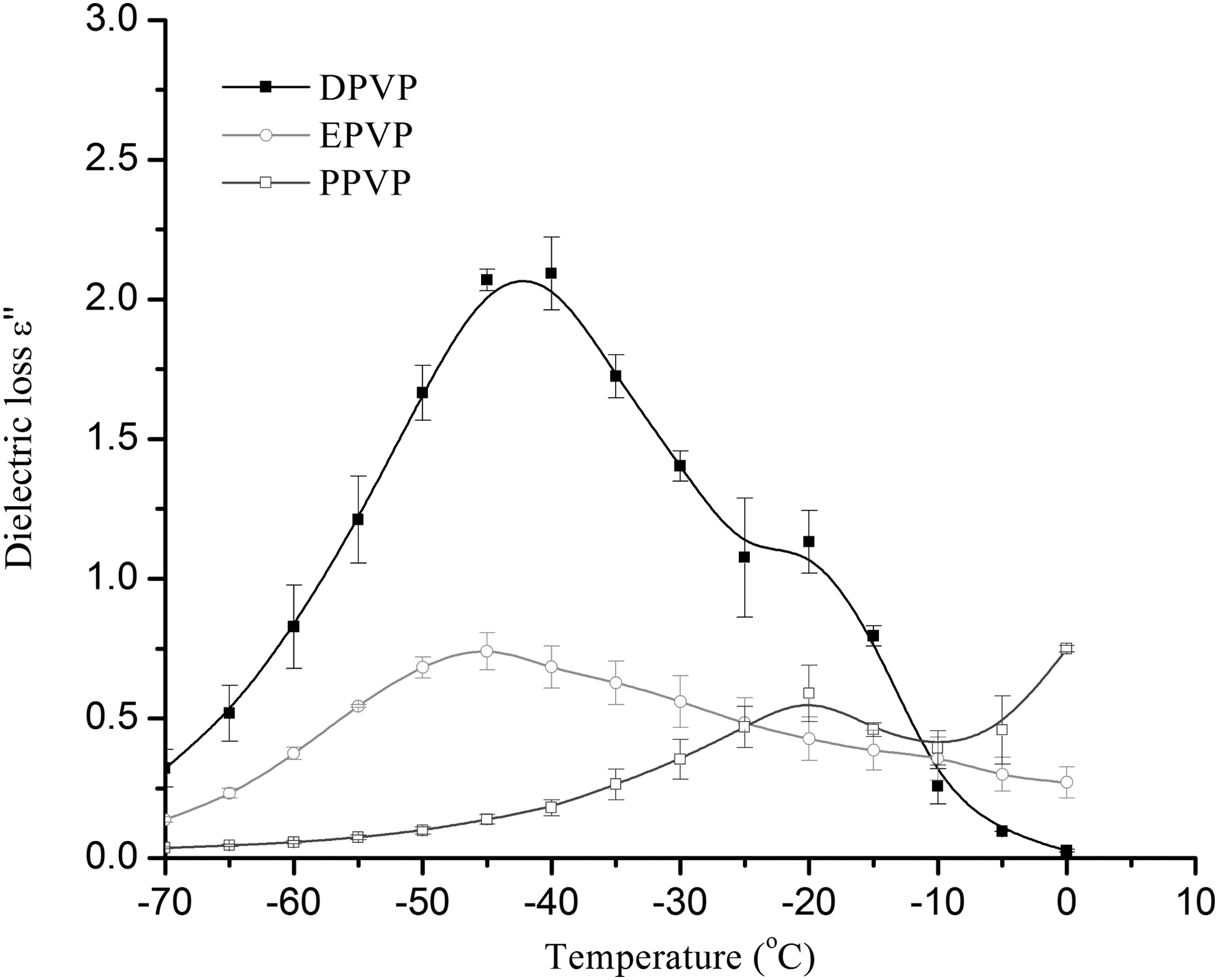
Measured dielectric loss of tested vitrification solutions in the subzero temperature range.
The penetration depth of EM waves into the vitrification solutions at different low-temperature ranges was calculated based on the results of DP

Penetration depths of tested vitrification solutions in the subzero temperature range.
Dielectric loss
\documentclass{aastex}\usepackage{amsbsy}\usepackage{amsfonts}\usepackage{amssymb}\usepackage{bm}\usepackage{mathrsfs}\usepackage{pifont}\usepackage{stmaryrd}\usepackage{textcomp}\usepackage{portland, xspace}\usepackage{amsmath, amsxtra}\usepackage{upgreek}\pagestyle{empty}\DeclareMathSizes{10}{9}{7}{6}\begin{document}
$$\varepsilon^{\prime\prime}$$
\end{document}
The combined heat transfer equation with EM energy as a heat source is shown in equation (11). If the EM field intensity is sufficiently high, the heat source due to the temperature gradient [first term on the right-hand side of equation (11)] can be ignored. In the second term, the EM energy source is the major contributor to the heating of a material.
Dielectric loss
The inverted U-shape of DPVP and EPVP solutions reveals that after their peak values, their dielectric loss decreases as temperature increases. Therefore, the warming rate of the area at higher temperature would slow down, and the colder area could be heated relatively more quickly to reduce the intrasample temperature difference. Among these vitrification solutions, DPVP has a higher dielectric loss. The higher dielectric loss can lead to a higher ability to absorb EM energy.
Uncertainty
It is found that the error of dielectric loss measurement is larger than that of dielectric constant. In the calibration processes, the linearity of the quality factor change related to
Conclusion
The aim of this investigation was to find optimal vitrification solutions for EM rewarming. A DP measurement system for vitrification solutions and biomaterials was designed and set up in this work. The cavity perturbation technique was utilized in the measurement system. The linearity of frequency shift and quality factor change in calibration results show that the resonant cavity returns results that are concordant with theoretically estimated values. We measured several vitrification solutions in the subzero temperature range and calculated penetration depths in vitrification solutions based on the experimental results. The penetration depths are deep enough for EM waves to propagate into and heat the tested vitrification solutions. Among these vitrification solutions, 41% DMSO and 6% PVP solution are preferred in EM warming, due to the higher dielectric loss
The dielectric measurement system can be used to determine optimal CPA/vitrification solutions or biomaterials for EM rewarming in cryopreservation. It would benefit other biomedical applications involving EM waves such as microwave heating hyperthermia therapy or microwave tomographic imaging.
Footnotes
Acknowledgments
This research was financially supported by the Bill & Melinda Gates Foundation. We are also thankful for Dr. Ming Chen's advice in the development of the measurement system.
Author Disclosure Statement
No conflicting financial interests exist.