




Abstract

Introduction
B
Materials and Methods
Biobank cooperation and qualification
Aiming at supporting research by combining samples from different biobanks in a biobank network initially required setting common standards regarding biobank organization, ethical, and legal issues, as well as sample processing, storage, and dissemination. Therefore, the first step of BA has been to draft a common ethical and data privacy framework that was discussed and finally approved in August 2013 by all three involved research ethics committees of TUM (Nr. 5428/12 2012-07-02), LMU (Nr. 240-21, 2012-08-20), and the Bavarian State Medical Association (Bayerische Landesärztekammer, Nr. 12056, 2012-09-24), as well as competent data protection officials. The discussion included also the superordinate Bavarian State data privacy official (Landesdatenschutzbeauftragter). Setting common standards for the scope and procedures of sample and data collection, for their anonymization, and for patient information and patient consent should be considered a significant achievement. Moreover, the BA protocol with supplemental consent checklist, patient information, and broad consent form was the basis for the following discourse on the national level in the workgroup of German medical research ethics commissions. As a consequence, this workgroup issued a joint template for patient information and broad consent in late 2013, followed by joint recommendations for the evaluation of biobank projects by research ethics commissions in June 2015. 2
This initial step was closely linked with the development in another m4 structural project, the Data Integration System (DIS), pursued at the same time. This project aimed at providing the necessary IT tools and infrastructure for biobanking.3,4 The developed solutions will be maintained and updated by a spin-off company.
As a next step, a common framework for total quality management (TQM) has been established based on European Consensus recommendations.5–7 Together, this added considerable momentum to biobank cooperation and consolidation at both universities and created the foundation of a joint comprehensive cancer center and the expansion of biobank collections with the highest quality standards.
Finally, the sample quality of the enhanced biobanking processes was to be evaluated also as an approach to evidence-based biobanking. 8 Therefore, the main scientific focus of the BA project has been targeting experimental collections of tissues. Several collections keep tissues from a number of donors, preserved by snap-freezing at several consecutive time points to control variation of ischemia times for proteome and RNA expression analysis. Significant variations on the proteome induced by preanalytical process variations9,10 resulted in critical considerations for projects concerning the identification of proteome-based biomarkers 11 on the one hand. On the other hand, only limited effects on RNA quality in liver tissue and ileum mucosa12,13 have been observed. Further analysis of the liver/ileum and additional colorectal cancer tissue collections at the mRNA/miRNA level also failed to produce significant ischemia effects owing to strong interindividual variations (results published in the final grant report).
Concerning the newly established collections of matching blood samples (EDTA whole blood, serum, plasma, RNA-stabilized whole blood: m4 kit), findings from metabolomics analysis in the large population cohort (LPC) consortium 14 suggested that the analysis of plasma samples in a large LPC ring trial could effectively prove BA sample quality. In this ring trial, an overview on the current sample quality status of eight biobanks will be given. It focuses on metabolomics, which is particularly sensitive to variations in preanalytical processing and storage of samples (e.g., sensitivity toward oxidation or hydrolysis will serve as a surrogate for sensitivity of sample quality). NMR-based metabolomics fingerprinting and LC-MS-based targeted metabolomics are performed in a total of 240 donors, that is, 30 donors per biobank with serum and/or plasma samples. Results are not yet published.
Based on this experience, BA consortium members supported the standardization of preanalytical workflows for biobanking and have been project leaders in CEN/TC 140 for drafting technical specifications for “Molecular in vitro diagnostic examinations—Specifications for pre-examination processes for different sample types” published by the European Committee for Standardization (CEN) in 2015. 15 These documents lay the foundation for upcoming ISO International Standards from ISO/TC 212, which are currently at the Draft International Standard stage for global voting.
Establishing a corporate service unit and developing the contractual framework
BioM has already served as the m4 consortium's overall coordinator. To keep required investments for founding a central service unit (SU) that would have to incorporate the BA and its standards as low as possible, BioM finally agreed to integrate ongoing activities into its present corporate structure as a new business unit. The established Biosample Service Unit at BioM provided the following:
(1) A central point of contact, comprehensive project development, and management mainly for projects across biobanks with mediation of interests. (2) Development and update of all common procedural documents as well as common TQM Standards. (3) Project reporting and public relations for societal acceptance.
The fully developed contractual framework of the cooperation agreement between BioM, acting as a central SU, and cooperating biobanks is based on the approved ethics and privacy policy as its common standard. Its implementation is verified by using the compliance checklist (Supplementary Data S1; Supplementary Data are available online at www.liebertpub.com/bio). This checklist includes document verification and biobank auditing procedures to make sure that TQM adheres to the common standard. Some of the other features are defined interfaces for reporting collection data. Mandatory operational requirements include the availability of aggregated data on the collections, a defined biobank portfolio, and the provision of operational figures (staff, consumables, number, and type of patients included, number of tissues collected per system of indication/organ, composition of archived collections), as well as a dedicated account for third-party (co-)funding of biobank activities.
Once the cooperation agreement is in place and all operational requirements have been met, the SU is able to act on behalf of the biobank and mediate requests and delivery, invoicing all project-related services and cofunding biobanks, drawing on annual reporting and payment. Figure 1 shows the entire workflow in a two-step flow chart, beginning with establishing the cooperation agreement between the SU and biobank. The second step is initiated by a user's request and highlights all documents for formal processes in the framework of the cooperation agreement. These are Project Protocol (Supplementary Data S2), Project Approval (Supplementary Data S3), User Agreement (Supplementary Data S4), and Allocation Note (Template: Supplementary Data S5). It also includes informal processes, that is, any initial user requests and complaints about sample quality. The chart ends at public reporting on projects by the SU based on the project report form (Supplementary Data S6), leading to subsequent requests. Following the color coding (see legend), it also depicts the complementary contribution of each entity (user vs. SU vs. biobank) to the overall process and, therefore, underlines the driving power of the SU.
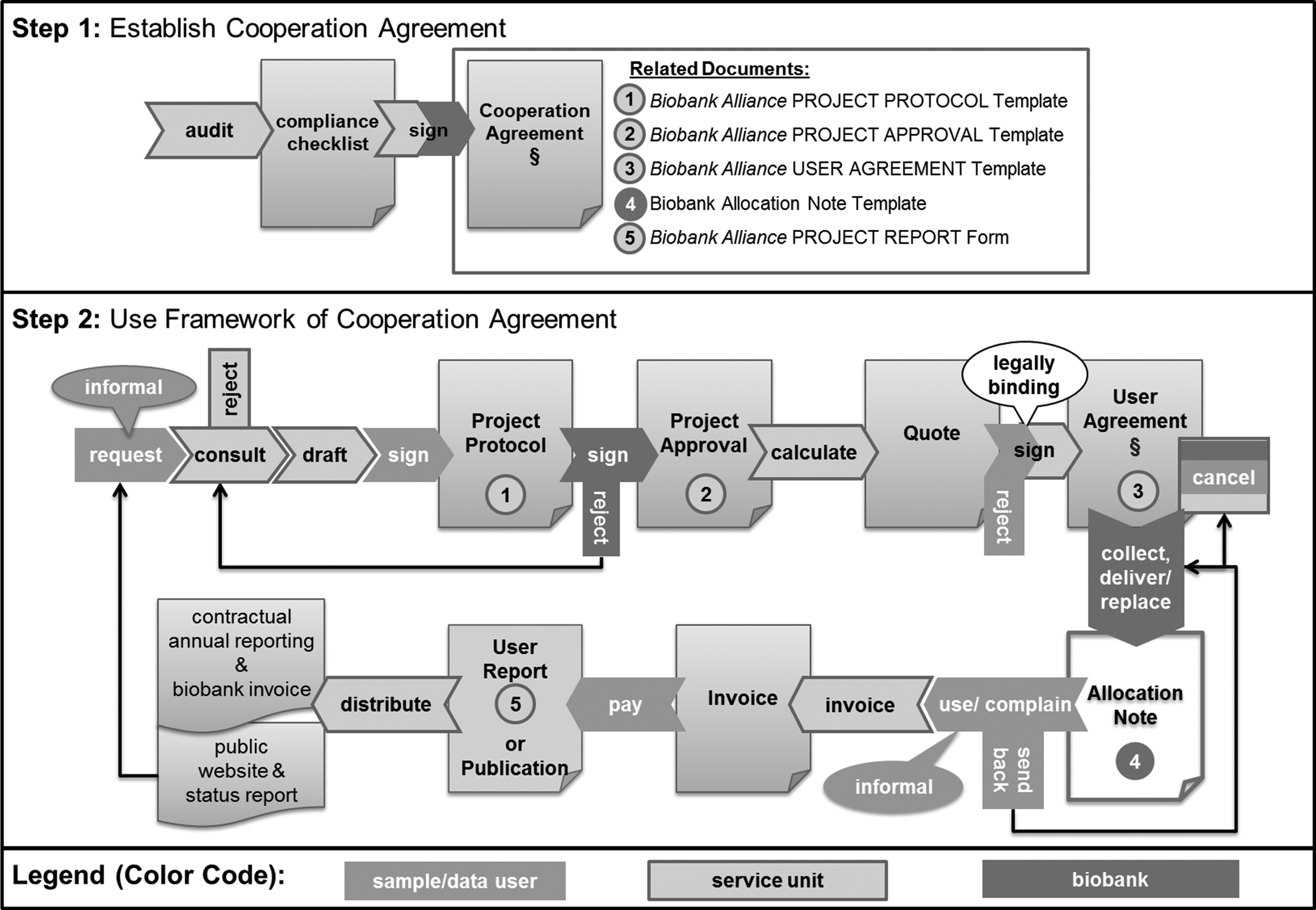
Biobank Alliance workflow from implementation of contractual framework to project workflow and related documents.
Results
This workflow has been developed from pilot projects, primarily collaborating with research projects of m4 consortium members, but going beyond these. Initial market research in 2011 ultimately focused on 23 personal interviews with representatives of companies from the regional biotech/pharmaceutical cluster. Until 2012, this resulted in 24 requests from seven companies. During ongoing marketing activities, personal contact has been established with another 23 companies, including 19 biotech small and medium enterprises and four large pharmaceutical companies, resulting in a total of 19 further requests from 2013 to 2015.
The initial document had been an extensive request form. The BA project soon revealed, however, obstacles to project development should be kept as low as possible. This resulted in informal requests developed by BioM down to the level of a project protocol to be approved by the user and by biobanks. The requests were very varied: regarding sample types, they ranged from providing FFPE or sections from cryoblocks (OCT) to the prospective collection of combined sample sets, such as plasma and tissues; regarding indications, they ranged from common oncological conditions such as colon cancer to rare infectious tropical diseases (chargas).
A total of 22 of 43 requests (ca. 51%) clearly surpassed, therefore, the scope of collections within BA framework, for example, explicitly did not include FFPE material from diagnostic archives. Two requests were, however, passed on to the BioM Trials Service Centre and could be implemented as single-purpose collections with individual protocols and ethical approval. Another request could be implemented by hepacult GmbH. Twelve requests (28%) were canceled by BioM because no final project protocol could be achieved, the project had been discontinued by the user, or the quote refused. One request was implemented by a single biobank as scientific cooperation outside BA.
In the BA framework, five projects (12%) could be implemented in total: 2 projects on cryosections, one on various primary epithelial tumors in stock at a single biobank, the other on primary tumors of mammary gland, prostate, head, and neck, glioblastoma, and primary lung carcinoma (NSCLC) across two biobanks. One project on the combined collection of plasma, tumor, and normal tissues in primary lung carcinoma (NSCLC) was also realized across two biobanks. The prospective collection of blood samples and tissues of primary pancreatic, esophageal, and gastric cancer with follow-up data for The Cancer Genome Atlas (TCGA) has been the most challenging project, but proven successful. Although this was implemented as scientific cooperation with a single biobank, the contribution of the SU at BioM for this international project, overcoming administrative hurdles such as the conclusion of the cooperation agreement, has been essential. The following Table gives an overview for the numbers discussed above. It shows additionally that marketing and project management by BioM improved in the second phase of the BA project, with more companies contacted actually placing requests and fewer requests going beyond the scope of m4 BA sample/data collection (Table 1).
Bold numbers highlight the conversion from requests to implementation as BA-projects.
BA, Biobank Alliance.
Although initial revenue could be generated from 3 fee-for-service projects, this revenue did not recover project-related costs. Further evaluation of these costs did not indicate a directly proportional relationship with the number of delivered donors/cases or type/number of samples, for example, the number of sections. This matches the findings from the LPC project 16 that revealed an overwhelming impact of fixed costs. An initial cost allocation model based on the present cooperation of KUM with hepacult GmbH has been developed, however, including an additional basic fee per project. The full contractual framework as shown above could only be implemented for the cooperation with one newly founded biobank so far.
The overall feedback from these projects indicates recognition of the corporate SU at medical centers/research institutes. BioM Biosample Service gained valuable experience in consulting projects that use human biosamples and medical data, as well as in their development and management. In summary, the BA project has successfully grounded participating biobanks in a common ethics and privacy framework, and in TQM, and it has refined biobanking processes to shaping common standards, clarifying the scope and ownership of these processes.
Discussion
The established workflow shows in general that a central corporate SU does relieve both user and biobank of administrative tasks and project management, simplifying the process of samples/data collection and usage. Each of the three process stakeholders can focus on its core competency: the user on research, the SU on coordination and management, and the biobank on collection/provision of samples and data. Based on a firm contractual framework that ensures compliance and maintenance of common standards (as shown in the Biobank cooperation and qualification section), which is a prerequisite, a central SU can bundle volatile demand, organize requests, and develop projects across biobanks. Thus, it can develop into the integrative power of a biobank network.
However, even for a local type of federated biobanking, BioM as a corporate SU has been struggling with a diversified biobank portfolio and a broad range of public or private stakeholders. Hence, it remains to be seen whether a Biobank Alliance is appropriate for meeting user demands, especially when facing national or even pan-European undertakings to create specialized and, therefore, properly unified biobanking, targeting a single disease such as the Lungscape iBiobank by ETOP. 17 Moreover, local biotech and pharmaceutical demand for sample/data usage has turned out not to grow as much as indicated by initial market research, and even after three years of business, the development was insufficient for funding the SU. Finally, defining standardized cost-based service fees remains difficult because it depends on how strongly biobank processes are integrated into infrastructures of different purposes: treatment, diagnostics, or research. The higher the level of integration, the trickier is the allocation of fixed costs. The m 4 BA model therefore obviously requires a substantial separation of biobanking activities and may be more appropriate for biobanks already formed as separate organizational units with their own budgets, especially in academic institutions.
Whatever the prospect of Biosample Services as an SU at BioM GmbH, the presented outcome of a compiled contractual framework and project workflow and related documents may serve as a blueprint for the effective networking of independent biobanks to promote public–private partnerships in biomedical research. Next steps would require, of course, to broaden the user base by expanding the network across Bavaria or even on a national level. Any implementation of the m4 BA Blueprint should be accompanied by more detailed market research. However, at least on a global level, say, drawing on the example of TransHit Biomarkers Inc., finding ways to improve the use of biobanks, 18 that is, biomaterial sourcing for private biomarker and diagnostics development, can be considered an established business model.
In the context of central biomaterial banks being established at German academic institutions, primarily sustained by public funding through institutional budget and/or research grants, 19 public interest should support making samples and data available to a broader scientific community. Networking of these kinds of biobanks to effectively support private research and development on a national level would also need an appropriate contractual framework, applying a corporate SU as a driver and provider of comprehensive project development and management. On this level of biobank networking, founding an independent corporate SU would of course require a significant initial investment, leaving the question unanswered of who should ideally afford this economic risk for the purpose of cofounding biobanks.
Footnotes
Acknowledgment
This work was supported by the German Federal Ministry of Education and Research (BMBF) Spitzencluster Muenchen m4 Biobank Alliance grant no. 16EX1020A, 16EX1020F, 16EX1020D, 16EX1020C, and 16GW0018.
Author Disclosure Statement
No conflicting financial interests exist.
References
Supplementary Material
Please find the following supplemental material available below.
For Open Access articles published under a Creative Commons License, all supplemental material carries the same license as the article it is associated with.
For non-Open Access articles published, all supplemental material carries a non-exclusive license, and permission requests for re-use of supplemental material or any part of supplemental material shall be sent directly to the copyright owner as specified in the copyright notice associated with the article.
