




Abstract
Background:
Distributed Research Infrastructures are gaining political traction in Europe to facilitate scientific research. This development has gained particular momentum in the area of biobanking where cross-national attempts have been made toward harmonizing the biobanking standards across the European Union through the establishment of the organization BBMRI (BioBanking and Biomolecular Resources Research Infrastructure). BBMRI exists as separate national nodes across several European countries, although Sweden took on a pioneering role in its early stages. Thus, the Swedish node, BBMRI.se, was set up in 2009.
Purpose:
To document publications addressing the current debate on large-scale distributed medical and/or biobank Research Infrastructures and identify the most pressing issues discussed by these articles through a narrative review.
Methods:
The Web of Science (WOS) and PubMed databases were searched to find prior studies of large-scale medical Research Infrastructures, with no limits set with regard to study design and/or time period. All identified articles published up until March 2016 were included in the initial review.
Results:
A total of 145 articles were retrieved from WOS and PubMed, though merely 17 ultimately made it past the final exclusion criteria. About two-thirds of the articles listed a first author affiliated to a European country. The articles most commonly discussed the need for developing and expanding the use of “infrastructures.”
Practical implications:
The future of scientific research will call for a deeper and more widespread multidisciplinary collaboration. This will emphasize the need of research seeking to optimize the preconditions of securing sustainable scientific collaboration. Future investigators will thus need to understand the components and mechanisms of Research Infrastructures in addition to acquiring knowledge of how to build, manage, brand, and promote them as well.
Introduction
Background
Storing and procuring human tissue samples has been part of scientific practice since the 1950s.1–3 These sample collections are stored in biobanks (or biorepositories).4–6 A biobank may in its broadest sense be defined as a collection of samples of human body material that is connected with genetic data and/or health data from patients or donors (in general: associated personal data) 7 (p. 9). To this end, biobanks that facilitate international collaboration are essential as researchers need to achieve statistical inference through comparing data extracted from different population/sample groups. 8
Since the late 1990s, biobanks have acted as a key resource for supporting many different types of contemporary research, for example, genomics and/or personalized medicine.9,10 As technology evolved, the possibilities of sharing data in a wider capacity became more feasible than in the past. 11 This would open up possibilities for scientists to make valuable findings using samples originally collected for other purposes. 12 In this day and age, biobanks are essential for advancing public health through discoveries related to various diseases.10,11,13,14 Extant 21st century medical scientific research has disclosed that there is presently an increased investment in biobanking in the Western world in general and Sweden in particular.10,15,16
In a related course of development, there was throughout the early 2000s much political discussion concerning how to make scientific collaboration more effective. ESFRI (European Strategy Forum on Research Infrastructures), a European cooperative body for infrastructure initiated by the European Commission, concluded in 2006 that Research Infrastructures were needed to facilitate development in a number of areas that were deemed to be of particular scientific value. 5 As interest for biobanking had gained recent traction, it was listed as one of the areas that were eligible for EU funding in the event that Member States would launch a Research Infrastructure initiative in this particular area. To this point, ESFRI defined a Research Infrastructure as: “facilities, resources or services of a unique nature that have been identified by European research communities to conduct top-level activities in all fields” 17 (p. 7). Essentially, Research Infrastructures exist in three different formats: single-site, digital, or distributed.18–20 The latter format involves several different stakeholders at different locations. It is inherently the most convoluted and complex of the three types of Research Infrastructures as it requires considerable coordination between researchers spread across different locations and academic centers. While Research Infrastructures have had a weak position historically, the concept of Research Infrastructures has become more prominent in the more recent academic discourse. 21 However, there is, by and large, a lack of research on distributed national Research Infrastructures, which ultimately constitutes a gap in today's scientific knowledge.22–25 Moreover, in terms of Research Infrastructures, biobanks have historically found themselves in an even more unfavorable position as there has been no effort in bringing congruity to the standards or the regulation of biobanking. 21
For this reason, ESFRI presented an initiative seeking to harmonize biobanking standards. This initiative became known as BBMRI (BioBanking and Biomolecular Resources Research Infrastructure). BBMRI was built on existing sample collections, resources, technologies, and expertise that were specifically complemented with various innovative components. 26 The ambition was to integrate biobank resources into a pan-European distributed hub-spoke infrastructure across the EU Member States. 27 The main function of BBMRI was to serve as a bridge between sample donors (patients as well as healthy individuals) and scientists. 28 Furthermore, it intended to serve as a gatekeeper to protect sensitive data from being improperly disclosed. 29
BBMRI saw its initial launch in 2008. It subsequently grew into a consortium including more than 50 members and involving more than 280 associated organizations (mostly biobanks) from 33 different countries.30,31 Thus, BBMRI became one of the largest Research Infrastructures in Europe. 28 BBMRI was implemented through a new legal entity called ERIC (European Research Infrastructure Consortium). 32 The European Union enacted ERIC as a legal framework in 2009. 33 An ERIC is not an EU-agency but a consortium, meaning it is not part of the Member States. Rather, it serves as an international organization established by a directive from the Commission. This decision originates from an application submitted by three or more Member States. 34 The ambition with this consortium is to put the EU research policy into action by establishing a superior-class Research Infrastructure that can compete in the international arena. 32 Through a consortium such as ERIC, Member States can jointly fund and manage the Research Infrastructures in a manner that would not be possible for separate Member States to do on their own. The pronounced aim of BBMRI-ERIC is to “facilitate the access to resources as well as facilities and to support high quality biomolecular and medical research.” 34
The national hubs of BBMRI were established under the ERIC legal entity. They connected the national scientific community, including universities, hospital, research institutes, and others, to BBMRI-ERIC. 28 This design built on the assumption that the distributed architecture would enable a positive impact on the regional development in all participating Member States. 35 Sweden, with a long-standing history of collaboration between government, education, and industry, took on a leading role in the early stages; owing much to its advantageous legal framework, population cohorts, and leading researchers.10,15,16,36,37 A Swedish node, BBMRI.se, was thus set up in 2009. It received extensive funding from the Swedish Research Council and became the largest distributed medical Research Infrastructure ever funded by the Swedish Research Council. To this end, Swedish BBMRI.se would be one of the most ambitious national undertakings to fully implement the BBMRI infrastructure.28,38 Nevertheless, there has been a scarcity of research on the processes and management of setting up Research Infrastructures.39–41 Given the fact that Research Infrastructures are on the rise, there is undoubtedly a pressing need to further research the area.
Objectives
The main premise of the study was to document publications addressing the current debate on large-scale distributed medical and/or biobank Research Infrastructures and identify the most pressing issues discussed by these articles. “Large-scale” is in this context defined as a Research Infrastructure with a total financing cost of at least EUR 1,000,000 (including the nonrefundable portion of VAT). 42 By comparison, BBMRI.se received initial funding from the Swedish Research Council of ∼EUR 15.5 million. 28 A detailed definition of “Research Infrastructure” was presented in the Introduction section of this article. This narrative literature review seeks to explore the available knowledge on the areas of Research Infrastructure and biobanking, to establish what knowledge gaps are present and what need there is of further research into the area.
Materials and Methods
Narrative review
A literature review is a combined objective and thorough summary and critical analysis of pertinent, extant research literature on a topic being studied. 43 The literature study was based on a narrative review. In simple terms, a narrative review aspires to summarize different primary studies.44,45 These summaries serve as a foundation from which conclusions may be drawn into an overarching interpretive overview. This is in turn reinforced by the reviewer's experience, models, and/or existing theories. 46 One of the main advantages of the narrative review is that it seeks to draw an understanding of the pluralities and complexities around the researched area. 47 As such, narrative reviews are appropriate for large-scale and/or comprehensive topics. 48 A narrative review is signified by making explicit search criteria and inclusion criteria. 49 This narrative review has sought to unveil the patterns and/or significant themes discussed by the extant literature on the subject. 50 The goal was to uncover what themes exist within the current discourse and to determine how many articles support each theme.51,52 The ultimate aim was to discern which of the themes dominates the current debate. This review was devised and conducted solely by the author.
Processing criteria
This study aimed to identify all modern English-language studies pertinent to the field of large-scale medical distributed Research Infrastructures. While employing a narrative review, this study has opted to use the guidelines presented by the PRISMA statement for Systematic Reviews and Meta-Analyses Guidelines when processing the reviewed articles. 53 This entailed a four-phase flow diagram (Identification, Screening, Eligibility and Included). This procedure was used to maximize the quality of the inclusion criteria as well as ensuring consistency and stringency in data selection. 54
During the identification process, the following inclusion criteria were selected:
Qualitative studies within the areas of business management, social studies, medical studies, biology, political science, or similarly relevant scientific fields Subject concerned large-scale Research Infrastructures in biobanking, medical science or any other comparable area of relevance (e.g., data mining, cohort studies etc.) Published during the 20th and/or 21st century Published full-length articles (i.e., no reviews, unpublished doctoral dissertations meeting abstracts, or proceeding papers etc.)
The criteria for the screening process:
Published in English language No duplicates
The criteria for eligibility were that the articles would in some way pertain to the following topics:
Had received at least one citation IF published before March 2014 (at least 2 years before this field work of study). Articles without citations but published more recent than this date were included in the study Published in an indexed journal containing a “DOI-number”
Entries mentioning more than one of the search terms (such as “infrastructure” and “medical”) in a manner that did not connect the terms in a relevant context were excluded. Likewise, articles that made mere passing/peripheral mention of Research Infrastructures in irrelevant contexts were also excluded. All retrieved publications were reviewed manually.
As mentioned in the introduction, the concept of large-scale distributed Research Infrastructures is a fairly recent scientific occurrence. One must consequently conclude that the available literature on the topic is somewhat limited, at least compared to other types of “infrastructures,” such as “digital” or “single-sited” infrastructures. Thus, this study has investigated and applied some of the existing literature on nondistributed Research Infrastructures analogously.
Information sources
The point of departure of this review was performing a search in the Web of Science (WOS) database. An additional, identical, search was conducted in the PubMed database to provide full coverage of the area.
Study selection
The articles were selected for a narrative review using a predefined search string in WOS and PubMed. The ensuing process was that the articles were initially identified in each respective database (WOS and/or PubMed). The identification stage involved selecting qualitative studies written in scientific fields such as business management, social studies, medical studies, biology, political science, or similarly relevant disciplines. The reason these disciplines were included was that they would potentially include the need of Research Infrastructures and any potential pitfall in a way that a quantitative science could not do due to the sheer number of available variables. Also, the articles had to pertain to Research Infrastructures relevant to biobanking, medicine, or any other comparable large-scale Research Infrastructure. Due to the contingency of technological advancement, only articles published in the 20th and 21st century were considered. Also, to safeguard comparability, only full-length articles were included, which excluded reviews, meeting abstracts, proceeding papers, and so on.
The following screening stage ensured that articles written in any non-English language were also excluded, as well as any duplicates.
Finally, the eligibility stage stipulated that each included article published before March 2014 (2 years before the date of the literature search) had to have received at least one citation. This was to ensure that the articles included had achieved some form of circulation in the academic community. More recent articles were exempted from this criterion due to them not yet having had the possibility of receiving citations. Moreover, only indexed articles (containing a “DOI-number”) were included to ensure adequate article quality as well as full traceability.
These steps were ensured by reading the abstract and keywords for each respective article during the identification stage. For subsequent stages, the full-length articles were reviewed. The main messages of each article were then summarized, along with number of citations in WOS, or PubMed (if unavailable in WOS) in Table 1.
Synopsis and Themes of Retrieved Articles
WOS, Web of Science.
Search strategy
The search strategy used a combination of the search terms Biobank* OR Biorepositor* OR “Biological Specimen Bank*” OR medic* AND Infrastructure AND harmoni* OR standardi* AND scien* The search terms were selected, after minor modifications, in consultation with an academic workshop at the author's research institute specializing at creating relevant academic search strings. The purpose was to exhaust the number of relevant search terms in an objective manner through an independent third party with specialized competency in the area of data base searches. No additional limits were set in regards to study design and/or time period to fully expend the possible search results. The search was conducted in March 2016 and included a search period of all articles released in the 20th and 21st century.
Data collection process
The data extraction included all retrieved articles from the selected databases by importing them into EndNote X6. The results were then checked for potential double entries. Irrelevant studies, or those failing to meet the inclusion criteria, were subsequently removed from the list. The final sets of articles were then tabulated into an Excel table with full bibliographic references for each articles (date of publication, journal, issue, page number etc.).
The data variables:
Type of journal Number of recurring journals Country of publication Type of funding (if any)
Risk of bias
A risk of bias in individual studies is the exclusion of population control. This was mitigated through the development of a clear set of eligibility criteria at the outset of the study. 55 Also, an inherent risk of publication bias means the results rely more on the tested hypothesis and less on the quality of research. The potential consequences are undesired type-1 errors, or “false positives,” as the researcher may feel more inclined to publish results supporting a stated hypothesis than results that disprove it. 56 This is especially a problem for studies with small effects; however, this study has reduced the risk through the use of larger-scale studies that have provided for a better representation of the area. 57
Results
Study selection
The initial search in WOS yielded 52 cited articles, while the search in PubMed returned 93 articles (i.e., a total of 145 articles). Although there were no duplicate articles in each respective database, there was an overlap of 20 articles among WOS and PubMed. Even though no time period limit was set, all of the returned articles were published within the span ranging from 1996 to 2016. Forty-two articles were excluded from WOS due to lack of relevance. One non-English language article was excluded. All of the 10 retained articles were original research. Sixty-six articles were excluded from PubMed due to lack of relevance. Two non-English language articles were excluded. Twenty were excluded to an overlap with WOS. Six out of seven retained articles were original research, while the final one was a commentary. Ultimately, 17 articles were included in the study. The procedure for selecting the articles is depicted in Figure 1.
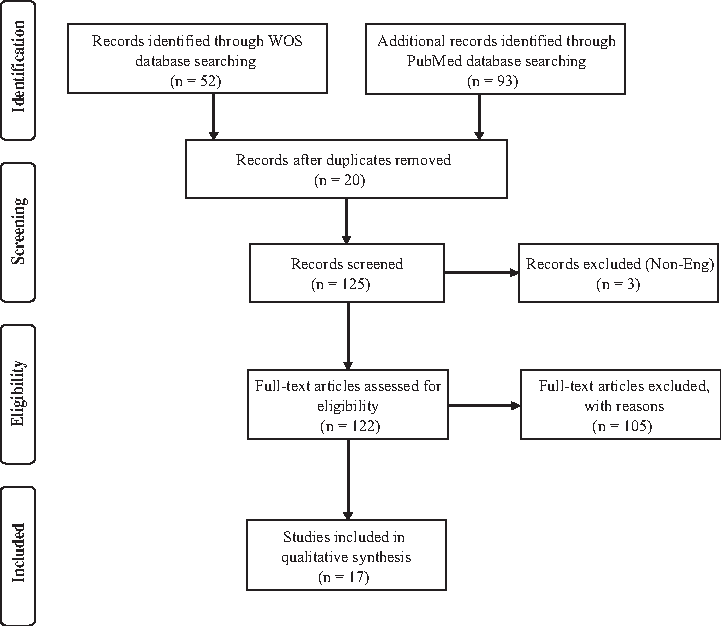
Flowchart of the different phases of article processing throughout the systematic review (adapted from Moher et al. 59 ).
Synthesis of results
Table 1 summarizes the main findings of each of the 17 retrieved articles. The first column identifies the article, second column provides a brief synopsis, and third column lists the number of citations each article has received (and whether this was in WOS or in PubMed). The fourth and final column reveals which need the article emphasized the most. Please note that each article may discuss multiple needs, in which case each of these have been separated with a semi-colon (;). Essentially, four different needs were identified in the articles, which may be summarized as follows:
Cultural/procedural harmonization: Emphasizes the need of securing harmonization of “softer components” that is, employees and/or managers at the various institutions. It suggests the impediment is mainly attitudinal and/or relates to exclusionary design in that institution’s regulations and/or values, norms, cultures, and traditions. Data harmonization: Emphasizes the need of updating the technical procedures and/or hardware to a uniform system that is used by all participating members. Infrastructure: Emphasizes the need of an actual infrastructure, usually in the form of a physical infrastructure, but sometimes in more a conceptual sense. While this is doubtless the most wide and abstract of the four types of needs, the articles would emphasize the general and practical need of establishing a Research Infrastructure for a given (larger) purpose rather than a particular aspect of said Research Infrastructure. Regulatory harmonization: Emphasizes the need of securing harmonization on higher, political level, usually via policy-making. These articles would often highlight the need of coordinating various political efforts to ensure legal frameworks that serve as common practice for all members and will enable them to successfully implement an effective Research Infrastructure.
Discussion
Study characteristics
The articles were published throughout 2003–2015. Most retrieved articles were based on theoretical research, while only two were based on empirical data. The articles were relatively evenly spread through different journals. Still, the journals Biopreservation and Biobanking and Pathobiology were slightly more represented, with two publications each (as demonstrated in Table 2).
Journals Involved in Publishing Articles on Biobank/Medical Research Infrastructures
The most cited article was Riegman et al. 58 This article received 31 citations, with an approximate of 3.1 citations per year. Two of the articles mentioned BBMRI by name. Nine of the articles were cited five times or more since publication. Although there is a relative scarcity of total number of articles, the analysis illustrated that the available articles' first authors were fairly well-distributed among different countries, which is to say that all continents were represented among retrieved articles. However, the first author was affiliated with a European country in 8 out of 12 cases. This indicates that Research Infrastructures remain a European-centered topic, as seen in Table 3.
Journal Country of Origin for the Articles Cited
Most of the retrieved articles were funded through grants, while approximately one-third of the articles did not specify the origin of funding. In only one case did the authors claim that they received no funding for their study, as shown in Table 4.
Most Common Type of Funding
Summary of evidence
The results, summarized in Table 5, indicate that most (11 in all) articles discussed the “need of infrastructure” to achieve a higher purpose, such as facilitating further investments and securing greater degrees of interdisciplinary collaboration. This was followed by six articles discussing the “need of cultural/procedural harmonization,” which in turn targets the “softer” values within an organization. This was followed by five articles discussing the “need of regulatory harmonization,” calling out to the regulatory/political actors to facilitate the developments of Research Infrastructures. Lastly, four articles cited the “need of data harmonization,” targeting the technical fragmentation presenting obstacles for collaboration in large-scale Research Infrastructures.
An Overview of the Most Recurrent Themes Throughout the Retrieved Articles
Moreover, this study sought to make an objective and impartial assessment of the extant research and/or discussions on Research Infrastructures in medical sciences in general and in biobanking in particular. This narrative review has outlined how publications in the field are presented to the public and in which publications they surface. It would appear that the topic is more prevalent in biomedical publications, though the issue is correspondingly raised in publications specializing in ethical, psychological, and social scientific issues. The results of the articles illustrate that there is an overall consensus for the need of large-scale Research Infrastructures. However, at the same time there is also a lack of literature actually studying Research Infrastructures per se.
Analyzed separately, the United States had the largest representation of first author associations, with three publications. This is followed by The Netherlands, Sweden, and the United Kingdom with two respective publications each with first author affiliation. Even though there were isolated representation from countries located on other continents, such as Asia and Africa, most first author affiliations could be found in European countries. This suggests the topic is of greatest relevance in Western Europe, and to some extent in the United States.
Apart from a few that did not declare a funding source and one that did not receive any funding whatsoever, all articles except one, received funding from a project, grant, or government agency.
Limitations
The aim of this analysis was to acquire publications addressing the current debate on large-scale distributed medical and/or biobank Research Infrastructures and identify the most pressing issues discussed by these articles. As such, the intent was to assess every pertinent article that did so in a qualitative manner. Hence, the articles evaluated have not been ranked beyond mentioning the number of publications in any given journal, and this merely for purposes of determining whether there has been a discernible pattern of publication. Hence, the PRISMA flowchart presented in Figure 1 omits the final, optional phase of meta-analysis synthesis.53,59
Conclusion
The harmonization of the medical sciences through Research Infrastructures brings implications not only to the biobanks per se, but also to the very foundation of future large-scale research collaboration. The future of scientific research will undoubtedly call for a more profound and more widespread multidisciplinary collaboration. For this reason, it is essential to find ways to secure the best prospects for research optimization.
The narrative literature analysis of the articles published in the field illustrated that emphasis was placed on accentuating the need of more developed and widespread infrastructures to accommodate the development of multidisciplinary sciences. The issue will most likely surface recurrently in the academic discourse of “big sciences” and collaborative science within the near future, as Research Infrastructures continue to evolve. Consequently, investigators will need to not only understand the mechanisms and components of a Research Infrastructure, but they will also need to know how to build, manage, brand and promote them as well. This will not only serve investors, but the scientific community at large.
Footnotes
Acknowledgments
This study was funded by The Department of Biobank Research, Umeå University and The Swedish Research Council (2009) as part of the BBMRI.se Operation Grant application [2009-18438-71700-89] through the creation of Work Package 8 (funding and financing). The author gratefully acknowledges the staff and team of KIB-labb for their help and expertise in conducting this study.
Author Disclosure Statement
No conflicting financial interests exist.