




Abstract
Allografts are used to compensate for bone defects resulting from revision surgery, tumor surgery, and reconstructive bone surgery. Although it is well known that the reduction of fat content of allografts increases mechanical properties, the content of liquids with a known grain size distribution has not been assessed so far. The aim of the study was to compare the mechanical properties of dried allografts (DA) with allografts mixed with a saline solution (ASS) and with allografts mixed with blood (AB) having a similar grain size distribution. Fresh-frozen morselized bone chips were cleaned chemically, sieved, and reassembled in specific portions with a known grain size distribution. A uniaxial compression was used to assess the yield limit, initial density, density at yield limit, and flowability of the three groups before and after compaction with a fall hammer apparatus. No statistically significant difference could be found for the yield limit between DA and ASS (p = 0.339) and between ASS and AB (p = 0.554). DA showed a statistically significant higher yield limit than AB (p = 0.022). Excluding the effect of the grain size distribution on the mechanical properties, it was shown that allografts have a lower yield limit when lipids are present. The liquid content of allografts seems to play an inferior role as no statistically significant difference could be found between DA and ASS. It is suggested, in accordance with other studies, to chemically clean allografts before implantation to reduce the contamination risk and the fat content.
Introduction
A
The gold standard for reconstructive surgery is the usage of autografts, which can be obtained from the femoral head during total hip arthroplasty or from the iliac crest.9,10 Autografts have osteoconductive, osteoinductive properties and allow osteogenesis, but they are available only in limited quantity and cannot be used in case of reduced bone quality due to osteoporosis.11,12
To compensate for the limited availability of autografts, synthetic materials13,14 or allografts can be used.15,16 Allografts derived from cortical bone provide a higher initial mechanical stability than morselized cancellous bone tissue, whereas the latter has better osteoinductive and osteoconductive properties. 17 Depending on the preparation method, allografts are classified into freeze-dried grafts or fresh-frozen allografts. Freeze-dried grafts are treated with an antibiotic solution, frozen to −70°C, and dried to reduce the water content to 5%. 18 Freeze-dried grafts showed, on the one hand, less immunological reactions and, on the other hand, impaired osteoinductive, osteogenetic, and mechanical properties compared with fresh-frozen allografts. To compensate for impaired mechanical properties, rehydration of the grafts is recommended. 19
Fresh-frozen allografts have shown good long-term results in different studies.20,21 The preparation process involves freezing the allografts to −80°C, which results in minimal changes of the mechanical properties. 22
Chemical cleaning preparation methods use ethanol, hydrogen peroxide, or other anti-infective agents to reduce infection risk.23,24 By using a chemical washing process, the fat content of the allografts can be reduced, which improves primary mechanical stability.25–27 However, due to chemical cleanings, the presence of bone growth factors and cytokines is reduced.28,29
Mechanical properties of the allografts can be enhanced additionally by controlling their grain size distribution25,30 and by proper compaction of the graft material.31,32 Several studies have shown that the better the graft material is compacted, the less subsiding of an implant is observed.33,34 A higher compaction grade can be achieved by selecting an appropriate compaction force and by applying several compaction cycles.35,36
Bone grafts obtained during surgery and subsequently sterilized can be stored for a maximum of 5 years at −80°C.23,37,38 To limit the risk of infection for the recipient, bone banks routinely test graft material for the presence of infectious agents. 39 It was suggested by Wurm et al. to perform tests also on the osteogenic capacity of the graft material, measuring the content of typical bone compounds (amide I, amide III, PO4, CO3, and CH2) or using bone morphogenetic protein 7 (BMP-7) as a surrogate marker.39,40 Storage at −80°C did not significantly alter the amount of BMP-7 in bone graft material in the study by Wurm et al. 40 Bormann et al. compared the osteogenity of native cancellous bone with peracetic acid-ethanol sterilized cancellous bone and concluded that proliferation was significantly enhanced with the cancellous bone and decreased with the sterilized bone. 41 Preservation of bone proteins during the storage period is important to enhance fast bone ingrowth when allografts are implanted. In several studies, it was shown that the reduction of fat content of allografts increases mechanical properties.26,27,42 Performing a defatting procedure would be the matter of choice to increase mechanical stability, with the drawback that the amount of osteogenic factors will be reduced. Liquids containing the osteogenic factors could be added after the defatting procedure, increasing the osteogenic properties. However, no comparison has been made so far of the liquid content of allografts with a similar grain size distribution. The aim of the study was to compare the mechanical properties of dried allografts (DA) with allografts mixed with a saline solution (ASS) and with allografts mixed with blood (AB) by controlling their grain size distribution.
Materials and Methods
All allograft material was obtained from the femoral head of donors who underwent total hip arthroplasty. All patients gave their informed consent for donating bone material and blood samples to the local tissue bank. The Institutional Review Board (IRB) approval was not necessary for this study. Handling of human DRG tissue was carried out according to legal provisions and rules of the medical faculty of the Innsbruck Medical University.
Cortical bone tissue and any cartilage tissue were removed with a bone saw. Morselized spongious bone chips with a size of 5–10 mm were produced by using a bone mill (Spierings Medische Techniek BV, Nijmegen, The Netherlands).1,43,44 The graft material was fresh frozen at −80°C according to the local bone bank routine and following national and international regulations on storage conditions of bone banks (European Association of Tissue Banks [EATB]). Governmental guidelines were strictly followed for quality controls regarding contamination and the presence of transmittable diseases, for example, the Austrian Tissue Safety Law (GSG, German acronym), the Tissue Bank Act (GBVO, German acronym), and the Tissue Removal Department Act (GEEVO, German acronym).39,40 According to the specified guidelines, patients were asked to complete a specific anamnesis questionnaire and smear tests for fungi, aerobic, and anaerobic germs. Long-term incubation and histological examinations were performed, as well as serological tests that include, but are not limited to, HIV, hepatitis A, hepatitis B, hepatitis C, parvovirus B 19, Lues-serology, and glutamate pyruvate transaminase. 40 Studies have shown that freezing to −80°C destroys immunogenicity in the long run and deep frozen bone is incorporated similar to fresh autogenous bone. 45 After withdrawal at the local bone bank graft, material was stored in a freezer at −20°C for three weeks. 46 Allografts were thawed at laboratory conditions (25°C) overnight.
The allograft material (Total weight of the allograft material: 338.3 g) was mixed to reduce patient- or gender-specific properties. 29 The allografts were chemically treated according to a modified cleaning procedure of DePaula et al., 23 described in a study by Coraca-Huber et al. 47 The allografts were sonicated several times in distilled water (40 kHz, 200 Weff, BactoSonic; Bandelin eletronic GmbH & Co. KG, Berlin, Germany) and rinsed in 700 mL of 1% Triton X-100 (Sigma-Aldrich, Schnelldorf, Germany), 500 mL of 3% hydrogen peroxide solution (Sigma-Aldrich, Schnelldorf, Germany), and in a 70% ethanol solution. 47 The allografts were dried for four consecutive days in a microbiologic incubator (Memmert GmbH & Co. KG, Schwabach, Germany) at 37°C and with fresh air exchange (set to maximum level). The weight loss was recorded by using a high precision balance (SI-603, Balance precision: 0.001 g; Denver Instrument, Bohemia, New York).
The allografts were separated according to their grain size by using sieves ranging from 0.063 to 16 mm in correspondence ASTM C 125 standard (Application time 1 hour, Amplitude 10 mm; Haver und Böcker, Ölde, Germany). The sieved bone chips were reassembled in specific portions to approximate an optimized grain size distribution (Table 1). 25 Twelve samples with a mean weight of 8 ± 0.01 g were obtained and divided into three groups, each containing six samples. Four milliliters of 0.9% NaCl saline solution (Fresenius Kabi KG, Bad Homburg v. d. H., Germany) was added in the ASS group. In the samples from the allografts mixed with the human blood (AB) group, 4 mL of blood was added. All donors gave their informed consent for providing the blood samples for scientific reasons. The blood was donated to the local tissue bank and stored at 4°C. The remaining DA samples were used as a control group.
Each sample was filled into a cylindrical compaction chamber with an internal diameter of 40 mm. The allograft material was initially consolidated with a weight of 1.45 kg to achieve a uniform sample height of 1.7 cm. After consolidation, the bulk solid specimen was relieved of the consolidation stress and the steel cylinder was removed. A uniaxial compression test was carried out with a testing machine to determine the yield limit measuring compression force and sample height (Zwicki-Line Z 2.5, maximal load 2.5 kN, 320 kHz sample rate; Zwick GmbH & Co. KG, Ulm, Germany) with an accuracy of ±0.04 N and ±2 μm. The preload was set to 5 N, the data sample rate was 50 Hz, and the compression velocity was 1 mm/min. A punch with a diameter of 15 mm was used to carry out the measurements.
For compaction of the allograft material, a fall hammer apparatus was used. A weight of 1.45 kg was dropped 10 times from a height of 18 cm. Measurements were taken before and after using the fall hammer apparatus. Twenty measurements were taken for each group.
From the resulting force displacement curves, the initial sample density (d1) and consolidation stress (σ1) as well as the sample density at the yield limit (dYL) and yield strength (σYL) were determined. The flowability coefficient (ffc) was calculated as the ratio between consolidation stress and yield strength.
The yield strength was determined by performing a peak analysis using OriginPro8.5 (Origin Lab Corporation, Northampton, MA). In all curves, a fitted baseline (50 anchor points, 1 and 2 derivation method, polynomial smoothing of order 2) was subtracted to remove the logarithmic trend. The signal was analyzed for positive local maxima over 100 data points with a smoothing window size of 10 data points.
Statistical analysis was performed by using SPSS software v.20 (IBM, Chicago, IL). The two-tailed t-test for dependent samples was used to compare the allografts before and after compaction. All groups were tested for normal distribution by using the One-Sample Kolmogorov-Smirnov Test and for variance homogeneity. If variance homogeneity was not fulfilled, the Brown Forsythe test and Tukey Post Hoc analysis were used for pairwise comparison. In case of variance homogeneity, ANOVA and Games-Howel Post Hoc analysis were used for pairwise comparisons. A p-value of 0.05 was considered statistically significant.
Results
The initial weight of the allografts of 338 g was reduced to 215 g after the washing process, which corresponds to a weight loss of 36%.
Three outliers were removed from the density at the yield limit values of DA before compaction. At the yield limit, three outliers were removed in DA, one in ASS and one in AB before compaction, and two in DA and one in AB after compaction. From the flowability measurements, one outlier was removed for DA before and after compaction, one for AB before and after compaction, and one for ASS after compaction.
All compacted samples showed a statistically significant difference compared with the initial situation (p < 0.05), except the density at the yield limit (dyl) for DA and ASS and the initial density (d1) of AB, which did not reach the significance level (Table 2).
The difference was calculated as a percentage, and p-values of the t-test (comparison between before and after compaction) were reported.
AB, allografts mixed with blood; ASS, allografts mixed with a saline solution; DA, dried allograft.
The initial density, yield limit, and flowability coefficient before compaction and the yield limit and the flowability coefficient after compaction were not homogeneously distributed. In these cases, the Brown Forsythe Test was used for a comparison between groups and the Games-Howell Post Hoc Analysis was used for a pairwise comparison.
A statistically significant lower initial density was found for DA compared with ASS (p < 0.001) and with AB (p < 0.001) before compaction (Fig. 1). No statistically significant difference could be found between ASS and AB before compaction (p = 0.993). After compaction, the initial density was lowest for the DA group, which was statistically significantly different from ASS (p < 0.001) and AB (p < 0.001). AB had a statistically significantly higher initial density after compaction in comparison to ASS (p < 0.001).
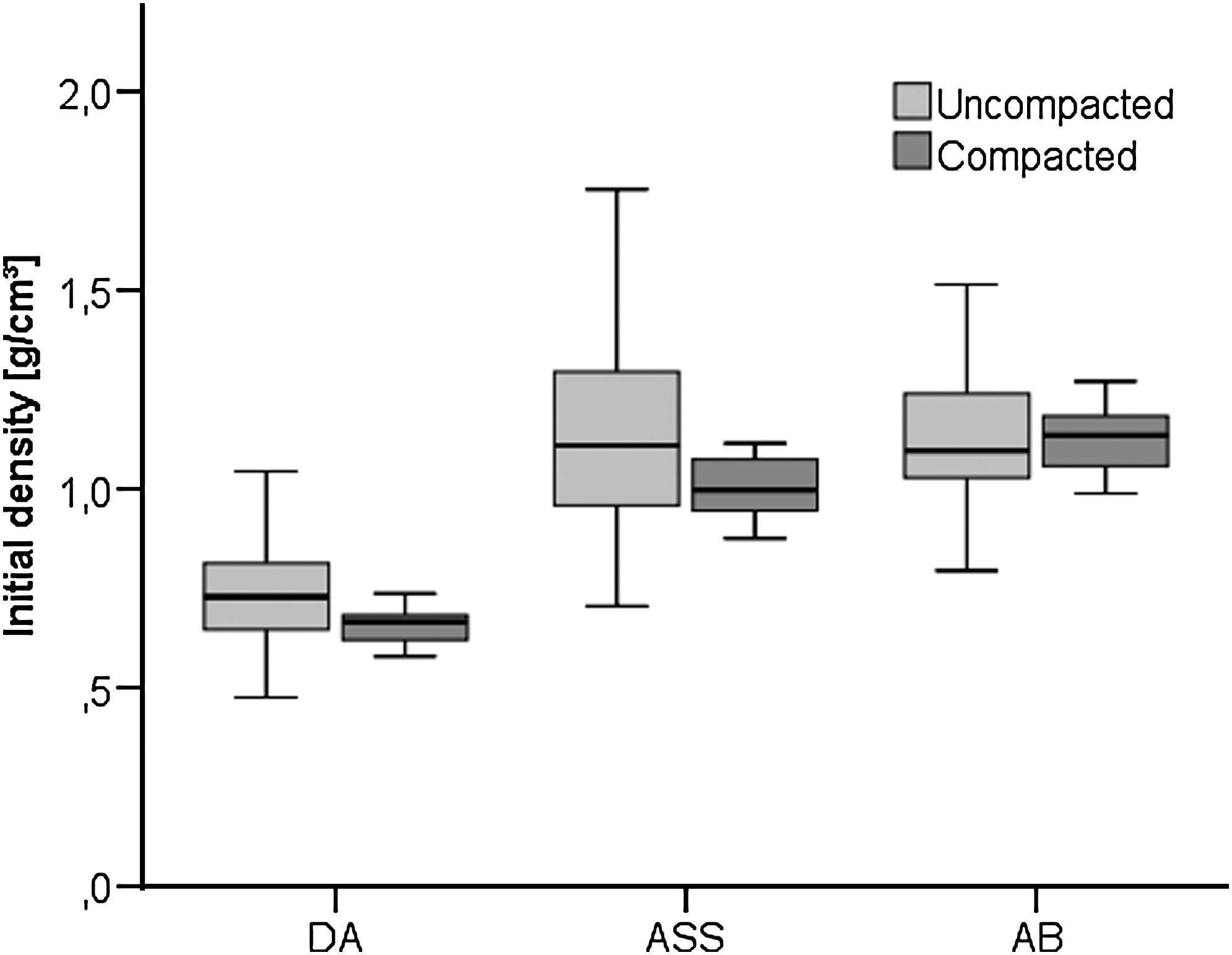
Comparison of the initial density for the three groups (DAs, ASS, and AB) under investigation before and after compaction. AB, allografts mixed with blood; ASS, allografts mixed with a saline solution; DA, dried allograft.
DA showed the lowest density at the yield point in comparison to ASS (p = 0.001) and to AB (p < 0.001) before compaction (Fig. 2). After compaction, DA showed again a lower density at the yield point in comparison to ASS (p < 0.001) and AB (p < 0.001). AB showed no statistically significant difference in comparison to ASS (p = 0.061) before compaction, but it reached a higher statistically significant value after compaction when compared with ASS (p < 0.001).

Comparison of the density at the yield limit for the three groups (DAs, ASS, and AB) under investigation before and after compaction. Outliers (1.5 × interquartile range) were marked with a small circle.
No statistically significant difference could be found between all three groups for the yield limit (p = 0.339) before compaction as well as the flowability coefficient before (p = 0.515) and after compaction (p = 0.492) (Figs. 3 and 4). No statistically significant difference could be found between DA and ASS (p = 0.339) and between ASS and AB (p = 0.554). AB showed a statistically significantly higher yield limit than DA (p = 0.022).
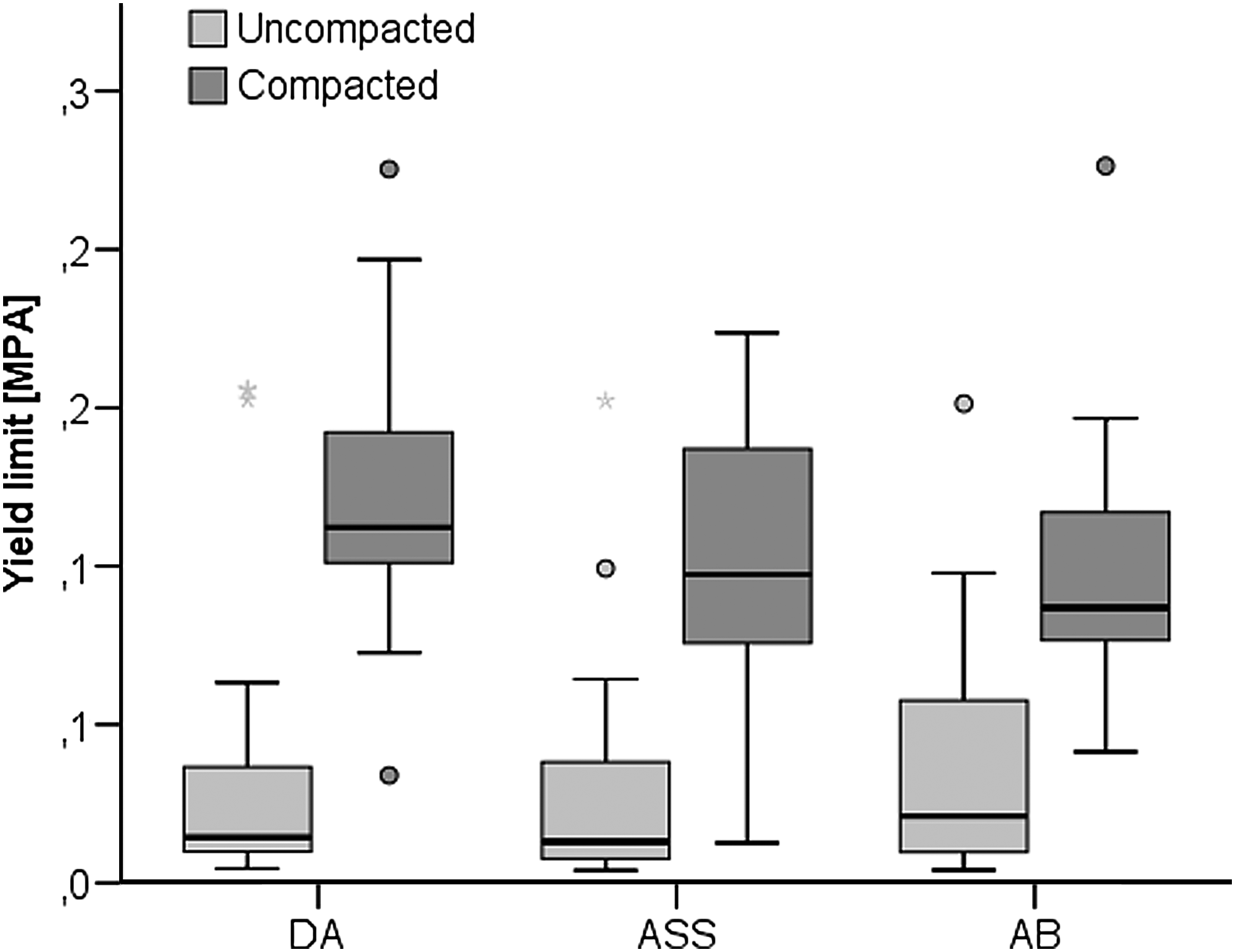
Comparison of the yield limit for the three groups (DAs, ASS, and AB) under investigation before and after compaction. Outliers (1.5 × interquartile range) were marked with a small circle, and extreme outliers (3 × interquartile range) were marked with a star.

Comparison of the flowability coefficient for the three groups (DAs, ASS, and AB) under investigation before and after compaction. Outliers (1.5 × interquartile range) were marked with a small circle, and extreme outliers (3 × interquartile range) were marked with a star.
Discussion
The study shows that by considering a similar grain size distribution, no relevant difference could be found when adding a saline solution considering the yield limit. A statistically significant difference was found when blood was added to the DAs, lowering the yield limit. No difference could be found when adding liquids, considering the flowability coefficient between the three groups. Differences in the mechanical properties may depend mostly on the grain size distribution and fat content of the allografts, in accordance with other publications.25,48 The liquid part of allografts may not play as big a role in the mechanical properties as fat content and grain size distribution. Indeed, differences in the mechanical properties reported in other studies such as by Cornu et al. may be attributed mainly to the different grain size distribution of the samples and the varying of fat content. 49 Adding donor blood decreases the mechanical properties, as a lower yield limit was reported in comparison to the control group. This can be explained due to blood containing a significant part of lipids and other proteins. The negative impact of fat content was confirmed by several studies,27,42,48 whereas the study presented here shows that the liquid content may play an inferior role regarding the yield limit.
The cleaning and drying process reduced the weight of allografts by 36%. The fluid part was, therefore, comparable to the study of Cornu et al. 49 but inferior to previous studies, where 50% of weight loss was reported. 48 The presence of a remaining fluid part could have yielded similar results between the three groups. On the other hand, almost 50% of saline solution in weight was added in one group and 50% of blood was added in the second group. Adding liquids to the DAs did, as expected, alter the density before and after compaction, showing the highest density for the AB group. Surprisingly, no statistically significant difference could be found before and after compaction for the initial density and the density at the yield limit. Initial measurements were characterized by a higher standard deviation, as cohesion between particles was almost not existent and the material became very brittle, especially in the DA group. Also, the preload of 5 N may have been too high to detect the early phase of contact between punch and graft material, resulting in a similar initial density as after compaction.
Higher densities could be obtained after compaction for the allografts mixed with blood, probably due to a better lubrification between particles, facilitating relative movement. A better relative movement could also explain a lower yield limit in the allografts mixed with blood in comparison to the DAs. The compacting procedure was shown to successfully increase the yield limit by ∼20% in all cases, whereas the flowabiliy coefficient diminished by approximately 80%. The compressibility was, therefore, comparable between the three groups.
All samples were mixed carefully to reduce any bias of the measurements. Liquids may be lost during the compaction process, altering the sample composition. In our experiments, we added 50% in weight of liquids to compensate for any liquid loss during the measurements. The drying process reduced the liquid part of the allograft material by 30%. The effect of losing liquids during the compaction process should be, therefore, minimized. The exact remaining liquid content of the allografts could not be measured. The presence of a liquid part due to insufficient drying may have altered the results. As all bone material was dried under the same conditions, the comparison between groups remains valid.
Conclusion
In conclusion, excluding the effect of the grain size distribution described in other studies, 25 it was shown that allografts have a lower yield limit, when lipids are present (allografts mixed with blood) in the graft material. The liquid content of allografts seems to play an inferior role as no statistically significant difference could be found in comparison to DAs. It is suggested, in accordance with other studies, to chemically clean allografts before implantation to reduce the contamination risk and the fat content.27,42 Growth factors and bone formation proteins should be added to chemically cleaned allografts, enhancing the bone ingrowth before implantation. 44 An optimum liquid level still remains to be defined. By sterilizing bone allografts with a chemical cleaning procedure, the fat content of the bone material is getting reduced. The cleaning procedure has the drawback that osteogenic proteins are washed out. The osteogenic proteins can be mixed by using a liquid phase to the cleaned allografts artificially after the thawing procedure. Preservation of the allografts may be changed to lower conservation temperatures; however, national guidelines have to be followed. The considerations described here are relevant for filling up bigger bone defects; whereas in smaller defects, the differences between different preparation methods may be less prominent. Bone ingrowth of chemically cleaned allografts should be evaluated in an in vivo study.
Footnotes
Acknowledgments
No funds or any financial support was received for this study. The authors gratefully acknowledge  . Dennis Huber for providing statistical support for the data analysis, Birgit Ladner and Marion Kos, OR-nurses, for helping to prepare bone allografts. The experiment for the particle size distribution was carried out in the laboratory of IGT (Institut für Geotechnik und Tunnelbau, Innsbruck) and was supported by Stefan Tilg, technical assistant.
Author Disclosure Statement
This study was carried out with internal funds from Experimental Orthopedics, Innsbruck Medical University. David Putzer, PhD, Christoph Gert Ammann, PhD, Débora Coraça-Huber, PhD, Ricarda Lechner, PhD, Werner Schmölz, PhD, and Michael Nogler, MD, are paid employees of Medical University of Innsbruck. Michael Nogler, MD, and David Putzer, PhD, are paid consultants of Stryker Orthopaedics.