




Abstract
Background:
Biospecimen shipping and handling challenges in Africa include climates that can potentially jeopardize sample integrity, and infrastructure and regulation limitations that affect courier reliability, access, and costs. There is a lack of investigations reporting on validation of standardized processes for biospecimen exchange among African countries and regions. The Human Heredity and Health in Africa (H3Africa) Initiative funded four African biorepositories (BR) to pilot test operations, and assess effectiveness of trans-African shipment of high-quality DNA, and other biospecimens for genomics research. Pilot studies tested the following: workflows and forms related to biospecimen exchange, transport logistics, and comparability and confirmation of quality control (QC) methods.
Methods:
Ethical and legal requirements for biospecimen, and data transfer were acquired before shipment. Biospecimens were collected and subjected to QC by the BR of origin before shipment, and by the recipient BR on arrival. Minimal QC requirements included concentration and purity for DNA. Paired Student's t-tests were used to determine significant differences in DNA concentrations, DNA purity, and urine pH pre- and postshipment.
Results:
The turnaround time for import/export permits was 21–90 days and material transfer agreements 1–10 months. There were nine shipments. Shipping duration averaged 5 days. Shipments sent at uncontrolled ambient temperature fluctuated between 5.6°C and 32.7°C. Seventy-seven percent of source DNA had purity ratios within the acceptable range before shipment. Eighty-nine percent of the DNA results did not differ significantly before and after shipment. Ninety-five percent of DNA extracted from shipped whole blood had acceptable purity.
Conclusion:
African BRs can collect, process, store, and ship biospecimens of good quality. This study shows it is possible to ship biospecimens between different regions of Africa in a reasonable time frame, without compromise to the cold chain and biospecimen integrity. It is also possible to harmonize ethical documents, guidelines, and processes among African BRs to facilitate collaboration.
Introduction
I
Issues with preanalytical processes account for half to nearly 75% of all laboratory errors, and impact downstream analysis and future research.4,5 Poor shipping and handling are of great concern in Africa, due to a climate that can potentially jeopardize biospecimen integrity.6,7 Poor infrastructure and lack of regulations affect courier reliability, access, and shipping costs. Furthermore, some cold chain transport boxes are unreliable. 5
Biospecimens from H3Africa genomics projects are collected, processed, and temporarily stored at numerous clinical sites before transport to a central laboratory and ultimately the recipient BR. Therefore, during the BR planning phase, it was critical to establish and share minimum shipping requirements to maintain biospecimen integrity.6–11 Standard operating procedures (SOPs), guidelines, and shipping forms were developed and distributed to the working group members for review, and to the H3Africa Steering Committee for approval. Subsequently, the four BRs pilot tested the shipping process by shipping biospecimens to each other, as shown in Figure 1. This article describes results that
(1) test workflows and forms related to biospecimen exchange;
(2) test biospecimen transport logistics in Africa and;
(3) test, compare, and verify biospecimen quality control (QC) methods.
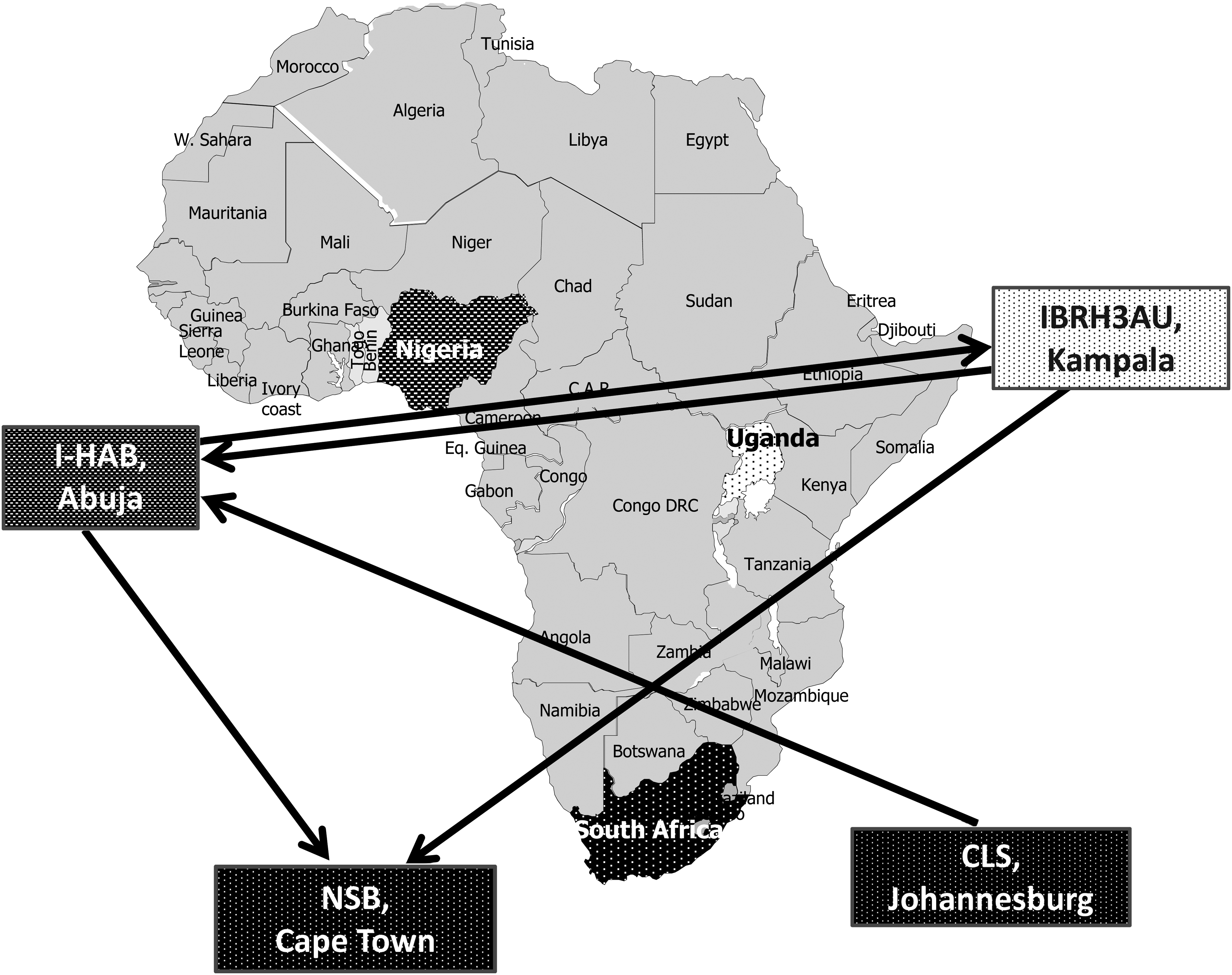
Biospecimen distribution.
Methods
Ethical, legal, and social issues
All biospecimens were collected and shared according to ethical and legal requirements of the countries and institutions of origin. Ethical approval was provided by the National Health Research Ethics Committee (HREC) for I-HAB, School of Biomedical Sciences Research Ethics Committee, Makerere University College of Health Sciences for IBRH3AU, and Stellenbosch University HREC for NSB. CLS did not require ethical approval because they used residual biospecimens intended for destruction. Material transfer agreements (MTAs), whether governmental or institutional, were obtained for all biospecimen transfers. Biospecimen export and import permits required for SA were obtained from the Department of Health (DOH), Republic of SA. I-HAB and IBRH3AU did not require export permits, since the MTA served this purpose.
Documents and data management
The H3Africa BRs harmonized SOPs from international sources to develop 31 reference SOPs covering biospecimen collection, processing, QC, storage, transport, and acceptance and rejection criteria. Biospecimen Deposit Guidelines were also developed to introduce the process of sending DNA and other collections to recipient BRs, and describe requirements and communications. Finally, the following forms were created (http://h3africa.org/consortium/documents):
• Shipment Checklist: a bench aid that ensures all required procedures and documents are completed properly. • Shipment Notification Form: alerts the recipient biorepository that a shipment is scheduled, and summarizes the content and conditions. • Manifest: an Excel CSV file containing the required associated data for each biospecimen, including minimum essential data on each barcode. • Shipment Receipt Confirmation and Query Form: completed by the recipient biorepository and provides a place to document nonconformities. The form must be returned to the shipper for corrective and preventative measures.
The Laboratory Information Managements System (LIMS) used to collect and store associated data was Freezerworks (Dataworks Development, Seattle, WA) for I-HAB and IBRH3AU, LDMS (Frontier Science Foundation, Amherst, NY) for CLS, and RUCDR STARLIMS (https://rucdrlims.rutgers.edu/starlims10.rucdrlims) for NSB.
The BRs created an H3Africa Biological Pilot SOP to plan and document pilot activities, including the purpose, procedural overview, ethical, legal, and social issues (ELSI) and shipping regulatory requirements, data sharing, biospecimen collection, processing, QC, distribution, and receipt.
Biospecimens used in the pilot
Biospecimens were obtained as follows: CLS acquired previously collected biospecimens intended for destruction by the pathology laboratory; I-HAB collected biospecimens from healthy volunteers through a consented process; IBRH3AU received 10 archived biospecimens from volunteers. All biospecimens were anonymized and assigned unique identification numbers to protect patient identity. The biospecimens were destroyed after this study.
Minimally, each BR was required to ship DNA extracted by the salting-out method for CLS and by QIAmp DNA Blood Mini Kit (Qiagen, Hilden, Germany) for I-HAB and IBRH3AU. Plasma, serum, whole blood collected in BD EDTA vacutainers®; whole blood collected in DNA PAXgene tubes (PreAnalytiX, Qiagen); and urine were also shipped. Whole blood was included to test appropriateness for DNA extraction postshipment. Table 1 shows biospecimen types, QC methods, and shipping conditions.
The “x” in front of numbers refers to the multiplication symbol. Thus, x12 means aliquotted times 12.
NanoDrop (Inqaba Biotechnical Industries, Hatfield South Africa), Combur 10 Test kit-Cobas (Roche Applied Science, Penzberg, Upper Bavaria, Germany), CYBOW 11 (DFI CO., Ltd. Gimhae-city, Gyung-nam, Korea).
NanoDrop (Inqaba Biotechnical Industries, Hatfield South Africa), BioDrop (United Kingdom), MColorpHast pH-Indicator Strips Nonbleeding (Merck KGaA, Darmstadt, Germany), 12177A: Beckman Coulter Φ Series pH and Electrochemistry Meters, Beckman Coulter, Johannesburg, SA).
NanoDrop (Nanodrop Technologies, Thermo Fisher Scientific), Qubit (Life Technologies, Thermo Fisher Scientific).
QC, quality control.
QC protocols and analysis
The biospecimens were subjected to QC analysis by the BR of origin before shipment, and by the recipient BR on arrival, in accordance with SOPs and Biospecimen Submission Guidelines. Minimal QC requirements included concentration (absorbance at 260 nm) and purity (260/280 absorbance ratio) (NanoDrop, Thermo Scientific) for DNA; turbidity, and hemolysis using visual grading for plasma and serum; and pH and turbidity for urine. The visual grading range for hemolysis and turbidity was 0–5 in incrementing numbers according to increased hemolysis/turbidity starting from normal (0).
Paired Student's t-tests were used to determine significant differences in DNA concentrations, DNA purity, and urine pH pre- and postshipment (GraphPad prism V6, GraphPad Software, La Jolla, CA). Serum, plasma, and urine visual results were compared for consistency, as these investigations do not yield quantitative results.
Shipping and handling
Biospecimens were shipped according to International Air Transport Association (IATA) regulations under Biological Substances, Category B (UN 3373). All shipments minimally included Temp Tale4 temperature loggers (Sensitech, Beverly, MA) to monitor temperatures during transportation. Serum, plasma, and urine were shipped frozen (−70°C) in accordance with best practices and H3Africa SOPs. CLS also shipped these same biospecimen types at controlled ambient and refrigerated temperatures to compare integrity after shipment. Whole blood was shipped at controlled ambient temperature; and DNA was shipped at a combination of uncontrolled ambient (temperature fluctuations), controlled ambient (15–25°C), refrigerated (2–8°C), and frozen (≤−70°C). The IBRH3AU shipped DNA at uncontrolled ambient temperature to evaluate its appropriateness as a method for shipping DNA in Africa.
DHL, World Courier, and Marken were selected due to their experience in biological shipment within Africa according to associated regulations; specifically in cold chain management logistics, 7 and also feasibility, cost, and history with the BR, where appropriate. CLS distributed biospecimens using World Courier. Gel packs were used for refrigerated and controlled ambient shipments, and dry ice for frozen shipments. I-HAB shipped samples under controlled ambient conditions with DHL and frozen with World Courier. I-HAB distributed biospecimens at controlled ambient temperature using Credo Cube storage boxes (Pelican BioThermal, Plymouth, MN) as an alternative to gel packs, which could not be replenished by commercial couriers. The Credo Cube system is equipped with an internal refrigerant that lasts for up to 7 days according to model specifications. I-HAB used 3™ WarmMark Time Temperature Indicators (TelaTemp, Anaheim, CA) in addition to temperature loggers to monitor shipping temperature. IBRH3AU transported biospecimens with World Courier. Refrigerant was not included, as all of their shipments were at uncontrolled ambient temperature. The biospecimen transport routes are depicted in Figure 1. Shipping duration and nonconformities were documented.
Results
ELSI and shipping regulatory documentation
The ethics review process took 1–3 months from application submission to ethical approval through the corresponding ethics board. The turnaround time ranged from 21 to 90 days for import/export permits, and 1–10 months for MTAs, due to legal negotiations, differences in various National Health Acts regarding shipping and storage, and whether a governmental and/or institutional MTA was required.
Shipping and handling
A total of nine shipments under different temperature conditions were shipped: three by CLS (controlled ambient, refrigerated, and frozen), four by I-HAB (two controlled ambient and two frozen), and two by IBRH3AU (two uncontrolled ambient). The average shipping duration was 5 days (range 2–10). There were two outliers: one for the shipment sent from IBRH3AU to NSB via World Courier that took 2 days; and one for the frozen shipment sent from I-HAB to IBRH3AU via World Courier that took 10 days due to a delay at customs (arrived in Kampala in 1 day). The courier could not reach the consignee. The two shipments sent by IBH33U at uncontrolled ambient fluctuated between 5.6°C and 32.7°C (acceptable range 18°C–25°C according to SOP). The temperature indicator of the frozen shipment sent to NSB from I-HAB indicated that it was exposed to temperature greater than −18°C for less than an hour. This short deviation may have occurred when World Courier replenished dry ice. Unfortunately, the temperature logger was damaged and could not provide the exact temperature or duration. The logger had been used successfully several times in the past. Damage can result if the electronic housing contacts the dry ice environment. No other out of range temperatures were noted.
Biospecimen and QC
In total, 150 biospecimens were shipped: 64 DNA aliquots (20 uncontrolled ambient, 21 controlled ambient, 2 refrigerated, and 21 frozen), 21 whole blood (6 EDTA, 6 EDTA with DNAgard, and 9 PAXgene) all shipped at controlled ambient, 12 plasma (2 uncontrolled ambient, 2 refrigerated, and 8 frozen), 6 serum (2 shipped controlled ambient, refrigerated, and frozen), and 59 urine (frozen). Overall, 23% (7 of 30) of unique source DNA biospecimens had a purity ratio beyond the acceptable range of 1.6–2.0 before shipment. The site distribution was 0 of 1 for CLS (0%), 2 of 19 for I-HAB (11%), and 5 of 10 (50%) for IBRH3AU. Two hundred sixty/280 absorbance ratio values below 1.6 may indicate significant protein contamination, while values above 2.0 suggest significant RNA contamination. Using paired t-tests (Table 2), 89% (8 of 9) of the DNA results compared did not differ significantly before and after shipment. Concentration results reported for DNA shipped frozen from I-HAB to NSB were significantly different. The purity results for DNA shipped frozen from I-HAB to IBRH3AU were significantly different.
Values that are italicized symbolize significant difference according to paired t-test.
Quality control results obtained from different analysis methods.
CLS, Clinical Laboratory Services.
Nineteen whole blood biospecimens were shipped in EDTA, EDTA-containing BiomatricaDNAgard® and PAXgene tubes for DNA extraction by the recipient BR. Extracted DNA was subjected to QC to determine appropriateness of the additive at controlled ambient shipping environment. Of the 19 DNA extracts, one (5.3%) had unacceptable purity (1 of 9 PAXgene).
For other biospecimen types, the pre- and postshipment QC results for concordance were 100% (6 of 6) for serum hemolysis and turbidity, 33.3% (4 of 12) for plasma hemolysis, 83.3% (10 of 12) for plasma turbidity, and 100% (29 of 29) for urine turbidity (30 of original 59 were omitted because IBRH3AU did not receive urine dipstick tests for pH in time to test). Using paired t-tests, pH values for urine shipped from I-HAB to NSB were significantly different (p < 0.0001) (Table 2), although within two standard deviations; whereas, values for urine shipped from CLS to IHAB were equal/identical.
Discussion
Despite overall success, we incurred various challenges particularly related to ELSI and regulatory matters, while shipping delays presented additional challenges or barriers. For example, the turnaround time for ethical approvals, permits, and MTAs postponed the initial timing of the pilot. NHREC had begun a new process of registering biobanks in Nigeria. Thus, I-HAB had to apply for and be registered as a biorepository in Nigeria before initiating ethical review. The MTA process was the most time-consuming, because ethical boards and legal offices from different countries and institutions had to reach terms of agreement. Consequently, the BRs created an H3Africa MTA template, as a reference for direct adoption or modification. Also, the BRs engaged H3Africa investigators early on using the Site Engagement tool, developed to guide activities between the BRs and assigned investigators. The tool covers activities from site initiation through biospecimen deposition, and includes ethical and legal requirements, document submission, pilot activities, and phase II biospecimen submission. The collective strategy has helped to harmonize H3Africa documents and processes, and to implement pilots between BRs and improve the timeliness at which pilot and submission activities occur.
Although shipments were generally delivered within 5 days without interruption to the cold chain, the frozen shipment from I-HAB to IBRH3AU took 10 days due to the inability of the courier to reach the consignee. As World Courier replenishes dry ice, the environment was maintained throughout the delivery process and was ruled out as a factor that could have contributed to the significant difference in DNA purity from I-HAB to IBRH3AU. One dry ice temperature logger was damaged during delivery. It is imperative that temperature loggers containing dry ice probes be properly handled to prevent destruction and to ensure that detailed temperature monitoring is accessible. Credo Cube Shippers should be considered a reliable alternative choice when refrigerant is unattainable, limited, or comparatively expensive. As a future preventative measure, procedures were amended to require shippers and consignees to track shipments daily, from pick up until delivery. An alternative contact is also required for consignees in case the primary contact is unreachable. In addition, permits must be sent to the courier in the country that is sending the shipment as well as the courier in the country that is receiving the shipment, thus aiding faster customs preclearance. The BR also needs to ensure that all couriers have the required permit documentation to avoid customs delays in future.
IBRH3AU's inability to analyze urine biospecimens because they did not receive the intended dipstick tests before the pilot, exemplifies the common challenge of timely access to laboratory products in many parts of Africa and developing counties. Being aware of this challenge, the BRs must forecast consumables, and establish standing orders, or routine orders that enable procurement well in advance of need. It is also crucial for African BRs and investigators to jointly advocate for improved access to laboratory products; and leverage accounts, access, and costs when negotiating with international manufacturers, distributors, and couriers.
Generally, DNA of good quality was extracted and tested for purity and concentration using NanoDrop. There were nine shipments containing DNA, which were assessed before and after shipment. Overall, 77% of the DNA in this pilot study had acceptable purity before shipment. The two significantly different pairs of results reported above (one for concentration and one for purity) reflected outliers such as negative purity ratios. The negative readings demonstrate that the blank had an OD reading greater than the DNA sample. Possible sources for this error can include using a different solution as a blank than the eluent, using a contaminated blank, unclean sample port, and pipetting error. Other potential contributors include pipetting error, DNA degradation, biospecimen handling, and wavelength accuracy. The ambient and frozen shipments were shipped by different couriers and arrived on different days; thus, they may not have been subjected to the same practices and procedures. The remaining DNA concentration and purity results were consistent among the sites.
There was only one DNA biospecimen extracted from whole blood after shipment that had purity outside the acceptable range. This suggests that EDTA shipped at controlled ambient temperature for a mean of 4 days was sufficient for extracting DNA of acceptable integrity.
To improve on outcomes in DNA comparative analysis, BRs need to carefully examine their preanalytical processes, from biospecimen collection through DNA extraction, to identify problems and preventative procedures. The BRs are designing DNA QC algorithms that incorporate electrophoresis for DNA integrity and Qubit for improved sensitivity and specificity. Our results also highlight the need to conduct pilot, validation, proficiency, and competency exercises to determine weaknesses and devise strategies for improvement.
Visual grading for turbidity and hemolysis was performed for serum and plasma biospecimens. Considering that the protocols are identical, the results for plasma and serum were combined for discussion purposes. Concordance was defined as being equal/identical. As described above, the visual grading is 0–5. For each instance of discordance, the difference was between 0 and 1. The slight differences emphasize the subjectivity of the method and the vulnerability to varying interpretations according to operator. Despite these small variations, visual grading remains an affordable simple method for clinical/collection sites to communicate minimal information about the biospecimen that could be useful to determine appropriateness of downstream analysis. The BRs will investigate appropriateness, benefits, and costs of incorporating more informative QC measures.
Visual grading for turbidity and pH determination were reported for urine. The high concordance between sites for turbidity suggests it is a cost-effective method for sites to provide basic information reflecting biospecimen quality. For pH, the two sites that used similar dipstick methods reported identical results; however, where one site used a dipstick method and the other used an electrode, there was significant differences. It is important to note that pH results varied on an average of 0.59 (range difference 0.2–1) and that the dipstick method consistently provided slightly higher pH than the electrode. This suggests that different testing platforms may vary in reporting, and highlights the need to pilot and/or compare differing testing methods prior to implementation to identify and account for differences. The average pH was 6.22 preshipment and 5.65 post-shipment. This is consistent with the findings of Rist et al. that freezing urine immediately on dry ice causes pH variation, as a result of differences in CO2 concentration. Rist et al. recommend freezing urine at −20°C and transferring samples to lower storage temperatures within 1 week. 12 The H3Africa biorepositories are updating relevant SOPs accordingly and exploring other methods for urine: (1) QC such as microalbumin and/or other analytes, (2) processing such as centrifugation and additives, 13 and (3) storage 13 to ensure high-quality biospecimen for future studies.
Conclusion
Multisite research consortia face numerous challenges for maintaining biospecimen integrity when multiple stages of the preanalytical process occur outside the laboratory. These factors are compounded in Africa where there is poor infrastructure and limited courier access and reliability. 5 Thus, it is even more critical to develop and harmonize guidelines, SOPs, and other documents and train staff accordingly to establish minimum requirements. Pilot exercises provide a method to evaluate biobanking processes in the African environment to identify gaps before implementation.
There is a lack of investigations reporting on the validation of standardized processes for international biospecimen exchange among African countries and regions. We have established that African BRs can collect, process, store, and ship biospecimens of good quality within the continent. We have also shown that it is possible to ship biospecimens between different regions of Africa in a reasonable time frame, without compromise to the cold chain and biospecimen integrity. Furthermore, despite country and institution policy differences, we have demonstrated that it is possible to harmonize ethical documents, guidelines, and processes among African BRs and their home institutions to facilitate collaboration.
Footnotes
Acknowledgments
The H3Africa Consortium Biorepositories are funded by the U.S. National Institutes of Health Grants UH3HG007008, UH3HG007051, UH3HG007438, UH2HG007092 of the H3Africa Common Fund Initiative. The authors also thank the Wellcome Trust for thoughtful comments on the H3Africa biospecimen sharing guidelines.
Author Disclosure Statement
No conflicting financial interests exist.