




Abstract
Background:
Due to increased utilization of biospecimens for research and emergence of new technologies, the availability and quality of biospecimens and their collection are coming more and more into focus. However, the long-term economic situation of biobanks is still mostly unclear. Also, the common sustainable utilization of various international biobanks is challenging due to local differences in sample processing, law and ethics.
Aim:
This article discusses possible strategies to achieve a sustainable utilization of biospecimens as part of the business plan of biobanks.
Methods:
The following questions were addressed as part of a business plan: (1) How can a biobank build up and maintain an up-to-date infrastructure? (2) What kind of funding can support the sustainability of a biobank? (3) Is there an international solution for informed consents to enable sample and data sharing? (4) How can a biobank react during economically unstable periods? (5) Which kind of biobanking research is innovative? (6) What kind of education could be most needful for knowledge transfer in biobanking? (7) Does an expiration date for a biobank make sense according to the period of funding?
Conclusion:
A strategy for optimal utilization begins with sharing of resources, infrastructure, and investments at the planning stage of a biobank, and continues to the transfer of knowledge and know-how by education. For clinical biobanks in particular, a long-term funding and cost recovery strategy is necessary for sustainable utilization.
Introduction
T
Quality issues of samples and data are directly associated with sustainability issues of biobanks. Generally, there are key factors for sustainability of biobanks 3 that must be considered in a biobank business plan, including development and improvement of infrastructure,4,5 short- and long-term funding for stable financing,6,7 data protection and management in line with bioethics,8,9 adaptability to economic and social changes, 6 biobanking-associated research (e.g., development of new methods for storage or analysis methods) for innovation in this field,10–14 as well as knowledge transfer and education of future biobanking experts. 15
A stable financial situation for the basic activities of biobanks is pivotal for their long-term sustainability. However, access to long-term funding for biobanks is rare, and strategies to recover costs for data and sample processing and retrieval are emerging. 3 At the same time, it has become clear that publicly funded biobanks cannot financially maintain themselves simply with the recovery of handling fees from users. The above situation results on one hand in prioritizing the development of biobanks to cooperate with academic as well as industrial partners to enable innovative biomedical research and healthcare improvements; and on the other hand that there is the necessity for long-term public funding. 6
In addition, the demands on biobanks increase constantly with the growing number of biomedical analytical technologies developed to investigate biospecimens. Therefore, the preanalytical workflow within biobanks, in combination with sample storage and data handling, comes more and more into focus and requires personnel who are trained adequately. So far, the opportunities for international postgraduate biobanking courses are rare. Therefore, it is important to change this situation by implementation of e-learning, distance learning, and part-time master of science courses in biobanking to close this educational gap.15,16
For instance, Biobank Graz has already investigated national and international funding acquisition possibilities using the publicly available Boston-Consulting-Group Analysis. Accordingly, a transparent cost calculation for academic and nonacademic researchers has been designed. This analysis has clarified the economic position of Biobank Graz, including opportunities to leverage a number of innovations and services that could be used to cover the administrative costs of the biobank as well as fund research and development for the field of biomedical research. Furthermore, costs for termination and sample destruction for a biobank such as Biobank Graz have been calculated. 3
Here we discuss possible strategies to meet current and future demands as well as challenges in biobanking for a sustainable utilization of biospecimens in biomedical research. So far, an expiration date for a biobank or the avoidance of it has only rarely been discussed.
Methods
Worldwide, the diversity of biobanks is enormous. Even within one subgroup of biobanks, for example, clinical biobanks, the diversity of working directions is surprisingly high, from collections of a single disease or organ type to collections of almost all possible types of human biospecimens. Many of the clinical biobanks pursue prospective collections based on multiple projects, while a considerable number of population-based biobanks collect and store samples almost without any limitation in terms of duration of storage for retrospective and epidemiological studies. Hence, the diversity of collection strategies requires smart planning skills. Accordingly, it is unknown if and when a biobank will have exhausted all of its biospecimens for biomedical research.
Based on these considerations, a structured planning and strategic development approach, including all standard and well-known sections of a business plan, needs to be implemented. In addition, biobanking specific questions need to be addressed, to be explicitly applicable for the specific biobank.
The following questions were addressed as part of a suitable business plan for biobanks: (1) How can a biobank build up and maintain an up-to-date infrastructure? (2) What kind of funding can support the sustainability of a biobank? (3) Is there an international solution for informed consents to enable sample and data sharing? (4) How can a biobank react during economically unstable periods? (5) Which kind of biobanking research is innovative? (6) What kind of education could be most needful for knowledge transfer in biobanking? (7) Does an expiration date make sense according to the period of funding?
A business plan is one of the central documents of a biobank, should be updated annually, and newly drafted every 4 years. It may contain the following headings
3
:
1. Biobank name, including a profile 2. Business environment, including the international environment and biobank research projects 3. Services of the biobank: service portfolio 4. Market, including market segmentation/market analysis and customer groups 5. The scientific and economic structures around the biobank 6. Development plan of the biobank, including a vision statement, critical success factors, and strategic goals such as promotion of relevant study cohorts, cooperation, management, infrastructure and personnel development, Ethical, Legal, and Social Issues (ELSI)-dissemination development, and public relations 7. Risks and hazards 8. Exit strategy and termination possibility, including a cost calculation 9. SWOT analysis
Results and Discussion
How can a biobank build up and maintain an up-to-date infrastructure?
The definition of costs for sampling and inserting biospecimens into a biobank includes costs for (1) sample processing and handling (costs for personnel and IT infrastructure), (2) consumables (costs for tubes and reagents), and (3) storage (costs for storage systems, including maintenance).
Implementation, maintenance, and updating of biobank infrastructure are very expensive and represent a major part of fixed costs for a biobank. In a number of biobanks, public funding covers the investment and implementation costs, while it does not cover further costs for maintenance or personnel. It mostly does not provide funding for renewal of infrastructure after, for example, 10 years. Hence, for each biobank, an initial detailed cost breakdown to identify ongoing fixed costs is necessary to calculate budgetary needs over a certain time frame.
What kind of funding can support the sustainability of a biobank?
The majority of biobanks receive their financial resources from first-, second-, and third-party funding. First-party funding is wholly owned by the platform holder (e.g., company or university) and second-party funding is, for example, research assignments from government offices. 17 National and international funding possibilities for biobank activities need to be screened periodically to keep sustainability of third-party funding up-to-date. As an example, the first- and second-party funding of Biobanks Graz is represented by the Medical University of Graz (first party) as well as the Austrian and local Styrian Governments (second party), including funding of the BBMRI.at platform. Second-party funding also includes funding for infrastructure, public relations, and ELSI initiatives. The last two points include initiatives and research projects for more transparency and a better knowledge transfer between researchers and the public. The importance is reflected in the trust and participation of biobanking donors and is addressed by education, bioethics, and focus groups initiatives in this field. Funding opportunities can be screened for public relations, for basic research, and for infrastructure calls. Of course, participation in larger projects such as projects funded by the European Union (Horizon2020) or the Gates Foundation needs to be taken into account as well.
At nearly every biobank, some employees are recruited by third-party funds, while the major part of the infrastructure is mostly funded by national public funding. Nevertheless, a cost calculation by the biobank for cost recovery to support research projects is essential and can be divided into different categories such as external and internal or academic and industrial research.
In addition, funding can be acquired for various innovative research projects as well as for training and educational projects in the field of biobanking. Figure 1 shows the three key areas of third-party funding for Biobank Graz as an example of a clinical biobank. Biobank Graz performed an Austrian Research Promotion Agency (FFG) project to educate pupils and students in the field of biobanking and biomarker research from 2014 to 2016.
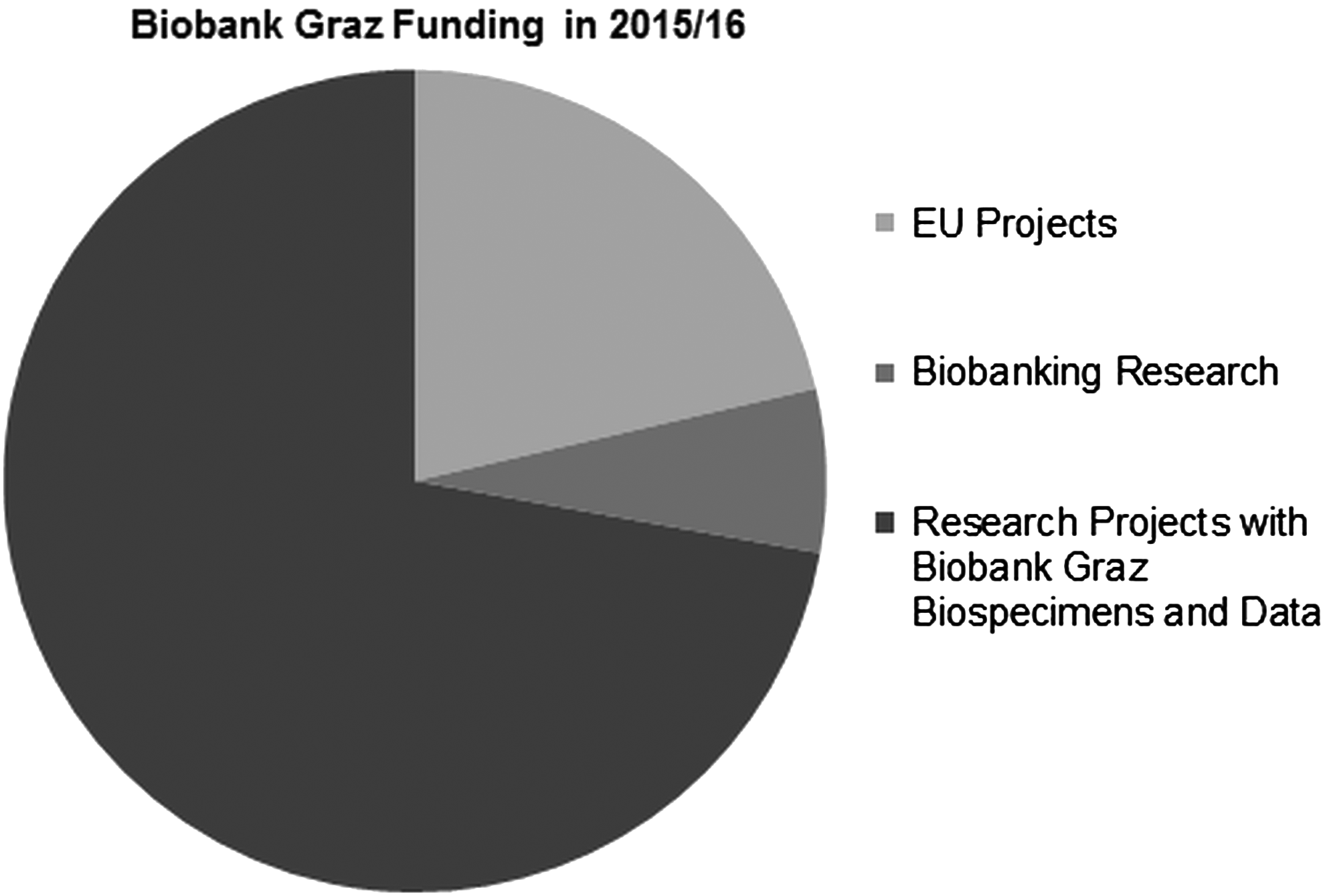
Three key areas of funding for Biobank Graz.
Is there an international solution for informed consents to enable sample and data sharing?
Due to national and international differences in law and ethics and even between local ethics committees within a single country, it is very difficult and challenging to use biospecimens and data from different countries for a single project. For instance, the Danish National Biobank does not ask donors to sign an informed consent (opt out option) for use of medical biospecimens from routine procedures, and primarily supports national biomedical research. The Danish Data Protection Agency has decided that the Act on Processing of Personal Data covers the processing of tissue samples (Act No. 429 of 31 May 2000 on Processing of Personal Data). 18 Also, biobanks in The Netherlands 19 and Belgium 20 are allowed to use samples of routine specimens without informed consent only from secondary biobanks, for example, FFPE (formalin-fixed paraffin-embedded) tissue samples of the department of pathology, including an option for opt out for patients. In contrast, in countries such as Austria and Sweden, each sample for research use has to have an informed consent signed by the donor, irrespective of whether it is a broad or specific informed consent.
Previous European studies often used only a specific informed consent, and therefore, a further use of samples and data after termination of the specific study was no longer allowed. For this reason, many biobanks such as Biobank Graz and the da Vinci European Biobank combine a specific consent of a study with a broad informed consent for their prospective studies. In this way, biospecimens and data of prospective studies can be used afterward for further research projects, which increases sustainability of sample use and hence of biobanks.
Moreover, it must be stressed that there are major differences in European biobanking regulations. Only some countries such as Finland and Estonia have adopted a specific biobanking law. In other countries, such as Austria, the regulatory weight is at the Austrian Bioethics Committee, the data protection agencies, and the local independent ethics committees.
Based on these differences, the common use of European biobank resources is still a challenge. However, exchange of international professional experiences leads to reaching more and more consensus in the field of biomedical ethics and law.
How can a biobank react in economically unstable periods?
When planning a biobank, it is pivotal to take into account the best and the worst economic case scenario for a business plan. In addition, during the planning phase, a worst and best case scenario, as well as a financial reserve, needs to be included into the business plan. In economically unstable periods, it is essential to bundle local existing resources and to limit local collection strategies to decrease costs. Furthermore, active marketing of existing services and resources is inevitable to gain further funding.
A business plan of an academic clinical biobank should include risk management and risk prognosis. Different possibilities of disaster scenarios and/or sudden funding drops need to be discussed, and ways of dealing with respective challenges with exact action strategies should be described. At the same time, not each and every risk factor can be expected or indicated in the forefront. Taken together, the advance estimate of disaster scenarios or funding gaps can be essentially helpful, even if unexpected risks may add to the burden.
Finally, a key success parameter for a biobank should be the amount of distributed samples and data, and the use of stored biospecimens in research. Biobanking reports state that the biobanking market (sample usage volume) is directly dependent on various factors from country-specific demographic conditions and business cycles to market specific microeconomic influences. Recent biobanking market research numbers show that the global biobanking market has had a value of 142 million USD in 2011, with a growth forecast of 5.4% it may reach 216.3 million USD in 2018. At the same time, the biobank market in the private sector had a value of 42.4 million USD in 2010, with a projected market value of 93.7 million USD in 2018. Although the United States and Europe have the largest biobanking market size, the market does not only focus on the Western world but also includes Asian countries. There is rapid growth of the population in the Asian/Pacific countries affecting the biobanking market in such countries. At the same time, the largest biobanking market is still in Europe due to the high demand from research active countries such as the United Kingdom, Italy, and Germany. 21
Which kind of biobanking research is innovative?
The demands on biobanks increase constantly with the growing number of analytical technologies to investigate biospecimens. Accordingly, it is pivotal to recognize various needs of researchers who work with biobanking resources. There is the need for a frequent communication between researchers and biobankers to discuss newly developing special requests for samples, data, and thus biobanks. Hence, it is up to each biobank to perceive these suggestions and requests and to utilize them to initiate new innovations. Such requests often include topics such as preanalytical quality control, new sample processing, and storage methods (e.g., for viable cryopreserved tissue samples) or development of specific biobank databases to enable the discovery of new biomarkers and development of new diagnostic and clinical applications.
At the same time, social and ethical studies are highly important to detect the acceptance of and the knowledge level on biobanking and associated areas. Such studies help to inform donors on data privacy issues and generate information transfer between researchers, public, and government since biobanks cannot work without public trust.
What kind of education could be most needful for knowledge transfer in biobanking?
Exchange of experience and training of young researchers and professionals have fundamental importance for biobanks and their sustainability (Fig. 2). Only through this approach is harmonization between established and emerging biobanks possible. Therefore, the support of established biobanks for emerging biobanks by means of consulting, education, training, and workshops is urgently needed.
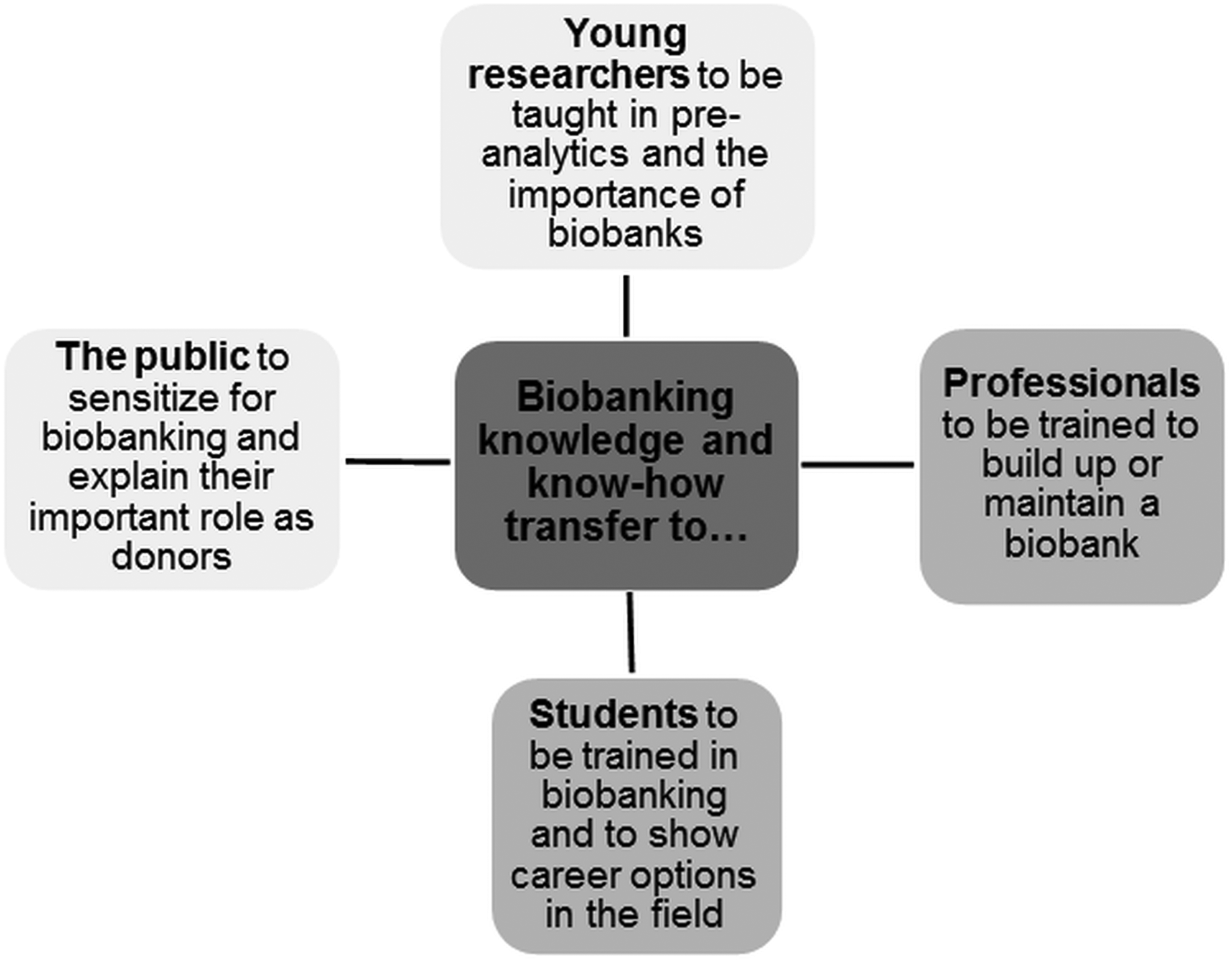
Different kinds of biobanking education.
In addition, local biobanks should start to offer biobanking courses lasting for a few days up to a few weeks as well as master courses in biobanking as postgraduate studies. Such master courses will teach and train the next generation of biobankers to start with a profound knowledge and become trained in respective skills in the field of biobanking. Currently, biobank personnel are trained on the job and are mostly familiar with the needs of the respective local biobank, but are not necessarily aware of the general needs of biobanks.
Does an expiration date make sense according to the period of funding?
Biobanks have different options regarding collection of biospecimens and frequently biobanks are embedded into a hospital landscape and laboratory routine (clinical biobank). In case of a clinical biobank, an agreement between the biobank and the department of pathology could be arranged to transfer the whole storage and management of FFPE biospecimens from the pathology department to the biobank. By transferring the storage of FFPE samples to the biobank, synergies can be used efficiently for both. Also, the department of pathology may profit from innovative solutions of storage systems in a biobank.
This way, a clinical- and population-based collection from a region can be set up and used for retrospective studies. At the same time, this synergistic approach no longer allows for establishing an expiration date for such a biobank without losing a large number of epidemiological samples and data, as well as losing samples for re-evaluation in the clinical routine setting. Such a biobank plays a pivotal role for sample management of routine pathological samples and thus needs to be maintained.
In general, costs for a shutdown of a biobank are underestimated. They may be in the range of nearly 1 million Euros, including sample disposal and respective consumables, but without calculating the costs for reconstruction of infrastructure and the possibility for utilization by another institution. 3
Conclusion
An optimal utilization of a biobank begins with ideas of sharing of resources, infrastructure, and investments starting at the planning stage. This needs to be done in cooperation with associated and adjoining institutions and should be continued by transfer of knowledge and know-how, using high-quality education for international researchers and biobankers.
Long-term funding options for biobanks are extremely rare and the total recovery of costs is not an option. 22 Biobanks have to provide researchers with high-quality samples and data for their projects, independent of acquisition of third-party funds. Costs for a shutdown of a biobank can be extremely high and need to be calculated upfront and included in the business planning. For clinical biobanks, a long-term funding and cost recovery strategy seems to be necessary to maintain a sustainable operation.
A 4-year strategy and a respective 4-year business plan are useful tools for any biobank.
Footnotes
Acknowledgments
The authors would like to acknowledge the Austrian Federal Government, Ministry of Science, Research and Economy (BMWFW; Konjunkturpaket II and BBMRI.at) as well as the local government of Styria (Zukunftsfond Steiermark) for their support of further development in infrastructure and resources of Biobank Graz.
Author Disclosure Statement
No competing financial interests exist. This work was supported by the Medical University of Graz.