




Abstract
RNA is an essential biological material for research in genomics and translational medicine. As such, its storage for biobanking is an important field of study. Traditionally, long-term storage in the cold (generally freezers or liquid nitrogen) is used to maintain high-quality (in terms of quantity and integrity) RNA. Room temperature (RT) preservation provides an alternative to the cold, which is plagued by serious problems (mainly cost and safety), for RNA long-term storage. In this study, we evaluated the performance of several RT storage procedures, including the RNAshell® from Imagene, where the RNA is dried and kept protected from the atmosphere, and the vacuum drying of RNA with additives such as the Imagene stabilization solution and a home-made trehalose solution. This evaluation was performed through accelerated (equivalent to 10 years for RNAshell) aging and real-time studies (4 years). To check RNA quality and integrity, we used RNA integrity number values and RNA-seq. Our study shows that isolation from atmosphere offers a superior protective effect for RNA storage compared with vacuum drying alone, and demonstrates that RNAshell permits satisfactory RNA quality for long-term RT storage. Thus, the RNA quality could meet the demand of downstream applications such as RNA-seq.
Introduction
R
RNA-seq as well as most of the other RNA analytical technologies can be reliably used only on high-quality samples, which is a fundamental problem since RNA is fragile and affected by multiple degradation factors, mainly by RNAse contamination, oxidation, and hydrolysis,12,13 during the preanalytical phase and after collection, isolation, and storage. The main nonenzymatic degradation event is the spontaneous cleavage of the phosphodiester linkage through transesterification catalyzed by Bronsted acids and bases. 14 Water appears as a main degradation factor. 1 Therefore, to maintain RNA quality, storage and transportation procedures must be carefully carried out.15,16 The gold standard for RNA transportation and storage is the cold chain consisting in dry ice, freezers, liquid nitrogen, etc. However, these methods have drawbacks and limitations in consideration of the cost, complexity, and lack of safety, such as handling and maintenance costs, power consumption, and freezer failure risks.17,18 The development of novel techniques allowing the stabilization and preservation of purified RNA at room temperature (RT) would avoid the disadvantages of the cold chain.19,20
Several techniques for RT storage of purified RNA have recently been developed.15,16,21 One of those, RNAshell®, developed by Imagene, relies on the encapsulation of the purified and dehydrated RNA in the presence of a proprietary stabilizer into an airtight container. This air- and water-tight capsule can be stored at an ambient temperature with no additional conservation measures. Previous studies showed that RNAshell was fit-for-purpose for short-term storage or transportation (2 weeks) at RT in terms of total RNA recovery, and rRNA and mRNA integrity assessed by real-time polymerase chain reaction (PCR) analysis. 15 Previous studies demonstrated that quality RNA storage demands full protection from the atmosphere, as atmospheric humidity was identified as a major deleterious factor. It was also found that the logarithm of the nucleic acids' degradation rate constants was linearly correlated to the reciprocal value of the absolute temperature, as expected from the Arrhenius' law. This model can be used to estimate the RNA degradation rate at 25°C and the acceleration brought by higher temperature, allowing choosing the time and temperature for simulating any length of storage time at RT. 1 RNAshell is an air- and -water-tight capsule, which allows maintaining an anhydrous and anoxic environment and thus protecting RNA from the deleterious elements of the atmosphere. 1 It was demonstrated that the RNA quality, as evaluated by the RNA integrity number (RIN), of those preserved in RNAshell 1 week at RT was similar to the original samples, and remained high after a simulation of storage of about 7 years. 19
Trehalose is known as a stabilizing agent for lyophilization. 22 A previous study has demonstrated that the addition of trehalose increased DNA-free and protein-free RNA stability in a vaccine stored at RT. 23 Imagene stabilization solution is a proprietary stabilizer used for RNA protection during the vacuum drying procedure. In this study, we evaluated three dried-RNA storage conditions, including the commercial technology RNAshell, the drying of RNA in the presence of the Imagene stabilizer, and a home-made trehalose solution. We performed accelerated aging studies through heating to assess the preservation quality under those three different conditions through different approaches, including RIN analysis and RNA sequencing, etc., and we also conducted studies for 4 years to evaluate the RNAshell protective performance at RT, in real storage conditions. We demonstrated that RNAshell allows for RNA preservation at RT, and that the RNA quality is adequate for common downstream analyses such as RNA-seq.
Materials and Methods
RNA preparation for the accelerated degradation studies
Total RNA was extracted at Imagene from HeLa cells using the phenol–chloroform–isoamyl alcohol method as described previously. 19 The extracted RNA without DNase treatment was dissolved in RNase-free water. About 6.7 μL of RNA/vial (2 μg RNA) was aliquoted and subsequently treated according to the four methods described below for the accelerated degradation studies. RNA sample processing for the accelerated degradation studies were conducted by Imagene. Specifically, the RNA processing was performed in parallel with the RNA samples of the same batch at a concentration of 300 ng/μL.
Dried RNA in RNAshell minicapsules (hereinafter, RNAshell)
An aliquot containing 6.7 μL RNA was mixed with an Imagene proprietary stabilization solution (hereinafter, Imagene stabilizer) to a final volume of 30 μL. A total of five repetitions were tested. The Imagene stabilizer was supplied by Imagene as a part of the encapsulation procedure. RNA encapsulation, vacuum drying, and laser sealing of RNAshell minicapsules were performed according to Imagene's protocol as reported in the previous study. 1 RNA solution was vacuum dried for 1 hour using a GENEVAC EZ2 Evaporating System (Genevac, Ipswich, United Kingdom) under the condition of medium boiling point program, 2 mbar, 43°C. Subsequently, the RNA samples in other storage conditions were desiccated in the same condition.
Dried RNA in 2 mL Safe-Lock Eppendorf microtubes with Imagene stabilizer
An aliquot containing 6.7 μL RNA was deposited in a 2-mL Safe-Lock Eppendorf microtube and mixed with the Imagene stabilizer to a final volume of 30 μL. A total of five repetitions were tested. After vacuum drying, the cap was firmly closed and sealed with a sealing film.
Dried RNA in 2 mL Safe-Lock Eppendorf microtubes with trehalose (hereinafter, trehalose)
An aliquot containing 6.7 μL RNA was diluted with an equal volume of 20% trehalose (W/V, in nuclease-free water) to a final concentration of 10% trehalose (Cat. No. T9531; Sigma-Aldrich Co.). A total of five repetitions were tested. Vacuum drying and capping were performed according to the same protocol described for Group 2.
RNA in solution
Without any further treatment, 10 μg RNA solution was deposited in 2-mL Safe-Lock Eppendorf microtubes after extraction and stored in a −80°C freezer until analysis.
Degradation studies
Accelerated degradation studies
To simulate the long-term preservation of RNA samples, we performed accelerated degradation studies based on the Arrhenius' law.
The RNA samples protected by RNAshell, Imagene stabilizer and 10% trehalose were incubated in an oven at 90°C, 75% relative humidity (RH) for 0, 3, 6.5, and 16 hours, respectively, (equivalent to about 0 day, 2 years, 4 years, and 10 years at RT calculated by extrapolation from the published Arrhenius model 1 ). The humidity condition was generated from a saturated salt solution and independent of the ambient% RH of the laboratory.
After heating, the RNA samples were stored <1 month at −80°C and were transported to BGI on dry ice. After reception by BGI, the RNA samples were again stored at −80°C.
Real-time degradation
For the real-time degradation study, Imagene provided BGI with RNAshell minicapsules produced during the establishment of RNA encapsulation platform in 2010. Thus, these samples represented the longest storage time at RT. The RNA samples with an initial RIN value of 7.2 were extracted from HeLa cells in 2010 and six RNAshell minicapsules containing 2 μg of RNA per minicapsule were processed by Imagene. A set of three RNAshell minicapsules was stored at −20°C and the other set of three RNAshell minicapsules was stored at RT (average 22°C). After a 4-year period of storage, six RNAshell minicapsules were sent to BGI on dry ice. For this study, no control RNA stored in solution at −80°C was available.
Rehydration of dried RNA samples
Dried RNA samples were rehydrated by adding 30 μL of RNase-free water with mixing using a pipette tip.
Quantity and quality analysis
The RNA quality and quantity were evaluated by an Agilent 2100 Bioanalyzer (G2939A; Agilent Technologies) using the Agilent RNA 6000 Nano Kit in BGI before the downstream tests, and the workflow is shown in Figure 1. RNA quality was assessed by determining the RIN and the ratio value of 28S to 18S rRNA (hereinafter, 28S/18S).
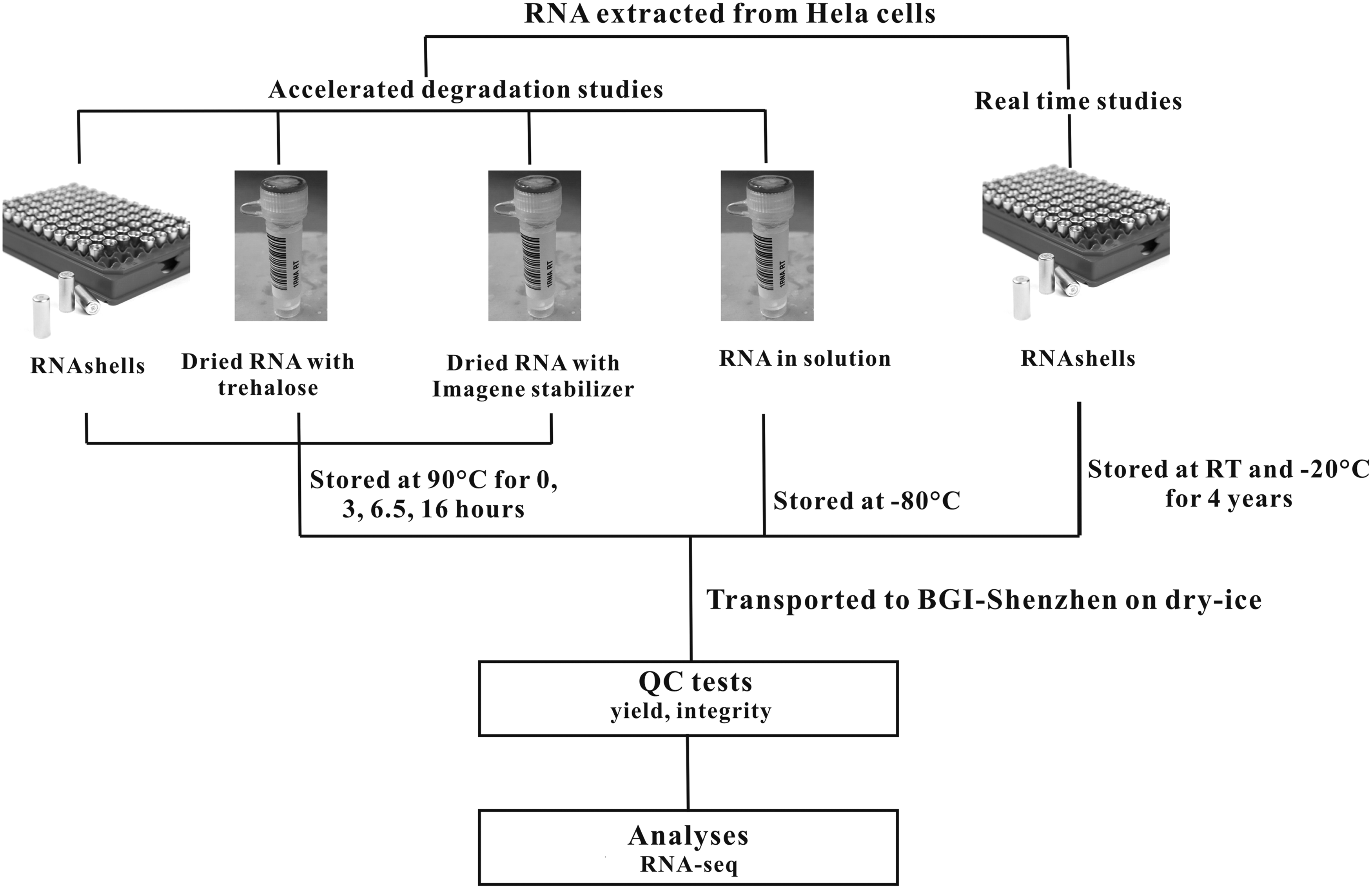
Pilot study workflow.
RNA-seq
Five micrograms of RNA were used for the RNA-seq library synthesis using the poly(A)-selected mRNA as described previously. 24 Then the libraries were sequenced on the Illumina HiSeq 2000 system with PE101 (pair-end, 101 bases). With regard to the accelerated aging study group, raw reads values obtained were 23,823,100 for the RNA control sample, 23,822,840 for the RNAshell 0H sample, 23,822,914 for the RNAshell 3H sample, 23,822,768 for the RNAshell 6.5H sample, and 23,823,040 for the RNAshell 16H sample (Supplementary Table S1; Supplementary Data are available online at www.liebertpub.com/bio). While for the real-time study group, raw reads values obtained were 26,203,950 for the RNAshell sample stored at −20°C, and 26,203,952 for the RNAshell sample stored at RT (Supplementary Table S1).
Raw sequencing reads were filtered by SOAPnuke (http://soap.genomics.org.cn) according to the following criteria: (1) if a read has >10% of bases as n; (2) if a read has >40% of low-quality (value ≤10) bases; (3) if a read is contaminated by the adaptor sequence or produced by PCR duplication. After filtering, the clean reads were submitted to alignment analysis with the genome/gene (HG19) as a reference using the BWA/Bowtie method as previously described.25,26 Then the gene expression analysis was performed by assembling the transcripts using RSEM tools. 27 Gene expression was calculated by fragments per kilobase of transcript per million mapped reads (FPKM), and we performed differentially expressed gene (DEG) analysis with the threshold “FDR ≤0.001 and the absolute value of Log2Ratio ≥1” to identify the DEGs.
Statistical analysis
Statistical analysis was conducted by GraphPad Prism software with t-test for significant difference determination (p-value <0.05 was considered significant). Results were presented as the mean ± standard deviation (SD) with n = 5 or 3. In statistics, the Pearson Correlation Coefficient shows the linear relationship between two variables. A Pearson Correlation Coefficient of two genes represents the relationship in an aspect of gene expression regulation, which was obtained by SPSS software (R2 > 0.8 was considered as highly correlated).
Results
RNA yield and integrity
To evaluate the RNA yield after rehydration, quantification was performed by Agilent 2100 Bioanalyzer. In the accelerated aging study (Table 1), RNA yield from RNAshell ranged from 1.92 to 2.03 μg, and for the RNA dried with Imagene stabilizer, the recovery varied between 2.05 and 2.32 μg. Interindividual yields for the two groups did not show significant changes for each time point. After 16 hours of heating, the trehalose RNA samples showed the lowest yield (0.82 ± 0.26 μg) and a significant loss compared with control.
p < 0.0001, ap denotes a statistically significant difference between trehalose 16H sample and the control group, namely the RNA solution stored in a −80°C freezer.
SD, standard deviation.
For the samples preserved in RNAshell and stored at RT for 4 years, the RNA yield remained close to those of the samples kept at −20°C (Table 2).
RIN, RNA integrity number; RT, room temperature.
RNA integrity was assessed by the RIN and the ratio of 28S/18S values (Fig. 2). It is worth mentioning that poor RIN values were observed for four samples in the accelerated degradation studies; thus repeated measurements for the four samples were undertaken. As RIN is becoming a de facto standard for RNA integrity, the inconsistency in RIN values was considered. However, the RIN values were 9.6 ± 0.9 (SD) for Imagene stabilizer 0H sample, 2.2 ± 0.5 for Imagene stabilizer 16H sample, 8.6 ± 1.2 for trehalose 0H sample, and 3.0 ± 1.1 for trehalose 3H sample. As for the concentrations of the four samples, the concentration values were 68.5 ± 8.7 ng/μL (SD) for Imagene stabilizer 0H sample, 72 ± 8.3 ng/μL for Imagene stabilizer 16H sample, 70.8 ± 8.6 ng/μL for trehalose 0H sample, and 65.9 ± 14.4 ng/μL for trehalose 3H sample. Statistically, poor RIN values had little influence on the range and variation of samples preserved in Imagene stabilizer or trehalose. Significant differences resulted from comparison between samples preserved in RNAshell and samples preserved in Imagene stabilizer or trehalose (Fig. 2).

RNA integrity analysis of the RNA samples in the accelerated aging studies. ), the RNAshell ( ), Imagene stabilizer (
 ), and trehalose (
 ). Data are shown as mean ± standard deviation (n = 5). #p denotes a statistically significant difference between each heated sample (3 hours/6.5 hours/16 hours) and nonheated sample (0 hour) stored in the RNAshell. *p denotes a statistically significant difference between each heated sample (3 hours/6.5 hours/16 hours) and nonheated sample (0 hour) stored in the Imagene stabilizer. ^p denotes a statistically significant difference between each heated sample (3 hours/6.5 hours/16 hours) and nonheated sample (0 hour) stored in the trehalose. RIN, RNA integrity number.
For the three dry storage solutions, the RIN values showed significant decreases after 3 hours of heating. For the samples preserved in RNAshell, the RIN value decreased from 9.86 to 9.48. This difference was only 0.38 and all the RIN values were >8. Therefore, in spite of a reduction trend of the RIN values, the RNA remained efficiently protected in RNAshell. For the RNA samples dried in the presence of Imagene stabilizer or trehalose, the RIN values showed a sharp decrease to 3.22 and 2.54, respectively, after 3 hours of heating. The variation of 28S/18S values showed a similar tendency, whereas RNAshell 28S/18S values were all >1.7 for up to 16 hours of heating.
In the RT real-time degradation study, there were no significant variations of the RIN and 28S/18S values between the RNAshell minicapsules stored at −20°C and RT for 4 years (Table 2). With regard to the RNA samples with an initial RIN value of 7.2, the samples stored for 4 years were degraded slightly.
RNA sequencing
We performed RNA sequencing on the RNAs preserved in RNAshell both in the accelerated aging study and real-time study, and analyzed the sequencing data quality, alignment, reads randomness, and gene expression. We obtained high-quality RNA-seq data, and the analysis, including the rate of clean data, Q20 quality control, Q30 quality control, and GC content (Supplementary Table S1). All of the sequenced samples presented balanced and satisfactory base composition percentage as shown in Supplementary Figure S1.
As for the % clean reads data in Supplementary Table S1, the clean reads are the remaining reads after filtering. The step of filtering removes data noise, thus clean reads are suitable for downstream bioinformatics analysis. The % clean reads data are all above 95%, adapters and low-quality reads constitute a minimal proportion. The% clean reads data meet the criteria of Illumina and apply to quality control analysis such as base composition.
The reads distributions of reference genes for all sequenced samples are shown in Figure 3. The RNA in solution at −80°C and RNAshell 0H showed an even coverage along the gene body. However, the reads number was biased toward the 3′ end of the transcripts over the heating time. It showed a slight 3′ mapping bias after heating for 3 and 6.5 hours, and significant 3′ mapping bias after 16 hours of heating in the accelerated aging study. In the long-term real-time study, a similar coverage from 5′ to 3′ end between RNAshell stored at −20°C and RT was shown.

The distribution of clean reads after filtering on the reference genes for each sample.
Results showed that all samples, either heated or stored at RT for 4 years, presented only a small proportion of DEGs (<1.58%), indicating that RNAs stored in RNAshell kept approximately the same gene expression profiles as the respective control RNAs (Table 3). We found that the number of DEGs in RNAshell increased over the heating time, and a slight increase was detected after heating for 16 hours, which may be caused by RNA degradation.
RNA solution stored in −80°C freezer.
RNAshell stored at room temperature for 4 years.
RNAshell stored in −20°C freezer for 4 years.
DEGs, differentially expressed genes; DiffGene (down), the DEGs that have higher expression in sample A (lower expression in sample B); DiffGene (up), the DEGs that have higher expression in sample B compared with sample A.
The average gene length of each group is shown in Table 3. The table shows that the DEGs with a higher expression in the −80°C RNA controls were longer, on average, than the DEGs with higher expression in the RNA samples protected by RNAshell after heating. Similar results were obtained when comparing the heated RNAshell minicapsules with the nonheated (RNAshell 0H) in accelerated aging study and comparing the RNAshell minicapsules stored at RT to the ones stored at −20°C for 4 years.
We compared RNA expression profiles between the samples preserved by RNAshell at different time points with control (RNA solution stored in −80°C freezer), respectively, in the accelerated study (Fig. 4), and all results showed high correlations (R2 > 0.990). A similar result was obtained in the real-time study between RNAshell stored at RT with RNAshell preserved at −20°C for 4 years (R2 = 0.994). This indicates that RNA expression profiles changed little after storage in RNAshell for a long time (about 10 years in the accelerated study and 4 years in the real-time study).

The comparison of gene expression profile.
Discussion
In this study, our objective was to evaluate the performance of RNA protection by the RNAshell technology from Imagene, and by vacuum drying with additives such as the Imagene stabilizer and a home-made trehalose solution, in the context of long-term preservation. We carried out accelerated aging and real-time studies and assessed the yield, integrity, and RNA-seq performance.
RNA yield and integrity
RNA yield was determined by the Agilent 2100 Bioanalyzer. In accelerated aging study, the RNA yield from high to low was: dried-RNA with Imagene stabilizer (2.05–2.32 μg), RNA dried in RNAshell (1.92–2.03 μg), and dried-RNA with trehalose (0.82–2.19 μg).A significant decrease was measured in trehalose after 16 hours of heating at 90°C, 75% RH, perhaps due to a strong degradation resulting in a decrease binding of the intercalating dye. The yield of RNAs dried with Imagene stabilizer was greater than the original 2 μg quantity. This may be due to experimental errors (analytical variability), and recovered yields that are greater than the original quantity for RNA stored at RT has been already reported. 28
RIN is widely used to detect RNA degradation, with RIN values ranging from 10 (intact) to 1 (totally degraded). 29 In general, RNA samples with high RIN (>7) values are considered suitable to be used in RNA sequencing experiments. 30 Nevertheless, the initial RIN value of the RNA samples tested in the real-time degradation study was 7.2 and a slight decrease of RIN occurred during the 4-year storage period.
Our results showed that RNAshell had an efficient protection effect against RNA degradation in the drastic condition of heating at 90°C with 75% RH atmosphere (the RIN value ranged from 9.86 to 8.44). In spite of the fact that a statistically significant change in the RIN value was detected at the 3-hour time point of heating in the RNAshell (equivalent to ∼2 years at RT) compared with 0 hour (9.48 vs. 9.86), and that the results showed a tendency to degradation over time, all the RIN values remained high and fully compatible with classic molecular analysis requirements, in concordance with the findings of Liu et al. 19 On the contrary, severe degradation was observed in RNA dried with the additives, where the RIN values dropped to below 3. This is most probably due to the microtubes which are known to be nonhermetic 31 and thus could not protect RNA from humidity as opposed to the laser-sealed stainless steel RNAshell. These results highlight the need for total atmosphere protection of RNA samples for a reliable storage at RT.
With regard to the four samples with poor RIN values in the accelerated degradation studies, the poor values might result from instrumental bias factors rather than recovery efficiency of RNAshell. The high reproducibility of RIN in samples recovered from RNAshell was demonstrated by several previous studies related to RNAshell storage. Cayuela et al. reported that RIN of recovered RNA from RNAshell was consistent between five laboratories and met the usual criteria. 32 Mathay et al. also demonstrated the rRNA integrity was not affected and RNA preserved in RNAshell gave the highest RIN among all six storage conditions. 15 In addition, poor RIN values had little influence on the conclusion, and data analysis of RIN supported high reproducibility to some extent.
In the real-time studies, we observed little change in the RNA yield and RIN values for the RNAshell stored for 4 years at RT in comparison with those stored at −20°C, which suggested a good protection of RNA samples stored at RT by RNAshell compared with the cold storage. However, because no control RNA stored at −80°C was available during the Imagene RNA encapsulation platform set-up in 2010, further studies would be needed to evaluate the difference between RNAshell stored at RT and RNA in solution at −80°C.
Although the samples stored in RNAshell for 4 years had a RIN value of 6.5, RNA sequencing was performed to characterize the samples. Romero et al. reported that useful data could be collected using RNA sequencing even from highly degraded samples. 33 They also demonstrated that the samples with RIN values higher than 6.3 revealed greater numbers of uniquely mapped reads and reads mapped to genes. 33 Briefly, the RIN result of 6.5 did not reduce reliability of the research.
RNA sequencing
All RNAshell minicapsules stored at 90°C with high RIN values were selected to perform RNA-seq analysis. We obtained more than 95% of clean reads, high-quality data (Q20 > 97%, Q30 > 92%), and stable GC content from each RNAshell stored sample regardless of the storage temperature (90°C or RT). Also, the base composition percentage was all balanced and satisfactory. Compared with RNA stored at −80°C, all the RNAshell samples had a similar mapping rate to the human genome/gene. These results indicate that RNAs processed in RNAshell could give high-quality data, comparable with RNA-seq data obtained from RNAs stored in the traditional −80°C method.
To evaluate the RNAshell preservation capacity during the long-term RT storage, we also analyzed 5′ to 3′ gene body coverage and differential gene expression, which was reported to be correlated with RNA degradation.30,34,35 The gene body coverages were comparable for RNA stored at −80°C (RIN = 10) and RNAshell 0H (RIN = 9.86). Compared with these two groups, a slight 3′ bias was observed in RNAshell 3H (RIN = 9.48), RNAshell 6.5H (RIN = 9.36), and RNAshell 16H (RIN = 8.44). These results reflect partly the degradation of RNA with lower RIN values, which is consistent with earlier findings showing that RNA samples with decreasing RIN values led to an increase in 3′ bias. 30 Meanwhile, there was no significant 3′ bias increase between the RNAshells stored for 4 years at −20°C (RIN = 6.5) and at RT (RIN = 6.5).
For RNAshell 16H, the number of DEGs increased, short transcripts were overrepresented, and longer transcripts had lower expression when compared with RNA solutions stored at −80°C or RNAshell 0H. This may be due to slight degradation of RNA, and is in accordance with previous reports that the long transcripts tend to be overrepresented in samples of higher quality. 30 Wan et al. presented a contradictory conclusion that RNA degradation rate and the transcript lengths were independent. 36 However, this discrepancy may not be relevant to our study, since their conclusion is based on a theoretical model which does not agree with all the available data. So, the relationship between RNA degradation and transcript lengths is still unclear, which is a topic requiring further investigation. Another interesting point is that, since RNA degradation seen by RNA-seq and RIN seem to be correlated, most of these DEG could be corrected as shown by Gallego Romero. 33
The expression profiles of those RNA preserved in RNAshell at 90°C for 0, 3, 6.5, and 16 hours were highly correlated to the RNA solution stored in −80°C freezer in the accelerated study, a similar result was obtained in the real-time study, which indicated that RNA preserved in RNAshell maintained nearly invariable gene expression profiles similar to RNA stored according to the traditional freezing method. These results suggest that the quality of the RNA preserved and stored in RNAshell could stay nearly constant up to 4 years and may undergo only weak degradation until 10 years of storage at RT.
In short, simple vacuum drying with trehalose or the Imagene stabilizer cannot provide adequate protection for long-term RNA storage at RT, whereas hermetic RNAshell providing an absolute isolation from oxygen, moisture, and light can efficiently maintain the quality of RNA.
Actually, RNAstable and GenTegra are also prevalent stabilization technologies, which allow for the storage of RNA at RT in a cost-effective manner. The cumulative summary of Biomatrica demonstrated that the longest recorded storage of RNA in RNAstable was 29 months at RT. 15 While in the accelerated aging studies, IntegenX demonstrated the good preservation of RNA samples stored in GenTegra RNA in an equivalent of 4 years at ambient temperature (https://www.novabiostorage.com/gentegra-rna). At the same time, performance of RNAshell was manifested through a real-time aging study of 4 years at ambient temperature. The RNAshell encapsulation actually requires a lot of professional welding and leak control in a specific encapsulation station, and RNAstable and GenTegra are more convenient for user operation. The GenTegra-RNA is a water-soluble and inert chemical matrix that offers the easiest sample handling, whereas RNAstable technology may apply a semipermeable membrane to an open tube when using a vacuum drying method. 16 However, the RNAshell minicapsules can be stored at ambient temperature with no additional conservation measures and provides a significant storage condition advantage for RNA samples. In addition, the potential advantages of the RNAshell technology in long-term storage were demonstrated.
In conclusion, our study revealed that it was practicable to preserve RNA in RNAshell for long-term storage at RT, and the RNA quality was still suitable for downstream application such as RNA-seq.
Footnotes
Acknowledgments
This research was funded on Chinese Medicinal Plants Genetic Information Research Program, which is supported by Shenzhen Municipal Government of China (No. JCYJ20160510141910129). This research also received funding on the Genomics Mapping, Research and Application of Chinese traditional and Herbal Drugs, which is sponsored by Shenzhen Municipal Government of China (No. CXZZ20140421112021913). Many thanks to Imagene company for providing the encapsulated samples and the corresponding controls as free supplies. In addition, the authors want to express their sincere thanks to their colleagues at the China National GeneBank for their selfless help.
Author Disclosure Statement
M.C. is an employee of Imagene Company; J.B. is a shareholder and a consultant for Imagene Company. The remaining authors declare no competing financial interests. The authors have declared that no competing interests exist.
References
Supplementary Material
Please find the following supplemental material available below.
For Open Access articles published under a Creative Commons License, all supplemental material carries the same license as the article it is associated with.
For non-Open Access articles published, all supplemental material carries a non-exclusive license, and permission requests for re-use of supplemental material or any part of supplemental material shall be sent directly to the copyright owner as specified in the copyright notice associated with the article.
