




Abstract

Introduction
ISBER
CTRNet is a network of Canadian tumor biobanks, funded by the Institute for Cancer Research, Canadian Institutes for Health Research (CIHR), which is one of the national agencies that is responsible for funding health research in Canada. The mandate from CIHR to CTRNet was to define and disseminate standards for tumor biobanking. To this end, CTRNet began developing a biobank certification program with supporting online education modules in 2010. To begin to develop the program, CTRNet completed a national and international landscape assessment of available standards as well as education programs, and it consulted with leaders in research ethics, researchers, and biobank leaders and staff to determine the best approach for Canadian research. This led to the decision to create a Biobanking Education Course as part of the dissemination strategy, in parallel with the creation of a set of national standards, based principally on ISBER's Best Practices, and to combine these into two integral components of a single certification program. This strategy was chosen to meet the goals of Canadian research funders and to harmonize biobanking practices not only in the Canadian tumor biobanks but also within research laboratories. The program has since been adapted to be applicable globally to all kinds of biobanks supporting human research.
As a result, the introductory-level biobank education course is designed to cover the key elements of a set of standards based on ISBER's Best Practices in a framework that also conveys why standards are important. The course is designed to be applicable to those handling research biospecimens such as biobank technicians, consent coordinators, project managers, and other related staff. But given CTRNet's mandate, the education content is also intended to be useful to introduce all research stakeholders (ethics personnel, funders, research, and hospital administrators) to the ISBER's Best Practices that underpin international norms for the activity of biobanking. The ISBER-CTRNet partnership allows ISBER members and non-members to access this education through the ISBER website. The partnership also allows ISBER to meet its objective to offer Best Practice-based education to its members without incurring the substantial costs of developing education, an enrollment scheme, and the associated IT infrastructure. ISBER has also structured the partnership to achieve its objective to extend its global impact by offering biobank education to low and middle income countries (LMICs) by completing an agreement with the World Health Organization International Agency on Research on Cancer (IARC) to allow free access to the ISBER-CTRNet education program.
The Course
See Figure 1 for the title and focus of each education module.
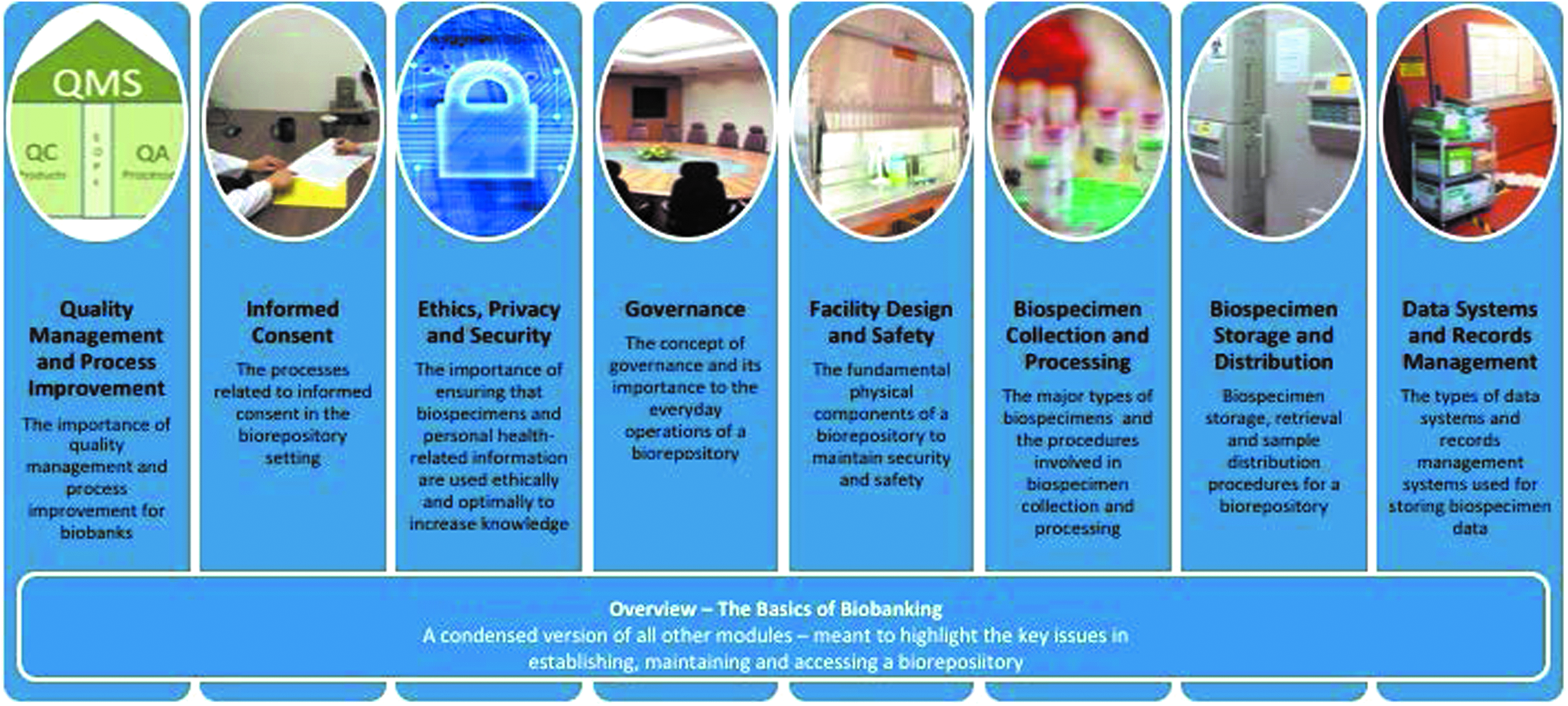
ISBER-Canadian Tissue Repository Network education modules title and topics.
The “Basics of Biobanking” is the first module of the course. This overview module provides an outline of the key issues in establishing, maintaining, and accessing a biobank. The first step in developing the overview module involved defining learning needs in the context of the ISBER's Best Practice Guidelines available at the time. Project management involved coordination of a volunteer biobank staff working group guided by an instructional designer. Development of the content of the initial introductory module took 6 months and approximately 6900 hours. The development of the content of the remaining eight specialty modules with an equivalent scale of content was more efficient and took only another 8 months. A baseline English version of the draft content of the educational modules then underwent international review by internationally recognized leaders in biobanking and members of ISBER from Canada, Australia, and the United States. This input was then incorporated before all modules were translated into French, and both language versions were mounted in an online learning management system on the CTRNet Biobank Resource Center website. The online content of the baseline English version of the education program was subsequently adapted with ancillary content to be applicable to different country-specific issues (e.g., in the areas of ethics, laws, regulations, etc.), and it is currently applicable to the United States, Australia, and Germany. An overall estimate of the total cost of developing and delivering the education course is ∼$585,000 (Canadian), including the IT infrastructure required to host the program. Subsequent additions of new clinical discipline-specific modules to the course have been completed and/or are underway at an additional cost of ∼$40,000 (Canadian) per module.
The complete education course can be accessed on the ISBER website (www.isber.org/?page=IntrotoBiobanking) and through the CTRNet Biobank Resource Center (www.biobanking.org). There is a discounted cost of $195 US for ISBER members and non-members can purchase access for $395 US. Individuals from LMICs can purchase the education at a discounted rate of $49, whereas those who are also members of IARC Biobank and Cohort Building Network can access the education for free. The same education course remains integrated with other core components that together make up the completion requirements of the CTRNet Biobank Certification program, and it is accessible for biobanks enrolling in this program through the CTRNet Biobank Resource Center. To date, more than 1000 individuals from 26 countries have accessed the educational modules.
Discussion
There are a number of education and training programs available (www.isber.org/?page=BiobankEduOpp). Many are integral to graduate degrees that are focused on biobank managers/administrators. However, the ISBER-CTRNet course is the only online, internationally accessible, introductory-level course that is focused on the personnel handling research biospecimens in biobanks and research laboratories based on ISBER's Best Practices.
There were a number of challenges in developing and delivering the “Introduction to Biobanking” course. Given that the education is based on evolving Best Practices and intended to be directly relevant to biobanking in different countries, the course needs to be frequently reviewed, and therefore tracking of updates is important to ensure ongoing alignment with Best Practices and to reflect country specific changes, as well as the feedback from the many learners who have completed the course. Coordination of this ongoing process of review, input, and revision involves significant ongoing costs and is a time-consuming endeavor.
The education program is currently available in English and French to meet the requirements of a national program in Canada. English is the international language of published science but in practice biobank technicians and researchers handling research tissue use the local language in their daily work activities. To reflect the ISBER community's global reach, both the Best Practices and associated education should ideally be translated into other languages. However, translation and verification and maintenance of multiple language versions would be expensive, and partnerships with industry and national biobanking societies and research funders need to be sought to fund this.
One area where significant adaptation has been necessary is in sections dealing with ethics. The course was developed by Canadian biobankers and researchers. Research involving human biospecimens in Canada is guided by the Tri-Council Policy Statement (TCPS 2 2014) (www.pre.ethics.gc.ca/eng/policy-politique/initiatives/tcps2-eptc2/Default). This policy of the three main federal health research funding agencies is based on an ethical (as opposed to a legal) framework. Therefore, the influence of the TCPS 2 within education content has also required some adaptation and introduction of region-specific content to ensure applicability to other regions in the world that operate under a different ethical framework.
Learners taking the course self-evaluate knowledge uptake, and progression through the education is self-paced and un-monitored. There is no examination component associated with the ISBER-CTRNet education. This is intentional and allows the course to be integrated with other education, training, or certification/accreditation approaches. Further, the education was developed to engage learners in the importance and existence of standards and to be integrated with a variety of approaches to encourage, recommend, or require verified adoption of the most appropriate set of standards. Neither ISBER nor CTRNet has the authority at present to set a threshold or act as an accreditation or degree-granting body. However, the education course has been integrated with an examination component in the New South Wales (Australia) biobank certification program and ISBER has recently committed to the development of an examination developed by the American Society of Clinical Pathology, a mature organization that has developed validated examinations for health and research professionals. This examination is expected to be available to ISBER members in 2019.
Future Plans for the ISBER-CTRNet Education Modules
The education modules will be updated to be aligned with the 2018 and future versions of the Best Practice guidelines. An international panel of ISBER experts will be engaged to advise on and validate these updates. There are also plans underway, and funded proposals will be welcomed, to collaborate and translate the content to other languages and/or to add additional region-specific content beyond that already implemented for Australia, Germany, and the United States.
The current ISBER-CTRNet education course was developed in the setting of available education delivery technology in 2010–2011. The content consists of pages of text with graphics, links to content-associated interactive activities, and articles. However, in the 7 years since the program was launched, the sophistication of learning management systems has increased significantly. We have recently acquired experience in these systems through developing a new online course using EdX, one of the largest global Massive Open Online Course platforms available (www.edx.org). On this platform, we have developed new material and changed the focus to include “biobanking in the lab” as well as “biobanking in a biobank,” to create a 6-week intensive Biospecimen Research Methods course. But we have also learned the advantages of current technology in learning management software that enables integration of didactic online lessons, instructional “how-to” videos, a real-time discussion board, quizzes, and a final exam. Since its launch, we have presented this course three times, and partly because this is a certificate-level course backed by the University of British Columbia and partly because of the improved learning management system, it has attracted students from around the globe (www.edx.org/course/biospecimen-research-methods-ubcx-biobank1x-1).
If resources were available, it would be important to consider migrating the existing ISBER-CTRNet course to a modern learning management system that allows adding newer learning tools, interactive activities and test/quiz/examination questions, and video-based content to enhance the learner experience.
Footnotes
Acknowledgments
This work is supported by British Columbia Cancer, BC Provincial Health Services Agency, the University of British Columbia Department of Pathology and Laboratory Medicine, Terry Fox Research Institute, and Canadian Institutes for Health Research.
Author Disclosure Statement
The authors have no conflicts of interest or financial ties to disclose.