




Abstract
Recent advances in biotechnology are making it possible to advance science and improve healthcare with increasing speed and precision. Biobanking, as a foundation of the biotechnology infrastructure, is critical to the assurance of quality for many of the key components for these advancing technologies in both the human and nonhuman domains. Biobanking must advance to support the increased complexity and required precision needs of biological resources. Standards development can provide an important link for the research and development community by providing tools to ensure quality, fitness-for-purpose, and reproducibility in biobanking. ISBER has been developing the ISBER Best Practices revision. At the same time, ISO/TC276/ WG2 has been developing an International Standard (IS) ISO/DIS 20387 General requirements for biobanking standard.
It is important that ISBER and ISO/TC276/WG2 harmonize and/or align their products to enable members of the diverse biobanking community to tailor their own suite of tools to support their specific needs. The availability of both standards and best practices that are complementary will maximize available support for all biobanks. The increased availability of complementary standards, tools, and best practices will facilitate the path to new biotechnology advances and a better future.
Introduction
R
Biobanking, as a foundation of the biotechnology infrastructure, is critical to the assurance of quality for many of the key components for these advancing technologies in both the human and nonhuman domains. Biobanking must advance to support the increased complexity and required precision needs of biological resources. Standards development can provide an important link for the research and development community by providing tools to ensure quality, fitness-for-purpose, and reproducibility in biobanking.
Status of ISO/TC276/WG2 Biobanks and Bioresources
The International Organization for Standardization (ISO)/TC276 (Technical Committee 276) Biotechnology Working Group was created in February 2013. ISO/TC276/WG2 (Working Group 2) Biobanks and Bioresources was established in December 2013 as one of the first four working groups in TC276. 1 Since then, ISO/TC276 Biotechnology has grown to 30 participating member countries, 14 observing countries, and 7 liaison organizations, including ISBER, BBMRI-ERIC, and ESBB. More than 150 experts from 27 countries are currently active and contributing to the development of standards in WG2.
The nine standards currently under development in WG2 are listed in Table 1. WG2 is currently most closely focused on revising ISO/draft international standard (DIS) 20387 General requirements for biobanking. This standard is intended to serve as an umbrella standard under which other more specific standards will be developed. An explanatory document, approved work item (AWI)/TR 22758 Implementation guide for ISO 20387, is being concurrently drafted as a technical report (TR) to provide guidance to biobanks on the use of ISO 20387. These two documents are intended as the first to be published out of WG2. The development of more specific standards will follow (Table 1 and Fig. 1).
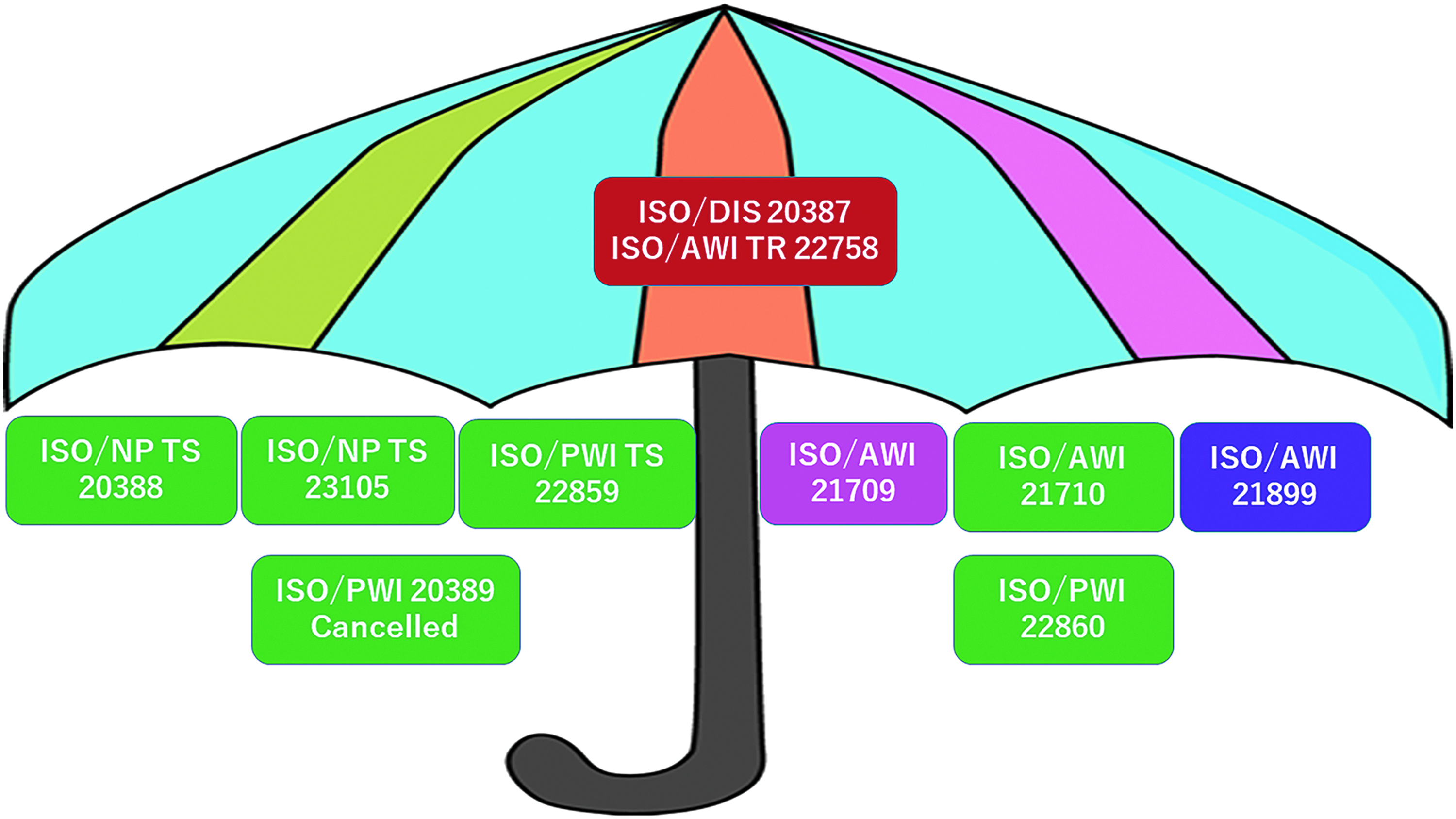
Various proposals will be further developed after completion of ISO/DIS 20387 and ISO/AWI TR 22758. These and other standards will address more specific requirements and will be aligned with the “parent” document and its implementation guide. AWI, approved work item; DIS, draft international standard; ISO, International Organization for Standardization; NP, new work item proposal; PWI, preliminary work item.
AWI, approved work item; CN, China; DIS, draft international standard; FDIS, final draft international standard; FR, France; KR, Korea; ISO, International Organization for Standardization; LU, Luxembourg; NP, new work item proposal; NWIP, new work item proposal; PWI, preliminary work item; TC, technical committee; TR, technical report; TS, Technical Specification; WD, working draft; WG, working group.
Status of ISO/DIS 20387
An ISO/DIS 20387 document was circulated in July 2017 as a DIS ballot, and included an opportunity for comments. More than 200 pages of comments were generated by national standards committees and liaison entities, including ISBER and BBMRI. 2 During the ISO/TC276/WG2 meeting in November 2017 in Rome, WG2 began to address these submitted comments—this process will continue during a 3-day meeting in January 2018 in Berlin. Per the ISO Directives, WG2 must address all comments by mid-February unless an extension is officially requested. By mid-February 2018, one of the following will happen: (1) a request will be made to extend the comment review deadline for the DIS, (2) the document will be submitted for another DIS (during which more technical comments may be submitted), or (3) the document will proceed to FDIS (during which only editorial comments may be submitted). The anticipated publication date will be between Fall 2018 and Spring 2019. Once the text of DIS 20387 has been finalized, the completion of the accompanying implementation guide, ISO/AWI TR 22758, will be the highest priority for WG2.
Other Related ISO Standards
The ISO Directives require the minimization of overlap among standards while at the same time encouraging harmonization. Based on this principle, ISO/TC276/WG2 will pursue the harmonization of ISO/DIS 20387 with ISO 15189 Medical laboratories—Requirements for quality and competence, which was developed by ISO/TC212 Clinical laboratory testing and in vitro diagnostic test systems. A liaison between ISO/TC276/WG2 and ISO/TC212/WG1 has been established and discussions for harmonization have already started.
Among the efforts aforementioned, harmonization between ISO/TC276/WG2 and ISO/TC212/WG1 has highlighted very important differences in the clinical and research and development fields covered by these documents.
Contribution of ISBER
ISBER has made significant contributions to the development of the ISO standards in a number of ways. During the development of the initial draft of 20387, the ISBER Best Practices 3 third edition was used as a significant resource. Many ISBER members participated in the working group and/or provided comments to this draft. ISBER has also established an ISO Task Force that has been providing input on the various documents2,4 and soliciting comments from ISBER members. ISBER has provided >100 comments, from both human and nonhuman domains, on ISO/DIS 20387.
Perspectives on WG2 and Its Products
Over the past several years, both ISBER and ISO/TC276/WG2 have been diligently and simultaneously developing tools for use by the biobanking community—the ISBER Best Practices revision and the ISO/DIS 20387 General requirements for biobanking standard are among these tools.3,5 At first consideration, it might appear that these activities are in conflict. Rather, these complementary tools are intended to serve the biobanking community as part of a suite of available tools to support quality and/or fitness-for-purpose of biospecimens. Together, these tools provide a robust infrastructure to support biobanks. ISO/DIS 20387 was not developed in isolation, but with input from various Best Practices guides, including ISBER's guide. The resulting alignment enables multiple tools to support each other in meeting a biobank's needs. Although these tools are aligned, they serve varied purposes. ISO/DIS 20387 is intended as an International Standard, a set of generalized requirements, to address quality and competence of biobanks. A biobank may choose to implement all or part of the standard, for example, to pursue accreditation or another form of conformity assessment, to apply quality management principles, or to just apply specific requirements to their efforts. The ISBER Best Practices guidelines, in contrast, do not contain requirements, rather, they provide detailed guidance, often at the working level, from which a biobank may select as appropriate. Although the documents are written at different levels with different goals, they might still be used together to strengthen a biobank's pursuits. It is important that ISO/TC276/WG2, ISBER, and other parties providing guidance documents work to harmonize and/or align their products where appropriate to allow the diverse members of the biobanking community to tailor their own suite of tools to support their needs. Whether the diversity of biobanks arises from economic scale, size, region, application (for example, research or clinical), or bioresource type (for example, human versus nonhuman), there will be shared needs. The availability of both standards and best practices that are complementary will maximize the available support for all biobanks.
Providing standards, tools, and best practices that will ensure quality, fitness-for-purpose, and reproducibility in biobanking will facilitate the path to new biotechnology advances and a better future.
Glossary/Acronyms List
1. ISO-related terms (glossary): (https://www.iso.org/glossary.html)
AWI: approved work item
DIS: draft international standard
FDIS: final draft international standard
National Standards Body (NSB): standards organization that acts as official representative of a country to ISO (one per country)
National Mirror Committee: National structure set up to mirror the work of an ISO Technical Committee within a National Standards Body. The NMC brings together stakeholders to establish a national consensus position on the work.
NP: New work item proposal: Idea for a new standard that is submitted for vote in the relevant TC or SC. If accepted, it becomes an AWI. NP is used in the proposals number—for example, ISO/NP 12345—when it is under ballot.
NWIP (New work item proposal): NWIP is the full abbreviation of NP. NP and NWIP are still interchangeable; however, NP is now the way a former NWIP is designated.
PWI: preliminary work item
SC: Subcommittee
TC: Technical Committee
WG: Specialized group within a committee that is responsible for drafting a particular standard or set of deliverables (Fig. 2).
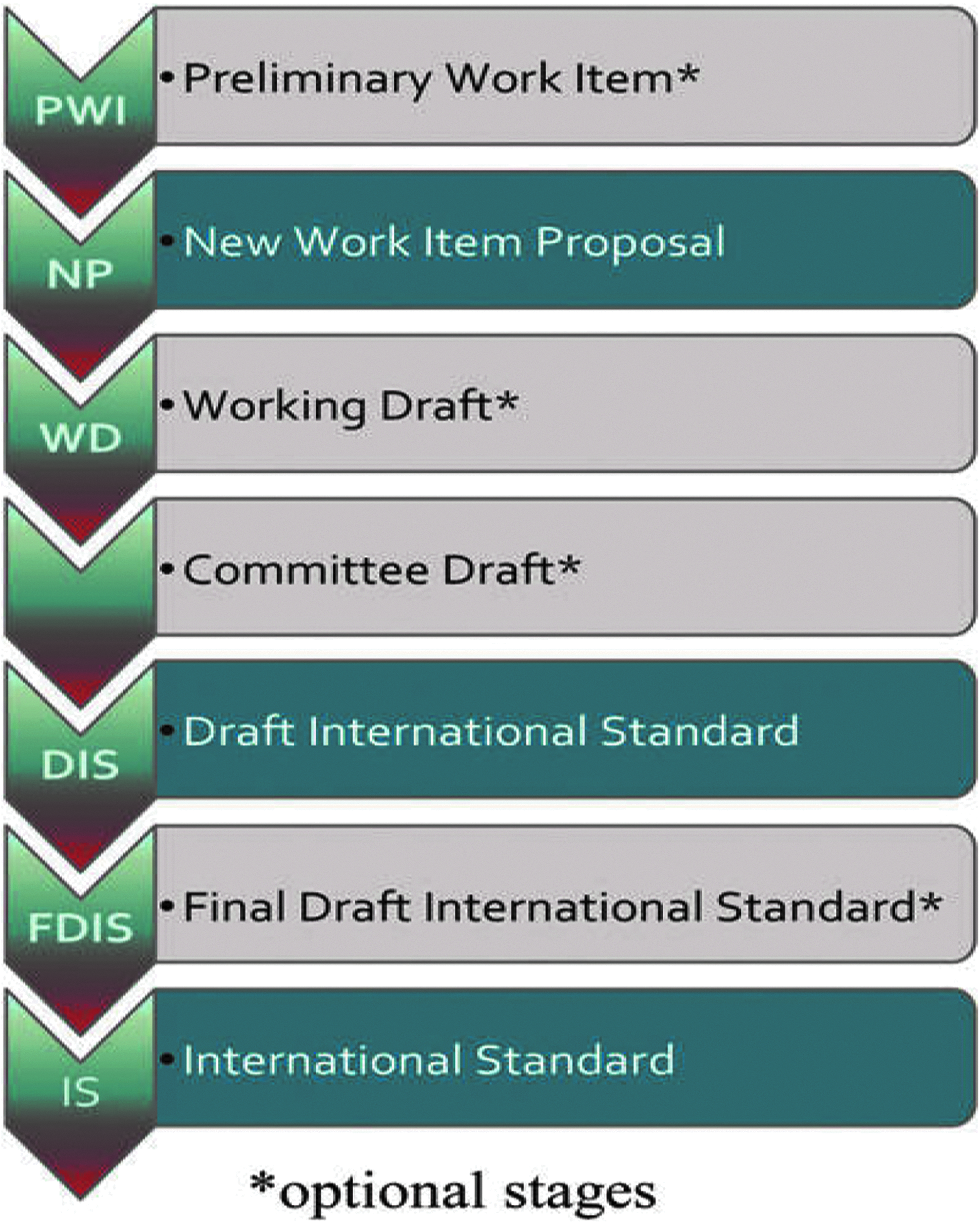
ISO standards development stages. 2
2. ISO development process: Project stages (https://www.iso.org/stage-codes.html)
Stage of a project's development, corresponding to an associated document:
Preliminary stage = PWI
Proposal stage = NP
Preparatory stage = AWI until there is a working draft
Committee stage = committee draft (CD)
Enquiry stage = enquiry draft (ISO/DIS)
Approval stage = final draft international standard (ISO/FDIS)
Publication stage = international standard (ISO)
3. ISO deliverables: https://www.iso.org/deliverables-all.html
International Standards
An International Standard provides rules, guidelines, or characteristics for activities or for their results, aimed at achieving the optimum degree of order in a given context. It can take many forms. Apart from product standards, other examples include test methods, codes of practice, guideline standards, and management systems standards.
TR: Technical Report
A Technical Report contains information of a kind different from that of the previous two publications. It may include data obtained from a survey, for example, or from an informative report, or information of the perceived “state of the art.”
Note: After discussions, participants of the WG2 meeting at Berlin in January 2018 agreed that the document will proceed to FDIS.
Footnotes
Author Disclosure Statement
No conflicting financial interests exist.