




Abstract

A
The event attracted a total of 857 participants and vendors from 53 countries, including 53 participants from low- and middle-income countries. The congress supported seven travel awardees. The attendees came from biobanks, clinical organizations, biological resource centers, industrial partners, policy-making organizations, ministries, and advocacy groups. This meeting was a close collaboration between three organizations, the European and Middle Eastern and African Society for Biopreservation and Biobanking (ESBB); the Biobanking and Biomolecular Research Infrastructure–European Research Infrastructure Consortium (BBMRI-ERIC); and the International Society for Biological and Environmental Repositories (ISBER). This first-time collaboration was the brainchild of Jan-Eric Litton, the now former Director General of BBMRI-ERIC.
The first meeting of the GBW Steering Committee was held in Vienna, Austria, at the time of the Europe Biobank Week (EBW) in 2016 during which the framework for the meeting planning was established. The steering committee was chaired by Jan-Eric Litton and vice-chaired by Brent Schacter, now Past President of ISBER (Fig. 1). Steering committee members included Elke Smits (ESBB Past President), Outi Törnwall (BBMRI-ERIC), Markus Pasterk (BBMRI-ERIC), Michaela Th. Mayrhofer (BBMRI-ERIC), Erik Steinfelder (Director General, BBMRI-ERIC), Balwir (Bal) Mathroo-Ball (ESBB President), Marianne Henderson (ISBER OAC Chair), Zisis Kozlakidis (ISBER President), Ana Torres (ISBER), Samantha Wale (ISBER), Gunnel Tybring (KI), Robert Hewitt (ESBB), and Nadia Taleb (Congress organizer).

From the left, pictured are Zisis Kozlakidis, Erik Steinfelder, Jan-Eric Litton, Elke Smits, Brent Schacter, Balwir Matharoo-Ball, and Marianne K. Henderson.
Marianne Henderson, was named the co-Chair of the Programme Committee (PC) along with Balwir Matharoo-Ball. The PC was assembled from representatives of all three organizations to allow the planning of the 30 excellent scientific sessions included in the GBW. The PC members came from six continents, only missing Antarctica in its reach!
The GBW theme, “Toward Harmonization in Biobanking,” highlights a critical role that biospecimen and data harmonization plays in moving scientific discovery from the donor to the laboratory and back to the bedside. The more collaboration a biobank establishes, the higher the volume of requests for harmonization. The lack of a comprehensive methodology for linking information across data providers globally reduces the ability of researchers to combine data from disparate sources.
Scientific integrity and the speed of discovery in science and technology require that we harmonize our processes and procedures for collecting, processing, storing, and annotating our biospecimens so that the data collected will be reproducible. It has become clear to the biobanking community that the biobank is a key resource for future research and that quality biospecimens will contribute to the reproducibility, validity, and rapidity of scientific discovery. Toward that end, the GBW provided a global platform for comprehensive discussion and collaboration on improving and harmonizing biobanking and biopreservation of samples and data for research.
The GBW was preceded by a two-part initial training workshop that focused on “How to build a Modern Biobank” and “IT for Biobanks.” Both workshops were fully subscribed and were well attended by a globally diverse audience. The feedback from these sessions reflected the need for continued biobanking education on ELSI, IRB applications, IT, and sustainability. In addition, there is a need for professional continued development of biobank technicians, managers, and directors. The feedback also emphasized how our biobanks need to educate through our management and operational structure on the value of quality biobanking to their overall scientific infrastructure.
The GBW was inaugurated by a representative from the Swedish government, Agneta Karlsson. Thereafter, Swedish folk songs were performed by Anna Johansson and at the piano Alexander Nordvall.
The highlight of the scientific sessions at GBW was on Day 1. The primary keynote lecture was given by Greg Simon, President of the Biden Cancer Initiative. His key messages were the need for biobankers to share their specimens, as the collections we have in storage cannot be valuable without sharing. “Bio-hoarding” will not lead to increased scientific knowledge and benefits to society. He noted that the donors of samples have placed their trust in the biobankers to use the samples to further scientific knowledge, so perhaps a better name for a biobank should be a “biotrust.” Throughout the week, these themes were echoed across the sessions and in discussions at the coffee breaks.
Jan-Eric Litton delivered the second keynote lecture, with his focus on reproducibility and reliability of sample and data from biobanks, and the future of biobank resources being produced by BBMRI-ERIC. FAIR-Health principles were also presented. These principles include the following: quality and traceability, incentive schemes, and privacy regulation compliance. At the conclusion of his lecture, he presented the DIN honorary pin for the SPIDIA project, which pioneered quality standards in biobanking, to Uwe Oelmueller (Fig. 2).
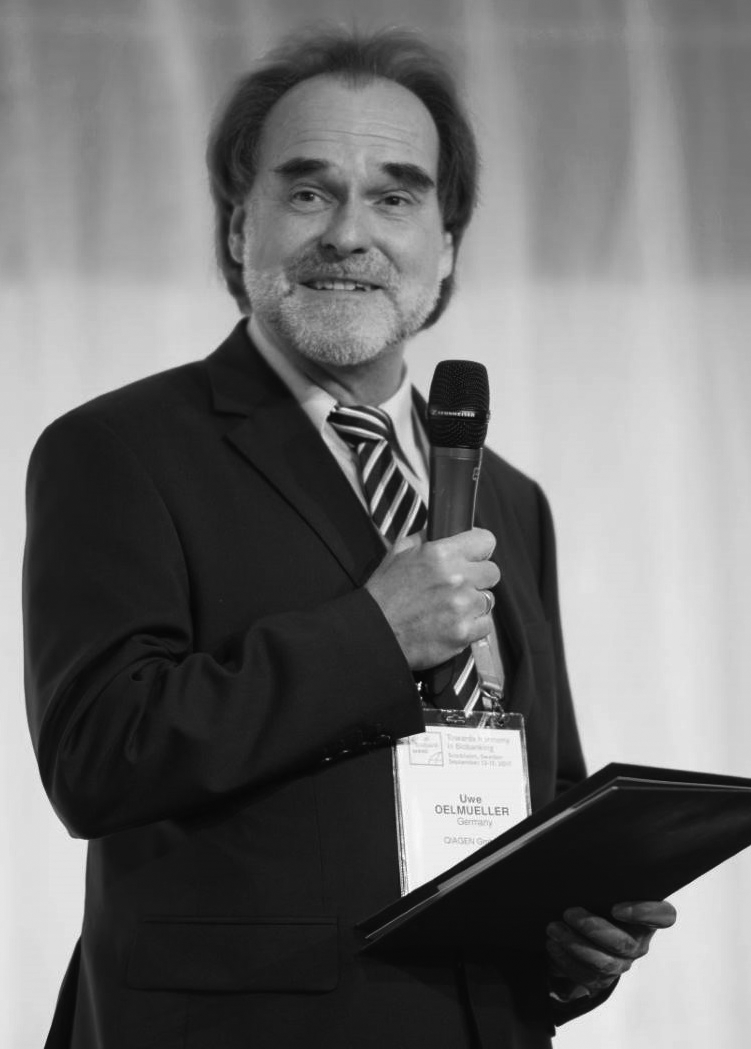
Uwe Oelmueller accepting the DIN honorary pin for the SPIDIA project.
The rest of Day 1 was filled with scientific sessions within three parallel scientific tracks, including metrics for biobank utilization, quality management, and regulations affecting the sharing of data and samples across the world. The first session of scientific posters was presented, covering topics relevant to the full continuum of biobanking. Several vendor symposia were available for participants to learn more about some of the items available in the exhibit hall.
During the welcome reception in the exhibit hall, the route: “From DNA sample to personalized feedback on genomics,” illustrated an interactive simulation of the biobanking workflow and return of research results to individuals spurring some great conversation among participants. The opening of the GBW Tool Booth, a site where biobankers could show their biobanking tools and received feedback, was well received and available throughout the week. Day 1 was capped off by tours of the Karolinska Institutet (KI) Biobank and the national center for molecular biosciences, SciLifeLab, as well as a visit to the Stockholm City Hall, the site of the Nobel Prize Banquet since 1930.
The morning of Day 2 of the GBW was filled with scientific topics, including collaborations with Pharma, digital pathology, utilization, and public trust. The highlight of the morning session was the International Biobanking Summit plenary, which focused on the ethical and legal aspects of direct to participant sample and data collection through mobile applications. The rest of Day 2 included another poster presentation session and discussions of biobanks and electronic health records, international biobank standards, and the state of sustainability of biobanks. Innovative technologies were also presented with a flash-talk session. This session culminated in the presentation of the President's Award for Innovative Technology to Bart Scheerder (Fig. 3).

Bart Scheerder accepting the President's Award for Innovative Technology at Global Biobank Week.
Networking is integral to our community to share best practices, to discuss challenges, consider evidence-based solutions, and to collaborate. This was clearly evident throughout the GBW and the successful evening networking dinner with 449 participants at the historic brewery in Stockholm. Jan-Eric Litton instructed the attendees on the customary way to toast the evening with a proper Swedish “Skål.” I imagine more than a handful of new collaborations were fostered throughout the informal evening discussions. After dinner, pop music by ABBA was played, inviting the tireless GBW participants to populate the dance floor.
The final day of the GBW opened with the Ethics Café discussion, “Are Donor Rights Valuable?” The café rapporteurs encouraged participation throughout the audience. The clear message is that honoring the contributions of donors is important to keep the trust in our biobanking activities. A simple “thank you” can go a long way! The scientific sessions included focus on reproducibility of data from pathology specimens, population research and big data, biobanking for precision medicine trials, best practices for formalin-fixed, paraffin-embedded (FFPE) tissues use, biobanking catalogs—metrics and utility, the importance of networks, human biomonitoring, and quality assessment. We definitely maxed out on our walking, as we moved from exciting session to exciting session during the GBW.
Overall, GBW was very successful in building momentum for collaboration, collegiality, and shared goals to increase the speed and quality of scientific discovery using biospecimens and data. This momentum, individually and through our organizations, requires that we all become better at sharing and global collaboration to keep trust in our name, Biobank = Biotrust! What can you do to capitalize on this global momentum? We look forward to new biomedical discoveries and global teamwork in the pages of Biopreservation and Biobanking for the benefit of patients and our citizens.