




Abstract
DNA extracted from formalin-fixed, paraffin-embedded (FFPE) tissue blocks is amenable to analytical techniques, including sequencing. DNA extraction protocols are typically long and complex, often involving an overnight proteinase K digest. Automated platforms that shorten and simplify the process are therefore an attractive proposition for users wanting a faster turn-around or to process large numbers of biospecimens. It is, however, unclear whether automated extraction systems return poorer DNA yields or quality than manual extractions performed by experienced technicians. We extracted DNA from 42 FFPE clinical tissue biospecimens using the QiaCube (Qiagen) and ExScale (ExScale Biospecimen Solutions) automated platforms, comparing DNA yields and integrities with those from manual extractions. The QIAamp DNA FFPE Spin Column Kit was used for manual and QiaCube DNA extractions and the ExScale extractions were performed using two of the manufacturer's magnetic bead kits: one extracting DNA only and the other simultaneously extracting DNA and RNA. In all automated extraction methods, DNA yields and integrities (assayed using DNA Integrity Numbers from a 4200 TapeStation and the qPCR-based Illumina FFPE QC Assay) were poorer than in the manual method, with the QiaCube system performing better than the ExScale system. However, ExScale was fastest, offered the highest reproducibility when extracting DNA only, and required the least intervention or technician experience. Thus, the extraction methods have different strengths and weaknesses, would appeal to different users with different requirements, and therefore, we cannot recommend one method over another.
Introduction
P
There are numerous kits available for extracting DNA from FFPE biospecimens. A review published in 2015 lists 47 kits designed specifically for this procedure, of which twelve additionally extract RNA from the same FFPE section(s), and sixteen are amenable to automation. 7 Extracting DNA from FFPE requires that the paraffin be removed in an initial step, usually followed by a proteinase K digest to release the DNA from the proteins that are bound to it because of formaldehyde modifications caused during fixation. Most automated extraction methods require the deparaffinization and any proteinase K digest to be carried out manually, with the cell lysate then being loaded onto the automated platform, whereupon the DNA extraction proceeds automatically, usually using magnetic bead technology. However, one system (Versant from Siemens) is fully automated in that it includes the deparaffinization step (the paraffin is heated until it melts whereupon it binds to the tube wall).
ExScale is an automated platform, recently developed by ExScale Biospecimen Solutions, Uppsala, Sweden, which, in a single run, extracts DNA from up to 12 FFPE biospecimens simultaneously. ExScale offers kits to extract DNA only, RNA only, or DNA/RNA from a single or multiple FFPE section(s). The preceding deparaffinization and steps are carried out in a single semiautomated step. There is no overnight proteinase K digest/lysis. Thus, the extraction process from beginning-to-end is faster (completed in less than 4 hours) and more user-friendly than most alternative purification methods (whether automated or manual), with fewer steps requiring intervention from a technician. However, it is not known whether simplifying the extraction protocol to such an extent results in a loss of nucleic yield and/or integrity. To answer this question, we have tested ExScale's automated platform using the their FFPE DNA only and FFPE simultaneous DNA/RNA extraction kits, comparing them with the commonly used QIAamp FFPE DNA Kit (Qiagen), the latter used both manually and loaded onto the QiaCube automated platform (also Qiagen).
Materials and Methods
A total of 42 FFPE tumor blocks, containing 5–8 mm3 tissue, were provided by Imperial College London NHS Trust Tissue Bank (one block per patient: 15 breast, 1 colon, 5 endometrium, 1 fallopian tube, 1 head and neck, 5 kidney, 10 ovary, 3 uterus, and 1 prostate). Written consent had been obtained from all patients. The Imperial College London NHS Tissue Bank is approved by the REC3 of Wales to provide deemed ethics for the use of biospecimens in research. The biospecimens were collected from three hospitals following routine surgery within 24 months of the study. The blocks were fixed in 10% neutral-buffered formalin, then processed on an automated tissue processor, and embedded in paraffin wax. For each DNA extraction method, one section of 10 μm was cut per block using a CUT 5062 microtome (SLEE Medical) and placed in 1.5 mL centrifuge tubes as scrolls, after an initial 4 μm section had been discarded. DNA extractions were then performed as described below, in batches of 12 (11 samples plus a positive control) for all extractions. The same operator performed all the extractions. The positive control consisted of one 10 μm section, cut from one homogenous FFPE cell pellet, and prepared as previously described. 8 For each method, the extractions were carried out as per the manufacturer's protocols. Table 1 presents a summary of each extraction protocol, highlighting the salient differences between the four protocols. In addition, one FFPE block was randomly selected for a reproducibility test, from which four extractions were performed per method in the same run.
Manual DNA extractions (Manual)
Each FFPE scroll was vortexed in 1 mL Histo-Clear xylene substitute (National Diagnostics), centrifuged, the Histo-Clear pipetted off, and the process repeated using 1 mL ethanol. After the ethanol had been removed, the now-deparaffinized section was allowed to air-dry for 10 m and an overnight digest carried out using 40 μL proteinase K (Qiagen). DNA was then purified using the QIAamp DNA FFPE Tissue Kit (Qiagen) as per the manufacturer's protocol, with each step being carried out manually. The optional RNase step was included to prevent the coelution of RNA 9 and the purified DNA eluted in 50 μL of the ATE buffer supplied in the kit.
QiaCube automated DNA extractions (QiaCube)
The deparaffinization and proteinase K digestion steps followed the same protocol as Manual, after which the DNA was extracted using a QiaCube automated platform (Qiagen) as per the manufacturer's protocol. The same QIAamp DNA FFPE Tissue Kit spin columns and reagents were used as in Manual, except no RNase digest was incorporated. As in Manual, QiaCube DNA elution was in 50 μL ATE buffer. Thus, the only differences between Manual and QiaCube were the automated nature of the extraction process in QiaCube and the inclusion of the RNase step in Manual.
ExScale automated DNA extractions (ExScale DNA only)
A 950 μL aliquot of HistoChoice clearing agent (Amresco, Inc.) was pipetted into each centrifuge tube containing an FFPE scroll. The tube was vortexed, left to incubate for 30 m, 50 μL T-solution (ExScale) added, and then, the tubes were centrifuged. The centrifugation caused the now deparaffinized tissue to collect at the base of the centrifuge tube in the T-solution (which was more viscous than HistoChoice). The tubes were then transferred (without further preparation) to a magLEAD 12GC benchtop workstation (Precision System Science Ltd.) that had been loaded with the prefilled reagent cartridges supplied in the FFPE DNA Purification Kit and programmed with the ES-SM110FP FFPE DNA Purification Software (all ExScale Biospecimen Solutions), plus empty 1.5 mL centrifuge tubes to collect the purified DNA. The workstation performed the DNA purification automatically as per the manufacturer's protocol, eluting the DNA in 50 μL of the manufacturer's Tris HCl elution buffer. The protocol does not include an RNase step.
ExScale automated simultaneous DNA/RNA extractions (ExScale simultaneous)
The protocol for the simultaneous DNA/RNA extraction was identical to that for ExScale DNA, using the same workstation, but with the following exceptions: the software program selected was ESP-SM110210FP, the prefilled reagent cartridges were from the FFPE DNA/RNA Purification Kit (both ExScale Biospecimen Solutions) and additional tips and collection tubes were loaded for the purification of the RNA. RNA was eluted in 50 μL of the same buffer as the ExScale DNA. The protocol did not include either an RNase or a DNase step.
Manual RNA extractions (Manual RNA)
Deparaffinization was performed as in the Manual DNA and QiaCube extractions. RNA was purified using the RNeasy FFPE Kit (Qiagen) without a DNase digest and eluted in 50 μL water.
Quantification and analysis
DNA and RNA concentrations were quantified in all extractions by spectrofluorometry using the Qubit dsDNA BR Kit (quantification range 0.1–1000 ng/μL) and Qubit RNA BR Assay Kit (quantification range 20–1000 ng/μL) (both ThermoFisher Scientific). For Manual DNA and QiaCube DNA, OD260 nm quantification and purity assessments (OD 260:280 nm and 260:230 nm) were additionally performed using a Take 3 Plate on a Synergy Mx spectrophotometer (BioTek Instruments). ExScale Biospecimen Solutions do not provide sufficient elution buffer for a blank (all reagents are in single-use capsules), so spectrophotometry could not be performed on any of the ExScale extractions.
DNA Integrity was assessed using the FFPE QC Assay (Illumina) and DNA Integrity Numbers (DINs). The Illumina FFPE QC Assay is a qPCR assay designed to determine a DNA sample's amenability to NGS, by comparing its cycle threshold number (Cq) with that from a Reference Template supplied in the kit, generating a ΔCq value (ΔCq = sample Cq - Reference Template Cq). Samples with ΔCq <2 are more amenable to NGS. 10 The assay was carried out on 21 FFPE blocks, from which DNA had been extracted using all four methods (n = 12 for ExScale simultaneous). Each assay reaction was performed in triplicate, using 2 ng sample DNA, 1 μL of the primers supplied in the assay, 5 μL Platinum SYBR Green qPCR 2 × SuperMix and 50 nM ROX (both Invitrogen) in a final volume of 10 μL. Reactions were carried out in Fast 96-well plates in an ABI 7500 thermal cycler and the data analyzed using SDS software v. 1.4.2 (all Applied Biosystems).
DINs range from 1 (DNA completely degraded) to 10 (DNA completely intact) and were determined on a 4200 TapeStation using the Genomic DNA ScreenTape Assay (all Agilent Technologies). The Genomic ScreenTape Assay requires DNA to have a minimum concentration of 10 ng/μL, and samples were concentrated where required, using a SpeedVac centrifugal concentrator (Eppendorf). DNA from 30 FFPE blocks was assayed, but one ExScale DNA only sample and seven ExScale simultaneous samples were subsequently excluded from analysis due to insufficient yield.
SigmaPlot software v. 12.5 (Systat Software, Inc.) was used for statistical analyses. We treated all extractions from the same FFPE blocks as sample-matched and performed Shapiro–Wilk normality tests, and then a paired t-test, Wilcoxon signed rank test, One-way ANOVA with repeated measures test, or the Friedman Repeated Measures Analysis test as described. Where data were normally distributed, stated averages are mean, otherwise median.
Determination of the amplicon length in the Illumina FFPE QC assay
Amplicon length in the Illumina FFPE QC Assay was determined using endpoint PCR. Aliquots containing 1–512 ng human genomic DNA (Promega) and 2.5 μL primers supplied in the Illumina FFPE QC assay were amplified (25 μL per reaction) using the AmpliTaq Gold DNA polymerase kit (Applied Biosystems). The PCR protocol was as follows: 10 m at 95°C (initial denaturation) then 30 cycles of cycling at 95°C (denaturation, 30 seconds), 57°C (annealing, 30 seconds), and 72°C (extension, 30 seconds), followed by a final extension of 72°C (5 m). PCR products were stained using Gel Red (Biotium) and visualized on a 1.5% agarose gel containing a 100 bp ladder, imaged using an ImageQuant system (both GE Healthcare).
Results
DNA of a concentration quantifiable by spectrofluorometry was extracted from 38 (90.5%) Manual, 39 (92.9%) QiaCube, 34 (81.0%) ExScale DNA only, and 33 (73.8%) ExScale simultaneous extractions. Only one block failed to return quantifiable DNA in all four of the extraction methods, with the remaining unquantified extractions originating from blocks that returned quantifiable but low concentrations in the other extraction methods.
Elution volumes were the same in all extractions. Median DNA concentrations by spectrofluorometry (ng/μL) were 7.7 (Manual), 6.0 (QiaCube), 5.2 (ExScale DNA only), and 3.2 (ExScale simultaneous) (Fig. 1). When the concentrations from the subset of blocks that had returned quantifiable DNA in all four extraction methods (n = 28) were analyzed by Friedman Repeated Measures Analysis of Variance followed by the Tukey Test, there were no significant differences in concentration between Manual and QiaCube, or between ExScale DNA only and ExScale simultaneous. However, the concentrations in both ExScale methods were statistically significantly lower than in either Manual or QiaCube (p < 0.001). We then used Wilcoxon Signed Rank tests to compare the larger cohort of samples that returned concentrations in both Manual and QiaCube (n = 38), and in ExScale DNA only and ExScale simultaneous (n = 30). Now, the lower concentrations in ExScale simultaneous compared to ExScale DNA only became significant (p = 0.009), but the difference between manual and QiaCube remained well above the level of statistical significance (p = 0.73).

Comparison of concentration (ng/μL) from 42 FFPE tissue blocks, in which DNA was extracted using Manual, QiaCube, ExScale DNA only, and ExScale simultaneous DNA/RNA methods. The boxes are the 25th to 75th percentiles, intersected by the median. The whiskers show the 10th and 90th percentiles and the spots represent remaining outliers. The difference in concentration between any two extraction methods is statistically significant (p < 0.05) with the exception of the comparison between Manual and QiaCube extractions.
For spectrophotometry (only performed for Manual and QiaCube), median concentrations were 30.0 ng/μL (Manual) and 24.8 ng/μL (QiaCube). Although spectrophotometry concentrations (unlike the spectrofluorometry concentrations) will include any coeluting RNA, Manual included an RNase digest and QiaCube did not, so coeluting RNA cannot explain why spectrophotometry concentrations were higher in Manual. However, as in the spectrofluorometry assay, the higher concentrations in Manual were not statistically significant (p = 0.34). The percent of total nucleic acid that was double-stranded DNA (dsDNA) was calculated (percentage dsDNA = spectrofluorometry concentration/spectrophotometry concentration × 100). Mean percentage dsDNA values were of similar magnitude in Manual and QiaCube (24.6% and 25.9% dsDNA, respectively), with the difference falling a little short of statistical significance (p = 0.09). Both Manual and QiaCube extraction methods purified DNA with similarly low OD 260:230 values (0.22 and 0.21, respectively), and high OD 260:280 values (1.92 and 1.86, respectively), with the differences between the extraction methods not being statistically significant.
Spectrofluorometry DNA concentrations in all four extraction methods positively correlated with Manual in the following order of decreasing correlation: QiaCube (x2 = 0.97, p < 0.001), ExScale DNA only (x2 = 0.77, p < 0.001), and then ExScale simultaneous (x2 = 0.60, p < 0.001). The correlation between ExScale DNA only and the DNA in ExScale simultaneous was of intermediate positivity (x2 = 0.69, p < 0.01).
For RNA, concentrations were higher in the Manual compared to the ExScale simultaneous extractions (median 26.2 ng/μL compared to 7.8 ng/μL, p < 0.001), with the two extraction methods showing a positive correlation (x2 = 0.70, p < 0.001). The correlation between DNA concentrations and RNA concentrations from the blocks was poorer when both analytes were extracted using ExScale simultaneous (x2 = 0.37, p = 0.04) than when the extractions were carried out using separate manual extractions (x2 = 0.78, p < 0.001).
In the reproducibility test, the coefficient of variation in spectrofluorometry DNA concentrations for the four technical replicates was 10.5% (Manual), 8.4% (QiaCube), 7.1% (ExScale DNA only), and 50.9% (ExScale simultaneous). In the RNA extractions, the coefficient of variation was 17.3% (manual RNA) and 66.9% (ExScale simultaneous RNA).
In the Illumina FFPE QC Assay, median ΔCq were 0.09 (Manual), 0.55 (QiaCube), 1.21 (ExScale DNA only), and 1.04 (ExScale simultaneous) (Fig. 2). The difference in ΔCq between any two extraction methods was statistically significant (p < 0.05) with the exception of the comparison between ExScale DNA only and ExScale simultaneous (p = 0.85). Thus, the results show that the extraction method delivering DNA most amenable to NGS (i.e., lowest ΔCq) was the manual method, followed by QiaCube and then both ExScale methods. Only two extractions returned ΔCq >2 (exceeding the threshold denoting greater amenability to NGS): one was a QiaCube extraction (ΔCq = 2.89) and the other an ExScale DNA only extraction (ΔCq = 2.24). These two extractions were from different FFPE blocks, and in both instances, the extractions carried out using the other three methods returned ΔCq ≤1.3. When the Grubbs Test for Outliers was applied, the QiaCube data point of 2.89 was found to be an outlier and the ExScale data point of 2.24 was not (at 95% confidence).

Comparison of ΔCq following the Illumina FFPE QC Assay from 21 FFPE tissue blocks, in which DNA was extracted using Manual, QiaCube, ExScale DNA only, and ExScale simultaneous DNA/RNA methods. Lower ΔCq values equate to better quality samples, with ΔCq <2 being defined as denoting higher amenability to DNA sequencing. The boxes are the 25th to 75th percentiles, intersected by the median. The whiskers show the 10th and 90th percentiles and each spot represents one remaining outlier. The difference in ΔCq when comparing any two extraction methods groups is statistically significant (p < 0.05) with the exception of the comparison between ExScale DNA only and ExScale simultaneous extractions.
A similar positive correlation between the ΔCq values was present between ExScale DNA only and ExScale simultaneous (x2 = 0.73, p = 0.007) and between Manual and ExScale DNA only (x2 = 0.75, p < 0.001). However, there was no correlation in ΔCq between Manual and ExScale simultaneous (x2 = 0.48, p = 0.11) or between Manual and QiaCube (x2 = 0.39, p = 0.08), despite the latter two methods sharing the same deparaffinization method, spin columns, and buffers.
The endpoint PCR assay to determine the amplicon length in the Illumina FFPE QC Assay returned a single band that was visible in all the reactions, regardless of the starting quantity of gDNA, estimated to be 110 bp in length (Fig. 3).

Amplicon length in the Illumina FFPE QC assay. Gel lanes are as follows: 100 bp ladder (lanes 1 and 16), blank, and negative controls (lanes 2–4 and 15), and doubling dilutions of genomic DNA (lanes 5–14). The amplicon in the assay is approximately 110 bp in size.
Median DINs were 5.95 (Manual), 5.70 (QiaCube), 5.70 (ExScale DNA only), and 4.70 (ExScale simultaneous) (Fig. 4). The higher DINs in Manual were statistically significant compared to all three other extraction methods (p < 0.003). The differences in DIN between the two automated DNA only extraction methods (QiaCube and ExScale DNA only) were not statistically significant (p = 0.45), and the differences between the two ExScale extraction methods fell just short of statistical significance (p = 0.06). Unlike in the Illumina FFPE QC assay, the correlation in DIN between Manual and QiaCube was highly positive (x2 = 0.91, p < 0.001). Correlation in DIN between the two ExScale extraction methods (x2 = 0.71, p < 0.001) and between manual and ExScale DNA only (x2 = 0.66, p < 0.001) was poorer than that seen previously stated between manual and QiaCube.
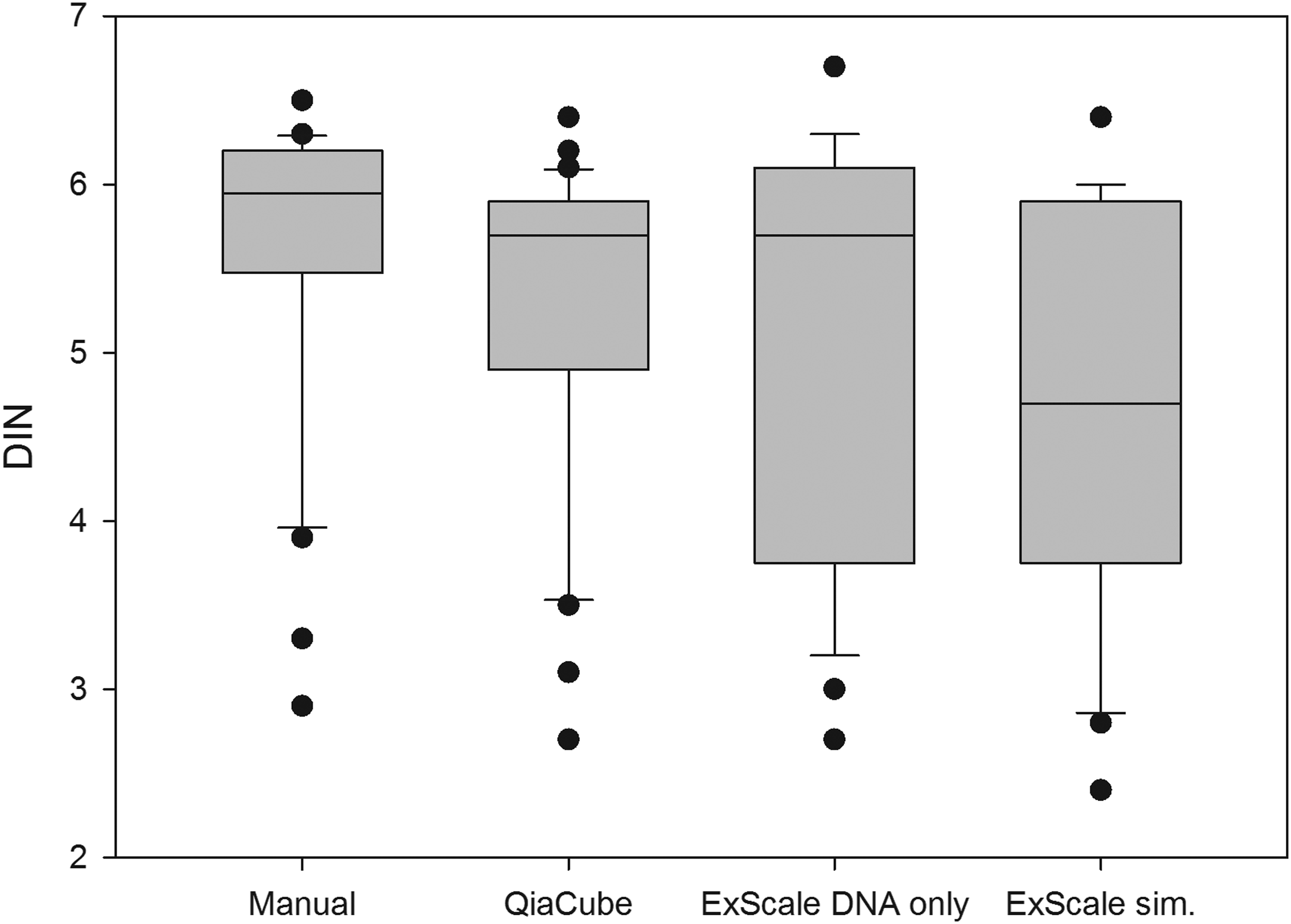
Comparison of DIN from 30 FFPE tissue blocks where DNA was extracted using Manual, QiaCube, ExScale DNA only, and ExScale simultaneous DNA/RNA methods. DINs range from 1 to 10, with higher numbers denoting less degraded DNA. The boxes are the 25th to 75th percentiles, intersected by the median. The whiskers show the 10th and 90th percentiles and each spot represents one remaining outlier. The difference in DIN between any two extraction methods is statistically significant (p < 0.05) with the exception of the QiaCube/ExScale DNA only and the ExScale DNA/ExScale simultaneous comparisons. DIN, DNA Integrity Number.
To better visualize the correlation between ΔCq and DIN, we converted DIN to 10-DIN, so lower numbers would equate to DNA of higher integrity for both of the assays being compared (Fig. 5). No correlation was found (x2 = 0.16, p = 0.18). The extraction methods that returned the highest quality DNA assessed using both methods were Manual and QiaCube, while the extraction methods returning the poorest quality DNA in both assays were the two ExScale methods. There were seven extractions where the DNA was in the highest quality 25 percentile for both the ΔCq assay and DIN: six were Manual and one was ExScale DNA only. Conversely, there were nine extractions where the DNA was in the lowest quality 25 percentile for both assays: seven of these were ExScale DNA only and two were ExScale simultaneous.

Comparison of ΔCq (from the Illumina FFPE QC assay) and 10-DIN for 75 extractions from 21 FFPE blocks (n = 21 for Manual, QiaCube, and ExScale DNA only and n = 12 for ExScale simultaneous). The boxes denote the samples that fall within the quartile denoting highest quality in both assays (ΔCq <0.27 and 10-DIN <4) and the quartile denoting lowest quality in both assays (ΔCq >1.1 and 10-DIN >5.85).
There were no statistically significant differences in DNA concentration, ΔCq or DIN between the different tissue types or between the hospitals at which the biospecimens were collected and processed.
Discussion
The results show that, in our hands, the manual method of extracting DNA from FFPE sections returned higher yields of DNA than all three automated methods. The manually extracted DNA had improved integrity, evidenced in both the DIN and the Illumina FFPE QC assays (based on nano electrophoresis and qPCR, respectively). The QiaCube extractions used exactly the same deparaffinization, proteinase K digest, and DNA purification protocol/extraction kit as the manual extractions, and the purified DNA was eluted in the same volume of the same buffer. The only differences in method between Manual and QiaCube were that Manual included an RNase digest and the post-deparaffinization DNA purification steps were performed by a robot in QiaCube and by a technician in Manual (but the protocol script, purification columns, and reagents were the same in both). Given that Manual included the RNase digest and QiaCube did not, we were expecting to see higher spectrophotometry concentrations in QiaCube, because RNA would only be present in QiaCube-extracted DNA. However, there was no statistically significant difference between the two methods. Therefore, either Manual purified more ssDNA than QiaCube to counterbalance the RNA eluted in QiaCube or coeluting RNA is not an issue in DNA extractions from FFPE sections using the QIAamp FFPE kit. Significant quantities of coeluting RNA (28%–52% of the total nucleic acid, depending on tissue type) have been found in DNA extractions from frozen tissue (also using Qiagen QIAamp spin columns) in the absence of an RNase digest, 9 so we think the explanation is that the Manual is extracting more ssDNA than QiaCube. Our finding that DNA concentrations were four times higher when spectrophotometry rather than spectrofluorometry was used for quantification is typical of what we see for FFPE biospecimens and is comparable to results reported by others. 11
There is no obvious reason why QiaCube returned poorer DIN and ΔCq results than Manual or why ΔCq values did not correlate between Manual and QiaCube. In a study where RNA was extracted from FFPE biospecimens using four different methods, then analyzed using qRT-PCR, correlation between manual and automated extractions using the same kit was better than correlation between different automated methods and the correlation between different manual methods. 3 We reject the possibility that residual DNase from earlier RNA extractions was present in the QiaCube, because the instrument was decontaminated before use and the difference between manual and QiaCube extractions was of comparable magnitude throughout the series of extractions, during which QiaCube was not used for RNA extractions. The lower ΔCq in Manual compared to QiaCube could be a consequence of the enrichment of ssDNA in Manual compared to QiaCube, as discussed previously. DNA was quantified and normalized between samples for the FFPE QC assay using spectrofluorometry, as specified in Illumina's protocol, so any ssDNA was unquantified and therefore not normalized between reactions. If unquantified ssDNA, enriched in Manual extractions, was more than 110 bp in length, it would logically be amplified in the Illumina FFPE QC Assay, lowering the Ct number and therefore ΔCq values in Manual extractions more than in QiaCube extractions. Furthermore, if ΔCq in the Illumina FFPE QC Assay is influenced by unquantified ssDNA that is variable in extent between samples, this would reduce correlation between ΔCq and DIN, because DIN is calculated using the PicoGreen fluorescence-based electropherogram trace and is therefore entirely dependent on dsDNA. An alternative explanation for the lack of correlation between ΔCq and DIN could be because the amplicon in the Illumina FFPE QC assay is of smaller size (110 bp) than the quantification range of the Genomic DNA ScreenTape (200–60,000 bp). Finally, PCR reactions such as those driving ΔCq are sensitive to formaldehyde-induced modifications and contaminants eluted with the purified DNA that are different to those determining the binding of PicoGreen to dsDNA and consequently DIN.11–15
Some parameters are likely to be different in the manual and QiaCube methods. For example, the centrifugation speed of the benchtop centrifuge used for manual extractions was higher than that in the centrifuge integrated into QiaCube. Such apparently minor differences can translate into noticeable differences in results; in a previous study, improved integrity in a manual method compared to its automated counterpart was found at least partially to be a consequence of a different shaking velocity during the sample lysis step. 3 Other studies have reported manual extraction methods to be superior to automated extractions in some, but not all parameters, although it is impossible to assign the differences to automation because so many other variables that could influence assays differ. Khokhar et al. compared the silica column-based AllPrep DNA/RNA FFPE mini kit (using it manually) to the automated Maxwell 16 FFPE Tissue system (extracting DNA only) and found the former to offer much improved yields (quantified using spectrophotometry only), and the latter performing better in respect of longer amplicons for PCR. 16 Although Maxwell 16 is comparable to ExScale in that it uses magnetic beads, the nucleic acid binding is via cellulose in Maxwell and silica in ExScale, and the buffers are different as well. In two other studies, one found no differences between manual and automated methods in qPCR, and the other found differences, but they were inconsistent and depended on the type of biological specimen.17,18
Although we found Manual to offer improved DNA yield and integrity compared to QiaCube, it is noteworthy that in the reproducibility test, the automated QiaCube and ExScale DNA only extractions were more reproducible than Manual. The finding that automated extractions are more reproducible than manual extractions has also been reported by others.3,17 It has also been reported that the Qiagen QIAamp FFPE Extraction Kit (which we used in manual and QiaCube extractions) has a high variance in yield compared to alternative kits, 11 so the relatively poor reproducibility we found might partially relate to our choice of kit rather than automation.
Logically, the amount of experience the users have is not only important in performing extractions, both in maximizing the yield and integrity of the DNA, but also in maximizing reproducibility. Indeed, technician experience was cited as a critical factor determining the success of DNA extractions from FFPE biospecimens and downstream PCR results in a RING trial involving thirteen laboratories. 11 In our study, technicians were experienced, and we cannot assume that the same results would apply when less experienced users perform extractions. Technician experience is not only relevant to the manual extractions but also to the automated extractions, because even though the extraction process itself requires no intervention while underway, it is easy to accidentally pipette off tissue while removing xylene (or xylene substitute) and ethanol in the preceding deparaffinization steps. In the comparison we have conducted, deparaffinization in both ExScale protocols was notably more straightforward because the deparaffinization steps do not require the removal of reagents. Thus, ExScale offers advantages to laboratories that do not have such experienced staff.
The QiaCube and ExScale DNA only extraction methods were comparable in that they both only purified DNA, twelve samples were processed at once and both methods used silica to bind the DNA (magnetic beads in ExScale and spin columns in QiaCube). The preextraction deparaffinization protocol for ExScale was considerably faster than with QiaCube, however, with, as shown in Table 1, far fewer tube-opening events and no overnight proteinase K digest. Indeed, the total number of tube-opening events was 12 in manual, 5 in QiaCube, and 3 in each of the two ExScale methods. Fewer tube-opening events mean less risk of contamination. However, QiaCube outperformed ExScale in respect of DNA concentration, the number of samples returning quantifiable DNA and in the Illumina FFPE QC assay. DINs were the same in the two methods.
It is possible that the lower DNA yields in both ExScale extraction methods were a consequence of the shorter proteinase K digest (2 hours rather than overnight), or the absence of or a less intense heating step to reverse the formaldehyde cross-links (it is not clear whether the ExScale protocol includes a heating step or not). Longer proteinase K digests and the heating step have each been shown to provide improved DNA yields in FFPE tissue.6,19–21 Thus, lower yields and a decline in integrity might be the price that the user pays for the shorter total processing time in ExScale. We did not evaluate the effect of either shortening the proteinase K digest to 2 hours in QiaCube or lengthening it to overnight for ExScale, so we do not know whether lower yields in ExScale are a consequence of the different extraction technology or the preceding steps. The additional work and processing time required to complete the QiaCube extractions compared with the ExScale extractions was in respect of the deparaffinization steps: once loaded onto their respective automated platforms neither method required user-intervention and took a comparable period of time to run. Thus, it would be possible to simplify the QiaCube (and Manual) extractions if the deparaffinization and proteinase K digestion steps were combined into one shorter step. Although we cannot speculate on what the impact of changing the deparaffinization protocol in this way would be in respect of DNA yield or integrity, a publication shows hexadecane, pentadecane, and tetradecane deparaffinization protocols, all showing improved yields compared to a longer xylene/ethanol deparaffinization protocol, with no impact on either DNA purity or integrity. 22
There is an apparent anomaly that DNA integrity is poorer in ExScale DNA only extractions compared with QiaCube extractions when assayed by the Illumina FFPE QC assay, but not when measured using DIN. It is likely that the anomaly is a consequence of one of the reasons why ΔCq and DIN do not correlate, as discussed above. Different kits have various efficiencies at removing inhibitors when purifying DNA from FFPE sections,23–25 so the ExScale system might simply be less efficient at removing inhibitors than the QIAamp kit. We could not perform OD 260:280 and 260:230 purity analyses on ExScale-purified DNA because ExScale does not provide sufficient DNA elution buffer to blank the spectrophotometer (a significant disadvantage of ExScale in our view). DNA concentrations were higher in QiaCube extractions compared with ExScale extractions, so more fresh buffer was added to QiaCube-extracted DNA to normalize the DNA to the 1 ng/μL concentration in a fixed volume for the Illumina FFPE QC assay. This would dilute impurities to a greater extent in QiaCube extractions.
Our finding that DNA was poorer in respect of yield and integrity in the simultaneous DNA/RNA extractions compared with the DNA only extractions is in line with results from other studies, for both FFPE and frozen biospecimens.16,26,27 A further study has, however, found that DNA yields were not reduced in a simultaneous extraction from FFPE. 23 Our finding that the ExScale simultaneous extractions recovered more RNA than it did DNA is the opposite result to that seen with other simultaneous extraction kits, 23 so ExScale simultaneous might appeal to groups wanting to carry out simultaneous extractions from FFPE, but who want to prioritize RNA over DNA. It is of course possible that the higher RNA yields are a consequence of poor DNA recovery rather than efficient RNA recovery or indeed the “missing” DNA might have coeluted into the RNA fraction. However, RNA yields in ExScale simultaneous were considerably lower than manual RNA extractions. We are of the opinion that multianalyte extractions are more suitable for cryopreserved biospecimens than for FFPE biospecimens. In FFPE blocks, sequential sections for dedicated single analyte extractions can be cut, increasing nucleic acid concentrations for both analytes and reducing the bias inherently associated with multianalyte extractions,27,28 leaving multianalyte extractions in FFPE for specific circumstances, such as small biopsies or where it is imperative that the different analytes come from the same cells. The correlation we found between DNA and RNA concentrations in the ExScale simultaneous FFPE extraction (x2 = 0.37) is lower but broadly comparable to that seen in a previous study using simultaneous kits for cryopreserved tissue (x2 = 0.59 and 0.41, p < 0.02, depending on which kit was selected). 27
In conclusion, we find that, for the QIAamp FFPE kit, manual extractions carried out by skilled and experienced technicians provide higher yields and better integrity for DNA extracted from FFPE sections compared to three automated methods. However, the single analyte (i.e., DNA only) automated extraction methods offered improved reproducibility compared to manual extractions. Although ExScale's DNA only extraction system performed more poorly than QiaCube, it was the most reproducible and the most user-friendly, requiring the least hands-on time, intervention steps or technician experience. Thus, the four extraction methods have different strengths and weaknesses, would appeal to different users with different requirements, and we therefore cannot recommend one method over another. It is likely that DNA yield and integrity can be improved in ExScale extractions if a longer proteinase K digest was included before the samples are loaded onto the automated platform, as this has been shown to be beneficial. 29 However, doing so would lengthen the processing time. Thus, additional validation using a wider range of samples (e.g., FFPE needle biopsies) is required, so that the scenarios, in which the lower DNA yield and integrity returned by the ExScale extraction system become consequential, can be defined.
Footnotes
Acknowledgment
The authors thank Fay Betsou from the Integrated Biobank of Luxembourg for constructive criticism of the article.
Author Disclosure Statement
The authors have no conflicts of interest.