




Abstract
Biobanking and BioMolecular resources Research Infrastructure (BBMRI)- European Research Infrastructure Consortium (ERIC) is the largest infrastructure launched in Europe in health research. By nature it is a distributed infrastructure, in which biological samples and data are hosted by the European Member States biobanks. As of today, BBMRI-ERIC consists of 19 European Member States and 1 international organization, the International Agency for Research on Cancer. This means that BBMRI-ERIC has a population of >500 million individuals in Europe. BBMRI-ERIC is a truly Pan-European Research Infrastructure for health research. Given that BBMRI-ERIC is set up to become a key source for users in both academic and scientific institutions as well as in the pharmaceutical and life science industries, it contributes directly to the Innovation Union concept. It is pan-European because BBMRI-ERIC already shows an excellent geographic and regional coverage all over Europe involving countries from South, East, West, North, and Central Europe. BBMRI-ERIC is a service-driven infrastructure for the European Member States, driven by science. The BBMRI-ERIC Directory consists of 100 million samples and a roadmap for better-defined quality in European biobanks for improving reproducibility and reliability of the biological sample and data.
Introduction
I
One of these proposals was the Biobanking and BioMolecular resources Research Infrastructure (BBMRI). The mission of the BBMRI was to sustainably secure access to biological resources and data required for health-related research.
The Seven European Union (EU) Framework program funded a 3-year BBMRI preparatory phase project (5 million Euros) with Professor Dr. Kurt Zatloukal from the Medical University of Graz, Austria, as the project coordinator. The project commenced on February 1, 2008. The ultimate objective of the preparatory phase was to deliver a document that can allow the European Member States to proceed toward implementation of the infrastructure. Seven work packages addressed the key issues2,3 relevant to further construction and operation of BBMRI. A catalog with 20 million human biological samples was created from existing major population-based and clinical or disease-orientated biobanks in Europe. 4
One of the outcomes after the preparatory phase was a business plan based on the planning work performed by the BBMRI consortium that participated in the preparatory phase. 5 The European Research Infrastructure Consortium (ERIC) legal entity was identified as the most appropriate legal entity to support the distributed operation of the BBMRI, with the alternative option discussed being a special project under The European Molecular Biology Laboratory (EMBL).
The main advantages of the ERIC legal entity are its functions as a platform, creating opportunities for long-term cooperation between the European Member States involved and their researchers. The choice of host country for the BBMRI-ERIC is very important, since it also entails a choice of the applicable legal order with regard to employment issues, tax and insurance policies, etc.
However, the ERIC legal entity does not provide for any substantial tools when it comes to addressing the diverse regulatory frameworks for biological samples and data in the EU, which is one of the more important hurdles.6,7
From BBMRI Preparatory Phase to a Legal Entity: BBMRI-ERIC
The preparatory phase of BBMRI came to its end in January 2011. On July 7, 2013, the BBMRI-ERIC application was sent in to the European Commission, and on December 3, 2013, 3 days after the statutes were published in the official journal of the EU, 8 almost 3 years after the completion of the BBMRI preparatory phase, the ERIC status was awarded. Austria, with representatives from the Federal Ministry of Science and Research, chaired the preparatory governance body during this time. The members of the BBMRI-ERIC were the countries and intergovernmental organizations that have signed the BBMRI-ERIC Statutes. Founding Member States at that time were Austria, Belgium, Estonia, Finland, France, Germany, Greece, Italy, Malta, the Netherlands, and Sweden. Official observers of BBMRI-ERIC were Norway, Poland, and Switzerland. The founding members jointly agreed to accept the Austrian Government's offer to host the headquarters in Graz, Austria. Graz is the city with the country's largest biobank.
To reach ERIC legal status and commence implementation required a long period of time and effort, but today represents the joint commitment of BBMRI-ERIC Member States to establish a pan-European research infrastructure. BBMRI-ERIC was able to constitute its respective governance boards and approve the appointment of Prof. Jan-Eric Litton from Karolinska Institutet, Stockholm, Sweden, as the first director general during the first session of its Assembly of Members on January, 22, 2014. The director general was expected to have a strong research background in a relevant scientific field and also required to have experience in research management in an international context.
After the preparatory phase but before BBMRI-ERIC, the Seven EU Framework project BBMRI-LPC (Biobanking and BioMolecular Research Infrastructure–Large Prospective Cohorts) was granted and conducted between 2013 and 2017. BBMRI-LPC involved 33 partners from 18 countries, inviting 21 large prospective cohort studies and 2 European cohort networks to promote collaborative transnational cohort research. 9 BBMRI-LPC was launched to support the upcoming BBMRI-ERIC infrastructure.
Biobanking and BioMolecular Resources Research Infrastructure-European Research Infrastructure Consortium
BBMRI is by nature a distributed infrastructure. Biological samples and data are hosted by the European Member States biobanks. It was suggested that it ought to be integrated into a pan-European hub-and-spoke distributed structure, and be embedded into European scientific, ethical, legal, and societal frameworks. BBMRI-ERIC's goal is to interlink these valuable resources across Europe to foster co-operation and research on a pan-European level for the benefit of patients and citizens.
Governance and management
The principles of governance and management rules required for the operation of BBMRI-ERIC are defined in BBMRI-ERIC Statutes 8 and in the rules of procedure adopted by the Assembly of Members in its first session. The statutes state that BBMRI-ERIC shall establish, operate, and develop a pan-European distributed research infrastructure of biobanks and biomolecular resources to facilitate the access to resources as well as facilities, and to support high-quality biomolecular and medical research. In the BBMRI-ERIC Statutes, Article 1(1), biobanks are also defined: “Biobanks (and Biomolecular Resources Centers) means collection, repositories and distribution centres of all types of human biological samples, such as blood, tissues, cells or DNA and/or related data such as associated clinical and research data, as well biomolecular resources, including model- and micro-organisms that might contribute to the understanding of the physiology and diseases of humans.”
Figure 1 illustrates graphically the governance and management structure of BBMRI-ERIC. The Assembly of Members consists of officially appointed delegates of participating members. As of December 2017, BBMRI-ERIC consisted of 19 Member States and one international organization, the International Agency for Research on Cancer. This means that BBMRI-ERIC represents a population of >500 million individuals in Europe.
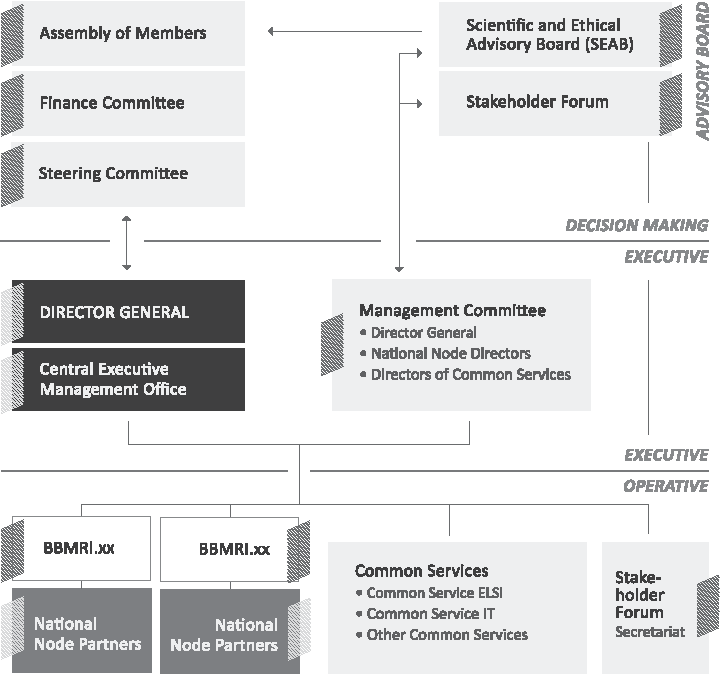
The BBMRI-ERIC governance structure. BBMRI, Biobanking and BioMolecular resources Research Infrastructure; ERIC, European Research Infrastructure Consortium.
A national node is designated by a Member State that coordinates the national biobanks in that country. Each national node has a director appointed by an appropriate authority of the Member State. Each Member State has to establish one national node.
An independent Scientific and Ethical Advisory Board (SEAB) periodically evaluates the activities of BBMRI-ERIC, with the SEAB also advising the Assembly of Members with regard to proposals from the director general on the implementation of the work program. The SEAB composes of distinguished global scientists or experts in their own right.
BBMRI-ERIC implemented its first work program in 2014. A work program includes a description of the strategy, planned activities, staffing, and funding of BBMRI-ERIC for a certain period of time. The director general, in collaboration with the national nodes and the directors of the common service, develops the work program. The work program was divided into several work plans (tasks), each of them consisting of different work streams. The budget of the work program is discussed in the finance committee and finally adopted by the Assembly of Members with the work program. The director general is in charge of the execution of the work program, including establishment of common services and expenditure of the budget (Article 13.3). The first director general was responsible for the working program 2014, 2015, 2016, and 2017. 10
Member States pay for the BBMRI-ERIC core budget, and the size is mainly determined by the country's gross domestic product.
BBMRI-ERIC also made continuous efforts to ensure additional funding for its activities. Between January and October 2016, BBMRI-ERIC participated in 18 proposals. Between 2014 and 2016, BBMRI-ERIC was involved in a total of 42 H2020 calls. Eleven of the proposals submitted were accepted. This equals an overall success rate of 26%, in contrast to the average success rate of 14%. This was a joint accomplishment of the Headquarters' team in Graz, the Common Services Ethical, Legal and Social Implication (ELSI) and Information Technology (IT) as well as the national nodes and our ambitious work program 2014–2016. A particularly important project was the ADOPT BBMRI-ERIC project.
Common services
BBMRI-ERIC Common Services form a key element of the infrastructure as they provide to the biobanking community and biobank users with top-level expertise, services, and tools in specific areas. Common services are placed under the responsibility of the director general and managed by a director, jointly appointed by the director general and the host Member State where the common service is located. The host of a common service was selected by an open call procedure (Article 15 BBMRI-ERIC Statutes).
A call for tender for a common service for ELSI was published on April 30, 2014. A single joint application, building on the existing ELSI expertise in Europe and a consortium reflecting the whole of Europe, was favored. A network of ELSI experts existed in Europe and many of the people active during the preparatory phase were still active in their particular parts of ELSI landscape. The first ELSI workshop on policy for access to biological sample and data was held in Paris in September 2015.
This common service was set up to also serve other life science infrastructures in Europe. In 2016, the key activities of the common services were to set up the Help-Desk for ELSI issues, the Ethics Check for projects that seek to access resources through and of BBMRI-ERIC, and to closely follow the latest developments on regulations, recommendations, and guidelines relevant to biobanking.
A BBMRI-ERIC policy for access and sharing of biological sample and data was finally agreed in 2017, including an update of the partner charter. A partner charter defines cornerstones for the participation of biobanks or biological resource centers (partner) that are associated with BBMRI-ERIC.
All proceedings to access and sharing must be compliant with national and European legislation such as the present Directive 95/446/EEC and the EU General Data Protection Regulation (GDPR) from May 25, 2018. The GDPR replaces the Data Protection Directive 95/46/EC and was designed to harmonize data privacy laws across Europe. It is national legislation that applies to the data controller responsible for a biobank, a registry, or a collection of personal data that, in turn, applies to the processing of biological samples and data, irrespective of where the biological samples and data are used.
On June 3, 2014, representatives from 18 Member States met in Vienna to discuss needs and requirements for common service IT. Key people from within the BBMRI-ERIC who coordinated or addressed IT and informatics in each respective national node attended to discuss their needs and specificities to elaborate a joint vision of the IT common service together with the director general. Although ELSI was relatively unproblematic to launch a common service for, it took much longer to agree on the structure of IT. Many meetings were required, partly in the field of IT and also joint meetings with the national nodes directors. Owing to the extended time between the preparatory phase and the launch of BBMRI-ERIC, momentum was lost, technology changed, and a lot happened at national level, where many countries began to build up national IT structures for biobanks resources.11–15 The largest work package during the preparatory phase was database harmonization and IT infrastructure—only 6 of 45 individuals from the preparatory phase were still involved for the first IT meeting with BBMRI-ERIC 2014. Important herein was to define a road map that was in alignment with activities in the national nodes and to collaborate with other infrastructure projects to reuse what had already been done.
A tender for common service IT was published on April 30, 2015. The main objective of this call for tender was to provide expertise, services, and tools relevant to the pursuance of tasks and activities of BBMRI-ERIC. Common service IT was to be complemented by the H2020 project ADOPT BBMRI-ERIC (see ADOPT BBMRI-ERIC section) that had been designed to accelerate the development and deployment of BBMRI-ERIC.
Stakeholders forum
Stakeholders can affect or be affected by an organization's actions, objectives, and policies. For BBMRI-ERIC, it is thus of high strategic importance to learn about the perspectives, concerns, and interests of key stakeholders such as patient organizations, industry, learned societies, and user communities. Having stakeholders on board early in the process eliminates huddles early on and remains an ongoing activity. Consequently in 2016, the stakeholder forum was set up following a participatory governance model and shall be rolled out on a broader basis with the proper resources (Fig. 2).
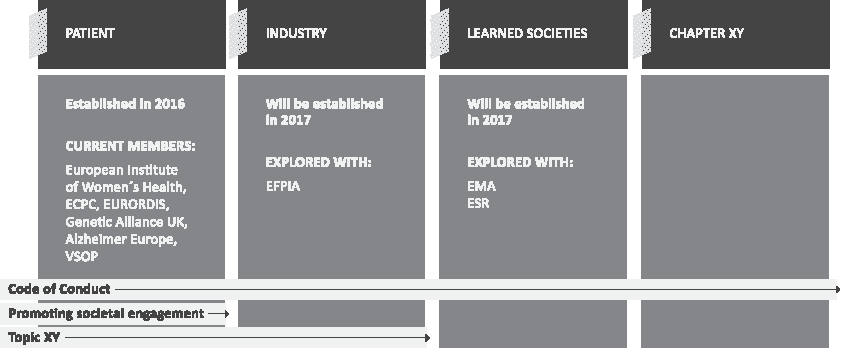
The stakeholder forum: organizational chapters and thematic topics. The stakeholder forum is designed as a timely and dynamic platform of exchange building on participatory governance. The thematic topics in question will determine whether one, some, or all organizational chapters of the stakeholder forum will meet in smaller, topic-specific workshops. Topics will be identified in a consultative manner with the stakeholders and selected based on their timeliness and urgency. An annual meeting shall bring stakeholders and the BBMRI-ERIC community together.
BBMRI-ERIC initially met with representatives of patient advocacy groups. The patient group stakeholders included the European Institute of Women's Health, the European Cancer Patient Coalition, EURORDIS–Rare Diseases Europe, Genetic Alliance UK, Alzheimer Europe, and the Dutch VSOP. The meeting took place in Brussels on April 19, 2016. It marked the beginning of a transparent consultation and participatory stakeholder engagement process, which will be enlarged by additional chapters involving industry and learned societies representatives.
BBMRI-ERIC-associated expert center/trusted partner
BBMRI-ERIC also foresees special solutions to facilitate access for industry through expert centers 16 that can be established as public–private partnerships and that are associated with BBMRI-ERIC. Expert centers will perform the primary analysis of biological samples and data in a precompetitive setting using latest technologies under standardized conditions and operate on a not-for-profit basis. Expert centers integrate precompetitive public and private research and development activities by facilitating integrated access not only to biological samples, made available through BBMRI-ERIC Directory, and medical data, but also to a broad spectrum of medical and scientific expertise related to the samples, the data, and their analysis, thereby extending the offering of biobanks with regard to standardized sample analysis and the integration of academic and industrial expertise.
In June 2016, CBmed GmbH was certified as the first BBMRI-ERIC Associated Expert Centre/Trusted Partner. CBmed GmbH, an Austrian-funded competence center, combines an excellent research infrastructure with scientific expertise and medical knowledge and provides a link to national and international industry partners for systematic medical biomarker research. In October 2016, the ATMA-EC consortia became the second certified BBMRI-ERIC Associated Expert Centre/Trusted Partner for biomarker research. The ATMA-EC Expert Centre links Centro di Riferimento Oncologico–CRO, Aviano, Italy; IRCCS SDN–Napoli, Italy; Universita degli Studi di Milano Bicocca, Milan, Italy; and Associazione Nazionale per lo Sviluppo delle Biotecnologie–As—sobiotec, Milan, Italy.
The concept of expert center was already proposed early during the preparatory phase and as a part of the BBMRI-LPC project. But going from a concept to finding a model for these centers took time. 17 The future can show if the model works or must be modified. Research institutions and associated infrastructure like biobanks can be the source of innovation and business development of a national node or a region. Public funding of research is increasingly linked to technology transfer objectives as the pressure on research public budgets grows because of fiscal deficits.
Hundred Million Samples in BBMRI-ERIC Directory
Human biological material and data stored in biobanks are the most critical resources that are required to translate progress in molecular biology and technology into a patient benefit. Consequently, one of the key challenges for BBMRI-ERIC is facilitating access to biological samples and data that represent the diversity of European populations and diseases.
The setup of the BBMRI-ERIC Common Service IT has been a critical activity since 2015. Establishment of this service included collection and revision of the use cases coming from the previous phases of the BBMRI-related projects, such as developing aggregate information about biobanks and collections, implemented using the BBMRI-ERIC Directory, and the Sample Negotiator, a tool designed to simplify communication between sample and/or data request and finally lookup of individual samples, the Sample Locator (Fig. 3). All of these use cases create foundations for the major development effort in the years 2016 and 2017. The major part of the software development during these years will be mostly funded through the ADOPT BBMRI- ERIC project (5 Million Euros), whereas remaining development and operations will be funded from BBMRI-ERIC core budget. In July 2015, Directory 1.0 was launched with 515 biobanks in Europe. 18 The BBMRI-ERIC Directory is closely coupled with the development of the MIABIS 2.0 standard. 19 MIABIS stands for minimum information about biobank data sharing and was suggested at the end of the preparatory phase. 20 MIABIS 2.0 was developed by systematically consulting biobank experts from BBMRI-ERIC members and international biobankers to simplify the core attributes. MIABIS is defined as a structured set of components consisting of a core and additional modules that can be represented in informatics management systems for biobanks and biomedical research. Today MIABIS 2.0 is the de-facto standard for many global biobanks.

The BBMRI-ERIC findability and accessibility tools: BBMRI-ERIC Directory, BBMRI-ERIC negotiator, and the BBMRI-ERIC sample/data locator. The BBMRI-ERIC Directory was the first service delivered by BBMRI-ERIC.
In 2016, the common service IT was focused on delivering Directory 3.0 and Negotiator 1.0 with support for capabilities of biobanks and semantic enhancements. The Directory 3.1 was launched in May 2016 and reached 100 million samples. BBMRI-ERIC Negotiator 1.0 is a tool to facilitate access to sample and data in BBMRI-ERIC-associated biobanks by simplifying communication among the requesters and biobankers (Fig. 4).
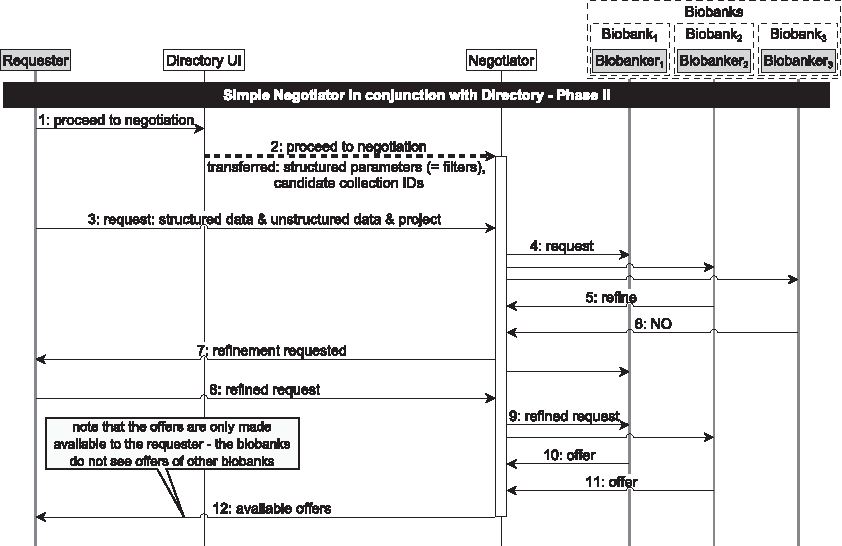
Overview diagram of communication between sample and data requesters and biobankers as implemented in the BBMRI-ERIC Negotiator 1.0 (http://negotiator.bbmri-eric.eu). The requester prefilter candidate biobanks in the directory using simple structured parameters, such as disease and type of biological sample and proceeds to the negotiator. Additional free text description on the search is added, allowing the sample collection representatives to access the sample and data availability. If the request is not specific enough, they refine the quarry and all the biobankers from other candidate biobanks see the regiment, which means that their process is improved. Finally the biobionks provide availability to the requester confidentially.
BBMRI-ERIC is a partner of the RD (Rare Diseases) connect project (rd-connect.eu). Rare diseases affect ∼30–40 million Europeans. Rare diseases and RD connect have been a part of the BBMRI-ERIC work program since the start of 2014. In 2017–2018, rare disease biobanks will be a section in the BBMRI-ERIC Directory.
Reproducibility and Reliability of the Biological Sample and Data
Ensuring reproducibility and reliability of scientific work is an issue of great concern for BBMRI-ERIC. One of the fundamental principles of science is reproducibility, the idea that a discovery is valid only if any scientist in any laboratory can conduct the same experiment under the same conditions and obtain the same results. The fact that preanalytical errors account for nearly 70% of all problems in laboratory diagnostics 21 and that there is an increasing concern about the reliability of medical research, with recent articles suggesting that up to 85% of research is wasted.22,23 One study found that only half of all reagents mentioned in >200 recent publications from a range of journals and fields could be adequately identified, indicating a failure of researchers to comprehensively report the reagents they use and of editors and reviewers to require such reporting. 24 Consequently it was decided that both better quality of and accessibility to biological samples and data should be facilitated and reported. This has been one of the most important parts in the working program 2016 and 2017. BBMRI-ERIC established five different quality expert working groups to develop a self-assessment survey based on the pre-examination processes using the CEN technical speciation's (CEN/TS) norms 25 and the upcoming ISO norms at a later stage.
As of September 2017, these working groups involved 106 experts and researchers of 18 different Member States, one of the largest networks in Europe for quality managements in biobanks. The CEN/TS published 26 were presented as a basis for standardized sample processing in the BBMRI-ERIC community to improve sample-handling processes (Table 1). Nine self-assessment surveys were developed with the BBMRI-ERIC quality community, making it possible to assess the biobanks internal sample handling processes by comparing them with the respective standards and the requirements of the CEN/TS for preanalytical sample handling. As a result, Member States biobanks can now check the quality of human samples with respect to the applicable standards through self-evaluation. After reviewing these biobanks or biobank samples and collections, BBMRI-ERIC can take steps to increase the visibility of these biobanks in the BBMRI-ERIC Directory by awarding them a quality label. BBMRI-ERIC has established an audit program to develop the necessary support for quality consultancy and internal audit services and evaluate labor costs. A call for quality and audit expert working group has been announced (Fig. 5).

Outlook on the process of accessing and using the BBMRI-ERIC self-assessment survey. This is the first time a biobank directory (or catalog) consists of common quality grade of a biobank sample in Europe.
SPIDIA (17) was a 4.5-year project funded by the European Union FP7 program. It brought together 16 leading academic institutions, international organizations, and life sciences companies, coordinated by QIAGEN GmbH. The project tackled the standardization and improvement of preanalytical procedures for in vitro diagnostics. Various new preanalytical technologies were developed. Within the CEN/Technical Committee 140 for “In vitro medical devices,” SPIDIA's results enabled the development and introduction of the first nine CEN technical specifications (CEN/TS) for preanalytical workflows in Europe. The SPIDIA4P27) project builds on SPIDIA's results and is funded by the European Union's Horizon 2020 research and innovation program. It plans to initiate, develop, and implement a comprehensive portfolio of an additional 14 pan-European preanalytical CEN/TS and ISO/IS documents as well as external quality assessment schemes, addressing the important preanalytical workflows applied to personalized medicine.
TS, Technical Speciation's.
BBMRI-ERIC facilitates access to samples of human health/disease-relevant biological resources including associated data in a manner that is efficient and in a quality defined way as well as in an ethically and legally compliant manner. Ultimately, BBMRI-ERIC has developed performance indicators to monitor the operation of the research infrastructure accordingly. 28
Since April 2015, BBMRI-ERIC has been actively contributing to the process of international standards development as an observer liaison of ISO Technical Committee (ISO/TC) 276 Biotechnology as well as of ISO/TC 212 Clinical Laboratory Testing and In Vitro Diagnostic Test Systems. Their implementation will become mandatory once the European In Vitro Diagnostics Regulation enters into force in 2020.
As an observer liaison, BBMRI-ERIC has been asked to contribute to the drafting process by addressing comments and references as well as to share the developments of the ISO working groups with the BBMRI-ERIC community.
This allows BBMRI-ERIC to fulfill its mandate as an international organization in the interests of the European biobanking community and the Member States of BBMRI-ERIC.
Provenance Information of Biological Material
Provenance information, which keeps track of history of biological material and data, is a fundamental component in reproducibility and reliability of the biological sample. BBMRI-ERIC proposes development of provenance information standards for the biotechnology domain, which would allow for interoperable generation and processing of provenance information in relation to the ISO/TC 276 Working Group 5 (Data Processing and Integration in Biotechnology). This provenance information is a part of the BBMRI-ERIC FAIR-Health principles.
The Directory, Negotiator, and Sample Locator are together with the BBMRI-ERIC access policy and the work of the quality of sample and data part of a bigger ecosystem, described in the FAIR-Health principals29,30 suggested by BBMRI-ERIC.
The rapid development in analyzing technologies makes it difficult to foresee whether the current sample handling techniques are adequate for future analysis purposes. The key is thus to provide a complete documentation of the entire process. In 2016, we took the first step for the “second B” (biomolecular resources) in BBMRI. How to use biobank samples is set to undergo dramatic changes in the coming years, necessitating efficient provision of support for users of the corresponding techniques. This means that biobanks in our Member States and their users will need support to adapt to not only new technologies but also study designs and research strategies, and finally to agree on preferred approaches to ensure that data can be combined across different sites and countries.
An important role will be to help industry to access resources and to support industrial development of new technologies as well as biomarkers for applications in clinical care using retrospective sample material. 31
Adopt Bbmri-Eric
Of the current active H2020 projects BBMRI-ERIC is involved in, the project ADOPT BBMRI-ERIC is the most important one. It is coordinated by BBMRI-ERIC and provides the funding to develop and speed up and implement BBMRI-ERIC services. An important question is how we can stimulate new powerful research strategies that will better take advantage of the value of European biobanks.
In 2015, a special call in H2020 was launched called INFRADEV-3-2015: Individual implementation and operation of ESFRI project. ESFRI approved the final selection of priority projects at its plenary meeting on April 1, 2014. BBMRI-ERIC was one of those infrastructures that could apply for this grant. 32
In the context of the call, BBMRI-ERIC was the only purely health-related research infrastructure that applied and received the grant. Therefore, the decision on a particular disease was of utmost importance. For a common disease, colon cancer was chosen, as this cancer is one of the most commonly diagnosed cancers worldwide. The project ADOPT BBMRI-ERIC will thus allow us to develop the most globally advanced and most comprehensive cohort of colon cancer cases, including biological samples and detailed medical information by simply pooling together cases from the Member States and their associated biobanks. In the long run, this cohort will allow key unsolved medical problems to be addressed, such as individual risk assessment of stage II colon cancer, which is critically needed to optimize therapy.
ADOPT is an acronym from the phrase: implementAtion anD OPeration of the gaTeway for health into the BBMRI-ERIC. 33 The collection has so far exceeded 10,000 cancer cases (November 2017) in this joint endeavor. For the biobanks in the Member States, the benefits are clear. They will be recognized and will gain visibility, new users, data, and high-quality research results. Furthermore, the collection will enable contributing biobanks to demonstrate their value and prominent role in driving medical research forward in Europe.
The project has given BBMRI-ERIC and its community at large an opportunity to accelerate the cooperative efforts that integrate the biobanks through the national nodes and their expertise into a fully operational distributed research infrastructure.
The expected benefits of ADOPT will not only involve contributions to high-quality research through building a gateway access to European biobanks, but also result in more uniformed biomedical landscape through implementing common standards and fostering scientific excellence in research collaborations.
Conclusion
BBMRI-ERIC is not just any research infrastructure, it is a critical infrastructure for health in the EU. 34 There is currently no infrastructure similar to BBMRI-ERIC outside of Europe, giving Europe a striking competitive advantage. 35 According to the Organization for Economic Co-operation and Development (OECD), biobanks are an essential part of the infrastructure underpinning the life sciences and biotechnology. They have the potential for a substantial impact on the economic growth and improvement of healthcare. Although ground-breaking technologies for biobank analysis have often had their roots in Europe, the practical utilization of such technologies has generally occurred in the United States, not infrequently using patient samples collected in Europe.
BBMRI-ERIC is a truly pan-European research infrastructure for health research. Given that BBMRI-ERIC is set up to become a key source for users in both academic and scientific institutions as well as in the pharmaceutical and life science industries, it contributes directly to the Innovation Union concept. It is pan-European because BBMRI-ERIC already shows an excellent geographic and regional coverage all over Europe, involving countries from South, East, West, North, and Central Europe. BBMRI-ERIC is a service-driven infrastructure driven by science. And many services have been defined for the Member States in many areas, including measurement of their performance.
BBMRI-ERIC takes a European collection of biological resources to new heights of coordination and efficiency, providing new services and better access for users. BBMRI-ERIC will provide a one-stop access to the collections of the European research community, expertise, and services building on the outcome of ADOPT BBMRI-ERIC proposal. The Colorectal Cancer Cohort was developed by BBMRI-ERIC as a part of the ADOPT project. Ultimately, this will not only save a lot of money for our Member States but also lead to better reproducibility and reliability of research results, provide added value for research, and stimulate the innovation process in Europe.
However, building up an infrastructure of this size with so many different Member States in Europe of different size, language, political agenda, and complicated legislation needs time 36 —a lot of time. Many of the present infrastructures in physics and astronomy, which harvest important findings today, took a long time to construct. The LIGO detector for observation of gravity waves took >40 years to construct. Although CERN (physics) is properly funded, only project funding is offered for life sciences in many European Member States. Some countries have been able to build their national activities but others have no funding at all or it is not sustainable. National funding is needed if impact is wanted. The project thinking persists, some national nodes are considered as projects.
Member States have to be patient and take care of our biobanks—the library of our life, so we are also able to harvest its benefit for European citizens in the future. Most of the current knowledge on diseases as well as available diagnostic assays and drugs is based on investigation of biological sample and data
Footnotes
Acknowledgments
I would like to thank the national node directors and the Member States for their contributions to this outstanding pan-European effort. I would also like to express my thanks to the staff at the headquarters in Graz and the common services IT and ELSI, and quality experts for their excellent work during 2014–2017. The names of staff at the headquarter in Graz, directors from the national nodes, and directors of common services can be found at ( ).
).
This work has been cofunded by BBMRI-Preparatory Phase supported by European Union FP7 grant agreement No. 212111, BBMRI-LPC funding from the European Union FP7 under grant agreement No. 313010, and ADOPT BBMRI-ERIC funding from the European Union Horizon 2020 Research and Innovation Program under grant agreement No. 676550. This work was also partially supported by grants related to the national nodes of BBMRI-ERIC.
Author Disclosure Statement
No conflicting financial interests exist.