




Abstract

Introduction
Up to the present time, tissue samples are mostly stored fixed in formalin and embedded in paraffin or as frozen samples. However, the direct extraction and storage of DNA is also common in biobanks. This reduces turn-around time, requires less space, and is more convenient for customers who are interested in genomics research. Routinely, DNA is stored in an aqueous solution (in water or low-percentage Tris-EDTA [TE] buffer) in −80°C freezers or in nitrogen tanks. Unfortunately, storage at ultra-low temperature has some requirements for fail-safe storage and complicated and costly backup systems are required to guarantee sample integrity. 1 To reduce costs and facilitate storage of DNA samples, storage at room temperature is therefore becoming increasingly popular. 2 To allow long-term storage and maintain DNA stability, lyophilized DNA is most commonly used. Furthermore, Imagene (Evry, France) has developed another system based on sample encapsulation of dried DNA in watertight, oxidation-proof DNAshell metal minicapsules. 3 The purified DNA is preserved under a controlled, anhydrous, and anoxic atmosphere. Consequently, DNAshells allow the long-term storage of dried DNA at ambient temperature without the need of complicated backup systems. Furthermore, more than 200,000 samples can be stored in a small laboratory area of ∼3 m 2 . Finally, the establishment of a duplicated DNA collection in different biobanks using the Imagene DNAshell system has been recently demonstrated. 4
While the DNA integrity has been demonstrated to be not affected by storage in DNAshell capsules,5,6 we wanted to analyze the effect of long-term storage on samples used for next-generation sequencing (NGS). Therefore, we used various commonly used sources in biobanking, lung and colon cancer tissue samples, DNA extracted from a lung cancer-derived cell line (A549), and from the bacteria Listeria monocytogenes, respectively. To simulate long-term storage, an accelerated aging model was used to mimic room temperature storage for 20 years. To assess whether the results are influenced by different sequencing systems, we performed a multicentric study, in which DNA sequencing was performed in each of the involved laboratories with their previously established NGS workflows.
Material and Methods
Sample preparation
Human lung and colon cancer samples, A549 cells, and, L. monocytogenes were provided by the hospital integrated biobank (BB-0033-00025) in Nice, the EPIGENETEC Saints-Pères Biobank in Paris and the Collection de l'Institut Pasteur, respectively. The study complied with the World Medical Association Declaration of Helsinki regarding ethical conduct of research involving human subjects and all patients provided informed written consent.
Various protocols were used for DNA isolation. Genomic DNA extraction from lung tissue and cell line and sequencing on an Ion PGM system (Thermo Fisher) was performed as published previously. 7 Likewise, colon cancer samples and L. monocytogenes samples were processed according to already established protocols.8,9
Samples were split before analysis. As DNA stability and strand breaks occur according to Arrhenius law, accelerated aging was performed by incubating the encapsulated samples at 76°C for 15 hours as described previously in detail. 3 This is equivalent to ∼20 years of aging (Fig. 1A).
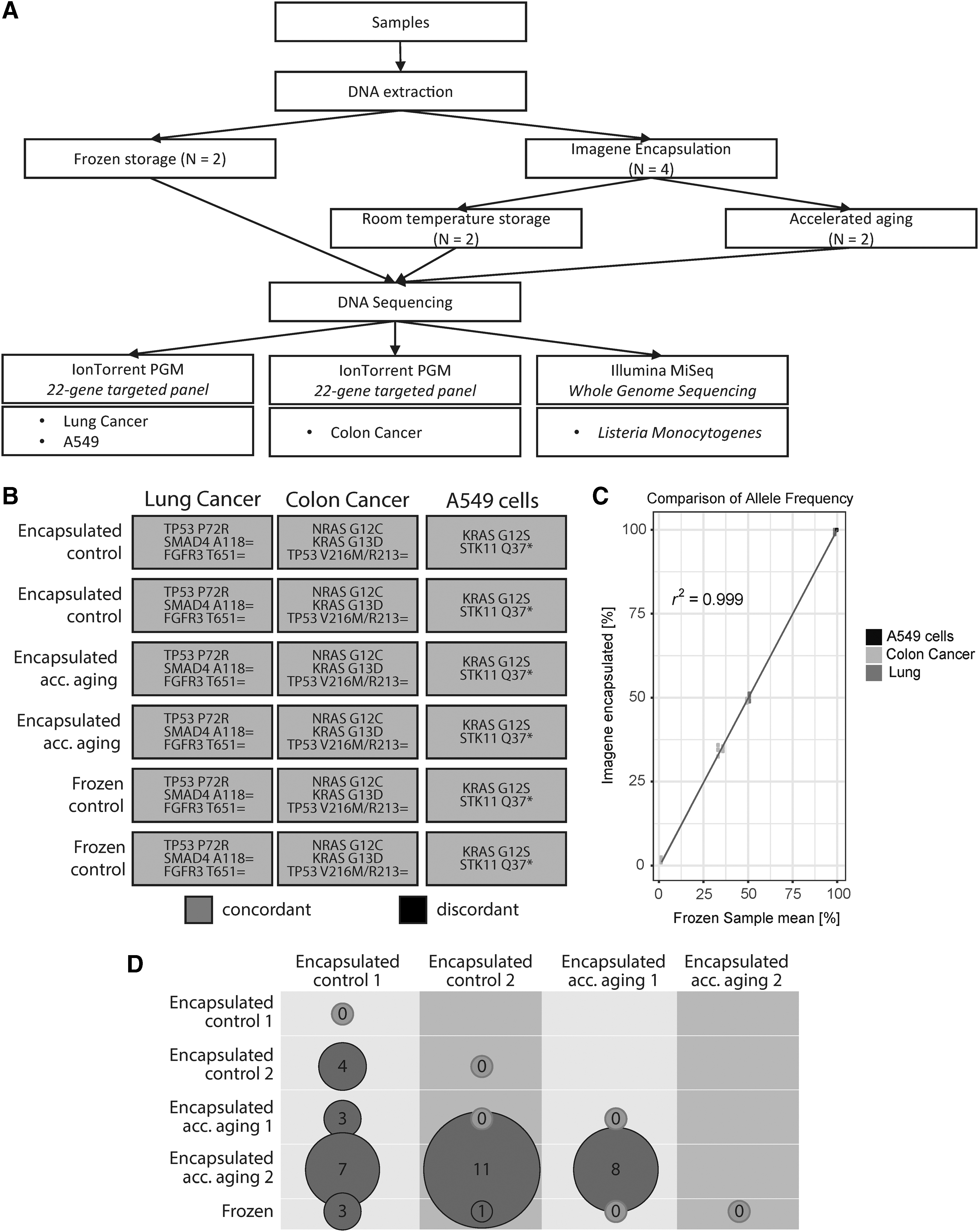
Correlation of sequencing results.
Imagene encapsulation
Aliquots of DNA were prepared and subjected to the French Imagene DNA encapsulation platform (Evry). Before encapsulation, DNA quality was analyzed using electrophoretic migration on agarose gels. In brief, between 400 ng and 2 μg of DNA, depending on the type of sample, was deposited on the bottom of a 0.2 mL cylindrical glass insert placed in an oxidation-proof metallic capsule (DNAshells), and all samples were vacuum dried for 30 minutes to 1 hour in a Thermo-Savant Explorer concentrator. Samples were sealed under a controlled, anhydrous, and anoxic inert atmosphere as described previously. 4
Results
Sequencing results from human cancer samples and cell lines are highly correlated
The detected mutations in colon cancer, lung cancer, and in the lung cancer-derived cell line, A549, were concordant between the different storage conditions (Fig. 1B). Importantly, the allele frequency of the detected mutations was perfectly correlated between the different storage conditions (Fig. 1C). Different sequencing platforms were used for the analysis.7,9 However, this did not affect the results and no false-negative or false-positive mutations were detected in all the analyzed samples. The TP53 p.V216M mutation in the colon cancer samples was present at a very low frequency (median from frozen sample = 1.53%). However, it was still detected in encapsulated DNA as well as in the accelerated aging model.
Imagene encapsulation can be used for the storage of bacterial DNA
Furthermore, we assessed the storage conditions in DNA encapsulated from the bacteria L. monocytogenes. In contrast to the cancer sources, we did not analyze mutations but single nucleotide polymorphisms (SNPs). Limited variations could be detected between the different storage conditions (Fig. 1D). Very few individual SNPs have been detected, with a maximum of 11 accounting for 0.00038% of altered bases in the L. monocytogenes genome. SNP counts in frozen DNA and simulated long-term encapsulated DNA were not significantly different (p = 0.26; χ2 test). SNPs detected were randomly distributed and the majority (25 out of 35; 71%) were detected in noncoding regions.
Discussion
Long-term storage of DNA is an important challenge in modern biobanking. We have, therefore, set up a storage system based on the DNAshell technology, which was shown to preserve DNA quality in short term as well as in our accelerated aging model mimicking 20 years of storage. NGS demonstrated perfect concordance for all samples used and independently of the used sequencing technology. Importantly, for demonstrating reproducibility, especially in larger trials, the detected allele frequency of found mutations was unaffected by the different storage conditions.
Bacterial DNA of L. monocytogenes was mildly affected by the different storage procedures. The number of individual SNPs detected was low, considering the size of the genome of 2.9 MB. Although, the phenotypical impact of the SNPs in coding regions remains to be elucidated, most of the individual SNPs were present in noncoding regions. Recently, small genomic variations in bacterial DNA stored as dried DNA have been shown to be common and independent of the storage conditions. 10
In conclusion, DNA can be stored long term at room temperature using the DNAshell technology without interfering with the downstream analysis using NGS.
Footnotes
Acknowledgments
This work was supported by IBiSa, the Infrastructure BIOBANQUES (Inserm, France), and the French Government (National Research Agency, ANR) through the “Investments for the Future” LABEX SIGNALIFE: program reference ANR-11-LABX-0028-01.
Author Disclosure Statement
No conflicting financial interests exist.