




Abstract
Aim:
The present study was designed to evaluate enrofloxacin (EN), a fluoroquinolone broad-spectrum antibacterial drug for use in cryopreservation of Zebu bull semen.
Materials and Methods:
Semen was collected from three Zebu bulls of the Sahiwal breed (Bos indicus) for 3 weeks (replicates) for each experiment. Experiment I: semen samples were cultured for isolation of bacteria and in vitro sensitivity tests against streptomycin, penicillin, and EN. Proteus spp., Pseudomonas aeruginosa, Staphylococcus aureus, and Escherichia coli were isolated. P. aeruginosa was found to be resistant to streptomycin and penicillin (SP), while Proteus spp. was resistant to streptomycin. EN effectively inhibited the growth of all four bacteria in an in vitro sensitivity test. Experiment II: in vitro dose toxicity of EN (0–2000 μg/mL) for bull sperm was assessed in 2.9% sodium citrate buffer. EN up to a concentration of 1200 μg/mL was found to be safe for motility and viability of bull spermatozoa. Experiment III: semen was cryopreserved in a tris-citric acid extender containing either SP or EN (400 μg/mL) or without antibiotics as the control.
Results:
Post-thaw sperm motility was found to be higher in the extender containing EN and SP compared to control. Nevertheless, sperm viability was recorded higher (p < 0.05) with EN compared to SP and control. Sperm chromatin integrity did not differ (p > 0.05) in EN, SP, and controls. The total aerobic bacterial count was recorded as zero in the extender containing EN compared to SP and control. The fertility rate was higher (p < 0.05) with 400 μg/mL EN (59%) compared to SP (44%).
Conclusions:
It is concluded that EN is capable of controlling the bacterial load in frozen Zebu bull semen, resulting in a higher fertility rate under field conditions.
Introduction
Artificial insemination (AI) is a technique that has been used in livestock species to enhance genetic potential through exploiting genetically superior bulls. Moreover, AI plays a vital role in controlling transmission of venereal diseases in herds. Although bulls used in AI programs are routinely screened for various economically important diseases at regular intervals to eradicate the risks of disease incidence,1–3 on a practical basis, it is impossible to obtain semen ejaculates free from microorganisms. The risk of contamination from testes, feces, respiratory secretions, skin/hair, epididymis, vas deferens, accessory sex glands, urethra, and artificial vaginas is inevitable. 4 In addition, the collection environment, unsterilized equipment, and extender components of animal origin may serve as sources of contamination. 5
Bacteria in semen have highly deleterious effects on semen quality, either by directly competing with sperm for nutrients supplied by the semen extender or by production of toxic metabolic by-products and toxins.6,7 Bacteria have a tendency to adhere to sperm8–10 and can cause reduction in motility 11 and a premature acrosome reaction. 12 Furthermore, bacteria may initiate production of antibodies against the sperm glycocalyx complex.13,14 Traditionally, during the last 50 years, antibiotics such as penicillin and streptomycin have been added to the semen extender to control bacteria.15,16
Over time, numerous antibiotics have been screened to identify more efficient antibiotics as bacteria are highly adaptive to changing environments and increasing resistance to classic antibiotics.17–19 This necessitates continuous screening of available antibacterial drugs for controlling the bacterial load in frozen semen. 18 Enrofloxacin (EN) is a bactericidal drug that has excellent activity against both Gram-positive and Gram-negative pathogens. 20 EN, a fluoroquinolone, inhibits DNA synthesis and bactericidal against a broad spectrum of aerobic and some facultative anaerobic bacteria, including strains resistant to many other antimicrobial agents. 21 Therefore, the present study was designed to determine the in vitro dose toxicity and efficacy of EN for bacterial control, quality (motility, viability, and DNA integrity), and in vivo fertility of Zebu bull semen.
Materials and Methods
Experimental bulls and sterilization protocol
Three healthy Zebu bulls of Sahiwal breed (Bos indicus) of age 6 to 7 years, maintained under standard management conditions, were used in the study. Before semen collection, bulls were washed by using towels soaked with 70% ethanol. All the glassware was decontaminated in a hot air oven at 200°C for 1 hour. All the required apparatus, for example, collection tubes and micropipette tips, were also sterilized. Artificial vagina was sanitized by pasteurization method (at 60°C–65°C for about 30 minutes).
Preparation of microbiological culture medium
Culture medium was prepared as described by Qadeer et al. 5 and Akhter et al.4,18 Briefly, the preparation consisted of adding 5 g of bacteriological agar (Oxoid, Hampshire, England), 20 g of tryptone soya agar (Oxoid), and 0.5 g of yeast extract (Oxoid) to 500 mL of distilled water. The culture medium was autoclaved and poured into sterilized Petri plates. These Petri plates were incubated at 37°C for 24 hours and checked for the presence of contaminants before further use.
Experiment I: Isolation and characterization of bacteria
Semen collected from three bulls (two ejaculates from each bull per collection) for 3 weeks/replicates was inoculated on prepared Petri plates to culture bacteria. The isolated bacteria were grown on media using standard techniques as proposed by Cappuccino and Sherman, 22 and for the purpose of having pure bacterial strains, the colonies were cultured under aerobic conditions at 37°C and 24 hours postincubation. The selection was made on the bases of their morphological features and recultured. Bacterial characterization was done by standard procedures as described by Akhter et al. 18
In vitro antibiotic sensitivity
Bacterial species isolated from fresh semen were used in this study. To test the in vitro antibiotic sensitivity for EN, the agar disk diffusion technique was used as described by Quinn et al. 23 For this purpose, streptomycin (Hebei, Shenzhou, China), penicillin (Hebei), and EN (Baytril, Bayer, Pakistan) loaded onto disks were used. A sterilized swab on a stick was dipped into the isolated bacterial suspension and streaked onto the whole surface of the solidified agar in a Petri plate. The inoculated plate was allowed to stand for 15 minutes. The paper discs with the known standard concentration of antimicrobial agents were placed at a proper distance with the help of sterilized forceps. The Petri plates were incubated at 37°C for 1 day. The diameters of the zones of inhibition were calculated.
Experiment II: Determination of in vitro dose toxicity of EN
Semen collection and processing
Two consecutive ejaculates collected from three bulls for 3 weeks (replicates) were transported to the laboratory immediately. Sperm motility was evaluated with a phase-contrast microscope at 200 × , whereas sperm concentration was calculated using a hemocytometer (Marienfeld, Germany). Qualifying ejaculates having a concentration >0.5 × 10⁹ spermatozoa/mL and >60% motility from each bull were selected and divided into aliquots. Before dilution, these aliquots were held in a water bath for 15 minutes at 37°C. Although it is known that toxicity of fluoroquinolones to mammalian cells is generally lower, 24 previously it was observed that ciprofloxacin from the same class of quinolones has a very large range of concentrations to be used in the extender for buffalo and camel semen.18,25 However, the experiment was conducted with the objective to thoroughly verify/determine dose toxicity of various concentrations of EN for Zebu bull semen. The obtained semen aliquots were diluted (50 × 106 motile sperm/mL) in sodium citrate buffer at 37°C. The buffer consists of 2.9 g of sodium citrate in 100 mL of distilled water. The buffer containing EN at concentrations of 200, 400, 600, 800, 1000, 1200, 1400, 1600, 1800, and 2000 μg/mL or control (without antibiotics) was prepared and evaluated for sperm viability (live and dead) and motility after incubation (37°C) of 15 minutes. 18
Sperm progressive motility and viability
Sperm progressive motility and viability were assessed for finding the in vitro dose toxicity of EN. Sperm progressive motility (%) was evaluated with the help of a phase-contrast microscope by placing a drop of semen sample on a prewarmed glass slide at 37°C. Sperm viability was evaluated by placing 5 μL semen samples on a glass slide and mixing with an equal amount of 0.4% of Trypan Blue solution. A smear was made and then air-dried, after which the slide was examined under a light microscope (1000 × ; Olympus BX20) with oil immersion. Sperm cells that remained unstained were counted as live, whereas those stained blue were counted as dead. Overall, 100 spermatozoa were evaluated in five different fields. 18
Experiment III: Evaluation of enrofloxacin for semen cryopreservation
Semen extender preparation, extension, and cryopreservation
Semen extenders were prepared, as proposed by Qadeer et al., 5 by adding 1.56 g of citric acid (Merck, Germany) and 3.0 g of tris (hydroxymethyl) aminomethane (Sigma, USA) in 73 mL of distilled water (pH 7.0; osmotic pressure 320 mOsmol/kg. Then, fructose (0.2% (w/v); Reidel-DeHhaen, Switzerland), glycerol (7% (v/v); Merck), and egg yolk (20% v/v) were also added. The antibiotics, EN (400 μg/mL) (concentration was adapted based on findings of the previous study, in which 400 μg/mL EN was found to be effective for sperm quality and fertility 25 ) and streptomycin–penicillin (SP, 1000 μg/mL and 1000 IU/mL; Hebei), were added to prepare the experimental extenders containing EN and SP, respectively. The control was without antibiotics. Two consecutive ejaculates collected from three bulls for 3 weeks (replicates) were transferred to the laboratory immediately. After initial evaluation, as described in an earlier section, qualifying ejaculates having a concentration >0.5 × 10⁹ spermatozoa/mL and >60% motility from each bull were selected and divided into three aliquots. Semen aliquots were diluted with the tris-citric acid extender either having SP or EN or without antibiotic (control), cooled to 4°C in 2 hours, equilibrated for 4 hours at 4°C, and filled into precooled 0.5-mL French straws with a suction pump in a cold cabinet unit at the same temperature. Straws were kept over liquid nitrogen vapors for 10 minutes. Straws were then plunged and stored in liquid nitrogen (−196°C; Akhter et al. 18 and Qadeer et al. 5 ).
Post-thaw semen quality assays
Semen quality was evaluated after thawing at 37°C for motility, viability, chromatin integrity, and total aerobic bacterial count (TABC).
Sperm motility
Sperm motility was assessed as described earlier in the semen collection and processing section.
Sperm viability
Sperm viability was assessed by a dual-staining technique using Trypan Blue and Giemsa stain, as described by Kovacs and Foote. 26 Equal drops of semen and Trypan Blue stain were placed on a glass slide, mixed, air-dried, and fixed with formaldehyde-neutral red. The slides were washed with distilled water. Then, fixed slides were immersed in Giemsa stain for 4 hours at room temperature. The slides were again washed, air-dried, and mounted with Canada balsam. Overall, 200 sperm were studied on each slide by light microscopy at 1000 × magnification in five different fields with oil immersion. Sperm with blue stain were considered dead, while cells having no stain and the acrosome stained purple were considered alive with a complete acrosome.
Sperm chromatin integrity
Sperm chromatin integrity was assessed by using toluidine blue stain, as shown by Mello. 27 The semen sample smear was air-dried and fixed in newly made ethanol–acetone solution at 4°C for 30 minutes and then hydrolyzed in HCl at 25°C. Then, slides were washed. The toluidine blue stain was used in staining. Overall, 200 spermatozoa were assessed in five different fields in each slide using a light microscope at 1000 × magnification with oil immersion. Sperm heads stained light blue were considered to have intact chromatin, and sperm heads stained violet or purple were considered to contain damaged chromatin.
Total aerobic bacterial counting
TABC was measured by culturing frozen–thawed semen samples in culture media as described by the Miles–Misra technique. 23 By using waterproof markers, lines were marked on the bottom of the Petri plate containing solidified agar, dividing it into four zones. A standardized inoculum (0.02 mL) was taken from each serially diluted semen sample (measured in a micropipette tip) and dropped from the height of about 2.5 cm on to the agar medium. Overall, four drops per sample were used. The sample was allowed to set and after that the Petri plates were incubated at 37°C for 24 hours. A dilution sample was selected on the basis of forming about 3–30 colonies per droplet.
Fertility
To assess the in vivo fertility rate, bull semen ejaculates were collected from two bulls, divided into two equal portions after initial evaluation, and frozen in the tris-citric acid extender having either SP or EN (400 μg/mL). Artificial insemination was performed (120 inseminations/extender/bull) in cows after 24 hours of onset of heat signs under field conditions. The rectal palpation method was used to check the artificially bred animals for pregnancy at least 90 days postinsemination. 18
Statistical analysis
Data on motility, viability, DNA integrity, and bacterial count were analyzed by analysis of variance in a complete randomized design. Data on fertility rates were analyzed using the chi-square test. The level of statistical significance was 5% (p < 0.05) (Assistat®; Ver.7.7 beta).
Results
Isolation of bacteria and antibiotic sensitivity
Data on bacterial isolation and in vitro antibiotic sensitivity are given in Table 1. Four bacterial species were isolated, namely Escherichia coli, Proteus spp., Pseudomonas aeruginosa, and Staphylococcus aureus. All bacterial isolates were found to be sensitive to EN. However, P. aeruginosa and Proteus spp. were found to be resistant to penicillin, while P. aeruginosa was resistant to streptomycin.
In Vitro Antibiotic Sensitivity of Bacteria Isolated from Bull Semen
In vitro dose toxicity of EN for bull spermatozoa
Data on the in vitro dose toxicity of EN for bull sperm in terms of motility and viability (live sperm with intact acrosome; %) are presented in Figure 1a and b. The increase in concentration of EN up to 1000 μg/mL did not have any significant effect on sperm motility. Nevertheless, a further increase in concentration of EN has a negative impact on motility, which dropped significantly. A total of 40% decrease in sperm motility was observed at 2000 μg/μL. Sperm viability did not decrease with increasing concentration of EN up to 800 μg/mL.
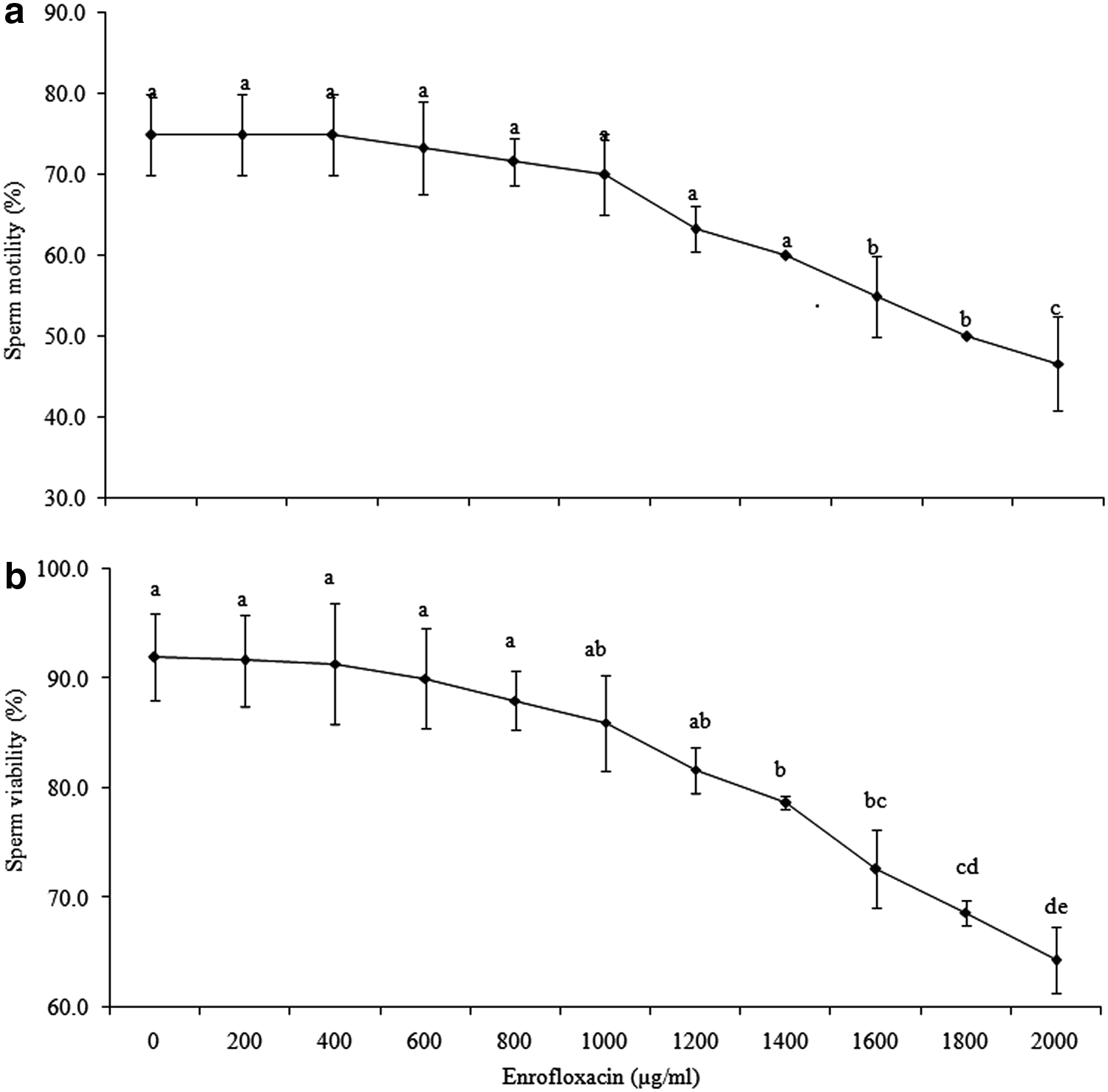
Effect of different concentrations of enrofloxacin on motility
Effect of antibiotics on semen quality of bull semen
Data on the effect of antibiotics in the extender on post-thaw motility, viability, and chromatin integrity (%) are presented in Figure 2a–c. The percentages of post-thaw sperm motility were found to be higher in the extender containing EN and SP compared with control. Nevertheless, sperm viability was recorded as higher (p < 0.05) in the extender containing EN compared with SP and control. Sperm chromatin integrity did not differ (p > 0.05) in EN, SP, and control.
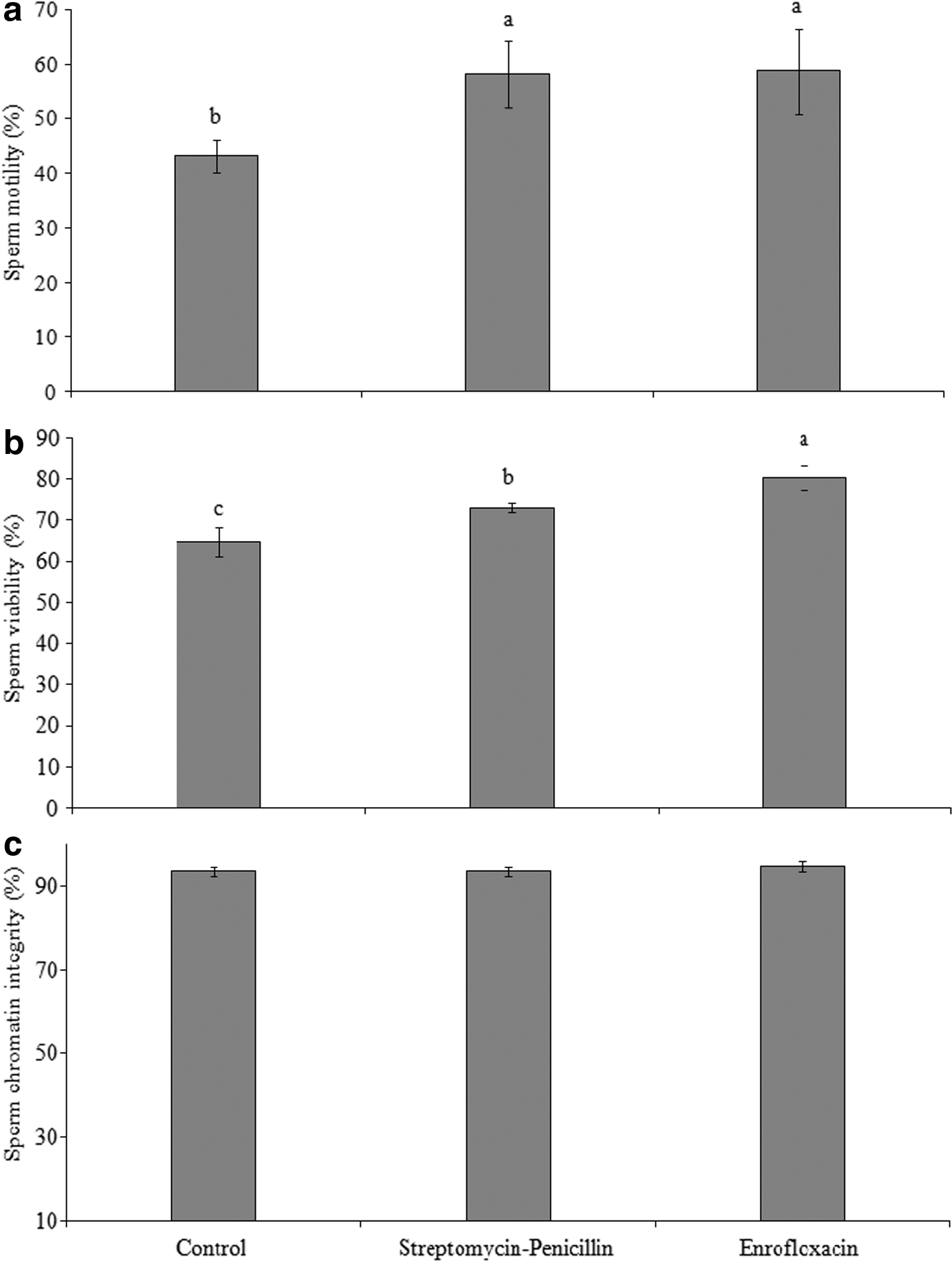
Effect of streptomycin–penicillin and enrofloxacin (400 μg/mL) in the extender on motility
Effect of antibiotics on TABC
TABC (1 × 10⁴ CFU/mL) was zero in the extender containing EN compared with SP (0.001) and control (0.01).
Effect of antibiotics on in vivo fertility rate
Data on the effect of antibiotics on in vivo fertility rates of bull semen are given in Table 2. The fertility rates based on 400 inseminations recorded (200/extender) were observed to be higher (p < 0.05) with the extender containing EN (59%) compared with SP (44%).
Effect of Streptomycin–Penicillin and Enrofloxacin on In Vivo Fertility of Bull Semen
SP, streptomycin–penicillin.
Discussion
Although breeding bulls are continuously screened for economically important diseases, it is impossible to obtain semen ejaculates free from microbial contamination.28–32 The risks of bacterial contamination during semen collection, processing, and storage are always present. Bacteria in semen have negative effects on semen quality and fertility.4,18,28 To control the bacterial load in frozen semen, antibiotics (SP) have been used for more than a half century. Studies have pointed out that bacteria have developed resistance to antibiotics and SP have failed to eliminate the bacterial load in frozen–thawed semen.31,33–35 It has become necessary to explore alternative antibiotics to eliminate bacterial contamination from frozen semen. Therefore, the present study was designed to check the efficiency of EN against the bacteria isolated from bull semen and effects of its inclusion in the extender on frozen–thawed semen quality and fertility rates under field conditions.
In the present study, four bacterial species, viz, E. coli, Proteus spp., P. aeruginosa, and S. aureus were isolated from bull semen. A previous study reported Staphylococcus spp., Micrococcus spp., E. coli, Corynebacterium spp., Bacillus spp., Pseudomonas spp., and Proteus spp. from the same breed. 36 The in vitro antibiotic sensitivity test reveals that Pseudomonas spp. has developed resistance to both penicillin and streptomycin, while Proteus spp. was resistant to penicillin. Nevertheless, all four bacterial species isolated from bull semen were found to be sensitive to EN. EN is the first quinolone marketed for veterinary use against Gram-positive and Gram-negative bacteria through inhibiting DNA synthesis. Studies have revealed that SP is ineffective against most of the bacteria isolated from bovine semen.37–40 It has been demonstrated that a combination of antibiotics consisting of penicillin, streptomycin, lincomycin, spectinomycin, and minocycline failed to eliminate P. aeruginosa in artificially infected semen before and after freezing. 41
EN has never been evaluated in an extender for bacterial control, so the appropriate concentration of EN that can eliminate bacterial species without affecting bovine sperm was not known. Therefore, in vitro dose toxicity of EN was evaluated for bull sperm through the procedure described by Akhter et al. 18 Results of in vitro dose toxicity tests revealed that EN up to 800 and 1000 μg/mL did not have any adverse effects on viability and motility of bull spermatozoa. Previously, it was observed that ciprofloxacin from the same class of quinolones has a very large range of concentrations that can be used in extenders for buffalo semen. 18
Motility and viability are important criteria used to determine the functionality of fresh and frozen–thawed semen. In the present study, post-thaw sperm motility was found to be higher with EN and SP compared to control (extender without antibiotic), while viability was observed to be highest in the extender with EN compared to SP and control. Similar findings have been reported with the use of ciprofloxacin in buffalos. 18 The highest efficiency of EN in an extender for improving viability can be explained by results of TABC in the present study, as TABC was recorded to be zero. It is suggested that bacteria in semen can cause depletion of energy by competing with sperm, which may lead to reduction in motility. 4 E. coli and S. aureus in the present study are very common semen contaminants, have a high tendency to adhere with sperm, and have been reported to produce a sperm agglutination factor that causes agglutination of sperm, motility impairment, and changes in morphology.42–44 Moreover, alterations are seen in the plasma and acrosome membrane and metabolic activity leading to cell death. Conventional antibiotics, SP, are bacteriolytic, which may increase levels of lipopolysaccharides (LPSs) during cryopreservation processes. Okazaki et al. 45 have reported that LPSs have the tendency to bind with sperm, which leads to impairment of motility and apoptosis. Furthermore, as part of innate immunity, Toll-like receptor 4 (TLR4) are expressed on mammalian sperm; the decrease in sperm functional parameters (motility, acrosome reaction, apoptosis, and fertility) is also reported to be due to LPS interaction with sperm.45,46 It has also been reported that LPSs increase reactive oxygen species (ROS) production, leading to oxidative stress by interacting with sperm TLR4 receptors. 47 EN has advantages over SP because it does not cause lysis of bacteria—rather, it stops bacterial growth by inhibiting DNA synthesis through prevention of DNA gyrase activity.
Chromatin intactness of frozen–thawed semen did not differ in the extender containing EN, SP, and control in the present study. These findings are partially in agreement with previous reports that demonstrated no difference in DNA fragmentation in frozen–thawed semen samples, either positive or negative for the presence of bacteria. 48 Nevertheless, the sperm DNA fragmentation rate was reported to be higher in semen samples bearing bacteria when incubated at 37°C in vitro. In a prior study, immediately after thawing, no bacterial growth was observed, but after incubation, bacterial growth was observed in semen between 0 and 96 hours of incubation. 49 It has been established that sperm DNA is highly susceptible to the ROS concentration and bacteria in semen are reported to be involved in production of ROS molecules and increase in oxidative stress. 46
In the present study, fertility rates were found to be higher with EN at 400 μg/mL compared with SP in the extender. In a similar study, higher fertility in buffalos was observed with ciprofloxacin in the extender compared to SP. 18 It is suggested that complete elimination of bacteria in frozen semen is necessary as in the female reproductive tract, there are chances of bacterial infection following physical injury during AI.18,48,49 It is relevant to mention that gentamycin, tylosin, lincomycin and spectinomycin (GTLS) is a comparatively better antibiotic combination 17 that has produced higher fertility rates of bovine and buffalo semen 39 in both liquid and frozen states. It is suggested that beneficial effects of EN on the fertility rate are mediated through eliminating bacteria in frozen semen.
Conclusions
It is concluded that EN as an extender is effective for controlling the bacterial load and improving viability of frozen Zebu bull semen. Moreover, EN improves the fertility rate in bovines under field conditions.
Footnotes
Author Disclosure Statement
No conflicting financial interests exist.