




Abstract
Subculturing is frequently used for the preservation of basidiomycetes. In this study, to assess and verify the risks of repeated subculturing on the long-term preservation of strains of culture collections, we performed single nucleotide polymorphism (SNP) analysis in genes encoding enzymes of the mevalonate pathway, 1,3-β-glucan synthesis, lignin degradation, and the tricarboxylic acid (TCA) cycle of mycelia before and after preserving for a 4-year period by the subculturing 30 times every 45 days of Ganoderma lucidum NBRC 8346. As a result of analyzing 60 genes of the strain, SNPs were found in 18 genes, and 14 of them were found in the exon region. Nonsynonymous coding SNPs were found in two genes (atoB_2, hmgr) encoding enzymes of mevalonate pathway and five genes (lcc1_9, lcc1_11, lcc1_13, dslcc6, aa5_1_9) encoding enzymes of lignin degradation after subculturing of G. lucidum NBRC 8346.
Introduction
Culture collections (CCs) play a role in the deposition, preservation, and distribution of large numbers of diverse microorganisms and provide related information for scientific, industrial, agricultural, environmental, and medical research. CCs also function as repositories of biological resources for the protection of intellectual property and providers of reference strains for international standard tests. To achieve these goals, various CCs have tried preserving microbial strains by lyophilization and cryopreservation, because repeated subculturing may not prevent genetic and physiological changes in the strains during long-term preservation.1,2 Avoiding intracellular crystallization during freezing is paramount for the lyophilization and cryopreservation of microbial strains, 3 but the water-rich hyphae of fungi are rather sensitive to freezing. The preservation of asexual spores is reported to be useful for the maintenance of fungal strains. Most basidiomycetes do not form asexual spores and cannot survive the freezing conditions used for lyophilization and cryopreservation. Lyophilization and cryopreservation are thus of limited application in the maintenance of basidiomycetes.4–8 Therefore, repeated subculturing is frequently used for the preservation of basidiomycetes, although some useful carriers and cryoprotectants are available for the lyophilization and cryopreservation of basidiomycetes.5,7 It is imperative to assess and verify the risks of repeated subculturing on the long-term preservation of strains of basidiomycetes in CCs. Genome mutations in bacterial strains during long-term preservation of CC have been reported. 9 On the contrary, genetic mutations during long-term preservation of fungal strains have not been researched extensively.
Ganoderma lucidum is a phenotypically and genetically well-characterized basidiomycete. 10 Thus, this strain is best suited for the verification of genetic stability under long-term preservation by repeated subculturing of CCs.
Lanostane-type triterpenoids and 1,3-β-glucan are the major bioactive constituents of G. lucidum.10,11 Triterpenoid biosynthesis is considered to start from the mevalonate pathway, and mevalonic acid is considered to be the only precursor of triterpenoids. 12 Furthermore, G. lucidum causes white rot and secretes enzymes that can decompose lignin. 13 Therefore, in this study, we focused on genes involved in these pathways.
The aim of this study was to validate the risks of long-term preservation of basidiomycetes by repeated subculturing of CCs. The validations were focused on gene mutations that resulted in nonsynonymous amino acid substitutions in proteins encoded by genes of basidiomycetes. To investigate this nonsynonymous gene mutation, we analyzed single nucleotide polymorphisms (SNPs) and SNP densities of genes encoding enzymes of the mevalonate pathway, 1,3-β-glucan synthesis, lignin degradation, and the tricarboxylic acid (TCA) cycle before and after repeated subculturing of G. lucidum NBRC 8346.
Materials and Methods
Basidiomycete strains
Dikaryotic hyphae of G. lucidum NBRC 8346 were used in this study. G. lucidum NBRC 8346 was grown at 25°C in 90-mm diameter Petri dishes containing 10 mL of potato dextrose agar (PDA; Becton Dickinson, Franklin Lakes, NJ) or potato dextrose broth (PDB; Becton Dickinson).
G. lucidum NBRC 8346 cultures that had been cryopreserved in the vapor phase of liquid nitrogen at the CC of NBRC were obtained (Lot 20061215). An agar plug with mycelia (6 mm in diameter) was grown on PDA. After cultivation for 14 days, an agar plug with mycelia from this culture was grown on PDB for 26 days. Next, mycelia were harvested and washed once with sterile water. These mycelia are referred to as “NBRC8346-original” in this study.
Another 6-mm agar plug with mycelia of G. lucidum NBRC 8346 (Lot 20061215) was grown on PDA. After cultivation for 45 days, an agar plug from this culture was inoculated on PDA. This subculturing was repeated 30 times every 45 days, spanning a period of nearly 4 years. After the subculturing, a 6-mm agar plug with mycelia was grown on PDB. After cultivation for 26 days, mycelia were harvested and washed once with sterile water. These mycelia are referred to as “NBRC8346-SC” in this study. NBRC8346-original and NBRC8346-SC were used for genome analysis.
DNA extraction
DNA was extracted from NBRC8346-original and NBRC8346-SC as described by Chang et al. 14 The DNA extract solution was used for genome sequencing.
Genome sequencing
Genome sequences of NBRC8346-original and NBRC8346-SC were obtained using a HiSeq1000 system (Illumina, San Diego, CA). Genomic library preparation and sequencing were performed according to the protocols supplied by Illumina.
Finding and comparing SNPs in genes encoding enzymes of the mevalonate pathway, 1,3-β-glucan synthesis, lignin degradation, and TCA cycle between NBRC8346-SC and NBRC8346-original
The genome sequence of NBRC8346-original was determined by assembling sequence reads of the strain, and genes of the assembled NBRC8346-original genome were predicted as a reference for SNP analysis. For assembling, sequence reads of NBRC8346-original were preanalyzed as described previously. 9 The reads of NBRC8346-original were assembled into contigs using Velvet 1.2.10. 15 Protein-coding sequences (CDSs) of the contigs of NBRC8346-original were predicted using AUGUSTUS. 16 The predicted CDSs were annotated based on comparison with public databases (National Center for Biotechnology Information, DNA Data Bank of Japan (DDBJ), and Kyoto Encyclopedia of Genes and Genomes).
Genes for enzymes catalyzing the steps of the mevalonate pathway, 1,3-β-glucan biosynthesis, lignin degradation, and TCA cycle were selected from CDSs of the contigs of NBRC8346-original using the following procedure. Amino acid sequences of these enzymes reported in G. lucidum G.260125-117 and amino acid sequences of CDSs of the contigs of NBRC8346-original were compared with the bidirectional best BLAST hit.11,17–20
SNPs in a set of genomes of NBRC8346-original and NBRC8346-SC were analyzed (Supplementary Fig. S1). Sequence reads of NBRC8346-original and NBRC8346-SC were aligned to the contigs of NBRC8346-original, and SNPs and allele frequencies at the SNPs (i.e., the ratio of reads supporting the variant to mapped reads at the locus) in both sets of genomes were analyzed as described previously. 9 Hereafter, the SNPs detected in the two sets of genomes are referred to as “probable SNPs.” To compare the SNPs between NBRC8346-SC and NBRC8346-original, allele frequencies at probable SNPs in the two strains were manually compared, and probable SNPs, which had a 100% allele frequency in either of the strains were determined to be SNPs differing between NBRC8346-SC and NBRC8346-original. SNPs detected in CDSs were analyzed by the CLC Genomics Workbench 7.5 to determine whether these variations caused amino acid substitutions in the proteins encoded by the CDSs.
Estimating the probability of misidentifying SNPs owing to sequencing errors
The probability of finding an SNP in a strain because of a sequencing error was estimated, as described previously. 9
Results
Genome sequencing
Datasets of 79,991,730 and 96,000,000 reads of 100-bp sequences were obtained by genome sequencing of NBRC8346-original and NBRC8346-SC, respectively. These datasets are publicly available in the DDBJ (DRA005532).
Preparation of a reference genome for SNP analysis
Using Velvet software, all reads from NBRC8346-original were assembled into contigs. Contigs that were 1500 bases or greater in length were selected. The number of contigs and sum of the length of the contigs were 8954 and 35,056,197 bases, respectively. The selected contigs were used as the reference for SNP analysis and the prediction of CDSs of the NBRC8346-original genome.
CDSs of the selected contigs were predicted using AUGUSTUS. Fragments of divided open reading frames were counted as independent CDSs. In total, 12,363 CDSs were obtained, and 60 genes encoding enzymes of the mevalonate pathway, 1,3-β-glucan synthesis, lignin degradation, and TCA cycle were annotated in the CDSs by bidirectional best BLASTP hit analysis.
SNPs and SNP densities in the 60 genes encoding enzymes of the mevalonate pathway, 1,3-β-glucan synthesis, lignin degradation, and TCA cycle between NBRC8346-SC and NBRC8346-original
SNPs and SNP densities in the 60 genes encoding enzymes of the mevalonate pathway, 1,3-β-glucan synthesis, lignin degradation, and TCA cycle were analyzed and compared between NBRC8346-SC and NBRC8346-original (Table 1, Fig. 1). SNPs were found in 18 genes encoding enzymes of the mevalonate pathway, lignin degradation, and TCA cycle (Table 1). Among these 18 genes, SNPs were found in exons, or both exons and introns, of 14 genes. In the remaining four genes, SNPs were found exclusively in introns (Table 1). SNP densities in exons and introns were 0.80–9.23 SNPs/1000 bases and 1.49–22.83 SNPs/1000 bases, respectively (Table 1). Among the 14 genes found in exons, the SNPs were nonsynonymous or both nonsynonymous and synonymous in 7 genes. All the SNPs found in the exons of the remaining seven genes were synonymous (Table 1). The densities of nonsynonymous SNPs and synonymous SNPs in exons of the genes were 0.48–3.62 SNPs/1000 bases and 0.52–7.06 SNPs/1000 bases, respectively (Fig. 1). The two genes of the seven genes found to be nonsynonymous SNPs were atoB_2 and hmgr encoding acetyl-CoA acetyltransferase and HMG-CoA reductase, respectively (Table 1), which are known as the enzymes for mevalonate pathway. The remaining five genes were genes involved in lignin degradation, which were lcc1_9, lcc1_11, lcc1_13 encoding candidate laccase, dslcc6 encoding candidate multicopper oxidase, and aa5_1_9 encoding candidate glyoxal oxidase (Table 1).
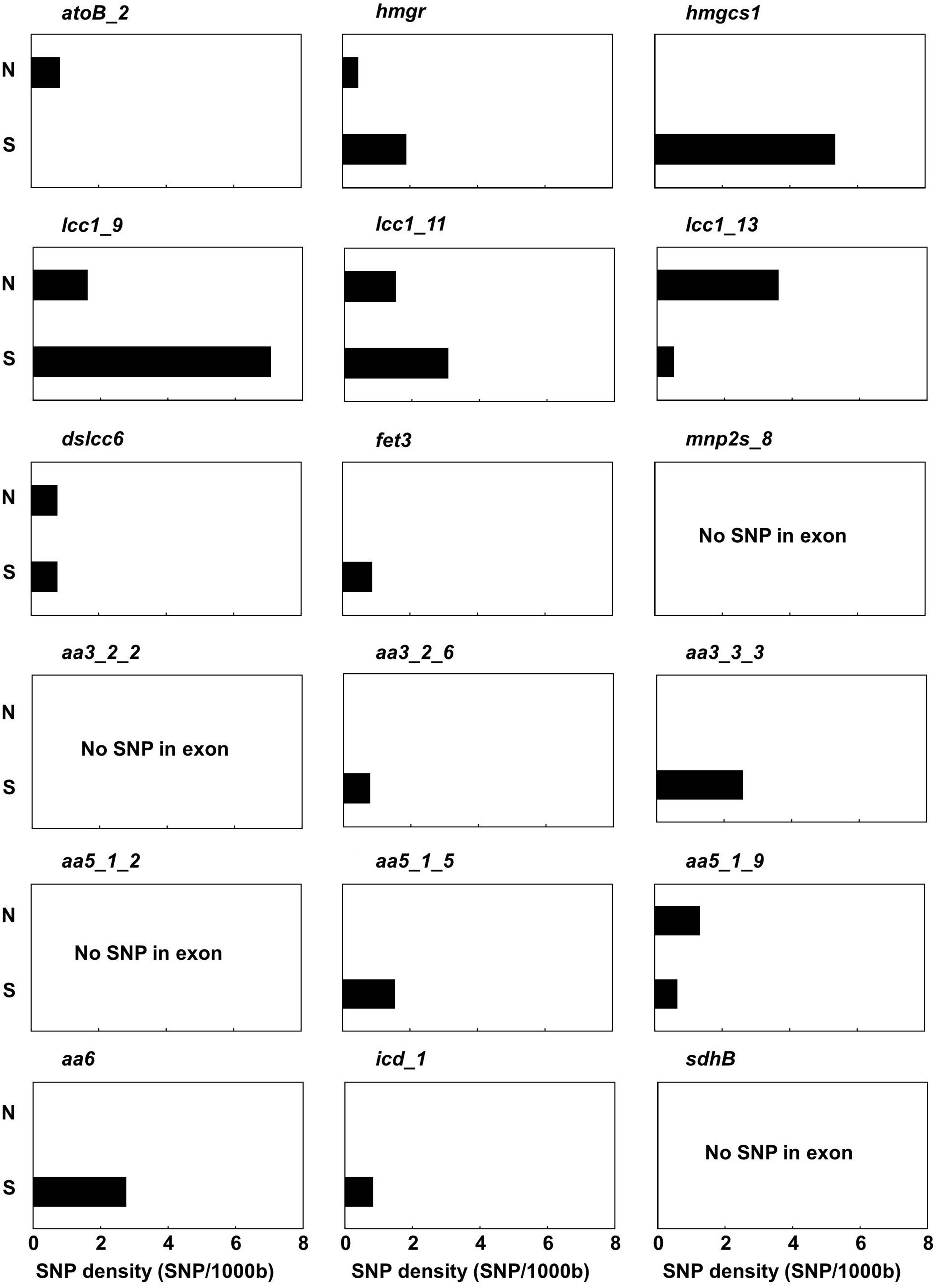
Nonsynonymous SNP densities and synonymous SNP densities in exons of the mutated genes. N, nonsynonymous SNP density; S, synonymous SNP density; SNP, single nucleotide polymorphism. atoB_2, Acetyl-CoA acetyltransferase; hmgr, 3-Hydroxy-3-methylglutaryl-CoA reductase; hmgcs1, 3-Hydroxy-3-methylglutaryl-CoA synthase; lcc1_9, Candidate laccase; lcc1_11, Candidate laccase; lcc1_13, Candidate laccase; dslcc6, Candidate multicopper oxidase; related to laccase; fet3, Candidate ferroxidase; mnp2s_8, Candidate manganese peroxidase or lignin peroxidase or versatile peroxidase; aa3_2_2, Candidate aryl alcohol oxidase; aa3_2_6, Related to glucose oxidase; aa3_3_3, Related to alcohol oxidase; aa5_1_2, Candidate copper radical oxidase; aa5_1_5, Candidate glyoxal oxidase; aa5_1_9, Candidate glyoxal oxidase; aa6, Candidate benzoquinone reductase; icd_1, Isocitrate dehydrogenase; sdhB, Succinate dehydrogenase iron-sulphur subunit.
Single Nucleotide Polymorphisms Between NBRC8346-SC and NBRC8346-Original Found in 60 Genes Encoding Enzymes of the Mevalonate Pathway, 1,3-β-Glucan Synthesis, Lignin Degradation, and Tricarboxylic Acid Cycle
+, SNPs found; −, SNPs not found. SNP densities are given in parentheses.
+, SNPs found in introns; −, SNPs not found in introns. SNP densities are given in parentheses.
+, SNPs were found in exons; −, SNPs were not found in exons. SNP densities are given in parentheses.
+, SNPs in exons were nonsynonymous; −, SNPs in exons were synonymous.
SNP, single nucleotide polymorphism; TCA, tricarboxylic acid.
Estimating the probability of misidentifying SNPs owing to sequencing errors
The probability of finding a SNP in a strain because of a sequencing error was estimated. The Sequence Quality Scores of each base in the sequence reads used for SNP analysis were ≥Q20, indicating that the probability of sequencing errors occurring in a read was ≥10−2. We found that the average coverages of the reference genomes with sequence reads ranged from 149.7 to 155.6, indicating that each genomic DNA base in each lot was sequenced 149.7–155.6 times. SNPs with a frequency of ≥35% were considered significant, which meant that >52.4–54.5 of the 149.7–155.6 sequence reads mapping to the SNP site had the same base. The maximum probability of an SNP found in a lot being a sequencing error could be defined as the probability that the same sequencing error occurred at the same site in the 52.4–54.5 sequence reads. The calculated range of probabilities was 10−105–10−109, indicating that the effects of technical bias during genome sequencing on the SNP analysis were low in this study.
Discussion
This study showed that nonsynonymous mutations occurred in the genes of certain important biological pathways, mevalonate pathway, and lignin degradation in Ganoderma lucidum NBRC 8346 by preserving the 4-year period with 30 times every 45 days of subculturing of the strain (Table 1). This phenomenon may occur similarly even in long-term preservation of basidiomycetes in biobanking of CCs. We did not analyze the relevant specified phenotype of mutated strains, but we cannot deny that biochemical mutation of basidiomycete could occur by nonsynonymous mutations. CCs is one part of the function of Biological Resource Centers (BRCs), and BRCs are an essential part of the infrastructure underpinning life sciences and biotechnology. 21 BRCs must meet the high standards of quality and expertise demanded by the international community of scientists and industry for the delivery of biological information and materials. They must provide access to biological resources on which R&D in the life sciences and the advancement of biotechnology depends. When considering the role of BRCs, securing the genomic stability of the biological resources under CC management is an important factor for improving the high quality of biological resources. Subculturing is frequently used for the preservation of basidiomycetes, because commonly known preservation methods such as cryopreservation and/or freeze–drying cannot be applied to the long-term preservation of basidiomycetes. Because of the preservation of various basidiomycete species for the R&D in the life sciences and the advancement of biotechnology, it is desirable to develop a long-term preservation method that does not cause genomic mutations as much as possible.
Footnotes

References
Supplementary Material
Please find the following supplemental material available below.
For Open Access articles published under a Creative Commons License, all supplemental material carries the same license as the article it is associated with.
For non-Open Access articles published, all supplemental material carries a non-exclusive license, and permission requests for re-use of supplemental material or any part of supplemental material shall be sent directly to the copyright owner as specified in the copyright notice associated with the article.
