




Abstract
The Canadian Tissue Repository Network (CTRNet) Biobank Certification Program was first launched in 2011 to foster translational research through improved access to high quality biospecimens. This was accomplished by creating and providing biobank education and through the establishment and deployment of common standards to harmonize biospecimen quality and approaches to governance. The CTRNet program comprises registration and certification steps as two linked phases. In the two-step registration phase, the biobank is registered into the system, and an individual completes an overview educational module. In the subsequent certification phase, biobanks undergo a seven-step process, including inviting team members, assigning and completing relevant education modules, uploading documents, and undergoing a documentation audit. As of June 2018, there were 251 biobanks engaged in the CTRNet program, 193 had completed registration, and 40 were fully certified. Over 3/4 of these biobanks completed registration within a week and over 1/3 completed certification within a month. Among registered biobanks, 163 were associated with North American institutions, while 30 were from other international locations, including Australia, Europe, and Asia. The CTRNet program enables biobanks to adopt standards with a flexible approach to accommodate different types of biobanks and a measured investment of effort, creating the foundation for increased access to high quality biospecimens.
Introduction
Asignificant proportion of human health research involves the use of human biospecimens. 1 Many of these biospecimens are obtained from existing collections in a biobank. But research is changing. As studies expand in scale, the desire to study specific subcategories of disease increases, and the importance of population representation is acknowledged, researchers require access to biospecimens from multiple biobanks to obtain sufficient numbers of specific categories of cases or to validate findings from more than one biobank.
Biobanks are also changing. Many researchers compile and store biospecimen collections in the context of research projects, translational studies, and clinical trials. These collections frequently persist and evolve and become shared with collaborators. Therefore, it is increasingly important that processes between all these types of biobanks are standardized and based on evidence-based standards.
A biobank striving to deliver quality fit-for-purpose biospecimens can select from a number of biobank quality assurance programs that differ in delivery approach, level of conformity assessment, and the associated standards. These programs include the Canadian Tissue Repository Network (CTRNet) Biobank Certification Program based on the CTRNet Required Operational Practices (ROPs) standard, 2 the College of American Pathology (CAP) Biorepository Accreditation Program based on the CAP checklist standard, and the anticipated national standards council (or equivalent federal organization) programs based on the recently released International Organization for Standardization (ISO) biobank standard—ISO 20387.
The CTRNet Biobank Certification Program was designed to improve the capacity and quality of the biospecimens through standardization and improvement of biobanking process and oversight. There are a total of 13 CTRNet ROP standards. 3 The ROPs are based on International Society of Biological and Environmental Repositories (ISBER) and National Cancer Institute (NCI) Best Practices, and the elements delineate key principles of operations to which a biobank should adhere to in order to meet the current best practice standards.4,5
The program development was initially supported by funds from the Institute of Cancer Research of the Canadian Institutes for Health Research, the national agency responsible for funding health research in Canada, and ongoing funding support is also provided by the Terry Fox Research Institute, a prominent national cancer funding agency. The program was therefore initially developed for cancer biobanks, but has since been adapted for application to all kinds of human health research biobanks.
The development and launch of the program have been described previously by Matzke et al. 2 A comparison of the CTRNet program to the CAP program has also been published. 6 The purpose of this article is to report on the progress of the CTRNet Certification Program since its inception.
The overall goals of the program are as follows:
To improve human biospecimen quality and availability for research through registration of collections. To align human biobank ROP standards in Canada with national and international standards and best practices to facilitate compilations of cohorts representative of both broad populations and precise subgroups. To uphold and promote public trust in researchers and organizations collecting biospecimens for research purposes through improved biobank governance and increased transparency around biobanking.
The CTRNet program is different than other certification/accreditation programs in that:
It disseminates biobanking ROP standards which are publicly available at no cost and through a delivery mechanism that is largely online, self-paced, and user driven.
It involves a conformity assessment that is partly based on an external party confirmation by the CTRNet certification office and partly based on a self-declaration.
Its origins arose out of a national strategy for cancer research developed by an alliance of cancer research funders 7 that led to the identification of the need to improve access and quality of biospecimens and the creation of the CTRNet to develop the strategy to achieve these goals.
It was developed by Canadian and international biobankers and researchers through a grass roots effort that importantly involved multiple stakeholders, including biobankers, funders, institutional leaders, research ethics boards, researchers, and patients.
It is designed to be applicable to all kinds of human research biobanks across the research spectrum (e.g., small laboratory-based collections to large formal biobanks and at all stages of development). As such the program incorporates a classification algorithm based on a biobank classification scheme 8 to ensure that requirements for certification are not only standardized but also scaled to the type of biobank.
The requirements include completion of an integrated education component that comprises both an introductory overview module and, depending on the scale and type of biobank, additional specialized modules covering specific aspects of biobanking.
The information provided in the registration phase of the program can be voluntarily added to a public and fully searchable register of biobanks in any location to enhance access and visibility.
The program is integrated with a Biobank Resource Center 9 that provides tools, templates, live online advice, and support for biobanks undergoing certification, as well as those in planning and development stages in both English and French.
The program is very low cost. The registration phase and access to standards are free, and the certification phase involves only a relatively low cost to the user and the program (discussed in the following section below, Maintenance of the program and cost of individual biobank certification of the discussion).
Other points of note about the CTRNet program are that:
The program delivery model can be adapted to certify to standards other than the CTRNet ROP standard. For example, closely related but region specific versions of the CTRNet ROPs have been developed and are used outside of Canada in adaptations of the CTRNet program.
The program education content, currently available in English and French, describes internationally applicable content followed by region specific content (legal, regulatory, ethical, etc.) indicated by national flags. The program currently includes region specific content from United States, Germany, Australia, and Canada.
While the focus of the program is human biobanks, it is estimated that ∼80% of the educational content is applicable to nonhuman biobanking sectors. This was determined by a formal analysis with review and input from experts in the nonhuman biobank sector.
Certification Process
The program comprises registration and certification steps as two linked phases and involving a number of requirements (Table 1). The first phase is the Registration phase. The goal of this phase is to collect basic information about the biobank and to populate an online locator of biobanks to enhance access. The Biobank Team Leader (e.g., the principal investigator [PI], manager, or most responsible person) creates an account and completes the Registration Form, as well as the online overview education module “Basics of Biobanking.” An option as to whether to be listed in the online biobank locator is made available. The applicant then receives the record of registration and education module completion report and the best practice standard documents to share with their biobank members.
Requirements for Certification
The assignment of education modules is based on a proprietary algorithm. The assignment is based on the type and scale of the biobank.
ROPs, required operational practices.
The overview education module provides information about all aspects of biobanking. The terminology used is mostly aimed at staff members working in biobanks but it is also assumed that the nature of the biobank may range from a researcher with a small biospecimen collection within their laboratory to a large formal biobank. The module is presented in a self-paced format, and thus, the speed of completion is determined by the learner. The learner may feel that they are knowledgeable in biobanking and just want to skim through the material and stop on one or two sections that are new to them or the learner may want to go through it in detail and complete a number of exercises also included (Fig. 1). The entire education can be completed in stages such that individuals can adapt their learning to their daily schedule.
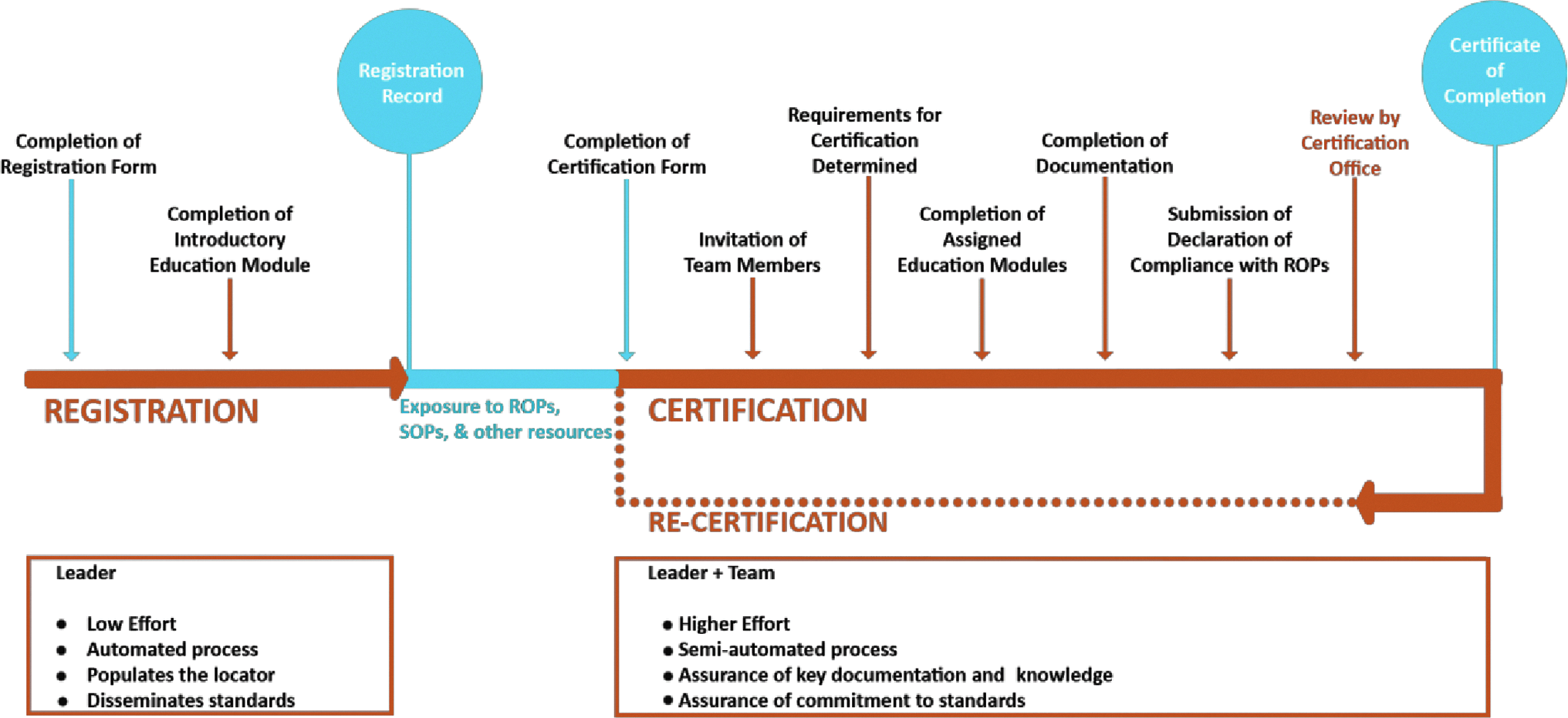
Registration and certification process diagram. Registration is a one-time process, while recertification is required after 5 years.
The second phase of the CTRNet program is the certification phase. The goal of this phase is to instill an understanding of quality and a commitment to standards. This phase involves completion of a seven-step process which includes: completion of the certification form, invitation of additional team members, recognition of the requirements for certification determined by the program, completion of assigned educational modules, provision of requested documentation, submission of declaration of compliance, document, and standards reviewed by CTRNet auditors, and following approval involves the issuing of a certificate of completion.
The Certification form requests the data provided at registration and solicits more detailed information about the biobank's operations, scale, and type; this information is used to input into an algorithm that determines the education modules that need to be assigned and completed by the biobank team and the specific documents required for review by the certification office to complete certification.
The completion of the education step involves two components. First the biobank leader enters the team member's emails, and the system generates an email invitation to each of the team members to create an account and complete assigned education modules. Second, all team members must complete the overview education module which is a base requirement for all biobanks and then other specialty modules that are assigned based on the system algorithm and the decision of the leader.
The specialty education modules expand on the overview module and are similar in presentation. They cover relevant biobanking topics, including biospecimen collection, processing, storage, and distribution, informed consent, ethics/privacy/security, facility design/safety, governance/planning, data systems/records management, and quality management/process improvement. The education stage is completed virtually and is in place to ensure that adequate knowledge is in place to assimilate CTRNet ROP standards.
The final steps to completion are the submission of a document checklist that informs the CTRNet office about the types of documentation that the biobank has in place and the submission of a selected set of documents for the CTRNet auditors to review. The documents that are mandatory include an approved research ethics certificate, a governance document/organizational chart, and Standard Operating Protocols (SOPs) covering biospecimen collection, processing, and storage. The document review stage is completed virtually and ensures that key documents are in place that conforms to CTRNet ROP standards.
Once the entire application has undergone review the CTRNet office issues a certificate which is recognized for 5 years. To maintain access to education modules and other resources, users are required to annually renew their membership in a subscription based system. After 5 years, the biobank is required to undergo recertification, which involves a modified version of the certification process.
Results
As of June 2018, 193 Biobanks have registered, and 32 of these have also been certified (Fig. 2). In addition there are another 58 biobanks in the process of registration and 45 in the process of certification (Table 2). A diverse set of biobanks are enrolled in the CTRNet registration and certification programs. Among certified biobanks 95% are associated with academic organizations and 5% with industry. Although the majority of registered banks are located in Canada and the United States, 30 are located outside of North America in 20 countries (Fig. 3).
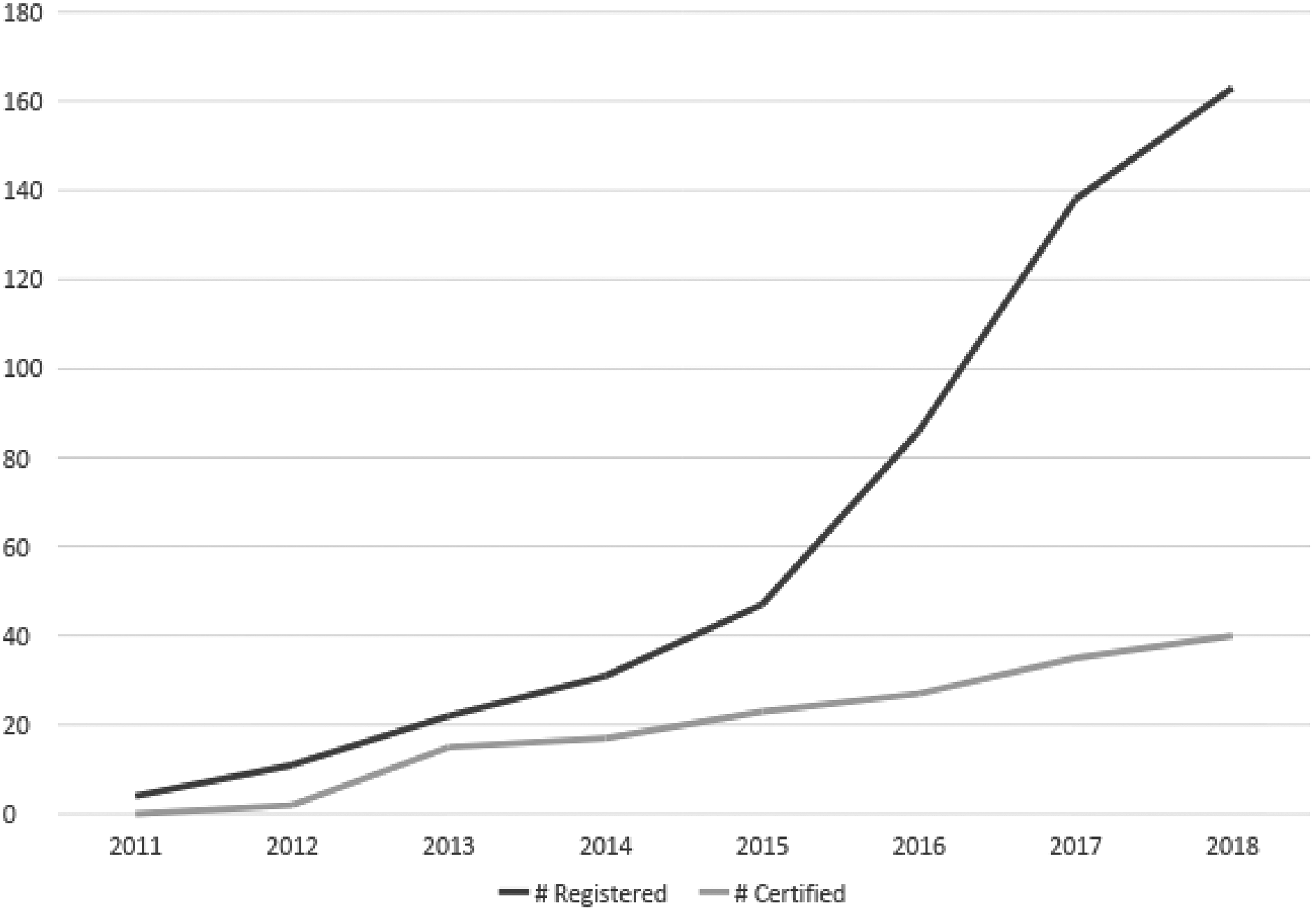
Cumulative enrollment from 2011 to 2018.
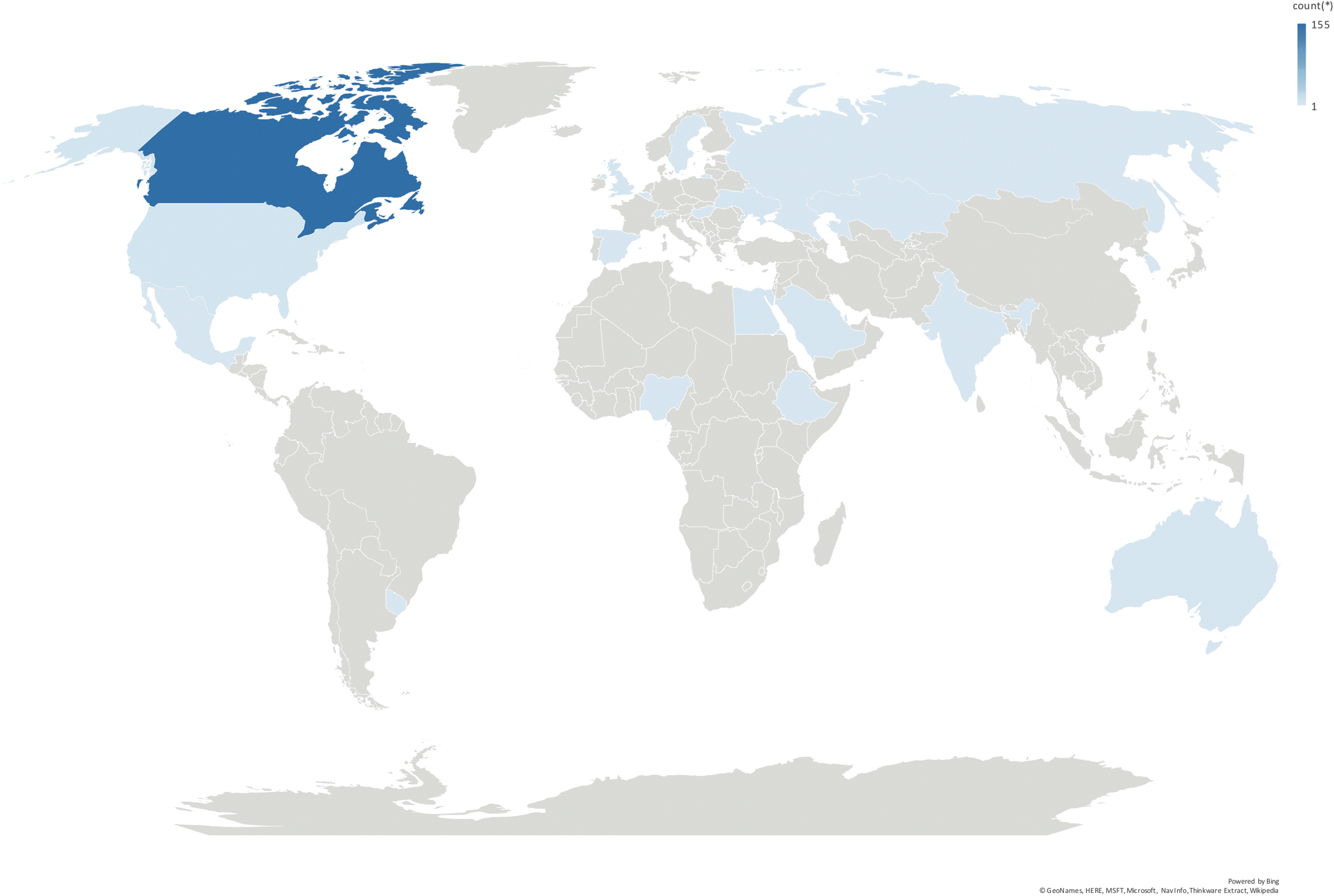
Registered biobank locations. The number of registered biobanks in each country are color coded according to the legend in the top right of the figure. For example, some countries (purple) have one registered biobank, while Canada (navy blue) has 155 registered banks.
Status of All Biobanks That Have Enrolled in the Canadian Tissue Repository Network Program
The research focus of the biobanks varies widely; cancer is the most common research focus for CTRNet registered and certified banks, making up 34% of biobanks. This focus is followed by Genetics (9%) and Circulatory and Respiratory Health (7%) biobanks. However, biobanks supporting research in all 11 categories defined by the Canadian Institutes of Health Research have enrolled (Fig. 4).
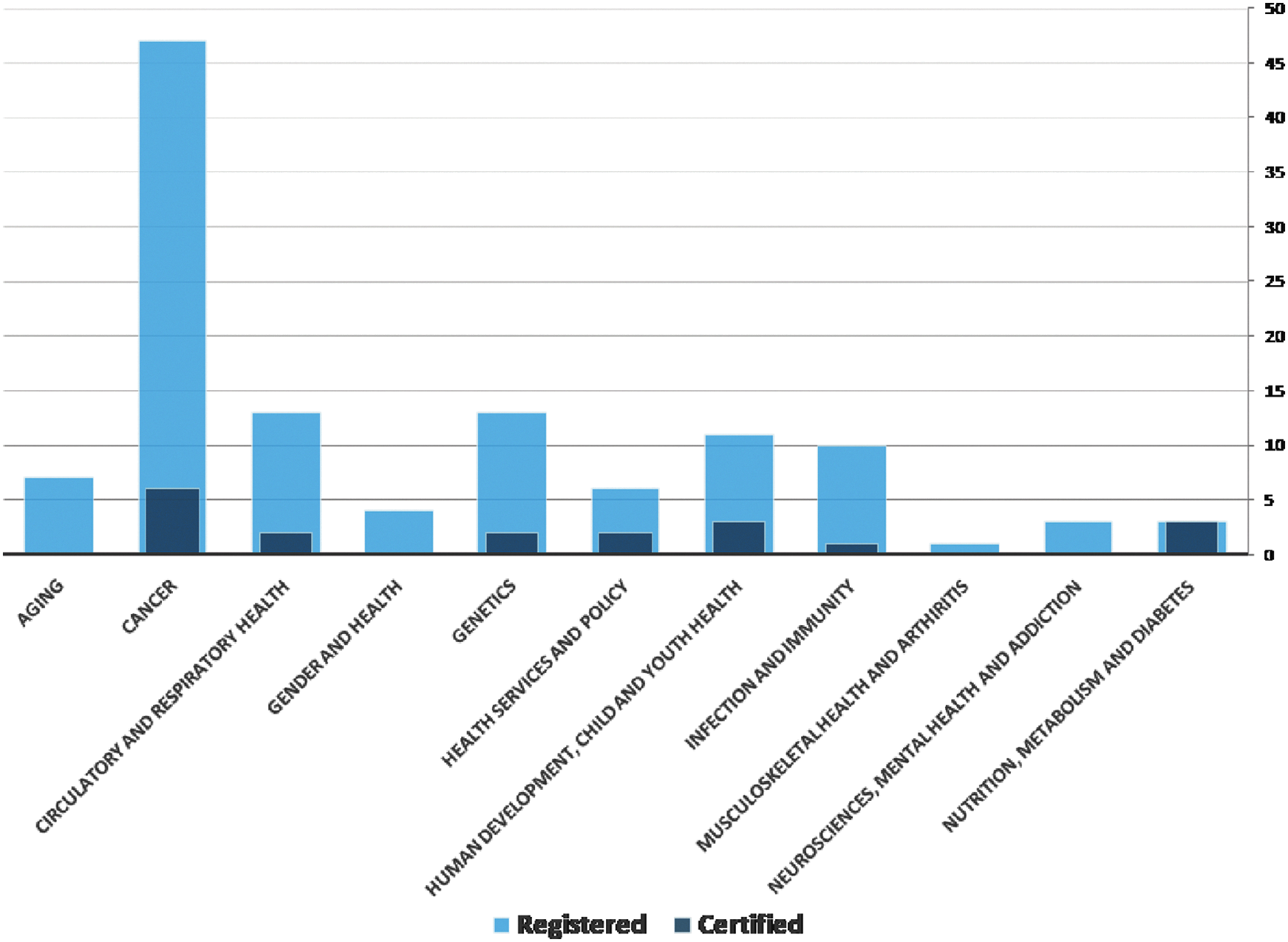
Biobank research focus categorized by CIHR category. Registered biobanks (light blue bars) and certified biobanks (dark blue bars). CIHR, Canadian Institutes of Health Research.
The average time to complete certification and registration varies between biobanks. Many biobanks complete registration within 1 day of account creation, and over 3/4 biobanks have completed registration within a week. Among biobanks that go on to the certification step, over 1/3 completed certification within a month, but some may take up to a year or more (Fig. 5).
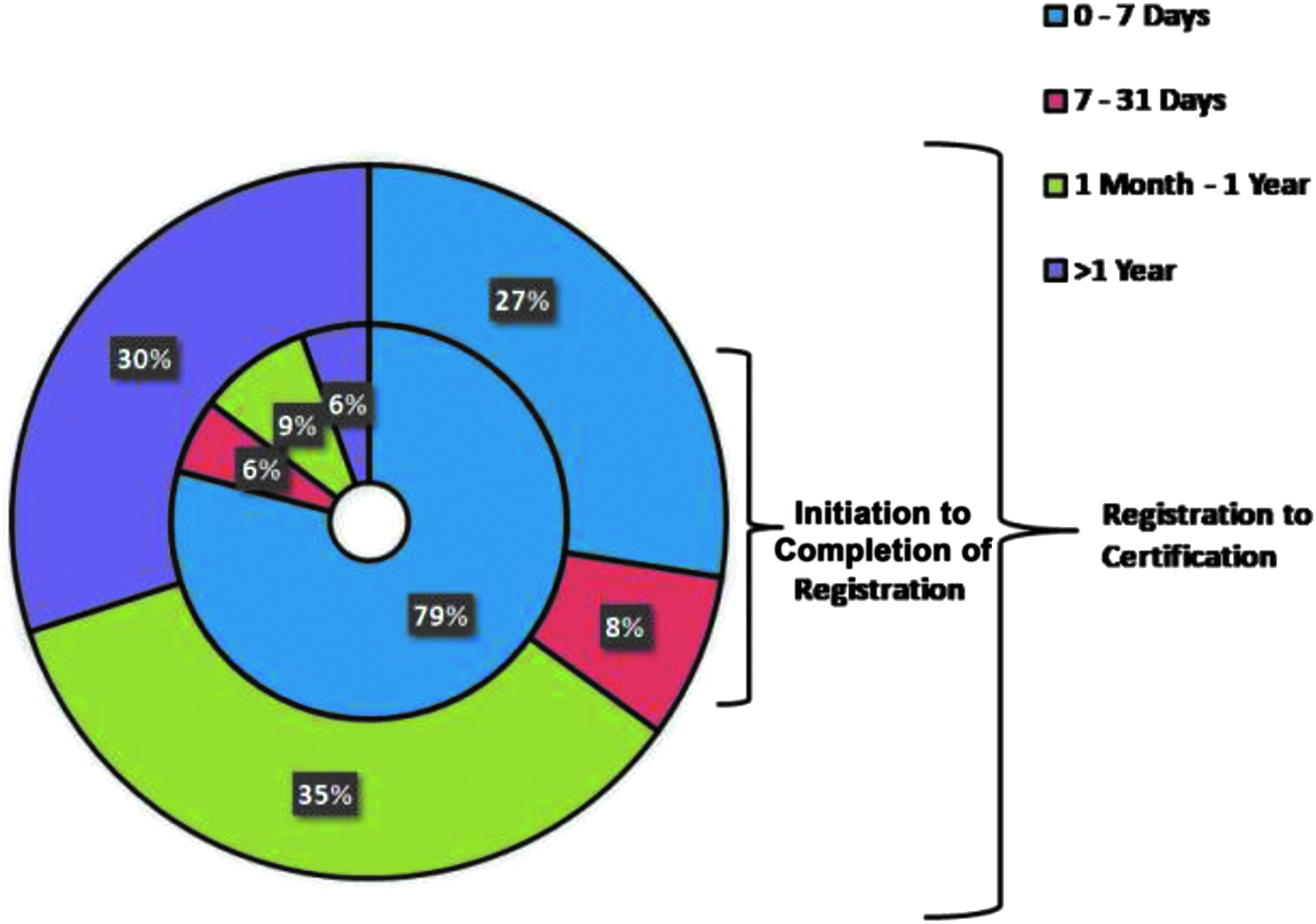
Distribution of time taken to complete registration and certification. Initiation to completion of registration to registration is displayed in the inner circle, and registration to certification is displayed in the outer circle.
Mono user biobanks are collections intended for one researcher or study; oligo-user biobanks serve several connected individuals or studies, while poly-user biobanks are intended to serve many users. These types tend to correlate with small, medium, and large size collections. 8 Other characteristics were that among registered biobanks, 11% were small (<200 cases), 27% were medium (200–1000 cases), and 55% were large (>1000 cases), while among certified biobanks the same categories comprised 0%, 25%, and 75%, respectively. These proportions corresponded to the distribution of mono-, oligo-, and poly-user biobank categories (Fig. 6).
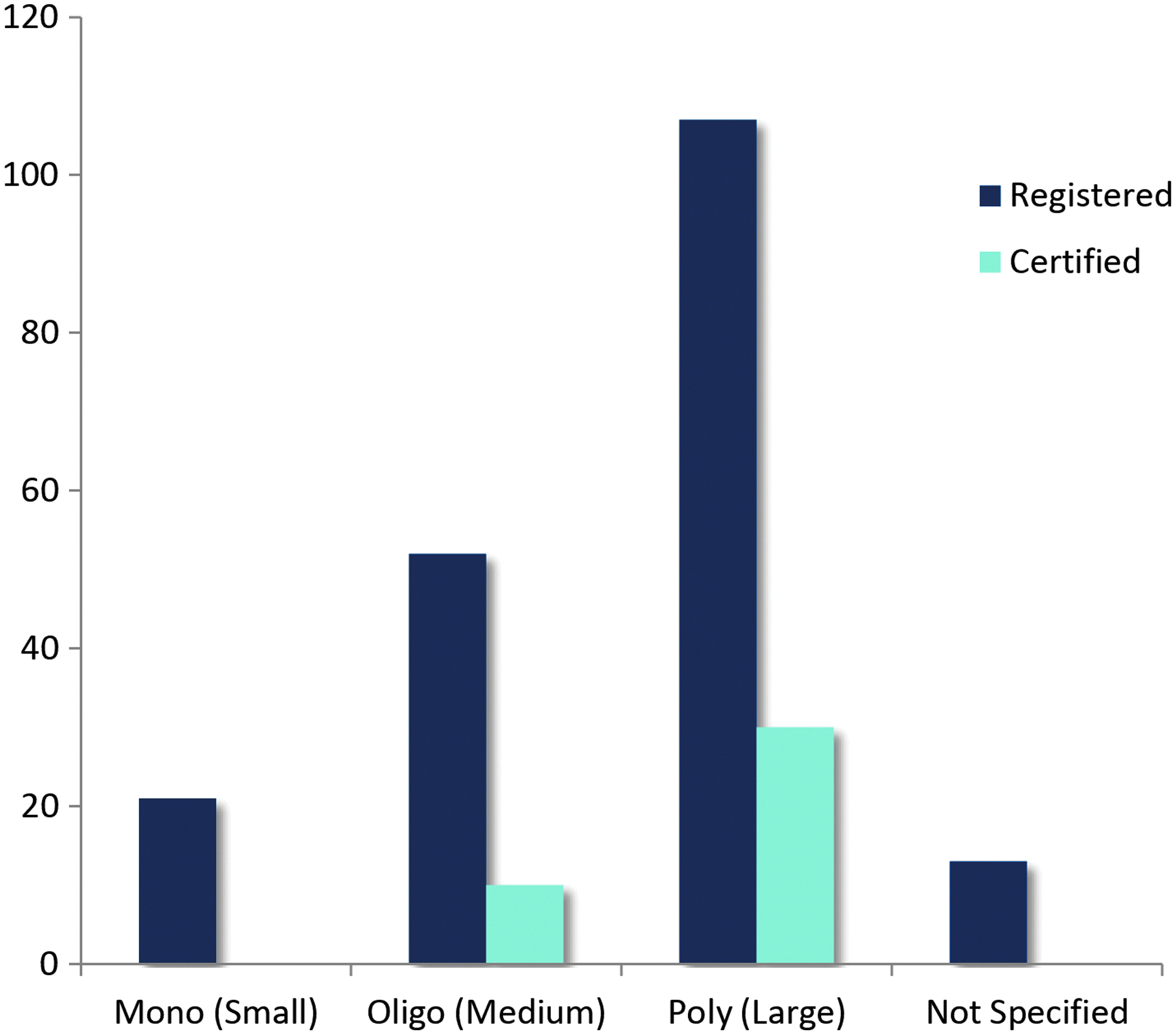
Distribution of three types of biobanks as registered or certified biobanks. Registered biobanks are displayed as dark blue, and certified biobanks are light blue. Mono user biobanks are collections intended for one researcher or study; oligo-user biobanks serve several connected individuals or studies, while poly-user biobanks are intended to serve many users. These types tend to correlate with small, medium, and large size collections. 18
The range of biospecimen types collected was very similar between registered and certified biobanks, with the rank order of frequency; blood, frozen, formalin-fixed paraffin-embedded (FFPE), and fresh tissue biospecimens were most often collected. The most common number of full and part time staff was 2, followed by 5, with a range up to 16 staff.
Determination of conformity with standards in the Certification phase involves both self-reporting and a virtual assessment by CTRNet auditors. One form of self-reporting is the completion of a document checklist, where the SOPs and forms of each biobank are recorded (Fig. 7). Some documents, such as a Consent Form or evidence of a waiver of consent granted by a research ethics committee, are common to all biobanks, while other documents, such as a formal business plan, are less common. Although the checklist is an optional step and has been formally completed by 34 biobanks, it serves as an important feedback tool to those who certify to identify and address gaps in documentation.
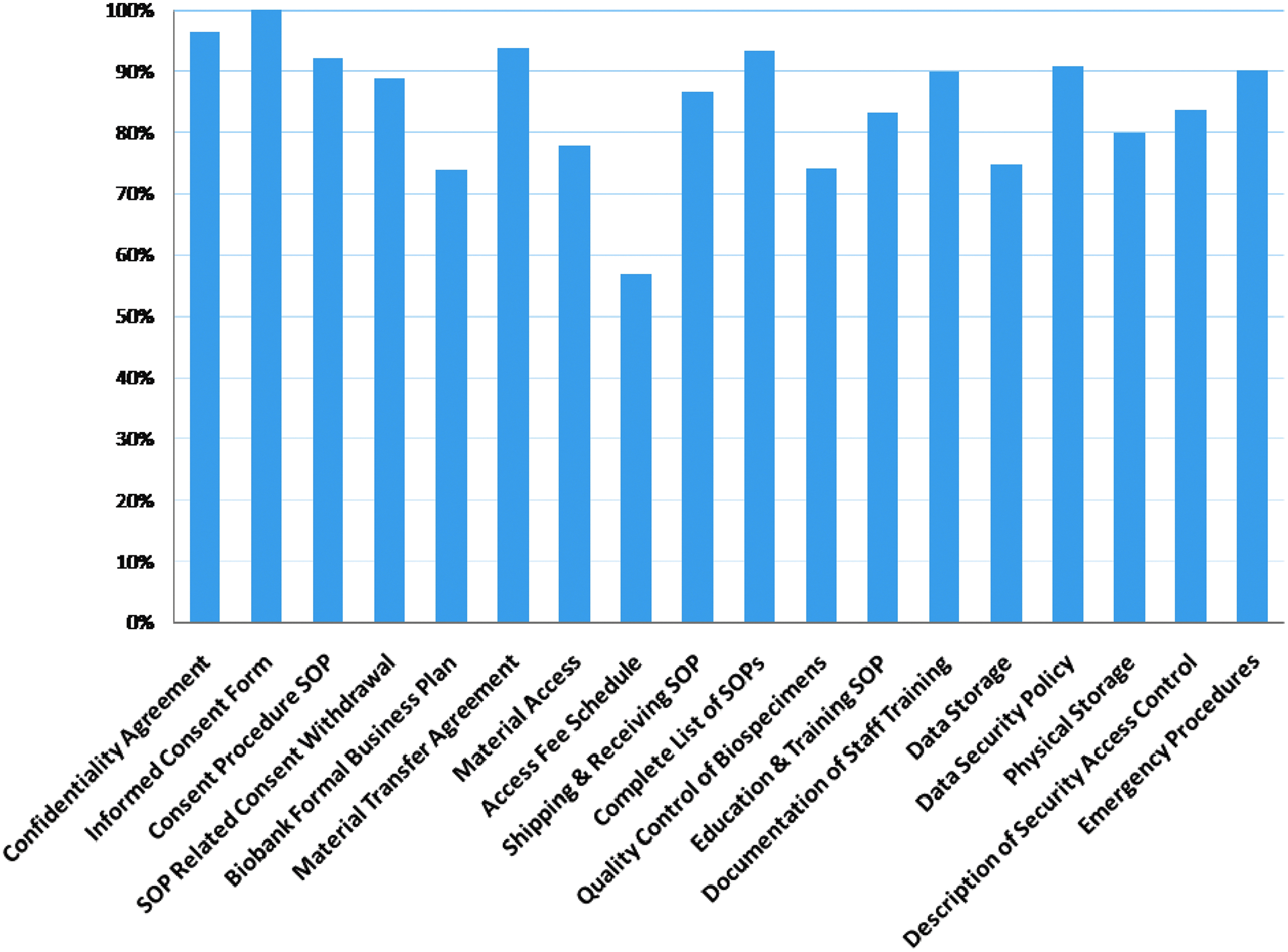
Proportions of biobanks reporting the existence of an SOP or equivalent controlled document covering 18 key operations and/or activities. Percentages are calculated from the proportion of biobanks self-reporting (yes vs. no for each document type, with N/A responses excluded). N/A, not applicable; SOP, Standard Operating Protocol.
Discussion
More than 6 years after launch the CTRNet program is thriving and continues to grow. A diverse array of biobanks has enrolled in the program nationally and internationally, from small mono-user research collections to large poly-user banks. This diversity is, in part, a reflection of the flexibility of the CTRNet program; requirements for certification are tailored to the needs of each individual biobank using a unique algorithm developed by CTRNet.
Our program is also made flexible by providing a relatively low effort process to complete registration and then the more extended full certification phase. This way, one designated individual from the biobank can access basic education, CTRNet ROP standards, and other resources with relatively low effort without paying a fee. The option to certify the bank can be taken at a later date. Overall 30% of biobanks have registered complete certification more than a year after initial registration, attesting to this flexibility.
Although no biobanks have withdrawn from the program after certification, some attrition of biobanks reflected in suspended activity does occur during the registration and certification phase. Overall 18% (46/251) of biobanks did not complete registration 1 year after creating an account, and 25% (21/85) of biobanks that had completed registration and began the certification phase have been inactive for over 2 years. We consider these as “lapsed” biobanks, as they have been inactive for a longer period than is reasonable to complete registration or certification, respectively.
There are likely several reasons for these lapses, including inertia by the biobank and also loss of funding and change in research direction. The initial impetus also varies, from a decision by the biobank to certify to improve their biobanking processes to a need by the biobank to satisfy a requirement laid down by an ethics review board or funding agency for enrollment in an external and quality assurance program. In the later case completion of certification may be deferred while awaiting confirmation of funding.
Strengths of the CTRNet certification program
The strengths of CTRNet Certification program include an emphasis on understanding standards through education, the ease of self-reporting and the benefit of virtual audits from an expert team, and the linkage to many resources made available to certifying biobanks. CTRNet's ROP standards are derived from international best practices,3,6 and the emphasis on the linked education means that biobank teams are not only being assessed but also are actively engaged in a process that increases their knowledge related to standards and the quality of their biospecimens. Virtual assessment of biobank documents enables CTRNet to keep the overall certification program costs low while offering support.
In addition, in the course of the process of certification, biobank staff can become familiar with navigation of the Biobank Resource Center that offers many tools for biobanks to use on an ongoing basis, including a biobank locator to list available resources for researchers, a cost calculator, SOPs and other document templates, a BRISQ biospecimen data reporting tool, and an open source biospecimen database (ATiM) developed and supported by CTRNet.
Maintenance of the program and cost of individual biobank certification
The core components of the program include the 13 ROPs and 53 SOPs, a data definition system, an online enrollment system (with data forms and decision algorithms to classify biobank types), an online education course (with 9 modules of education content), and the website and server infrastructure supporting the resource center (with documents, tools, and templates). The capital cost to create this was approximately $1.3M CAD invested over more than 3 years.
The maintenance of these core components involves periodic (every 3–5 years) review and update of ROPs/SOPs and education content and resource materials (to stay current with international best practice standards as these are updated) and periodic updates to web portal IT systems (to ensure ongoing web security and functionality), as well as server costs.
The cost to operate the program differs for the two phases. The first registration phase was intentionally designed to be a largely automated process. As such it has been possible to operate this phase with relatively low system costs and to offer individual enrollment with no fee. This has been important for some stakeholders, such as research ethics boards, as it allows the requirement to enroll at least into the registration phase to be mandated. The second phase was also intentionally designed to be semi-automated with both self-assurance and external party review components. This means that this phase operates with only moderate additional system costs and that we are able to offer individual biobank certification at a low fee.
The overall cost to the biobank to complete certification includes the initial enrollment fee of $150 CAD for Canadian academic biobanks and PI/staff time costs to the biobank in preparing the application and completing the education. 10 The program is also accessible at a slightly higher cost for academic biobanks in North America and internationally. The program is also available for industry biobanks. The time costs to the biobank include staff hours/time to complete the forms, the education modules, and provide documents and responses to auditor's comments. The time to complete each of the education modules varies widely. The two examples that follow are intended to provide the reader with an overview of the time and effort required to complete certification process for two different kinds of biobanks.
Example 1 is a (mono user) biobank with one PI and one research technician that aims to collect 150 samples for a single study that has been granted a waiver of consent and does not store personal identifiers of participants. It could take up to 6 hours to complete the required education. (The PI and the staff member may each take 3 hours for the Intro Module = 6 hours).
Example 2 is a more complex (poly user) biobank: This biobank has a PI and five staff members and consents participants for current studies and unspecified future research. The biobank aims to collect 5000 biospecimens and stores personal data from participants for more than 1 year and shares samples and data with researchers from all over the world. This bank can take up to 26 hours to complete the education. (The PI and the five staff may each take 3 hours for the Intro Module = 18 team hours. In addition at least one staff member must complete each of the relevant assigned specialty modules = 8 hours).
The PI or a staff member may also have to create or update documents for review by the certification auditor. The time to complete the documents for review and respond to the auditor's comments depends on the preexisting alignment of the biobank processes with best practices, certification requirements, and the maturity and complexity of the biobank. The document review of a biobank with well-organized documentation aligned with best practices and certification requirements can take as little as 1 hour to submit for review and respond to any reviewer's comments. A biobank with no formal documentation would have to create all the documents for submission and this is typically associated with a much lengthier auditing review process. The certification is valid for 5 years, and the cost to maintain it is $150 CAD per year.
While improving quality and standardization of biobanks in and of itself is widely regarded as worthwhile, there are always costs and trade-offs involved either for the research system that funds biobanking or the biobank or the end user. Therefore examination of the value and costs/benefits of all forms of both internal and external qualify assurance is important to consider. While there is currently little information on this topic in the biobank literature, Ling et al. have published a detailed economic analysis of New South Wales biobank certification program, which is an adaption of the CTRNet certification program. 11
Conclusion
Over time the acceptance of the CTRNet program by funders, institutions, researchers/research networks, and biobanks has increased regionally, nationally, and internationally. For example, in the province of British Columbia, Canada, most (14/16) research intensive universities, health authorities, and research institutes have endorsed and adopted requirements for enrollment in the CTRNet Certification program. Among research funders, three major Canadian cancer research funders (TFRI, CCSRI, and CRS12–14 ) have all implemented a requirement that researchers provide evidence of registration in the program (or an equivalent program) as a condition of funding for all new research projects involving the use of biospecimens.
In addition, several adaptations of the program have been created and launched for other regions and stakeholders. The certification program has been adapted by New South Wales (NSW) Health Pathology for biobanks and also pathology laboratories in NSW.15,16 The planning for the expansion of the registration phase of the program throughout Australia began in late 2018. The registration phase of the program has also been adapted for the Canadian Cancer Clinical Trial Network to ensure that staff at clinical trial sites across Canada (clinical trialists and coordinators) are familiar with biobanking best practices for samples collected in clinical trials. 17
Some of this growth in acceptance of the CTRNet program is because it is applicable to a broader spectrum of types of research biobanks. Unlike other programs, it arose out of a strategic priority of a national strategy for cancer research and so was developed to meet the requirements of an alliance of cancer research funders. 7 These priorities included improving access to, as well as quality of, biospecimens and ensuring applicability of the program across all forms of research collection and types of biobank. This has required development of a flexible, scalable, and accessible program based on standards applicable to the full range of research biobanking 8 and integrated with a strategy to enhance access.
But although other current (CAP) 18 and currently being implemented (ISO) external quality assurance programs differ in delivery approach, level of conformity assessment, the focus of the associated standards, and the types of biobank that have or are anticipated to enroll, we believe that they are very complementary. Based on the current status of implementation in several regions and areas of research, enrollment of all forms of biobanks into a program such as the CTRNet program might be considered as mandatory for registration and strongly encouraged for certification for larger biobanks. This would harmonize the foundations and prepare biobanks for the different levels of conformity assessment involved in CAP and/or ISO programs, which might be strongly encouraged for specific categories of biobank based on their size, type, and end user/customer requirements.
Footnotes
Acknowledgments
CTRNet is funded by grants from the Institute of Cancer Research—Canadian Institutes of Health Research and the Terry Fox Research Institute, and the current nodes have received support from members of the Canadian Cancer Research Alliance, including the Cancer Research Society and the Réseau de recherche sur le cancer of the Fonds de recherche du Québec–Santé.
Author Disclosure Statement
No conflicting financial interests exist.