




Abstract
Human biobanks are collections of biological samples and health information that allow the organization of biomedical research for upgrading the knowledge of human disorders from different diseases (cancer, allergies, rare diseases, etc.), and reach real answers for diagnosis and treatment. A wide range of samples can be stored in these biorepositories such as hair, nails, urine, tissue, whole blood, red blood cells, buffy coat, plasma, serum, DNA, and RNA. Among these, buffy coat and whole blood are widely used by researchers because they can obtain DNA and RNA from these matrices. Some preliminary studies have been performed on animals to evaluate the quality and functionality of the nucleic acids obtained from some of these matrices, although more in-depth studies are needed in this area. In this study, blood samples extracted by venipuncture from 30 healthy volunteers were used to obtain DNA from buffy coat and whole blood. The purity and integrity of the nucleic acids obtained were assessed by spectrophotometry, fluorimetry, and agarose electrophoresis, and functionality was assessed by PCR and real-time PCR. Another aspect tested in this study was based on the comparison between short-term and long-term storage at −80°C and fresh samples from both matrices to evaluate the storage conditions at the biobank. Results showed differences in the yield obtained from both matrices as a function of the storage time, although the functionality of all the obtained DNA remained intact.
Introduction
The great advances made in the field of molecular biology in recent decades have allowed researchers to discover precise answers to different pathologies and hence discovering new therapeutic targets and entering the era of personalized medicine. Therefore, it has been necessary to create infrastructures that are responsible for processing and handling biological samples, as well as the clinical information associated with these samples.
In this context, human biobanks have been created as biorepositories of collections of biological samples and health information. These entities are very useful tools that have helped biomedical research in improving the knowledge of different human diseases such as cancer, allergy, and rare diseases, thus reaching answers to current problems in diagnosis and treatment. A wide range of samples can be stored in these biorepositories, including hair, nails, urine, tissue, whole blood, red blood cells, buffy coat, plasma, serum, DNA, and RNA. 1 Among these types of samples, nucleic acids are widely used in biomedical research, even though some previous studies in animals and humans have shown that the functionality and quality of the extracted nucleic acids can be affected depending on the matrix through which the samples were obtained.2,3
Another important point to keep in mind about biorepositories is the quality and functionality of the samples stored, as well as the correct handling procedures after the storage. The development of standardized work protocols aids in obtaining high-quality samples that assist in obtaining reliable results in research studies. To slow down cellular metabolism and keep cellular characteristics intact, freezing is one of the options used in the preservation of samples. Mainly, for the conservation of nucleic acids, the range of temperatures used is −20°C for DNA molecules4,5 and −80°C for RNA molecules. 6 However, some studies carried out in this area show that modifications at the protein and genetic levels can be observed in samples stored cold for long-term periods. Changes in protein 7 and gene expression 8 levels have been observed after a period of freezing, so knowing the matrices that are less affected by this factor during the samples' storage is of great interest to the scientific community. In fact, to minimize the modifications produced by freezing or other conditions in stored samples, the International Society for Biological and Environmental Repositories, the National Cancer Institute, and other organizations have drafted best practices for collection and storage of human bioresources. 9
In this context, we have recently performed in the Andalusian Public Health System Biobank (BBSSPA), at the peripheral headquarters located in the Regional University Hospital of Malaga, a study with whole blood and buffy coat samples extracted from 30 healthy volunteers.
From these matrices, DNA extraction has been carried out to evaluate its performance, quality, and functionality according to the original matrix, and the influence of storage, in ultrafreezers, of these samples has been evaluated.
Overall, this study shows that both matrices are optimal for DNA extracts with high quality and functionality, but it has been observed that storage in the short or long term causes a decrease in yield, with this decrease being more severe in one matrix than the other one.
Materials and Methods
Subjects
Blood samples were obtained from 30 healthy subjects provided by the BBSSPA located at the Regional University Hospital of Málaga. Samples were withdrawn from the antecubital vein by venipuncture, and for each volunteer, six 3.5-mL acid–citrate–dextrose (ACD)-containing BD Vacutainer ACD solution A blood collection tubes (Becton Dickinson and Company, Franklin Lakes, NJ) were collected.
All enrolled subjects provided their written informed consent, obtained from the BBSSPA located in Málaga and approved by the Ethics Committee of Clinical Research from the Provincial Ethics Committee of Malaga. The study was carried out in accordance with The Code of Ethics of the World Medical Association (Declaration of Helsinki).
Sample processing
After blood collection, two citrate tubes for each volunteer were processed immediately, while the other four tubes were stored at −80°C until use.
For DNA extracted from whole blood, ACD tubes were stored at −80°C for a month or a year, and a citrate tube was processed immediately (see protocol below).
For DNA extracted from buffy coat, all ACD tubes were centrifuged with refrigeration at 1000 g for 20 minutes to eliminate the plasma. After the buffy coat was obtained, it was transferred in a new sterile tube and stored at −80°C for a month or a year. A buffy coat was also saved, to be processed immediately (see protocol below).
DNA extraction
DNA was extracted from 3.5 mL of whole blood and buffy coat using the commercial Gentra Puregene Blood Kit (Qiagen, Hilden, Germany) following the manufacturer's instructions. During the extraction process, a treatment with RNase A solution (Qiagen) was performed following the manufacturer's instructions. After extraction, samples were resuspended at 250 μL of sterile ultrapure water and stored at −80°C until use.
DNA purity and integrity from whole blood and buffy coat
DNA purity was analyzed by spectrophotometry using a NanoDrop 2000 (Thermo Fisher Scientific), considering optimum those samples that presented a ratio of 260/280 superior at 1.8 and a ratio of 260/230 superior at 1.9. An aliquot of each DNA sample on a denaturing agarose gel stained with SYBR Safe (Invitrogen) was used to assess the integrity of the samples. In addition, DNA was analyzed using the Quant-iT™ PicoGreen® dsDNA assay to determine the concentration of double-stranded DNA (dsDNA). 10
To verify the presence of dsDNA, 250 ng of DNA from each year studied was incubated with the restriction enzyme EcoRI (Hoffmann-La Roche, Switzerland) at 37°C for 2 hours. Results were evaluated on a 2% agarose gel stained with SYBR Safe.
DNA functionality
DNA functionality was evaluated by PCR amplification or real-time PCR assay.
For PCR amplification, fragments of 3396 and 429 bp from HGH and HLA genes, respectively, were amplified. PCR for the HGH gene has been previously published by Ortega-Pinazo et al. 11 Briefly, PCR mixtures for this gene contained 2.5 μL of 10 × VWR polymerase buffer (VWR International Eurolab, Spain), 0.2 μM of each primer forward and reverse, 1 μL containing 25 ng of DNA, and sterile ultrapure water to a final volume of 25 μL. The amplification program was carried out in a Veriti Thermal Cycler (Applied Biosystem) as follows: 1 cycle at 94°C for 5 minutes; 40 cycles with steps at 94°C for 30 seconds, at 58°C for 1 minute, and at 72°C for 30 seconds; and a final cycle at 72°C for 7 minutes. For the HLA gene, the SBT excellerator HLA kit was used following the manufacturer's instructions (GENDX, Portland). The amplification program was carried out in a Veriti Thermal Cycler (Applied Biosystem) as follows: 1 cycle at 95°C for 3 minutes; 35 cycles with steps at 95°C for 15 seconds, at 65°C for 30 seconds, and at 68°C for 5 minutes; and a final cycle at 68°C for 10 minutes. In both cases, PCR products were evaluated on denaturing agarose gels stained with SYBR Safe.
For the real-time PCR assay, 25 ng of DNA from each sample was amplified for the GAPDH gene, obtaining a PCR product of 87 bp in a LightCycler 96 System using the FastStart Essential DNA Green Master kit (Hoffmann-La Roche). A negative control was included in each assay. For each sample, duplicate determinations were made, and the Ct value was analyzed. The primer sequences for real-time PCR were as follows: forward 5′-TGCACCACCAACTGCTTAGC-3′ and reverse 5′-GGCATGGACTGTGGTCATGAG-3′.
Graphs and statistical studies
All graphics were performed with the Excel program. The numerical values represented in the graphics correspond to the mean and the bars to the standard deviation (SD). In the numerical charts, the values are represented as mean ± SD.
Statistical studies were performed using SPSS version 11.1 and R program. For the contrast of independent continuous variables (that responded to normal distributions), one-way repeated-measures analysis of variance (ANOVA) test or Student's t test was used. In these analyses, the mean difference was significant at the 0.05 level and a power of 80% was established.
The degrees of statistical significance were *0.01 < p ≤ 0.05; **0.001 < p ≤ 0.01; and ***p ≤ 0.001.
Results
The purity and functionality indicators in DNA samples isolated from whole blood and buffy coat were analyzed. The 260/280 purity ratio was obtained for each DNA sample, with the average value between 1.8 and 2.0 for both groups (Table 1). The data obtained from PicoGreen (PG) analysis showed the presence of dsDNA in all samples studied, and the ratio PG/NanoDrop (ND) was between 85% and 100% for both groups. In these parameters, significant differences were found for the buffy coat when the ratio PG/ND was compared with whole blood and with the storage time (p < 0.05). On the contrary, the 260/230 purity ratio, although was similar in fresh samples for both matrices, showed a decrement with respect to storage time, reaching values around 1.40 after 1 month of storage in the case of buffy coat (Table 1). Significance differences in pairwise comparison were found for both sample type (buffy coat/whole blood) and storage time for this ratio, with p < 0.001 at all points studied.
Comparative Values of Spectrophotometry with NanoDrop and Fluorescence Quantification with PicoGreen of DNA (Expressed as Mean ± Standard Deviation), Ratio 260/280, Ratio 260/230, and Ratio of NanoDrop/PicoGreen in Fresh and Long-Term Stored Samples from Whole Blood and Buffy Coat
SD, standard deviation; ND, NanoDrop; PG, PicoGreen.
On the contrary, differences in extraction yield were found depending on the type of matrix and the storage time. In fresh samples, no differences were found for both matrices (Table 1; Fig. 1), but when samples were stored for a month, a decrease of 46.3% and 78.6% (photometry) or 48.2% and 79.77% (PG) in the yield extraction was observed for whole blood and buffy coat, respectively. This decrease was constant in samples stored for a year for both matrices. The samples studied showed a higher yield of DNA extraction in those samples from whole blood, as can be seen in Figure 1. One-way repeated-measures using ANOVA indicated significant differences in pairwise comparisons both for the sample type assessed (buffy coat or whole blood) and the storage time (p < 0.001, F = 89.87).
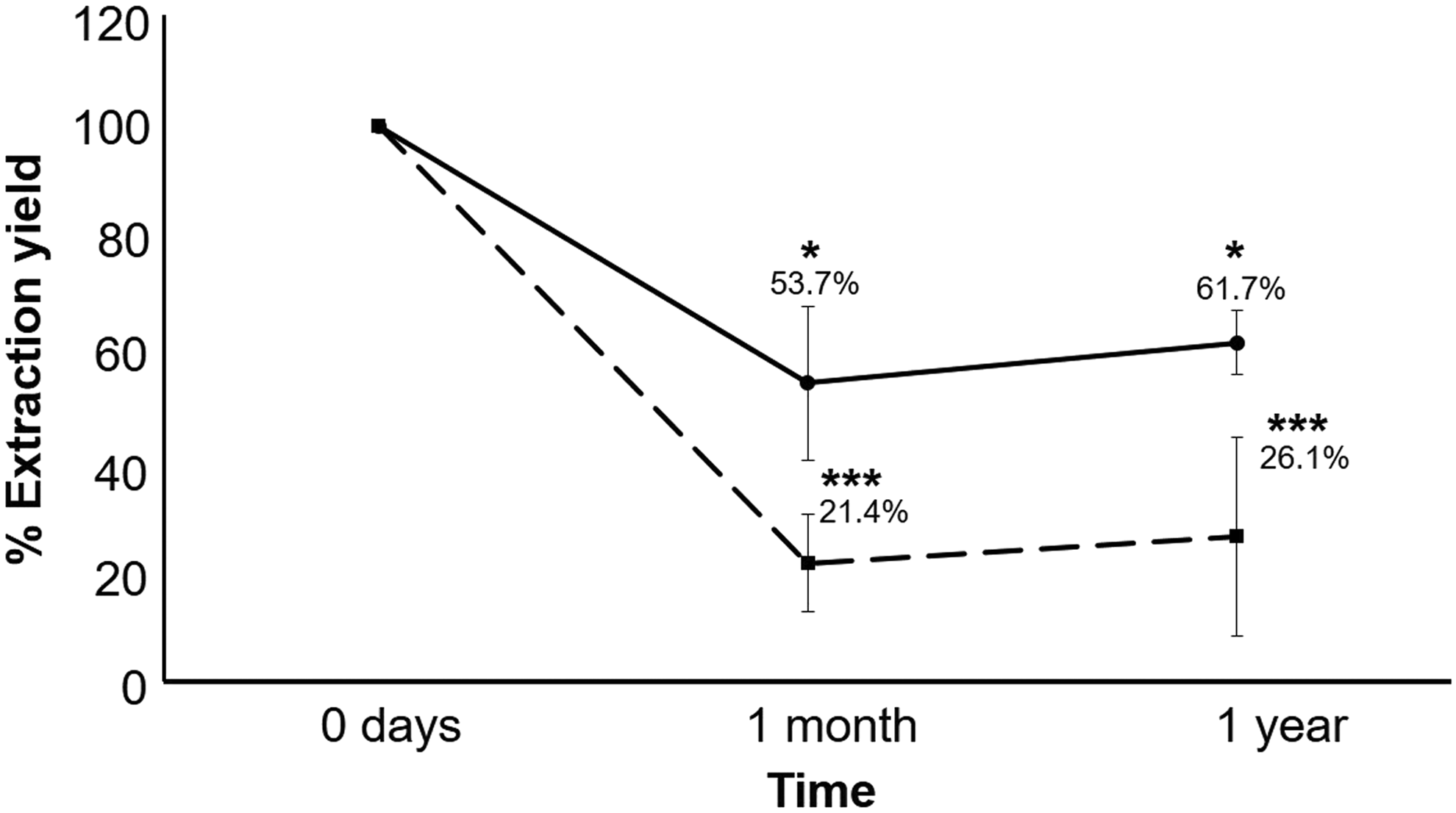
Yield of DNA extraction in samples from whole blood (
To verify the purity of the DNA obtained from all samples, an integrity analysis was performed using agarose gels of 0.8%. Gels showed an optimal integrity of the nucleic acids in all cases, regardless of the type of matrix and the storage time of the samples, as seen in Figure 2A, with bands of size around 23,130 bp.

Integrity of DNA extracted from BC and WB of samples stored for a month and a year.
On the contrary, to verify the results obtained previously about DNA integrity by fluorometry and the ratio between both absolute yields by PG and by spectrophotometry (Table 1), samples from each matrix and stored time were taken and digested with the restriction enzyme EcoRI, observing the disappearance of the genomic DNA band and obtaining a smear, which indicated that the DNA extracted for all the cases studied corresponded to dsDNA (Fig. 2B).
To determine the usability of DNA samples for downstream applications, a conventional PCR and a real-time PCR were performed. The conventional PCR was carried out by amplifying a fragment of 429 and 3396 bp from HGH and HLA genes (Fig. 3A, B). The real-time PCR assay was performed for the GAPDH gene (Fig. 3C). All samples tested were positive for the genes studied. An amplification band of the desired size and similar Ct values were obtained in all cases, regardless of the type of matrix and the storage time of the samples. No significant differences were found between all cases studied.
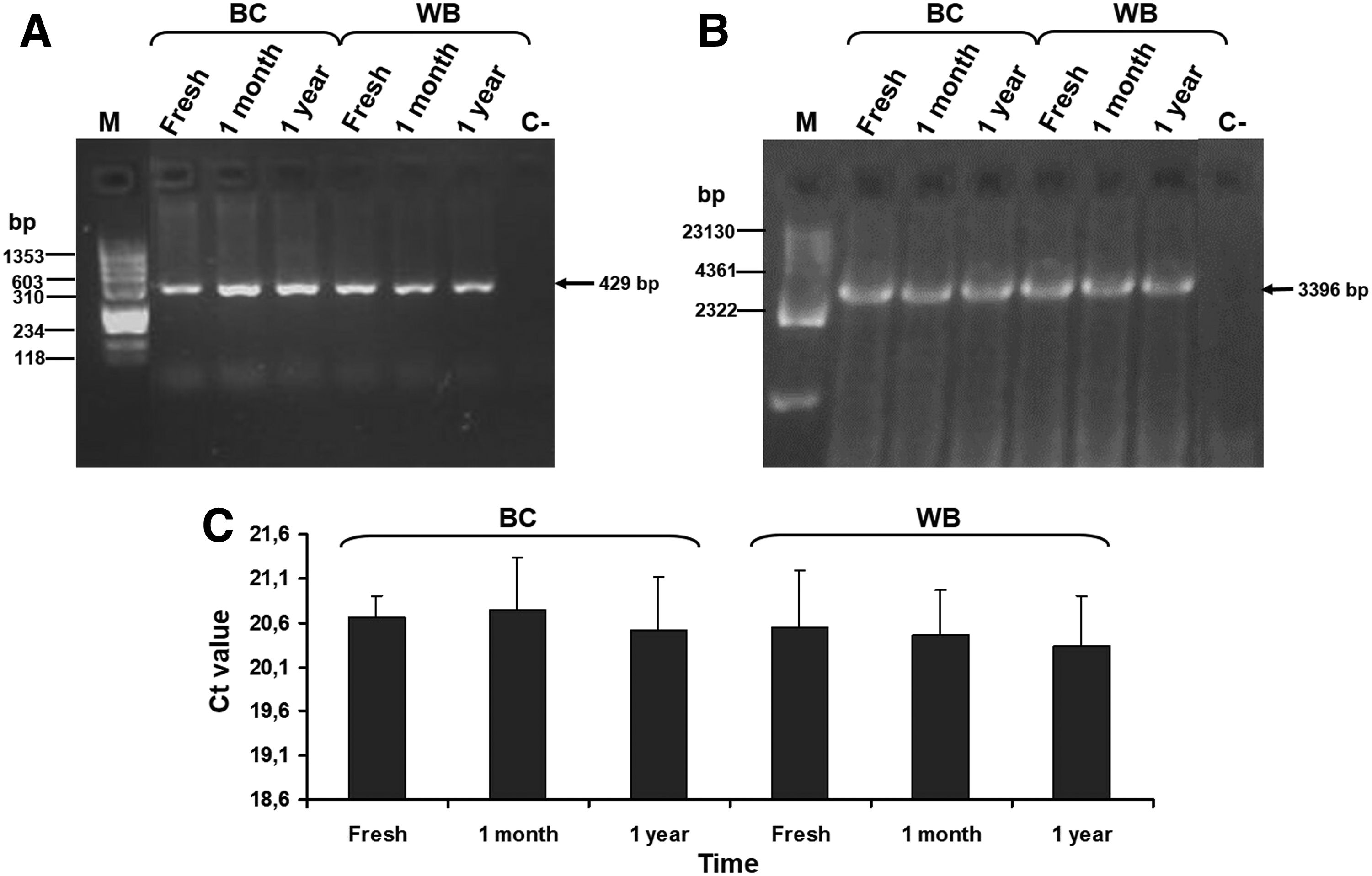
Functionality of DNA extracted from BC and WB samples stored for a month and a year.
Discussion
Obtaining high-quality DNA is essential to achieve optimal results in biomedical research. Due to the development of techniques that have allowed optimizing the quality and functionality of the DNA obtained from different matrices, molecular biology has experienced in the last decades an exponential advance, increasing the knowledge in the scientific community. 12 Nowadays, obtaining DNA can be realized practically from a biological matrix. 1 However, not all of these matrices provide high quality and good functionality for nucleic acids.2,3 For this reason, it is interesting to carry out in-depth studies in these matrices to know the potential of each one, and in this way, give information to researchers about which are the best options to use depending on the line of research being developed. Among the matrices most used by researchers to obtain high-quality DNA, we studied whole blood and buffy coat. This work focused on the assessment of nucleic acid performance, quality and functionality obtained from these two matrices, and if the storage time influenced the characteristics of the DNA obtained.
Previous studies carried out on fresh and 24-h frozen samples of whole blood and buffy coat showed that the total blood yielded better results in all the cases studied. 3 Other studies showed that whole blood obtained from ethylenediaminetetraaceticacid (EDTA) tubes and stored for 10 months, reached a DNA extraction yield percentage about 11.3% when compared with fresh samples. 13 The results obtained in our study showed no significant differences between both matrices for fresh samples, although a relative higher yield was observed in whole blood. This was probably due to the high dispersion of the samples in whole blood. On the contrary, the yield percentage obtained in samples stored after 12 months was higher than 60% for whole blood and 25% for buffy coat. In addition, the yield obtained for whole blood was similar to what was published by some authors3,14,15 and higher than the data published by others,16,17 while the yield obtained for buffy coat was higher than the 40.4 μg/5 mL published by Gail et al. 3 for dsDNA. In the case of buffy coat, this could be produced by the processing protocol of the samples and the type of kit used in DNA extraction and purification, or by the type of extraction tube; although studies with different additives have been performed on samples stored for 7 days, no difference has been found. 17 Therefore, as previously proposed by these researchers, it would be interesting to carry out a study with different kits in both matrices to assess the possible differences in the extraction process, as well as to assess different sample collection tubes since it is known that, for example, EDTA could affect the functionality of nucleic acids extracted, because it acts as a chelating agent and high levels could produce an incomplete amplification during the PCR process. 18 However, some preliminary studies on DNA obtained from plasma showed that an EDTA tube is better than one of heparin or citrate. 19 Thus, the study of DNA extracted from collection tubes with different additives in various kits in samples stored for long term, could be of great interest. Another factor that could affect the yield obtained could be the eluant used in DNA extractions. Elution buffer from the kit could inhibit some processes such as PCR protocols or restriction enzyme digestion, among other processes. Because of this, some researchers prefer water as eluant. However, water could produce degradation due to acid hydrolysis. Results obtained in this work show that no differences were found with respect to other DNAs eluted with Tris buffer, when DNAs are assessed in short term.3,14,15
In relation to the storage time, when our samples were stored for at least 1 month, significant differences were observed in relation to the yield obtained and the 260/230 purity ratio for both matrices, being better in whole-blood samples, and in agreement with previous studies performed in samples of whole blood, fresh or stored for 24 h, 3 although the data obtained were superior to those obtained by other authors in samples stored for 7 days. 18 The 260/230 ratio is used as a secondary measure of nucleic acid purity and it is expected that the 260/230 values will commonly be in the range of 2.0–2.2, so lower values indicate salt and/or contamination of alcohol in the samples and could be a problem in the sequencing processes, 20 for example. Therefore, it seems that the storage at −80°C could influence the yield of the DNA, depending on its original matrix, and could cause a high reduction in the usability of the process during nucleic acid extraction, and in the quality of the extracted DNA, depending on the original matrix. On the contrary, it seems that the presence of plasma could help in the sample preservation in cold conditions, allowing for obtaining a higher yield and a DNA of better purity, according to what the 260/230 ratio indicates.
However, despite the differences found in the yield DNA and the 260/230 purity ratio, all samples studied had a 260/280 ratio higher than 1.80 regardless of the original matrix, which indicates the absence of protein contamination in the samples. These data are similar to that obtained by other researchers for samples of whole blood or buffy coat studied separately,3,13 and show that the original matrix does not alter the 260/280 purity ratio of the nucleic acids obtained.
The PG/ND ratio, which is a quality indicator for DNA extraction, was greater than 80%, indicating that the DNA obtained was of high quality, and so, the protocol followed in these samples is better compared with that published by other authors such as Lucena-Aguilar et al., 21 who achieved a 67% ratio for whole blood. 22 However, this ratio was lower for buffy coat samples stored for a month and 12 months, and showed statistical differences when compared with fresh samples (p < 0.05). Integrity was evaluated by quantification with PG and agarose gel, showing very similar results in both matrices and was in agreement with data published by other authors about the integrity of whole-blood samples on agarose gels. These results showed that there was no degradation in the samples processed regardless of the storage time or the original matrix, despite the reduction of extraction performance due to storage time.
Functionality studies showed that all DNA samples were functional when assessed both by PCR and by real-time PCR, as has been observed in other studies on similar matrices.3,13,14,22 These results show that, although there is a decrease in yield related to storage time, DNA could be equally viable even for PCR fragments greater than 3000 bp, although it would be interesting to do wider genome studies to verify that the decrease in this yield does not cause the loss of some specific genomic regions.
Our findings have important implications for the handling of anticoagulated whole blood or buffy coat for biomedical studies. Some previous studies have been performed in whole blood and buffy coat for short-term storage, 3 but no comparative studies of both matrices from the same volunteers have been reported in samples stored for long term, so this study has that added value. The data obtained show that the storage time produces a significant decrease in the yield of DNA extractions, so it would be advisable to process the samples as soon as possible and preserve the DNA at −20°C or −80°C as there are studies that show its stability over time.23,24 Otherwise, whole blood is recommended as a preservation matrix.
In summary, the study conducted here on DNA samples obtained from two matrices conserved for a year showed relevant results that would recommend, in short-term or long-term storage sample cases, choosing whole blood to obtain high-quality DNA with a higher level of performance. However, a potential limitation of our study is that we have used only one method of extraction for DNA, and so, a more exhaustive study would be recommended, in which various extraction kits and various collection tubes with different additives are used, as well as expanding the number of matrices studied.
Footnotes
Acknowledgments
This work has been (partially) supported by Instituto de Salud Carlos III (PT17/0015/0041). The authors thank all the technical personnel of the genetic platform of the Instituto de Investigación Biomédica de Málaga (IBIMA).
Author Disclosure Statement
No conflicting financial interests exist.