







Abstract
Background:
The PAXgene Blood RNA tube is used to protect RNA of whole blood, and the stability of RNA in this tube has already been reported. However, there are few reports on the quality of RNA from long-term preservation of these tubes.
Materials and Methods:
Our biobank conducted quality control of RNA extracted from the tubes after varying storage periods. A total of 300 blood samples of renal disease patients were randomly selected at each time point (from 1 month to 7 years).
Results:
Median RNA yields were 3.46 (2.65–4.87) μg, 4.34 (3.20–5.87) μg, 4.77 (2.88–6.29) μg, 4.19 (2.65–6.26) μg, 3.85 (2.43–6.13) μg, and 3.21 (1.85–6.61) μg at 1 month, 1, 2, 3, 6, and 7 years, respectively. There were no significant differences in RNA yields among all the storage periods. A260/280 ratios were 2.02 ± 0.04, 2.05 ± 0.04, 2.05 ± 0.04, 2.08 ± 0.03, 2.12 ± 0.10, and 2.11 ± 0.05, all of which were ≥1.8. However, A260/280 of the samples stored for 6 and 7 years had a rising trend, compared with the other time points (p < 0.05). Median RNA integrity number (RIN) values were 8.4 (7.6–9.1), 8.3 (7.7–8.9), 8.3 (7.8–8.8), 8.5 (8.3–8.9), 7.6 (7.1–8.1), and 7.9 (7.2–8.3) at each time point. Lower RIN values were found at 6 and 7 years compared with the other storage periods (p < 0.05). The rates of RIN values ≥7.0 were 92%, 84%, 96%, 92%, 86%, and 84%, which exhibited no differences across all the storage periods. In addition, the yields and RIN values of RNA from samples with blood clots were significantly lower than those without (p < 0.001).
Conclusions:
The quantity and quality of RNA extracted from PAXgene Blood RNA tubes are stable throughout cryopreservation for 7 years.
Introduction
Extraction of high-quality RNA can fulfill the research needs of downstream biological experiments, such as quantitative real-time polymerase chain reaction (qRT-PCR), northern blot, transcriptome sequencing, and array analysis. Reliable RNA extraction, quantification, and quality control are critical for many molecular biology applications. 1 During sample collection, handling, and storage, RNA is more likely to degrade. Therefore, PAXgene Blood RNA tubes (Qiagen), which allow instant preservation of RNA, are widely used. RNA from the tubes was quantified by RT-PCR and expression levels were compared between patient samples and healthy controls.2,3 Using these tubes, a set of biomarkers was identified for monitoring preanalytical quality variation of messenger RNA (mRNA) in blood samples. 4 Furthermore, the tubes were used to prepare RNA for GeneChip and next-generation sequencing for screening mRNA and microRNA (miRNA) biomarkers.5,6 Blood specimens collected in the PAXgene Blood RNA tubes were stored for varying periods at different temperatures, and microarray analysis was performed on extracted RNA.
According to the PAXgene instruction manual description, if the tube is kept at −20°C or −70°C, RNA may be stable for 96 months (www.PreAnalytiX.com). In addition, there are some studies on RNA quantity and quality from the tubes after long-term cryopreservation. 7 These studies showed that miRNA could be recovered and quantified from human blood samples stored for up to 3 years. 8 Our biobank conducted quality control of the PAXgene Blood RNA tubes stored from 1 month to 7 years, to observe the changes of extracted RNA yields and quality at the different storage periods, which could provide references for subsequent research.
Materials and Methods
Patients and PAXgene blood RNA tube samples
Whole blood was collected into PAXgene Blood RNA tubes from patients with renal diseases. According to the user's manual for the PAXgene Blood RNA tube (Qiagen), it is necessary to invert the tubes 8–10 times gently, immediately after blood collection. Each tube contained 2.5 mL of whole blood and 6.9 mL of additives. These tubes were stored in −80°C freezers of our biobank. We began to collect blood samples using the PAXgene Blood RNA tubes since December 1, 2011. A total of 3724 samples were collected during December 1, 2011 to December 1, 2012. We used the method of stratified sampling, and sampled randomly 300 samples at the six time points as follows: January 2012 (n = 50, 1 month), March 2013 (n = 50, 1 year), June 2014 (n = 50, 2 years), December 2015 (n = 50, 3 years), December 2017 (n = 50, 6 years), and December 2018 (n = 50, 7 years), respectively. The procedure was designed to make the tests comparable, reducing the varieties of the tubes and sample-collection nurses, due to the long time span. All the patients' samples were obtained from the Renal Biobank of National Clinical Research Center of Kidney Diseases (Jiangsu Biobank of Clinical Resources) and approved by the local committee of human subjects at Jinling Hospital. All of the participants gave written informed consent.
RNA extraction and quality control
We extracted RNA from the PAXgene Blood RNA tubes and performed quality control at each time point. Finally, all the quality control results were analyzed centrally at the end of 2018.
All the samples were thawed at room temperature, 9 mixed and observed to determine whether there were blood clots in the tubes. The PAXgene Blood RNA kit and QIAcube were used to extract RNA from the samples automatically. 10 RNA was eluted with 75 μL elution buffer and stored at −80°C.
The RNA yield was estimated by measuring the absorbance at 260 nm in a NanoDrop 2000 spectrophotometer. RNA purity was calculated from the ratio of absorbance at 260 and 280 nm. RNA integrity was assessed using an Agilent 2100 BioAnalyzer and RNA 6000 Nano kit (Agilent Technologies, Palo Alto, CA), which provide RNA integrity number (RIN) scores for RNA quality control.11,12 A260/280 ≥1.8 (1.8–2.2) indicates good purity. RIN ≥7.0 demonstrates good RNA integrity.13,14
Statistical analysis
Statistical analysis was performed by using IBM SPSS 20.0 software, and p < 0.05 was considered statistically significant. Normal distribution was tested using the Shapiro-Wilk test, and the data were considered to have abnormal distribution when p < 0.05. The statistical analyses showed that the yields and RIN values of RNA were abnormally distributed (p < 0.05; Table 1), so median, Spearman correlation, and nonparametric tests were used in this study. Statistical analysis of RNA quantity and quality was carried out by the Mann–Whitney U-test of two independent samples in a nonparametric test. It was also used to compare the difference between the blood clot group and non-blood clot group, as well as the statistics of white blood cell counts. Spearman correlation was suitable for determining the correlation between two abnormally distributed continuous variables.
Normality Test of RNA Yields and RNA Integrity Number Values
Results
The median yields of RNA isolated from blood samples with the PAXgene Blood RNA tubes stored at 1 month, 1, 2, 3, 6, and 7 years were 3.46 (2.65–4.87) μg, 4.34 (3.20–5.87) μg, 4.77 (2.88–6.29) μg, 4.19 (2.65–6.26) μg, 3.85 (2.43–6.13) μg, and 3.21 (1.85–6.61) μg, respectively. There were no significant differences in RNA yields between all the storage periods (Fig. 1). Then, we analyzed the correlation between the yields and the leukocyte counts. In this experiment, a total of 281 samples of leukocyte counts were recorded. There were no statistical differences in the leukocyte counts between all the time points. However, a significant correlation was found between the yields and the leukocyte counts (r = 0.186, p < 0.05; Supplementary Fig. S1).
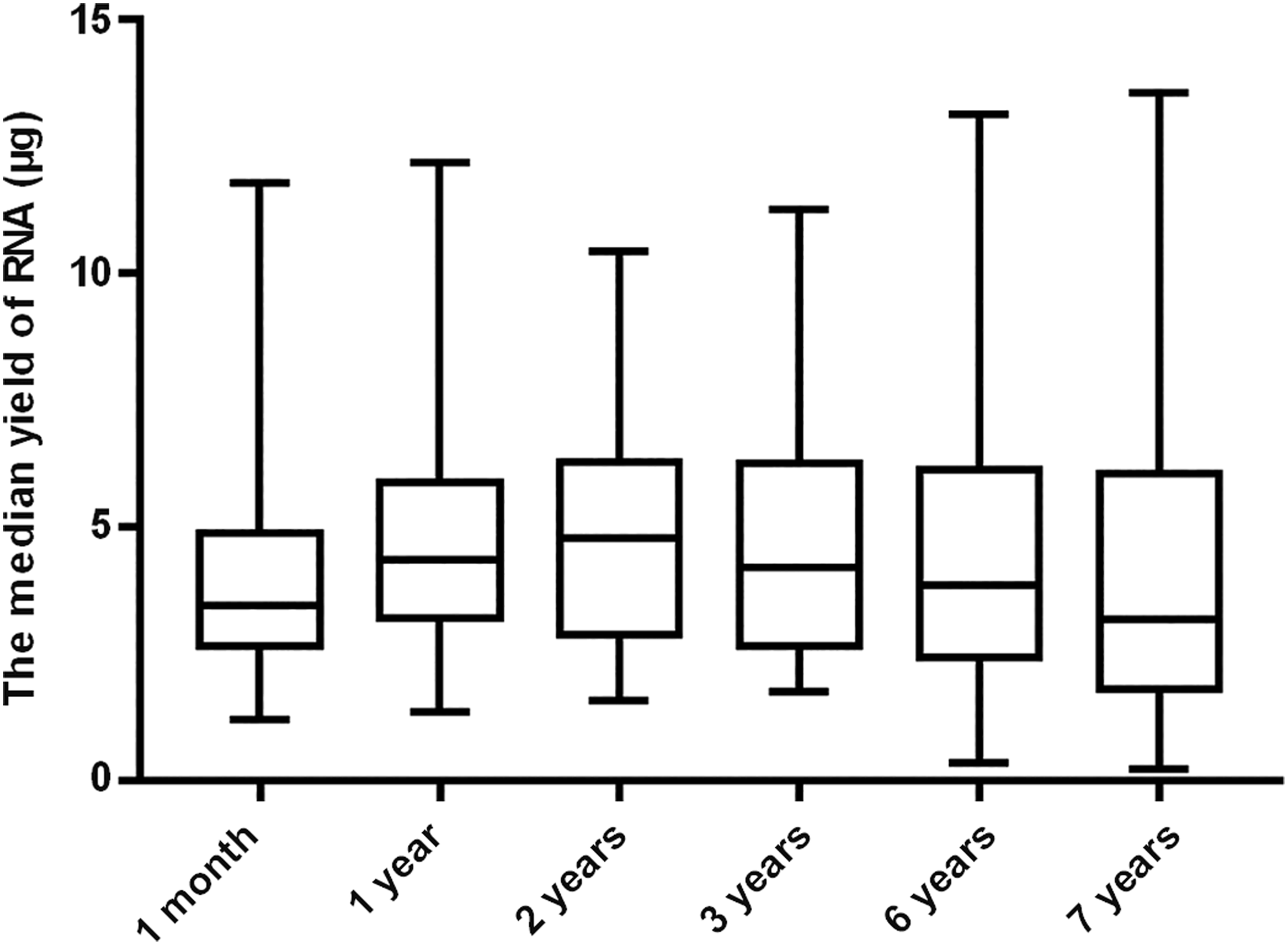
The median yields of the total RNA. The yields of RNA isolated from frozen blood with the PAXgene Blood RNA tubes stored at 1 month, 1, 2, 3, 6, and 7 years (n = 300). There were no significant differences in RNA yields among all the storage periods.
We assessed the RNA purity by measuring the ratios of A260/280 and A260/230. The mean values of A260/280 from the six storage periods were 2.02 ± 0.04, 2.05 ± 0.04, 2.05 ± 0.04, 2.08 ± 0.03, 2.12 ± 0.10, and 2.11 ± 0.05, respectively. OD ratio of A260/280 ≥1.8 (1.8–2.2) indicates good purity. The A260/280 of all time points was ≥1.8. However, the A260/280 values of the samples stored for 6 and 7 years had a rising trend, compared with the other storage periods (p < 0.05). The mean values of A260/230 at each time point were 1.25 ± 0.53, 1.38 ± 0.89, 1.23 ± 0.47, 1.25 ± 0.63, 1.26 ± 0.18, and 1.24 ± 0.32 (Fig. 2). There were no significant differences in A260/230 among all the storage periods.
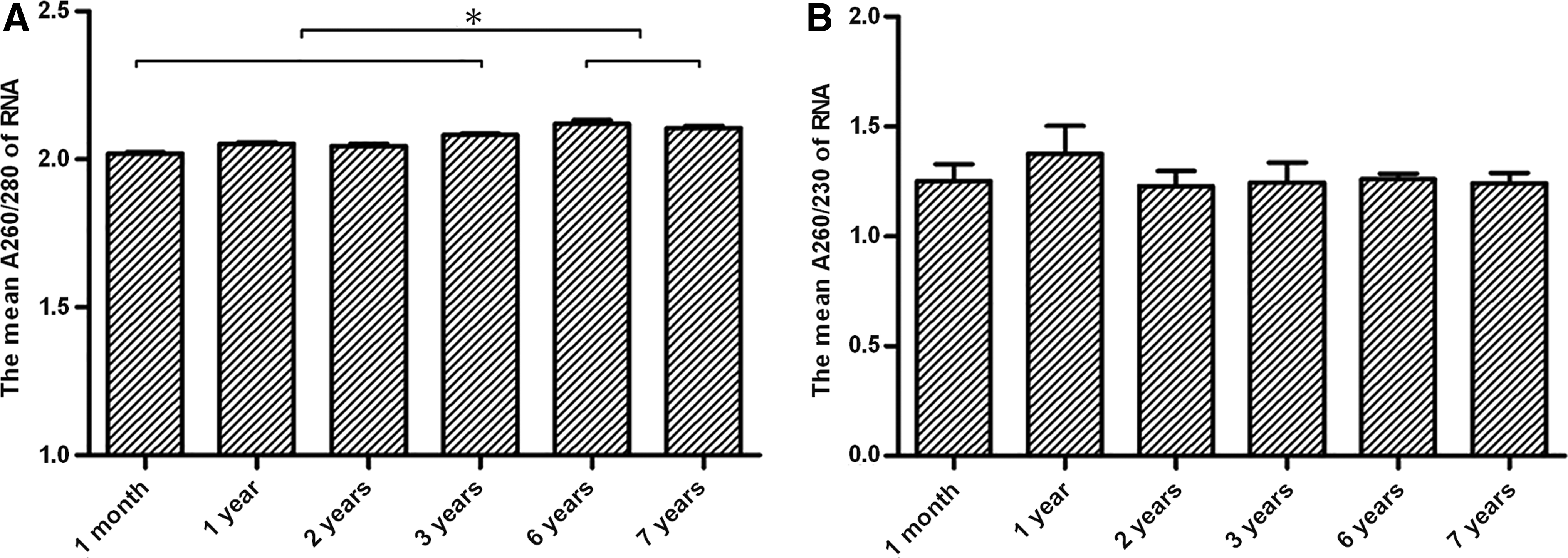
The mean A260/280 and A260/230 ratios of the total RNA.
Median RIN values were recorded as 8.4 (7.6–9.1), 8.3 (7.7–8.9), 8.3 (7.8–8.8), 8.5 (8.3–8.9), 7.6 (7.1–8.1), and 7.9 (7.2–8.3) at the six time points (Fig. 3). There were no significant differences in RIN values either between 1 month, 1, 2, and 3 years or between 6 and 7 years. However, the 6 and 7 years had lower RIN values than the other time points (p < 0.05). The rate of RIN value ≥7.0 was 92%, 84%, 96%, 92%, 86%, and 84% at each time, respectively (Fig. 4). We did not find significant differences in the rates of RIN value ≥7.0 in all time points. No correlation was found between RIN value and the rate of RIN value ≥7.0. In addition, there was a significant correlation between the yields and RIN values of RNA (r = 0.181, p < 0.05; Supplementary Fig. S2).
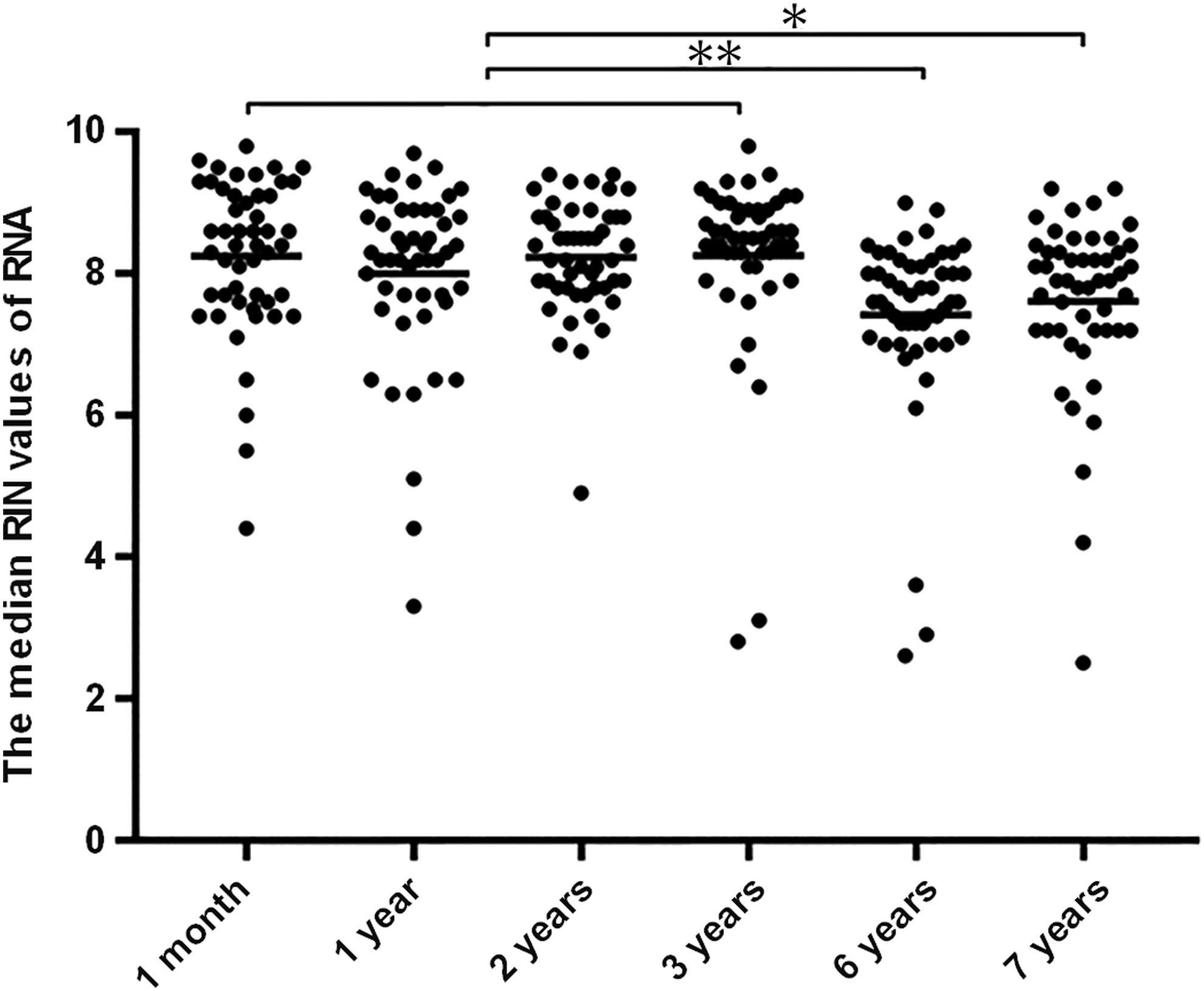
The median RIN values of the total RNA. 1 month, 1, 2, and 3 years versus 6 years, ** p < 0.001; 1 month, 1, 2, and 3 years versus 7 years, *p < 0.05. RIN, RNA integrity number.

The rate of RIN value ≥7.0 of the total RNA. The rates of RIN value ≥7.0 of the total RNA were 92%, 84%, 96%, 92%, 86%, and 84% at the six time points, respectively. There were no significant differences in the rates of RIN value ≥7.0 among all the storage periods.
It is worth noting that the integrity of RNA from samples with blood clots was generally unqualified. According to the experimental records, 1, 2, 1, 1, 6, and 8 samples with blood clots were found in all the time points, respectively. Therefore, in the total 300 samples of the six time points, 19 samples were found with blood clots. The yields and RIN values of the RNA from samples with blood clots were significantly lower than those without blood clots [yield: 2.46 (1.82–3.76) vs. 4.34 (3.07–6.37), p < 0.001; RIN: 5.9 (3.6–6.9) vs. 8.3 (7.7–8.8), p < 0.001] (Fig. 5). In the 19 samples, the rate of RIN value ≥7.0 was 21%. We did not find significant differences in A260/280 between the samples with and without blood clots.

Comparison of RNA from samples with and without blood clots. The yields
Discussion
Many literature reports indicate that RNA quality decreases over time, the rate of degradation being dependent on the storage system and temperature. However, PAXgene Blood RNA tubes contain specific reagents for RNA immobilization, and these reagent components protect RNA molecules from degradation by RNases and minimize changes in gene expression. Although previous studies have found that the RNA in the tube was stable up to ∼3 months at −20°C for microarray studies, and the RNA is stable after storage for up to 12 months at −20°C and −80°C, even after repeated freeze–thaw cycles, there is a lack of reports of RNA quality throughout long-term cryopreservation.15,16 According to the PAXgene technical note, whole blood could be stored in the tubes for at least 8 years at either −20°C or −70°C without loss of function in qRT-PCR analysis. 17 However, a limitation was identified in the blood collected from only 10 healthy volunteers. In this study, we performed a long-term observational study to monitor the quantity and quality of RNA extracted from the blood in the PAXgene Blood RNA tubes of kidney disease patients.
Based on this research, our results demonstrated that the yields of RNA isolated from the PAXgene Blood RNA tubes had no significant changes during 7 years of storage period, maintaining masses of 3–5 μg. We found a significant correlation between the RNA yields and leukocyte counts. In one study evaluating the stability of RNA during long-term storage of the PAXgene Blood RNA tubes, similar kits and instruments to ours were used for automated RNA isolation. The yield of samples stored for 2.5 years at −80°C was 4.48 ± 1.42 μg. That study found no significant reduction of total RNA and speculated that low white blood cells resulted in lower yields of RNA. 18 Therefore, this indicates that the quantity of RNA from this PAXgene RNA system (the tube and matched extract kit) is sufficient for downstream studies such as RT-PCR and microarray analyses.
In our study, although all samples stored for different periods showed A260/280 ≥1.8, there were four samples with A268/280 >2.2 after storage for 6 and 7 years. The RIN values of samples with A260/280 >2.2 were significantly lower than those with A260/280 ≤2.2 (data not shown), which means the RNA might degrade when A260/280 >2.2. Another earlier study was designed to evaluate the PAXgene Blood RNA tube for the purpose of gene expression, with the A260/280 ratio of RNA ranging from 1.8 to 2.1, indicating that high-quality RNA could be obtained in the PAXgene RNA system. 19 Six different pretreatment methods were compared for their effects on blood RNA extraction, including the RNA yields and quality. The A260/280 and A260/230 ratios of the RNA in PAXgene Blood RNA tubes processed with the same kit and instrument as ours were 2.05 ± 0.01 and 1.30 ± 0.16. The A260/230 ratios for all extracted RNA samples <1.5 may be caused by high salt concentration in the PAXgene elution buffer. 20 In this study, we found no significant differences among the A260/230 ratios of each storage period, with an average A260/230 <1.4. In fact, the salt in RNA can be eluted with RNA cleanup kits.
It is well known that a RIN ≥7.0 means the RNA has good integrity and is suitable for downstream studies.13,14 In our study, the RNA integrity was reduced after 6- and 7-year storage periods; however, the rate of RIN values ≥7.0 was consistent. In all the 300 samples, 90% were observed with RIN values ≥7.0, which has no significant differences at all storage periods. Duale et al. 11 investigated long-term storage of blood RNA collected in the Tempus tubes, similar to the PAXgene RNA tubes, and showed that the average RIN value of blood samples was 7.6 ± 0.5, which was stable during the storage period of 6 years. Another quality control study from the Spanish Renal Research Network Biobank showed that RNA extracted from the PAXgene Blood RNA tubes had RIN values ≥7.0 in 87 of a total of 96 samples during a storage period from 2007 to 2015. 21 These results demonstrated the good integrity of RNA extracted from long-term storage of the RNA protecting tubes. In addition, our study presented a significant correlation between RNA yield and integrity. Higher RNA yields of samples with RIN ≥7.0 (n = 270) were found in comparison of those with RIN <7.0 (n = 30) [4.19 (2.77–6.08) vs. 2.24 (1.44–3.62), p < 0.001]. And in a tissue-derived RNA study, it was also found that high RNA yield was significantly associated with high RIN values (RIN ≥5.0). 22
During RNA extraction of the 300 samples, we observed 19 samples with blood clots, 14 of them having been stored for 6 and 7 years. Both the yields and integrity of the RNA from samples with blood clots were significantly lower than those without blood clots. After the samples were collected, insufficient mixing of tubes with additives allows microclots to form, which would have an adverse effect on RNA extraction. In addition, after a long-term storage, the blood clots in the tubes might increase and affect the quality of the RNA extracted from these tubes. There are few reports about blood clots of PAXgene Blood RNA tubes, especially after a long-term storage. As for the samples with blood clots, alternative extraction methods may obtain better RNA quantity and quality. 23
We selected samples saved in the same year and performed quality control. Because of the high cost of PAXgene Blood RNA tubes, only one RNA sample was taken from each patient in our biobank. Therefore, it is impossible to detect the quantity and quality of samples from one individual patient after different storage periods. Instead, samples from different patients at the same time are selected for comparison. We will continue performing quality control of the RNA from the PAXgene Blood RNA tubes in the future after storage for longer periods.
In summary, the quantity and quality of RNA extracted from the PAXgene Blood RNA tubes are maintained at a relatively stable level after long-term cryopreservation. If kept under the constant temperature at −80°C, the RNA from PAXgene Blood RNA tubes can be qualified for downstream analyses stored for at least 7 years, which provides a reference benchmark for biobanks to use.
Footnotes
Acknowledgments
Our research was supported by the National Natural Science Foundation of China (Grant No. 81670699) and the Innovation Capability Development Project of Jiangsu Province (Grant No. BM2015004). We thank Accdon for providing linguistic assistance during the preparation of this article.
Author Disclosure Statement
No conflicting financial interests exist.

References
Supplementary Material
Please find the following supplemental material available below.
For Open Access articles published under a Creative Commons License, all supplemental material carries the same license as the article it is associated with.
For non-Open Access articles published, all supplemental material carries a non-exclusive license, and permission requests for re-use of supplemental material or any part of supplemental material shall be sent directly to the copyright owner as specified in the copyright notice associated with the article.
