




Abstract
Background:
To integrate biobanks into the Moroccan health system and to promote biobanks-based research projects, it is necessary to explore the knowledge of patients, their attitudes toward biobanks, and the reasons that motivate them to participate in biobanks.
Methods:
Face-to-face interviews were conducted with patients, and data were analyzed using SPSS.
Results:
One thousand one hundred thirty-three questionnaires were completed. The mean age of patients was 47.74 years (SD 15.26 years). More women (69%) were involved in this survey. Of the respondents, 97% had never heard of the term “biobanks.” Knowledge of biobanks varied significantly with respondents' education level. Overall, 80.7% of the participants (n = 914) expressed their willingness to participate in biobanking through donation of biospecimens associated with personnel and health data. Willingness to participate in biobanks was significantly associated with gender and age. We found that the main barriers to participation in biobanks were the lack of trust in biomedical research and concerns about privacy. When asked about the preferred type of consent, the majority of patients (75%) opted for a one-time consent.
Conclusion:
Despite the lack of knowledge of biobanks among patients in Eastern Morocco, the majority of them expressed willingness to participate in biobanking through donation of biospecimens. However, active participation depended upon a number of factors, notably, the trust in biomedical research and privacy. Therefore, more efforts are needed to increase awareness and promote wider participation in biobanking.
Introduction
Biobanks have become an essential resource for conducting innovative research leading to personalized medicine.1,2 However, biobanks also come with an array of ethical concerns.3–5 For example, it is not always possible to provide specific information to participants at enrollment regarding how their samples will be used, because donated biospecimens may be studied years later. 6 Furthermore, it is the role of the biobank to provide the ethical and legal framework for the use of biospecimens and to ensure the participants' rights. 7
The success of biobanks depends upon people's willingness to donate their samples for research. In a hospital-based biobank, patients are key actors, and their active support is an essential element for its success. 8 To encourage participation, it is crucial to understand the obstacles and challenges that might affect people's attitudes toward participation. 9 Many factors were found to be associated with willingness to donate, such as age, gender, education, residence, religion, biobanking knowledge score, family history of disease, trust in the health care system, and history of blood or tissue donation.2,9–23 In addition, willingness to donate varies according to country and culture.
In Morocco, biobanks remain a new concept and are therefore still poorly known by the general population. This lack of knowledge can make it difficult to recruit patients for biobanking. So, since patients are considered as the primary source of samples that supply biobanks, we conducted a study to explore the knowledge and attitude toward biobanks among patients in Eastern Morocco. We also evaluated their willingness to donate their own biological samples, personal and medical data to biobanks. The findings from this study will help improve strategies to further increase patients' recruitment into biobanks in Eastern Morocco.
Methods
Study population
Participants were enrolled during the period of April 2017 to October 2018 at four health care centers in Eastern Morocco: (1) Mohammed VI University Hospital (Oujda city), (2) Al-Farabi Regional Hospital (Oujda city), (3) Derrak Provincial Hospital (Berkane city), and (4) Public Health Center (Zaio city).
Recruitment methods
We conducted a cross-sectional survey among patients regarding their knowledge and attitude toward participation in biobanks. Patients in the hospital waiting rooms or inpatients were approached and given explanations about the purpose of the study. They were informed that participation in the study is voluntary, and that all data will be anonymous and confidential. The interviews were conducted face to face with the patients.
The questionnaire and the survey process
The questionnaire was designed according to previous studies.9,24–26 It was first tested in a pilot survey among 30 patients to assess whether the respondents correctly understood the survey items. After revision and improvement, the final questionnaire consisted of four sections. The first questions inquired about participants' personal information. Questions in the second section assessed biobanking knowledge and participation in previous research. The third part measured the participants' willingness to donate biological samples, personal information, and information related to their health and family to biobanks. This part also included questions about the reasons for their willingness or unwillingness to donate their biospecimens. Finally, the fourth section included a question about preferences for information and consent procedures.
Sample size estimation
To calculate the sample size, the Raosoft website was used. 27 The population of the studied regions of Eastern Morocco was 840,904 according to the latest Census of 2014. 28 We anticipated that ∼79% of participants would have a positive opinion toward biobanking as described. 29 Taking into consideration a confidence level of 95%, an error margin of 2.5% and assuming a nonresponse rate of 10%, the calculated sample size was 1121. A total number of 1133 patients were recruited in this study.
Statistical analysis
Data were analyzed with the SPSS software version 21. Descriptive analysis was used to describe the characteristics of patients, including frequencies and percentages. Bivariate analysis, including chi-square and Fisher's exact tests, was used to evaluate the association of the knowledge and the willingness of participants toward biobanks according to sociodemographic factors. Univariate logistic regression was used to examine the association between knowledge and willingness to participate in biobanks and sociodemographic factors. Variables identified with p < 0.25 level in univariate analysis were included in multivariate analysis. Multivariate logistic regression modeling was used to assess whether demographic and other factors were associated with patients' knowledge/willingness to participate in biobanks. Odds ratios (ORs) and confidence interval (95% CI) were reported. For the willingness to participate in biobanks, the possible responses were “agree,” “neutral,” and “disagree.” Responses of “agree” were coded 1, and responses of “disagree” or “neutral” were coded 0. p < 0.05 was considered significant.
Ethics statement
The study was approved by the ethics committee of the Faculty of Medicine and Pharmacy of Oujda (Ref. number: 08/2016). The survey was completely anonymous.
Results
Characteristics of the study population
The study included a total of 1133 patients. Table 1 describes the sociodemographic characteristics of the respondents. The mean age of patients was 47.74 ± 15.26 years (range 18–100 years). More women (69%) were involved in this survey. The majority of patients (74%) were from urban areas. Sixty-three percent of the participants were outpatients, whereas 37% were inpatients. The status of education was variable among respondents. In fact, most of the participants were illiterate (51%), 23% had a primary school level, 21% had a secondary school level, whereas only 5% had a university level. Among patients recruited in this study, 75% were unemployed, and most of the participants had health insurance (91% of cases).
Characteristics of the Study Population and Knowledge About Biobanks Among Patients (N = 1133)
The number is different from 1133 due to missing data.
SD, standard deviation.
Patients' knowledge of biobanks
Interestingly, only 3% had knowledge about biobanks and 97% had never heard of the term “biobanks.” Among the participants who had knowledge about biobanks before the survey, 84.8% had their information of biobanks through media, 9.4% from hospitals, and 6.2% through university courses (Table 1). When asked about previous research participation, only 0.3% had already participated in research studies (Table 1). A χ 2 test showed that knowledge of biobanks varied significantly with respondents' education level (p = 0.000). In contrast, there was no significant association between knowledge and the other variables (Table 2).
Association Analysis of Participants' Knowledge About Biobanks with Sociodemographic Factors
Fisher's exact test. Bold results are statistically significant.
Participants' willingness to donate their biospecimens to biobanks
Overall, 80.7% of participants (n = 914) expressed their willingness to participate in biobanking through donation of biospecimens. In contrast, 6.8% (n = 77) were unwilling to participate, and 12.5% (n = 142) responded that they did not know. Statistical analysis showed that willingness to participate in biobanking was significantly associated with participants' age and occupation (p < 0.05). On the contrary, there was no association between willingness to participate and either gender (p = 0.072), residence (p = 0.210), type of patients (p = 0.373), educational level (p = 0.202), health insurance (0.118), or knowledge of biobanks (p = 0.390) (Table 3). Indeed, the multivariate analysis confirmed the association between willingness to participate and the gender (male: OR 1.77 95% CI 1.25–2.52) and the age group (18–40 years: OR 1.78 95% CI 1.17–2.70). However, no significant association between willingness to participate and the education level (p = 0.202) or the knowledge of biobanks (p = 0.390) was found (Table 4).
Participants' Willingness to Donate Their Biospecimens to Biobanks
Fisher's exact test. Bold results are statistically significant.
Independent Factors Associated with Willingness to Donate Patient's Biospecimens
p < 0.05.
p < 0.01.
aOR, adjusted odds ratio; CI, confidence interval.
Patients who were willing to participate in biobanking were asked about their motivations to donate biospecimens. As shown in Table 5, many reasons were cited. In fact, the majority of patients agreed to participate for the benefit of future patients (53%). 19.4% of the patients were willing to participate as a sense of duty, and 19% of them participated for their own benefit or that of their family. On the contrary, 11.5% agreed to participate to improve biomedical research, 6.1% to please God, and 5.5% to maintain a good relationship with health care personnel.
Reasons for Participating and Not Participating in a Biobank
We also looked for the reasons behind the unwillingness to participate in biobanks among those patients who refused to donate their biospecimens to biobanks. The majority disagreed to participate in biobanks without specific reasons (68.8%), while 20.8% refused to participate due to a lack of trust in biomedical research, 6.5% were worried about their privacy, and 3.9% were unable to understand the concept of biobanks.
Concerning the information requested by patients before their participation in biobanking, we found that 75% of participants wanted to know the purpose of the study, while 42% wanted to know if there would be any benefit to their health care. On the contrary, 17% worried about potential risk to their health, while 3% had some questions about the confidentiality of their data. The remaining 7% of participants had no requirement to participate in biobanks or did not know how to answer (Fig. 1).
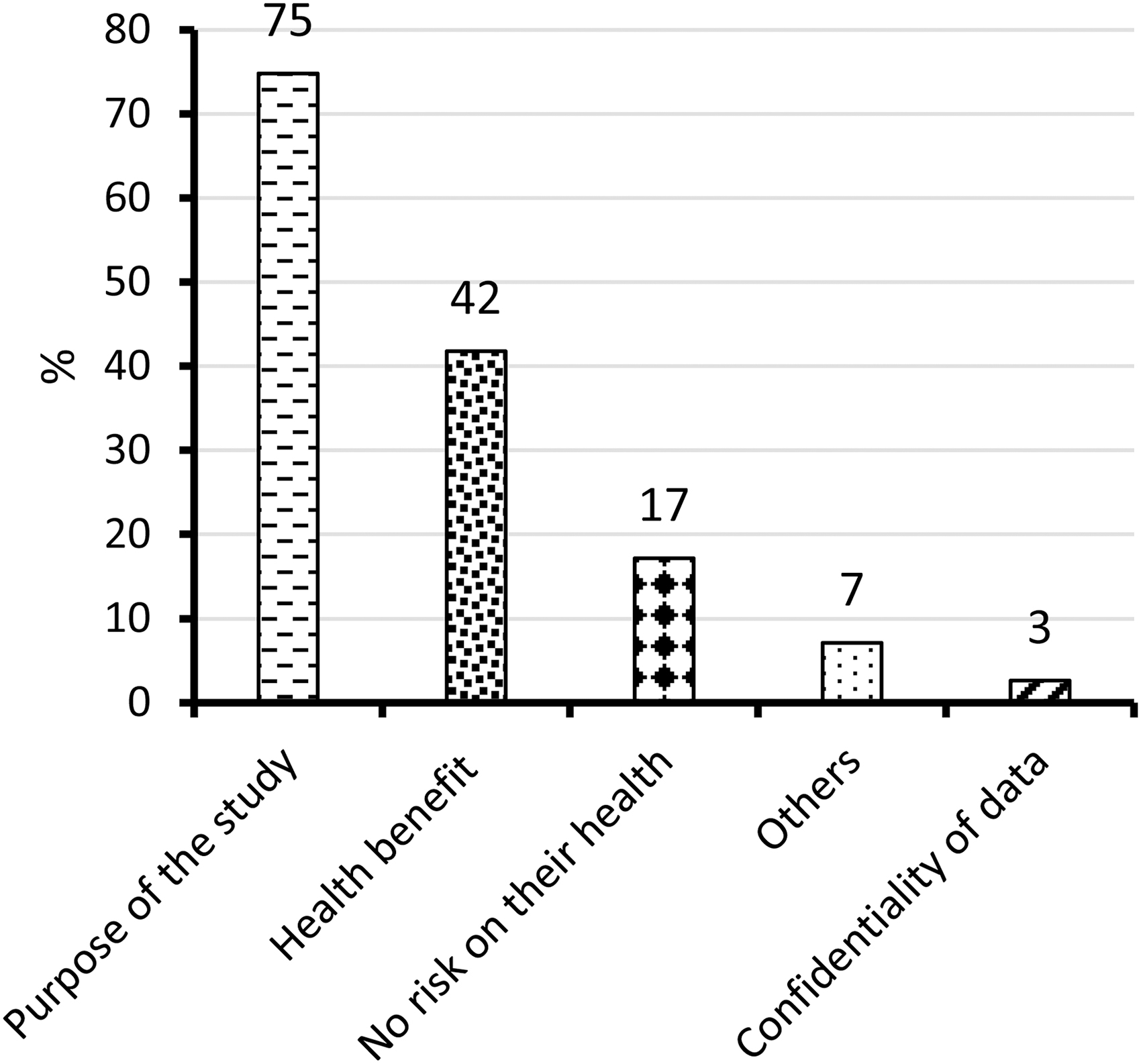
Information requested by patients before their participation in biobanks (N = 914).
The preferred type of consent
The last item in the questionnaire was about the preferred type of informed consent among patients. Three types of responses were provided: (1) “one-time consent,” which allow the use of patients' biospecimens and information in all future research projects; (2) “narrow consent” in which an informed consent is required for each individual project or whenever a researcher wanted to include their biospecimens in a new study; (3) “do not know.” In this study, we noticed that the majority of patients opted for a broad consent (75%), whereas 17% preferred a narrow consent and 8% indicated that they did not know.
Discussion
This study showed that the percentage of participants who had heard of the term biobanks in our population (3%) is significantly lower than those reported in other studies conducted in Finland, Jordan, Italy, and Germany, where the percentage of participants who had some knowledge of biobanks was between 9% and 36.5%.17,24,30–37 Knowledge of biobanks did not differ significantly between age groups or between men and women. Patients with a higher level of education were more likely to have already heard of biobanks. Similar results were reported in previous studies.30,32,35 Together, this assessment of knowledge of biobanks among our patients indicates that the concept of biobanks is relatively new in Eastern Morocco, and therefore it is important to educate patients by explaining to them what biobanks are. It is also important to inform them that biobanks may help scientists to gain a better understanding of the diseases and eventually lead to new forms of treatment and diagnosis in the future. This will encourage them to participate in biobanking-based research projects.
Despite the lack of knowledge about biobanks among our patients, the survey we conducted demonstrated that a large majority of patients (80.7%) were willing to participate in biobanks. These findings are in line with prior reports from other surveys conducted in many countries worldwide.6,9,12,14,24,26,29–31,35,38–43 However, our assessment is only a hypothetical willingness to participate in biobanking, and a request for a real involvement could provide a different, probably lower, rate. In fact, assessment of actual willingness to participate in biobank research in six countries showed a broad range of actual participation rates (10–98%). 44
The other finding of this study is that willingness to donate biospecimens was associated with gender. In fact, female participants showed lower positive attitudes toward biobanks than male participants. This result is similar to that reported by He et al. in China where female patients were less enthusiastic to donate biospecimens or related clinical data for research. 23
The positive attitude toward biobanks among participants was significantly associated with being younger (aged <40 years), which was consistent with findings from other studies.10,14 However, opposite results were obtained by other studies where older participants were more enthusiastic to donate their samples to biobanks.12,17
The factors such as level of education or previous knowledge of biobanks were not significantly associated with the intention of patients to participate in biobanks. A different picture was observed in many studies, where these factors were associated with willingness to donate biospecimens for biobanks or for research in general.2,9,12,14,23,31,32,40,45 Indeed, in those previous studies the high willingness to participate in biobanks is probably due to a high level of confidence in biomedical research among highly educated patients or those who have previous knowledge of biobanks. Previous studies in the United States (e.g., Hawaii) and Canada have also found a strong association between willingness to participate in biobanks and the confidence that patients place in biomedical research.46–49 This study indicates that the main barriers to participate in biobanking were the lack of trust in biomedical research and concerns about privacy, which is similar to what was reported in other studies.24,40,50–52
Regarding the motivation for participation in biobanks, we noticed that patients were willing to donate biospecimens for altruistic reasons such as helping future patients, their family members, or for advancing science. Our findings are similar to those reported in several previous qualitative studies exploring facilitators of research participation in biobanks and clinical trials among numerous populations.2,51–58
We also examined the preferred type of informed consent among patients. Despite the multitude of possible informed consent types for biobanking, we limited our question to two consent types: one-time consent (also called blanket consent or broad consent) and narrow consent (also called multiple consent or study-specific consent). 59 Our results clearly showed that the majority (75%) of patients who expressed their willingness to participate in biobanking preferred the broad consent option for participation in biobanking. These results corroborate findings from other studies. For example, a study analyzing consent preferences from leukemia patients in Canada found that 60% expressed a desire for one-time consent, 30% preferred a consent approach that provides multiple options, and only 10% preferred to be reconsented for each request to use their banked specimens. 60 In contrast, other studies have found that almost half of the participants had a preference for a reconsent for future use of their samples.4,61
Conclusion
This is the first study conducted in Morocco that provides an insight into the knowledge and attitude of Moroccan patients toward biobanking. Overall, it can be concluded that patients in Eastern Morocco appear to be willing to take part in biobanking-based research. Privacy concerns and the lack of trust in biomedical research remain the primary barriers for those patients unwilling to participate in biobanks. Therefore, more effort is needed to increase awareness and promote wider participation.
Footnotes
Acknowledgments
We are grateful to all patients at the participating public health centers in Oujda, Berkane, and Zaio city. We thank the Regional Director of the Ministry of Health in Eastern Morocco for his support. We also thank Dr. A. Azzouzi and all the administrative staff of the Faculty of Medicine and Pharmacy of Oujda for their valuable support and encouragement throughout the entire work.
Author Disclosure Statement
No conflicting financial interests exist.
Funding Information
No funding was received for this study.