




Abstract
The antimicrobial properties of honey have stimulated interest in evaluating it as an alternative to antibiotics for cryopreserved buffalo semen. Acacia nilotica, Brassica campestris and Ziziphus jujuba honey were analyzed and Z. jujuba honey was found suitable in terms of quality and purity. Buffalo semen (24 ejaculates) was studied for in vitro dose tolerability to Z. jujuba honey (0.1%–1%), and up to 0.2% (v/v) was not toxic to buffalo spermatozoa. Afterward, semen from three bulls (24 ejaculates) was cryopreserved (four replicates) in tris-citric egg yolk extender supplemented with 0.1% or 0.2% honey, with or without streptomycin–penicillin (SP); extender with SP used as a control. After dilution and cooling, extender without antibiotics but with 0.2% honey was better (p < 0.05) than control in terms of sperm motility and plasma membrane integrity. After thawing, the extenders containing 0.1% honey with antibiotics and extender having 0.2% honey without antibiotics consistently yielded good results in terms of all parameters studied compared to control and other extenders. The extender containing 0.2% honey without antibiotics was better (p < 0.05) in terms of total aerobic bacterial count. In conclusion, 0.2% honey improves the post-thaw quality of buffalo spermatozoa and can replace the use of antibiotics in extender through its antimicrobial activity.
Introduction
Bacteria have been around for millions of years, even longer than humans and are present almost everywhere. 1 Despite being very small, they are incredibly powerful at the global scale; 50% of total oxygen produced over the history of earth; 75% of addition of nitrogen to atmosphere; and 92% of removal from the atmosphere. 2 Furthermore, they allow herbivores to consume poor quality forages, aiding plant roots to access soil nutrients; thus, they are very useful for human beings and without them, humans would not be alive.3,4 However, some bacteria cause severe diseases5,6 and cause biological contamination of animate 7 as well as inanimate objects 8 due to their ubiquity, size, and fast growth rates. For the control of pathogenic bacteria, the discovery and development of antibiotics and antibacterial agents have remained one of the central themes of success in therapeutics. 9 However, the overuse and/or misuse of antibiotics is accelerating the process of drug-resistance. Therefore, scientists are challenged to develop new ideas for alternative and novel drugs to overcome the issue of bacterial resistance. 10
The semen used for cryopreservation is usually contaminated with bacteria from the surface of the penis, collection locality, people, environment, teaser animals, and handling equipment. 11 These bacteria survive well in neat semen as well as in the extended state. In addition, incubation temperatures, buffering capacity and specifically nutritive ingredients of extenders, such as sugars and egg yolk, all favor the growth of bacteria unless antibiotics are added.12–14 Even though antibiotics control bacterial growth, they are detrimental to sperm cells. 15 Furthermore, the bacteria develop resistance against antibiotics, 16 regarded as a global threat by the World Health Organization. 17 The acquired resistance increases the bacterial pathogenic potential and presents a serious challenge to the artificial insemination industry by decreasing the quality of preserved semen, as well as raising the costs for the control of resistant bacteria in the future. It is therefore suggested to reduce antibiotic usage as much as possible and to find alternatives to antibiotics in the form of natural products derived from animals, plants, and microorganisms. 15
Honey is a heterogeneous mixture of sugars, proteins, and secondary metabolites that are related to the source and botanical origin of the nectar. It is a complex substance with over 200 components 18 and is well recognized for its antimicrobial properties19–21 that also depend on the botanical origin of honey. 20 Interestingly, microbial resistance against honey has never been reported, which makes it a very promising and novel antimicrobial agent. 22 It is interesting to mention that the strains of Staphylococcus aureus and Pseudomonas aeruginosa, which were resistant to tetracycline and ciprofloxacin, surprisingly failed to develop resistance to honey under same conditions.22,23 The in vitro antibacterial activity of honey has been confirmed against many genera of gram-negative and gram-positive bacteria viz., Bacillus, Escherichia, Klebsiella, Micrococcus, Proteus, Pseudomonas, Salmonella, Staphylococcus, and Streptococcus.19,20,22,23 These are also reported to be present in semen ejaculates of animal species12–14 and honey can be used as an antibacterial agent to control these bacterial strains. 22 Previously, honey has been used as a source of energy, cryoprotectant, and antioxidant in extender and resulted in better postthaw semen quality in ram, 24 human, 25 Arab stallion, 26 and buffalo. 27 However, its use as an alternative to antibiotics has not been discussed. Keeping in mind the tremendous antimicrobial properties of honey, this study was designed to evaluate honey as an alternative to antibiotics in extenders for semen quality parameters and total aerobic bacterial count (TABC) of cryopreserved buffalo bull semen.
Materials and Methods
Ethical statement
All procedures performed in this study involving animal subjects were approved and in accordance with the ethical standards set by the Ethics Committee of Pir Mehr Ali Shah Arid Agriculture University Rawalpindi, Pakistan.
Quality assessment of honey
Unifloral honey of Acacia nilotica (Thorn Mimosa), Brassica campestris (Mustard), and Ziziphus jujuba (Ber) origin were purchased from the Honeybee Research Institute, Pakistan Agricultural Research Council, Islamabad. For quality and purity assessment of all honey samples, the parameters defined by the International Honey Commission (IHC) viz., color, density, moisture, total sugar, sucrose, pH, electrical conductivity, and acidity were verified from the Honeybee Research Institute, Pakistan Agricultural Research Council, Islamabad, Pakistan by standard methods of IHC. 28
Study animals and semen collection
Three adult Nili-Ravi Buffalo bulls of similar age kept under uniform conditions at the Semen Production Unit (SPU) Qadirabad, Sahiwal were used in this study. Before semen collection, bulls were cleaned using a towel soaked with 70% ethanol and the artificial vagina was disinfected by pasteurization, by keeping it at 60°C–65°C for 30 minutes. All the glassware used in the experiment were sterilized in a hot air oven at 200°C for 1 hour. Two consecutive semen ejaculates were collected from each bull using an artificial vagina maintained at 42°C and placed in water bath (37°C) until initial evaluation. The volume of ejaculates was measured in a conical tube graduated at 0.1 mL intervals. Sperm motility was assessed by placing 5 μL of neat semen sample on a microscopic slide (37°C) and covering it with a prewarmed coverslip (37°C). Spermatozoa from five different microscopic fields were evaluated by phase contrast microscope (Olympus BH-2) at 400 × magnification. 29 Subjective assessment of sperm motility was carried out using a standard scale ranging from no motile cells to more than 90% motile. All observations were taken in triplicate with complete randomization to avoid bias. Sperm concentration was measured by a photometer (Accucell, IMV France) at 540 nm wavelength. Ejaculated semen from each bull (volume ≥1 mL, motility ≥60% and concentration ≥0.5 billion sperm/mL) were pooled to eliminate individual bull effect and incubated at 37°C for 15 minutes before further processing.
In vitro dose tolerability of buffalo spermatozoa to honey
For assessment of in vitro dose tolerability of buffalo bull spermatozoa to Z. jujuba honey,14,29 a total of 24 ejaculates were collected from three bulls for a period of 4 weeks. Six ejaculates per week from three bulls were pooled, aliquoted, and diluted to a final concentration of 50 million sperm/mL at 37°C in a sodium citrate buffer [2.9 g sodium citrate (Merck, Germany) in 100 mL distilled water] having Z. jujuba honey (v/v) at the dose of 0, 0.1%, 0.2%, 0.3%, 0.4%, 0.5%, 0.6%, 0.7%, 0.8%, 0.9%, and 1%. All treatments were evaluated in triplicate with complete randomization for sperm progressive motility that was evaluated under phase contrast microscope (Olympus BH-2, 400 × magnification) by placing diluted semen sample (5 μL) on prewarmed microscopic slide (37°C) and covering with prewarmed (37°C) cover slip.14,29 The spermatozoa showing rectilinear forward movements were considered as motile and those that did not show movement were taken as nonmotile and scored as 0% to 100%.
Semen cryopreservation
Preparation of experimental extenders
Tris-citric acid stock extender (TSE) was prepared by dissolving 1.56 g citric acid (Sigma-Aldrich), 3.0 g tris-(hydroxymethyl)-aminomethane (Sigma-Aldrich), 0.2 g fructose (Sigma-Aldrich), 20 mL egg yolk, and 7 mL glycerol (Sigma-Aldrich) in 73 mL distilled water. Experimental extenders were prepared as; Control [TSE + antibiotics; Streptomycin Sulfate (1000 μg/mL, Chongqing, P.R China) and Benzyl Penicillin (1000 IU/mL, Shanxi Shuguang, China)]; E1 (TSE + antibiotics +0.1% Z. jujuba honey); E2 (TSE + antibiotics +0.2% Z. jujuba honey); E3 (TSE +0.1% Z. jujuba honey); and E4 (TSE +0.2% Z. jujuba honey). After preparation, pH (Hanna Instruments, HI 2210) and osmolality (Osmomat-030, Germany) were measured for all the extenders.
Semen processing
For cryopreservation, semen was collected from three bulls (6 ejaculates per week) for four consecutive weeks (total 24 ejaculates in 4 weeks). Qualified ejaculates were pooled, aliquoted, and diluted (50 million sperm/mL) with different experimental extenders at 37°C. The diluted semen was gradually cooled to 4°C within 2 hours, equilibrated for 4 hours at 4°C, and filled in French straws (0.5 mL; IMV, L'Aigle, France) at 4°C. After 10 minutes exposure to liquid nitrogen vapors, the French straws were stored in liquid Nitrogen (−196°C) till evaluation. For evaluation, thawing was done at 37°C in a water bath for 20 seconds.
Semen quality assessment and TABC
Sperm progressive motility
Sperm progressive motility was evaluated by the method described above.
Sperm plasma membrane integrity
Sperm plasma membrane integrity was evaluated using the hypo-osmotic swelling test (HOST). 30 A working solution of HOST was prepared by dissolving 0.735 g sodium citrate (Merck, Germany) and 1.351 g fructose (Scharlau, Spain) in 100 mL distilled water. Semen sample (50 μL) was mixed with HOST solution (500 μL) and incubated for 30 minutes at 37°C. An incubated sample of 10 μL was placed on a prewarmed glass slide (37°C) and covered with a prewarmed cover slip (37°C). The slides were randomly selected and observed using a phase contrast microscope (Labomed LX400, Los Angeles, CA, USA) at 400 × magnification and 100 spermatozoa were evaluated in five different fields. Swollen- and bent-tailed spermatozoa signify intactness of plasma membrane while the straight- and unswollen-tailed spermatozoa signify damaged plasma membrane. 31
Sperm viability and livability
A Trypan blue and Giemsa dual staining assay 32 was used to assess sperm viability (live sperm with intact acrosome) and livability (live dead ratio). The same volume of thawed semen and 0.2% Trypan blue solution (Sigma-Aldrich, St. Louis, MO, USA) were placed on a slide, mixed, and a smear was prepared. The smear was allowed to dry at room temperature and fixed in formaldehyde neutral red solution [86 mL 1 M HCL (Merck, Germany) +14 mL 37% formaldehyde (Merck, Germany) +0.2 g Neutral red (BDH, Spain)] for 5 minutes. After fixation, the slide was rinsed with running distilled water and placed in Giemsa stain (7.5%; BDH Laboratory Supplies, Poole, England) for four hours and then allowed to dry in air. Prepared slides of all treatments were randomly selected and 100 sperm were evaluated from five different fields of each slide under a phase contrast microscope (Labomed LX400) at 1000 × magnification. Sperm were differentiated into four categories as acrosome intact and live, acrosome lost and live, acrosome intact and dead, and acrosome lost and dead. 33
Sperm DNA integrity
Sperm DNA damage was studied by a DNA fragmentation test. 34 Semen smears were air dried and fixed in 96% ethanol-acetone (1:1) (BDH, England) at 4°C for 30 minutes. Acid hydrolysis with 4N HCL (Merck, Germany) was carried out at 25°C for 10–30 minutes. The smears were then rapidly rinsed three times for every 2 minutes in distilled water. The preparations were placed for 10 minutes in 0.05% toluidine blue solution. The smears were randomly evaluated under phase contrast microscope (Labomed LX400, USA) using 100 × oil-immersion objective lens. A total of 200 spermatozoa were assessed for each experimental extender. The evaluation was done on the basis of stain taken in by the sperm. Lightly stained sperm were considered as having intact DNA, while sperm stained dark were considered having damaged DNA.
Total aerobic bacterial count
The Miles Misra method 35 was used for TABC of frozen thawed buffalo bull semen samples. Bacterial culture media was prepared by dissolving 5 g bacteriological agar (Oxoid, England), 20 g tryptose soya agar (Oxoid, England), and 0.5 g yeast extract (Oxoid, England) in 500 mL distilled water, autoclaved, poured in sterilized Petri plates, and allowed to solidify. Before bacterial culture, contamination was checked by incubating Petri plates at 37°C for 24 hours and Petri plates with no contamination were divided into four segments. Thawed semen samples were diluted (serial dilutions), inoculated on culture medium from the height of 0.5 cm as drops of 0.02 mL and allowed to dry. After that the Petri dishes were incubated for 24 hours at 37°C and bacterial colonies were randomly counted on a digital colony counter.
Statistical analysis
Results are described as mean ± standard error of mean. The Shapiro-Wilk test was used to check the normality of data. For nonnormalized data, the z-test value was used for outlier detection and any outlier was removed to transform nonnormalized data into normalized data. The effect of different extenders on sperm progressive motility, plasma membrane integrity, viability, livability, DNA integrity, and TABC was analyzed by analysis of variance (ANOVA) by using IBM SPSS Statistics (Version 23) software. Statistical significance was set at p < 0.05 and Duncan's new multiple range test was used as a post hoc test.
Results
Honey quality and purity assessment
The data of quality and purity assessment of A. nilotica, B. campestris, and Z. jujuba honey are shown in Table 1. According to the results, Z. jujuba honey was of dark yellow, while, B. campestris honey was of dull yellow, and A. nilotica honey was of light yellow. The data on quality parameters indicate that the density, moisture, total sugar, sucrose, pH, electrical conductivity, and acidity of Z. jujuba honey were in accordance with the Codex Alimentarius standard for honey. 36 However, for A. nilotica and B. campestris honey, the values for moisture, sucrose and electrical conductivity deviated from Codex Alimentarius standard range, while the density, total sugar, pH, and acidity were within the Codex Alimentarius standard range. 36
Quality Parameters of Honey from Different Floral Origin
Codex Alimentarius Standard for honey (Alimentarious, 2001).
In vitro dose tolerability of buffalo spermatozoa to honey
According to the results (Fig. 1.), buffalo bull spermatozoa tolerated the honey concentration up to 0.2% as sperm motility was not affected (p > 0.05) at this concentration. However, higher concentrations of honey, that is, from 0.3% to 1%, resulted in decreased (p < 0.05) sperm progressive motility.
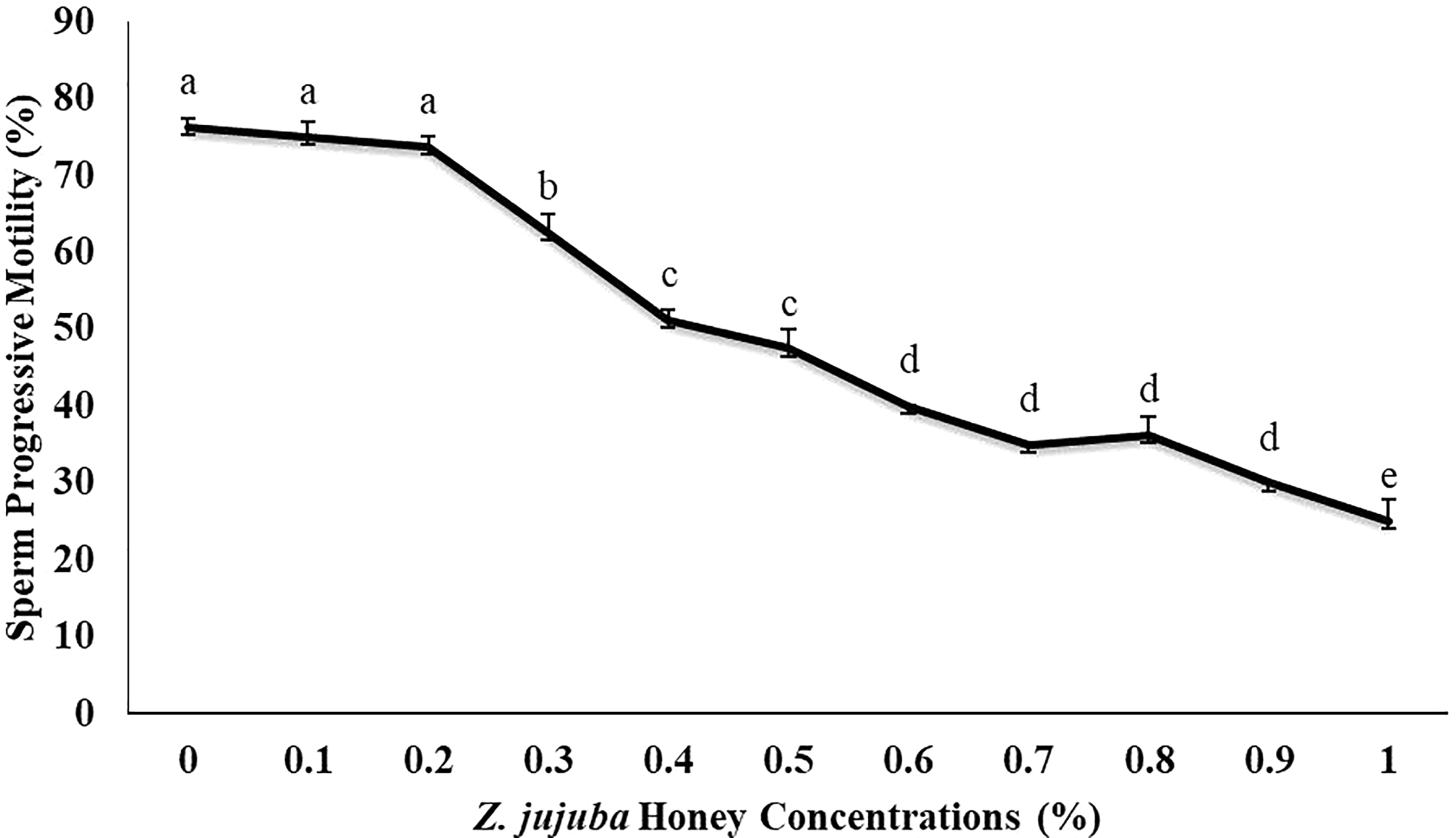
In vitro dose tolerability of Nili-Ravi buffalo bull spermatozoa to different concentrations of Ziziphus jujuba honey in terms of sperm progressive motility (mean ± SEM). Bars with different letters differed significantly (p < 0.05).
Quality of buffalo bull spermatozoa at different stages of cryopreservation
Results of semen quality assessment at different stages of cryopreservation are described in Table 2.
Quality of Buffalo Bull Sperm at Different Stages of Cryopreservation with Honey Supplementation in Extender
Values are mean ± SEM.
Different letters within the same column showed significant differences among the groups (p < 0.05).
E1 [Honey (0.1%) + Antibiotics]
E2 [Honey (0.2%) + Antibiotics]
E3 [Honey (0.1%) − Antibiotics]
E4 [Honey (0.2%) − Antibiotics]
PMI, plasma membrane integrity; TABC, total aerobic bacterial count; C, control.
Post-dilution
Sperm progressive motility was higher (p < 0.05) in the extender E4 (80.0 ± 1.3) that did not differ statistically (p > 0.05) from E1 (75.0 ± 0.0), but remained higher compared with control (72.5 ± 1.4), E2 (70.0 ± 2.8) and E3 (65.0 ± 2.8). When comparing extenders with the same honey concentration (0.1%), sperm progressive motility was better (p < 0.05) in extender E1 (with antibiotics) (75.0 ± 0.0) compared with extender E3 (without antibiotics) (65.0 ± 2.8). An increase in honey concentration up to 0.2% in the extender with antibiotics did not improve sperm progressive motility as it remained similar (p > 0.05) in extenders E1 (0.1% honey, 75.0 ± 0.0) and E2 (0.1% honey, 70.0 ± 2.8). An increase in honey concentration up to 0.2% in extender without antibiotics improves (p < 0.05) sperm progressive motility in extender E4 (0.2% honey, 80.0 ± 1.3) compared with extender E3 (0.1% honey, 65.0 ± 2.8).
Plasma membrane integrity was better (p < 0.05) in extenders E2 (79.5 ± 2.6) and E4 (79.0 ± 0.4) that did not vary from E1 (75.5 ± 1.4), but remained higher compared with control (70.0 ± 2.3) and extender E3 (69.5 ± 0.3). Sperm plasma membrane integrity remained similar (p > 0.05) in both extenders with same honey concentration (0.1%), one with antibiotics (E1: 75.5 ± 1.4) and other without antibiotics (E3: 69.5 ± 0.3). Similarly, honey supplementation in the extender with antibiotics did not improve sperm plasma membrane integrity as it remained similar (p > 0.05) in extender E1 (0.1% honey, 75.5 ± 1.4) and E2 (0.2% honey, 79.5 ± 2.6). When comparing both extenders without antibiotics, sperm plasma membrane integrity was higher (p < 0.05) in extender E4 with 0.2% honey (79.0 ± 0.4) compared with extender E3 with 0.1% honey (69.5 ± 0.3).
Post-cooling
The highest sperm progressive motility was observed (p < 0.05) in extender E4 (80.0 ± 0.0), that was similar to E1 (75.0 ± 1.4), but remained higher compared with control (70.0 ± 2.8), E2 (70.0 ± 2.8), and E3 (65.0 ± 0.0). Comparison within extenders of same honey concentration shows that sperm progressive motility was higher (p < 0.05) in extender E1 (with antibiotics) (75.0 ± 1.4) compared with extender E3 (without antibiotics) (65.0 ± 0.0). Sperm progressive motility was similar (p > 0.05) in both extenders with antibiotics, E1 (0.1% honey) (75.0 ± 1.4) and E2 (70.0 ± 2.8). Comparison of both extenders without antibiotics shows that sperm progressive motility was improved (p < 0.05) at a higher level of honey (0.2%) (E4: 80.0 ± 0.0) compared with low level of honey (0.1%) (E3: 65.0 ± 0.0).
Sperm plasma membrane integrity was improved (p < 0.05) in extender E1 (60.5 ± 1.4) and E4 (65.0 ± 1.7) compared with control (51.5 ± 2.0), E2 (52.5 ± 0.9), and E3 (55.5 ± 1.4). When comparing extenders with the same honey concentration (0.1%), sperm plasma membrane integrity was higher (p < 0.05) in extender E1 (with antibiotics) (60.5 ± 1.4) compared with extender E3 (without antibiotics) (55.5 ± 1.4). Comparison of both extenders with antibiotics showed that supplementation of honey at 0.1% (E1: 60.5 ± 1.4) improves (p < 0.05) sperm plasma membrane integrity compared to the extender with 0.2% honey (E2: 52.5 ± 0.9). Comparison of both extenders without antibiotics showed that sperm plasma membrane integrity was improved (p < 0.05) at a higher level (0.2%) of honey (E4: 65.0 ± 1.7) compared with a low level of honey (0.1%) (E3: 55.5 ± 1.4).
Post-thaw
In comparison to control the (45.0 ± 0.0), sperm progressive motility was higher (p < 0.05) in all extenders supplemented with honey viz., E1 (53.8 ± 2.3), E2 (53.8 ± 1.3), E3 (56.3 ± 1.3), and E4 (57.5 ± 1.4). It was similar (p > 0.05) in both extenders with 0.1% honey, E1 (with antibiotics) (53.8 ± 2.3) and E3 (without antibiotics) (56.3 ± 1.3); similar (p > 0.05) in both extenders with antibiotics, 0.1% honey (E1: 53.8 ± 2.3) and 0.2% honey (E2: 53.8 ± 1.3); and was also similar (p > 0.05) in both extenders without antibiotics, 0.1% honey (E3: 56.3 ± 1.3) and 0.2% honey (E4: 57.5 ± 1.4).
Sperm plasma membrane integrity was 45.3% ± 2.2% in control that did not improve (p > 0.05) in E3 (45.8 ± 0.5), however, it was higher (p < 0.05) in extender E1 (54.5 ± 1.2) and E4 (55.7 ± 1.1) compared with control, E2 (50.5 ± 0.6), and E3 (45.8 ± 0.5). Comparison of both extenders with 0.1% honey shows that sperm plasma membrane integrity was better (p < 0.05) in extender E1 (with antibiotics) (54.5 ± 1.2) compared with extender E3 (without antibiotics) (45.8 ± 0.5). Comparison of both extenders with antibiotics shows that sperm plasma membrane integrity was higher (p < 0.05) in extender E1 with 0.1% honey (54.5 ± 1.2) compared with extender E2 with 0.2% honey (50.5 ± 0.6). When comparing both extenders without antibiotics, sperm plasma membrane integrity was improved with the supplementation of honey at 0.2% (E4: 55.7 ± 1.1) compared to extender with 0.1% honey (E3: 45.8 ± 0.5).
Sperm viability was higher (p < 0.05) in extender E1 (53.3 ± 1.1), E2 (52.0 ± 1.2), and E4 (54.3 ± 0.9) compared with the control (38.3 ± 2.0) and E3 (45.3 ± 1.4). It was also higher (p < 0.05) in extender E1 (0.1% honey with antibiotics) (53.3 ± 1.1) compared with extender E3 (0.1% honey without antibiotics) (45.3 ± 1.4). Sperm viability was similar (p > 0.05) in both extenders with antibiotics, and 0.1% honey (E1: 53.3 ± 1.1) and 0.2% honey (E2: 52.0 ± 1.2). Comparison of both extenders without antibiotics shows that sperm viability was higher (p < 0.05) in extender with 0.2% honey (E4: 54.3 ± 0.9) compared with extender with 0.1% honey (E3: 45.3 ± 1.4).
Sperm livability was higher (p < 0.05) in extender E1 (63.5 ± 2.1) and E4 (63.0 ± 1.0) that did not differ significantly (p > 0.05) from E2 (58.5 ± 1.5), but remained higher compared with control (44.0 ± 1.8) and E3 (54.8 ± 1.3). Comparison of both extenders with 0.1% honey shows that sperm livability was improved (p < 0.05) in extender with antibiotics (E1: 63.5 ± 2.1) compared with extender without antibiotics (E3: 54.8 ± 1.3). Comparison of both extenders with antibiotics shows that sperm livability remained similar (p > 0.05) in extender E1 (0.1% honey) (63.5 ± 2.1) and E2 (0.2% honey) (58.5 ± 1.5). Comparison of both extenders without antibiotics shows that sperm livability was better (p < 0.05) in extender E4 (0.2% honey) (63.0 ± 1.0) compared with extender E3 (0.1% honey) (54.8 ± 1.3).
Sperm DNA integrity remained similar (p > 0.05) in all extenders viz., control (93.5 ± 1.0), E1 (94.5 ± 0.9), E2 (95.3 ± 0.9), E3 (95.3 ± 1.0), and E4 (94.3 ± 0.5). It was also similar (p > 0.05) in both extenders with 0.1% honey, with antibiotics (E1: 94.5 ± 0.9) and without antibiotics (E3: 95.3 ± 1.0); remained similar (p > 0.05) in both extenders with antibiotics, and 0.1% honey (E1: 94.5 ± 0.9) and 0.2% honey (E2:95.3 ± 0.9); did not differ significantly (p > 0.05) in both extenders without antibiotics, and 0.1% honey (E3: 95.3 ± 1.0) and 0.2% honey (E4: 94.3 ± 0.5).
Total aerobic bacterial count
According to the results (Table 2), the lowest (p < 0.05) bacterial count (cfu/mL) was observed in extender E2 (0.63 ± 0.3) and E4 (0.58 ± 0.2) in comparison with control (2.32 ± 0.1), E1 (1.10 ± 0.4), and E3 (1.50 ± 0.5). TABC was similar (p > 0.05) in both extenders with 0.1% honey, E1 (with antibiotics) (1.10 ± 0.4), and E3 (without antibiotics) (1.50 ± 0.5). When comparing both extenders with antibiotics, lower TABC (p < 0.05) was observed in the extender with 0.2% honey (E2: 0.63 ± 0.3) compared with the extender with 0.1% honey (E1: 1.10 ± 0.4). Comparison of both extenders without antibiotics shows that TABC was lower (p < 0.05) in the extender with 0.2% honey (E4: 0.58 ± 0.2) compared with the extender without antibiotics (E3: 1.50 ± 0.5).
Discussion
Antibiotics are widely used to promote growth, prevent infections, improve the overall health, and to produce higher yields and quality products in animal agriculture. 9 In addition, antibiotics are widely used in semen cryopreservation protocols to control bacterial contamination and to improve semen quality.12–14 This extensive use clearly drives the evolution of antibiotic resistance that becomes a serious global threat and it is no longer a prediction for the future, it is happening right now in every region of the world. 9 The severity of this issue is described in WHO report as “Without urgent, coordinated action by many stakeholders, the world is headed for a post-antibiotic era, in which common infections and minor injuries which have been treatable for decades can once again kill.” 37 This demands the exploration of natural products for development of novel antimicrobial agents that are capable of overcoming antibiotic resistance. 38
Honey is a complex substance 39 and its composition and biological activities vary according to the geographical and floral source used by the honey bees. 40 In the present study, Z. jujuba honey was considered as best due to its low moisture and sucrose content compared to honey from other plants (A. nilotica, B. campestris). In addition, high pH (6.28) and low concentration of acids present in Z. jujuba honey indicates the absence of undesirable fermentation, makes it promising for inhibition of bacterial growth and also favors its use in extender due to risk-free effect on pH. 41 Furthermore, Z. jujuba honey was preferred due to low HMF (Hydroxy Methyl Furfuraldehyde) content, high diastase activity, nutritional richness, higher ash content, 42 and strong antibacterial activity compared to honey from other plant sources. 22
Before actual experimentation on a supplement for sperm cryopreservation, a pilot study is usually preferred to assess the in vitro dose tolerability to decide the tentative levels of supplement. 43 In the present study, buffalo bull spermatozoa showed good tolerance to honey at low concentrations (0.1% and 0.2%), while at higher concentrations (0.3%, 0.4%, 0.5%, 0.6%, 0.7%, 0.8%, 0.9%, and 1%) sperm progressive motility started to decrease. We speculate that the level of sugars increases with an increase in honey levels, leading to a higher viscosity of buffering solution that might have hindered the sperm movement. Furthermore, high concentrations of honey might have generated higher hydrogen peroxide that caused oxidative stress and deteriorated the sperm motility. 44
Previously, very few attempts have been made to evaluate honey as a supplement in extenders and better postthaw semen quality was reported in human, 25 buffalo 27 and Arab stallion. 26 Honey has also been successfully evaluated as an alternative energy source in an extender for the cryopreservation of ram semen. 24 Owing to its antibacterial activity,19–21 we for the first time attempted to investigate honey as an alternative to antibiotics in extenders for buffalo semen. In the present study, the lowest TABC was recorded in extenders supplemented with Z. Jujuba honey (0.2%) either with or without antibiotics. The decrease in TABC can be attributed to bactericidal components of honey viz., hydrogen peroxide, antioxidants, lysozyme, polyphenols, phenolic acids, flavonoids, methylglyoxal, and bee peptides. 22 The lower TABC in extenders having antibiotics and supplemented with 0.2% honey can be explained by the fact that honey (or its components) when used with antibiotics have a synergistic effect, 22 and honey can even reverse the resistance of bacteria to the specific antibiotic. 45
While working with sperm cryopreservation, the purpose is not only to reduce TABC but also to maintain/improve sperm quality simultaneously. Although the TABC was lower with 0.2% honey both in extenders with or without antibiotics, the total replacement of antibiotics with honey (0.2%) was more efficient in terms of all semen quality parameters studied compared to the extender having antibiotics and honey, where some of the parameters remained similar to that of control. The reduced sperm quality with honey and antibiotics both might have been due to adverse effects of antibiotics on sperm 15 as the negative effect of orally administrated antibiotics on sperm quality parameters, testis architecture, and induction of apoptosis in testis has already been reported in rats.46–48 Furthermore, decline in sperm quality parameters was also reported in human semen when incubated with different antibiotics. 49
The antibacterial activity of honey can be attributed to glucose oxidase-derived H2O2 50 and the nonperoxide substances, including flavonoids, phenolic acids, and other nonperoxide inhibitory agents, derived from different botanical origins. 39 A proposed mechanism for flavonoid's antibacterial activity is the inhibition of bacterial RNA polymerase, degradation of bacterial cytoplasmic membrane, 51 increasing permeability of membranes, reduction in ATP synthesis, transport, and motility across membrane. 52 All of these components work synergistically to make honey a potent antibacterial agent as is evident in present study. Further studies are suggested to isolate and identify resistant bacterial species from buffalo bull semen and to evaluate the susceptibility of these bacteria for Z. jujuba honey, and the efficiency of honey to reverse the antibiotic resistance. Further studies are also suggested to evaluate fertility rate of buffalo semen with honey as an alternative to antibiotics in extenders to respond to the issue of emerging antibiotics resistance. 15
Conclusions
The present study concluded that, 0.2% Z. jujuba honey as an alternative to antibiotics in a tris citric-acid egg yolk extender improves the sperm progressive motility, plasma membrane integrity, viability, and livability and also lowers the TABC in Nili-Ravi buffalo bull semen.
Footnotes
Acknowledgments
The authors are thankful to the Honeybee Research Institute, Pakistan Agricultural Research Council, Islamabad, Pakistan, for analysis of honey samples.
Authors' Contributions
S. Akhter, S. Nasreen, and M. A. Awan designed the study, executed the experiment, and drafted the article. S. Nasreen, M. A. Awan, and A. U. Husna were involved in practical work. W. Holt, M. S. Ansari, and B. A. Rakha provided expertise in data analysis and drafting of article.
Author Disclosure Statement
None of the authors has any conflict of interest to declare.
Funding Information
No funding was received for this study.