




Abstract
The genetic diversity of livestock is decreasing and many countries have created gene banks for ex situ–in vitro conservation of animal genetic resources (AnGR). The collection, processing, and storage of animal germplasm require substantial investment and the material collected (and associated data) is highly valuable. Therefore, quality management systems (QMSs) and practices are important. The objective of this study was to review the quality management procedures of livestock gene banks around the world to identify the general strengths and weaknesses of quality control. A survey was administered by means of an online questionnaire consisting of 54 questions, most of which were yes/no with respect to the presence of a particular aspect of quality management. The survey was distributed through networks of the Food and Agriculture Organization of the United Nations that are associated with AnGR. Ninety responses were received from 62 countries. The gene banks were predominantly public institutions, with the main goal of preventing breed extinction. Approximately 30% of the banks reported having a QMS, 15 of which involved formal certification. Many other banks have plans to implement formal quality management within the next 5 years. Regarding specific aspects of quality management, more emphasis was placed on material entering the banks than on eventual utilization. Among the banks processing and freezing material, 90% followed specific standard operating procedures, but only 24% had policies regarding provision of access to external stakeholders. Increased cooperation among livestock gene banks could improve quality management. Sharing of knowledge could standardize procedures and cooperating peers could evaluate each other's QMSs.
Introduction
The genetic diversity of livestock is an important global common good for food security and livelihoods. The diversity of animal genetic resources (AnGR) for food and agriculture has, however, been continually decreasing over time. 1 The member countries of the Food and Agriculture Organization (FAO) of the United Nations have developed and adopted the Global Plan of Action for AnGR (GPA-AnGR), 2 which includes strategic priorities and actions to be undertaken by national governments and other stakeholders to ensure the proper management of existing livestock genetic resources. Conservation is one of the four Strategic Priority Areas of the GPA-AnGR and it addresses priorities for both in situ and ex situ conservation.
Although ex situ conservation of AnGR can be accomplished in vivo with zoos, research farms, or agricultural parks, in vitro conservation through cryopreservation or “cryoconservation” 3 is usually regarded as the more cost-efficient approach.4,5 Cryopreservation of germplasm (usually semen or embryos) provides the capacity to store AnGR indefinitely,6–8 and thus allows the creation of a collection of genetic material that can eventually be used for a variety of future goals, including population management, breed conservation, preservation of phenotypic and genetic diversity, repopulation, expanding the genetic base of a breed, new breed development, introgression, and research.9–11 Many countries have therefore adopted national cryoconservation strategies to impede the decrease in the diversity of their AnGR.
According to the Second Global Assessment of Animal Genetic Resources, undertaken in 2015, 1 58 countries had operational gene banks for in vitro conservation of AnGR and 41 countries had plans to develop such facilities. Gene banks are more common in industrialized countries than in countries with developing economies.
Nearly all the countries in the European Union have national gene banks for AnGR and the European Commission supports research on cryoconservation, including the current project “Innovative Management of Animal Genetic Resources” (IMAGE). The main objectives of the IMAGE project are to improve the management of animal gene banks and to enhance the utilization of their collections of genetic material. Research topics include genomics, reproductive technologies, and bioinformatics. Further details about IMAGE can be found online. The project currently involves 28 partners from 16 countries.
Genetic materials (and associated data) stored in animal gene banks are valuable resources. The collection, processing, and storage of the materials require substantial investment. The stored materials are an insurance to protect against the loss of valuable genetic diversity and to support or improve population management in situ. Gene banking is a complex operation, involving different types of materials from multiple species and specific and often complicated procedures.
A quality management system (QMS) is extremely useful in dealing with such complexity. A properly functioning QMS allows gene bank managers to identify the needs of users and other stakeholders, formalize the procedures to satisfy these needs, analyze the risks, and take actions for continual improvement to reach the objectives of the gene bank.
First, gene banks must ensure the technical quality of the reproductive material because maintaining their viability throughout the process is critical, inasmuch as the quality of samples is inextricably linked to the utility of the samples to their end users. Hence, quality control of cryopreserved samples is essential for developing a successful repository. 11
Beyond these technical aspects, attention to quality management has continually gained importance for managers of livestock gene banks, following the Organisation for Economic Co-operation and Development (OECD) initiative in 2001 to define the core missions of a biological resource center (BRC). These core missions include (1) collection/acquisition, (2) documentation, (3) storage, and (4) distribution of biological material, with all processes recorded in an associated data set containing at least minimal set of required variables. As they share these core missions, animal gene banks are considered as BRCs.
Several national gene banks have adopted officially certified QMS under International Organization of Standardization (ISO) 9001 standard and/or have participated in the development of the recently adopted ISO 20387 biobank standard, which includes all processes and procedures of a gene bank, regardless of the biological source of material (i.e., human, plant, animal, or micro-organism). However, substantial variability among countries and gene banks exists regarding quality management of animal gene banks.
This study was undertaken in the context of the IMAGE project. The objectives were to undertake a global review of quality management in animal gene banking and to identify the current areas of strengths and gaps in quality management in animal gene banks worldwide.
Methods
Global survey
The global survey of quality management of animal gene banks was undertaken by means of an electronic questionnaire, utilizing the Survey Monkey® web application. The questionnaire can be viewed online. The survey included 54 questions (see Appendix A1), grouped according to various aspects of gene bank management (e.g., general management, personnel, equipment and consumables, acquisition, collection, processing, storage, and access).
The majority (69%) of the questions were of the Yes/No variety, usually regarding presence or absence of an indicator of quality management (e.g., a quality policy). Most of these questions allowed the possibility to choose an intermediate response (e.g., to indicate a given indicator was partially completed). Thirteen questions involved lists of items (e.g., conservation goals) for which respondents were asked to indicate all applicable options. The questionnaire had a branching structure, so that certain questions were proposed to a respondent conditional on the result of a preceding question.
The questionnaire was distributed through three channels: (1) to all known managers of livestock gene banks in Europe; (2) to all National Coordinators for the Management of Animal Genetic Resources; and (3) to all subscribers of the Domestic Animal Diversity Network (DAD-Net). National Coordinators are persons officially nominated by their respective governments to coordinate national implementation of the GPA-AnGR and to network with local stakeholders and FAO on AnGR-related matters. 12 DAD-Net is an email discussion group on AnGR with more than 3000 subscribers. The questionnaire was made available between May and July 2018.
Data analysis
The data resulting from the responses to the questionnaire were evaluated by applying simple summary statistics to determine the proportions of gene banks that provided affirmative or negative responses. In addition, we hypothesized that responses to the various questions would not be independent; in general, gene banks applying a given aspect of a QMS were likely to apply others. To test this hypothesis, simple Pearson coefficients were calculated between questions. Positive responses were recorded as 1 and negative responses as 0. Responses indicating partial application of a quality management practice were coded as 0.5.
Results
General characteristics of livestock gene banks
One hundred four responses to the questionnaire were obtained. Ninety complete responses were retained. Responses were from 62 countries (Fig. 1). There were a particularly large number of responses from Spain, which has a network of essentially autonomous livestock banks in nearly every state.
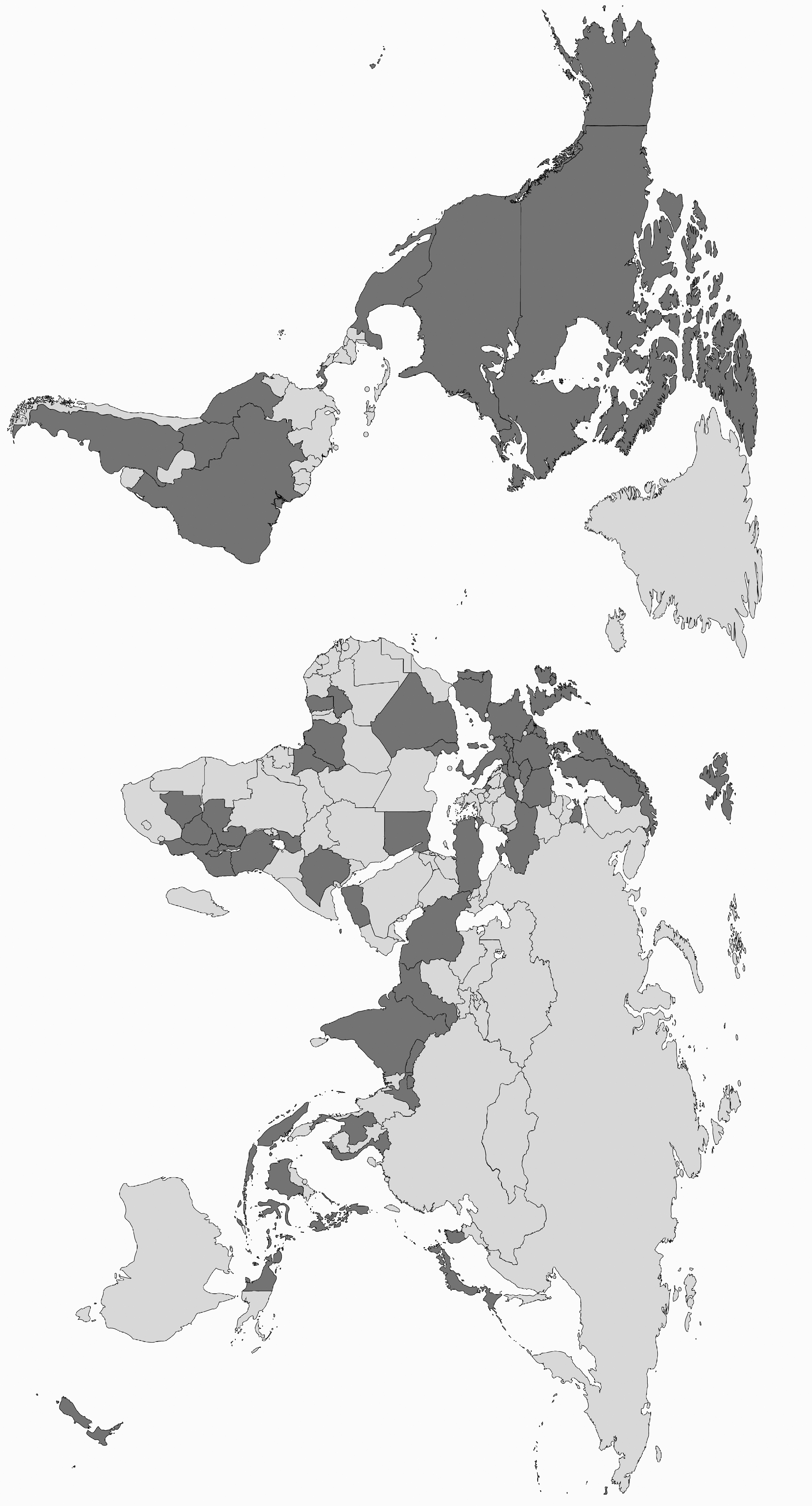
Countries responding to the gene bank quality management questionnaire (not visible include the Cook Islands, Palau, and Vanuatu; and the occupied Palestinian territory.) Source: mapchart.net
The vast majority of responding organizations were either 100% publicly (84%) or predominantly publicly (6%) funded. Twenty-four (27%) of the responding gene banks were national in scope, the remaining were subnational. No banks were multinational, in part, because international veterinary sanitation regulations hinder international livestock gene banking.
Figure 2 shows the frequencies of species stored in the various banks. The most common was cattle, with material in 69 (77%) of the gene banks. Goat (68%) and sheep (62%) closely followed. Goose was the least reported species, with only 7 (8%) organizations storing genetic material. Other infrequently mentioned species included deer (n = 3), bee (n = 2), guinea fowl (n = 2), turkey (n = 1), and guinea pig (n = 1).

Frequency of gene banks reporting various species with stored material.
Figure 3 shows the frequencies of material types stored in the various banks. Semen was the most commonly stored material, reported by 77 organizations (86%). Among those, 25 (32%) stored no other material. Other materials included blood (n = 5), nongonadal tissue (n = 3), and hair (n = 2).
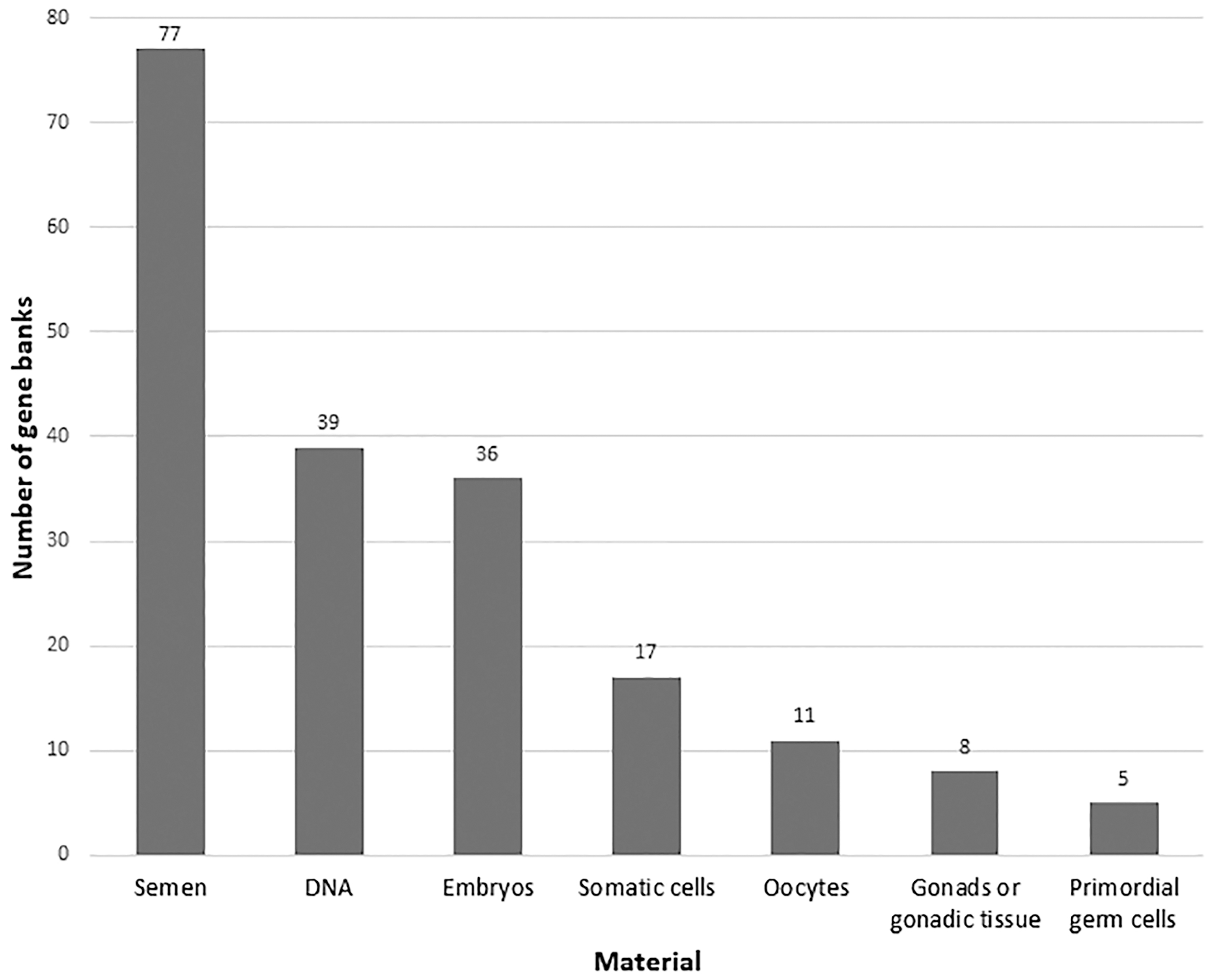
Frequency of gene banks reporting various types of genetic material.
General gene bank management
Table 1 has proportions of gene banks with different characteristics regarding general management. Thirty-six percent of the respondents reported to have a formally documented organizational and management structure. Thirteen percent reported to have undertaken a stakeholder analysis and prepared a communication plan. Just over a third of the gene banks (35%) reported having formally documented cryoconservation goals to guide their collection activities, although an additional 42% were in the process of defining such goals.
Proportions of Livestock Gene Banks Having Various Characteristics or Applying Various General Practices Associated with Proper Management
N = 90 gene banks.
The questionnaire allowed respondents with formalized goals or goals under development to specify these goals. The frequency distribution of conservation goals is shown in Figure 4. The questionnaire allowed respondents to indicate more than one goal. Thirty gene banks responded, all of which reported more than one goal. The most common cryoconservation goals were insurance against breed extinction, management of genetic diversity, and research.

Conservation goals reported by the gene banks responding to the global survey.
Slightly more than half of the institutions that completed the survey had identified the major risks to their gene bank (Fig. 5). Economic sustainability and loss of stored germplasm due to lack of liquid nitrogen or other failure in storage facility were most often reported, followed by catastrophic events, disease and transmission of pathogens, and loss of information. Only 13% of the institutions had prepared comprehensive preventive or mitigation measures to reduce or recover from potential impacts. An additional 36% had addressed some of the potential threats.
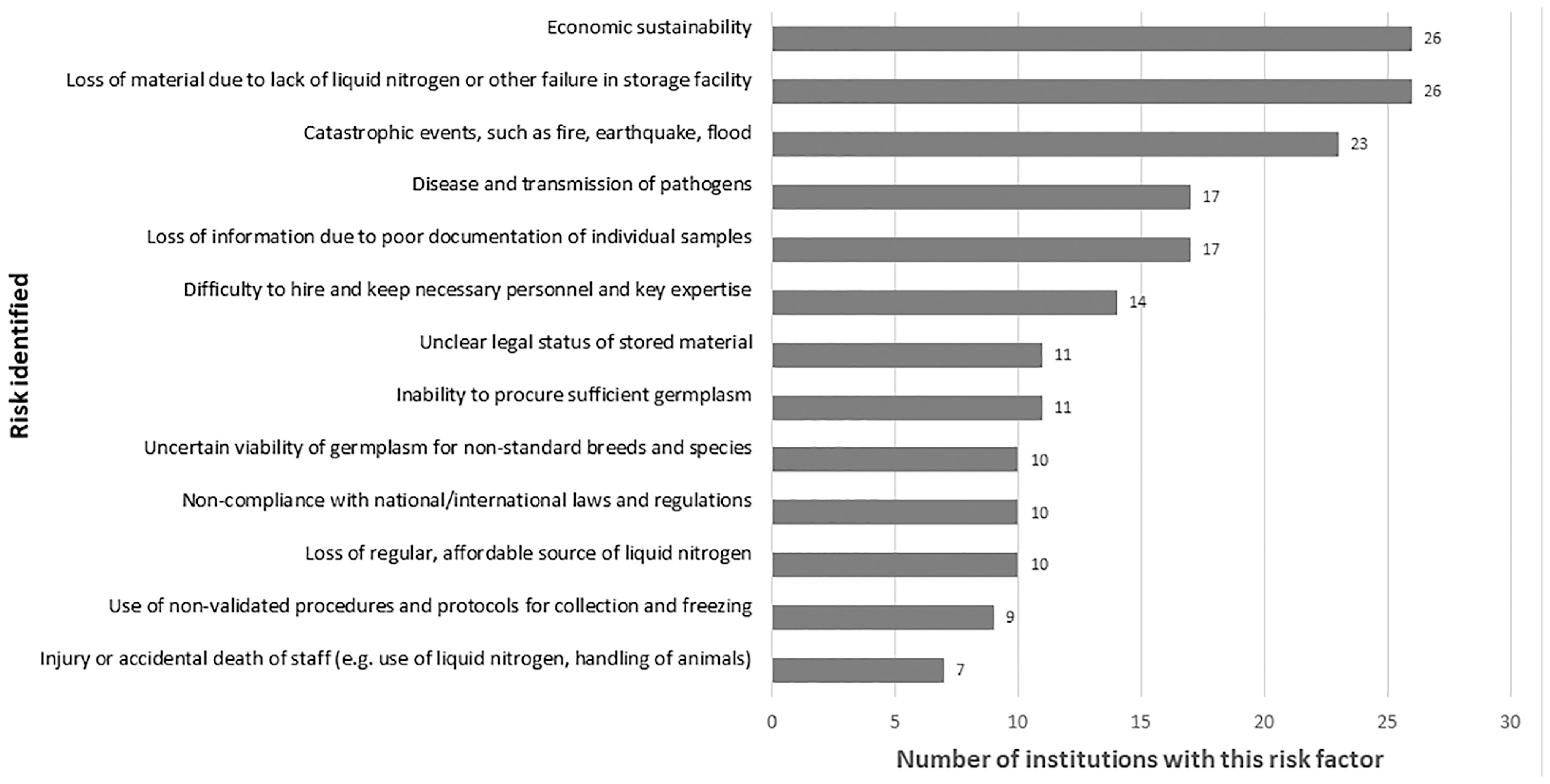
Common risks to sustainability reported by the gene banks responding to the survey.
General quality management
Twenty-seven gene banks (30%) have established a QMS, of which 15 involved formal certification. The formal approaches included 11 ISO certifications and the remaining banks cited national guidelines or regulations. Thirty-seven banks (41%) were in the process of developing a QMS.
Table 2 shows results for specific aspects of QMS. A quality manager was present in 55% of the gene banks. The vast majority of quality managers held advanced degrees, with either a Master's degree or a PhD. Twelve percent reported to have received specialized training in quality management. The hours devoted to quality management varied widely, ranging from 0–5 hours per week to more than 40.
Proportions of Livestock Gene Banks Having Various Characteristics or Applying Various General Practices Associated with Formal Quality Management Systems
N = 90 gene banks.
QMS, quality management system.
Gene bank personnel and equipment
Table 3 summarizes the key questions regarding management of personnel and equipment. Nearly 75% of gene banks had appointed a specific person responsible for overall management of the gene bank. This may or may not be the quality manager. Only about one-third of gene banks had prepared formal job descriptions and training programs for all employees, but most banks had these features for at least some of the staff (51 and 59%, respectively).
Proportions of Livestock Gene Banks Having Various Characteristics or Applying Various General Practices Associated with Personnel and Equipment
N = 90 gene banks.
Regarding equipment (Table 3), 34% of the gene banks had identified their critical equipment, and 37% reported having standard operating procedures for usage and regular maintenance of their equipment. Records of controls, routine maintenance, and/or calibration of critical equipment were maintained by 32% of the respondents.
Material acquisition
Acquisition of biological material, ownership, and rights to use stored material are critical issues for livestock gene banks, especially for international exchange following the adoption of the Nagoya Protocol of the Convention on Biological Diversity (CBD) 13 and subsequent national legislation. Table 4 reports the number of banks utilizing each of the five most common acquisition procedures. Thirteen banks did not report using any of the modes of acquisition and 46 banks used multiple modes. The most commonly used approach was collection of material already owned by the gene bank (or more precisely, by the government for public banks). Regarding legal agreements for obtaining material for the bank, Material Transfer Agreements or similar contracts were utilized by 59% of the banks. Only about one-third of these banks (i.e., around 20% of all banks) used such contracts for all acquisitions.
Common Modes for Acquisition of Material and Proportions of Gene Banks Using Each Mode
n = 90 gene banks.
For example, government research farms and institutions, including artificial insemination centers.
Material collection, reception, processing, storage, and distribution
Table 5 has the results for the main questions on quality management procedures associated with collection, reception, processing, storage, and distribution of genetic material. In some instances, not all gene banks were undertaking all steps of gene banking from material collection to distribution (e.g., only 60 gene banks collect and process the material they store), so the proportions reported take this factor into account. Nearly 90% of the gene banks collecting and processing material follow specific standard operating procedures for these processes and take care to individually label stored samples, but a slightly smaller proportion had a quality control system for their collected samples. Fifty-two banks accept previously processed material from other sources. Policies and procedures for quality control of externally processed material seem somewhat less rigorous than for internally processed samples (Table 5).
Proportions of Livestock Gene Banks Having Various Characteristics or Applying Various General Practices Associated with Material Collection and Processing, Introduction into the Inventory, Storage, and Distribution
n = 60 gene banks.
n = 52 gene banks.
n = 90 gene banks.
More than three-fourths (77%—Table 5) of the gene banks restrict the access to the storage area, although only 30% had a system to record the entry of persons into the storage area. Separate storage systems for different material types were utilized in only 20% of banks.
Collection and storage procedures currently receive more attention than those related to distribution. Only 22 banks (24%—Table 5) have formal policies regarding providing external stakeholders with access to material, although an additional 20 banks were in the process of preparing such policies. Most gene banks reported having standard operating procedures for preparing samples for distribution.
Data system for genetic material
Approximately half (49%) of gene banks reported having a “database” for monitoring their collections and another 22% of the gene banks were in the process of developing a data system. Approximately 75% reported having some system to record and trace the material stored in the gene bank.
A wide variety of data recording tools were used. Microsoft Corporation (Redmond, WA, USA) products Excel® (n = 32) and Access® (n = 3) were used by half of the banks specifying their data system. Ten banks use database software specifically designed for livestock cryoconservation. Five of these banks use A-GRIN, developed by the National Genetic Resources Program of the United States, 14 whereas the other five use CryoWEB, 15 developed for the European network of national gene banks. Fourteen banks used an in-house software and three used commercial software other than Microsoft®.
Twenty-one gene banks have made their data accessible to the public to a limited extent. Only one gene bank claimed full public access. In Europe, privacy legislation prevents the public sharing of some data fields. Data were backed-up regularly by 84% of the respondents with databases, although the frequencies of backing up varied substantially—ranging from daily or each time new data are inserted (n = 8) to once every 6 months (n = 2).
Relationships among questions
As hypothesized, the questions were not independent. The average Pearson correlation between pairs of questions was 0.28. Correlation coefficients were negative for only a few pairs of questions and not significantly so (p > 0.05). The average correlation between the presence of a formal QMS and all other questions was only 0.23. The small positive correlation coefficient suggests that many banks had some procedures, processes, and characteristics for quality management, even if they did not have a formal QMS.
The greatest association between two questions (r = 0.80) was for questions “Does the gene bank have a formally documented organizational and management structure?” and “Does the gene bank have a QMS?.” The second largest correlation (r = 0.70) was between questions on standard operating procedures for critical equipment and recording of when such equipment was serviced or maintained. Similar correlations (r = 0.69) were observed between questions on the presence of a database, its regular backing-up, and restriction of permission for read–write access.
Discussion
The total of 62 responding countries indicates a continual trend toward the increased adoption of cryoconservation of AnGR. Fifty-five and 58 countries reported gene banks in formal FAO assessments of the management of AnGR in 2007 and 2015, respectively. Moreover, those respective assessments involved 169 and 129 countries, respectively, and countries were somewhat obliged to participate, whereas this survey was entirely voluntary. The approaches toward quality management of the gene banks remain highly variable. A minority (30%) of the banks reported having formal QMS, but an additional 41% of banks were in the process of establishing a QMS and nearly all banks reported implementing some aspects of quality management.
The proportions of gene banks having individual characteristics or practices varied greatly. Compliance was generally more common for the technical aspects of gene banking, such as standard procedures for processing and freezing (88%) and quality control of processed samples (77%). Less commonplace were features associated with formal QMS, such as having a management system for quality documentation (14%) and documented identification of key processes (18%).
The reason for a low proportion of QMS among livestock gene banks may be associated with the history of the banks and their primary purpose. Nearly all the banks are public institutions, established primarily to insure against loss of local breeds or to avoid dangerously low genetic diversity in in situ populations. Supporting research is another common purpose, but this research is often performed by the gene bank or by closely associated research institutions.
These conservation goals reflect a need for high technical quality and viability of processed and stored material for potential use by the provider or gene bank and associated institutions, but less need to document quality to completely independent third parties. As noted earlier, only 13% of gene banks had undertaken stakeholder analyses and prepared communication plans and only 24% had a formal policy for external distribution of material to third parties.
This largely inward-looking management of gene banks may change in the future. Although individual breeds are considered sovereign to each country, their genetic diversity is a shared public good, at least conceptually. In addition, many breeds are transboundary, meaning that they are present in more than a single country. Genetic diversity of livestock continues to decrease and the need for external users to access collections may increase, including the need to access collections from other countries.
Economic sustainability was the most commonly cited risk to gene banking. As a buffer against potential decreases in public funding, alternative funding mechanisms, such as providing services to outside users may become more common and these users may demand documentation of quality management. In addition, the sources of genetic material may demand greater traceability of the genetic resources that they contribute. Financial constraints may also require greater efficiency, such as cross-country communication and coordinated cryoconservation of (transboundary) breeds. Standardized QMS may help facilitate cooperation in such efforts.
Similar issues have been recognized for animal gene banking outside of the livestock sector. As mentioned previously, the ISO 20387 standard on biobanking for multicellular organisms and micro-organisms was finalized in 2018. This standard has two particularly key principles, fitness-for-purpose and assessment of competence. Requirements for quality management vary according to the purpose of the bank and thus the practices undertaken to ensure quality must be appropriate. Assessment of competence is more demanding than basic certification, such as with ISO 9001. The FAO guidelines on cryoconservation of AnGR 3 emphasizes technical aspects of gene bank management, but does address the importance of documentation and the legal issues of material acquisition and access to stored material.
The Conservation Breeding Specialist Group of the International Union for the Conservation of Nature and Natural Resources' Species Survival Commission has for many years promoted international dialogue on the topic of coordinating genome resource banks. 16 CBSG working groups have recognized that repositories should be developed according to specific, scientific guidelines consistent with an international standard that ensures practicality, high-quality ethics, and cost-effectiveness. The Global Genome Biodiversity Network, 17 an international network of genomic repositories for nonhuman species, shares best practices for management of genomic samples and develops guidance documents.
In human specimen research, the World Health Organization has provided standard operating procedures to human tissue banks for years and its International Agency for Cancer Research recently published standards for biobanking in cancer research. 18
A logical initial step toward standardized quality control across gene banks is the adoption of a self- or peer-evaluation procedure or tool for livestock gene banks. Such a tool could help gene banks uncover the potential flaws in their system, as well as provide suggestions for improvement of their QMS, thereby universalizing the QMS to some degree.
Another option would be to have gene banks participate in an officially recognized external quality assessment scheme by an independent authority (e.g., ISO). A comparable example is accreditation through ISO 17025 for genetic testing laboratories. This obligatory quality assessment gives service providers formal accreditation and is a legal requirement in many countries for being able to perform genetic tests on a commercial basis. Such a formal and obligatory accreditation program may not be realistic for livestock gene banks, especially in the short term and on a global level, but a voluntary approach may be achievable.
One of the objectives of the IMAGE project is to develop procedures for harmonizing gene bank operations and a voluntary self or peer-based review of quality management could eventually result from this effort. Complementary training and awareness-raising in quality management would also be required. Such a system would presumably not only improve the technical quality of stored samples and fitness for their intended purpose but also help to build trust with existing utilizers of material. Awareness rising would increase the visibility of the bank to potential new clients.
Improved and more-standardized QMS for livestock gene banks could have other potential advantages, such as helping facilitate international exchange of gene-banked material. As mentioned previously, no multinational gene banks responded to the survey. Administrative issues associated with international sanitary regulations and transboundary access to genetic resources currently present major hurdles to multinational gene banking for livestock. The authors are unaware of any actively operating multinational banks, despite their possible benefits. A standardized approach to quality management, especially if developed in collaboration with veterinary regulatory bodies (or at least with their awareness) may help build a landscape in which multicountry gene banks can be established.
Conclusions
Gene banks for livestock are becoming more numerous as a tool to address the decreasing diversity of AnGR and to support research on a large range of domestic species. Collection and preservation of animal genetic material are complex and costly. The complexity and expense of gene banking, as well as the value of preserved samples, mean that quality control is critical. Formal QMS were reported for less than a third of the banks responding to this survey, but steps toward adopting QMS are being taken by many others. Quality management is currently more rigorous for incoming samples than outgoing material.
Greater cooperation among gene banks, including sharing good practices, exchanging protocols, and sharing data, may help improve quality management, as well as increase efficiency for management of the genetic diversity of breeds found in more than one country. With appropriate development and complementary training, a voluntary self- or peer-review process would be a powerful tool for ensuring a common standard for quality management of animal gene banks.
Footnotes
Acknowledgment
The authors thank the representatives of the countries and individuals who responded to the questionnaire.
Authors' Contributions
F.Z. analyzed the data and drafted the initial version of the article. S.-J.H. contributed to the development of the questionnaire and advised on its contents. M.D. and M.T.-B. proposed the initial concept of the questionnaire and undertook preliminary testing through direct interviews with a small group of gene bank managers. P.B. coordinated the study, developed and distributed the electronic questionnaire, and finalized the data analysis and article. All authors read, contributed to, and approved the final article.
Author Disclosure Statement
No conflicting financial interests exist.
Disclaimer
© The views expressed in this publication are those of the author(s) and do not necessarily reflect the views or policies of the Food and Agriculture Organization of the United Nations.
Funding Information
This work was supported by the European Union's Horizon 2020 Research and Innovation Programme (grant agreement no. 677353 [IMAGE]).