




Abstract
Objective:
This study was designed to assess the effects of using tris-soybean lecithin (TSL)-based extender supplemented with bovine serum albumin (BSA) on the quality of ram epididymal spermatozoa during refrigerated storage.
Method:
Epididymal sperm were collected from 22 Zandi rams, diluted in TSL-based extender at different concentrations (0%, 2.5%, 5%, 7.5%, and 10%) of BSA, and stored for 5 days at 4°C. Sperm parameters including motility, viability, plasma membrane integrity, chromatin protamination, and malondialdehyde (MDA) content were evaluated at 0, 24, 72, and 120 hours of refrigeration.
Results:
The addition of 10% BSA to the extender significantly improved sperm viability at 24 and 120 hours of refrigerated liquid storage (p < 0.05). An enhancement in plasma membrane integrity was observed along with a decrease in MDA level by increasing the concentration of BSA from 0% to 10% (p > 0.05). Sperm motion characteristics were higher in the BSA-free group at 120 hours of preservation (p < 0.05). No statistical difference was found for nuclear protamination between experimental groups (p > 0.05).
Conclusion:
BSA supplementation in TSL-based extender can preserve the viability of epididymal ram spermatozoa during liquid storage at 4°C.
Introduction
The postmortem recovery of epididymal spermatozoa is the last chance for the conservation of valuable genetic materials of domestic farm animals that die accidentally or must be culled due to serious illness, physical defects, disease carriers, poisoning, and stress problems.1,2 The retrieved epididymal spermatozoa should be instantly used in assisted reproductive programs or stored for future applications due to the short life span of sperm cells. 3
Cryopreservation is the only approved method for the long-term storage of spermatozoa. 4 However, sometimes immediate cryopreservation of postmortem samples is not possible due to the remoteness of the collection site from the laboratory where the epididymal semen could be properly frozen.3,5 Therefore, in this case, the short-term storage of spermatozoa at 4°C–5°C could be considered to maintain the quality of the collected samples.3,6 Furthermore, using frozen-thawed sperm in the artificial insemination of rams is restricted to the deep intrauterine deposition procedure because the fertility rate achieved with thawed semen after vaginal-cervical insemination is very low. 7 This low fertility rate is related to the deleterious effects of cryostorage, which leads to irreversible damage to sperm motility, viability as well as fertilizing ability.7,8 Hence, currently, the most useful method to increase the fertility of vaginal-cervical insemination in sheep species is to use sperm preserved at cool temperatures. 7
During the chilled preservation (4°C–5°C), the metabolism of spermatozoa is not totally arrested, which results in the generation and accumulation of reactive oxygen species (ROS) inside cells. 9 Excessive production of ROS induces damage to sperm proteins, DNA, and lipids, which subsequently reduces the function of spermatozoa during refrigerated preservation.10,11
To improve the quality of chilled-preserved spermatozoa, different extenders with various additives such as antioxidants, proteins, and amino acids have been tested in previous studies.12–15 The growing body of literature has shown that the addition of bovine serum albumin (BSA) to extenders can efficiently maintain sperm quality during the storage period.10,11,16,17 One of the main features of BSA is its antioxidant capacity, which could remove free radicals created by oxidative stress.18,19 Furthermore, BSA, as a cryoprotectant, can be adsorbed onto the sperm surface to preserve its membrane fluidity and integrity during the cryopreservation process.16,20 BSA may also improve the motility, viability, and pregnancy rate of ejaculated semen following the freezing-thawing process by dilution in storage extenders.21–23
Liquid preservation of ram epididymal spermatozoa in the extender containing BSA at refrigerated temperature has not been reported yet. Therefore, this study was designed to evaluate the effects of different concentrations of BSA in tris-soybean lecithin (TSL)-based extender on ram epididymal sperm motility, viability, plasma membrane integrity, chromatin protamination, and malondialdehyde (MDA) level during 5 days of storage at 4°C.
Materials and Methods
All animal experiments and study protocols were approved by the Royan Institute Ethics Committee (Reference No. IR.ACECR.ROYAN.REC.1396.59).
Chemicals and reagents
All the products were acquired from Sigma-Aldrich (St. Louis, MO).
Animals and sperm collection
The testis samples were removed during the breeding season (October to December) from 22 healthy and sexually mature Zandi rams (aged between 3 and 5 years, weighing between 68 and 75 kg, and with proven fertility) immediately after slaughter and taken to the laboratory in a cooler box (4°C). Upon the samples' arrival within the first 2 hours postmortem, their processing was instantly started in a cold room. First, the superficial vessels were dissected to avoid blood contamination. Epididymal spermatozoa were then obtained by performing small cuts on the cauda epididymis with the scalpel and collected in microtubes containing TSL-based extender by using a pipette for concentration assessment. Sperm concentration was subsequently determined by computer-assisted sperm analysis (CASA) system using the Sperm Class Analyzer® software (SCA, Version 5.1; Micro-Optic Co., Barcelona, Spain).
Extender preparation
TSL-based extender was prepared according to Emamverdi et al. 24 with some modifications. In brief, 2.71 g tris, 1 g fructose, and 1.40 g citric acid were dissolved in 100 mL of deionized water and mixed with 1% (w/v) of soybean lecithin. The osmolality and pH of the extender were adjusted to 320 mOsm/kg and 7.2 mOsm/kg, respectively. BSA was then supplemented in the basic extender at concentrations of 0%, 2.5%, 5%, 7.5%, and 10%, according to Table 1.
Composition of Tris-Soybean Lecithin-Based Extenders Containing Different Concentrations of Bovine Serum Albumin
BSA, bovine serum albumin; DW, deionized water; SL, soybean lecithin.
Sperm dilution and storage
After the evaluation of epididymal spermatozoa concentration by CASA, the samples were diluted to the final concentration of 800 × 106 sperm/mL in the base extender containing different levels of (0%, 2.5%, 5%, 7.5%, and 10%) BSA. Then, all the samples were preserved in the refrigerator at 4°C. An aliquot was finally taken from each of the samples at 0, 24, 72, and 120 hours of storage, and sperm assessments were performed.
Sperm assessments
Motion characteristics
Motility parameters of epididymal spermatozoa were evaluated by the CASA system using the SCA software (Version 5.1; Micro-Optic Co.). An aliquot of 10 μL of the sperm samples was placed on prewarmed glass slides, covered with a coverslip, and inspected under a phase-contrast microscope (Eclipse E-200; Nikon Co., Tokyo, Japan) at 10 × magnification (negative phase-contrast field Ph1 BM, with a green filter). Sperm motion characteristics, including total motility (%), progressive motility (%), straight-line velocity (VSL, μm/s), average path velocity (VAP, μm/s), curvilinear velocity (VCL, μm/s), amplitude of lateral head displacement (ALH, μm), and beat cross frequency (BCF, Hz), were analyzed in five randomly selected fields. 25
Viability
Sperm viability was assessed by the eosin–nigrosin stain technique. The stain was first made by dissolving 2.90 g of sodium citrate, 10 g of nigrosin, and 1.67 g of eosin-Y in 100 mL distilled water. Sperm smears were then prepared by mixing two drops of stain with a drop of sperm suspension on a slide. Finally, viability was evaluated by counting 200 cells under a bright-field microscope at 100 × magnification. Spermatozoa showing partial or complete purple staining were counted as nonviable; only cells displaying strict exclusion of stain were considered as viable. 26
Plasma membrane integrity
The functional sperm membrane integrity was examined by using the hypo-osmotic swelling test. In brief, 30 μL of semen was added to 300 μL of a 100 mOsm/L hypo-osmotic solution (4.9 g sodium citrate and 9 g fructose per liter of distilled water). After 1 hour incubation at 37°C, 0.2 mL of the homogenized mixture was applied to a slide, mounted with a coverslip, and eventually observed under a phase-contrast microscope (Eclipse E-200; Nikon Co.). A total of 200 sperm were evaluated in different microscopic fields at × 40 magnification. The percentage of cells with swollen and curved tails was determined.
MDA level
MDA concentration, as an indicator of lipid peroxidation (LPO) in sperm samples, was measured using the thiobarbituric acid–trichloroacetic acid (TBA–TCA) assay, in accordance with the method of Selvaraju et al. 27 Concisely, 1 × 10⁸ sperm were first washed twice in phosphate-buffered saline (PBS) by centrifugation at 500 g for 5 minutes at 4°C, and the pellet was resuspended in 1 mL PBS. MDA level was then assessed after the addition of 2 mL of cooled TBA–TCA solution (0.25 M HCl, 0.375% w/v TBA, and 15% w/v TCA) to 1 mL of cell suspension. Subsequently, the mixture was boiled for 1 hour in a water bath. After cooling, the mixture was centrifuged at 500 g for 15 minutes at 20°C–25°C. The supernatant was then collected for reading the absorbance at 535 nm by a spectrophotometer. The concentration of MDA was determined according to the following formula.
MDA concentration (μmol/mL 1 ) = [optical density × 106 × total volume (3 mL)]/[1.56 × 105 × test volume (1 mL)].
Chromatin protamination
The Chromomycin A3 (CMA3) test was applied to evaluate the extent of sperm nuclear protamination. In short, an aliquot of 20 μL spermatozoa suspension was smeared on a microscope slide. The smear was then fixed in precooled Carnoy's solution (glacial acetic acid/methanol 1:3) at 4°C for 20 minutes. After fixation, the slide was covered with 100 μL of CMA3 staining solution at 25°C for 20 minutes in a dark place. The CMA3 staining solution was made by dissolving the CMA3 in McIlvaine's buffer (7 mL of 0.1 mol/L citric acid mixed with 32.9 mL of 0.2 mol/L Na2HPO4 and 10 mmol/L MgCl2, pH 7.0) to a concentration of 0.25 mg/mL. The slide was finally rinsed in PBS, dried away from light, and mounted with buffered glycerol (1:1). Microscopic analysis was performed on the slides using a fluorescent microscope with a 460–470 nm filter. Evaluation of CMA3 staining was done for 200 sperm per sample by distinguishing between CMA3-positive spermatozoa (bright yellow-stained sperm with abnormal chromatin condensation) and CMA3-negative spermatozoa (dull yellow-stained sperm with normal chromatin condensation).
Statistical analysis
All the presented values were expressed as mean ± standard error of the mean. The means of this study were analyzed by repeated-measures analysis of variance with one between-subject factor followed by Tukey's post hoc and Bonferroni test to determine significant differences in all the parameters between different concentrations and times, respectively. All analyses were evaluated using SPSS software (version 16 for windows; Chicago, IL).
Results
Motility parameters
The effects of varying concentrations of BSA on ram epididymal sperm motion characteristics after the refrigerated preservation are presented in Tables 2–4. Our analysis indicated that there were no significant variances between the control and treatment groups at 24 and 72 hours of preservation in total and progressive motility (Table 2). Nevertheless, in the groups where 7.5% and 10% BSA were added, total and progressive motility were significantly decreased at 120 hours of refrigeration in comparison with the control (p < 0.05).
Comparison of Total and Progressive Motility of Ram Epididymal Sperm Between Different Concentrations of Bovine Serum Albumin During 120 Hours of Refrigeration
Values are given as mean ± SEM. Different letters indicate significant differences (p < 0.05). The letters (a, b) were used for group comparisons. The letters (A–D) were used for time comparisons.
TM, total motility; PM, progressive motility; SEM, standard error of the mean.
According to Table 3, none of the treatment groups displayed any significant changes in VSL and VAP parameters at 24 and 72 hours of refrigeration. However, VSL in the 5%, 7.5%, and 10% BSA groups and VAP in the 7.5% and 10% BSA groups were statistically lower than the control at 120 hours of the preservation process. In the case of VCL, the values obtained for the 10% BSA group were significantly lower than those without BSA during the storage time. Furthermore, at 120 hours of liquid preservation, groups that included 5% and 7.5% BSA showed lower VCL in comparison with the control.
Comparison of Curvilinear Velocity, Straight-Line Velocity, and Average Path Velocity of Ram Epididymal Sperm Between Different Concentrations of Bovine Serum Albumin During 120 Hours of Refrigeration
Values are given as mean ± SEM. Different letters indicate significant differences (p < 0.05). The letters (a, b) were used for group comparisons. The letters (A–D) were used for time comparisons.
VCL, curvilinear velocity; VSL, straight-line velocity; VAP, average path velocity.
Comparison of Beat Cross Frequency and Amplitude of Lateral Head Displacement of Ram Epididymal Sperm Between Different Concentrations of Bovine Serum Albumin During 120 Hours of Refrigeration
Values are given as mean ± SEM. Different letters indicate significant differences (p < 0.05). The letters (a–c) were used for group comparisons. The letters (A–D) were used for time comparisons.
BCF, beat cross frequency; ALH, amplitude of lateral head displacement.
As shown in Table 4, there were no statistical differences among various BSA concentrations at 24 and 72 hours of refrigeration in the BCF parameter. Nonetheless, the group containing 10% BSA had a significantly lower BCF than the control group at 120 hours of the preservation process. On the subject of ALH, spermatozoa stored in extenders containing 7.5% and 10% BSA exhibited significantly lower ALH throughout the storage period compared with the BSA-free group. Moreover, at 24 hours of liquid-refrigerated storage, both concentrations of 7.5% and 10% demonstrated statistically lower ALH in comparison with 2.5% and 5% BSA groups. ALH was also significantly lower in 5% BSA group than in control at 72 and 120 hours of refrigerated preservation.
Viability
The viability of ram epididymal spermatozoa treated with different concentrations of BSA over the refrigerated storage period is presented in Figure 1A. At 120 hours of storage time, the percentages of live sperm in the 5%, 7.5%, and 10% BSA groups were significantly higher when compared with the control (p < 0.05), whereas at 72 hours there were nonsignificant variations between the control and treated groups. Furthermore, at 24 hours of preservation, the group treated with 10% BSA showed higher viability in comparison with the BSA-free group (p < 0.05). On the contrary, the viability was also statistically higher in 10% BSA group compared with the group of 2.5% BSA at 120 hours of refrigeration storage (p < 0.05).
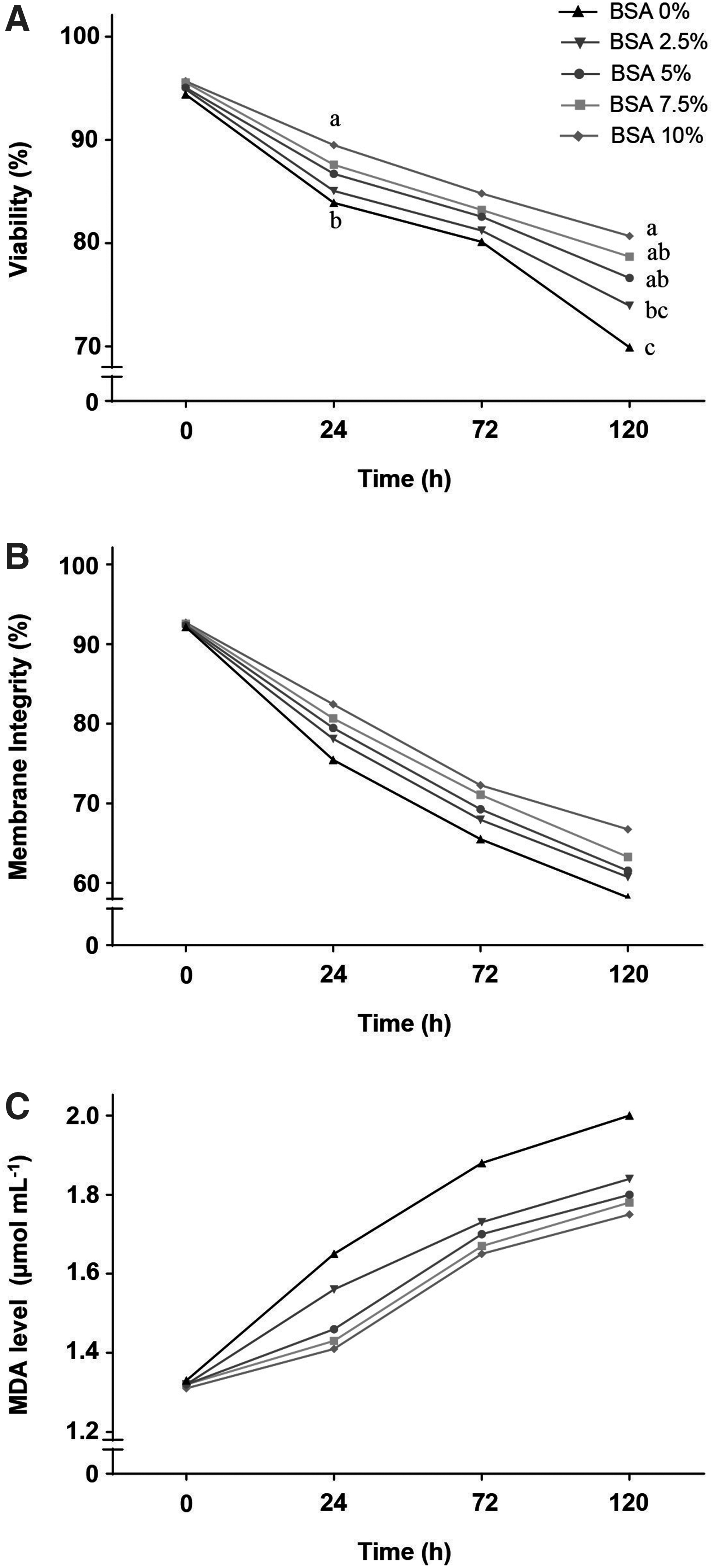
Comparison of
Plasma membrane integrity
The percentages of the intact plasma membrane in epididymal semen samples of rams, at various concentrations of BSA during liquid storage period for 120 hours, are given in Figure 1B. BSA supplementation increased the percentage of spermatozoa with the intact membrane in diluted samples. Nevertheless, this increase was not statistically significant among the groups.
MDA level
The effects of varying concentrations of BSA on MDA content of ram epididymal semen during 120 hours liquid preservation are shown in Figure 1C. The addition of different levels of BSA led to a reduction in MDA content in all of the groups; however, it was not statistically different among the control and treatment groups.
Chromatin protamination
Throughout the storage time, the analysis of CMA3-positive ram epididymal sperm showed that different concentrations of BSA had no remarkable effects on spermatozoa nuclear protamination status (Table 5).
Comparison of Chromomycin A3-Positive Ram Epididymal Sperm Between Different Concentrations of Bovine Serum Albumin During 120 Hours of Refrigeration
Values are given as mean ± SEM. No letters indicate no statistical differences (p > 0.05).
CMA3, chromomycin A3.
Discussion
Refrigeration is a short-term method for storing epididymal spermatozoa in breeding programs of ram species. 3 To our knowledge, no previous research has evaluated the effects of BSA supplementation in TSL-based extender on ram epididymal sperm quality during a long period of liquid storage at 4°C.
Appropriate sperm motility of preserved spermatozoa is required for improving cervical insemination outcomes in the sheep breeding industry. 8 The obtained results from our study demonstrated that the BSA-free extender achieved maximum percentages of sperm total and progressive motility, although BSA could not generally improve sperm motion characteristics during the storage period. These data were in disagreement with the studies performed on ram,18,21,28 boar, 11 rabbit, 10 and buffalo 16 spermatozoa in which a significant enhancement was observed in sperm motility after supplementation of BSA in the preservation extender. Such discrepancies in our experiment may be due to differences in the type of extender, the method of preservation, the source of semen, and the species investigated. The higher preservation properties of TSL-based extender than other previously used extenders can be assumed as one of the reasons for the different results.29,30 Furthermore, since the chemical and physical features of epididymal cells appeared to be different from ejaculated cells, this would have differentiated our findings from others.31,32
Our results also indicated that other kinematic parameters of sperm (VCL, VSL, VAP, ALH, and BCF) were lower for the groups supplemented with BSA compared with the control group. This may be explained by the higher viscosity of BSA containing extender, which results in lower sperm velocity patterns, ALH, and BCF. Based on our findings, adding BSA to TSL-based extender may not affect epididymal sperm motility parameters during refrigeration time.
Maintaining the spermatozoa viability throughout the preservation period is very important to improve storage outcomes. 8 The addition of 10% BSA to the extender showed significantly better sperm viability than other BSA concentrations and the control during liquid storage. Our findings were consistent with previous studies showing that BSA enhances the survival of preserved spermatozoa.16,18,28,33 Sperm refrigeration reduces energy production through the glycolysis pathway, which in turn decreases cell survival rate. Fatty acids of BSA as an energy supply could increase ATP production after the liquid storage of spermatozoa.10,33 Thus, BSA would likely extend the viability of ram epididymal spermatozoa during the preservation period.
Plasma membrane stabilization is one of the major contributing factors to sperm function and metabolism. 34 In this study, as the BSA concentration increased from 0% to 10%, the sperm tail swelling rate was superior during the refrigeration time. However, this enhancement was not statistically different between control and treated samples. Many experiments have been conducted on different spermatozoa species to determine the potential of BSA to improve membrane integrity.10,11,23 Previous studies indicated that spermatozoa could rapidly adsorb BSA on its membrane. The adsorbed BSA can modify the sperm lipid composition by removing cholesterol from the plasma membrane, which preserves the fluidity and integrity of the sperm membrane during the storage period.16,20 Therefore, sperm plasma membrane stability might be protected by the addition of BSA to a preservative extender.
LPO is one of the serious sperm chilling damages. The high content of unsaturated fatty acids in the spermatozoa plasma membrane makes them susceptible to undergo peroxidation by free radicals that are produced during the cooling period.18,35 Subsequently, this oxidative stress results in various structural injuries inside the cells. The scavenging of free radicals could occur by supplementation of antioxidant additives in the extender.23,36 BSA is well known as the antioxidant substance that could protect spermatozoa through trapping the free radicals. 19 Several researchers have shown that BSA could eliminate ions from different sperm species during the preservation process.10,11,37 Yet, the extent of the sperm peroxidative damages is determined by measurement of the MDA level as the product of LPO reaction.10,11 In the current investigation, it was found that the MDA level decreased when the concentration of BSA increased among our treatment groups. However, no meaningful differences in the level of MDA were observed between control and experimental groups. These results perhaps mean that BSA could protect spermatozoa effectively through its antioxidant properties.
Protamination of the sperm nucleus is necessary for condensing the DNA to protect it from oxidative stress. 38 Protamines can be damaged by the production of excessive ROS during sperm preservation. 39 This damage leads to less compaction of DNA and more incidence of relaxed chromatin, which increases the possibility of DNA breaks due to ROS. 38 In the present research, we could not observe any considerable changes in the extent of chromatin protamination of ram epididymal spermatozoa throughout freezing-free preservation at 4°C. This result may be relevant to the types of protamine present in the ram sperm nucleus. Ram spermatozoa, unlike other species that express both types (I and II) of protamine, have only type I protamine. 40 This makes the ram sperm more resistant to oxidative stress caused by the storage process because type I protamines are more stable than type II protamines due to the maximum number of disulfide bonds. 41
In conclusion, this study showed that supplementing 10% BSA to TSL-based extender only has significant positive effects on sperm viability during 5 days liquid storage of epididymal ram spermatozoa at 4°C. However, further research on the fertilization rate after artificial insemination of chilled ram epididymal spermatozoa stored in TSL-based extender containing 10% BSA is required to verify whether 10% BSA can preserve ram epididymal sperm at 4°C during liquid storage.
Footnotes
Authors' Contributions
A.S., T.R.T., and M.N.B. participated in study design. P.R. conducted all experiments, data collection, and interpretation. P.R. drafted the article. N.Z. edited the article. A.H. contributed to technical support. S.M.J.T.-M. performed sample collection and preparation. S.M. carried out the statistical analysis. A.S. and T.R.T. were responsible for overall supervision. A.S., T.R.T., and M.N.B. revised and approved the final version of the article.
Author Confirmation Statement
Miss P.R., Mrs. N.Z., Mr. S.M.J.T.-M., and Dr. A.S. are from the Royan Institute for Reproductive Medicine; Dr. T.R.T. is from Tabriz University of Medical Sciences; Mr. A.H. is from Tarbiat Modares University; and Dr. S.M. is from Guilan University of Medical Sciences, all where research and education are the primary functions.
Acknowledgments
We thank the staff of the sperm biology laboratory for their full support.
Author Disclosure Statement
No conflicting financial interests exist.
Funding Information
This work was funded by Royan Institute, Tehran, Iran (Grant number 94000251).