




Abstract
Cryopreservation, which refers to preservation of cells or tissues at subzero temperatures, inevitably involves the problem of cryoinjury caused by ice crystals. The application of an external electric field during the freezing process has been shown to be a promising approach to produce miniature ice grains and decrease the fraction of ice crystallization at a slow cooling rate. Thus, the dielectric and thermodynamic properties of NaCl-H2O binary solutions at subzero temperatures were tremendously important for understanding the mechanism of ice formation under the manipulation of an AC electric field in biopreservation. However, there was still a lack of relevant information in the literature. The first objective of this study was to systematically measure the dielectric spectrum of 0.9% NaCl-H2O binary solutions at temperatures ranging from −100°C to 0°C with a cooling/heating rate of 2°C/min. We further measured the thermodynamic properties of a 0.9% NaCl-H2O binary solution while applying a series of electric fields near its dielectric relaxation frequency. The effect of the electric field on the crystal morphology was studied last. Pure water was selected as the control group. The results showed that an AC electric field can alter the thermodynamic process and thus the phase transition and ice crystal structure could be manipulated. It was concluded that the AC electric-assistant preservation method will be a promising technology in cryopreservation.
Introduction
Programmed slow-freezing and vitrification are two conventional cryopreservation methods, which involve the use of cryoprotective agents (CPAs) such as glycerol, DMSO (dimethyl sulfoxide, Me2SO), and other chemical agents to protect cells from freezing injuries. Vitrification is more appropriate for several cell types, as it enables elimination of lethal ice formation. However, the toxicity of CPAs at high concentrations and the ultrarapid cooling rate required hinder the wide use of vitrification, especially for large volume organs.
Water molecules have an intrinsic electric dipole moment, which rotates in response to an applied electric field. 1 Based on this mechanism, dielectric heating is widely used. However, it is less well known that an electric field may be able to influence ice formation during cryopreservation by nonthermal mechanisms. The cornerstone of this method can be traced back to 1961, when Salt proposed a method to use an electrostatic field in the freezing of water and insects. It has been demonstrated that supercooled water and two species of insects frozen at higher temperatures than normal when placed in an electrostatic field. 2 Following those results, electrostatic,3–6 electric fields oscillating at radio7,8 or microwave frequencies,9–11 and magnetic fields 12 have been intensively and successfully used in cryobiology to alter supercooling and suppress ice formation by electrically disturbing water molecules.
Sun et al. studied the effects of dipole polarization of water molecules on ice formation under an electrostatic field with a strength in the range of 103–105 V/m, and the dipole moment oriented along the electrostatic field direction can be obtained according to Boltzmann distribution law that assists in forming the critical nuclei.5,6 Petersen et al. introduced an experimental setup by the application of an electric high-voltage pulse for controlled freezing of aqueous solution. The cooling rate and, in particular, the nucleation temperature can be controlled via electrofreezing. 11 Ma et al. confirmed that the degree of supercooling in 0.9% NaCl aqueous solution was enhanced by an AC electric field (100 kV/m at 106 Hz) due to the induced electric dipole oscillation. 8 However, Peleg proved an opposite conclusion by showing that a surface charge density of up to ∼75 nC/mm2 and an electric field of up to ∼1 × 10⁸ V/m do not order water molecules into an ice-like configuration. 13 Recently, Kang et al. focused on understanding of ice nucleation processes and introducing the applications of electric field and magnetic field for preservation of food and biological materials through a review, which show that some of the mechanisms and detailed effects have not been adequately elucidated yet and results in the literature appear contradictory, in particular, alternating electric field and oscillating magnetic field's impacts. 12
Rapid changes in the thermodynamic properties of water and dilute solutions, such as chemical potential, enthalpy, and heat capacity, were also observed.14–16 Many hypotheses have been proposed to rationalize these so-called anomalous effects, and the thermodynamic properties of aqueous solutions at low temperatures are exploited in numerous practical applications.17–19
There have been many experimental studies of the electro-assisted preservation method for biomaterials. To reveal its physical mechanism, the dielectric spectra, mainly in the microwave region,20–23 and thermodynamic properties14–16 of aqueous solutions have been separately measured or simulated using various experimental or theoretical methods. However, the thermal effects of microwave frequencies are dangerous for cells or organs.24, 25 Although we have previously shown that using a low-frequency electric field (kHz–MHz) to assist Sprague Dawley rat liver preservation could improve the efficiency, 26 the sample's dielectric response and thermodynamic properties are very important factors during the freezing procedure of biomaterials under the control of electric fields. In this study, we measured and analyzed the dielectric relaxation at low frequencies and the thermodynamic properties of a 0.9% NaCl-H2O binary system under the control of an electric field from −100°C to 0°C, which represented a very relevant model for biological living system.27–29 Pure water was selected as the control.
Materials and Methods
The study was approved by IRB and informed consent was abandoned.
Preparation of solution
NaCl was purchased from GIBCOTM Invitrogen Co. (Beijing, China). Purified water produced by water-cleaning equipment (MinIPORE Milli-Q) was used to prepare the solution. The saline solution contained 0.90% (w/w) NaCl and 99.10% (w/w) deionized water.
Dielectric spectrum measurement system
Temperature-dependent dielectric frequency domain spectroscopy was performed on the aqueous solution samples using the Concept 80 system (Concept 80 Broadband Dielectric Spectrometer; Novocontrol Technologies GmbH & Co. KG.) from 0.1 Hz to 10 MHz to obtain values for the capacitance (C) and dielectric loss (tan δ). The dielectric constant (ɛ) was obtained according to the equation: ɛ = 4Ct/ɛ0πd 2 . Here, t, d, C, and ɛ0 denote the thickness, diameter, capacitance, and vacuum dielectric constant (ɛ0 = 8.85 × 10⁻¹² F/m), respectively.
Differential scanning calorimeter measurement system
Thermodynamic properties of the samples were measured using a differential scanning calorimeter (DSC Q2000; METTLER TOLEDO). The temperature scale for DSC was carefully calibrated as described elsewhere. 30 To verify the influence on the formation and structure of ice crystals during the process of cooling under the control of an electric field, an electric field with dielectric loss frequency was applied. Copper microelectrodes with 200 μm distance were fabricated using a printed circuit board on the surface of Al2O3 ceramic and fixed in all crucibles. The DSC measurement system with electric field is shown in Figure 1.

DSC measurement system
A small amount of each solution (5–10 mg) was loaded into the DSC crucible and equilibrated at 10°C for 5 minutes. The sample was cooled to −60°C and then heated back to 10°C with a cooling/warming rate of 2°C/min. During the cooling process, the microelectrodes were connected to the function signal generator (AFG3250C; Tektronix) through a thin metallic conductor line. The strength of the electric field was 1 × 10⁵ V/m, and the frequencies were 100 kHz, 1 MHz, and 10 MHz, based on our previous results. 8
Morphology of crystals
The cryomicroscope consists of a temperature-controlled stage (BCS196; Linkam™), a temperature controller (THMS 600; Linkam), a liquid nitrogen pump (LNP; Linkam), a light microscope (BX51; Olympus) with a charge-coupled device camera and the image processing software Linkam. Ice crystal morphology is recorded and stored; furthermore the grain size also can be obtained by the image processing software Linkam. The temperature of samples on the stage varied from −196°C to 125°C and at the cooling rate of 2°C/min. Details about the cryomicroscopy setup with microelectrodes are described in previous references.8,31
Results
Dielectric spectrum
Previous studies have shown that the frequency variation of the dielectric constant of an aqueous solution of polar molecules has two dispersion regions, one due to the relaxation of solute and one due to that of the water molecules. The two dispersion regions are widely separated, and that of the solute makes only a negligible contribution to the dielectric constant in the microwave region. Therefore, many studies have focused on the frequency of water relaxation.
In the present work, we measured the complex permittivity ɛ* = ɛ′ − iɛ″ between 0.1 Hz and 10 MHz for NaCl-H2O at different temperatures. The dielectric loss (tan δ) and relaxation time (τ) were evaluated. Activation energy parameters (Ea) in kJ/mol were also reported, as calculated by Equation (1).
where τ = 1/fp, fp is the frequency of the dielectric loss peak. T is the absolute temperature. A is Arrhenius factor, for a given chemical reaction, A is a constant. R is the gas constant, about 8.31 KJ/mol.
Figure 2a and c show the temperature dependence of dielectric loss for pure water and the NaCl-H2O binary system during cooling. Figure 2b and d shows, respectively, the lnτ-1/T curve of pure water and that of the NaCl-H2O binary system at the frequency peaks shown in Figure 2a and c. In contrast to the single peak for pure water (Fig. 2a), there were two peaks for the NaCl-H2O binary system, representing the solid+liquid and the solid phase (Fig. 2c); the corresponding frequency ranges were 105–106 and 102–104 Hz, and 102–105, and 10−1–101 Hz, respectively. When dissolved in water, the sodium chloride dissociates as Na+ and Cl−, which are then hydrated by the polar water molecules and form an induced electric dipole when an AC electric field is applied. 8 The peaks shifted to lower frequencies with decreasing temperature, especially in the temperature range from −30°C to −100°C, and the corresponding relaxation time increased. According to dielectric theory, it can be speculated that the right loss peak was related to the relaxation polarization of a type of dipole moment that presents a disordered state, while the left loss peak was related to the relaxation polarization of a pure water (ice molecule) dipole moment.
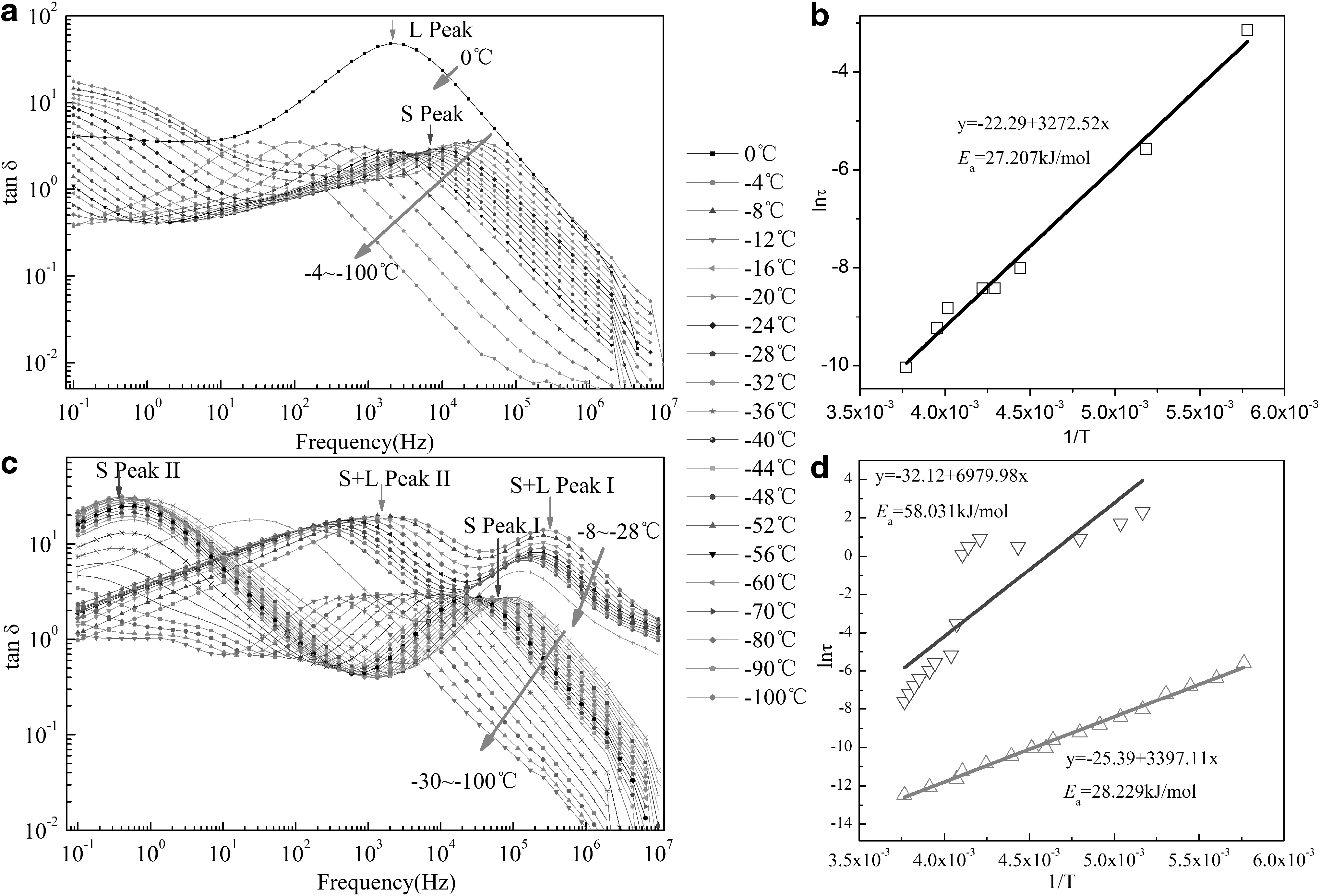
The liquid-solid phase transition can also be identified by permittivity measurements. The solid peak values of tan δ were markedly smaller than those of the liquid or solid-liquid mixture phase (Fig. 2a, c). The activation energy can reflect the degree of difficulty of a chemical reaction. Compared with that of pure water, the first-order activation energy of the NaCl solution was slightly increased, indicating that the salt solution phase transition was more difficult than in pure water. The liquid-solid phase transition activation energy of pure water was 27.207 KJ/mol (Fig. 2b), while the first-order phase transition activation energy of NaCl+H2O was 28.229 KJ/mol and its eutectic phase transition activation energy was 58.03 KJ/mol. Thus, it can be concluded that the addition of salt ions increases the difficulty of the first-order phase transition.
Thermodynamics
A series of DSC thermograms are shown in Figure 3. The samples were first cooled to −60°C and then warmed to 10°C with a cooling/warming rate of 2°C/min. Each experiment was repeated six times. For quantitative comparison, the heat release of each sample was normalized with respect to the mass of the sample and denoted as specific heat flow. As shown in Figure 3b, pure water showed one exothermal peak (point A) and one endothermic peak (point B), owing to the solidification/melting of water/ice. As shown in Figure 3b1–b4, the latent heat of NaCl solution during cooling was too high to induce the temperature reheat up to 1°C and form an exothermic ring. The crystallization and melting entropy were reduced by the external field, especially at 1 MHz.
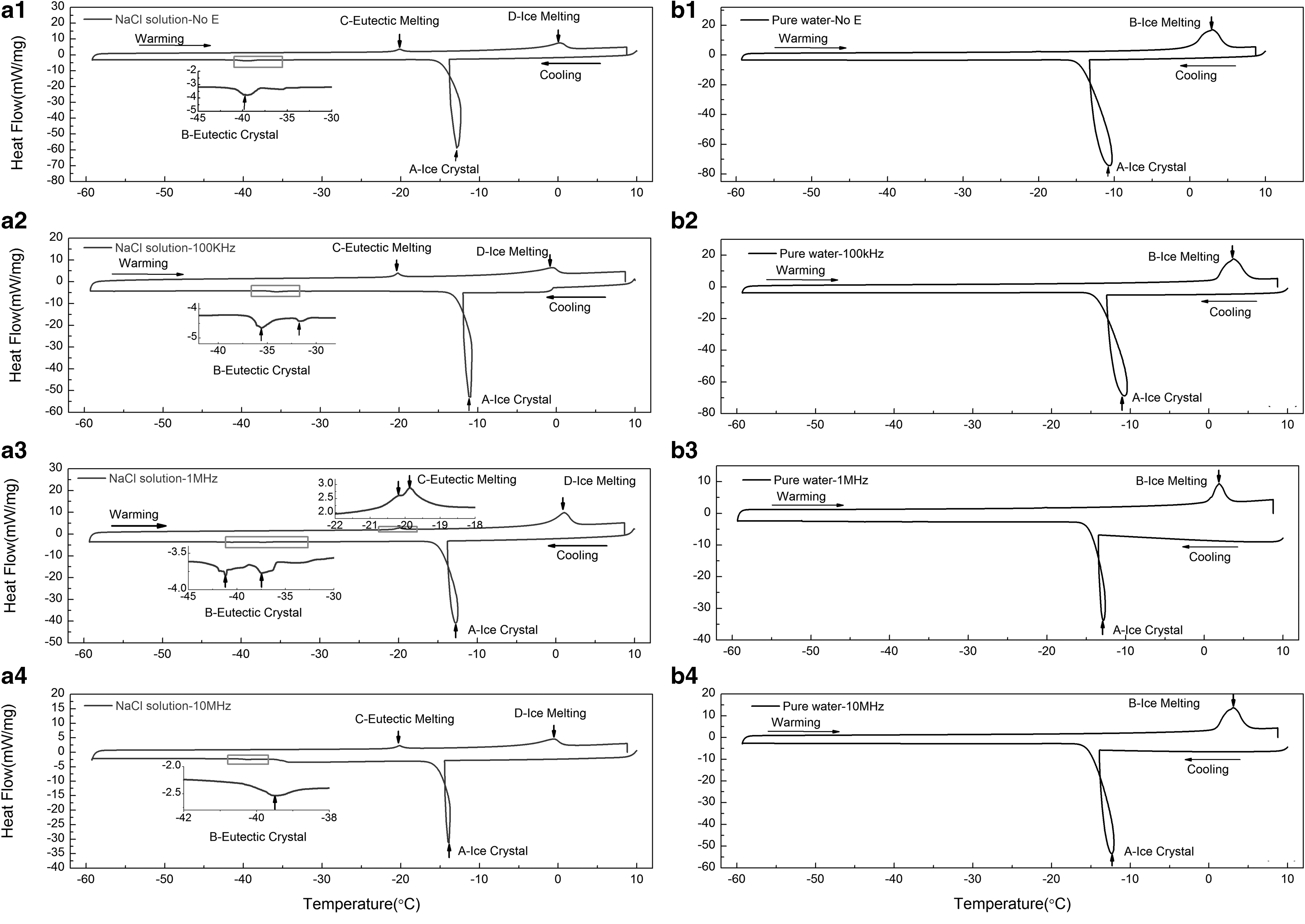
A series of representative DSC thermograms of pure water and NaCl-H2O binary solution under the control of an electric field with a cooling/warming rate of 2°C/min.
As shown in Figure 3a, two exothermic peaks (points A and B) were observed during cooling. Peak A represents the heat release of ice crystal growth, while peak B represents eutectic crystallization, which occurs at a significantly supercooled temperature compared with the thermodynamic equilibrium eutectic temperature of −21.2°C.30,32 The exact onset temperature of eutectic formation is stochastic as is ice nucleation. 33 During warming, however, the eutectic melting (endothermic peak at point C) started very close to its thermodynamic equilibrium eutectic temperature, followed by another endothermic peak representing ice melting (point D). The phase change behavior during warming is very close to thermodynamic equilibrium, as can be predicted by phase diagrams in the literature. During the freezing process, there was also a primary heat release, forming an exothermic ring in the NaCl-H2O solution. With increasing frequency of the electric field, the values of the first exothermic ring heat flow decreased, possibly reflecting the ice nucleation becoming easier.
Eutectic crystallization refers to the process of the unfrozen part of the solution (water and solute) solidifying at the same time. In the case of the NaCl-H2O binary system, the eutectic ice temperature always occurs at 40°C or below. 30 This temperature increased at 100 kHz and 10 MHz but decreased at 1 MHz, that is, the eutectic crystal formation became more difficult. Another interesting phenomenon was that the eutectic solidification/melting peak split into two peaks at the frequencies of 500 kHz and (more obviously) 1 MHz, as illustrated in the inset of Figure 3a3. A possible explanation is that crystallization formed two different steady states under the control of the external electric field: the area of poorer thermal stability solidified/melted at a relatively low temperature, while the area of higher thermal stability solidified/melted at a relatively high temperature, thereby forming double peaks.
In this work, the enthalpy change ΔH was calculated using Equation (2):
Here, Cp is the heat capacity at constant pressure and T is the absolute temperature of the system.
Using the DSC thermograms and Equation (2), the thermodynamic parameters of pure water and NaCl-H2O binary solution during thawing were obtained, and the mean ± standard deviation values are summarized in Tables 1 and 2, respectively. The melting temperature of ice crystals (Tmi) increased and there was a five-fold decrease in the value of ΔH when pure water applied a 1 MHz electric field during the cooling procedure.
Thermodynamic Parameters of Pure Water During Thawing (Mean ± Standard Deviation)
Thermodynamic Parameters of NaCl-H2O Binary Solution During Thawing (Mean ± Standard Deviation)
Thermodynamic parameters of the NaCl-H2O binary solution can be found in Table 2. Notably, the electric field had an influence on both phase transition orders to different degrees; this was especially obvious with respect to the water/ice melting temperature Tmi. The values of both ΔH1 and ΔH2 decreased when applying an electric field during cooling, as the lower transition enthalpy allowed the transition to proceed more easily. It can be concluded that the content of ice in the two different states decreased. ΔH2/ΔH1 indicates the relative degree of difficulty of the second-order phase transition. We also observed that theΔH2/ΔH1 ratio decreased when applying the electric field during cooling. In particular, it decreased to 0.027 at a frequency of 1 MHz, indicating that the reduction of eutectic ice was greater than that of pure water ice. Formation of both ice and eutectic crystal were inhibited by the external electric field, and the effect was more significant for eutectic crystal. Therefore, it can be concluded that application of the electric field can reduce ice crystal formation, especially in the case of eutectic ice, and thus may be able to suppress low-temperature damage.
Crystal morphology
The effect of the electric field on the crystal morphology was studied at four different frequencies: 0, 100 kHz, 1 MHz, and 10 MHz. Digital video cryomicroscopy images at −60°C of pure water ice (Fig. 4a1–a4) and NaCl-H2O (Fig. 4b1–b4) under different cooling conditions are shown in Figure 4. The scale bar shown in the image is 25 μm. For pure water, dendritic patterns were observed. When there was no electric field (Fig. 4a1), the dendritic ice crystal grows along the direction of the temperature gradient. The formation of dendritic ice crystals directly destroyed the cell structure, even caused the cell to death. When an AC electric field was applied, those dendritic patterns gradually decreased and disappeared at the frequency of 10 MHz. As we know, the natural polarization frequency of a water molecule is 2450 MHz. Thus, the closer the frequency is, the more obvious the thermal effect of water molecules polarization is, which affects the crystallization of water molecules in the cooling process.
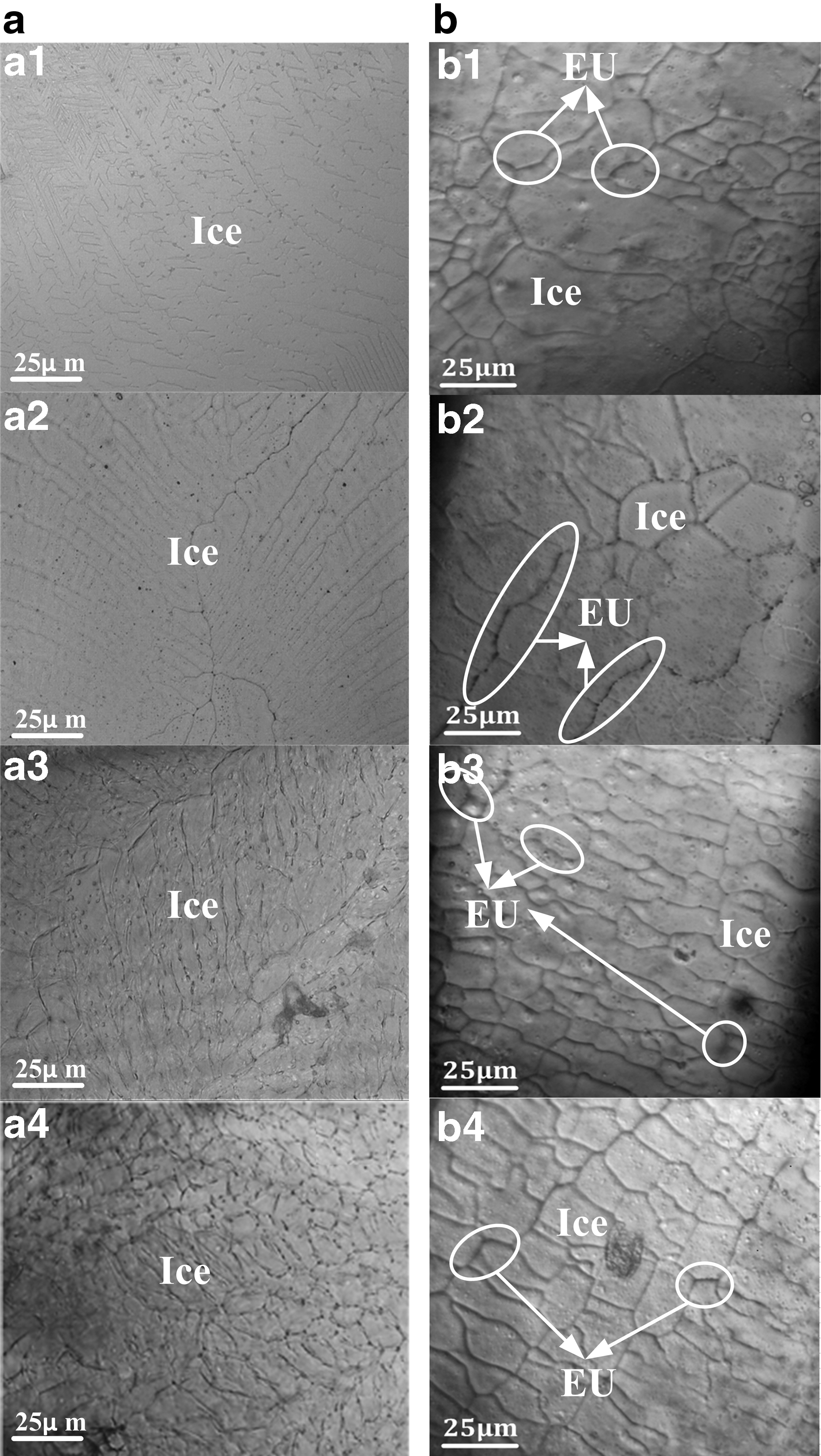
Cryomicroscopy images of pure water and NaCl-H2O binary solution under the control of electric field with a cooling/warming rate of 2°C/min.
When each NaCl-H2O sample is cooled further below the equilibrium eutectic phase change temperature −21.2°C in the literature, a eutectic crystal has never been observed until much lower temperatures.27,34 Comparing Figure 4b1–b4, it can be seen that the samples with an AC electric field showed more ice crystals than those with no field. Moreover, the ice grains observed at high frequencies were smaller, especially at 1 MHz, which can be computed by the image processing software Linkam. This result is consistent with the previous study. 8
Discussion
In cryopreservation, pure water ice and eutectic ice are two important factors in low-temperature damage. Previous studies suggested that adding a small amount of DMSO into water increased the ordered arrangement of water molecular, while having little effect on the hydrogen bonding of water or acting as a structure breaker. It has been proposed that DMSO acts as a proton acceptor. On the basis of thermodynamic considerations, the DMSO-H2O hydrogen bond, stronger than the H2O-H2O hydrogen bond, has been confirmed to be strong enough to disrupt normal water structure and reduce the formation of ice nucleus. 35 In this article, our results show that an electric field can be substitute for the role of DMSO, which can reduce both pure water ice crystals and eutectic crystals.
Crystallization utilizes the dielectric response that occurs under a small AC voltage owing to dipole deflections along the same direction of spontaneous polarization. In the process of temperature-induced structural phase transition, the path of dipole deflection depends on the orientation of electric field. The actual dipole deflection is along with the lowest barrier energy. On the one hand, the crystal structure itself determines dipole potential in different directions and the dipole rotation path. On the other hand, it can determine the phase transition during the temperature change. No other external condition changes, the dipoles deflection states are fixed. As they all have a uniform structure, it can be speculated as to the orientation of the dipole under an electric field, a phase transition that occurs during the temperature change.
It is considered that an AC electric field causes distortion of the outer layer of the crystal embryos, which can decrease the barrier potential between atoms and embryo, and reduce the binding energy of water molecules. That is, more water molecules can be combined together through hydrogen bonds. The formation of hydrogen bonds requires a high activation energy, which leads to a reduction in molecular energy and the stabilization of water molecules. Therefore, it can be concluded that an optimum electric field can make the ice growth become more difficult.
Eutectic crystallization is defined as simultaneous solidification of an unfrozen fraction into solids, which occurs only with supercooling. CPAs could prevent the eutectic formation of electrolytes, and even make eutectic crystallization negligible or nonexistent.30,36 The eutectic formation that occurs during supercooling in CPA-containing solutions has been noted by several researchers. 29 In our article, an explanation of the crystallization physical mechanism under the control of an electric field has been found. Our experiments showed that an electric field can play the same role as CPAs. The transition enthalpy of the first-order phase (ΔH1) and eutectic phase (ΔH2) was decreased by the electric field, especially at 1 MHz, which indicated that the phase transition became increasingly difficult. There was also evidence that the ΔH2/ΔH1 ratio decreased from 0.14 (no field) down to 0.027 (1 MHz), indicating that the reduction in eutectic ice was greater than that of pure water ice. The mechanism of this process has been illustrated in our previous work. 7 For the NaCl-H2O binary solution, there are two types of crystal structure that occur upon crystallization, pure water ice (grain), and eutectic ice (boundary), which correspond, respectively, to the “Ice” and “EU” labeled in Figure 3b. The DSC thermograms and cryomicroscopy results from this study show that pure ice nucleation became easier but more difficult to grow into large grains. The dielectric spectra also suggest that the activation energy of eutectic nucleation is larger than that of pure ice, and could be significantly affected by the electric field (Fig. 2d).
The freezing injuries that accompany pure water ice formation and eutectic crystallization may have a negative impact on cryopreserved objects. The results also allow us to propose a possible explanation of how electric fields influence the process of crystallization. When dissolved in water, the sodium chloride dissociates as Na+ and Cl− ions. During liquid-solid transition, the nucleation and growth of ice crystals expel most of the ions to the liquid inclusions, with some ions remaining on the grain boundaries to undergo eutectic crystallization. When applying an AC electric field to the NaCl aqueous solution, the induced electric dipole will be oscillating. In the dielectric relaxation frequency region, the induced polarization will not completely follow the change in the external electric field, producing spatial disordering for electric dipoles. Such nonuniformity of local polarization may make the formation of ordered crystallized ice difficult and thus inhibit crystal growth.
Conclusion
In summary, pure ice and eutectic crystal formation can be controlled by applying an AC electric field during liquid-solid transition for 0.9 wt.% NaCl aqueous solution. First, based on the dielectric temperature spectrum, the optimal electric field of about 1 MHz may influence the freezing process of the NaCl binary system. Such a condition is located in a specific dielectric relaxation region for the sample. Furthermore, from the point of view of thermodynamics, it can be concluded that the phase latent heat and enthalpy decreased when an electric field was applied during cooling. In particular, the ΔH2/ΔH1 ratio decreased from 0.14 (no field) down to 0.027 (1 MHz), which indicated that the reduction of eutectic ice was more than that of pure water ice. Finally, it could be seen from the cryomicroscopy images that the number of ice nuclei increased and the size of ice grains decreased under the electric field.
Footnotes
Author Disclosure Statement
The authors have no competing financial interests to disclose.
Funding Information
The authors gratefully acknowledge the support of the Shaanxi Innovation Capability Support Plan (2018KJXX-095), Xijing University Special Foundation for Research and Development of Talents (XJ17T03).