




Abstract
Hu sheep is a valuable sheep breed in China, and semen cryopreservation of Hu sheep is important for sustainable development of the agri-food industry. This study aimed to evaluate the effect of thawing rate and antioxidants (procyanidins [PC] and mitoquinone [MitoQ]) on the quality and antioxidant enzyme activity of post-thaw sperm in Hu sheep. Our results showed that the highest sperm quality was obtained from the group thawed at 70°C for 5 seconds. Furthermore, addition of 150 nM MitoQ in the extender could enhance motility, integrity of the membrane and acrosome, and mitochondrial activity, whereas only sperm motility and membrane integrity were increased with 10 μg/mL of PC supplementation, compared with the control group. Meanwhile, both PC (10 μg/mL) and MitoQ (150 nM) supplementation increased the levels of superoxide dismutase and glutathione peroxidase and decreased the levels of reactive oxygen species and malondialdehyde. In conclusion, the optimal thawing protocol of semen cryopreservation in Hu sheep was 70°C for 5 seconds. MitoQ supplementation (150 nM) in the extender could improve sperm quality and reduce the level of oxidative stress in Hu sheep semen after cryopreservation. Further studies are needed to evaluate fertility of the post-thaw semen using MitoQ.
Introduction
Semen cryopreservation plays an important role in the development of artificial insemination and animal husbandry. Hu sheep is a valuable local sheep breed for meat and skin usage in China. Moreover, Hu ewes start estrus all seasons of the year, which makes up for the defect that the traditional sheep industry only fattens in autumn and winter, thus ensuring the mutton supply in spring and summer. 1 However, the viability of Hu-sheep sperm after cryopreservation is still low (30%–40%), 2 and currently there is no optimal protocol of semen cryopreservation reported in Hu sheep.
The cryopreservation technology of semen generally employs liquid nitrogen (−196°C) as the storage medium and the semen is thawed before artificial insemination to restore its fertilization ability. 3 The thawing rate has been considered as an important factor that could affect the quality of sperm after freezing. The commonly used thawing temperature for frozen ram sperm is 30°C–40°C.4–6 However, it has also been reported that a higher temperature (70°C) with a faster thawing rate would be beneficial for recovery of post-thaw ram sperm. 7 It is unknown which thawing temperature works better in semen cryopreservation in Hu sheep.
In the process of rapid cooling, semen will be subjected to peroxidation damage and oxidative stress, which leads to the dysfunction of mitochondria, the decline of semen quality, and the decrease of conception rate.8,9 Therefore, it is crucial to reduce the oxidative damage and improve the quality of semen, and several antioxidants, such as vitamin E, 5 CoQ10, 6 and melatonin, 10 have shown protective effects of post-thaw sperm after addition to the cryopreservation extender. Procyanidins (PC) harbor antioxidant activity, which can effectively scavenge a variety of reactive oxygen species (ROS), 11 and prevent H2O2-induced DNA damage in Fao cells. 12 A previous study has found that the addition of PC to the basic diluent could improve goat sperm quality when preserved at 4°C. 13 Mitoquinone (MitoQ) has been reported to be a mitochondrial targeted antioxidant, which can significantly reduce the level of ROS in cellular mitochondria. 14 Fang et al. found that the quality of frozen semen was improved when 20 nM of MitoQ was applied to the extender in yellow fish. 15 Also, MitoQ was used for human semen cryopreservation by Liu et al. 16 Moreover, there have been few reports about the toxicity of PC and MitoQ in semen cryopreservation.
Therefore, in this study we aimed (1) to evaluate the effect of thawing rate on sperm quality after cryopreservation, and (2) to investigate the effect of antioxidants (PC and MitoQ) on quality and antioxidative activity of post-thaw sperm in Hu sheep.
Materials and Methods
PC was purchased from Shanghai Yuanye Bio-Technology Co., Ltd (Shanghai, China). All the other chemicals were purchased from Sigma-Aldrich (Missouri, USA), unless otherwise stated.
Semen collection
Six Hu rams (2- to 3-year old) from the Shanghai Yonghui Sheep Industry were selected for semen collection using an artificial vagina twice a week during the breeding season. The ejaculates with a volume of 0.75–2 mL, sperm concentration >2.5 × 10⁹/mL, milky white color, normal odor, high density, and high viability (>80%) were used for experiments. To eliminate individual differences, semen samples from six rams each session were pooled. Each pooled sample was split into different equal aliquots and diluted with the freezing extenders according to the experimental design. All the experiments were repeated five times. The semen collection was performed by the company—Shanghai Yonghui Sheep Industry. So no live animals was directly included in this study. Semen was purchased from Shanghai Yonghui Sheep Industry.
Semen freezing and thawing
To prepare the freezing extender, 20% (v/v) egg yolk, 6% (v/v) glycerol, and 200 IU/mL of penicillin sodium and streptomycin sulfate were added to the basic extender (Tris [0.3 M], citric acid [0.95 M], and glucose [0.28 M]). 17
The protocol of semen freezing a previous study was followed. 4 In brief, the pooled semen samples were diluted into the freezing extender at a ratio of 1:3, and then slowly chilled to 4°C for 2 hours. The samples were packed into 0.25 mL plastic straws and sealed. The straws were then placed horizontally on a metal rack and frozen in liquid nitrogen vapor (3 cm above the liquid) for 15 minutes before being dipped into liquid nitrogen for long-term storage.
After 48 hours of liquid nitrogen storage, semen were thawed either at 42°C 18 or 70°C, 19 according to the experimental design. Then the semen from one straw (0.25 mL) was put into 1 mL of the basic extender and kept at 37°C for 30 minutes before subsequent analysis.
Sperm motility and viability
The sperm analyzer (IVOS version 12; Hamilton-Thorne Biosciences, MA, USA) with a Mailang disposable sperm counting chamber (Mailang, China) was used to detect sperm motility and viability. In brief, the post-thaw semen was gently mixed, and 15 μL of the semen was dropped onto a counting chamber preheated at 37°C. At least four different microscope fields were randomly selected at 37°C under a 200 × optical microscope, and the number of motile sperm, linear motile sperm, and dead sperm were automatically identified by the sperm analyzer. The viability was calculated as the ratio of motile sperm to the total number of sperm, and the motility was the proportion of the number of linear motile sperm to the total number of sperm.
Sperm membrane integrity
The sperm membrane integrity was detected by the hypo-osmotic swelling test. 7 In brief, 10 μL of post-thaw semen was added to 100 μL of prewarmed (37°C) hypo-osmotic solution (0.9 g of fructose, 0.49 g of sodium citrate, dissolved in 100 mL of distilled water) and incubated at 37°C for 1 hour. Five different visual fields were randomly selected under a 200 × optical microscope, and the proportion of the number of sperm with curled tail to the total number of sperm was calculated. A representative image is shown in Figure 1A.
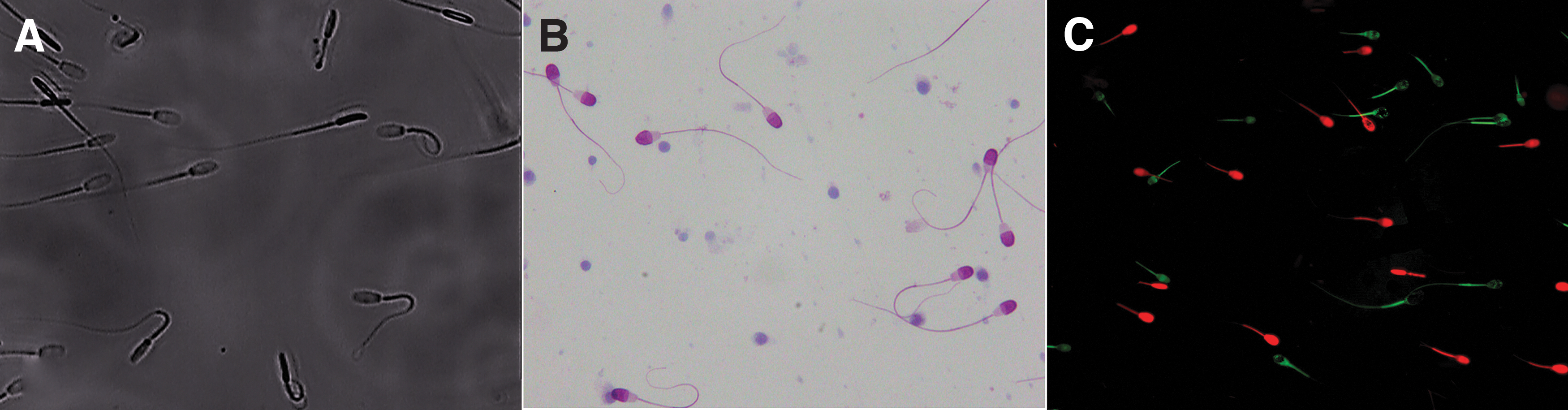
Representative images of hypo-osmotic swelling test to detect sperm membrane integrity
Sperm acrosome integrity
The Coomassie brilliant blue method was performed to evaluate sperm acrosome integrity. In brief, 100 μL of semen was added into 0.5 mL of saline prewarmed at 37°C, and then the mixture was centrifuged at 8000 g for 20 seconds. The precipitate was resuspended with 0.5 mL of paraformaldehyde, followed by standing for 0.5 hour and washing with phosphate-buffered saline (PBS). After resuspension with 100 μL PBS, 5 μL of the washed semen sample was dropped onto the glass slide, and the smear was stained with Coomassie brilliant blue after drying, followed by standing for 30 minutes. After air drying, the acrosome integrity was observed under an oil immersion microscope (400 × magnification) with at least four different random visual fields. The purple or blue acrosomal region indicated that the acrosome was intact, and the unstained or light blue acrosomal region indicated an incomplete acrosome. 20 A representative image of staining is shown in Figure 1B.
Mitochondrial integrity
The semen mitochondrial activity was evaluated with reference to the report by Zou et al. 21 The post-thaw semen sample was diluted to 1.5 × 10⁶ sperm/mL with a basic extender, and 10 μL of rhodamine 123 (Beyotime Institute of Biotechnology, China) were added to achieve a final concentration of 1 μmol/L at 38°C for 20 minutes. After centrifugation at 500 g for 3 minutes, 5 μL of 1 mg/mL propidium iodide was added to the sperm suspension. The sperm samples were counted with an epifluorescence microscope equipped with an excitation filter (450–490 nm) (100 × ). The sperm were classified as live spermatozoa with active mitochondria (R123+/PI−) and dead spermatozoa (PI+). For each sample, at least 200 sperm were counted. A representative image of staining is shown in Figure 1C.
Antioxidant enzyme activities
The main active oxygen scavenger is superoxide dismutase (SOD), which can effectively maintain the metabolic balance of ROS and protect the structure of sperm membrane. The level of SOD activity was determined with a SOD assay kit (Beyotime Institute of Biotechnology). Glutathione peroxidase (GPx) can decompose H2O2 to reduce damage to cell membranes by oxidation. 22 Post-thaw semen samples from different groups were lysed in lysis buffer and assayed using the Cellular Glutathione Peroxidase Assay kit (Beyotime Institute of Biotechnology) at room temperature according to the manufacturer's instructions. If the total amount of ROS exceeds sperm tolerance, lipid peroxidation will occur and affect the conception rate. 23 The levels of ROS were measured by a chemiluminescence assay (5-amino-2,3-dihydro-1,4-phthalazinedione, luminol), according to a previous study. 14 Malondialdehyde (MDA) is a product of lipid peroxidation, which leads to the decrease of semen quality. 24 The lipid peroxidation by MDA formation in semen was measured by a commercial kit (Beyotime Institute of Biotechnology) based on the thiobarbituric acid reaction test.
Statistical analysis
Five replicates were conducted for every single test. The data were analyzed by one-way ANOVA using SPSS 19.0 software. The results were expressed as mean ± standard error, and p < 0.05 indicated significant differences.
Experimental design
Experiment 1
Effect of the thawing rates on quality of post-thaw semen. After 48 hours liquid nitrogen storage, semen samples were thawed either at 42°C (for 15, 17, or 20 seconds), or 70°C (for 3, 5, or 8 seconds). Viability, motility, membrane integrity, and acrosome integrity were evaluated as indicators of quality of post-thaw sperm.
Experiment 2
Effect of antioxidants (PC and MitoQ) on quality and antioxidant activities of post-thaw sperm. Different concentrations of PC (10, 20, 40, and 80 μg/mL) or MitoQ (50, 100, 150, 200, and 400 nM) were added to the freezing extender. The semen was thawed at 70°C for 5 seconds (the optimal thawing rate based on Experiment 1), and then used for evaluation of sperm quality (viability, motility, membrane integrity and acrosome integrity, mitochondrial activity) and antioxidant enzyme activities assays, for example, SOD, GPx, ROS, and MDA.
Results
Experiment 1: Effect of the thawing rate on quality of post-thaw sperm
In all three thawing times at 42°C, higher motility, intact membranes and acrosomes of post-thaw sperm were observed from the group of 17 seconds (Table 1). There were no differences in viability within all three groups. When thawing sperm at 70°C for three different times, the group of 5 seconds resulted in the better quality in all the sperm parameters (viability, motility, membrane integrity, and acrosome integrity). Looking at thawing rates of 42°C for 17 seconds and 70°C for 5 seconds, there was a higher percentage of viability and motility in post-thaw sperm from 70°C (p < 0.05), but no differences on integrity of membrane and acrosomes. Based on the results, 70°C and 5 seconds were chosen to evaluate the effect of PC and MitoQ on semen cryopreservation in Hu sheep.
Effect of Thawing Rates on the Quality of Post-Thaw Sperm
Different superscripts in same column indicate significant differences (p < 0.05).
Experiment 2: Effects of PC and MitoQ on quality and antioxidant enzyme activities in post-thaw sperm
As shown in Table 2, among all four different concentrations of PC, the highest percentage of viability, motility, membrane integrity, acrosome integrity, and mitochondrial activity in the post-thaw sperm were observed with 10 μg/mL of PC supplementation; however, only motility and membrane integrity were significantly higher, compared with the control group (p < 0.05). When the concentration of PC was >40 μg/mL, there was a decline in most sperm quality parameters. Compared with the control group, a significant decrease was observed in all sperm parameters when PC was 60 μg/mL (p < 0.05). A similar trend was observed using MitoQ as a protective agent in extender (Table 3). The sperm quality was improved with increasing concentrations of MitoQ (100 and 150 nM), and the sperm quality parameters (sperm motility, viability, membrane integrity, acrosome integrity, and mitochondrial activity) were the highest with 150 nM of MitoQ supplementation in the extender. When the concentrations of MitoQ were increased to 200–400 nM, the sperm quality started to decrease. The viability, motility, and intact membranes of the post-thaw sperm with 400 nM of MitoQ supplementation were significantly lower than those in the control group (p < 0.05).
Effects of Different Concentrations of Procyanidins on the Quality of Post-Thaw Sperm
Different superscripts in same column indicate significant differences (p < 0.05).
Effects of Different Concentrations of Mitoquinone on the Quality of Post-Thaw Sperm
Different superscripts in same column indicate significant differences (p < 0.05).
The antioxidant enzyme activities of the post-thaw sperm with PC and MitoQ supplementation are presented in Tables 4 and 5. With 10 μg/mL of PC supplementation in the extender, there were significantly higher levels of SOD and GPx and lower levels of ROS and MDA in the post-thaw sperm than those in control group (p < 0.05). From 20 to 60 μg/mL, a negative effect of PC was shown in the post-thaw sperm with decreased SOD and GPx levels and increased ROS levels, compared with the control group (p < 0.05). In Table 5, the best antioxidant enzyme activities of the post-thaw sperm were obtained with 150 nM of MitoQ supplementation. When the concentrations of MitoQ were 200 and 400 nM, the levels of SOD and GPx started to decrease, whereas the levels of ROS and MDA increased, compared with 150 nM of MitoQ; however, they were not significantly different from the control group (except GPx).
Effect of Different Concentrations of Procyanidins on Superoxide Dismutase, Glutathione Peroxidase, Reactive Oxygen Species, and Malondialdehyde of Post-Thaw Sperm
Different superscripts in same column indicate significant differences (p < 0.05).
GPx, glutathione peroxidase; MDA, malondialdehyde; ROS, reactive oxygen species; SOD, superoxide dismutase.
Effect of Different Concentrations of Mitoquinone on Superoxide Dismutase, Glutathione Peroxidase, Reactive Oxygen Species, and Malondialdehyde of Post-Thaw Sperm
Different superscripts in same column indicate significant differences (p < 0.05).
Discussion
Among many domestic sheep breeds, Hu sheep is the leader because of its strong fecundity, rapid growth, and strong adaptability to house feeding. 1 To the best of our knowledge, this study is the first to explore the effect of thawing rates and antioxidants on semen cryopreservation in Hu sheep, which would be beneficial for biobanking and the breeding of Hu sheep.
After freezing semen samples, a fast thawing rate is required to prevent recrystallization of intracellular ice. Thawing semen at 70°C has been reported in Boer goat 19 and ram. 25 Compared with 35°C, both the percentage of pregnancy and lambing were not affected by thawing at 70°C, 19 which suggested the quality and fertility may not decline after thawing at 70°C. In our study, when we compared two thawing temperatures and six thawing times, enhanced recovery of motility, viability, membrane, and acrosomal integrity were observed in sperm thawed at 70°C for 5 seconds. A similar finding was also reported by Söderquist et al., that a higher percentage of ram sperm showed intact membranes after thawing at 70°C than those thawed at 35°C. 7 Therefore, a fast thawing rate improves the quality of sperm after cryopreservation in Hu sheep.
During the cryopreservation process, oxidative damages caused by the generation of supraphysiological levels of ROS in sperm could impair cellular functions and survival. 26 As potential additives, antioxidants were reported to partially or completely reverse impairments associated with freeze–thaw stress (e.g., vitamin E and melatonin) and further facilitate the quality and function of post-thaw ram sperm.4,5,10 Our data showed that a low concentration of PC supplementation (10 μg/mL) in the extender increased the motility, membrane integrity, SOD and GPx activities, and decreased ROS and MDA activities in the post-thaw sperm, whereas other sperm parameters did not differ from the control group. A similar finding was also reported in a previous study, that PC could protect sperm motility, acrosome membrane integrity, and higher SOD activity in goat sperm under 4°C preservation. 13 However, negative effects were observed when PC concentrations were 40 mg/mL or higher, which suggested a toxic effect of PC at high concentrations during cryopreservation, which has not reported before. Further studies of gene expression profiles related to sperm quality and ROS would be useful to explore the toxic effect of PC on sperm.
MitoQ, a mitochondrial targeted antioxidant, has been reported to increase viability, and reduce ROS production and MDA in frozen–thawed semen in yellow fish. 15 Our results showed that the highest levels of all the sperm parameters were obtained with 150 nM of MitoQ, while all the antioxidant enzyme activities reached the best levels. Interestingly, unlike the negative effect seen at the higher concentrations of PC (40 and 60 μg/mL), within the range of concentrations of MitoQ we investigated, there were no significant decreases in acrosome integrity and mitochondrial activity, SOD, and MDA, as well as no increase in ROS level, compared with the control group. These results suggested a less toxic effect of MitoQ in semen cryopreservation.
Previous studies reported that acrosome integrity was correlated to the in vitro fertilization rate in cryopreserved sperm in pig 27 and bovine. 28 Mitochondria play a pivotal role in maintaining normal sperm function and fertility,29,30 and mitochondria injury during freezing may be implicated in the poor fertility of frozen ram semen. 9 Therefore, evaluation of acrosome integrity and mitochondrial activity may suggest the fertility of sperm after cryopreservation. In this study, compared with the control group, both acrosome integrity and mitochondria activity were significantly higher in the post-thaw sperm with 100 and 150 mM of MitoQ supplementation, whereas no significant increase of these two parameters were observed with any concentrations of PC and control. These results suggested a better protective effect of MitoQ than PC, which potentially may also facilitate fertilizing capacity.
In conclusion, the optimal thawing protocol for semen cryopreservation for Hu sheep is 70°C for 5 seconds. MitoQ supplementation (150 nM) in the freezing extender could improve sperm quality and reduce the level of oxidative stress in Hu sheep semen after cryopreservation. Moreover, compared with PC, our results also suggest a less toxic effect of MitoQ at high concentrations in semen cryopreservation. Further studies are needed to evaluate fertility of post-thaw semen using MitoQ.
Footnotes
Author Disclosure Statement
No conflicting financial interests exist.
Funding Information
This study was supported by Shanghai Committee of Science and Technology (Grant Nos. 17140900100 and 19140900100) and Climbing Plan of Shanghai Academy of Agricultural Sciences (PG171), Shanghai Agriculture Applied Technology Development Program, China (Grant No. Z20170303).