




Abstract
Background:
Fibroblast growth factor 23 (FGF23) has become increasingly important in chronic kidney diseases (CKDs), cardiovascular calcification, and metabolic bone diseases. Fresh or stored blood samples are widely used for the FGF23 assay. Clarifying the factors influencing the FGF23 assay can help to quantify FGF23 more accurately. This study explored the effects of low-temperature storage time and repeated freeze–thaw cycles on the measurement of serum intact FGF23 (iFGF23).
Materials and Methods:
We selected 60 serum samples from patients with CKD stages 3–5 and hemodialysis patients. An enzyme-linked immunosorbent assay was used to measure the changes in serum iFGF23 levels after 6 years of storage at −80°C. In total, 18 fresh serum samples were frozen and thawed for 0, 1, 3, and 5 cycles to explore the effects of repeated freeze–thaw cycles on serum iFGF23 levels.
Results:
Median serum iFGF23 concentrations were 252.17 (interquartile range [IQR] 113.82–592.38) pg/mL and 203.85 (IQR 64.76–545.39) pg/mL before and after 6 years. There were no significant differences between them. However, we found a downward trend of 48% in the samples close to the normal level of iFGF23 (<150.34 pg/mL) after 6 years of storage (p = 0.160). In addition, the iFGF23 levels of samples frozen and thawed for 0, 1, 3, and 5 cycles were 278.41 ± 39.51 (mean ± standard deviation) pg/mL, 262.84 ± 38.42 pg/mL, 252.97 ± 34.65 pg/mL and 250.49 ± 37.12 pg/mL, respectively. A slight downward trend in iFGF23 levels was observed with increasing freeze–thaw times; however, no significant differences were found among different freeze–thaw cycles.
Conclusion:
Serum iFGF23 levels remained stable after storage at −80°C for 6 years. In addition, five freeze–thaw cycles had no significant effects on serum iFGF23 levels.
Background
Fibroblast growth factor 23 (F
A laboratory test of FGF23 was used in the China Dialysis Calcification Study (CDCS) to investigate the association between all causes and cardiovascular disease mortality, and nonfatal cardiovascular events and disease management in Chinese patients with CKD on hemodialysis or peritoneal dialysis. The CDCS is a prospective cohort study initiated in 2014, and plans to recruit 1520 patients with end-stage renal disease receiving hemodialysis or peritoneal dialysis for at least 6 months in 24 dialysis centers in China. The study includes a baseline visit and 24-month follow-up period.5,6 The FGF23 level is associated with vascular calcification in patients with CKD, thereby impacting the clinical outcome significantly. 7
FGF23 plays important roles in the development of hypophosphatemic diseases such as tumor-induced osteomalacia and X-linked hypophosphatemic rickets/osteomalacia. 8 In community-dwelling adults with largely preserved kidney function, established cardiovascular risk factors and higher phosphorus intake were associated with higher FGF23. 9 Circulating FGF23 may reflect novel and important aspects of cardiovascular risk yet to be identified. 10
In view of the clinical significance of FGF23, it is necessary to explore the factors influencing FGF23 detection, such as sample type, processing method, temperature, sample storage time, or freezing and thawing. We noticed that several studies used long-term stored serum or plasma of patients to assay FGF23 values, but there was no mention of factors including storage time or freezing and thawing.
The FGF23 precursor contains 251 amino acids (aa) and can be divided into a signal sequence (24 aa), a FGF receptor (FGFR) binding domain (155 aa), and an α-Klotho binding domain (72 aa). After removal of the signal sequence, active intact FGF23 (iFGF23) is secreted into the blood or cleaved between aa 179 and 180 into inactive amino-terminal FGF23 and C-terminal fragment (cFGF23). 11 Therefore, FGF23 in blood exists in the form of iFGF23 and cFGF23, and the latter can compete with iFGF23 for binding to the FGFR, thus exerting certain biologic functions. 12 As for the study of vascular calcification and cardiac complications in CKD, iFGF23 and/or cFGF23 was measured in serum/plasma samples in different studies.13–15 The Kainos FGF23 assay kit detects iFGF23, 16 and cFGF23 is detected by the Immutopics FGF23 assay kit. 17 The level of iFGF23 was designed to measure in the CDCS. In our study, we aimed to investigate the effects of long-term storage and repeated cycles of freezing and thawing on iFGF23 levels 18 to offer a reference for researchers.
Materials and Methods
Selection and processing of serum samples
This study selected 60 patients with CKD stages 3–5 and patients with end-stage renal disease who received hemodialysis or peritoneal dialysis at the National Clinical Research Center of Kidney Diseases for at least 6 months of treatment in the CDCS. 5 Fasting venous blood was obtained from all cases in the morning and serum was separated by centrifugation within 2 hours. Each sample was aliquoted into cryovials for storage at −80°C in a renal biobank, avoiding repeated freezing and thawing until batch analysis. 17 iFGF23 concentrations were measured immediately after isolation of serum. Then, we retested iFGF23 levels after 6 years of cryopreservation. Based on the fresh serum assay results, we investigated whether iFGF23 levels changed after long-term storage.
At the same time, 18 serum samples were freshly drawn from the hemodialysis patients of our center. These samples were aliquoted in advance, and a new cryovial was used for each analysis. To investigate the effect of freeze–thaw on iFGF23 stability, all the samples underwent 0, 1, 3, and 5 freeze–thaw cycles under the same conditions, and were finally tested at the same time. For each freeze–thaw cycle, samples were thawed at room temperature for 2 hours and then returned to −80°C for storage. 18
This study was conducted in accordance with the principles established by the 18th World Medical Assembly (Helsinki, 1964) and all subsequent amendments. All patients provided written informed consent, and all protocols were approved by our hospital's institutional review board. Every participant agreed that personal medical information and biological samples would be legally and reasonably used by our center. Moreover, their privacy will be fully protected.
iFGF23 concentration assay
During this study, the same iFGF23 enzyme-linked immunosorbent assay (ELISA) kit (catalog no. CY-4000; Kainos Laboratories, Tokyo, Japan) was used to study both iFGF23 stability after long-term storage and the changes in iFGF23 concentrations after multiple freeze–thaw cycles. It is a two-point ELISA kit for the determination of iFGF23 in serum. The quantitative range of this kit is 3–800 pg/mL. Samples with concentrations outside the range need to be diluted before testing. The samples were tested by the same technicians at all times. All samples were assayed in duplicate. During this experiment, the ambient temperature was strictly controlled at 22°C–26°C.
Statistical analysis
Statistical analysis was performed by using IBM SPSS 20.0 software, and p < 0.05 was considered statistically significant. The Shapiro–Wilk test was used to test the normal distribution. When p was >0.05, the data were considered to follow a normal distribution. Statistical analysis showed that the serum iFGF23 levels were abnormally distributed before and after 6 years of storage in this study, whereas iFGF23 levels followed a normal distribution during repeated freeze–thaw cycles. Then, both the median and mean were used in this study. Comparison of iFGF23 levels before and after 6 years of storage was performed by means of a nonparametric test, namely, the Mann–Whitney U test. Differences in iFGF23 levels from multiple freeze–thaw cycles were analyzed by using one-way analysis of variance (ANOVA). We checked the homogeneity of variance of serum iFGF23 levels after different freeze–thaw cycles. And a post hoc test with Bonferroni's correction was used to correct the significance value in the one-way ANOVA.
Results
Sixty patients with CKD were selected to explore iFGF23 stability after long-term storage for up to 6 years. Compared with those in the fresh assay, the median levels of serum iFGF23 after 6 years of storage were stable, without a significant difference between them (252.17 [interquartile range (IQR) 113.82–592.38] pg/mL versus 203.85 [IQR 64.76–545.39] pg/mL) (Fig. 1).
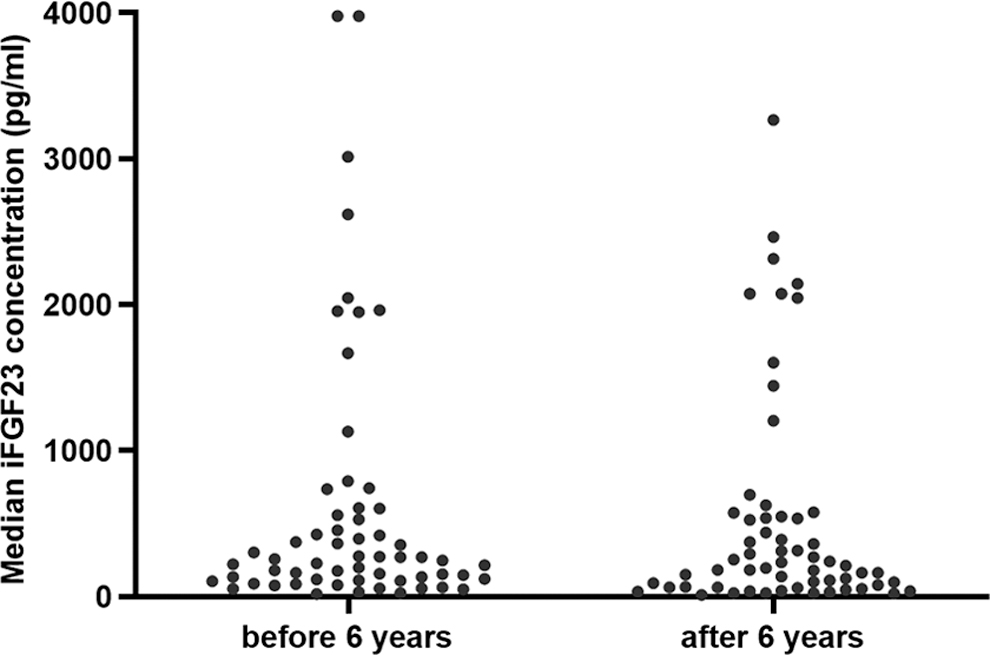
iFGF23 concentrations before and after 6 years. The iFGF23 concentrations before and after 6 years of storage. No significant differences were found between them. iFGF23, intact fibroblast growth factor 23.
To explore the effect of long-term storage on different levels of iFGF23 in serum, we sorted the serum iFGF23 concentrations of these 60 samples tested 6 years ago from low to high value, ranging from 17.76 to 3983.36 pg/mL.
To further investigate whether iFGF23 was more easily degraded in serum samples with lower concentrations, we conducted grouping studies on these samples. According to the principle of interval grouping, they were divided into three groups equally. The concentrations of the sites occupied by 33.3% and 66.6% were 150.34 and 410.75 pg/mL, which represented the critical points of low, medium, and high values, respectively. They were the low-value group (concentration <150.34 pg/mL, n = 20), medium-value group (150.34 pg/mL < concentration <410.75 pg/mL, n = 20), and high-value group (concentration >410.75 pg/mL, n = 20). The median iFGF23 levels before and after 6 years were (81.88 [IQR 52.63–117.00] versus 42.21 [IQR 26.42–87.94]) pg/mL, (252.17 [IQR 185.54–296.62] versus 203.85 [IQR 115.91–287.10]) pg/mL, and (960.52 [IQR 570.62–2027.06] versus 951.20 [IQR 540.16–2076.06]) pg/mL, respectively.
No significant differences were found between before and after 6 years in the low, medium, and high value groups. However, we observed a downward trend in the median iFGF23 concentrations of the low-value and medium-value groups after 6 years of storage, with decreases of 48% and 19%, respectively (Fig. 2).

iFGF23 concentrations before and after 6 years in subgroups. The iFGF23 concentrations of the low-, medium-, and high-value groups before and after 6 years of storage. Downward trends were observed in the low-value (p = 0.165) and medium-value (p = 0.157) groups, but there were no significant differences.
Furthermore, we selected 18 fresh serum samples from the hemodialysis patients to explore the influence of freezing and thawing on iFGF23 detection values. After freezing and thawing for 0, 1, 3 and 5 cycles, the iFGF23 levels were 278.41 ± 39.51 pg/mL, 262.84 ± 38.42 pg/mL, 252.97 ± 34.65 pg/mL, and 250.49 ± 37.12 pg/mL, respectively (Fig. 3). No significant differences were found in any of the freeze–thaw cycles. Compared with the samples without any freeze–thaw cycle, iFGF23 concentrations under 1, 3, and 5 freeze–thaw cycles decreased by 6%, 9%, and 10%, respectively, showing a mild decreasing trend (Fig. 4).
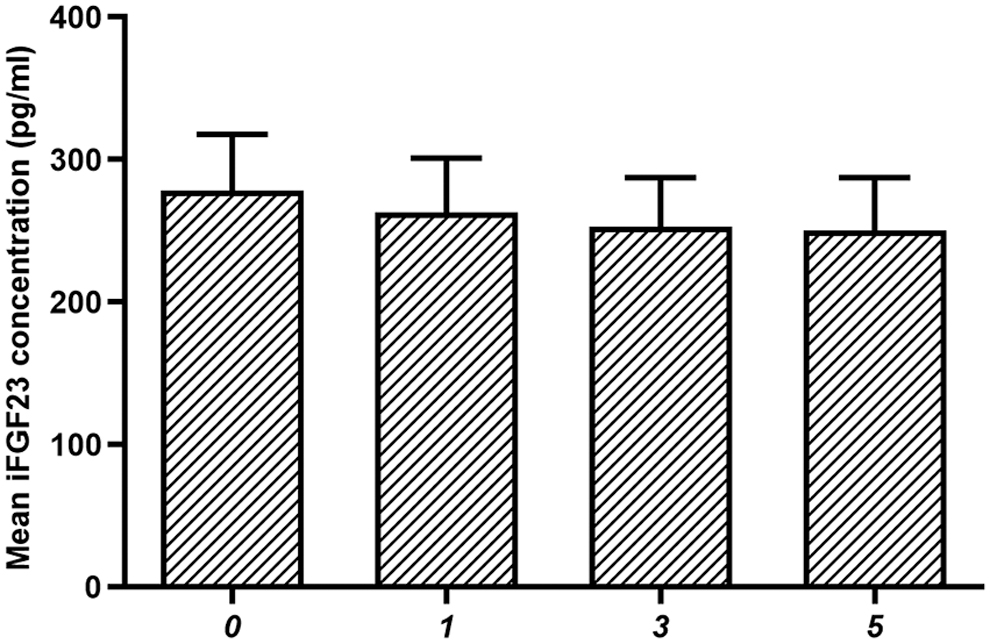
iFGF23 concentrations at different freeze–thaw cycles. The mean iFGF23 concentrations of 0, 1, 3, and 5 freeze–thaw cycles. No significant differences were found in any of the freeze–thaw cycles.
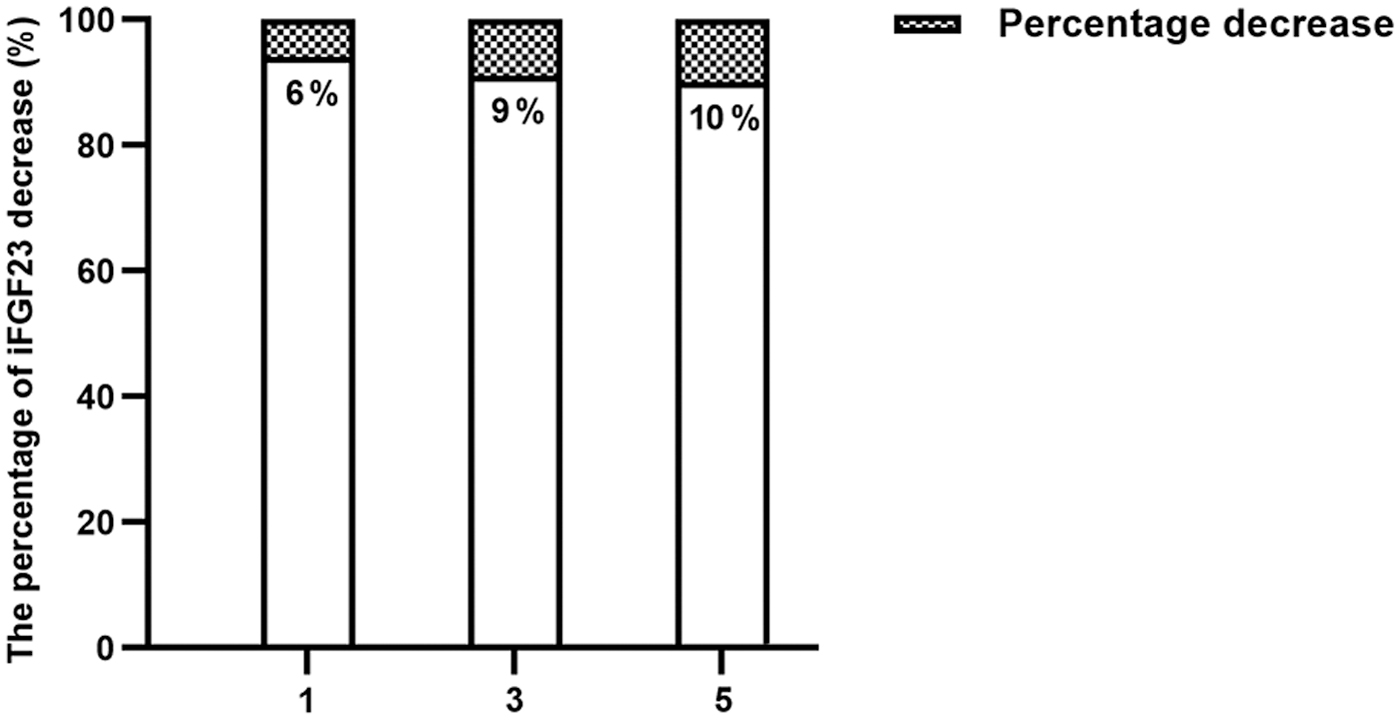
The percentage of iFGF3 concentrations decreased after freeze–thaw cycles. Compared with the samples without any freeze–thaw cycle, iFGF23 concentrations decreased by 6%, 9%, and 10% under 1, 3, and 5 freeze–thaw cycles, showing a mild decreasing trend.
Discussion
The biologically active form of iFGF23 is a 32 kDa glycoprotein with an N-terminus and a C-terminus. FGF23 levels increase during the progression of CKD. 19 Many studies have shown that a single time point value of FGF23 is associated with mortality,20,21 left ventricular hypertrophy,22,23 and progression of kidney failure.13,24,25 The iFGF23 or cFGF23 assay has been equally used for many cohort studies, both of which indicated pathological significance. iFGF23 was selected to determine the association of CKD and cardiovascular complications in the CDCS. In addition, a study that measured both iFGF23 and cFGF23, and calculated the iFGF23/cFGF23 ratio, speculated that downregulated iFGF23 during acute sepsis may participate in the counter-regulatory response to severe inflammation in CKD patients with sepsis. 26
At present, there are few studies on the factors influencing FGF23 detection. In the manual of the Kainos Laboratories iFGF23 ELISA Kit, the laboratory tests indicate that the activity of a given sample decreases to 86.6% after 13 days at 2°C–8°C. Samples may remain stable for ∼3 years at −80°C. Another study showed that long-term storage at −80°C up to 40 months (iFGF23, five tumor-induced osteomalacia and five X-linked hypophosphatemic rickets patients) and up to 60 months (cFGF23, five tumor-induced osteomalacia and six fibrous dysplasia patients) induced some variability (generally a decline) in plasma FGF23 levels. 16
To explore whether long-term cryopreservation has an effect on serum iFGF23 levels, our center analyzed 60 serum samples stored for 6 years and found no significant changes in iFGF23 concentrations. We continued to analyze the change in iFGF23 concentration in the high-value, medium-value, and low-value subgroups. Then, a downward trend of the samples close to normal iFGF23 levels (<150.34 pg/mL) was found after 6 years of storage. According to the downward trend we observed, it could be speculated that the low iFGF23 levels, especially those lower than 150.34 pg/mL, would become lower after long-term storage. In fact, in the CDCS, the percentage of iFGF23 levels <150.34 pg/mL was ∼5% (data not shown).
There are also few studies on the effect of freeze–thaw cycles on FGF23 stability. One study conducted in two patients with tumor-induced osteomalacia found that both iFGF23 and cFGF23 concentrations were stable after five freeze–thaw cycles (samples frozen in dry ice). 16 Another study showed that three freeze–thaw cycles had no effect on either iFGF23 or cFGF23 concentrations. 18 In contrast, another study found that three freeze–thaw cycles (−20°C to 24°C) caused an 11% decline from baseline values in plasma iFGF23 concentrations (Kainos FGF23 assay kit), although the described results were unpublished. 27
In our study, although a trend toward a decrease in serum iFGF23 concentrations was observed, we did not find significant effects on serum iFGF23 levels after five freeze–thaw cycles. Therefore, a reference was provided for analyzing whether freezing at a higher temperature and thawing may affect the test results of serum iFGF23 during sample transportation and storage.
It is worth noting that serum samples for FGF23 measurement should be obtained by centrifugation as soon as possible after whole blood collection. 16 FGF23 concentrations will decline when centrifugation is delayed up to 8 hours, and prompt centrifugation is, therefore, advised. 28 For the measurement of iFGF23, samples with results exceeding the upper limit of the standard curve should be diluted and rechecked to ensure accuracy.
In conclusion, iFGF23 levels remained stable in serum samples after 6 years of storage at −80°C. Furthermore, five freeze–thaw cycles had no significant effects on serum iFGF23 concentrations.
Footnotes
Author Disclosure Statement
No conflicting financial interests exist.
Funding Information
Our research was supported by the National Natural Science Foundation of China (Grant No. 81670699). All the samples were from Renal Biobank of National Clinical Research Center of Kidney Diseases, Jiangsu Biobank of Clinical Resources.