




Abstract
The COVID-19 era has brought about a number of novel challenges for the global biobanking community. An array of diverse tools (e.g., standards, best practices, and plans) exists to support quality and fitness-for-purpose in biobank operations. The International Society for Biological and Environmental Repositories (ISBER) COVID-19 Response Task Force has set out to identify needs and gaps in these tools and make recommendations for the next generation of available tools, having closely examined the COVID-19-related challenges. While conducting this work to examine the relationships between tools and biobank adaptability, a subgroup of the task force conducted a parallel effort to develop and describe individual COVID-19 era case studies based on a number of operating biobanks. Each case study presents a different combination of implemented tools. Observations and lessons learned from these case studies are provided, and experiences with tool implementation are discussed. This information is supplemented by data relating to tool usefulness that was obtained through an ISBER survey discussed in a companion article. The knowledge gained from this study will be combined with other task force efforts to make recommendations to better position the biobanking community in their response to future emergencies.
Introduction and Background
COVID-19
A companion article, 2 also in this issue, describes a survey administered within the biobank community that provided an abundance of information about the challenges faced by biobanking professionals globally during the pandemic. 2 The survey also explored general gaps, lessons learned, and needs for future tools and resources. However, this information reflects experiences over a short period of time at the beginning of the pandemic period for most countries. This article supplements survey findings related to biobanking tools, and describes six case studies, each relaying a biobank's experiences over several months, focusing on tool use to address pandemic-associated challenges. Discussion focuses mainly on case study examples.
Tools
Despite a long history, 3 biobanking is still growing. 4 A variety of tools help address quality and fitness-for-purpose in biobanking. These tools are generally aligned to four categories, as may be seen in Figure 1, and are further described below, accompanied by descriptions of specific biobanking tools:
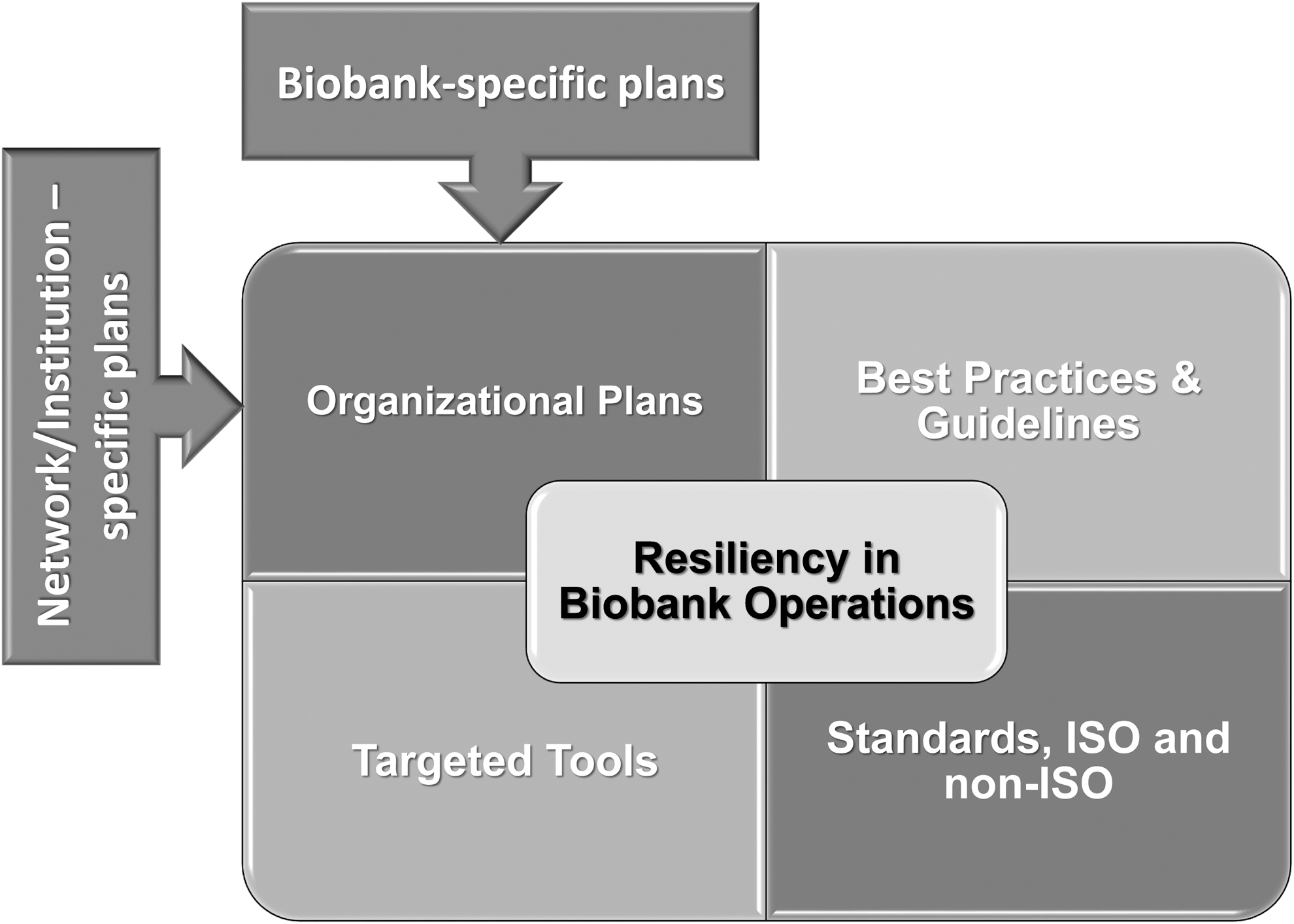
Categories of biobanking tools. A biobank's implementation of an appropriate suite of tools can support resiliency in biobank operations.
Emergency/Disaster Preparedness Plan: focuses on preparing procedures and equipment for a disaster, such as a pandemic. The procedures and equipment can be used to reduce vulnerability to disaster, mitigate the effects of disaster, or respond more efficiently in an emergency.
7
Business Continuity Plan: relays contingencies for business processes, assets, human resources, and business partners during an unplanned disruption in service. This exceeds a disaster recovery plan and creates a system of prevention and recovery to deal with potential threats to a biobank.
8
Business Plan: is a formal written document containing business goals, the methods on how these goals can be achieved, and the time frame within which these goals need to be achieved. The document serves as a roadmap that provides direction to the entity.
9
International Organizations for Standardization (ISO) 20387:2018 General Requirements for Biobanking 10 : is a conformity assessment standard with requirements and recommendations to enable biobanks to demonstrate competent biobank operation and provide biological material and associated data of appropriate quality (fit for purpose) for research and development. This standard may be used for first-, second-, or third (accreditation)-party attestation.
Other ISO standards, including ISO 15189:2012 Medical laboratories - Requirements for quality and competence, 11 ISO 17025:2017 General requirements for competence of testing and calibration laboratories, 12 ISO 17034:2016 General requirements for the competence of reference material producers, 13 and ISO 9001:2015 Quality management systems - Requirements, 14 provide background quality measures and processes. Relevant content of these has been incorporated into ISO 20387.
Quality Management System (QMS): is a formalized system of management, support, and operational processes considering customer requirements, and is aligned with the organization's purpose and strategic direction—ISO 9001 is an example of a QMS. It is expressed as the organizational goals and aspirations, policies, processes, documented information, and resources needed to implement and maintain quality operations.15,16
Canadian Tissue Repository Network (CTRNet): is a Canadian national standard intended for human research biobanks and aligns with 60% of ISO 20387 requirements. 17 The CTRNet Biobank Certification program combines education with these standards.18,19
College of American Pathologists (CAP) Biorepository Accreditation Program: covers the biospecimen lifecycle from consent and procurement to processing, storage, and distribution. It is centered around CAP's “Standards for Biorepositories,” 20 based, in part, on International Society for Biological and Environmental Repositories (ISBER) and the National Cancer Institute (NCI) Best Practices.
ISBER Best Practices 21 : shares guidelines for the management of specimen collections and repositories to enable high-quality biological and environmental specimens for future research. An addendum provides a focus on liquid nitrogen-based cryogenic storage.
NCI Best Practices 22 : provides guidance on many key aspects of biobank operations and biospecimen handling.
Organisation for Economic Co-operation and Development (OECD) Best Practice Guidelines for Biological Resource Centers (BRCs) 23 : serves as a target for the quality management of collections and is meant to provide guidance for those that seek to improve the quality of BRCs.
World Federation for Culture Collections Guidelines 24 : an internationally approved set of guidelines that provides a framework for the establishment, operation, and long-term support of microbiological and cell resource centers.
These tools address specific needs in the pursuit of quality, fitness-for-purpose, or education. The former category can include the ISBER Self-Assessment Tool, 26 internal audit tools (ISBER Internal Audit tool under development [M. Albert, pers. comm.]), Integrated BioBank of Luxembourg (IBBL) Biorepository Proficiency Testing Program, and ISBER Biospecimen Science Working Group: Standard PREanalytical Code.27–29 The latter category, education, can include the Qualification in Biorepository Science Examination 25 and ISBER Essentials of Biobanking. 30
Methodology
This is the second article of a continuing effort in pursuit of an improved understanding of the relationship between tools and the ability of biobanks to overcome the challenges resulting from the pandemic. The methodology in this article is focused on a combination of two approaches: analysis of the tool-related results of a survey led by the ISBER COVID-19 Response Task Force 2 (discussed in a companion article); and the development of six case studies to build upon the general survey findings with specific examinations of biobank operations during each response to the COVID-19 pandemic. Biobanks were chosen for the case studies based on their knowledge and experience with an array of existing tools—indeed, each of the case study authors has been involved in the development of one or more of the tools discussed. Biobank case study authors were joined by additional subject matter experts from the task force to analyze the findings. While the ISBER task force survey focused mainly on challenges presented by the pandemic, the implementation of tools was also explored. Survey respondents were asked to evaluate the usefulness of any biobanking tool that they had in place during the pandemic. Results are presented in this article as an indicator of the connection between biobanking tool implementation and perceived/projected usefulness of the tool during the pandemic.
Results: Survey Results Regarding Tool Implementation
The ISBER COVID-19 Response survey conducted in April 2020 contained a question related to biobanking tool usefulness: “For each tool that your biobank currently has in place, please indicate the usefulness level of the tool thus far.” A list of tools was provided. 2 For each tool being used by a biobank, possible responses were: minimally useful, fairly useful, very useful, extremely useful, and not sure. Of the 113 total survey respondents, 89% (101/113) professed to be using at least one biobanking tool. In addition, 86% (97/113) of respondents cited at least one tool as fairly, very, or extremely useful.
A ranked summary of the number of survey respondents to identify a biobanking tool as either very useful or extremely useful is shown in Figure 2. The biobank's quality management plan and the biobank's or institution's emergency preparedness plans (EPPs), were the most frequently cited tools. These three tools were cited as either very useful or extremely useful by 38% (43/113), 28% (32/113), and 26% (29/113) of survey respondents, respectively. Business continuity plans, the ISO 20387 standard, and NCI and ISBER best practices followed next, having been cited as very/extremely useful by 19% or more of respondents.

Number of survey respondents (of 113 total survey respondents) to assess a biobanking tool as either very useful or extremely useful.
Results: Case Studies
Tables 1–6 feature case studies reported by six globally dispersed biobanks during the COVID-19 pandemic. The case studies describe issues faced and illustrate how tools helped address arising challenges. They communicate lessons learned and provide recommendations for preparedness in the future.
Case Study: Biobank Antwerp, Belgium, Describing the Issues Faced During the COVID-19 Pandemic
QMS, quality management system; ISBER, International Society for Biological and Environmental Repositories; BRC, Biological Resource Centre; ISO, International Organizations for Standardization; EPP, emergency preparedness plan; NF, norme francaise; OECD, Organisation for Economic Co-operation and Development; BP, Best Practices; LIMS, Laboratory Information Management System.
Case Study: Cornell Veterinary Biobank, United States of America, Describing the Issues Faced During the COVID-19 Pandemic
CVB, Cornell Veterinary Biobank; BCP, business continuity plan.
Case Study: Leibniz-Institut DSMZ German Collection of Microorganisms and Cell Cultures, Germany, Describing the Issues Faced During the COVID-19 Pandemic
DSMZ, Leibniz-Institut DSMZ-Deutsche Sammlung von Mikroorganismen und Zellkulturen GmbH; IDA, International Depositary Authority; BPG, Best Practice Guidelines; DQS, DQS GmbH Deutsche Gesellschaft zur Zertifizierung von Managementsystemen.
Case Study: Duke BioRepository and Precision Pathology Center, United States of America, Describing the Issues Faced During the Covid-19 Pandemic
BRPC, BioRepository and Precision Pathology Center; CAP, College of American Pathologist; BAP, Biorepository Accreditation Program.
Case Study: Ontario Tumour Bank, Canada, Describing the Issues Faced During the COVID-19 Pandemic
OTB, Ontario Tumour Bank; OICR, Ontario Institute for Cancer Research; CTRNet, Canadian Tissue Repository Network.
Case Study: Micoteca da Universidade do Minho, Portugal, Describing the Issues Faced During the COVID-19 Pandemic
MUM, Micoteca da Universidade do Minho; WFCC, World Federation of Culture Collections; APCER, Associação Portuguesa de Certificação.
Table 7 illustrates the various tools in place at each of the six biobanks associated with a case study. The predominant commonality is the presence of and reliance on a QMS. There are several alternative paths to pursue a QMS, either standalone (e.g., ISO 9001) or as a component of another standard or requirement (e.g., ISO 20387). The biobanks in these case studies have a QMS in place, and all are certified, accredited, and/or are preparing for accreditation. As is illustrated in Table 7, organizational plans such as business plans and EPPs are often requirements within a more comprehensive standard.
Various Tools in Place at Each of the Six Biobanks Featured as a Case Study
Discussion
Several common themes emerged from the case studies: risk management; level of preparedness to quickly implement a comprehensive response; communications; planning; and competence.
Risk management emerged as a common theme for continuation of critical activities despite the diverse challenges of the pandemic. For example, Cornell Veterinary Biobank (CVB) trained backup personnel for essential activities, based on a risk assessment of the probability of staff getting sick with COVID-19. Biobank Antwerp (BA) conducted risk analyses and implemented associated changes, following up with a check during an internal audit—this practice enabled BA to adapt its processes with efficiency and confidence in the selected changes.
BioRepository and Precision Pathology Center (BRPC) has an EPP in place as per its CAP accreditation, supporting its COVID-19 response with a list of identified operational priorities and decisions based on risk assessment. Thus, BRPC was able to quickly ensure employee safety, preserve existing biological material and associated data (BMAD), and continue to handle samples for interventional clinical trials as essential activities. Consenting of new participants and receipt/processing of new specimens for basic and translational research were among activities rapidly put on hold.
Risk management can identify a prioritized set of issues requiring solutions, for example, remote monitoring for long durations; implementation of scenario-driven safety plans; and remote activities, including telework and e-consent. Risk management also serves as an essential step in pursuit of a standard, for example, ISO 20387. Regardless of certification/accreditation status, risk management activities are important for pandemic response.
Level of preparedness to quickly implement a comprehensive response was crucial to biobank adaptability to abrupt changes associated with the pandemic. BA has a feedback system established with providers of processes, products, and services, facilitating continual and clear communications. This was particularly useful as the advent of the COVID-19 era brought concerns of supply disruptions affecting biobank operations. Demonstrsting foresight, BA successfully used its communication lines to assure the continuing provision of consumables, such as cryovials. For Ontario Tumour Bank (OTB), the implementation of tools such as the QMS and Internal Audit Tool (IAT) enabled quick adoption of additional or modified monitoring and controlling of new processes. For example, IT security audits could be conducted remotely and more frequently for those remotely accessing restricted data, such as protected health information.
Those biobanks with a prepandemic establishment of strong networks and clear communication channels were well served by the ability to access other resources to address challenges. For example, BA relied on well-established communication lines with its parent organizations' safety department, enabling the biobank to efficiently receive COVID-19 sample handling information. Also, BA's participation in ISO/Technical Committee 276/Working Group 2 Biobanks and bioresources has broadened its contact network. This network facilitated participation in a community of practice (CoP) 31 during the COVID-19 era; enabling access to CoP discussions throughout the pandemic has been supportive and informative. This activity resulted in improvement of several SOPs, including the EPP and its associated risk assessment.
Aggregation of lessons learned from the pandemic experience can inform a stronger approach to planning for similar events in the future. BRPC, for example, has recognized the need to consider longer-term situations, like pandemics, as well as short-term emergencies (weather related and accident related). In particular, biobanks might approach the concept of emergency planning with fresh eyes to encompass this realization of a broader scope.
All of the case-studied biobanks were placed in the position of broadening their concept of competence. For long-term emergency operations, these biobanks found themselves needing to evaluate both the existence and distribution of individual competencies needed for successful operation. This motivated them to establish alternative approaches to address issues such as reduced and distributed facility access, as well as physical distancing requirements. As part of BA's preparation for ISO 20387 accreditation, the implementation of clauses related to competence and training introduced a new adaptability that enabled operation in changed circumstances. The result was a robust and flexible training program developed on short notice, addressing both multiskilling and training of new personnel. OTB, within the structure of its CTRNet certification, ensured that staff were competent in multiple aspects of biobanking, not just in their localized tasks. This enabled OTB to mobilize its team to create a COVID-19 task force to address any challenge unique to the pandemic.
While none of the case-studied biobanks considered themselves to be completely pandemic prepared, the practice of developing and implementing plans within the framework of a QMS enabled efficient adaptation of existing operations to withstand some of the worst consequences of the pandemic. For example, OTB found its EPP to be a useful starting point, with a number of issues already considered (e.g., inventory of equipment at each location, emergency contact information, backup freezer locations, lists of safety resources/toolkits, and templates for emergency scenarios). This was easily amended as solutions for COVID-19-related challenges were identified.
The aforementioned examples also demonstrate how the implementation and mindset of continuous improvement, a key concept in QMS, positioned biobanks to cope with unanticipated changes imposed by the pandemic. The case studies reflect a focus on strategy, people, processes, and products supporting mitigating the risk of a variety of challenges.
In addition to the identification of common themes among the case-studied banks, the implementation of specific tool categories was also explored. Four categories of tools were introduced earlier in this article—the six biobanks in the case studies cumulatively used tools in all four of these categories to address their COVID-19-related challenges. Commonalities, gaps, and drivers determining use are examined in this study.
The case studies presented herein illustrated a variety of biobank perspectives on implementation of tools. The experiences of the six biobanks are addressed below in the context of tool categories:
Organizational Plans, including Institutional/Network/Biobank-specific plans: All six case-studied biobanks have implemented at least one tool in this category, fitting with a common aspiration for optimal operational stability. Those embedded in parent institutions typically have access to one or more of these tools, usually a business plan, business continuity plan, or EPP. The EPP was unsurprisingly among the most commonly cited tools, consistent with the survey results (Fig. 2). The case-studied biobanks each looked to their EPP early on, and although these were insufficient, the biobanks were able to fall back on a structure created by their use of tools.
While this pandemic uncovered a need to be prepared for unanticipated emergencies, the chronic long-term nature of pandemics had generally not been recognized by biobanks. Deutsche Sammlung von Mikroorganismen und Zellkulturen (DSMZ) was the only biobank to have a pandemic plan in place; other biobanks' EPPs focused on shorter-term emergencies such as climatic and other events. For DSMZ, transition from a theoretical manual was necessary to align to practical needs for actual pandemic response practice.
Standards: The biobanks relied on an established QMS as an adaptable framework to cope with changes and continuous improvement. Two biobanks use ISO 9001, and the remaining four biobanks had QMS as part of other implemented standards (e.g., conformity assessment standards such as ISO 20387, CAP) or regional guidelines. CVB has already implemented ISO 20387, and BA and DSMZ have begun the process. QMS frameworks integrate continuous improvement, using stakeholder feedback, risk analysis, nonconformity management, internal and external audits, reviews, and experience. Strengthened by usage of specific plans, organizations are more resilient through change.
SO 20387 implementation can be helpful to face disaster-related challenges. Formal accreditation can assure that biological resources are protected through the use of monitoring and response systems, an EPP, controlled documents, and biobank personnel prepared for response (CVB). By adhering to other conformity assessment standards (e.g., ISO 17034:2016) and best practices (e.g., ISBER and OECD), DSMZ has experienced risk reduction and an eased transition to ISO 20387.
Non-ISO-based standards, such as CAP, also provided structure to assure biological resource stability and protection for BRPC. Although preparation for all risks is not possible, having significant structure and team competency makes it easier to respond adeptly. OTB resilience is supported by CTRNet certification, which provides for documentation, standardized processes, and well-trained and highly competent staff, in the context of an extensive QMS.
While standards can help significantly as a backbone upon which to build solutions, none of these standards specifically addresses emergencies of a long-term nature, such as a pandemic. This will require consideration in future revisions.
Best practices: Best practices can be extremely helpful in establishing efficient, day-to-day biobanking operations. These can also be useful for ensuring quality and fitness-for-purpose in biobanking at any level and can help build resilience needed to respond in emergency situations. Best practices can provide valuable recommendations whether a biobank is just starting or is working toward accreditation. The best practices provide detailed recommendations and practical approaches for biobanking, rather than requirements as in standards. The best practices of ISBER, NCI, and OECD, along with other relevant documents, were used as a resource for the development of ISO 20387. While some address emergency preparedness (e.g., ISBER and NCI), the community would benefit from further guidance for responding to global emergencies of a long-term nature. All the best practices are freely available for download. The OECD best practices do not address emergency preparedness, but do provide some overall guidance on biosecurity; however, they are not subject to a revision process.
Targeted tools: Targeted tools, for example, audit or qualification tools, are intended to streamline a biobank's approach for adapting to their environment. These tools are dedicated to specific needs/tasks and are designed to fulfill specific stakeholder needs and can be eminently useful. These tools can be used independently or within frameworks.
Targeted tools were not as frequently identified in either the case studies or the survey. This may partly reflect limited awareness of targeted tools and their use. Education, promotion, and case studies may be employed to mitigate this situation.
The survey data and case studies, as shown in Figure 2 and Table 7, reflect the wide variety of tools that have been implemented to ensure quality and fitness-for-purpose in biobanking.
Since tool selection and implementation are typically neither trivial nor initially inexpensive,32,33 biobanks should carefully consider their own selection of a suite of tools for their needs. As each tool is considered, its potential benefit is dependent on three general factors. These include the following:
suitability: how well a tool is suited to meet the biobank need(s) (e.g., a standard introduces requirements, all of which may not be suitable for a particular biobank's needs),
extent of implementation: the extent of implementation of the tool (e.g., if using a standard, the term “shall” indicates a requirement, while “should” refers to a recommendation—there can be a vast difference in the measure of usefulness where requirements only are followed, without considering the applicability of any of the recommendations), and
complementarity: how well the prospective tools complement previously implemented tools.
This determination is made easier with increased user knowledge of tools with potential for application. Optimal tools selection, whether addressing COVID-19-related challenges or normal biobank operations, should reflect the degree of complexity of the biobank, its size, and diversification of biological resources stored.
The middle of a pandemic may not be an optimal time to implement unfamiliar tools, particularly for hospital personnel and other frontline workers, and therefore users might choose a less demanding time for implementation. Institution or parent entity support is crucial to permit such a critical review and plan for implementation.
Given these challenges, biobanking organizations may want to consider the development of a system to locate and facilitate the selection, access, and implementation of tools. This effort can be initiated with the development of a tool information repository, and later be built upon as resources become available.
While there are biobanks in every country which do not have extensive tools in place, Low- and Middle-Income Countries (LMICs) face additional and sometimes unique challenges. These challenges are addressed in another article. 34 The factors impacting biobanking operations in LMICs are generally similar to those reported in High-Income countries (HICs). A major difference, however, is the difference in available infrastructure to support the LMICs in comparison to HICs. LMICs' infrastructures may contain larger gaps in areas such as competent personnel availability, training and documentation in appropriate languages, supply chain reliability, information accessibility, funding, and communication tools. Economic status is often not as adequate as required to ensure the financial sustainability of biobanks. 35
The LMICs could significantly benefit from greater accessibility to comprehensive guidance to provide direction and possible solutions during an emergency. For example, an ISBER program provides web-based education modules through the Biobank and Cohort Network (BCNET) program of International Agency for Research on Cancer. 36 Unfortunately, most such guidance from international organizations is prepared only in English,37–39 and can thus impede the flow of information to LMICs in a non-English environment—this needs to be addressed in anticipation of future global emergencies.
The survey results and case studies identified a range of gaps in existing tools, as well as challenges posed by the pandemic. The following recommendations are proposed to address these issues:
Be architectural
The experiences of the case studies clearly demonstrate how the use of and compliance with existing management system tools or/and more specialized biobanking tools can pave the way to creation of a solid foundation that will help identify, improve, and protect the core processes at the heart of biobanking efforts, which most require protection during emergencies.
Be alert
An important aspect of experiencing an emergency of any type is timely awareness. Conducting environmental scans as part of a business plan can help identify uncontrollable external threats and opportunities in a timely manner. This exercise can prime a biobank to take advantage of emerging opportunities (e.g., innovative technologies and new sources of funding) or activate emergency plans for occurrences with possible negative impact. While external threats may be uncontrollable, and a biobank cannot always control its reaction to the situation, a biobank could address potentially damaging effects through early detection and mitigation.
Be prepared
The collective case studies illustrate clearly that preparedness needs to be considered, addressed, and even tested insofar as is possible, for even the most unlikely of emergencies. Creative planning can allow adaptable and therefore appropriate responses for each newly experienced emergency/disaster, whatever the cause/effect. This pandemic experience has highlighted the usefulness of planning for longer-duration and wider scale emergencies. Plans should be understood, tested, and revised at regular intervals by well-trained personnel of solution-focused mindset for ability to handle and respond to the challenges arising from the emergency/disaster.
Preparedness plan elements can address the following:
assembly of a specialized response team,
risk assessment for prioritization, noting that there may be a requirement to accept a certain undefined level of risk deemed unacceptable during nonemergency times,
change management,
setting of priorities, for example, for personnel safety, core biobanking processes, and emergency communication,
escalation protocol, to reflect changing threat levels, including triggers, actions, and possible contingencies, and
checklists with links to credible resources and useful information to assist with determining state of readiness.
Be agile
Practice agility in systems to build organizational resilience. Keys to success at times of urgency are elements of agile systems. This could include rapid approval mechanisms as well as timely, open, and pertinent communication to harness the cooperation required for sudden changes to processes. A responsibility matrix inclusive of personnel succession planning and multiskilling policies to ensure retention of biobanking competencies could prove indispensable. Experience in document creation of new or altered procedures to address challenges at a time of emergency will add to a biobank's adaptability.
Be everywhere
While budgetary constraints might exist, a biobank equipped with carefully considered remotely accessible biobanking and IT tools regularly used during nonemergency times will be well poised for remote work where necessary (e.g., BA's digital electronic documentation, Laboratory Information Management System (LIMS), and remote monitoring; and BRPC'S remote monitoring). Similarly, relevant documentation should exist in appropriate format accessible by personnel even during remote working for remote training, auditing, (DSMZ and OTB), and so on. If possible, laboratory space could be designed as a modular system, for example, workbenches, to optimize workflow redesign, facilitating circumstantial adaptation, while adhering to safety measures and lean principles.
Be adaptable
Remote knowledge sharing can offer solutions to those biobanks constrained in offering face-to-face training and competency assessment (e.g., within a newly restrictive laboratory layout or differently scheduled personnel). Approaches for consideration include formal education modules (OTB-CTRNet) or the creation of short training modules using prerecorded or live videos, webinars, and presentations combined with a system of reminders such as clear work instructions placed on equipment, and refreshers in blogs, emails, or quick quizzes. CTRNet modules are being used in LMICs for education.
Be resilient
Building a supportive culture will promote personnel well-being and a solution-focused mindset. This can be achieved as follows:
as part of a parent organization or biobank network, coordinating responses and sharing common systems and processes during emergencies,
through membership in formal large biobanking organizations,
through community-based support networks such as a CoP, 31 and
by adoption of emergency-adapted leadership models to enhance team resilience and improve overall response.
Such environments could also prove useful to the following:
identify new opportunities (BA—networks fostered new projects and tools to increase sample access),
access credible sources of guidance for integration into local procedures, and
help with unanticipated challenges, for example, parent organization facilitating change of purchasing terms to permit flexibility during times of supply chain issues during an emergency.
Limitations
The case studies were based on the pandemic experiences of only six biobanks, and data were supplemented using a companion survey. 2 The descriptive data discussed in this article will be used to inform a larger and more robust follow-on survey. This survey will gather additional data from the biobanking community about the challenges faced during the pandemic, how existing tools and resources were used to overcome them, and what changes are needed to develop the next generation of biobanking tools to better prepare the biobanking community for future emergencies.
Conclusion
The COVID-19 era has presented globally shared, prolonged, and emergency-involving unprecedented challenges to biobank operations. While survey results and case studies illustrated how existing biobanking tools can support an effective response, some gaps were also identified. A primary gap was the fact that none of these tools sufficiently addressed long-term emergencies such as pandemics.
The case-studied biobanks identified several key elements for a successful pandemic response: QMS, planning, risk assessment and management, and competence. The QMS principle of continuous improvement provided the biobanks with a framework for negotiating the unprecedented challenges of the pandemic and instilling agility and adaptability within their network. Planning and emergency management are essential for withstanding unanticipated events and ensuring sustainability of both the biobank and its personnel. Many of the protracted, global challenges associated with the pandemic were not in the traditional scope of biobank planning. Tools such as ISO 20387, ISBER Best Practices, and Biobank EPPs need to address both long-term chronic and short-term acute emergency situations. Biobanks also need to adopt strategies that protect not only infrastructure but also personnel and ongoing operations during a sustained emergency. A risk assessment and management plan can be an important tool for identifying and prioritizing risks and solutions. For long-term emergency operations, the case-studied biobanks found themselves needing to evaluate both the existence and distribution of individual competencies needed for successful operation of the biobank.
Although it can be difficult for potential users to compare and evaluate the myriad of existing tools for suitability, some of the examples described in this article may be helpful. One solution is to develop a new Biobanking Tool Information Hub to act as a central information repository and facilitate the decision process for biobanks wishing to assemble a set of tools tailored to their needs. The use of a suite of biobanking tools that are fit-for-purpose can safeguard biological resources and underpin a biobank's mission.
Biobanking tools contribute to innovation, productivity, and systematic harmonization of solutions. The implementation of appropriately selected tools can help to create a robust framework for an effective pandemic response. It is anticipated that with feedback from the diverse biobanking community, for example, through the ISBER COVID-19 Response Task Force activities, future tool revisions can better prepare the biobanking community for future emergencies.
Footnotes
Disclaimer
Where authors are identified as personnel of the International Agency for Research on Cancer/WHO, the authors alone are responsible for the views expressed in this article and they do not necessarily represent the decisions, policy, or views of the International Agency for Research on Cancer/WHO.
Acknowledgments
This study was performed by a Task Force organized by members of the International Society for Biological and Environmental Repositories (ISBER) Standards Advisory Committee. The authors gratefully acknowledge our fellow ISBER COVID-19 tools Task Force members who reviewed this article, developed figures and tables, and provided valuable feedback, particularly Daniel Simeon-Dubach, Rebecca Pugh, Sergey Anisimov, and Yehudit Cohen.
Author Disclosure Statement
No conflicting financial interests exist.
Funding Information
Shannon McCall and the Duke University BioRepository & Precision Pathology Center receive funding from the United States National Institutes of Health, National Cancer Institute under UM1CA239755 (The Cooperative Human Tissue Network) and P30CA014236 (Duke University's Cancer Center Support Grant).