




Abstract
This study assessed the feasibility of in vivo embryo production and nonsurgical embryo recovery (NSER) in Morada Nova ewes (an endangered native Brazilian breed of sheep) subjected to different estrus synchronization and/or superovulation protocols. Ewes received intravaginal sponges soaked with 60 mg medroxyprogesterone acetate (MAP), which were kept in place for six (G6; n = 12), nine (G9; n = 12), or 12 (G12; n = 12) days. Half of the ewes in each group remained estrus synchronized only (SYNCH) and the other half was superovulated (SOV) with 133 mg porcine follicle-stimulating hormone (pFSH). There were no differences (p > 0.05) in antral follicle counts determined with ultrasonography 60 hours before MAP sponge removal (or at the time of the first pFSH dose) among G6 (6.4 ± 0.9), G9 (6.2 ± 0.7), and G12 (5.5 ± 0.6). Estrus responses and NSER success rates did not vary (p > 0.05) among the three progestin-treatment groups of ewes for either estrus-induced or superovulated animals. The onset of estrus occurred 10–12 hours later (p < 0.01) in G9SYNCH ewes compared with G6SYNCH and G12SYNCH, and the duration of estrus was ∼19 hours greater (p < 0.01) in G9SOV than in G6SOV. The average duration of the NSER procedure was 32.6 ± 1.3 minutes. At least one structure was recovered in 85.7% of synchronized and in 87.5% of superovulated ewes. Viable embryo recovery rates were also similar (p > 0.05) for G6 (1.0 ± 0.3 and 2.5 ± 1.5), G9 (1.3 ± 0.5 and 4.8 ± 2.0), and G12 groups (1.0 ± 0.3 and 4.8 ± 2.3; estrus-synchronized and superovulated ewes, respectively). In conclusion, progestogen pretreatment of different durations and NSER can be employed in Morada Nova ewes, resulting in reasonable viable embryo recovery rates in both estrus-synchronized and superovulated animals. Therefore, both techniques are suitable for use in commercial settings as well as small ruminant conservation programs.
Introduction
Brazil, just as many other colonized countries, has a vast variety of naturalized animals, which have adapted to its peculiar and diverse biome conditions. Due to their impact on local economy and sustainable agriculture practices, several naturalized animal breeds were included in the Conservation and Utilization of Genetic Resources program founded by the Brazilian Agricultural Research Corporation (Embrapa) in 1983. 1 The Morada Nova is one of the main naturalized sheep breeds in Brazil and its genotype is probably of African origin, with some contribution from the Portuguese Bordaleiro breed. 2 Morada Nova sheep are haired animals of a relatively small size (sexually mature ewes reach body weight of 30–50 kg), characterized by moderate prolificacy (1.5) and good ability to produce meat and hides even under unfavorable climatic conditions. 3 Despite their importance for sustainable production systems, 2 indiscriminate crossbreeding due to general preference of sheep breeders for more specialized breeds brought Morada Nova sheep to the brink of extinction.2,4,5 In 2009, the Morada Nova was added to the Embrapa's genetic resources conservation program, whose objectives entail the creation of germplasm banks for endangered livestock breeds and species.
Reproductive biotechnologies are pivotal tools for saving and maintaining endangered species. 6 Assisted reproductive techniques, such as in vivo embryo production (IVP), are essential to overcome the risk of animal extinction. These techniques accelerate the propagation of herds, increase genetic gain from both males and females, and the resultant embryos may be cryopreserved to create germplasm banks. The female donors used for IVP are typically subjected to superovulatory treatments conducted in conjunction with an estrus synchronization protocol using exogenous progestins (e.g., medroxyprogesterone acetate—MAP). There is tremendous variability in ovarian responses to estrus and ovulation synchronization protocols in sheep. 7 In the past, our research team aimed to establish the optimal duration of the treatment with progestogen-releasing devices for estrus synchronization and superovulation in Lacaune8,9 and Santa Inês ewes. 10 To date, however, there have only been three documented attempts to perform hormonal superovulation in Morada Nova ewes of either white 11 or red12,13 variety, and all those attempts used the long-term (14 days) progestogen priming. Even though progestogen priming is essential to synchronize estrus and ovulations and to reduce the incidence of inadequate corpora lutea (CL) after mating, long-term exposure (10–18 days) to intravaginal progestogen-releasing devices may be associated with declining fertility in ewes. 14 Shortening the period of treatment with progestogen inserts is also desirable because it reduces the loss of intravaginal devices as well as the occurrence of vaginal discharges and infections. 15 In anestrus Saanen goats, the estrus synchronization treatments using progestogen-impregnated sponges inserted for 6, 9, or 12 days yielded similar results, 16 but such a comparative study does not exist for Morada Nova ewes.
Although embryo collection in sheep is still done mainly by laparotomy, there is a great deal of evidence to suggest that nonsurgical embryo recovery (NSER) is equally efficient. 17 When both approaches were compared, NSER has proven to be equally or more effective in terms of embryo recovery rates but significantly less stressful to animals than laparotomy.18,19 Moreover, significant advances in the application of NSER have recently been achieved in both nonsuperovulated (estrus-synchronized) and superovulated Santa Inês,10,20 Lacaune,8,9 and Dorper ewes. 21 In Morada Nova ewes, however, two previous studies employed laparotomy11,13 and the only attempt to use NSER for embryo flushing was unsuccessful. 12 Considering the present concerns about animal wellbeing,22–24 the development of efficient NSER in different strains of sheep is of paramount importance.
As with other endangered breeds or animal species, both the superovulatory regimens and embryo collection techniques ought to be considered to effectively implement embryo germplasm banking. Moreover, embryo recovery from nonsuperovulated animals can also contribute to the enrichment of germplasm banks.25,26 Cryopreservation is one of the best strategies for animal biobanking. Although embryo freezing and storage are more expensive than gamete preservation, the use of embryos is associated with accelerated breed reconstitution compared with that attained using only semen. 27 Lastly, the use of less-invasive approaches is highly preferable in conservation programs of endangered animals. Thus, the main goal of the present study was to compare the ovarian responses and IVP embryo yields in nonsuperovulated and superovulated Morada Nova ewes subjected to either short- (6 days), intermediate- (9 days), or long-term (12 days) progestin-based estrus synchronization protocols and NSER.
Materials and Methods
General experimental conditions
The Animal Care Ethics Committee of Embrapa Dairy Cattle (process: 2512100516) had approved this study. The present experiment was carried out during the breeding season (July to August) in São Carlos, Brazil (latitude 22°01′S, longitude 47°54′W, altitude 850 m above sea level). Thirty-six clinically healthy, multiparous ewes and four rams of Morada Nova breed (red variety) were used in this study; no animal showed any signs of reproductive abnormalities detectable with sonographic and gynecological/andrological examinations. The animals were kept in paddocks of Panicum maximum cv. Aruana grass and received daily rations of concentrate, according to their nutritional demand. Mineral salt licks and water were available ad libitum.
Experimental design
Estrus synchronization and superovulation protocols are depicted in Figure 1, from 4 consecutive days (n = 9 ewes per day) with the same number of ewes of each progestogen duration and a similar number of estrus-induced and superovulated ewe for progestogen duration daily. The Morada Nova ewes were allotted by age, weight, and body condition score (BCS; 1 = thin to 5 = obese) to three groups (each n = 12) (Fig. 1). All ewes were fitted with intravaginal sponges containing 60 mg of MAP (Progespon®; Syntex, Buenos Aires, Argentina) that were kept in place for six (G6; age: 49.0 ± 4.3 months, weight: 40.5 ± 1.2 kg, and BCS of 3.3 ± 0.1), nine (G9; age: 51.0 ± 5.1 months, weight: 41.2 ± 1.7 kg, and BCS of 3.3 ± 0.1), or 12 days (G12; age: 51.0 ± 4.2 months, weight: 41.6 ± 1.6 kg, and BCS of 3.3 ± 0.1). The sponges were inserted and removed between 5 and 6 pm. The estrus-synchronized ewes (G6SYNCH, G9SYNCH, and G12SYNCH) received 200 IU of equine chorionic gonadotropin for follicular growth induction and ovulation (Folligon 5000®, MSD Animal Health, Cruzeiro, SP, Brazil) intramuscular (i.m.) and 37.5 μg of an analog of PGF2-α for luteolysis (
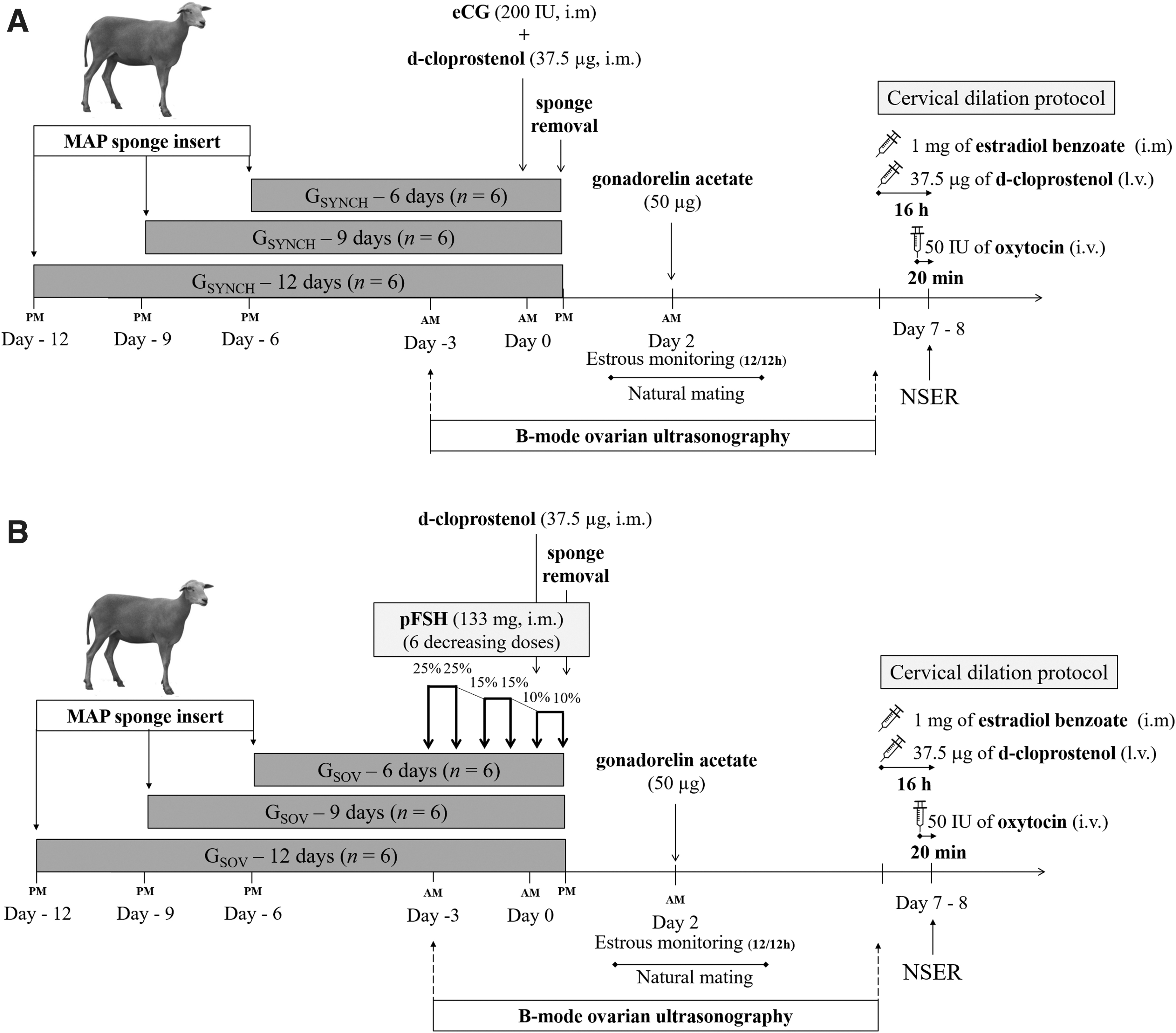
Schematic representation of the experimental procedures designed to evaluate different progestogen-based estrus synchronization protocols (short- [6 days], intermediate- [9 days], or long term [12 days]) in
Ovarian ultrasonographic evaluation
Ovaries were scanned with a portable B-mode scanner (M5 Vet®; Mindray, Shenzen, China) equipped with a 7.5-MHz transrectal transducer adapted for use in small ruminants. Ultrasonographic examinations were performed in all ewes 60 hours before MAP sponge removal (at the time of the first pFSH dose in superovulated ewes) and 16 hours before NSER to determine the number of visible antral follicles and CL, respectively. Ovarian follicles were grouped according to their diameters into: Class 1 (≤2 mm), Class 2 (2.1—3.0 mm), Class 3 (3.1–4.0 mm), Class 4 (4.1–5.0 mm), and Class 5 (>5.0 mm). 28
NSER procedures
All mated ewes were prepared for the cervical dilation protocol using both physical and chemical restraint as previously described. 29 NSER was performed 6–7 days after the onset of estrus. Cervical assessment, anesthetic desensitization, clipping, and retraction were performed as previously described for Lacaune ewes. 8 After retraction, Hegar dilators (size 3–4) were used to traverse the uterine cervix. The “cervical map” depicting the location of all cervical rings was recorded 17 and the time taken to traverse the uterine cervix was recorded. The Hegar dilator was kept in place for 30 seconds and then removed, and a sterile catheter #8 equipped with a metal mandrel was inserted and used to traverse the cervical rings. Each uterine horn was flushed separately with successive injections and aspirations of a total of 180 mL/horn of sterile phosphate-buffered saline prewarmed to 37°C (plus 40 mL to wash the flushing apparatus). All recovered structures, including unfertilized eggs were enumerated for the fertilization condition (fertilized and nonfertilized), and the embryos were classified based on their developmental stage (morulae to expanded blastocyst) and quality (1 = excellent or good, 2 = fair, 3 = poor, and 4 = dead or degenerated) as detailed by the International Embryo Technology Society manual. 30 Embryos of quality 1–3 were cryopreserved by slow freezing according to a method described by Figueira et al., 31 and were added to the Brazilian embryo biobank for future use.
Study end points and statistical analysis
The following data were recorded at 60 hours before MAP sponge removal (time of the first pFSH injection in superovulated ewes): percentage of ewes with large antral follicles (≥5 mm in diameter); diameter of the largest follicle (mm); total follicle count and number of follicles in different size classes per ewe (class 1: 1.0–2.0 mm; class 2: 2.1–3.0 mm; class 3: 3.1–4.0 mm; class 4: 4.1–5.0 mm; and class 5: >5.0 mm). Subsequently, the following data were recorded or calculated: estrus response (number of ewes in estrus/number of treated ewes × 100%); timing of the onset of estrus (in hours, time from MAP sponge removal to estrus detection); duration of estrus (in hours); number of CL per ewe; percentage of ewes successfully penetrated and flushed (ewes flushed/total number of ewes × 100%); number of CL per flushed ewe; duration of the cervical penetration procedure by Hegar and mandrel/catheter (in minutes, time from Hegar dilator or mandrel/catheter insertion to its removal); duration of the uterine flushing procedure (in minutes, time from flushing catheter insertion to its removal); duration of NSER procedure (in minutes, time from epidural anesthesia to catheter removal/cervical unclipping); fluid recovery efficiency (volume of fluid retrieved/total fluid infused × 100%); recovery rate (total number of nonfertilized eggs and embryos recovered/number of CL detected with ultrasonography × 100%); embryo viability rate (number of embryos with quality scores of 1–3/total structures recovered × 100%); successful recovery rate (number of ewes with at least one structure recovered/number ewes flushed × 100%); total number of structures (i.e., embryos and/or nonfertilized eggs) recovered per ewe; number of viable embryos (embryo quality of 1 to 3); and number of degenerated embryos per donor ewe.
Data analysis was performed using the R software (version 3.6.1; the R Foundation for Statistical Computing). The Shapiro–Wilk test was used to check the normality of the residues and homogeneity of variance was assessed by Levene's test. Whenever necessary, the Box–Cox transformation of the original data was performed. Non-parametric analyses were done using the Kruskal–Wallis test, Chi-square, and Fisher's exact test. Parametric data were analyzed by analysis of variance followed by Tukey's test for comparisons of individual mean values. Results are presented as mean ± standard error of the mean unless otherwise indicated. The level of significance used for all analyses was 5%.
Results
Ovarian follicular profiles recorded at 60 hours before MAP sponge removal in all ewes studied are given in Table 1. No difference was observed (p > 0.05) for any of the parameters related to antral follicle population among the three groups of ewes (exposed to progestin pretreatments of varying duration).
End Points (% or Mean ± Standard Error of the Mean) Related to Ovarian Antral Follicle Populations Determined Ultrasonographically at 60 Hours Before Medroxyprogesterone Acetate-Sponge Removal in Morada Nova Ewes That Underwent Either Short- (6 Days, G6), Intermediate- (9 Days, G9) or Long-Term (12 Days, G12) Progestin Pretreatment
Various end points obtained after MAP sponge withdrawal in estrus-synchronized and superovulated Morada Nova are presented in Tables 2 and 3, respectively. In estrus-synchronized ewes, the mean interval from MAP sponge removal to the onset of estrus was approximately 10–12 hours longer (p < 0.01) for G9SYNCH ewes compared with the animals subjected to either G6SYNCH or G12SYNCH protocol (Table 2). The duration of estrus was greater (p < 0.01) after the G9SOV protocol compared with the G6SOV protocol (Table 3). All ewes, with the uterine cervix successfully transversed with the Hegar dilator, could also be penetrated with the mandrel/catheter and undergo uterine flushing. All ewes in which cervical penetration with the Hegar dilator was not possible, cervical clipping and traction could be performed and the uterine cervix appeared relaxed, but a large misalignment of the cervical ring was evident.
Estrus Characteristics and NSER Results (% or Mean ± Standard Error of the Mean) Recorded in Morada Nova Ewes Subjected to Medroxyprogesterone Acetate-Based Estrus Synchronization Protocols of Varying Durations and Nonsurgical Embryo Recovery 6–7 Days After the Onset of Estrus
Synchronization protocols consisted of 60 mg MAP intravaginal sponge for 6 (G6SYNCH), 9 (G9SYNCH), or 12 (G12SYNCH) days plus 200 IU of eCG and 37.5 μg of
Within a row, mean with different letter superscripts differ significantly (p < 0.05).
eCG, equine chorionic gonadotropin; MAP, medroxyprogesterone acetate; NSER, nonsurgical embryo recovery.
Estrus Characteristics and NSER Results (% or Mean ± Standard Error of the Mean) Recorded in Morada Nova Ewes Subjected to Medroxyprogesterone Acetate-Based Estrus Synchronization Protocols of Varying Durations, Hormonal Superovulation, and Nonsurgical Embryo Recovery 6–7 Days After the Onset of Estrus
Superovulatory protocol consisted of 60 mg MAP intravaginal sponge for 6 (G6SOV), 9 (G9SOV), or 12 (G12SOV) days with 133 mg of pFSH administered in six decreasing doses (25-25-15-15-10-10%) at 12-hour intervals starting 60 hours before MAP-sponge removal; both 200 IU of eCG and 37.5 μg of cloprostenol were administered 12 hours before the end of MAP treatment; additionally, 50 μg of gonadorelin acetate was applied 36 hours after MAP-sponge removal. (), number of animals or range; [] total number of corpora lutea or structures or their proportions.
Within a row, mean with different letter superscripts differ significantly (p < 0.05).
pFSH, porcine follicle-stimulating hormone.
There were no significant differences (p > 0.05) for any of the variables related to estrus responses or the efficiency of the NSER procedure among the three subsets of ewes varying in the duration of progestogen exposure, in either estrus-synchronized (Table 2) or superovulated animals (Table 3). The end points were therefore pooled for all superovulated (SOV) and synchronized (SYNCH) animals, regardless of the duration of MAP treatment, and presented in Table 4.
End Points (% or Mean ± Standard Error of the Mean) Recorded in Morada Nova Ewes Subjected to Estrous Synchronization Protocol with Intravaginal Devices Containing 60 mg of Medroxyprogesterone Acetate for 6 (Short-), 9 (Intermediate-), or 12 (Long-Term) Days Plus 200 IU of Equine Chorionic Gonadotropin and 37.5 μg of Cloprostenol Given 12 Hours Before and 50 μg of Gonadorelin Acetate Given 36 Hours After Device Removal, Followed (SOV) or Not (SYNCH) by the Superovulatory Treatment with 133 mg of Porcine Follicle-Stimulating Hormone, and Nonsurgical Embryo Recovery (NSER) 6–7 Days After the Onset of Estrus
(), number of animals; [] total number of corpora luteal/structures or their proportions. The pFSH was administered in six decreasing doses (25-25-15-15-10-10%) at 12-hour intervals, starting 60 hours before device removal, and NSER was performed 6–7 days after the onset of behavioral estrus.
n.s., not significant.
Discussion
This is the first report of IVP followed by NSER in a naturalized Brazilian breed of sheep (Morada Nova) at the risk of extinction.3–5 Therefore, this study helped us gather useful information on the outcomes of estrus synchronization and hormonal ovarian stimulation protocols as well as the feasibility of NSER in Morada Nova ewes. From all indications, NSER is a valuable method not only for commercial applications but also for the purpose of small ruminant conservation.
The onset of estrus was delayed in G9SYNCH ewes compared with the two other groups of estrus-induced Morada Nova ewes. Harl 32 reported that the short-term progestogen-based estrus synchronization regimens were associated with a delayed onset of estrus in ewes during the breeding season, indicating the occurrence of a delayed and/or longer period of antral follicular maturation. Since ultrasonographic examinations did not reveal any differences in antral follicle populations among the three groups at 60 hours before sponge removal, this difference is most likely due to subtle dissimilarities in follicular estrogenicity. 33 It is feasible that dominant antral follicles in G6SYNCH ewes were recruited from the first ovarian follicular wave emerging after sponge insertion. 34 These follicles could still be in their growing phase around the time of MAP sponge withdrawal, which resulted in the earlier attainment of estradiol threshold heralding behavioral estrus as compared with G9SYNCH. 35 Moreover, the duration of behavioral estrus was longer in G9SOV compared with G6SOV superovulated ewes. This fact could also be attributed to the stage of dominant follicle lifespan at which MAP sponges were removed and numerically (p > 0.05) greater numbers of potentially estrogenic, ovulatory follicles in G9SOV (12.0 CL) than in G6SOV (7.8 CL). Nevertheless, our present observations indicate that short-, intermediate-, and long-term estrus induction protocols can all be used in cyclic Morada Nova ewes.
The average flushing efficiency as well as viable embryo production and recovery rates for nonsuperstimulated Morada Nova ewes were comparable to those recently reported in synchronized Santa Inês20,29,36 and Lacaune ewes. 8 Considering the low level of NSER invasiveness (e.g., compared with laparotomy 19 ), the use of this method permits frequent embryo recoveries in Morada Nova ewes following estrus synchronization. NSER can be successfully performed in nonsuperovulated Morada Nova ewes yielding, on the average, one viable embryo per ewe without the need for food and water deprivation, in animals restrained in a standing position, and in the presence of other animals. Clearly, nonsuperovulated ewes can be an additional source of valuable genetic material, with the ewes subjected to estrus synchronization and NSER being returned to the breeding flock, without any adverse effects on their fertility and overall health status. 21
The mean number of viable embryos per donor ewe in the G9SOV and G12SOV groups of the present study (∼5 viable embryos per flushed ewe) was similar to that recovered by laparotomy from superovulated Morada Nova ewes (4.9–5.6 viable embryos per flushed ewe11,13). This is highly encouraging and warrants further trials and ultimate implementation of hormonal superovulation combined with NSER in Morada Nova ewes and other endangered small ruminant species.
All Morada Nova ewes, in which the cervix could be penetrated with the Hegar dilator, could also be penetrated with a mandrel/flushing catheter. Both penetration tests have been performed after estrus synchronization to select animals that are suitable for NSER after hormonal superstimulation. 36 It is worth noting that the present Morada Nova ewes are the second breed of sheep for which NSER was successful in 100% of animals, as reported for superovulated Lacaune sheep. 37 In earlier studies, the percentage of estrus-synchronized ewes successfully penetrated with the mandrel/catheter was lower compared with that penetrated with the Hegar dilator (by 5% in Lacaune ewes, 37 by 3% in Dorper ewes, 21 and by 40% in Santa Inês ewes 20 ). The main reasons for impeded or incomplete cervical penetration in ewes are the lack of sufficient cervical dilation and/or anatomical problems that hinder visualization, clipping, or retraction of the os cervix by an operator. A high degree of cervical ring misalignment can typically be observed in the ewes that cannot be penetrated with the Hegar dilator. In the past, some sheep successfully penetrated with the Hegar dilator could not be penetrated with the mandrel/catheter probably because the latter is less rigid than the Hegar dilator.20,21
As expected, the superovulatory treatment in this study resulted in nearly five times more ovulations and yielded approximately four times more viable embryos compared with the estrus synchronization regimen. However, since cervical penetration and uterine flushing were feasible in both subsets of animals, it is evident that embryo recovery can successfully be performed in estrus-induced and superovulated ewes using NSER. Embryo collection from nonsuperovulated animals can be preferred in some instances (e.g., due to limited cost or availability of animal facilities for housing the donor ewes throughout the period of hormone administration). NSER is less invasive an approach compared with laparotomy and hence is a better option in terms of maintaining animal wellbeing.18,19 Simple anesthesia/analgesia protocols and short period of recuperation post-treatment make NSER a valid alternative to surgical procedures for embryo recovery in small ruminants, especially during the conservation programs with limited numbers of available animals. The entire NSER procedure does not require animal fasting, can be performed in under 30 minutes by experienced/trained individuals, and after the procedure all ewes can return immediately to their routine management conditions. The most recently updated report on Animal Production and Health/Cryopreservation and Genetics Recourses (FAO) 38 does not recommend NSER for sheep and goats. This was based largely on the results of earlier studies indicating that NSER was less effective in terms of embryo recovery rates and that embryos collected by NSER resulted in lower pregnancy rates per transferred embryo than those achieved with surgical transfer. However, more recent studies in Santa Inês,10,19,20,29,36 Dorper, 21 and Lacaune ewes,8,9 as well as in dairy goats39,40 have shown that: (1) in a vast majority of estrus-synchronized or superovulated ewes and goats, NSER resulted in the retrieval of at least one viable embryo; (2) embryo flushing efficiency was similar to that achieved with laparotomy; and (3) NSER was more suitable a technique with regard to animal wellbeing concerns. 19 The current study using Morada Nova ewes fully confirmed those earlier observations, reporting 85.7% or 87.5% of ewes with at least one embryo recovered and an average of 1.1 or 3.9 viable embryos recovered per donor ewe for estrus-induced and superovulated animals, respectively. Finally, the FAO report 38 also emphasized the risks of disease transmission associated with embryo transfer. However, the potential risk of Caprine Arthritis Encephalitis Virus (CAEV) transmission was reduced with the use of NSER and NSET compared with laparotomy, probably due to the 10-fold greater virus dilution factor (400 mL flushing media used for NSER vs. 40 mL of holding media used for laparoscopic deposition41,42). Collectively, NSER has the makings of the technique to provide more suitable solutions for other genotypes of endangered sheep and goats as well as for wild-living animals.
Embryo quality is of primary concern during the application of assisted reproductive techniques. Our group has recently reported satisfactory pregnancy rates following the transfer of either fresh43,44 or cryopreserved (slow freezing; 43,45) small ruminant embryos collected by NSER. The success of slow freezing has also been confirmed by molecular approach for sheep embryos. 46 Therefore, the embryo preservation protocol used in the present study was based on that developed originally for goat embryos, 43 and is currently used for all breeds of goats and sheep under the aegis of the Brazilian Embryo Biobank coordinated by Embrapa.
Conclusion
Results of the present study have indicated that either short-, intermediate-, or long-term progestogen-based estrus synchronization protocols can be efficiently applied before embryo recovery using NSER in both synchronized and superovulated Morada Nova ewes, paving the way to their implementation in biodiversity conservation programs.
Data Availability
The data that support the findings of this study are available from the corresponding author upon reasonable request.
Footnotes
Author Contributions
J.F.F. is mainly responsible for study conceptualization; A.M.A., G.B.V., J.F.F., J.M.G.S-F., L.M.F., and M.E.F.O. collected the data from experimental animals; J.F.F., M.R.B.M., M.E.F.O., and J.M.G.S-F. discussed the study design of and analyzed the data.; S.N.E. and V.S.A.P. assisted with animal care, handling, and data collection/analysis; A.M.A. wrote the first version of the article; P.M.B. revised statistics and edited the article. All authors revised and approved of the final submitted version of the article.
Acknowledgment
The authors would like to thank Embrapa Livestock Southeast's collaborators for all their help and support during this experiment.
Author Disclosure Statement
J.F.F., J.M.G.S-F., and M.E.F.O. are CNPq fellows. J.F.F. is also fellow of FAPEMIG and J.M.G.S-F. of FAPERJ. All other authors have no competing financial interests.
Funding Information
The authors also thank Embrapa Goats and Sheep (Project Superovi—22.13.06.026.00.03 and 22.13.06.026.00.04) and FAPEMIG (Project CVZ-PPM 00201-17) for financial support. A.M.A. was supported by CAPES (Personnel, Finance Code 001).