




Abstract
Dry blood spots (DBS) offer many advantages over other blood banking protocols due to the reduction of time and equipment needed for collection and the ease of processing, storage, and shipment. In addition, the sample size makes it a very attractive method when considering the banking of small pediatric samples. On that note, the Centers for Disease Control and Prevention (CDC) preanalytical standards for DBS are commonly used in the worldwide mass spectrometry-based inborn errors of metabolism screening programs. However, these guidelines may not apply for analytes and protocols not included in these programs. In fact, the availability of leftover samples and the ongoing interest in protocols outside this scenario are providing us with new DBS biobanking insights. Herein, we review the literature for indicators that should be considered in the design of prospective fit for purpose DBS biobanks, especially for those focused mostly on pediatric and OMIC platforms.
Background
Dry blood spots (DBS) offer many advantages over other blood banking protocols 1 due to the reduction of time and equipment needed for collection and the ease of processing, storage, and shipment. The initial proposal to preserve a human biological sample in a dry state for future chemical analysis is ascribed to Ivar Christian Bang in 1913. 2 Currently, DBS applications have expanded into the arenas of infectious diseases, 3 therapeutic drugs, and inherited metabolic diseases4,5 among others. As suggested, the method is particularly attractive for clinical trials and population studies. 6
On that note, the abundance of leftover DBS from newborn screening programs worldwide has caught the attention of epidemiological investigators, law makers, and the public.7,8 In fact, the different legal and ethical perspectives surrounding the accessibility to these samples8–13 have generated controversies worldwide. 14 In the United States, 15 before recent establishment of general guidelines, millions of samples were destroyed in the states of Minnesota and Texas. In contrast, ∼30,000 parents avoided a similar fate for the DBS leftover cards in the Republic of Ireland 16 by the end of 2014. Sweden and Denmark continue to have an open policy and are actively using the countries' leftover samples for development projects, as suggested by this review.
In general (Fig. 1), DBS can be collected by a skin prick or by transferring from a blood tube with a calibrated pipette. The spots created as per CDC guidelines 17 may contain 15–50 μL of whole blood (WB). The standard for drying is 3–4 hours with no need for specialized equipment. In general, drying should be performed on a nonabsorbent surface at room temperature (15°C–22°C), should be kept away from direct sunlight, and should not be stacked or touch other surfaces. Although not universally implemented, sealed bags with desiccants have been recommended for proper storage. 2 Furthermore, DBS cards are often kept at room temperature, alleviating freezer operation costs. For longer storage and certain analytes, subzero temperatures (−20°C or −80°C) have been suggested or are routinely used (Table 1). The significant advantage for DBS is the reduction of shipment costs compared to frozen samples. As an example, the estimated shipment cost of $75–285 for a 10-pound package of dry ice can be avoided with DBS cards. As such, DBS may require special protocols for shipment 2 in sealed bags or envelopes, but in general there is no need for a cold-chain protocol. 18 In fact, DBS are classified as nonregulated, and only a triple-packaging system is recommended for safety. Importantly, all of these steps can be easily implemented in less developed environments with no electrical power.
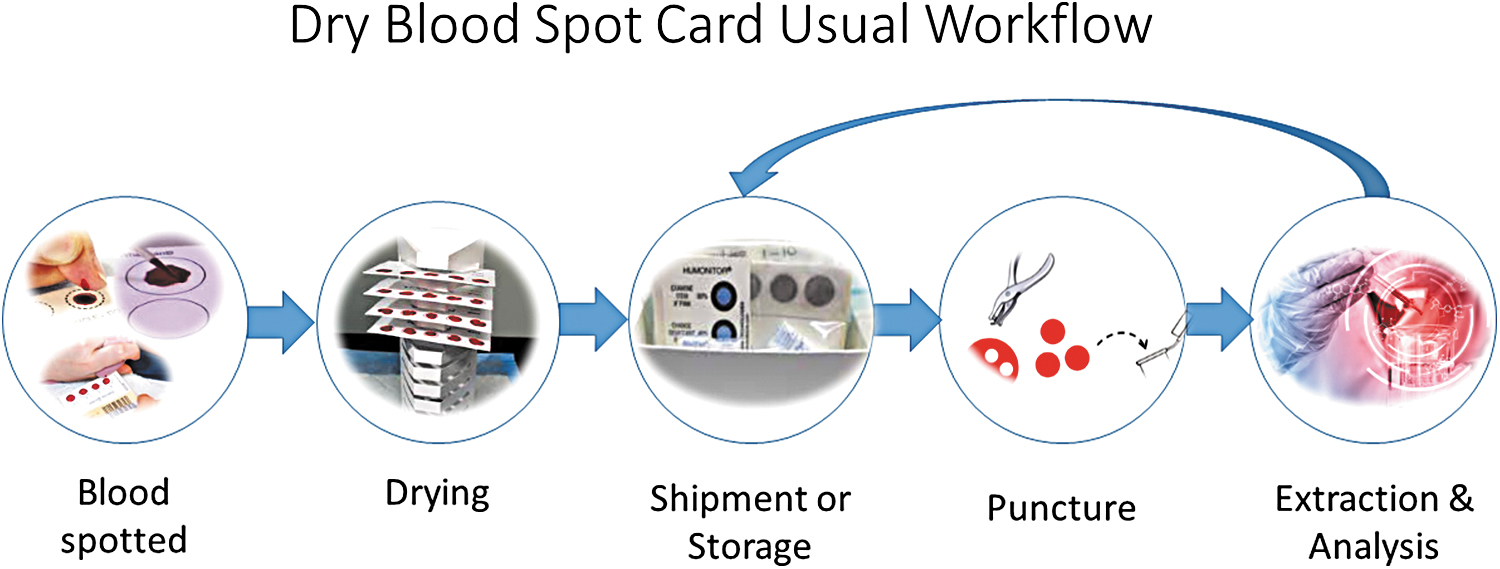
Dry Blood Spot Card Usual Workflow.
Dry Blood Spots Downstream “OMIC” Analysis and Quality Control
ANOVA, analysis of variance; ASCA, adaptive sine cosine optimization; CV, coefficient of variation; des, desiccant; FPKM, fragments per kilobase million; GAPDH, glyceraldehyde-3-phosphate dehydrogenase; GCR, genotype call rate; GEP, gene expression profile; GUSB, glucuronidase beta; HCA, hierarchical clustering analysis; HPLC, high pressure liquid chromatography; HPRT1, hypoxanthine phosphoribosyltransferase 1; GWA, genome wide association; IA, immunoassay; L, lipid/lipidomics; M, metabolite/metabolomics; MA, microarray; MS, mass spectrometry; Mut, mutation analysis; P, protein/proteomics; PCA, principal component analysis; PCR, polymerase chain reaction; RIN, RNA integrity number; RT- PCR, reverse transcription–polymerase chain reaction; SD, standard deviation; Seq, sequencing; WES, whole exome sequencing.
In the United States, there are two filter paper cards approved by the Food and Drug Administration (FDA), the S&S 903/Whatman 903 or 903® and the Ahlstrom 226, 19 which are utilized in the U.S. newborn screening program. As a contingency, these cards are monitored by the Newborn Screening Quality Assurance Program (NSQAP) to ensure lot consistency. 17 The program also ensures the uniformity and absorption characteristics between lots, the matrix influence on the diffusion of blood spots, the hematocrit,20–21 and blood volume effects. Other commercially available cards are not monitored by the NSQAP and may be chemically treated for improved extraction recovery, cell lyses, protein denaturation, and bacterial growth inhibition. In such cases, the European Bioanalysis Forum suggests a validation analysis covering linearity, sample dilution, accuracy, precision, extraction recovery, matrix effects, drying conditions, and storage stability. 22 Periodic updates from the Clinical Laboratory Standards Institute 23 also provide consensus standards and/or best quality control practices.
Importantly, drying, storage length, and shipping conditions, such as temperature and humidity, can vary significantly,24–25 and stringent controls are not enforced. Despite the quick stability provided by this method for short periods of time, many organic and nonorganic compounds 26 do not appear to be as stable for longer storage periods (> 6 months) and environmental conditions should be carefully addressed.
Review
Nucleic acids
Despite the average consensus that DNA is very stable, it can be degraded by multiple factors. Water, UV light, ozone, oxygen, metabolites, and various contaminants all can lead to depurination, depyrimidination, and deamination, base or sugar oxidation, cross-linking, and single-strand breaks that may lead to analytical errors. 27
One of the first attempts to extract DNA from DBS stored at room temperature was reported in 1987. 28 The rehydration method described was able to generate 0.5 micrograms of DNA from the dried equivalent of 50 μL of WB in a reproducible manner. The extracted DNA yield decreased with storage of DBS at room temperature over a period of 4.5 months. However, there was no significant DNA fragmentation after extraction, and the quality and quantity were still considered adequate for endonuclease digestion, electrophoresis, transfer, and hybridization. Since then, the utility of DBS for nucleic acid multiplex studies has attracted worldwide attention.
In 2003, as new DNA sequencing technologies and recommendations by the American College of Medical Genetics/American College of Obstetrics and Gynecology (ACMG/ACOG) emerged, a mutation panel for 25 Cystic Fibrosis (CF) mutations and four polymorphisms was evaluated. 29 Neonatal DNA was heat extracted from Guthrie cards that were stored for up to 9 years at room temperature. In all 13 CF patient samples, the mutation analysis coincided with those obtained from a reference laboratory.
Some of the most significant contributions were published by Hollegaard's group between the years of 2011 and 2013.30–32 In 2011, 30 the ability to extract adequate DNA from DBS for whole-genome amplification following genome-wide scanning was confirmed with three commercial platforms. This large-scale analysis included 4641 DBS samples and raised a few important but minor issues. A linear regression model was utilized to compare the length of storage, storage conditions (−20°C vs. +4°C), and type of filter paper (S&S2992 and S&S903) on the whole genome amplification (wgaDNA) concentration in the three study arms. Overall, storage time affected the wgaDNA concentration negatively. The lowest values were seen in the samples stored for the longest period of time. Independent of the years of storage, −20°C appeared to have a significant positive effect. In contrast, the type of filter paper card did not significantly change the effect of time or the concentration. Overall, none of the downstream arrays performed poorly, and the call rates still ranged between 98.7% and 99.6%. In addition, the concordance rate was up to 99.999% in 27 technical replications.
As mentioned, this initial report was followed by two smaller reports. In one, 31 the utility of 3.2 mm disks for genome-wide methylome profiling was investigated by comparing two adult individuals' (26 and 28 years) fresh whole-blood samples, with a fraction of their samples stored for 3 years as a DBS at −20°C and their own newborn DBS samples archived by the national program. The methylation profile between the WB and the 3-year-old DBS revealed no significant differences; however, compared to the 26–28-year-old DBS, 50 sites were significantly different. In a second follow-up study, 32 the group examined the ability to utilize DBS for whole genome sequencing (WGS) and whole exome sequencing (WES) by comparing a set of samples similar to the previous study. The results from the archived DBS were similar to the WB, and the group concluded that neonatal DBS stored for decades are an excellent resource for WGS and WES studies.
In 2014, a group from Korea 33 reported the concentration of DNA extracted from DBS samples and frozen-liquid samples from the same healthy adults using a modified DNA extraction procedure and a commercial kit. The comparison revealed a slight advantage of the frozen-liquid samples over DBS samples with respect to dsDNA quantity. Of interest, the concentration of ssDNA was significantly greater in the DBS samples.
The robustness of DBS for WGS was later also confirmed by Poulsen's group 34 in 2016 on archived samples stored at −20°C. After comparing neonatal DBS against adult WB and before filtering variant calls, the correlation of DBS against WB was slightly lower than between any two WB samples from the same subject. In addition, overall correlations were dependent on the variant type, with single nucleotide polymorphism performing best. Of significant interest, accurate results could be obtained with 1.6 mm instead of 3.2 mm punches.
In 2017, Boemer 35 focused on performing WES for inherited metabolic disorders listed in the Belgium program by utilizing leftover dry cards from 15 patients previously diagnosed by Sanger sequencing. Overall, the quality and quantity of DNA obtained from five 3.1 mm spots were considered adequate for high-throughput sequencing, and all mutations were identified.
On a related and practical note, an international breast cancer consortium demonstrated that Hi-Plex screening for the PALB2 predisposing gene could be effectively performed on their dried blood spots with no false positive results 36 opening the door for similar cancer screening programs.
RNA is more labile than DNA, and the main nonenzymatic mechanism of instability is a trans-esterification reaction initiated by an attack of the 3′–5′ phosphate by the ribose 2′ OH. More importantly, RNA is sensitive to trace amounts of RNases that are prevalent in many samples.
With that in mind, in 2009 a group at the Karolinska Institute evaluated the stability of
The potential of DBS RNA was also demonstrated at the Van Andel Research Institute in 201139 utilizing nine control samples stored between 6 months and 3 years. No information about the storage conditions was provided. Overall, an average 9068 genes could be detected with a commercial microarray utilizing three 3 mm spots and despite a RIN of 2.
A few years later, a Danish group 39 evaluated the global gene expression profile of DBS cards by comparing different whole transcriptome amplification (WTA) kits, storage methods, and disc sizes. Interestingly, the dynamic range was better for samples stored at −20°C. Furthermore, the samples stored at room temperature showed differential expression for a third of the gene-specific probes. More importantly, the length of storage (10 years) did not affect the results. As expected, WTA kits led to different results and confirmed an interprotocol variability as well. Despite the low number of samples, the project also suggested that the size and number of DBS discs could be minimized by comparing results between two 1.6 mm, one 3.2 mm, and two 3.2 mm samples.
In 2016, 40 an RNA based sequencing proof of concept was demonstrated utilizing two 3.2 mm DBS punches stored at −20°C from 10 volunteers (Male:Female = 1:1). The goal to differentiate sexes was achieved by a combination of six transcripts. Furthermore, the group also stated that “…the effects of storage time and temperature on RNA-seq data obtained from DBS is currently unknown and warrants future investigation.”
Nonetheless, in a recent comprehensive report focused on monitoring viral diseases, 41 the value of DBS as a tool for resource-poor environments and during outbreaks was highlighted.
In this context, a review in 201042 summarized the accuracy of HIV viral load and resistance genotype with DBS samples. In general, there were limitations related to the sample size compared to liquid samples. The −20°C DBS appeared to produce better results compared to room temperature storage. Also, controlled humidity and temperature during drying, storage, and shipping appeared to be essential for good quality samples. The need for standardization was emphasized, and optimization was also highlighted.
Metabolites
The analysis of metabolites from DBS has been the most widely published due to the worldwide expansion of newborn screening programs. Since Guthrie's heel prick method for PKU screening, simple and accurate procedures for stabilization, extraction, and analysis of targeted metabolites 43 from DBS cards have been adopted, often with a high accuracy rate. 44 However, metabolites stored as DBS may be affected by the environment, 45 shipping conditions, 25 and/or different extraction protocols leading to analytical results 46 that may not fit reference intervals determined directly from plasma. As an example, a recent correlation utilizing DBS and dried spot serum (DSS) samples was performed for 25-hydroxyvitamin D. 47 The findings demonstrated a lack of correlation between the dried spots and a reference range for each matrix. Furthermore, DSS was proposed as a better alternative for long-term banking. On a similar note, the utility of monitoring diabetes by analyzing HbA1c extracted from DBS 48 revealed an agreement of over 95% compared to standard venous samples, but results obtained from DBS cards older than 7 days had to be adjusted. The experience with lipidomics utilizing DBS cards has been limited. In 2017, the lipidomics profile obtained from air dried DBS cards stored with desiccants at different temperatures (4°C to 37°C) and stored from 3 days to 2 weeks was comparable to a WB matrix sample. 49 However, significant changes were noted for diacylglycerides in cards stored at 4°C and RT for up to 2 weeks and in most lipids stored at 37°C. On a similar analysis of about 350 metabolites, 50 significant variations were noted at higher temperatures compared to −20°C.
Proteins
The interest in DBS for protein storage evolved from the newborn screening programs for hemoglobinopathies. However, the growing interest around the preservation of single proteins 51 and the advent of new extraction protocols for mass spectrometry based analysis 52 led the way to a growing interest in DBS banking for downstream proteomic applications. In 2017, 92 oncology related proteins were analyzed using multiplex proximity extension assays in DBS stored for up to 30 years at either +4°C or −24°C. 53 Drying appeared to have only a slight influence on the detection of blood proteins. However, storage over three decades showed increased degradation compared to 10 years at −24°C. A few studies utilizing stable isotopes as controls54–55 demonstrated an excellent correlation between DBS and WB samples analyzed by multiple reaction monitoring. Interestingly, samples were stable over a period of up to 154 days at different storage temperatures (−20°C to 37°C). These publications were followed by a more recent report 56 detailing the reproducibility of 82 medium and high abundance proteins extracted from DBS and serum through a multiplexed targeted protein analysis. In this analysis, the DBS samples stored at room temperature had a CV of 13.2%, and the serum CV was 8.8%. Of note, the relative peptide abundance reported by the two sample types had a borderline strong correlation of 0.72.
In 2013, in an attempt to standardize the processing of DBS cards for infectious diseases protein analysis, a comprehensive protocol with 1762 serum/DBS samples was analyzed through an automated commercial platform. 57 The authors suggested that antigens and antibodies stored up to 2 weeks at room temperature could be considered stable; however, freezing was recommended for longer storage periods.
In 2020, a reproducible protocol was developed to detect five primary immunodeficiencies utilizing 17 patient samples and 20 controls. 58 The analytical CV remained at <20%. In addition, a few cards were stored at room temperature (RT), 37°C, and at −20°C. Analysis of these cards after 7 days of incubation revealed <20% peptide concentration changes except for a platelet marker that increased at room temperature and 37°C.
Nonorganic compounds
DBS is also commonly used for animal toxicokinetics studies.59–60 Due to expected differences compared to serum or plasma, however, strict criteria should be implemented when utilizing DBS for clinical care and trials. Currently, many protocols have been published for a variety of drugs,61–66 including those for HIV, H. Influenza, malaria, and immunosuppressants among others. An interesting decision tree based on the blood: plasma ratio, hematocrit, and a few other constants, was suggested for those considering the implementation of DBS for pharmacokinetic studies, 67 to normalize results. The adequate stability of analytes was reported by many; however, the full range of shipping conditions was examined by only a few. Of interest, one study concluded that a drying time of at least 24 hours was needed for adequate recovery of several immunosuppressants. 68 In contrast, only a few studies reported on the stability of drugs of abuse on DBS. 69 More importantly, and similar to the newborn screening programs for Inborn errors of metabolism (IEM), an international effort to standardize DBS for therapeutic drug monitoring 70 was recently published. Of interest, the group emphasizes the need to investigate DBS quality not only from a processing and storage (biobanking) point of view but also from an analytical and clinical perspective before implementation. On a similar note, another recent report highlighted the potential of heat degradation on the recovery of a few immunosuppressants like Sirolimus and Everolimus but not Tacrolimus. 71
Summary
As noted throughout this review, DBS cards have been extensively validated for IEM screening programs worldwide. However, as new DBS protocols are developed for other fit-for-purpose goals, a few key factors should be considered:
Cards: Most studies utilize the NSQAP monitored cards. However, the experience with other commercially available cards, including those with added stabilizers, has been relatively limited or not reported. As such, an extensive validation of these cards should be performed as suggested by the European Bioanalysis Forum. There is ongoing evidence that smaller (1.6 mm vs. 3.2 mm) punches may fit the needs for certain applications. Drying and humidity: Unfortunately, most studies did not report the drying time or environmental humidity conditions of their samples during processing, shipping, or storage. High humidity (>50%) was only mentioned occasionally, and few studies utilized protective bags with desiccants, with no further details. Unfortunately, the variable porosity of bags was never addressed in any of the studies reviewed. Temperature: Several studies focused on the long term storage at −20°C defeating the general assumption that room temperature is an adequate storage environment for all analytes. In fact, room temperature stabilization has been recommended for up to 2 weeks only by a few investigators. Short exposures to extreme temperatures, as seen in shipping conditions, may be detrimental; however; this experience was only reported for HIV monitoring. Length of storage: In general, longer storage periods (> 6months) appear to have a minor detrimental effect on most samples, even for DNA. Quality control: There is no universal internal standard, and downstream analytical results are often utilized as surrogates (Table 1). Of interest, DBS RNA appears to be more resistant to freeze–thaw cycles compared to frozen liquid samples. Quantitative analysis: The entire spot should be processed to avoid diffusion artifacts. Reference ranges: Investigators should be aware of the lack of reference ranges for DBS, for different platforms, protocols, and especially for the newborn period. Validation: DBS based protocols should be validated against gold standard methods before implementation at all times.
Footnotes
Author Disclosure Statement
No competing financial interests exist.
Funding Information
No funding was received for this article.