




Abstract
The aim of this study was to evaluate the effect of hydrated carbon 60 fullerene (C60HyFn) on ram semen quality during cryopreservation. Three ejaculates from each of seven Akkaraman rams were collected using an artificial vagina during the nonbreeding season and pooled. Pooled semen samples were divided into 10 equal parts and diluted with tris + egg yolk extender not containing (control) and containing 100, 200, 400, and 800 nM and 1, 5, 10, 20, and 40 μM C60HyFn at 37°C. After addition of 5% glycerol and an equilibration process for 3 hours, the samples were frozen in 0.25-mL straws in an automatic freezing device at −140°C and stored in a liquid nitrogen container. Straws were thawed 24 hours after freezing and analyzed immediately with no incubation period. Motility, kinematic parameters, abnormality, vitality, hypo-osmotic swelling test (HOST), and oxidative stress levels were analyzed in thawed semen. Compared with the control, 200, 400, and 800 nM and 1 and 5 μM C60HyFn doses increased motility and HOST values and decreased the dead sperm rate. When compared with the control, addition of C60HyFn significantly decreased malondialdehyde levels (between 200 nM and 40 μM doses) and significantly increased glutathione peroxidase (between 800 nM and 40 μM doses) and catalase (between 1 and 40 μM doses) activities. In conclusion, results of this study show that the C60HyFn nanoparticles are nontoxic to ram semen and their supplementation in the extender is beneficial to sperm motility and membrane integrity after freeze–thawing.
Introduction
The sheep is an animal of great economic importance, yielding products such as meat, milk, and fleece all over the world. It is necessary to increase the reproductive quality of this species and to improve the yield characteristics by genetic breeding techniques. For this reason, reproductive biotechnological studies have also focused on this species. Artificial insemination is the most important tool used to achieve these reproductive biotechnological goals. Long-term storage of semen by freezing is inevitable to increase the advantages of artificial insemination compared with natural mating. It facilitates the transport of semen and ensures the long-term usage of semen having superior genetic characteristics even after the death of the sire animal. However, in sheep, pregnancy rates obtained from insemination with frozen–thawed semen, especially from intracervical insemination, which is easy to use in the field, are very low compared with pregnancy rates obtained from fresh or liquid-stored (5°C) semen.1,2 The main cause of this problem is that the freezing process induces various physical and chemical stresses in the membranes of spermatozoa because the structure of the ram spermatozoon membrane has a different lipidic composition compared with other species.3–5
The different lipidic structure of the membrane makes ram spermatozoa susceptible to freeze–thaw process-induced increased reactive oxygen species (ROS) and oxidative stress damage that leads to irreversible motility losses, morphological disorders, and deaths. 6 Ram spermatozoa contain a high proportion of polyunsaturated fatty acids and a low cholesterol/phospholipid rate compared with other species.7,8 Spermatozoa resist excessive ROS production and lipid peroxidation (LPO) with the cooperation of seminal plasma, membranes, and cytoplasm together with an antioxidant protective system, including superoxide dismutase (SOD), glutathione-peroxidase (GSH-Px), and catalase (CAT). However, this cooperation is partially changed during freeze–thaw processes and serious damage may occur.8–10
Many studies have demonstrated that addition of antioxidants improves ram semen quality during cryopreservation,9,11–13 but the desired success has not yet been achieved. Carbon 60 (C60) fullerene is the third allotrope of carbon and is considered the most prominent member of the nanomaterial family. It can be found in spherical, cylindrical, or ellipsoidal shapes. Fullerene was first discovered in 1985. Fullerenes are a huge research topic in the field of nanomaterials due to their physicochemical structures and biological activities. 14 Fullerene was developed by the method of producing water-soluble and chemically unmodified C60 fullerene without the use of any solvents or stabilizers. The preparation obtained was named as hydrated C60 fullerene (C60HyFn). Stable aqueous solutions of C60HyFn contain single, hydrated, C60 fullerene molecules of 3–36 nm size as well as unstable clusters as secondary additions. C60HyFn water molecules are highly hydrophilic. 15 Recently, it has been indicated that fullerenes have beneficial biological effects as neuroprotective, anticancer, anti-inflammatory, antiatherogenic, and radioprotective agents.16–18 C60 fullerene and some of its derivatives have been reported to provide effective protection against in vitro and in vivo oxidative stress19–21 without causing acute or subacute toxicity.22–24 C60HyFn has been suggested to have strong antioxidant properties even at very small concentrations25,26 and to provide improvement in the motility of frozen–thawed human 27 and liquid-stored pig 28 semen. In addition, it has positive effects on the motility and morphology of ram semen stored at 5°C. 29 However, as far as we know, there is no study on how C60HyFn affects semen freezability as well as semen quality after thawing in rams. In this study, the goal was to investigate the effects of addition of different doses of C60HyFn to ram semen extender on motility, kinematic parameters, morphology, vitality, membrane integrity, and oxidative stress after freeze–thawing.
Materials and Methods
Ethical approval and animals
The Fırat University Animal Experiments Local Ethics Committee approved this study under Protocol No: 2016/149. In the study, seven Akkaraman breed rams, clinically healthy with an average age of 1.5 years, were used to provide the biological samples. Animals were housed at Fırat University, Animal Hospital, Hospitalisation Unit, throughout the study. During the study, the rams were fed with concentrated and high-quality roughage and drinking water was provided ad libitum.
Collection, dilution, and freezing of semen
On the day of semen collection, stock solutions were prepared by diluting pure C60HyFn with distilled water to create nine different dose groups. C60HyFn doses in this study were the best doses selected among 14 doses used for short-term storage of ram semen in our previous study. 29 Semen samples were collected using an artificial vagina three times during a period of 2 weeks from each ram during the nonbreeding season (May) between 08:30 and 9.30 A.M. A total of 21 semen samples, 7 at each semen collection time, were studied. All semen samples had >70% initial motility and >2 billion/mL concentration. Samples from seven animals at each semen collection time were mixed (pooling) in a tube at 37°C. The pooled semen was divided into 10 equal volumes. Each volume was diluted with tris + egg yolk extender [297.58 mM tris (hydroxymethyl) aminomethane +96.32 mM citric acid +82.66 mM fructose +100,000 IU penicillin +100 mg of streptomycin +15 mL of egg yolk + enough distilled water to complete to 100 mL], including and not including (control) C60HyFn doses (100, 200, 400, and 800 nM and 1, 5, 10, 20, and 40 μM), and its temperature was lowered to 5°C. Then, 5% glycerol was added and equilibrated for 3 hours at 5°C. The samples were drawn into 0.25-mL straws. The straws were frozen in liquid nitrogen vapor at −140°C in an automatic freezing device (MicroDigitcool, IMV, France) by adjusting the temperature transitions according to time (1°C per minute from 4°C to −20°C and 25°C per minute from −20°C to −140°C) 30 and stored in a liquid nitrogen container at −196°C. After 24 hours of storage,31,32 the straws in each group were taken from the liquid nitrogen container and thawed in a water bath at 37°C for 25 seconds. Spermatological and oxidative stress analyses were performed immediately after thawing (Fig. 1).
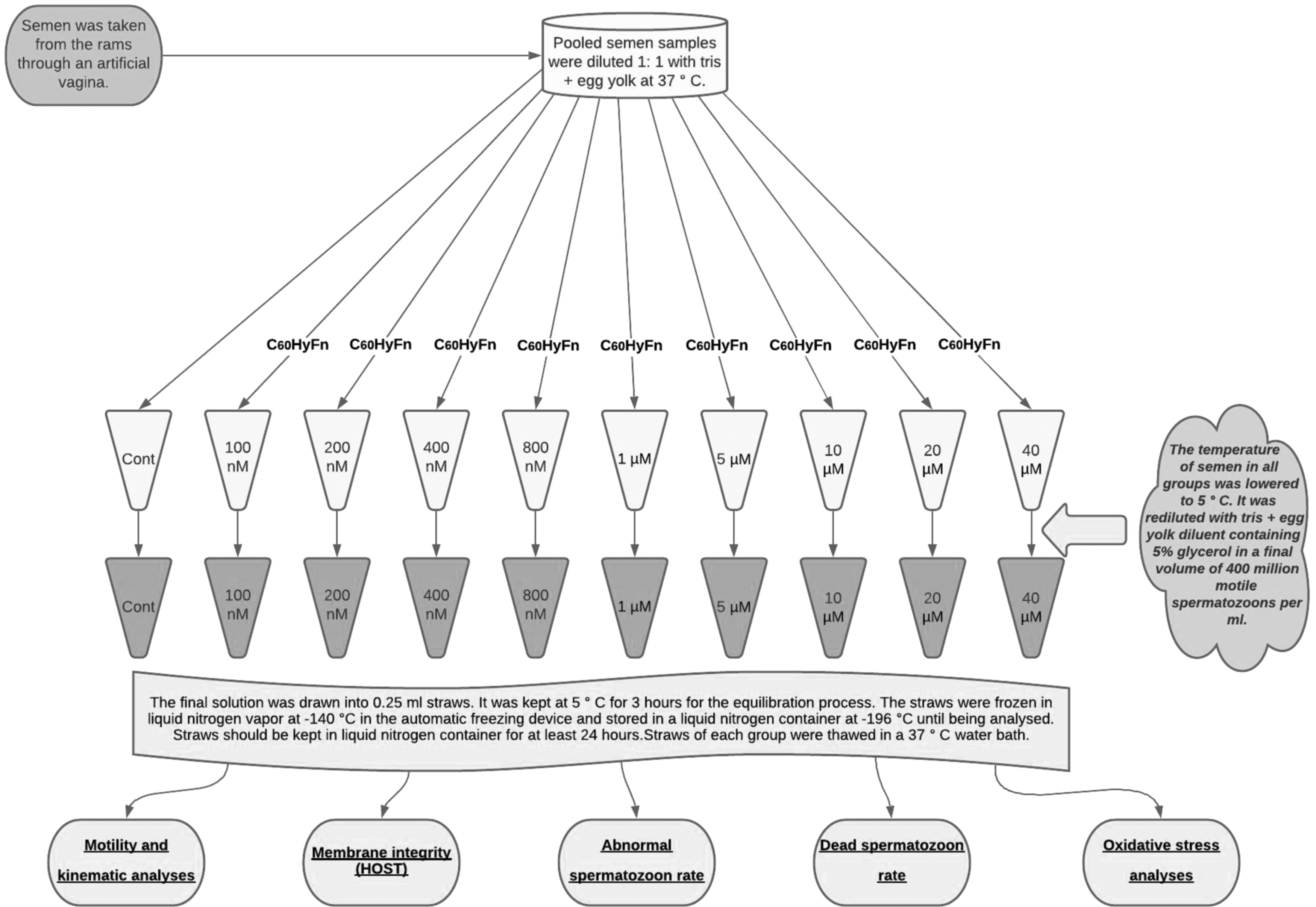
Flowchart describing all the steps of the study.
Spermatological analyses
Motility and kinematic parameters
Motility and kinematic analyses were determined with a computer-assisted sperm analyzer (CASA, ISAS v1, Proiser, Spain). Thawed semen straws were diluted with tris buffer solution [0.3 M tris (hydroxymethyl) aminomethane +0.027 M glucose +0.1 M citric acid +100 mL of distilled water] in an Eppendorf tube and kept at 37°C for 30 seconds; 3.5 μL of the tris buffer–thawed semen mixture was placed on a special slide (Spermtrack 20 μm, Proiser, Spain) for analysis. Then, using the motility module in the computer program, the total and progressive motility (with rapid, medium, and slow motility) rates (%), static spermatozoon rates (%), and values of the kinematic parameters [VCL, curvilinear velocity (μm/s); VSL, straight line velocity (μm/s); VAP, average path velocity (μm/s); LIN, linearity (%); STR, straightness (%); WOB, wobble (%); ALH, amplitude of lateral head displacement (μm); and BCF, beat cross frequency (Hz)] were recorded.
Membrane integrity—hypo-osmotic swelling test
The frozen–thawed semen samples were diluted with tris buffer solution at a rate of 1:5 at 37°C and 50 μL was taken and mixed with 500 μL of hypotonic solution (0.49 g of citric acid, 0.9 g of fructose, and 100 mL of distilled water) and left to incubate for 60 minutes at 37°C. After incubation, 200 spermatozoa were examined using 400× magnification of the phase-contrast microscope (Nikon ECLIPSE Ci, Tokyo, Japan). The proportion of intact spermatozoa with a swollen and curled tail was expressed as a percentage. 33
Abnormal spermatozoon rate
Thin smears were prepared from the mixture of tris buffer–thawed semen. They were air-dried for 5–10 minutes. The commercial Diff Quick staining set was used for staining. For this purpose, the smears were dyed by dipping them into A, B, and C solutions of the Diff Quick set for 10, 6, and 6 seconds, respectively, as suggested by the manufacturer. The stained smears were washed with distilled water for about 1 minute and then air-dried. The smears were examined under a phase-contrast microscope at 400 × magnification. The proportion of spermatozoa with abnormal shapes (head, tail, and total) and damaged acrosomes was expressed as a percentage by examining a total of 200 spermatozoa for each slide.
Dead spermatozoon rate
Twenty microliters was taken from the tris buffer–thawed semen mixture and dropped onto the slide at 37°C, and 60 μL of eosin–nigrosin (1.67 g of eosin, 10 g of nigrosin, 2.9 g of sodium citrate, and 100 mL of distilled water) stain was added and mixed in. Thin smears were prepared from this mixture and left to dry in air for 5–10 seconds. The smears were then examined under a phase-contrast microscope at 400 × magnification. A total of 200 spermatozoa were examined in each smear and the spermatozoa having a pink-stained head were considered dead, and the dead spermatozoon rate was expressed as a percentage. 34
Oxidative stress analyses
LPO level
The LPO level was determined spectrophotometrically according to the concentration of thiobarbituric acid-reactive substances. 35 The amount of malondialdehyde (MDA) released as the secondary by-product of LPO was used as the LPO index. One volume of frozen–thawed semen sample was mixed with 2 volumes of stock solution (15% trichloroacetic acid in 0.25 N hydrochloric acid and 0.375% thiobarbituric acid in 0.25 N hydrochloric acid) in the centrifuge tube. The mixture was incubated in boiling water at 100°C for 15 minutes. After cooling, it was centrifuged at 1500 g for 10 minutes and the released precipitate was removed. The absorbance of the supernatant was then read against the blank with a spectrophotometer (2r/Ultraviolet visible, Shimadzu, Tokyo, Japan) at 532 nm. The MDA level was expressed as nmol/mL.
Glutathione level
To determine the glutathione (GSH) level, frozen–thawed semen samples were precipitated with 50% trichloroacetic acid and centrifuged at 1000 g for 5 minutes to remove the precipitate; 0.5 mL was taken from the supernatant and the reaction mixture was formed by adding 2 mL of tris-ethylenediaminetetraacetic acid buffer solution. After the mixture was kept at room temperature for 5 minutes, absorbance was read at 412 nm with a spectrophotometer. The GSH level was expressed as nmol/mL. 36
Glutathione peroxidase activity
For determination of glutathione peroxidase (GSH-Px) activity, frozen–thawed semen samples were precipitated with 50% trichloroacetic acid and centrifuged at 1000 g for 5 minutes to remove the precipitate; 0.1 mL of the supernatant was taken and transferred to 0.8 mL of reaction mixture and incubated at 25°C for 5 minutes before reacting with 0.1 mL of peroxide solution. Absorbance was read in the spectrophotometer at 340 nm for 5 minutes. GSH-Px activity was expressed as IU/L. 37
Catalase activity
For detection of catalase (CAT) activity, 0.2 mL of frozen–thawed semen sample was incubated in 1 mL of substrate at 37°C for 60 seconds. The enzymatic reaction was terminated with ammonium molybdate. The color change resulting from this reaction was read against the blank with a spectrophotometer at 405 nm. The CAT activity in the samples was measured according to the decrease in hydrogen peroxide level and expressed as ku/g protein, where k represents the first-order rate constant. 38
Statistical analyses
All statistical analyses were done by using the SPSS (Version 22.0; IBM Corp., Armonk, NY) program. Values are presented as mean ± standard error of the mean (SEM). The Kruskal–Wallis nonparametric variance analysis was used to determine differences between groups, and the nonparametric Mann–Whitney U test was used for paired comparisons. A value of p < 0.05 was accepted as statistically significant.
Results
Motility and motion characteristics
Mean values for motility and kinematic parameters are given in Table 1. Compared with the control, 200, 400, and 800 nM and 1 and 5 μM C60HyFn doses increased the total and progressive motility rates and decreased the static spermatozoon rate. However, 100 nM and 10, 20 and 40 μM C60HyFn caused numerical decrease in rapid motility rates. No statistical significance was determined between the control and all C60HyFn groups with regard to all kinematic parameters.
Effects of Hydrated Carbon 60 Fullerene (C60HyFn) on Computer-Assisted Sperm Analyzer Parameters of Ram Spermatozoa During Cryopreservation
The capital letters (A, B, C, and D) in the same column show significant (p < 0.01) differences between groups.
VCL, curvilinear velocity; VSL, straight line velocity; VAP, average path velocity; LIN, linearity; STR, straightness; WOB, wobble; ALH, amplitude of lateral head displacement; BCF, beat cross frequency.
Membrane integrity (hypo-osmotic swelling test), abnormality, and vitality
Mean values for hypo-osmotic swelling test (HOST) rates, abnormal spermatozoon rates, and vitality (as dead) are given in Table 2. All values belonging to HOST rates for all C60HyFn doses between 200 nM and 5 μM were found to be higher, and all values for 100 nM and 10, 20, and 40 μM C60HyFn doses were found to be lower in comparison with the control. All values belonging to dead and total abnormal spermatozoon rates for 200, 400, and 800 nM and 1 and 5 μM C60HyFn doses were lower, and all values for 100 nM and 10, 20, and 40 μM C60HyFn doses were higher.
Effects of Hydrated Carbon 60 Fullerene (C60HyFn) on Sperm Membrane Integrity, Abnormality, and Vitality of Ram Spermatozoa During Cryopreservation
The capital letters (A, B, C, and D) in the same column show significant (p < 0.01) differences between groups.
HOST, hypo-osmotic swelling test.
Oxidative stress levels
Mean values for MDA and antioxidants (GSH, GSH-Px, and CAT) are given in Table 3. All C60HyFn doses between 200 nM and 40 μM significantly reduced the MDA levels compared with the control (p < 0.05). All C60HyFn doses between 800 nM and 40 μM resulted in a significant increase in GSH-Px activity (p < 0.05) and all C60HyFn doses between 1 and 40 μM resulted in increased CAT activity (p < 0.05). On the other hand, similarly in total, progressive motility and static spermatozoon rates, all C60HyFn doses between 200 nM and 5 μM increased GSH-Px and CAT activities and also decreased the MDA level. In terms of GSH levels, all C60HyFn doses between 200 nM and 5 μM did not provide any improvement.
Effects of Hydrated Carbon 60 Fullerene (C60HyFn) on Oxidative Stress Parameters of Ram Spermatozoa During Cryopreservation
The capital letters (A, B, C, and D) in the same column show significant (p < 0.05) differences between groups.
MDA, malondialdehyde; GSH, glutathione; GSH-Px, glutathione peroxidase; CAT, catalase.
Discussion
In this study, the potential of C60HyFn nanoparticles to prevent damage caused by the freeze–thaw process in ram spermatozoa was investigated, and it was determined that doses between 200 nM and 5 μM had an effective role in preventing damage.
It has been reported that enzymatic (SOD 9 and CAT11,39) and nonenzymatic antioxidant (xanthan gum 40 ; methionine, cysteamine, and cysteine 12 ; GSH and oxidized GSH 13 ; ellagic acid and curcumin 41 ; canthaxanthin 42 ; vitamin E 43 ; vitamin C 31 ; lycopene 44 ; L-arginine 45 ; L-carnitine 46 ; and rosemary extract 47 ) addition resulted in a decreased LPO level and increased sperm quality parameters (motility, membrane integrity, acrosome integrity, and mitochondrial activity) in frozen–thawed ram semen. Fullerenes have direct antioxidant properties. These properties are due to the presence of π-conjugated double bonds between hexagonal and pentagonal structures. While fullerenes exhibit their antioxidant effects, they remain unchanged, collect free radicals, and bind them to each other. 48 Oxidative stress is cryodamage that occurs during cryopreservation. C60HyFn can prevent this damage and promote cellular regeneration. 49 C60HyFn can interact with biological membranes by entering the intracellular space through passive diffusion or endocytosis. 50 For fullerenes to exhibit these biological properties, it is inevitable that they interact with the cell membrane. The C60HyFn molecule is characterized by its hydrophobic properties and affinity for biological membranes. C60HyFn are molecules that can affect cellular membranes by adsorption and by entering the lipid bilayer. 51 In a previous study, it has been reported that C60 increases conductivity by penetrating the two-layered lipid membrane. 52 In another study, it was reported that C60 molecules are predominantly bound to mitochondria inside the cell. 53 Fullerene and similar carbon molecules can inhibit crystal formation and the growth of this crystal, which occurs during freezing. 54
In our previous study, 29 we observed that although 100, 200, 400, and 800 nM and 1, 5, 10, 20, and 40 μM C60HyFn doses positively affected the values of motility, membrane integrity, morphology, and dead spermatozoon rates at the 144th hour in ram semen stored at 5°C, doses of 25 and 50 nM and 60, 80, and 100 μM were ineffective. In the present study, C60HyFn doses of 200, 400, and 800 nM and 1 and 5 μM, which were selected based on our previous study, increased the total, progressive, and rapid motility and HOST rates and decreased the rates of static, dead, and total abnormal spermatozoa when compared with the control. During freezing of semen, free radicals are released. Various physical and chemical stresses caused by these radicals cause damage especially in the ram spermatozoon membrane. In the present study, some doses of C60HyFn achieved certain success on freezing of ram semen. The reason for this success may be that C60HyFn provides a protective effect against LPO 55 without causing acute–subacute toxicity and shows bioantioxidant properties. 25 In addition, a different hypothesis concerning the prevention of LPO is that C60HyFn may facilitate permeation of internal and external cryoprotectants into the cells and possibly sustain the sperm cell membrane stability. Since C60HyFn is a nanoparticle, it may carry and evenly distribute the cryoprotectant components during the freezing process. However, all of the 10, 20, and 40 μM C60HyFn doses caused a slight decrease in total, progressive, and rapid motility and HOST rates and a slight increase in static, dead, and total abnormal spermatozoon rates compared with the control. The reason for this situation may be the osmolarity differentiation caused by a high dose of C60HyFn.
All C60HyFn doses between 200 nM and 40 μM significantly reduced MDA levels, all C60HyFn doses between 800 nM and 40 μM significantly increased GSH-Px activity, and all C60HyFn doses between 1 and 40 μM increased CAT activity in comparison with the control in the present study. It has been reported that in vivo administration of C60HyFn prevents diabetes-induced damage in spermatozoon quality by its powerful antioxidant feature in rats. 55 In a study performed on goat epididymal spermatozoa, following incubation with 1, 10, and 100 μM C60HyFn at 32°C for 3 hours, increments in GSH-Px, glutathione reductase, and SOD activities and decreases in LPO levels were recorded depending on the dose. 56 Similarly, in a recent study, 28 pig semen with addition of 1, 2, 3, and 4 μg/mL C60HyFn was stored for 10 days at 4°C, and at the end of the 10th day, C60HyFn-added semen was reported to have higher motility, acrosome integrity, and mitochondrial activity compared with control. The underlying mechanism for this effect of C60HyFn in pig semen has been suggested to be prevention of protein dephosphorylation through the cAMP-PKA signaling pathway due to the increased ROS and energy deficiencies induced by cold storage. 28 However, to the best of our knowledge, there is only one scientific study 27 on the effect of C60HyFn against freeze–thaw damage on human semen with asthenozoospermia, and C60HyFn at doses of 10, 20, 30, 40, 100, and 200 μg/mL was added to diluted semen and subsequently frozen. In that study, it was observed that doses of 10 and 20 μg/mL had no effect on membrane and DNA integrity and a significant increase in motility, but doses of 40 μg/mL and above decreased motility and damaged spermatozoon DNA and membrane integrity in frozen–thawed semen compared with the control.
To the best of our knowledge, no evidence was found about the in vitro effect of C60HyFn for the purpose of protecting spermatozoa against freeze–thaw damage in rams. Therefore, the results of this study are the first findings about the effect of C60HyFn on the freezability of ram semen. In this study, although high doses (10, 20, and 40 μM) of C60HyFn had a positive effect on oxidant/antioxidant balance, no positive effect on sperm parameters (total, progressive, and rapid motility; HOS; and dead and abnormal spermatozoon rates) could be detected. On the other hand, the results showing that high doses do not have a positive effect on semen parameters are in agreement with the results of studies conducted in humans. 27 The results obtained from this study demonstrate that C60HyFn has a strong antioxidant property25,55,56 and, with this feature, it may protect ram spermatozoa against LPO damage by reducing excessive ROS production and increasing diminished enzymatic antioxidant activities (evidenced in the present study) induced by the freeze–thaw process.
In conclusion, the results of this study show that C60HyFn nanoparticles are nontoxic to ram semen and their supplementation in an extender is beneficial to sperm motility and membrane integrity after freeze–thawing. Based on this, C60HyFn is strongly recommended for use in the composition of diluents for freezing ram semen. On the other hand, further molecular analyses are needed for more detailed effects of C60HyFn on ram spermatozoa.
Footnotes
Authors' Contributions
S.G., M.S., and G.T. planned the study. İ.H.G., S.D.C., T.C.A., R.H.K., S.A.A., C.C., A.Ç., F.F., M.S.H., İ.Y., N.B., and Ş.Ö.K. participated in semen collection, dilution, freezing, and also spermatological analyses. G.A., M.K., and A.Y. performed the oxidative stress analyses. İ.H.G. wrote the first draft of the manuscript. S.G., M.S., and G.T. reviewed and edited the first draft of the manuscript. All authors provided equal contribution to interpretation of the results.
Author Confirmation Statement
Mr. İ.H.G., Mrs. S.D.C., Mr. T.C.A., Dr. G.A., Mr. C.C., Miss A.Ç., Miss F.F., Mr. M.S.H., Mr. İ.Y., Miss N.B., Assoc. Prof. Dr. Ş.Ö.K., Assist. Prof. Dr. M.K., Prof. Dr. A.Y., Prof. Dr. S.G., Prof. Dr. M.S., and Prof. Dr. G.T. are from the Fırat University Faculty of Veterinary Medicine; Mr. R.H.K. is from Bingöl University Faculty of Veterinary Medicine; and Dr. S.A.A. is from Kahramanmaraş İstiklal University, Elbistan Vocational School—all from institutions where research and education are the primary functions.
Author Disclosure Statement
No conflicting financial interests exist.
Funding Information
This study was financially supported by The Scientific and Technological Research Council of Turkey (TUBITAK, Grant No: 117O300). It was presented at the 21st ISANH Redox and 4th ISANH-ME Congress in Muscat, Oman.