




Abstract
Freshly isolated human hepatocytes are an important model for translational research, validation of experiments done in animals, and preclinical studies. Human hepatocyte isolation often cannot be carried out easily on demand in common research laboratories, and researchers often collaborate to share hepatocytes or outsource hepatocyte isolations. As a prerequisite for such a strategy, hepatocytes have to maintain their phenotypes after transport. Therefore, this study aimed to determine if overnight storage or shipment of hepatocytes affects their quality when viability, adherence, and cytochrome P450 (CYP) activities are considered. Hepatocytes were stored overnight or shipped to a collaborator in a cold storage solution on wet ice. On the next day, viability of hepatocytes was assessed before plating the cells to determine adherence. Hepatocytes were also cultured in a sandwich culture to determine CYP activities and inducibility. The results showed that although viability (79% ± 0.7% on isolation) was significantly decreased by overnight storage or shipment by 11% (p < 0.001) or 15% (p < 0.001), respectively, the viability of hepatocytes the next day at above 64% ± 2.2% remained sufficiently high for further experiments. In addition, hepatocytes stored for 18 or 24 hours were adherent the next day, and a high confluence of 81% ± 10% to 91% ± 4% was achieved after 48 hours in culture when hepatocytes were adhered on collagen-coated plates. Furthermore, CYP enzyme activities were inducible and not affected by variables such as fibrosis, age, type of operation, steatosis, and body mass index. However, our data would suggest that the type of cancer (primary/secondary), sex (male/female), hypertension, glutamic oxaloacetic transaminase activity, partial thromboplastin time, and size of perfused liver had significant effects (p < 0.05) on induction of some CYP enzymes. In conclusion, human hepatocyte isolation can be carried out at a centralized site and shared between multiple researchers, increasing flexibility and access to a representative human liver in vitro model.
Introduction
It is widely accepted that freshly isolated human hepatocytes have metabolic activities most similar to intact tissue compared against cryopreserved hepatocytes.1,2 However, carefully selected cryopreserved hepatocyte batches, for example, with high cytochrome P450 (CYP) enzyme activities, are more popular due to their ready availability on demand, possibilities for retesting, and comprehensive prior characterization.
Nonetheless, there are areas of research where freshly isolated hepatocytes have advantages. For example, freshly isolated hepatocytes have higher viabilities and plating efficiencies1,3 compared to cryopreserved and thawed hepatocytes and, as such, would be more suitable for 2D or 3D cultures. In addition, it has been shown that a wide variety of hepatic-specific functions, such as uptake of bile acids, protein synthesis, glycogen synthesis, glycogenolysis, drug metabolizing enzyme activities, and urea production, can be affected or reduced by cryopreservation and thawing,1,2 making cryopreserved hepatocytes less ideal for a selection of research topics and potential clinical applications such as liver cell transplantation. 4
In order for researchers to have the option to use freshly isolated human hepatocytes when required with an ease of use comparable to cryopreserved hepatocytes, hepatocyte isolations often have to be outsourced as the manpower and logistical requirements to obtain donated human liver on demand are less feasible for the average laboratory. For this purpose, isolated hepatocytes have to be able to tolerate overnight shipping. Juric et al. 5 have shown that hepatocytes cold-preserved in SureTran™ matrix retained viability and can be used for in vitro induction studies. In their model, hepatocytes were plated on collagen-coated plates and then overlaid with SureTran matrix before shipping. 5
Our study aims to further examine hepatocyte viability, adherence, CYP enzyme activities, and induction percentages after overnight storage or shipment in a liquid-based cold storage solution with the hypothesis that overnight storage should not compromise the hepatocyte usage for subsequent in vitro studies. The use of a liquid Cold Storage Solution (CSS, Human Tissue and Cell Research [HTCR]-Services GmbH) allows shipping of hepatocytes in suspension and increases flexibility, as researchers can use hepatocytes in their model of choice. In this study, CYP activities were examined in particular because they are a major source of variability in drug pharmacokinetics and response. 6
Materials and Methods
Donated human liver specimens
Liver specimens were provided double-coded by the biobank under the administration of the HTCR Foundation at the Ludwig-Maximilians-University (LMU). The framework of the HTCR Foundation, 7 which includes written informed consent from all donors, has been approved by the ethics commission of the Faculty of Medicine in the LMU (no. 025-12) and the Bavarian State Medical Association (no. 11142). The biobank collected resections from the operation suites directly in sterilized vessels, which were placed on wet ice in an insulated ice box. The specimens were kept on ice the whole time except during the pathologist's examination. Macroscopically healthy tissue from the resection margin not required for diagnostic purposes and suitable for isolation was selected by the pathologist. This piece of donated tissue was then distributed on wet ice for hepatocyte isolation.
Hepatocyte isolation
A modified two-step collagenase perfusion technique was used to isolate hepatocytes. 8 After the last wash, the hepatocyte pellet was resuspended in CSS (HTCR-Services GmbH), a cold storage solution designed for transportation of hepatocytes that is formulated to maintain a pH value of 7.4. Viability and yield were immediately assessed using a hemocytometer-based trypan blue exclusion assay. Centrifuge tubes or vials containing hepatocytes were placed on ice whenever there was any waiting time, such as when counting or before packing in wet ice for shipment.
Storage and shipment of hepatocytes
Hepatocytes suspended in CSS were adjusted to a final concentration of 10–15 million viable hepatocytes per mL CSS. The hepatocyte suspension from one donor was sealed in two glass vials and packed in two separate ice boxes containing wet ice according to UN recommendations on transport. One ice box was shipped overnight to Bayer AG, Wuppertal, Germany through a logistics company, and the other ice box was left overnight in the laboratory in Munich. Each pair of vials containing hepatocytes from the same isolation had a similar storage time on ice, and the times on ice ranged from 14 to 17 hours. Only one hepatocyte isolation was done daily, and 79 shipments were sent over the course of this study.
Characterization of hepatocytes
Viability of hepatocytes was assessed the next morning in hepatocytes stored overnight in Munich or shipped to Wuppertal. Density gradient centrifugation with medium such as Percoll® was not done as the actual viability after storage and shipment was desired as an indication of cell quality.
To assess adherence of hepatocytes, 1.2 million viable hepatocytes were pipetted into each well of a 6-well collagen 1-coated plate (Corning, Kaiserslautern, Germany) in hepatocyte medium (Dulbecco's modified Eagle's medium supplemented with 800 μg/L hydrocortisone, 125 U/L insulin, 100 kU/L penicillin, 100 mg/L streptomycin, 2 mM glutamine, 7.4 μg/L glucagon, and 10% Fetal Calf Serum [FCS]). The plate was then placed in an incubator (37°C, 95% air, 5% carbon dioxide). After 4 hours for adherence, medium was refreshed with hepatocyte medium without FCS. Confluence was independently assessed by two people using phase contrast microscopy at 24 and 48 hours after plating. An unbiased confluence determination was made by comparison of the view under phase contrast imaging to prepared representative images depicting confluence at 5% intervals.
For CYP enzyme induction assays, hepatocytes were cultured in sandwich culture models between two layers of collagen, and CYP activities were measured according to Kern et al. 9 In short, after 2 days in culture, hepatocytes were exposed to rifampicin or omeprazole dissolved in the culture medium.
Basal CYP enzyme activities were measured before the addition of rifampicin and omeprazole on day 2 of culture, and induced CYP activities were measured after rifampicin and omeprazole on day 7 of culture. Rifampicin- or omeprazole-containing medium was changed daily. Incubations of hepatocytes with probe substrates were performed in 96-well format and started by addition of 40 μL medium containing a cocktail of substrates, phenacetin (150 μM), and testosterone (165 μM) to each well in a humidified culture chamber (37°C/5.5% CO2). At 60 minutes, the incubation mixture was removed and stored at −18°C until liquid chromatography-tandem mass spectrometry (LC-MS/MS) analysis. Following phenacetin/testosterone incubations, the same set of wells were incubated with medium containing probe substrate S-mephenytoin (250 μM) for 4 hours in a humidified culture chamber. At 4 hours, the incubation mixture was removed and stored at −18°C until LC-MS/MS analysis.
CYP1A2, CYP2B6, CYP2C19, and CYP3A4 activities were determined by measuring phenacetin dealkylation (CYP1A2), S-mephenytoin N-demethylation (CYP2B6), S-mephenytoin 4′-hydroxylation (CYP2C19), and testosterone 6β-hydroxylation (CYP3A4) in situ. Aliquots of supernatant fractions from both substrate incubations were pooled with two volumes of acetonitrile and analyzed by LC-MS/MS.
Acetaminophen, nirvanol, 4′-hydroxymephenytoin, and 6β-hydroxytestosterone were analyzed using an LC-MS/MS assay. The biotransformation products of the probe substrates were separated by high-performance liquid chromatography (HPLC) using a modular 1290 HPLC system (Agilent). MS/MS was performed on an API 6500 QTRAP mass spectrometer (Applied Biosystems MDS Sciex, Concord, ON, Canada). The API 6500 was operated in the turbo ion spray mode. A CTC HTC PAL autosampler equipped with Fast Wash Station was used (CTC Analytics AG, Zwingen, Switzerland).
CYP activity is reported as picomole specific metabolite per minute per 106 hepatocytes. The metabolites measured as an indicator for CYP1A2, CYP3A4, CYP2B6, and CYP2C19 activities were acetaminophen, 6β-hydroxytestosterone, nirvanol, and 4′-hydroxymephenytoin, respectively.
Statistical analyses
The data in the text of the article are represented as mean ± standard error of the mean. The error bars in the figures depict the standard deviation. All sample sizes (n) presented in this article refer to biological replicates. Before statistical analyses, logit-transformations were carried out on the percentage data. For scatter plots, curve estimation (linear, quadratic, and cubic) was done to assess if independent variables reliably predict the dependent variable. When p-values of the curve fits are above 0.05, representative images depicting linear regression are presented. Statistical analyses were then carried out as shown in Table 1. Differences with p < 0.05 were regarded as statistically significant. Two-way analysis of variance (ANOVA) was done using GraphPad Prism 7 (GraphPad Software; GraphPad Holdings, San Diego), and all other tests were done using SPSS Statistics version 26 (IBM, New York).
Statistical Tests
ANOVA, analysis of variance.
Results
Viability of hepatocytes in CSS overnight was maintained at a level sufficient for further experiments
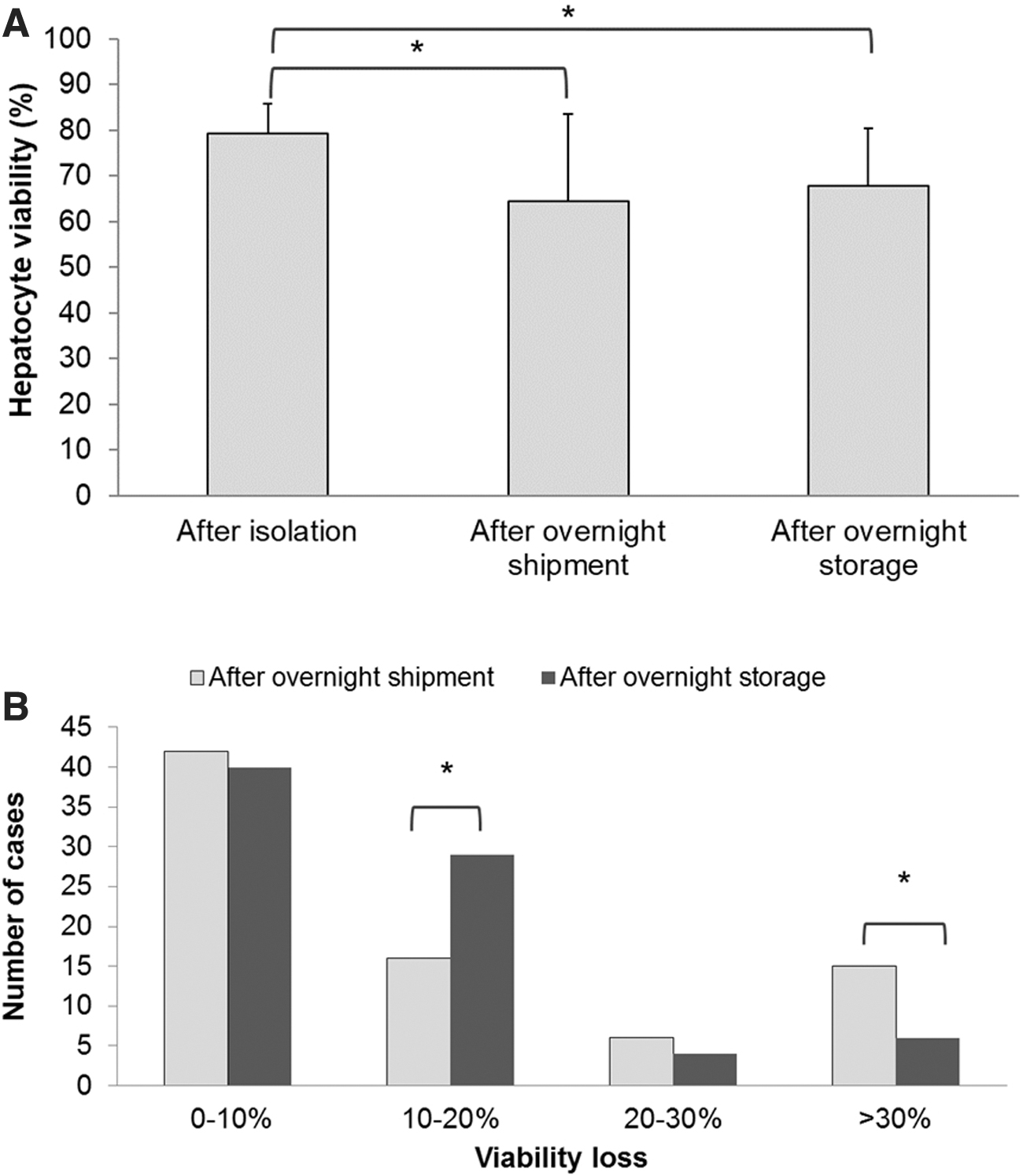
The average hepatocyte viability after isolation was 79% ± 0.7% (n = 79). Viabilities after overnight shipment or storage were significantly decreased to 64% ± 2.2% and 68% ± 1.4%, respectively (Fig. 1A). Although there were significant drops in viability, the magnitudes of the drops were relatively small at 11% or 15%, respectively (Fig. 1A). When the viability losses were ordered into categories (0%–10%, 10%–20%, 20%–30%, or >30% loss categories), it can be seen that most losses (51% or 53% of total batches) were in the 0%–10% loss category (Fig. 1B). The category with the next largest number of biological replicates was 10%–20% loss, with 20% of the batches shipped in ice overnight and 37% of the batches stored in ice overnight (Fig. 1B).
Isolated hepatocytes were adherent after storage in CSS for 24 hours
A subset of hepatocyte samples (n = 5) was used to examine adherence after storage in CSS on ice for 18 or 24 hours. These time points were chosen because almost all shipments arrived at the destination before 18 hours, while 24 hours would be the longest possible shipment time if there were delivery problems. Figure 2A shows that the viability drop after 18 or 24 hours in CSS was in line with the full set of data shown in Figure 1A, with an 11% or 19% drop in viability, respectively.

After 48 hours in cell culture, hepatocytes adherent on collagen-coated plates exhibited characteristic morphology and high confluences of 81% or 91% despite the 18 or 24 hour storage in CSS after isolation (Fig. 2B, C). While there was a significant 13%–14% decrease in confluence when hepatocytes were plated after 24 hours of storage in CSS compared to cells plated immediately after isolation, 18 hours of storage in CSS had no significant effect on confluence compared to immediately plated hepatocytes (Fig. 2B). This is reassuring as almost all shipments arrived well before the 18 hour mark.
CYP enzyme activities of isolated hepatocytes were inducible
After overnight transport, CYP enzyme activities were inducible in culture. Table 2 shows that induced CYP activities were significantly higher than basal CYP activities except for CYP2C19 activity after segment resection. On closer inspection, the p-value of this exception just missed reaching significance (p = 0.068) due to the variation within the basal and induced groups. Secondary cancers had significantly higher induced activities of CYP1A2 compared to primary cancers (Table 2). However, all other variables examined, such as fibrosis, sex, age, type of operation, hypertension, steatosis, and body mass index (BMI) category, had no significant effect on basal or induced CYP activities (Table 2).
Enzyme Activities (pmol Specific Metabolite Min−1 Million−1 Hepatocytes) of Cytochrome P450
The metabolites measured as an indicator for CYP1A2, CYP3A4, CYP2B6, and CYP2C19 activities were acetaminophen, 6β-hydroxytestosterone, nirvanol, and 4′-hydroxymephenytoin, respectively.
Significantly different from the indicated condition, p < 0.05.
Significantly different from the corresponding basal condition.
BMI, body mass index; CYP, cytochrome P450.
It is well known that there is a large variation in basal and induced CYP enzyme activities between individuals (Fig. 3). When the raw values of CYP1A2, CYP3A4, CYP2B6, and CYP2C19 were averaged before calculating induction percentage, a significant induction by omeprazole or rifampin by 9.7-, 3.7-, 4.8-, and 8.1-fold, respectively, can be observed (Fig. 3A–D). However, when percent induction was first calculated for each donor, it can be seen that the final averaged percentage induction was 1155%, 510%, 572%, and 974% for CYP1A2, CYP3A4, CYP2B6, and CYP2C19, respectively (Fig. 3E). Thus, in order not to miss any relevant significant differences and to further examine CYP inducibility that is important for many researchers, the data were also processed to consider individualized enzyme inductions in the next section.

Basal and induced enzyme activity (pmol specific metabolite min−1 million−1 hepatocytes) of
Donor and process variables that affect the magnitude of CYP activity inductions
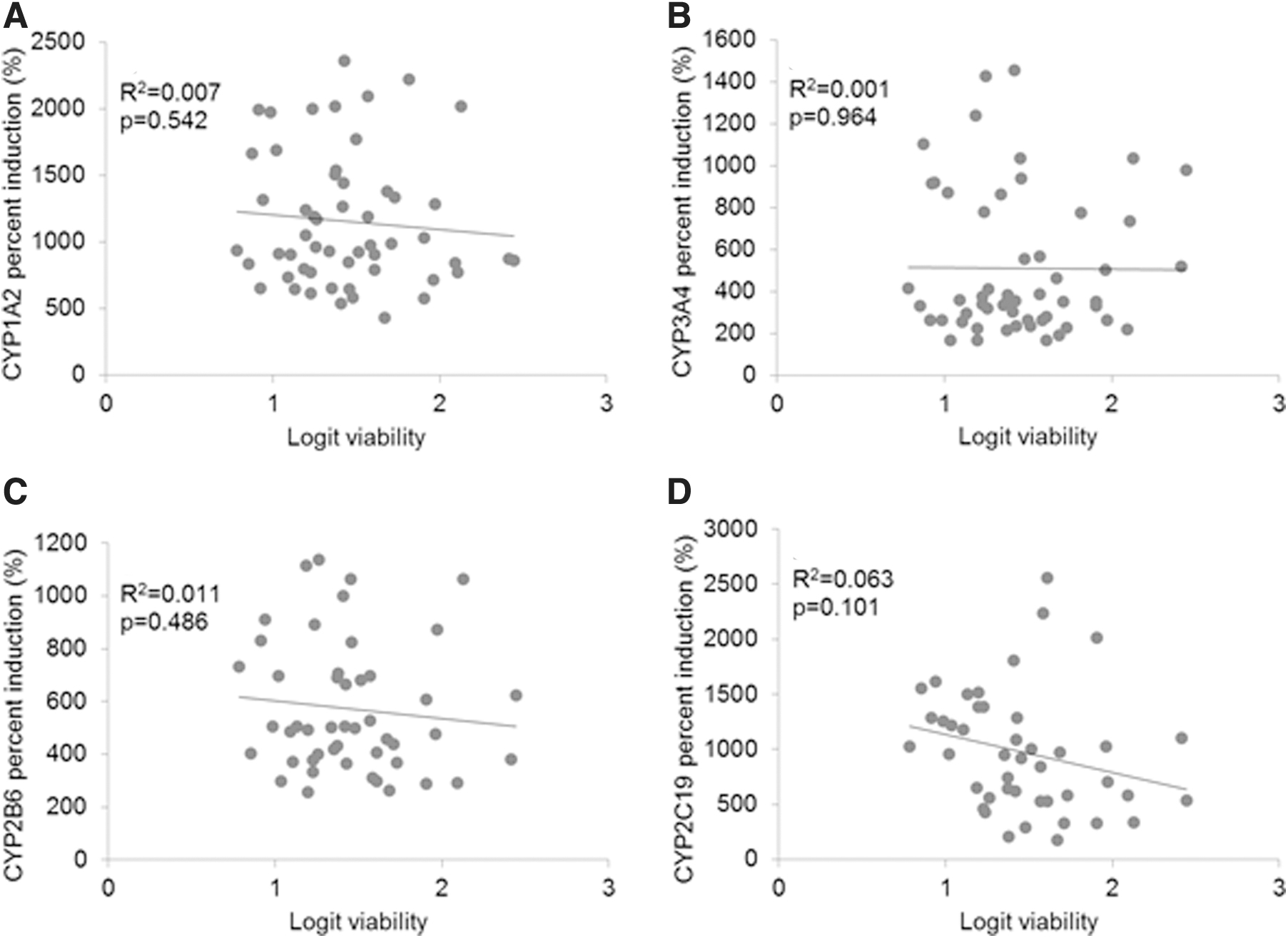
For all CYPs examined, there was no significant relationship between the magnitude of the CYP activity inductions and viability (Fig. 4).
Dot plots of
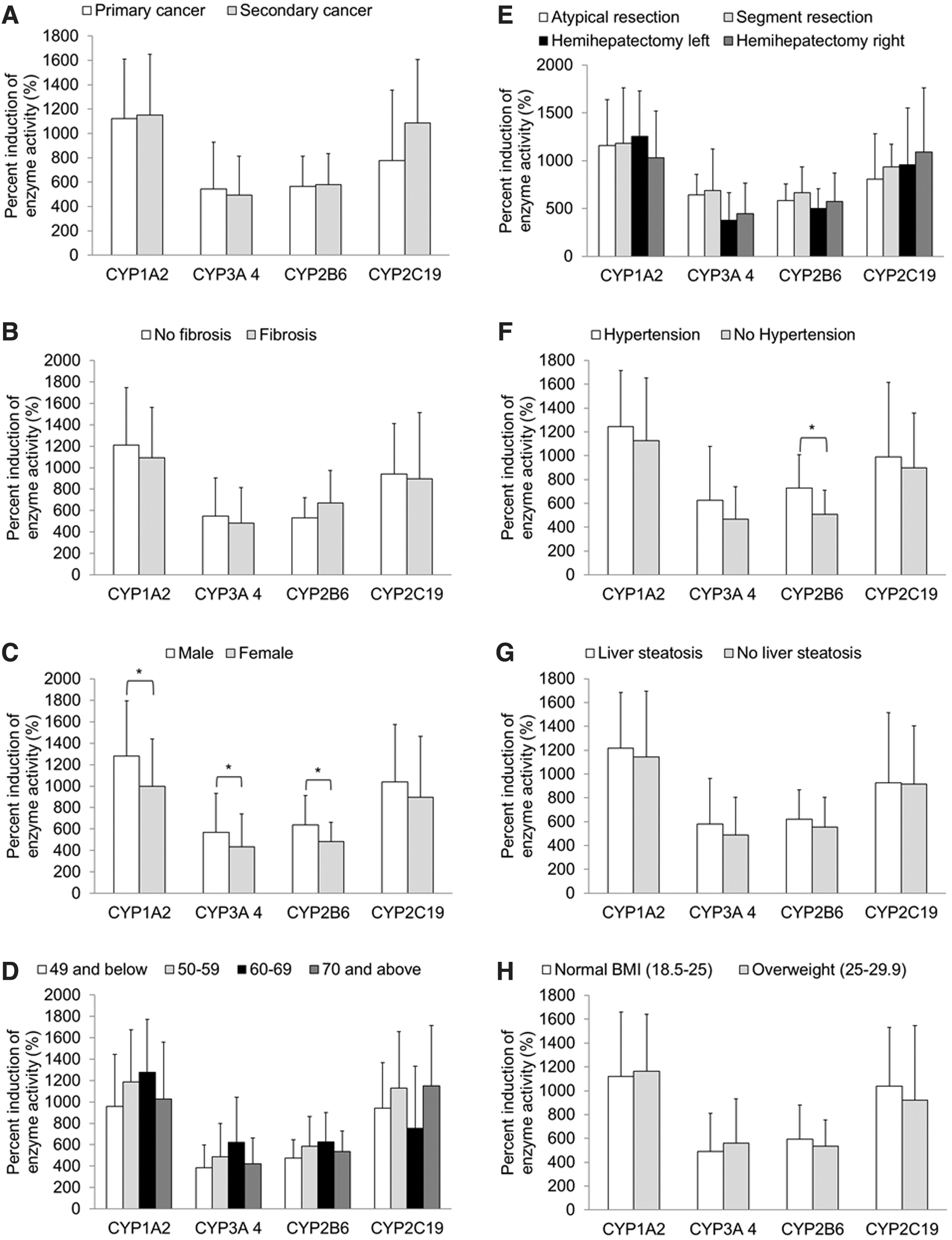
Furthermore, it was found that type of cancer (primary/secondary), fibrosis, age range, type of operation, steatosis, and BMI category (normal or overweight) did not affect the inducibility of all CYP enzymes examined (Fig. 5). However, sex had an effect with males showing significantly higher induction of CYP1A2, CYP3A4, and CYP2B6 by 1.3-fold. Hypertensive patients yielded hepatocytes that exhibited significantly higher induction of CYP2B6 by 1.4-fold (Fig. 5F). Finally, regression analyses showed that CYP1A2 induction could be predicted by glutamic oxaloacetic transaminase (GOT) activity, partial thromboplastin time (PTT), and the size of the perfused liver, while CYP3A4 activity is dependent on cold ischemia time (Table 3). The detailed scatterplots illustrating the regression analyses can be viewed in the supplementary data (Supplementary Figs. S1–S12).
Percent induction in CYP1A2, CYP3A4, CYP2B6, and CYP2C19 activities in hepatocytes isolated from patients
R2 and Probability (P) from Regression Analyses on Patient and Processing Variables
Significant relationship between the variables.
n refers to sample size.
AP, alkaline phosphatase; GGT, gamma-glutamyl-transferase; GOT, glutamic oxaloacetic transaminase; GPT, glutamic pyruvic transaminase; PTT, partial thromboplastin time.
Discussion
The use of human hepatocytes in research is important for a variety of reasons, such as validation of experiments done in animal models (such as murine models), translational studies, pharmacokinetic studies, mechanistic studies, and preclinical studies. Despite the relevance and importance of human hepatocytes in in vitro models, it remains difficult for many researchers to gain access and regular supply. Some of the main barriers to access are the high requirements for manpower, logistical requirements, and expertise required for acquisition of donated human liver and human hepatocyte isolation. As such, it is promising that hepatocytes maintain high viability overnight (Fig. 1), are adherent the next day (Fig. 2), and have inducible CYP enzyme activities (Table 2 and Fig. 3).
An average hepatocyte viability of 79% ± 0.7% after isolation is consistent with a previous publication (78% ± 10% viability) by our group that examines the effects of donor characteristics, intraoperative factors, tissue processing, and cell isolation parameters on viability and yield of isolated hepatocytes immediately after isolation. 10 In this study, we found that the majority of the hepatocyte batches maintain viability well after overnight storage in a cold storage solution (Fig. 1A). Shipping resulted in significantly fewer cases with 10%–20% viability losses and more cases with more than 30% viability losses compared to overnight storage in the laboratory (Fig. 1B). This could be due to possible excessive agitation during a number of shipments and highlights an area for improvement. This finding highlights the importance of preparing a vial of hepatocytes as a quality control, to allow for quick identification of poor shipment conditions, enabling the recipient to make a timely decision to call off an experiment when necessary.
In Munich, it is not possible to obtain donated liver from completely healthy donors for research purposes as such donations can only be used for transplantation. Instead, hepatocytes were isolated from surplus tissue not required by the pathologist for diagnostic purposes after elective surgeries. The tissue used for hepatocyte isolations came from the resection margin deemed macroscopically healthy by the pathologist. While it was not possible to compare hepatocytes isolated from the resection margin to hepatocytes isolated from completely healthy donors in this study, it is highly encouraging that analyses of the magnitudes of CYP activities show that hepatocytes are unaffected by many patient and organ variables such as fibrosis, sex (male/female), age, type of operation, hypertension, steatosis, and BMI (Table 2).
Similarly, when CYP induction percentages were considered, the type of cancer, operation type, fibrosis, steatosis, age, BMI, alkaline phosphatase activity, gamma-glutamyl-transferase activity, glutamic-pyruvic transaminase activity, bilirubin level, prothrombin time, weight of resected liver, and warm ischemia in vivo (Table 3 and Fig. 5) did not have significant effects. The literature can be contradictory on this topic, but the above results are consistent with some publications, which did not see an effect of variables, such as age, 6 on in vitro experiments. This means that hepatocytes isolated from macroscopically healthy resection margins from most operations are suitable for isolation thereby increasing availability of isolated hepatocytes for research.
In contrast, this study has found some variables that have an effect on CYP activities or inductions. The type of cancer (primary/secondary) significantly affected induced CYP1A2 activity (1.8-fold increase in secondary cancers, Table 2). This decreased CYP1A2 activity observed is consistent with the findings of Yu et al., who demonstrated that the reduction of CYP1A2 promoted the growth of primary hepatocarcinoma. 11 The mechanism proposed is that the suppression of CYP1A2 stimulates HIF-1α and HGF synthesis to activate PI2K, AKT, NF-κB signaling leading to facilitation of tumor growth, migration, and invasion. 11
Most CYP enzymes are multifactorially controlled, and male or female sex is known to differentially regulate CYP activities.6,12,13 Our results show that males exhibit significant 1.3-fold increases in CYP1A2, CYP3A4, and CYP2B6 induction compared to females (Fig. 5). However, the magnitudes of induced CYP activities were not significantly different between males and females (Table 2) as shown by other researchers.6,13,14 The differences in results could be due to the usage of different models, for example, Parkinson et al. examined CYP activity in cryopreserved hepatocytes or in hepatocytes adherent to collagen-coated culture surfaces, 14 while sandwich culture was used here for hepatocyte culture. Thus, depending on the study, researchers should consider whether to recruit females or males when setting up inclusion criteria.
Patients with hypertension had a significant 1.4-fold increase in CYP2B6 induction. One possible explanation is that hypertension could be caused through expression of CYPs by receptors such as the inflammation-associated aryl hydrocarbon receptor 15 or the nuclear pregnane X receptor. 16 Interestingly, a traditional medicine used to treat hypertension in China and Korea showed strong inhibition of CYP2B6 enzyme activity, hinting that CYP2B6 inhibition might play a role in alleviating hypertension. 17
Regression analyses show a clear relationship between CYP1A2 enzyme inductions and GOT, PTT, and size of perfused liver with the proportion of the variance in enzyme induction due to the above variables being 17%, 24%, and 7.7%, respectively (Table 3). GOT is often used as an indication for liver health. Floreani et al. showed that as liver dysfunction becomes severe in a rat model, CYP1A2 inducibility is markedly reduced by impairments at the transcriptional level. 18
The mechanism by which PTT is linked to CYP1A2 induction in our patient set cannot be identified at present. It is possible that these patients had a certain medication history or other underlying characteristics that may lead to CYP1A2 enzyme induction.
With regards to the size of the perfused liver, a previous publication by our group found that isolated hepatocyte yield was decreased when large pieces of liver were used for perfusion. 10 This is in agreement with Lloyd et al. who found that 100–200 g liver pieces result in lower yield. 19 When median absolute deviation was used to identify outliers, two of the liver pieces were above 100 g (116 and 166 g). When these values were removed from the linear regression, the relationship between CYP1A2 and perfused liver size was lost (p = 0.836, R2 = 0.001). While the exact reason that large liver pieces lead to CYP1A2 induction is not known, it is clear that excluding large liver pieces above 100 g avoids dysregulations of CYP1A2 induction. It is possible that poor perfusions in these large liver pieces not only affect yield but also result in additional stresses that could lead to CYP1A2 induction.
Finally, there is a relationship between CYP3A4 induction and cold ischemia time (accounted for 14% of the variance in enzyme induction, Table 3). Further statistical analyses on data sets limited to samples collected under 60 or 45 minutes showed that the significant relationship between CYP3A4 and cold ischemia is abolished with p-values increasing to 0.056 and 0.271, respectively. This information provides us with an impetus to optimize our process to bring cold ischemia time under 45 minutes. This goal should be achievable as 93% or 86% of this set was collected under 60 or 45 minutes, respectively.
To summarize, there are a tremendous number of publications on the topic of CYP activities and inducibilities. Given the complex nature of CYP regulation and individual variability in pharmacokinetics of many drugs, it is understandable that there are many conflicting articles about variables that affect CYP activities and inducibility.6,10–16,18–23 In our hands, we have found that CYP inducibility and activities are unchanged by a variety of variables. Furthermore, we have found a small number of variables that do affect CYP activities and induction. We assume that this information will help researchers when setting inclusion criteria and highlight optimal cold ischemia times when collecting specimens.
In conclusion, this study has shown that hepatocytes tolerate overnight storage and transport well, maintaining high viabilities, the ability to adhere to culture surfaces, and inducibility of their CYP enzymes. These positive findings open the door to many future possibilities.
First, isolation of hepatocytes can be done with a cooperative effort, allowing one group to share hepatocytes with other researchers. This maximizes the use of donated human liver and removes barriers to access. Second, researchers do not have to complete their experiments immediately after isolation and can instead break their experiments into two parts. This is a big advantage as donated liver is often received in the afternoon, meaning that isolated cells are available only in the evening or at night. Third, isolated hepatocytes could potentially be used in the future for cell therapy in patients with small-for-size syndrome. Hepatocyte isolation can be carried from the healthy margins of a liver resection in parallel with the ongoing operation. Hepatocytes can then be stored in cold storage medium until the surgeon is ready to inject them into mesenteric lymph nodes for the formation of ectopic livers.24,25 This avoids another trip to the operation theater for the patient and also avoids the use of cryopreserved hepatocytes, which usually have lower viability.
Footnotes
Acknowledgments
Donated human tissues were provided by the HTCR Foundation, a foundation under German civil law, which facilitates research with human tissue by providing an ethical and legal framework for prospective sample collection. Our sincere thanks go to the technicians in the Biobank of the Department of General, Visceral and Transplantation Surgery for their excellent work and support in the collection of liver samples, hepatocyte isolation, and data entry.
Author Disclosure Statement
No conflicting financial interests exist.
Funding Information
This work was funded by a EuroTransBio grant (031B0110B) from the Federal Ministry of Education and Research (BMBF).

References
Supplementary Material
Please find the following supplemental material available below.
For Open Access articles published under a Creative Commons License, all supplemental material carries the same license as the article it is associated with.
For non-Open Access articles published, all supplemental material carries a non-exclusive license, and permission requests for re-use of supplemental material or any part of supplemental material shall be sent directly to the copyright owner as specified in the copyright notice associated with the article.
